Book endings and authors’ obligations to readers

Deborah Harkness provided me some useful information but no answers.

It’s been several weeks since I finished reading the final book in the “All Souls” trilogy by Deborah Harkness, The Book of Life, and after writing a few reviews of it for various sites and chewing on my ideas for some time, I had the opportunity to attend Harkness’ book signing in San Francisco a couple of days ago. After asking the author two questions during the open Q&A and then one “spoiler” question while she signed my books, I still have mixed feelings about how the series concluded.

I’ll just say that this observation is a little spoiler-ish but not in detail, so if you have not read the final book, then skip over this paragraph: I felt that many of the questions I had about Ashmole 782, the elusive and strange magical manuscript introduced in the very beginning of A Discovery of Witches, were not answered. And while some of my questions may be just “my own” or somewhat indirect, some were directly brought up by the characters in the book quite early on. And THEY WERE NOT RESOLVED. ARRRGGGGH. Considering that this was a huge part of the plot of the series, I felt gypped as a reader (of 1700 pages, no less) that they were left open. Talk about unsatisfactory. So I asked Harkness this: “Do YOU know where the book came from, who made it, etc.?” And she immediately and firmly responded with a “yes.”

She KNOWS, and she did not tell readers? Whaaaat?

Harkness told me this: “Everything readers know in the book comes from the point of view of Diana and the other characters. She doesn’t really know (at the end of the series) yet the answers to these questions, so readers don’t.”

During the hour of the author reading from the book, talking about it and herself, and then doing Q&A, she said a few things that are relevant: One, she really intended to keep the series as a trilogy, so as she explored the story while writing, she had to limit herself so it wouldn’t get unwieldy. Two (and I’m piecing this together a bit), I think she said, essentially, that anyone’s full story is never contained in a book. Things happen before and things happen after. The book is then a part of the whole story. And (after someone observed that the last book was the darkest of the series) she was trying to show what happens in a relationship after the fun, easy, falling-in-love part, where it gets trickier and is more work, and so on. So I’m going to extrapolate that she doesn’t intend for her writing to “tie everything up in a bow” at the end. But the part of their lives that is the pertinent story is captured and pinned down a bit within the pages of the series.

Now here’s where this gets interesting. Some readers can get up in arms when a story doesn’t end the way they expect, or it doesn’t end “happily” or it doesn’t tie up all the loose strings. And it may show a sign of reader immaturity when one gets mad that a story doesn’t end with a happily ever after — life, after all, is never that simple and “satisfying,” and books are best when they reflect the messiness and realities of life. So at what point should readers rightly expect some kind of conclusion?

Here’s my take: it depends on the type of book (genre) and how thoroughly expectations were set up in the book and plot. In a mystery, for example, it’s understood that various disparate elements are going to be introduced and then the mystery “solved” at the end, with those elements put together in certain ways to provide a satisfactory ending, leaving the reader with the “aha!” feeling of “That’s why all those items were important.” In a memoir, one may fairly reasonably expect the author to recount parts of his or her life that relate to a certain theme, a story arc that includes pertinent facts, experiences, and observations, because it would be impossible and undesirable for that person to just sit down and write everything that’s happened without giving it shape, form, or meaning.

Regarding the expectations, if a few things are simply mentioned as facts that might give a better idea of characters’ personalities, motivations, expectations, development, etc., they don’t require further attention by the author. But if the book frequently mentions certain plot elements and has the characters and readers questioning them as a large part of the book and plot, they need to be answered.

In the case of the All Souls series, as Harkness put it in her talk, the three “main characters” are Diana, the historian and witch; Matthew, the vampire and researcher; and Ashmole 782, the manuscript. Since she herself said that explicitly and since all of the book’s promotional materials and synopses focus on those three characters, one rightly expects to get questions answered about them. We learn quite a lot about Matthew and Diana’s histories (where they came from), their personalities, and their fates. We don’t know all the details about what will happen to them in the long term, but their stories as presented in the books are concluded well and make sense. But Ashmole 782, as a “main character,” gets short shrift. We know where it ends up, but we still have no idea where it came from and why. I appreciate that Harkness says readers only know what Diana and the other characters know, and that she had to keep the series to a manageable size, but I still feel she did not do her job as an author and conclude that part of the story. If she had to cut out other things to still keep it manageable, or if she had to make it a little longer so readers could come along to the point Diana knew more, then so be it.

Harkness did make one comment that gave me some hope for future satisfaction: I said, “I’d really like to know what you know!” and she responded something along the lines of “You will.” But since she said she won’t be writing more about Diana and Matthew, but may revisit the “world” of the books to explore other characters and stories, I’m not sure how that might come about. So we shall see.

What do you say? How much should readers expect in these situations?
Favorite authors

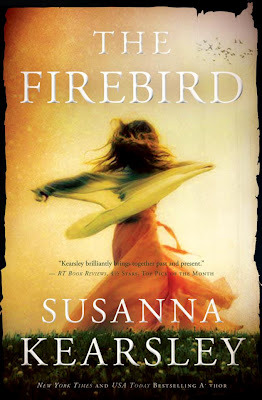
The FirebirdSo I just finished reading The Firebird, Susanna Kearsley’s latest novel. This being the second book of hers I’ve read (after The Shadowy Horses), I am finding she is probably being added to my mental list of favorite writers (perhaps I should make an official list on GoodReads…).

I enjoyed The Firebird so much that I read all the back material about the history and her research and even her bio. I read that she’s been compared to Daphne du Maurier, Mary Stewart, and Diana Gabaldon, all of which are on my list already! Well, there ya go. I was only in my early teens when Mary Stewart became part of my favorite-authors list: I read her amazing set about Arthur and Merlin, which begins with The Crystal Cave, and found myself transported. Almost any other book about Arthur has let me down since then. I read probably four of her other books in my teens, whatever I could find in the local library or at used-book stores. Of course, I loved du Maurier’s Rebecca, that being essentially THE classic gothic tale, as I see it. And I’ve now read half of Gabaldon’s very entertaining (but lengthy) Outlander books.

When I was a young reader, I gobbled up everything I could find by Agatha Christie (I collected probably 20 or 25 of her books and read far more from the library) and by the awe-inspiring Madeleine L’Engle. I adored Susan Cooper’s The Dark Is Rising sequence but never found anything else, at the time, that she had written (I’ve since seen more but haven’t tried reading any).

In between, I’ve swallowed whole most of Michael Crichton’s books (they were almost all gripping, more intelligent than many other best-sellers, and based on fascinating science), Amy Tan’s beautiful stories of Chinese mothers and daughters, and a fair number of Orson Scott Card’s novels, mostly the fantasy ones and not the sci-fi (I’m just now getting around to reading Ender’s Game, and at the halfway point, I’m just mildly interested).

Most recently, I’ve become a huge fan of Cassandra Clare (yes, her Shadowhunter books are deliciously entertaining), Carlos Ruiz Zafon, Elizabeth Knox, and Kate Morton (yep, Zafon and Morton both write what I consider to be gothic tales, or close to it). Of course, I think it goes without saying that I loved J.K. Rowling’s Harry Potter books, but I was very disappointed by her first adult novel, The Casual Vacancy, and I haven’t tried her detective novel written under a pseudonym.

I think what I love most about these authors and their writing is their ability to really take me somewhere far, far away. Most have some elements of magic or something supernatural, or the hint of there being a possibility. There are deep, dark secrets and mysteries, long buried. There are thrills that keep me hooked till the very end. Many are set in other countries besides my own (I love England; the very soil seems to be soaked with layer after layer of story). The writing is beautiful and carefully crafted; the characters are ones I want to know. Ah, to be able to just open a simple book, step into it, and be completely enveloped, surrounded by other places and times!

There are always new books and new writers that impress me. Some I admire; others I adore. Thank you for sharing your gifts.

If I’m going to take a “personality” test, of course it’s going to be literary

So I was reading Josh Hanagarne’s blog, World’s Strongest Librarian, and he posted about using a fun little site called I Write Like, which uses an algorithm of some sort to analyze whose writing style your writing most resembles. Now I typically don’t get caught up in those cutesy types of things everyone posts on Facebook (which Jersey Shore person you’re most like or which reality show you’d be best on, etc etc.), but this certainly hooked my interest. I mean, I love to read, and I love to write. And having myself compared to a famous author can only stoke my writer’s vanity, right?

So I eagerly tripped right on over to the site and pasted in a few different paragraphs from my blog and from my reviews on Rated Reads. I clicked the “analyze” button and only had to wait a second for the site to spit out its conclusion: I write like Vladimir Nabokov. Ohhh-kaaay. Haven’t read any of his work, actually (no, I’ve never been interested in reading Lolita, thankyouverymuch). But it was a fun game to play.


I write like
Vladimir Nabokov

I Write Like. Analyze your writing!


Hanagarne noted that he hadn’t seen any female writers pop up so far, and my sample certainly lines up with that. Anyone else care to give it a shot?

Strong language in books: not so common as one might think

After addressing my great discomfort with the number of strong and vulgar language in J.K. Rowling’s first book for adults, The Casual Vacancy, I looked at other bloggers’ reviews on the book, and I was perhaps a tiny bit surprised that few expressed any frustration with that issue. Several that I commented on basically did respond that they thought that the really, really frequent use of harsh language felt “authentic” to them.

So I decided to do a little analysis of how frequently the f-word, for instance, pops up in popular books to see just how much use readers are “used to” or tolerate.

My ratings website, Rated Reads, features nearly 1,000 reviews of a variety of fiction, nonfiction, and young adult books. Of those, only about 175 are rated “high” and a few are rated “DIRT” (for “don’t invest reading time” — not because of the quality of the writing, but just because of the offensive content). I thought that it would be interesting to see how many uses of the f-word tend to be used among those books my reviewers and I have already rated “high,” which means in terms of language, more than five or six uses of the f-word.

Here’s the breakdown: 17 of the “high” ratings have no use of strong language (they’re rated high for detailed sexual content); 91 have between 6 and about 15; 31 have between 20 and 40 uses of the f-word; and only 15 have more than 50 uses of that strong word (or the very rare c-word).

My conclusion? Writers of the most “popular” or “critically acclaimed” books, which are sampled fairly well on Rated Reads, don’t tend to use the f-word much more than 15 times. Only a very few use it very liberally, 50 times or more.

Which is why J.K. Rowling’s book for adults seemed so outrageous to me: she must use the f-word 100 times or so (and the c-word at least once), not to mention a liberal use all the other “milder” language. That puts The Casual Vacancy into a very small group: only about 1 percent of books, according to my sample of about 1,000 books, use strong language that casually.

It brings me back to wondering why authors use strong language. Readers who “defend” the liberal use of harsh language say it’s because the authors are being “authentic.” Especially when it comes to high school-age kids, they say, that kind of language is used all the time. I don’t argue that notion. It’s true that one can hear a lot of bad stuff in a school hallway. And then there are different groups in society that tend to use that kind of language very frequently and without any thought for what it says about them. But if most authors would hope to be “authentic,” then why do so few actually use that kind of strong language very often? In a book of 300 to 500 pages, my “most common” group of usages of the f-word only feature about 6 to 15 uses of it. That’s actually not too “true to life,” one could argue.

In fact, a lot of the books that readers really love don’t have any use of the f-word, or very limited use of it. It would seem that those authors, who write well and with large followings, don’t feel a need to use “authentic” language. Hm.

Most of the books out there that are really entertaining or thought-provoking, that open a window into other worlds of all sorts, succeed at transporting us as readers, making us think and experience other places and groups of people, and do the job we want them to do — most of the time without using really harsh language (even if the characters, places, and situations might genuinely call for that kind of language if they were to be completely “authentic”). Are most of us complaining that they don’t use more authentic language? No. But when an author does use a lot of bad language in the service of being authentic, people just say, “Well, that was authentic.” Where’s the outrage here? If only a small percentage of writers (in this case less than 1 percent) really go for it and use tons of vulgarity, why don’t they stand out from the crowd that doesn’t write with tons of that trash?

I’ll let you all ponder on these facts and draw some of your own conclusions. Then comment and let me know what you think.

All I want to say to conclude is that in real life, yes, there is plenty of “authentic” rampant use of vulgarity and harsh language. I hear it sometimes, and I heard it when I was in school. My high-schooler hears it at her school. But given the choice, we both try to avoid it as much as we can, because regardless of what we’re “forced” to hear, we still don’t like it, and we haven’t “gotten used” to it. I avoid the groups of people and places where I would be likely to hear that kind of abuse of the English language, and likewise, I try to avoid books and movies that contain that language. I don’t HAVE to read or watch those books or movies or TV programs. I have a choice. And I choose to stay away from them.

Exciting book news

I must say there have been some recent announcements about publishing contracts that have caught my particular interest, mainly three that I can think of.

A few weeks ago, the most high-profile story was that J.K. Rowling will be publishing a novel aimed at adults, details of which will be released later this year. Now, I can’t find the reference, but I seem to recall reading that the book is already written, or at least that seems to be the implication. I’m not naive enough to believe that it will “live up to” the Harry Potter books, but there is no doubt that it should at least be worth reading. Rowling is a skilled writer when it comes to plot and characterization, and the wit and warmth with which she infused her stories were most welcome. As long as she brings those talents to the table with the new book, it should be a fine novel. But I don’t expect it to capture the world’s fancy as much as Harry; I don’t think that’s possible. But as a writer, I know that Rowling won’t be content to sit back and do no more writing from here on out. It’s not about earning more money; it’s about the compulsion to write. Once a writer, always a writer. It’s not possible NOT to write.

Now the other two announcements have been exciting for me. One is that Carlos Ruiz Zafón has a third book coming in the “cycle of novels” that began with The Shadow of the Wind and The Angel’s Game. Those two books were delightfully gothic and drew me in utterly to a fantastic world set in post-war Spain. Just the fact that they featured a “Cemetery of Forgotten Books” should be a hook for book lovers. I can’t wait to dive back in to that world in The Prisoner of Heaven. It looks by the Amazon.uk website that it will be released there in June, and apparently, according to the U.S. Amazon site, it will be released on that same date here. Thank goodness! I was afraid I was going to have to wait longer. Sigh. Three more months. I am hoping that the third book is more like the second in terms of strong language (the first had 10-plus uses of the f-word, but the second only had one, which made me scratch my head a bit; authors tend to stay in the same pattern of that kind of stuff).

The last announcement also has me waiting eagerly. Young adult writer Cassandra Clare has written now two series of novels about the world of Shadowhunters, in her Mortal Instruments set and Infernal Devices series. Now I hear that she’ll be writing a third series, The Dark Artifices, about Shadowhunters, set in Los Angeles. One could argue that she’s milking it a bit much and the whole concept is getting old, but her writing is so deliciously entertaining that I’m not going to fault her that. Her characters are so enjoyable, the romance irresistible, and the writing laugh-out-loud funny. So I’ll be happy to belly up to the bar for more. Keep ’em coming, Cassandra!

Anyone else looking forward to some great new books?

An ode to words

Aren’t words wonderful? Some may argue (and rightly so) that the English language is crazy and difficult and full of rules that are just as often broken as they are adhered to. But I’m in awe of just how much can be said with all the delightful words that our language contains. We’ve adapted and co-opted words from all kinds of places and times and made them work for us. I have an utter reverence for what can be conveyed with the right use of vocabulary.

I think of our language as a toolkit full of a variety of tools, each just the right size and shape and weight to fit any job. But what dismays me is that most of our society today only carries around a mini-kit with a few basics (hammer, screwdriver, a few nails) which they use for every single need. I try to lug around the jumbo version of the toolkit (even the whole garage full of cupboards and shelves, sometimes) so I’ll be able to fit just the right tool to whatever I need to accomplish.

That’s what makes me particularly enamored of certain authors’ writing. Some authors are great storytellers, with vivid imaginations and tons of neat ideas for stories, but they’re not great writers (Stephenie Meyer has said this about herself, for example, and she’s absolutely right). But some authors can tell any story but make it compelling and beautiful because of the words they select from their kits and how they put them together in seemingly fresh ways.

I love to use my thesaurus. It’s full of options to help find just the right word to convey the perfect meaning. But as with any tool, it must be used correctly. Many people have the mistaken notion that they can take out a thesaurus and pick willy-nilly any word out of the synonyms listed. Wrong. Each word in our language has a very precise meaning that, if the writer or speaker and the reader and listener both know it, can communicate meaning as well as is possible with language (of course, communication is a whole other topic; let’s just say that spoken or written language is only a small part of communication, so since that’s the case, we’d better be sure to be careful with the words we do use so we can communicate as effectively as possible). The ideal use of the thesaurus is to stimulate our thinking and allow our brain to go through its options and then select the best one. We still must know the exact meaning of each synonym, because synonyms are merely similar words, not usually exact matches. Even identical twins have slight differences in appearance, voices, and certainly personalities, don’t they?

So as a writer, I like to look at the thesaurus when I have a general idea of what I’m trying to express. Glancing through the list of synonyms of any given word can help my brain to make connections and eventually say, Aha! That’s exactly what I’d like to say. As an editor of other people’s writing, I have to use the thesaurus to help them come up with the word that’s going to say what they obviously mean to say in the context of their topic and sentence or paragraph. I often think as I’m reading someone else’s raw work, I do not think that means what you think it means (thanks to Inigo and Vizzini of “The Princess Bride”). Sometimes their efforts are unwittingly comical; sometimes they could even be potentially offensive, egregiously misleading or just plain wrong.

Given that I do a lot of editing, then, and I see many misuses of language, I am so appreciative of the writers who have honed their craft and lovingly put to use the full toolkit of the language. Each word, carefully chosen, can instantly create a picture in my mind, complete with emotions and sensations. Every word has nuances and layers of meaning, and used well can convey those layers in just one perfect word, allowing a writer to write concisely but elegantly. A writer with a shallow portable toolkit will have to use many more simple words to get a message across that could be portrayed nicely with one or two words in the hands of a skilled writer with an excellent grasp of vocabulary.

I’m not saying that we should all use “hoity-toity” vocabulary at all times or words that are just rarely used and never understood. But there are so many options that are rich in meaning that can communicate effectively that people don’t bother to use. As a parent, I’ve always used my regular vocabulary to speak to my children, rather than trying to “dumb down” what I say in baby talk. I might rephrase something in simpler language so they can understand, but then I’ll also use the richer words so they can hear them in context and learn. And as they read, just as I did growing up and still do now, they (and I) can learn new words just through context and, if they’re so inclined, looking them up in the dictionary.

Even as I write, I’m now self-conscious about how I wrote. Did I convey exactly what I wanted to express? Did I use just the right words? I hope so. I’m not one of the most gifted writers out there, but I hope that I can at least say what I mean to say. And my hat’s off to those amazing writers who have transported me because of their judicious use of language.