Over the past few years, it has really struck me just how strong the power of a story is.
But really, most of us just take for granted how surrounded we are by stories, how they can captivate us, ensnare us, direct us and shape us, without our even realizing that it’s happening.
Of course, as a dedicated reader (and editor and writer), I love to be willingly captured by a good story, whether it’s one that’s been spun completely out of someone’s imagination or one that’s based in reality and been tamed just enough to be put down in words. I’ve come to realize how difficult it is to extricate ourselves from a story once we’ve stepped inside of its boundaries. The story could be shared via any medium: books, film, television, or any other kind of art.
Have you ever noticed that even if you’re watching a movie or reading a book that’s even just mediocre, it’s challenging to walk away? (I can detach myself from a story that’s really poorly told, however.) Something in us yearns to know “the rest of the story.” It’s so against our nature to not find satisfaction in completion. We must know how the story plays out ’til its bitter end.
What’s even more entrancing is to find ourselves enmeshed in stories within stories. One recent example that had me absolutely mind-boggled was the movie “Inception.” There were so many stories layered inside of each other that I wasn’t even satisfied completely with one viewing; I had to go back and let my mind wander those strange passages several times so I could really follow the stories and how every detail fit together. I absolutely adore complexity. And surprises. (I’ve written about that already in my post on gothic tales.)
But books and movies don’t by any means hold a lock on story. Our minds always create stories for us. We lay down memories that are ordered in some kind of story format. We consciously and unconsciously create stories to make sense of information we run across. Yes, story-making is hardwired within us. Some people are just skilled at weaving the stories within them for others’ consumption, but they are not the only storytellers. I recently loaned some of my favorite books to a friend, and she very kindly extricated some wonderful quotes from the second in the set, Carlos Ruiz Zafon’s The Angel’s Game. One goes like this: “Everything is a tale. … What we believe, what we know, what we remember, even what we dream. Everything is a story, a narrative, a sequence of events with characters communicating an emotional content. We only accept as true what can be narrated.”
Yes, story is a powerful thing. It can be dangerous; it can be liberating; it can be instructive. It has the power to move people to action, for good or evil.
I just thank those people who have the gift to create and shape stories and share them with me. I think that’s why books are so beloved, and why even writers pay homage to other writers and to the written word itself. Books and the stories in them can transport us and change us, so much so that they come alive themselves. As Zafon also writes, “As long as there is one person left in the world who is capable of reading [books] and experiencing them, a small piece of God, or of life, will remain.” Thank goodness for that!
I tend to hear about many books that end up being “hot” early in the game thanks to all the ways I stay connected in the publishing world. In the case of The Hunger Games, I heard about it on Stephenie Meyer’s website. I have found that Ms. Meyer has quite good taste in books. She talked about Suzanne Collins’ eventual blockbuster on her website when the first book came out, and I ran out and bought a copy. (She also recommended a fantastic “duo” of books starting with Dreamhunter, which I really liked as well but which isn’t the phenomenon that The Hunger Games has become; in fact, I’ve run across no one else who has read it.) I was thoroughly impressed by the fascinating premise and by the skilled execution of the great idea. I think a lot of what got my attention was the idea that in some messed-up future, the most horrific of survivor reality shows would be enacted. I’ve never been a fan of pretty much any reality shows on TV, preferring well-written, original scripted programs whether they be comedy or drama, so I thought it was brilliant to take our current society’s obsession with the cheaply-produced stuff that passes for entertainment to its gory and worst-case conclusion.
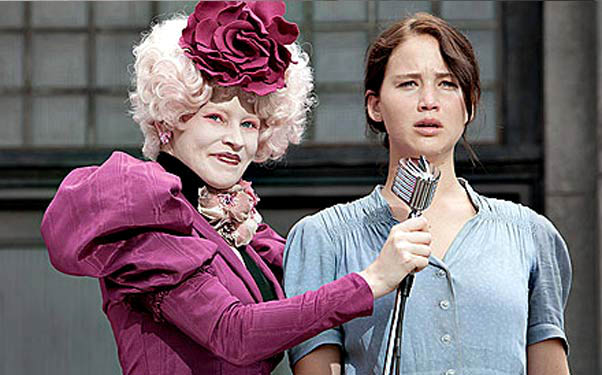
Elizabeth Banks and Jennifer Lawrence star in "The Hunger Games." credit: Lionsgate Films/Murray Close
Of course, since I read the first book when it was newly published, I had to wait a year for Catching Fire. As it happened, I ended up putting my newly purchased copy on a shelf and holding on to it for a year until Mockingjay was published. At that point, I then had two fresh, unread copies of the rest of the series, but it had been two years since I’d read the first book. That meant that I had to reread The Hunger Games so I could refresh my memory. Since the books are so intense, I still had to take a little break between reading the second book and then the third, reading one or two other books in between. From what I hear, this is unusual; everyone else I know, including my husband, who isn’t a BIG-time reader, just sat down and gulped the books down in practically one sitting, reading all three straight through. For me, I just needed to take a step back from the violence and, well, sadness. Either way, though, I was gripped by the story and how it unfolded. I liked how it showed people’s resilience and the need to rebel against an oppressive government. Collins had a wonderful idea for the books and then just showed great talent as a writer in taking the story through to its conclusion. I knew that she wouldn’t tie everything up neatly in a bow and that there wouldn’t be perfect happy endings for every character; I could tell, as most readers probably did, that this would be a gritty, more “realistic” set of books, with messier but mostly true-feeling plot lines. Some were shocked by how she finished the series, but I didn’t find myself completely taken aback or annoyed by it. It worked for me.
Now that I’ve had an opportunity to see the movie adaptation, I can say I’m very satisfied. Books turned into movies can be generally very un-satisfying propositions, so to be able to attend this film and say, “Wow. That was really well done” was a happy ending for me. I wasn’t terribly pleased with the first several Harry Potter film adaptations, feeling that although they did bring to big-budget life main plot points of the first books, they somehow lost a lot of the “feel” of the books. Part of what I loved about J.K. Rowling’s writing was not just the complex world and plot arc over seven books, but the whimsy. They are so clever in the names and in all the little non-crucial, witty touches. They made me laugh. The movies just didn’t do that at first. They felt lifeless. And Twilight… that’s a whole other story altogether.
So I was pleased with the movie because it completely captured the feel and tone of the books, the harshness of the regular citizens’ lives and the hopelessness, and the barbaric nature of the Capitol’s Games, carried out with such pomp and calculated publicity every year, even as 24 teens were brutally encouraged to leave behind their humanity and kill each other to survive, just to go back to their bleak lives.
The acting was superb and the script was deftly adapted. A movie really is a different animal than a book, and much as book lovers hate it, movies must make changes as the story goes from one distinct medium to another. I love good films (my dad taught me how to appreciate the classics), and I enjoy seeing how a director and all the other skilled people who contribute to a film really bring out the best in a story using all the tricks up their sleeves. For instance, the fact that there wasn’t much music in the film was a method that contributed to its tone. When music was used, it was spare and simple, echoing the story lines.
I think what I most appreciated, though, was that the visual nature of film really struck home to viewers the messages of the story even more than the book. The book tells us about totalitarian regimes and what governments do when they have too much power; it tells us about how people still can’t keep their eyes off of watching others fight and suffer, even in larger-than-life color (the rubbernecking, train-wreck mentality). It showed us the obliviousness of the people living in the Capitol to the real lives of the rest of Panem’s citizens. The movie, though, because of its very nature, really made me think about how silly and superficial those in the Capitol were, how they pranced about in their lives of ease and wealth, wearing their ridiculous clothes and crazy makeup and hair, not caring at all that people in their own country were mostly poor and always hungry and struggling. The Hunger Games were really just a game to them, a spectacle. It was disturbing and made me realize yet again how absolutely wealthy I truly am compared to so many people around the world, and so many of us here in the United States are, but even so, most of us complain that there are still others richer than we are, rather than thinking about the many who are poorer. We go around getting plastic surgery and Botox and spend ridiculous amounts of money on electronics and fattening fast food while others are struggling just to have something to eat. We sit in our comfortable living rooms watching big-screen TVs with scenes playing out of “reality” that’s not at all real: people pretending to love each other and women fighting each other for the “love” of one superficial guy, other people supposedly using survival skills to “win” on a remote island that’s been rigged for the show.
I was nervous about the violence of the movie, since the books truly are about violence. I will just briefly say I was pleased not to be too overwhelmed by violent images. The issue of violence in books and movies in general is something I find really interesting and important, but that will be a topic for another day. Suffice it to say for now that I enjoyed both this book and its movie version, and I was pleased that it made the leap between mediums in a satisfying manner.

 Life and Lims