Words DO matter

For the second time this week, I’ve come across a “campaign” to ban a word. Today, it’s the “Ban Bossy” movement, asking people to stop calling young girls “bossy” when they assert themselves, so we can better encourage girls to be leaders. Earlier this week, it was the campaign to ask people to stop using “the R-word.”

I can heartily get behind not just the idea of cutting the overuse and/or misuse of these words, but with the overall goals of the campaigns themselves. As a woman and the mother of four daughters, I am happy to support encouraging girls in their desires to make a difference in whatever community they’re in, whether it’s a classroom, a school, or a group of some kind. And as the mother of a delightful daughter with Down syndrome, I HEARTILY support the request for people to pledge to stop using the word “retarded.” I have never heard someone use it as a neutral descriptor of someone’s development, which is what it was intended to do: it simply means being slower or stopped in intellectual or emotional development or academic progress. What people always use it to mean is “stupid” or “beneath” or “outrageous.” It’s used as an epithet, as a put-down, a derogatory descriptor. I flinch whenever I hear someone use it in casual conversation.

Some may say that language is constantly evolving and that some of these movements are just about semantics. But words have meaning, whether that meaning is different today than it was one year ago or 50 years ago. They pack a punch. I absolutely adore words. I love their power to express thought and feeling, to communicate what sometimes is difficult to translate from abstract notions in one’s head and heart. Their accurate and precise use can feel like a miracle.

The problem is this: many people do not know their own language sufficiently well to be able to articulate correctly what they want to get across. They get by on a pocketful of vocabulary words when a stuffed backpack would do the job much more effectively. They do not understand that their careless use of that limited pocketful can end up coloring a picture in someone else’s mind that does not match at all the picture that originated in their own. That breakdown in transmission of understanding can create hurt feelings at the very least; it can change actions (not in the intended way); it can change attitudes (not for the better).

Since our language currently has evolved to use the word “retarded” to mean the colloquial “lame!” or “stupid” or “ridiculous,” the cat’s out of the bag now and we can’t force it back in, for the word to go back to meaning just its “neutral,” “unloaded” version. It is now a loaded word and will cause people to cringe. It will continue to insult those who have disabilities and those who care about them. So, yes, it’s time to take that loaded word out of our pocket or backpack and just toss it in the trash.

When it comes to empowering girls, who are growing into future women leaders, capable of contributing a great deal to society, we can stop belittling them with words like “bossy.” We can talk to them using words that express our confidence in their abilities, that don’t compare them negatively with boys, that don’t show some underlying expectation that they are lesser. We can value them as females and acknowledge that there are differences between the sexes but not fall back on easy gender stereotypes. “Bossy” may very well be already a loaded word with too many associations attached that we can no longer un-attach. At the very least, we need to be much more careful of how we employ it and in what situation.

Yes, words matter. They’re the building blocks of how we share our opinions, our feelings, our ideas. We need to choose them wisely and assemble them effectively.
Here’s something radical: We disagree. We can still be friends.

Civil discourse. Sometimes it seems like an impossibility, a utopia, a thing of the past. In the age of instant publication of everyone’s thoughts to a potentially huge audience, and with no way of taking back a rash, thoughtless statement once it’s escaped one’s texting or posting fingers, it feels as if cyberspace (and, thence, real space) is clogged with outrage, name-calling, and sometimes straight-up mean-spiritedness, all because we are drawing battle lines over a variety of hot topics. New blog posts that go viral, legislation, personal experiences all get hashed out in great detail as toes and fingers dig into the lines in the cybersand.

Friendship and lines in the sand: do they mix?

Again, though I don’t write about the really controversial topics on this blog or go into detail about my opinions on some of them, it may be fairly simple to figure out where I stand on certain things. I am religious and conservative. As I said in my previous post, about body image and “feminism,” sometimes people’s conclusions about what I think might be different from what I actually believe, but in general, they’re probably going to be mostly right. But the reasoning and the emotion and compassion and time I’ve taken to draw my conclusions are almost NEVER going to be as cut-and-dried and automatic as some might assume, which is a point I’d really like to make clear.

The past years, for instance, have brought same-sex marriage to center stage in the national consciousness and in legislation. And it’s been interesting to have discussions with friends (and acquaintances and their acquaintances) about the various issues that tie into that hot topic. Various states are still in the process of approving or banning it (or having their voters’ decisions overturned); attorneys general are weighing in; states are introducing legislation that deals with related issues to gay marriage (Arizona’s current potential law trying to safeguard business owners who would like to exercise religious opinions on it is a biggie this week). As all these legalities make their way through the various systems to some kind of eventual, kind-of-final resolution, many still have mighty strong opinions about all the ins and outs.

Again, I won’t talk about all my opinions on this topic. There are some truly good sites out there that do better than I could for all the sides. What’s interesting to me, however, is HOW we present these ideas. And in many ways, it is NOT a pretty picture. It’s ugly out there, folks. Discourse is so far from civil it’s not even on the spectrum sometimes (is it DATcourse? ha ha).

But when I’ve talked about this topic, for example, with friends I adore and respect and think the world of in cyberspace, mostly Facebook, I’ve found that though the discussion can still get a touch heated, it’s still pretty respectful. And so far I’m talking about people who are all of my same religious persuasion and similar backgrounds, I’d roundly say. And we still have very different and strong opinions about all the issues-within-the-issue. Here’s what I love, though: that it stays respectful and devoid of name-calling or (mostly) generalizing. I’ve not changed my mind, and I am sure they haven’t, but we’ve had some interesting discussions and even insights and ideas that were generated. And we walk away still liking and loving each other.

I think about this when I drive sometimes: when there’s a driver who’s been doing something that’s “making me crazy” on the road, it’s once or twice been someone I ended up knowing! And when I know who it is, then my frustration just dribbles right out of me. I think twice now when someone’s really going slowly or ___(fill in the blank) because I wonder, “Could it be someone I really like?”

I wonder if it’s possible to do this more in public discourse. Could we imagine that the people we’re “talking” with in cyberspace, for example, are decent human beings, ones we might be friends with in real life? Can we treat them with the respect due to that kind of relationship? This isn’t a new idea: it’s all about not de-humanizing people. (In extreme situations, severe de-humanization — or objectification, if you will — has led to slavery and genocide.)

I’ve been taught from these discussions and hope I’ve said something that might give someone else “on the other side” a new insight or understanding. And if we were all together in person, I imagine us smiling, shaking hands, and heading out for a nice dinner together, laughing, joking, and just enjoying time together as friends. Now THAT’s pretty radical.

Silence isn’t emptiness; it’s potential

Ever noticed how uncomfortable silence makes most people? It’s as if any unfilled space is a vacuum they must rush in to fill. People abhor it, indeed.

I’ve come to appreciate silence, those golden but seemingly interminable seconds between what most people consider the “active” moments. Because so much really does happen in those quiet spaces between.

I’ll use a church setting as an example. Sunday School teachers often ask questions, because they’re told that’s part of being a good teacher. Typically, however, they’ll make one of two mistakes: they’ll ask a yes/no question or one with only one short “right answer” that’s so obvious and “easy” that everyone feels silly answering it, or they’ll ask a really great thought-provoking question and then shut down any potential for discussion if no one raises their hand within about three seconds. The best teachers, however, are comfortable with waiting and letting their listeners’ minds work, even as silence descends on the group. If given a moment, participants can really create an invigorating or inspiring (or both) discussion.

Think about time you’ve shared with someone you’re either trying to get to know better or with someone you do know well but with whom you’d like to have a kind of serious or challenging talk. When you ask a question, do you sit patiently and quietly, showing with your facial and body language that you support them and respect them enough to give them some time to think and respond in a way that they’ll feel comfortable with? Or do you rush to reframe or redirect or say, “Oh, never mind” or “Don’t worry about it”?

My oldest daughter and I have talked about how many people tend to talk to us and share things with us. I think it’s because we’re active listeners. We’re comfortable with quiet and that space that is silent but most definitely not empty. We’re interested in what others have to say and don’t always have to respond to give our two cents’ worth. And maybe it’s nice to know that people feel comfortable confiding in us, trusting us with their “secrets.”

I’ve also realized that keeping my mouth shut for an extra minute or two when I might be inclined to respond quickly with an easy answer or snap judgment can yield some surprising results and make me glad I didn’t say anything. Just yesterday, my little 6-year-old, who can easily cause some frustration and annoyance in her older siblings (and parents), said to me, “So, there’s this new girl in my class, and she’s really annoying!” I admit I immediately thought, “Oh, really!? Pot, meet kettle.” But I held my tongue. Then she went on to say, “Yeah, she goes around choking people.” What? (Still not sure what exactly “choking” entails, and we’ve made sure to impress on her that if anyone at school is trying to hurt her, etc., to immediately tell a teacher; my point here is that “annoying” in her mind wasn’t quite the meaning I usually attach to it.) If I had responded what I’d been thinking rather than just continuing to listen, she might not have shared that last vital bit of information that allowed us as parents to teach her something important.

Keeping silent has value and can allow us to learn much we wouldn’t know otherwise. Unfortunately, it’s a skill that we don’t emphasize nearly enough in our culture of nonstop information. Turning off the TV, the computer, the smartphone, and other devices has power; turning off our tongues does as well.

It’s not just paper and ink; it’s love

I just finished reading a New York Times review of a book about letter-writing (I doubt I’ll have time to read the book itself, To the Letter, by Simon Garfield) and was reminded once again how much I appreciate and enjoy the written word. I suppose that should be obvious, given that I am a writer and here I am writing on a blog. I’m not just one of those people who savors language and words and how, used just so, they can sometimes express what it feels impossible to share outside of the seemingly wordless depths of the heart. Sure, I can and do use the sublime gift of language to share my feelings and thoughts through electronic means, but I really do like to take a pen and commit those ideas on a more permanent medium. It just seems a bit more serious and heartfelt to show my feelings in a way that’s more tangible and keep-able.

I love to receive, too. And, yes, I’m one of those old-fogies-at-heart who bemoans the loss of the art of writing notes and letters. I still frequent the Hallmark store. I have pretty notepaper and thank-you notes, and I relish using my good ink pens, shaping letters carefully and making sure my words not only sound appealing but look nice as well. Since I like those things so much, I do enjoy receiving them, as well. I love knowing that someone I care about took the extra time to put pen to paper (or card) to express their love for and admiration of me.

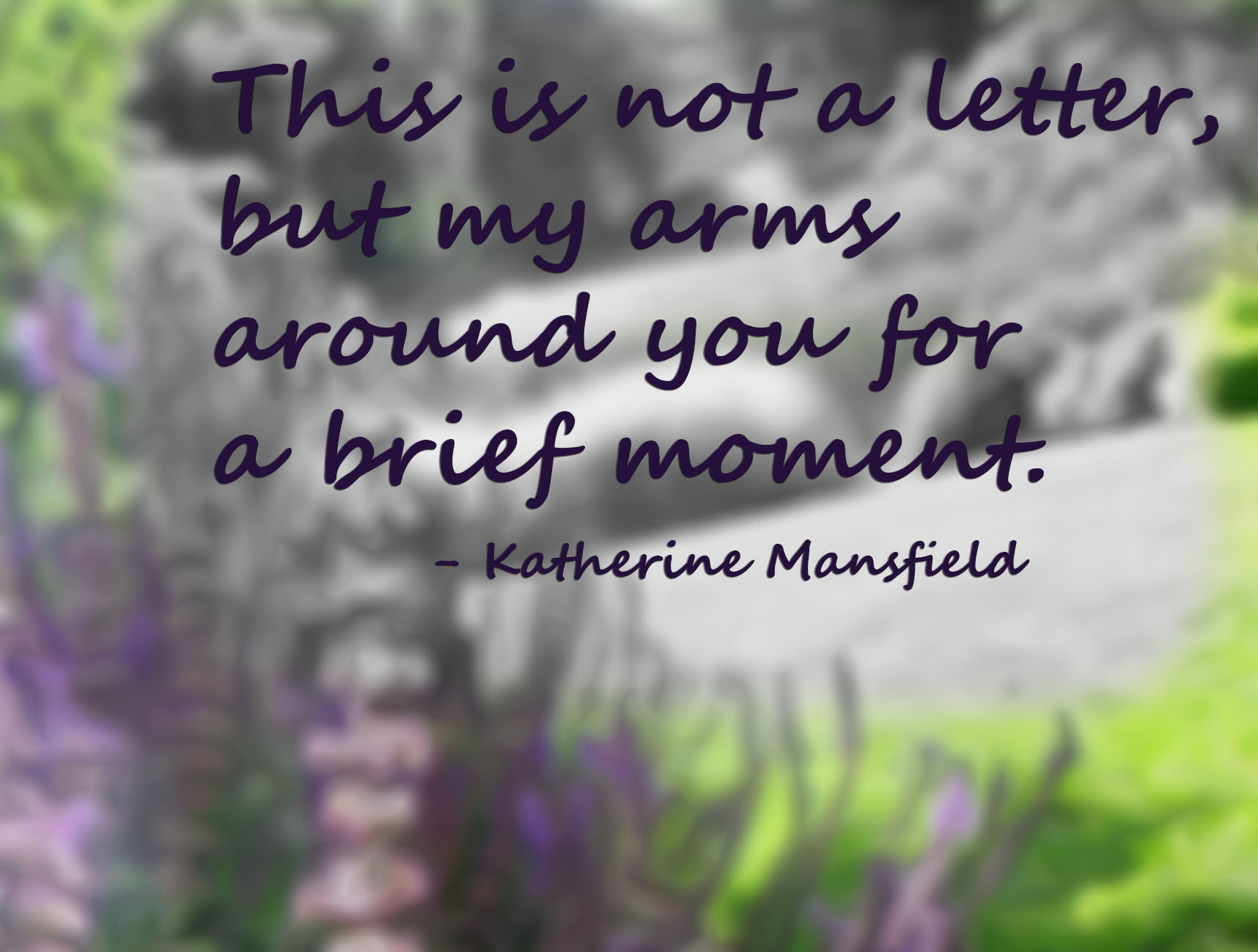
my arms around youSure, I have folders in my documents file on the computer, some of which hold electronic correspondence from others, and I have kept emails that mean a lot to me. And it’s admittedly kinda nice that these don’t take up any physical space (neatness, too, is a virtue I value), but I also have a few boxes’ worth of just letters and cards from people who have meant a lot to me. They take up real estate in my closet, but I’d never part with them.

Perhaps at this time of the year, where we shop so much online and send e-holiday cards and e-gift cards, we could take just a few minutes to write a personal note. Maybe after Christmas, when life isn’t quite so hectic. Perhaps as part of a physical thank-you note to someone who gave us a gift we unwrapped or just has given us the gift of themselves, we can get out a nice ink pen and craft a few heartfelt words of love and appreciation. What a present that would be!

Brilliant! no, barmy. no, lovely. Ah, cheers.

So I’ve been vacationing in England for three days with my husband, and we’re getting the biggest kick out of British English and our lack of understanding of it, being American and all. You’d think that being somewhat of an Anglophile (I love reading books set in England; I watch foreign films, indies, what-have-you), I’d be a bit better prepared for the difference in vocabulary, let alone the accent. I mean, I already knew that “biscuit” really means “cookie” and that “crisps” are “chips” (and “chips” are french fries).

But it honestly takes us a couple of “excuse me”s to understand people’s meaning around here. The accent and dropped letters make it hard to clearly understand the meaning of words we actually do share, and then different words entirely make it extra-challenging.

We have observed that “brilliant” is a lovely all-purpose word to say that any service was great. Dinner? Brilliant. Sights? Brilliant. And the all-purpose word for anything else? Cheers. Hanging up? Cheers. Buy something? Cheers. Not sure what else to say to anything? Cheers.

Guess what these are. You'll never guess. Really. (Brits, no cheating.)
Guess what these are. You’ll never guess. Really. (Brits, no cheating.)

Food has been fun. I thought that it was a little challenging choosing food from the menu in Paris when we went there 9 years ago. But it’s been just as foreign ordering from British menus. Baps? Queenies? Bangers? And I finally had to ask, What the heck is treacle? I’ve read about treacle tarts for years. Then we went to a pub that served treacle bread. It was just a nice wheaty bread. Hm. What could treacle be if it’s in regular bread and tarts? The answer: it’s a sugary syrup of some kind. Huh. Okay. Then I bought a little collection of chocolates on the Isle of Man, and one was toffee that had treacle in it. My husband and I finally figured out what treacle really is when we popped the toffee in our mouths: it’s molasses, or something darn near like it. Huh. Molasses bread: fine. Molasses toffee: eh. Molasses tart? I’m not gonna try it.

Last of my observations: the Brits can sure conjure up some hilarious-sounding phrases. The one I’ve loved the best so far I saw on a sign in a train station: “lovely jubbly.” Lovely jubbly to you all, fair readers. Cheers.

The power of story

Over the past few years, it has really struck me just how strong the power of a story is.

But really, most of us just take for granted how surrounded we are by stories, how they can captivate us, ensnare us, direct us and shape us, without our even realizing that it’s happening.

Of course, as a dedicated reader (and editor and writer), I love to be willingly captured by a good story, whether it’s one that’s been spun completely out of someone’s imagination or one that’s based in reality and been tamed just enough to be put down in words. I’ve come to realize how difficult it is to extricate ourselves from a story once we’ve stepped inside of its boundaries. The story could be shared via any medium: books, film, television, or any other kind of art.

Have you ever noticed that even if you’re watching a movie or reading a book that’s even just mediocre, it’s challenging to walk away? (I can detach myself from a story that’s really poorly told, however.) Something in us yearns to know “the rest of the story.” It’s so against our nature to not find satisfaction in completion. We must know how the story plays out ’til its bitter end.

What’s even more entrancing is to find ourselves enmeshed in stories within stories. One recent example that had me absolutely mind-boggled was the movie “Inception.” There were so many stories layered inside of each other that I wasn’t even satisfied completely with one viewing; I had to go back and let my mind wander those strange passages several times so I could really follow the stories and how every detail fit together. I absolutely adore complexity. And surprises. (I’ve written about that already in my post on gothic tales.)

But books and movies don’t by any means hold a lock on story. Our minds always create stories for us. We lay down memories that are ordered in some kind of story format. We consciously and unconsciously create stories to make sense of information we run across. Yes, story-making is hardwired within us. Some people are just skilled at weaving the stories within them for others’ consumption, but they are not the only storytellers. I recently loaned some of my favorite books to a friend, and she very kindly extricated some wonderful quotes from the second in the set, Carlos Ruiz Zafon’s The Angel’s Game. One goes like this: “Everything is a tale. … What we believe, what we know, what we remember, even what we dream. Everything is a story, a narrative, a sequence of events with characters communicating an emotional content. We only accept as true what can be narrated.”

Yes, story is a powerful thing. It can be dangerous; it can be liberating; it can be instructive. It has the power to move people to action, for good or evil.

I just thank those people who have the gift to create and shape stories and share them with me. I think that’s why books are so beloved, and why even writers pay homage to other writers and to the written word itself. Books and the stories in them can transport us and change us, so much so that they come alive themselves. As Zafon also writes, “As long as there is one person left in the world who is capable of reading [books] and experiencing them, a small piece of God, or of life, will remain.” Thank goodness for that!

Make it permanent, make it right!

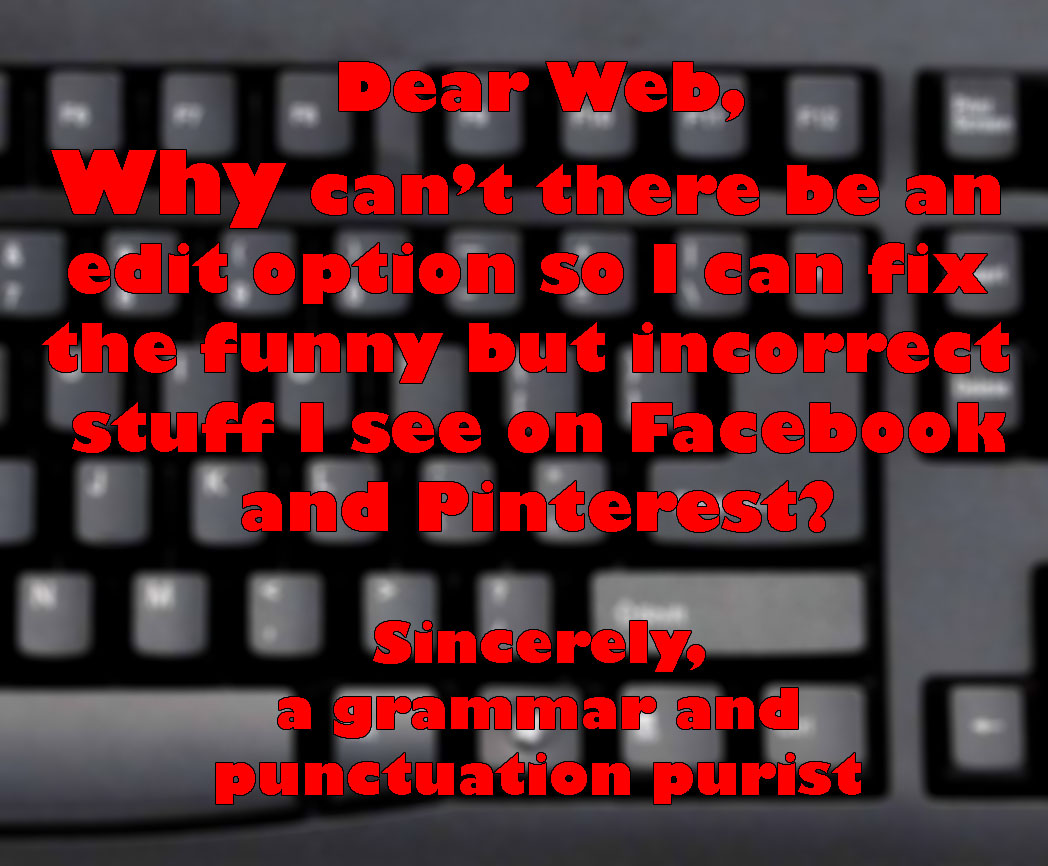
OK, I’ve already made clear how I feel about proper grammar and punctuation. I read and write book reviews and run a book-review website, and I work as a copy editor. I suppose I became a copy editor because I have always been so precise and persnickety about the proper use of punctuation and grammar. Then editing for a living has just cemented my punctiliousness and dedication to our lovely language and how it’s expressed, especially in writing.

So it is not an exaggeration to say it PAINS ME to see our language atrociously abused and misused. What gets my goat in our wired day and age is people’s inability to get even the most basic concepts correct when they communicate electronically. OK, I admit I’m forgiving when an iPhone or similar device is being used; they are notorious at messing up a comment or word that was written correctly in the first place. And quick emails or texts are forgivable as well. What I just cannot understand is when someone takes the time to craft a fun meme or e-card or something else “permanent” that is intended to be passed around the Web for public consumption. Is it not possible to make sure that “you’re” or “your” is used properly, or that a comma is put in the right place? One of the worst mistakes I’ve seen in indelible use is the poor, innocent apostrophe. It exists to do good. But it’s employed so wickedly wrongly. Outside of the Internet, I see it most often misused in those carved wooden signs outside people’s front doors: welcome, the signs say, to “the Smith’s”. (*Silent scream*) I’ve always said if I were to commission one of those signs, I would send it back to the artist for redo were that apostrophe so nefariously inserted into that simple plural of my last name.

Glancing on Pinterest this very morning, I saw a lovely graphic that proudly proclaims “Seven days of camping recipe’s!” There’s that naughty use of the poor apostrophe right at the top of my page. Further down is an inspiring saying that throws in a hapless comma: “You are always responsible for how you act, no matter how you feel. Remember, that.” (Remember, not, to, use, commas, needlessly!!!) And one simple green e-card is generous enough to illustrate my point about spelling by containing not one but TWO mistakes: “What I love most about our friendship is that it’s based soley on innapropriate conversations that no sane person should have. Ever.” Solely. Inappropriate.

I mean, really, folks. If you’re going to craft a cute meme or card, please use spell check before you hit “save” and ask a friend about your punctuation. Simple as that. I may enjoy your meme but simply WILL NOT re-pin or share it if it has mistakes. Simple as THAT.

And here is my own little meme. Share as you will.

A voice for vocabulary, aka, a rant on proper usage

The English language is tough and resilient and has evolved miraculously over centuries, but it takes a huge amount of abuse. Once every .003 nanoseconds, it is misused somehow, somewhere. It is time for someone to speak up on behalf of the voiceless, our lovely language, which, sadly, is unable to speak for itself, despite a slew of wise, wordy weapons in its arsenal.

Here I am going to take a stand on behalf of the proper use of vocabulary. It won’t be pretty, but I’m going to expose the improper uses of words and then show which words should have been used in their places. Brace yourselves. (These are in no particular order, mind you.)

  • “Unphased.” As in, “she was unphased by his poor use of the word.” The word that should be used here is “unfazed.”
  • “Reigned in.” I’ve seen this time and again. “She had to reign in her bad language.” “Reign” has to do with royalty. I do believe that those who have blue blood would be appalled at this improper use of “reign.” The word that should rightly stand here tall and stately is “rein.” When we talk about “reining in” a horse, we use a rein. Even queens do not “reign in” the animals that draw their carriages.
  • I heard something pretty funny in “The Hunger Games.” A character said something was “very lethal.” “Lethal” means something kills you. So if it’s “very” lethal… hm. You would be “very” dead. Brings to mind that the only way you can be somewhat dead as opposed to very dead is if you were Westley in “The Princess Bride…”: “mostly dead.”
  • “Bazaar.” Really, how often do people write about street fairs? Probably not as often as they desire to refer to something being “bizarre,” or really strange.
  • “Peddle.” More people find themselves needing to use the word “pedal” than its frequently used homonym “peddle.” “Pedal” as a verb means to move a bike along by pushing pedals with your feet. “Peddle” means to sell something. One could peddle pedals in a bizarre bazaar, if shoppers are in need of replacement parts for their bicycles.
  • Predominate. I rarely have need to use this word, and I rarely see anyone else need to use it or use it correctly. What I DO see, however, very often, is the use of this word instead of “predominant,” an adjective meaning “having influence or power” or being the “primary” focus of something. Just say the word out loud, folks. It has an “n” in it.

This is just a start, mind you. I expect to be adding lots more over time. Anyone care to weigh in?

OK, time to add some more.

  • Ravish. Most of the time people use this word in writing, they mean “ravage.” Ravish is generally associated with rape, or just a lusty man taking a woman strongly in a bodice-ripper book. But ravage is about wreaking havoc or destroying. Ravage a town, and the buildings are destroyed, the people scattered. Ravish the people of a town, and outsiders will feel particularly outraged.
  • Tenants. Whenever I see this word used, the writer invariably is talking about the belief system of a religion or just some kind of way of life. Today, fittingly enough, I read an article on HLN.com about “11 words adults just can’t spell.” I agreed with a few as being common errors (the others just didn’t seem to be the most-screwed-up ones, in my opinion), and then I clicked over to another article on HLN about Alanis Morissette giving her opinion about attachment parenting. Naturally, the article spoke of the “tenants” of that way of raising kids, when what it needed to say was the “tenets” of that philosophy. So I clicked right over from an article on spelling errors and found a biggie on MY list right there on another one. I couldn’t refrain from posting a comment on that one.

An ode to words

Aren’t words wonderful? Some may argue (and rightly so) that the English language is crazy and difficult and full of rules that are just as often broken as they are adhered to. But I’m in awe of just how much can be said with all the delightful words that our language contains. We’ve adapted and co-opted words from all kinds of places and times and made them work for us. I have an utter reverence for what can be conveyed with the right use of vocabulary.

I think of our language as a toolkit full of a variety of tools, each just the right size and shape and weight to fit any job. But what dismays me is that most of our society today only carries around a mini-kit with a few basics (hammer, screwdriver, a few nails) which they use for every single need. I try to lug around the jumbo version of the toolkit (even the whole garage full of cupboards and shelves, sometimes) so I’ll be able to fit just the right tool to whatever I need to accomplish.

That’s what makes me particularly enamored of certain authors’ writing. Some authors are great storytellers, with vivid imaginations and tons of neat ideas for stories, but they’re not great writers (Stephenie Meyer has said this about herself, for example, and she’s absolutely right). But some authors can tell any story but make it compelling and beautiful because of the words they select from their kits and how they put them together in seemingly fresh ways.

I love to use my thesaurus. It’s full of options to help find just the right word to convey the perfect meaning. But as with any tool, it must be used correctly. Many people have the mistaken notion that they can take out a thesaurus and pick willy-nilly any word out of the synonyms listed. Wrong. Each word in our language has a very precise meaning that, if the writer or speaker and the reader and listener both know it, can communicate meaning as well as is possible with language (of course, communication is a whole other topic; let’s just say that spoken or written language is only a small part of communication, so since that’s the case, we’d better be sure to be careful with the words we do use so we can communicate as effectively as possible). The ideal use of the thesaurus is to stimulate our thinking and allow our brain to go through its options and then select the best one. We still must know the exact meaning of each synonym, because synonyms are merely similar words, not usually exact matches. Even identical twins have slight differences in appearance, voices, and certainly personalities, don’t they?

So as a writer, I like to look at the thesaurus when I have a general idea of what I’m trying to express. Glancing through the list of synonyms of any given word can help my brain to make connections and eventually say, Aha! That’s exactly what I’d like to say. As an editor of other people’s writing, I have to use the thesaurus to help them come up with the word that’s going to say what they obviously mean to say in the context of their topic and sentence or paragraph. I often think as I’m reading someone else’s raw work, I do not think that means what you think it means (thanks to Inigo and Vizzini of “The Princess Bride”). Sometimes their efforts are unwittingly comical; sometimes they could even be potentially offensive, egregiously misleading or just plain wrong.

Given that I do a lot of editing, then, and I see many misuses of language, I am so appreciative of the writers who have honed their craft and lovingly put to use the full toolkit of the language. Each word, carefully chosen, can instantly create a picture in my mind, complete with emotions and sensations. Every word has nuances and layers of meaning, and used well can convey those layers in just one perfect word, allowing a writer to write concisely but elegantly. A writer with a shallow portable toolkit will have to use many more simple words to get a message across that could be portrayed nicely with one or two words in the hands of a skilled writer with an excellent grasp of vocabulary.

I’m not saying that we should all use “hoity-toity” vocabulary at all times or words that are just rarely used and never understood. But there are so many options that are rich in meaning that can communicate effectively that people don’t bother to use. As a parent, I’ve always used my regular vocabulary to speak to my children, rather than trying to “dumb down” what I say in baby talk. I might rephrase something in simpler language so they can understand, but then I’ll also use the richer words so they can hear them in context and learn. And as they read, just as I did growing up and still do now, they (and I) can learn new words just through context and, if they’re so inclined, looking them up in the dictionary.

Even as I write, I’m now self-conscious about how I wrote. Did I convey exactly what I wanted to express? Did I use just the right words? I hope so. I’m not one of the most gifted writers out there, but I hope that I can at least say what I mean to say. And my hat’s off to those amazing writers who have transported me because of their judicious use of language.