I’ve watched the past few days as different people and media observers have discussed the backlash as well as support for the very fit mom of three boys who posted a picture of her scantily clad self with the title “What’s your excuse?” I’ve wanted to say so many things to respond to so many other people who have added their own reactions to the whole thing.
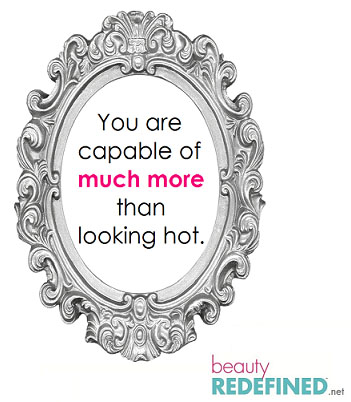 Here’s the lowdown, though: practically no one has gotten down to the nitty-gritty of the real issue here. There have been two primary reactions: “her story is inspiring, as she meant the post to be” or “it’s shaming.” The latter response has skirted it but hasn’t fully developed it. But the great ladies who started Beauty Redefined and who work tirelessly to spread their message about women have already addressed this topic on their blog and have revisited it many times: We as women are capable of more than just being objects, of just being something to look at.
They discuss the topic of “fitspiration” in a blog post they wrote almost a year and a half ago. Here’s one point: how do you (if you are a woman) feel when you look at this incredibly fit woman? Do you feel inadequate, less than worthy, embarrassed about your own body? Because I think that for the majority of us who aren’t this incredibly toned and fit, that is the real reaction we have immediately, whether or not we talk ourselves through it, even very quickly, to a place where we think the more acceptable “oh, that’s so inspirational.”
Let’s be real here: yes, many of us in the U.S. could do better to take care of our physical health. Too many of us are overweight, don’t eat enough of the healthy foods our bodies need and too much of the foods our bodies don’t need; too many of us don’t exercise regularly, even if it’s just for 20 minutes. HOWEVER, even if all of us did eat healthier and spent 30 minutes exercising four or five times a week, which is essentially what most experts on health recommend, we would not look like this woman. There’s this thing called genetics, and some bodies are just not built that way. But eating right and exercising will make those bodies healthy and strong, which is the real goal of fitness and taking care of ourselves.
What this photo does is tell us that if we don’t look like this, we’re clearly NOT doing the right things. This woman, Maria Kang, has said she spends about an hour each day working out. I don’t know what her diet plan is; it may be healthy and satisfying; it might be pared down to a small number of calories. Whichever it is doesn’t matter here; what does matter is that her eating and hour of exercise lead her to look like a model. I can honestly say that if I eat the number of calories I should (which I admit I have been overdoing a bit for some stressful months here) and continue the hour of exercise that I already do incorporate into my life five to six times per week, I WOULD NOT LOOK LIKE HER.
And that’s OK. Isn’t she saying we’re supposed to make ourselves a priority and exercise? But what the picture tells us is that the point is to LOOK a certain way, not have our own version of good health, which is often correlated with appearance but not entirely. Yes, diets lead to “looking” thinner. But if she and other “fitspiration” advocates, as well as their supporters, truly just wanted us all to be healthier, there would be no need for pictures that make women feel bad.
The truth is this: our society is still firmly entrenched in certain results, in appearances, in what we consider an ideal, which today is being very trim, with firm and hopefully large-ish breasts, not just thin but toned. (Fifty years ago the ideal was different; one hundred years ago it was very different.) Just because this is TODAY’s ideal doesn’t mean it’s some kind of eternal, absolute Truth.
I’m sure that Kang did want to inspire. But she bought right in to our culture’s damaging belief about appearance being paramount. It’s so prevalent that it’s almost invisible. We can’t see that it’s there right in front of our eyes because it’s been “taught” to all us, male and female, since we were born into this world. The only way to notice it is to start taking action, to respond in positive but strong ways that women are more than objects.
How about the radical notion that, rather than stripping down and showing off her abs and thin but toned thighs, Kang posted some information about her actual health: cholesterol levels, healthy blood sugar, etc.? Because that’s what health is about, what the fitspiration posters SAY they want to promote. So stop the shaming photos of ideals that really are not possible for at least half the population (and I’m being conservative here). Talk about health and measure it.
The women who did complain about Kang’s post are experiencing shame twice now, once as they felt bad about themselves when seeing Kang’s perfect body, and a second time by being called “catty” and “jealous.” They should be supported as they remind us all that shame is not an effective motivation, not in the long run. It’s “counterproductive, … debilitating and discouraging,” according to an excellent post on shame at Beauty Redefined. Please take the time to read that post because it is absolutely crucial in understanding what’s going on in our culture. The more that we can talk about this issue, the better. All in our culture, women and men, need to change their mindset, need to totally rewire their brains when it comes to how they think about appearance. Let’s unlink “health” from “appearance.” Let’s stop thinking of our bodies, our appearances, as the most important part of our SELVES. Let’s compliment ourselves and others for more important things than how we look.
Let’s have this conversation and do it right. Be an advocate. Share these “radical” ideas. Kindly challenge and help remind others, wherever you are, whether it’s online (Facebook, Pinterest, Instagram) or in person, that we are capable of being more than looked at. Start changing how YOU think, the horrible messages society has drilled into your brain for years, and help others to do so too. We can all do it if we just speak up.

 Life and Lims