Best young adult novels?

So NPR just released the results of a poll it conducted asking people to nominate and then vote on finalists in the category of teen novels. I did see the poll soon enough to vote on the finalists. I found that I was a little surprised at some of the books that were nominated enough to make it to a finalists list of 235 titles. There were some fun books on there, but quite a few weren’t ones I would consider truly excellent or memorable. I do think that this final 100 is fairly good and mostly reflects books that will stand the test of time.

Some of my favorites on the top 100 are these:

  • Harry Potter. No question. These books were popular for a very good reason. Not only was the whole series complex, detailed and full of wonderful twists and turns, but it had great characters, an unforgettable world to visit and revisit, and cleverness and wit galore.
  • The Book Thief. Yes, it got a lot of attention and word-of-mouth when it was published a few years back, and rightly so. Many books have been written about the Holocaust, but this was one that was relatable for teen readers as well as adults and was beautifully rendered, powerfully affecting and vividly evocative.
  • The Giver series. I suppose that this was almost an early entry in the now-burgeoning sub-category of dystopian novels. But each of the novels in the series got my attention and made me think about the cost of “equality” and “perfection.”
  • His Dark Materials series. When I finished the first book in this series, I was kind of scratching my head and not sure if I wanted to continue. But I’m so glad I forged on. The series was just so imaginative and deeply thought-provoking I wished I could just continue to experience it. And that is the hallmark of a great book: it creates a land you simply don’t want to leave.
  • The Dark Is Rising sequence. A never-to-be-forgotten school librarian introduced me to these books when I was only nine years old. I will forever be grateful. Even on multiple readings as an adult, I am still in awe at how well-written these books are and how complex. This is one of the best epics of good versus evil, light versus dark, EVER. Magic, Arthur and Merlin, the old hills in Wales … it’s all steeped in British legend.
  • Flowers for Algernon. Love, love, love this book. It can make me cry every time, too. What a lovely story about intelligence and humanity and gaining new skills and a new life and then losing them.

  • The Mortal Instruments and the Infernal Devices series. I absolutely adore these books by Cassandra Clare. When I found the first set a few years ago, I devoured them in no time flat. The story is good, but the characters and their dialogue and interactions are the best part. I loved how Clare could make me laugh out loud, and the romance between the two main characters is truly sizzling.
  • Anna and the French Kiss. I don’t know how much this completely compares to the others on my list here for utter staying power and memorability in, say, 20 years from now, but it absolutely delighted me. It’s a very fun teen romance.
  • If I Stay. Wow, what a great book. I loved the absolute real-ness of the whole story and its ability to make me root for the characters. The main character has such a beautiful relationship with her family members. I loved that the family unit was intact and that the parents and children loved each other so much. But at the same time, the main character has to decide if she should go with them or stay with her life and her boyfriend, who is a fine young man.
  • Feed. I really didn’t like the HUGE amount of strong language in this book. For me, it was really distracting. But the story is a really fine tale to get teens thinking, no question, about the amount of electronic interaction they have in their worlds. How far will we go as we allow electronics to become literally embedded in our lives?
  • The Hunger Games series. Yes, these are almost so ridiculously popular right now it seems silly to comment on them. But they are good books, and no doubt will become new classics.
  • A Ring of Endless Light. I read all of the Madeleine L’Engle books I could get my hands on when I was a teen. I will have to write about L’Engle in another post sometime. I just feel bad she didn’t get better represented on this list. She was amazing.
  • The Goose Girl. OK, I haven’t read this one. I must change that. I have read about five other Shannon Hale books, and I think she is an amazingly talented writer. She writes with a beautiful, lyrical style in the “serious” books, and she’s just got a great sense of humor in her lighter ones.

A few I thought were good but I don’t think will necessarily stand out from the crowd given a few years:

  • Divergent series. I did enjoy the first book, but I haven’t even felt compelled to read the second one yet. I may or may not get around to it.
  • Vampire Academy? Bloodlines? Wha? I don’t think so. I only think it’s on here because it and a bunch of other similar books are riding the popularity coattails of Twilight. If I’m wrong, please tell me I must read these and why. Same goes for House of Night series. Coattails.
  • Sarah Dessen books Just Listen, Along for the Ride, and The Truth About Forever AND This Lullaby. Wow. Four whole books. Eh. I enjoyed reading Along for the Ride, and I wrote that it was good, but apparently it wasn’t great enough for me to want to rush out and read more, and now I barely remember it.

And then there are a few others that are kind of in the middle for me. I did enjoy the Shiver series by Maggie Stiefvater, but I don’t know if I’d call it among the 100 best. Hm. Same goes for Delirium. I admit I eagerly await the third book after finishing the second installment, but we’ll have to wait and see if it should also be among the top 100. I would probably put Uglies as a single book in the top 100 for sure, but as much as I really liked that book, I liked the series less and less as it went along. I just didn’t like the direction it ended up taking. I also read Before I Fall and Unwind, which were thought-provoking in their own ways, but I don’t know if they’d get top billing. At the same time, though, I haven’t read any other Neal Shusterman, but I hear he is quite good, so he does probably merit a spot in the top list. As for the Gemma Doyle trilogy, I read the first book and was only mildly interested. Never read the rest.

I may very well need to make this into a series of reflections and think about some books I’d add onto the list if it were mine. But that is going to be for another post and another day.

Clean romance: does anyone want to read it?

So as those of you who pay attention to my “reading life” posts know, I review books. I have for years now. I run a website, Rated Reads, that exists to help readers know about the potential offensive content of books they might like to read. I think it goes almost without saying that I tend to prefer and appreciate books that don’t have lots of offensive material, be it vulgar language or sexual situations or even violence. I just clap my hands with joy when I find a book that’s just great in every way AND doesn’t have offensive content. Yay!

There are all kinds of genres and sub-genres out there: sci-fi, fantasy, paranormal fantasy, historical fiction, memoir, biography, young adult, romance, self-help, science, business … the list goes on forever. But certain types of genres sell particularly well overall, and some get extra attention during “fads.” Ever since Twilight, vampire love stories are very of-the-moment. And now it’s Fifty Shades of Grey. No vampires, but the protagonist is still super-hot and super-rich, just like the Twilight hero. In the case of this uber-popular new series, the love story isn’t necessarily about forbidden or supernatural love, but it’s about kinky sex, explicitly detailed in the book.

Um, no thanks.

So while those books are flying off the shelves and, most of all, being furtively downloaded onto e-readers, where no one else can tell what the purchaser is reading, I still say, Publishers and authors, please give me some great clean romance. Men often wonder why in the world so many of us women swoon over the Regency-era books, where the happy couple don’t even necessarily get a single kiss. I’ll tell you why: because the fun of romance is in the chase, in the slow buildup of longing looks and quiet exchanges of meaningful glances and words. It’s amazing to have a man treat us with respect and chivalry. I just don’t want to read about some gallant hero spanking a bound woman. Gah.

One of my review contributors, Teri Harman of Book Matters, talked about good clean romances on today’s KSL-TV Studio 5 segment:


She asked me a month ago what books I recommended that would fit the parameters. I pored over all the reviews I’ve written over the past four or five years and posted on Rated Reads and, sadly enough, came up with an extremely short list. This is what I wrote to her:


  • Major Pettigrew’s Last Stand is a delightful romance about an older English gentleman and a widowed Pakistani woman. I rated it mild for some language.
  • I really enjoyed all of Carrie Bebris’s books continuing the story of Darcy and Elizabeth Bennet. They’re mysteries, but they’re love stories as well in Austen mode. I like that she does a good job with them and feels true to the originals.
  • I loved Erin McMahon’s I Now Pronounce You Someone Else, a sweet YA book that I rated moderate for teens but mild for adults. Nice bonus: main character is saving sex for marriage, and she sticks to it.
  • I did enjoy Edenbrooke, the first in a new set of books that will be published by Deseret Book called “Proper Romances.”
  • Flipped is a very charming middle-grade book about two eighth-graders. Very cute.
  • Of course, I liked Austenland, but I’m sure other people know about that one by Shannon Hale.

What’s striking is that three of them are either Regency/Austen-type books or are patterned after them. Two are written by authors who are members of The Church of Jesus Christ of Latter-day Saints. Though they aren’t the Christian genre, their authors are going to decidedly keep their writing fairly clean because of their religious beliefs. So, sure, it might be easy enough to find a decent enough clean romance because it’s either a classic or patterned after a classic or because it’s in the Christian genre, but finding just any other romantic books out there in general fiction that aren’t some type of genre that demands or expects clean content is a tricky task.

So, yeah, authors and publishers. The dirty stuff apparently does sell. But so does the clean stuff. If you’re going to hop on a bandwagon, can you please hop on the latter one? ‘Cause I’m not riding the dirty wagon or patronizing it in any way. Thanks.

Me and my Kindle: why I’m no longer a paper purist

I think there were always two places I loved to smell. One was Baskin-Robbins. My grandparents would take me there when I was very small, and I can still remember standing in front of one of those freezers, not really even tall enough to see through the glass behind which lay the big tubs of ice cream. And for years, I just loved the smell every time I stepped into one of those stores: milky with the overlay of warm fudge and toasty cones and somehow even the scent of the freezers themselves.

The other places that make my nose happy are bookstores and libraries. While graced with similar scents, libraries (and used-book stores) have the tang of age and dust. Bookstores are crisper and fresher, but both just smell like paper and ink somehow. Ahhh. So welcoming and soothing.

So I love the smell of books. I also love how they feel, just turning page after page, whether a new book with fresh, untouched paper, or an old, beloved tome with soft pages that are worn down like Grandma’s bedsheets.

Then there’s just looking at them. My office walls are lined with bookshelves, shelf upon shelf of paperbacks and hardcovers, fiction and nonfiction, classics and newly published, humor and memoir, religious, dictionaries and thesauruses. I love  swiveling around from my computer to cast my eyes on these old friends. Of course, my living room has a wall lined with books too, some of my prettiest ones, matching sets, coffee table books, and a few of my absolute favorites. And my bedroom has a small bookshelf near my side of the bed, with some books I haven’t gotten around to reading yet but hope to. My daughters’ rooms all have lots of shelves, too, with all the picture books, tween and young adult books I’ve amassed over the years. I can walk into any room of the house and feast my eyes on my paper-and-ink friends.

Now. That said, I was resistant to the idea of ebooks, particularly the Kindle. Considering how much I’ve engaged in a love affair with print books for 40 years, the concept of holding a little electronic device didn’t excite me. It was kind of ugly and just seemed rather pointless. And how could I betray my longtime associates, all with their eyes watching my every move throughout my house?

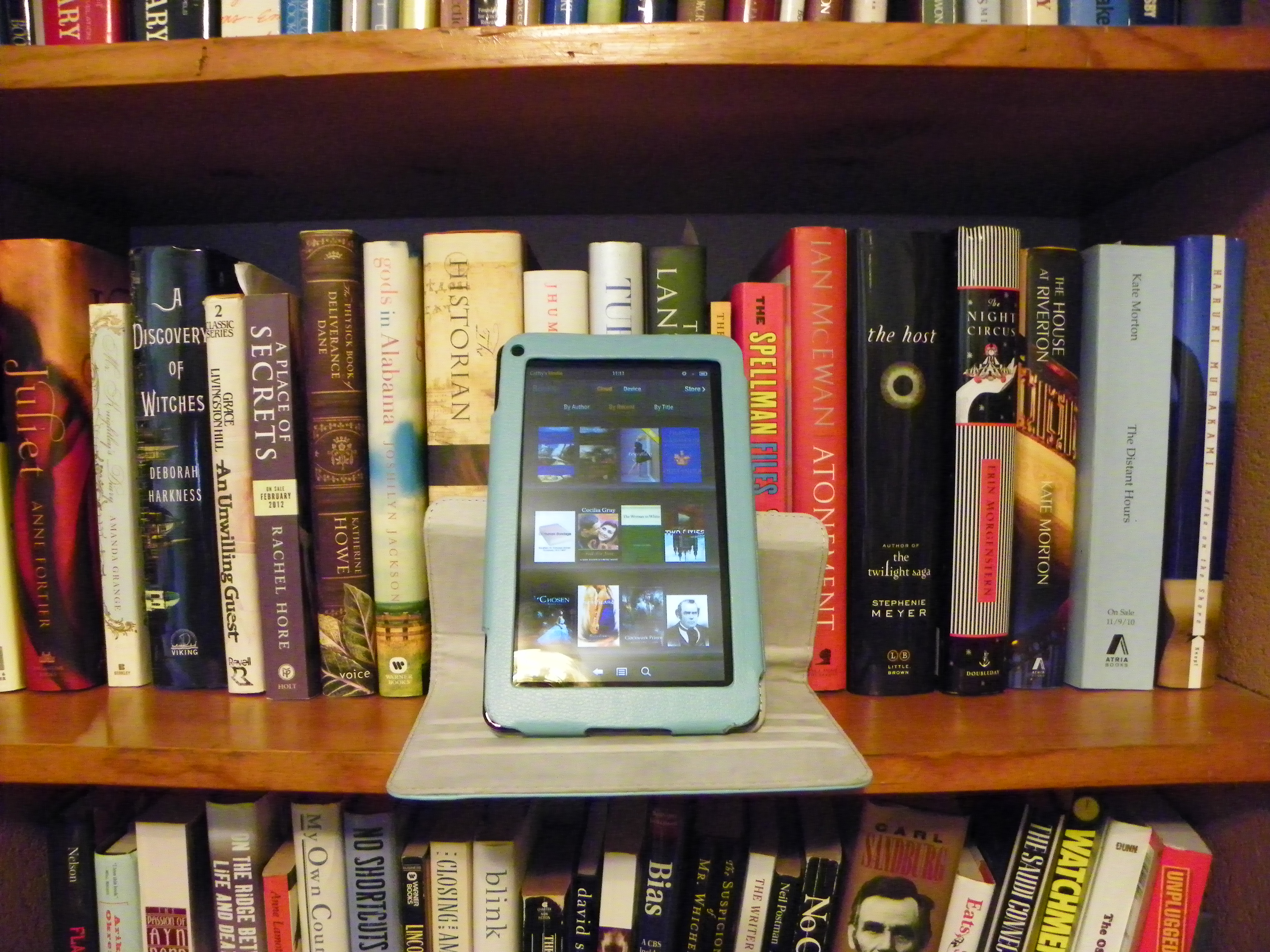
Sadly, that all changed when the Kindle Fire arrived late last fall. It seduced me with its beautiful, sleek lines and full-color screen. Its multifunctionality is what snagged me, I think. I could watch videos on it if I wanted, in larger size than I could view on my iPod Touch. Knowing that all I had to do was take along this one gadget to the gym for my daily workouts and be able to read or watch a movie or TV show, given what kind of mood I was in, was a huge selling point. I’ve been reading books on workout machines for years, and it’s always been awkward, though I’ve managed. Even using those plastic book-holders that slide over a machine’s console has certainly never been ideal. If the book is slim, the pages never get held down flat, and if it’s thick, it’s hard to turn pages. Argh. So knowing I wouldn’t have to use the plastic thingies as often was oh-so-tempting.

I had also started to be lured to the ebook device when reading a very thick novel. No matter where I was, at the gym or on a comfy couch, holding up that 750-page tome to read was sometimes a little annoying. And knowing that there was an alternative … well, I heard that siren call.

So I got a Kindle Fire for Christmas. And I have been using it practically nonstop ever since. It’s so easy to carry around, and I can switch among books easily. (I tend to like reading two or three books at the same time, and having them all in my hand at once makes switching and choosing a snap.) I’ve downloaded a number of classics that, somehow, I didn’t own … all for FREE. Who can resist free books, people?

I love the dictionary feature. I have a very good vocabulary, but there are still some books that offer up words I haven’t heard or am not too familiar with, and on my Kindle, all I have to do to look up their meanings and pronunciations is hold my finger on the word for a second. Up pops a dictionary entry. I no longer have to ignore my curiosity or interrupt my reading to go on the hunt for a dictionary off my shelf; it’s instant, and my reading can continue posthaste. It’s so cool!! I’ve been reading a series set in the 1700s that features some archaic words and location-specific vocabulary, and it has been the neatest thing to look up meanings so easily and quickly. I love it!

Along those same lines, if the dictionary won’t do it, I can quickly switch over to the Web feature and do a quick Google search for a phrase or place or something else I don’t understand or know little about. Quick, easy, handy information at my fingertips. Awesome.

I’ve already mentioned how it’s much easier to read a very thick book on my thin Kindle. It satisfied my hopes in that vein. The Outlander series I’ve been enjoying so much, set primarily in 1700s Scotland (so far), comprises about 8 very thick books. It’s been a lot easier to handle these 700-plus-page tomes as ebooks.

And let’s not forget instant gratification. I thought I’d “try” the first Outlander book on my Kindle because of its length, and I got hooked on the great story and characters. When I finished, I had to know what happened next, so all I had to do was go to the Kindle store and press a button. In seconds, the entire second book was there in my palm. Ahhh. No waiting for a trip to the library or a book to arrive in the mail (because we no longer have a bookstore here in town, thanks to Borders going under). Oh, no. When I really want a book, I can get it immediately. I love that!

All in all, my Kindle and I are very happy together. Sure, it has its downsides. I have to charge it every couple of days, but it doesn’t take long. And the Fire is hard to read in direct sunlight, such as when I’m driving in a car at certain times of day. That’s a problem. And like all electronic devices, I’m sure it’s going to give me a few fits. But even so, I’m still thoroughly enjoying my Kindle. I still love to look at all my books on the shelves. And the series I already have in hardback I’ll still finish buying in paper form, just to have a complete set, or I’ll buy certain books in their standard form for other sentimental or practical reasons. And even though I can borrow some books on Kindle from the library, most I still have to get in old-style form. That’s OK. For now, I like my new e-pal.

‘Authenticity’ and vulgarity in books

Those of you who have paid some attention to my biographical information (if not, take a look at “about”) will know that I run a book review website, Rated Reads. There are quite literally thousands of blogs out there that review books. What there are not nearly so many of are websites that try to provide information about the content of those books reviewed. I have been a book reviewer for probably 15 years now, and I’d say I have done it as “professionally” as is possible; I’ve written for newspaper book pages for all that time, I was the book page editor for one newspaper for a couple of years, and I’ve been a member of the National Book Critics Circle for probably 10 years. So I’d like to feel that I know a little something about book reviewing.

Since it has been well known among my acquaintances what I do in the reading sphere, many people have asked my advice on books, from all kinds of angles. What I concluded some years back was that there was a hole in available information out there about book content. I am a Christian and have been raised in particular being taught that it is wise to avoid using vulgar language or watching movies or TV shows with vulgar content, so it follows that I would want to avoid books with vulgar content as well. And those friends of mine who came from a similar background would often ask me what kinds of books I’d enjoyed that were also mostly “clean” when it came to content.

But there are no ratings systems available for books. There are many reasons for this, but the hole in available information remains nonetheless. I just thought I could do my part to fill in that gap, just a little bit. So I started Rated Reads four years ago. I’ve noticed now more blogs devoted to a similar objective: to just provide some information about book content to readers who care about sexual scenes, violence and offensive language. Some out there in the world today may criticize the movie or TV ratings systems or think they’re silly, but I think most people understand and agree that they have value in providing information that allows viewers and parents of under-18 viewers to make better decisions regarding what they watch. So I would think that logically most people would agree that having information available in a similar fashion for books would be desirable and welcome.

The naysayers have generally left Rated Reads alone. There have been a few occasions, however, when an individual who doesn’t share my values or the values of those who use the site or simply doesn’t appreciate that anyone in the world might have different values than he or she has makes disparaging comments about what I and my reviewers are trying to do. In those few cases, I have gently reminded those commenters that the site exists to provide information for those who would like to limit offensive content in what they read. They can disagree, but some people value what Rated Reads is trying to do.

As a reader, I find it laughable that some writers and readers continue to insist that, in order for their work to be “authentic,” it must contain graphic material. I think that there are a few occasions that this is actually true, but it isn’t true for nearly the number of occasions it becomes a sticking point. Writing about and for teenagers tends to get the most attention here, for some reason.

Let me just say this: I was a teen once. Yes, it was 25 years ago, and yes, it was perhaps a slightly nicer time in which not quite every scary or bad or dangerous or vulgar behavior was out in the open, and media reflected that. (An example: I distinctly remember the big fuss over George Michael’s song “I Want Your Sex.” Some radio stations simply would not play that, so there was a version called “I Want Your Love.”) Today, I am of the opinion that pretty much everything is now out in the open, rather than hidden behind doors, spoken of only in whispers. But I heard bad language when I was growing up; I heard sexual references. So I remember what it was like to be a teen and to hear and see things.

I can also say this: I have two teens. My oldest is almost 16, and she talks to me about everything. She is bombarded by vulgar language and talk about all kinds of dangerous and sad behavior. And even though, technically, students aren’t supposed to be allowed to use vulgar language at school or in the classroom, teachers have mostly given up on trying to reprimand or give any consequences. So my very tender, gentle and sweet child constantly hears peers using “f-” this and “f-” that and sexual language and all kinds of things that she simply doesn’t want to hear. (She doesn’t have a lot of choice in what she hears in class or in passing, but I will make clear that she does have a choice what she hears from friends. She has chosen friends who are like-minded in that they don’t use bad language, and if she does have friends or classmates with whom she interacts regularly who are inclined to use bad language, she has politely asked them to refrain from using it, and they have always graciously tried to honor her wishes because they like and respect her.)

So when it comes to media, including movies and books, yes, I can wholeheartedly agree that “reality” is not pretty in many respects. But just because some teens, or even many teens, are involved in dangerous behaviors or use vulgar language doesn’t mean that ALL do. My daughter has plenty of friends who don’t have sex and who don’t use rough language. This isn’t she or I being unrealistic or seeing through rose-colored glasses; it is a fact. There are plenty of great teens out there who aren’t having sex or using rough language.

Just as we can choose friends who are like-minded, we can choose media that reflects our values as well. My daughter doesn’t want to hear offensive things at school, so she certainly doesn’t want to come home and deliberately choose to read a book that has offensive material, if there are other options. I want her to have a place that she can feel comfortable, where she ISN’T surrounded by vulgarity. That is our home. And our home’s media options reflect that place of comfort and security. I don’t bring offensive media into our home. It is a sanctuary, as much as is possible, from the world of so-called “reality.” And our home life is just as “real” as what’s going on outside it — actually, more so.

So I appreciate the authors who can craft great works of literature without bringing in some of that “reality.” I’ve read many wonderful books with fully-formed characters who interact in a true-t0-life fashion with each other, with stories that are clever, that are witty, that are wise, that transport me, that make me think, that help me experience places and things I wouldn’t get to otherwise. And those books have felt absolutely real. They’ve been authentic; they have struck a chord in my heart and soul. I love those books and I give thanks to the authors who don’t feel the need to insert offensive material to make them more “authentic.” Generally speaking, I have found that the books that have used lots of strong language and detailed sexual scenes could have gotten their messages across equally well without that stuff. And all too often, those “markers of reality” have been poor substitutes for good writing. I don’t want to read a mediocre work, period, let alone by an author who thinks that inserting lots of nasty “reality” will instantly make it real. Why waste my time with that stuff when there’s just SO much good literature out there, so much I can’t possibly ever read it all?

I know well enough what’s out there, what kind of depravity and vulgarity and sadness exists. I am not so isolated or insulated that I’m completely ignorant. But I don’t have to wallow in filth just because I know it exists. Life is difficult enough for everyone that there’s no reason to choose to bring things into our lives that are filthy or degrading. We all have struggles, we all have challenges to work through. And good literature does reflect that fact. But it also can reflect that we as human beings can triumph over the bad, that we have the strength and the light in us to choose good and to be good despite the difficulties we encounter. And I’m going to choose to read books that don’t bring unnecessary vulgarity into my mind. I’m also choosing to run a website that provides necessary information so others who want to make informed choices can do so.

Readers who don’t agree with me can go ahead making their own choices. That’s fine. But respect that not everyone wants to consciously bring filth into their lives. And authors, if you write books with lots of bad language and sexually explicit material, you must appreciate that not everyone will want to read it (and parents have the right to monitor what their younger children or teens read). Most likely, you’ll have a broader audience if you could limit the offensive material you write into your book. The concept holds true just as it does for R-rated movies versus G- or PG-rated movies. More people do go to see those movies with more “family-friendly” content. They don’t have to be “cheesy” or trite or “unrealistic” just because their ratings aren’t “strong.” There have been some excellent “clean” movies, just as there are some excellent, authentic “clean” books. Consider making your writing the best it can be without using offensive material as a crutch to make it “true to life.” I, and many other readers, will thank you for it. Profusely.

Violence in popular books and movies

I am not sure why I am even attempting to broach such a huge and important topic, but since I am often ambitious and stubbornly determined, despite my limitations, I am going to try to at least put in a few words and opinions about this subject.

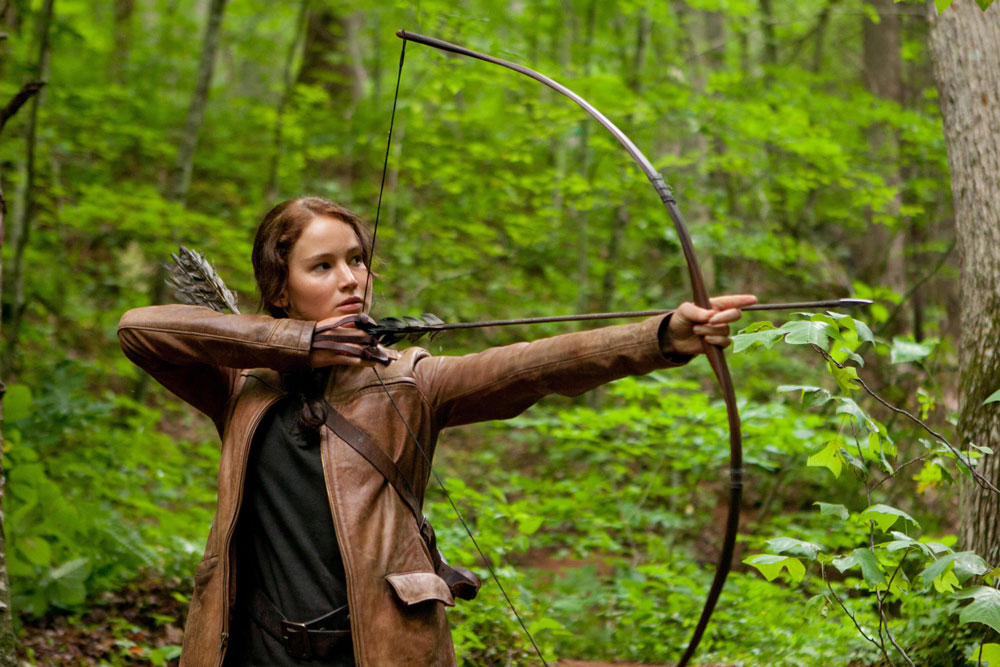
Jennifer Lawrence plays Katniss Everdeen in "The Hunger Games." Credit: Lionsgate/Murray Close

The recent uber-popularity of the book and movie versions of The Hunger Games has brought this topic to mind yet again. I think it is vital that as a society we seriously consider the issues of the kinds of content we view, hear and read in the media, whether it’s TV, movies, books, music or video games. There is a lot of research available about these issues, and there are definitely people who are concerned about these topics, but I think it still bears discussion. Since I have this blog as a forum, I’ll bring it up here.

First, I think it’s safe to say that the media we view/read has gotten steadily more detailed and explicit over the years as a whole. Sure, there have been incidences of movies or books years ago that were heavily sexualized or violent, but I think that overall, more and more of the things we see have become filled with content that could be offensive or outright dangerous. I know I have read about studies that link violent behavior with the levels of violent content viewed in movies or video games, but I won’t attempt to find them or list them here. I’ll leave that for others. This is just a blog post. I’ll talk about my feelings and experiences.

I was raised not watching any movies that were rated R. I also was raised by a father who was a television director. He worked in the TV industry and then moved on to teach about it as a university professor. He and my mother both were sensitive to the ways the media influence us and were somewhat cautious about what we watched, and when we did watch TV and movies, we often talked about them. We even talked about commercials and what messages they were giving. On the other hand, for example, my husband grew up watching R-rated movies, plenty of stuff that was filled with violence and bad language, and didn’t really give it much thought until we were married. So I find it interesting to compare how we react to things we watch.

When I see a film that contains violence, each violent act strikes home to me, and I feel it. I particularly feel affected by the portrayal of just plain evil characters. I appreciate good acting, but I never cease to be bothered by really effective portrayals of characters who are purely wicked, whose sole intent is to cause pain and suffering in others, whether it’s for gain or purely because they enjoy seeing someone else suffer. That feels all too real to me, and I would prefer not to experience that. I often don’t see the point of having to portray those kinds of people or the point of my needing to see/feel it. I flinch and cringe away from the screen. My husband, on the other hand, doesn’t seem to be as affected as I am. I feel it personally, and he views it as just part of the plot of a fictional story.

I know that how much violence we see affects how we continue to experience it. The more violence viewers are exposed to, the less it bothers them. We can actually have our feelings numbed, where difficult images don’t disturb us anymore, if we see a lot of violence. I worry a great deal about people, young men in particular, who are constantly exposed to strongly violent images and acts via movies and video games. It changes their very natures, so they are no longer bothered by acts that should be bothersome. That inevitably translates into real life in some way or another.

Now, I’m talking mostly about what might be termed “gratuitous” violence. Violence, as well as sex and strong language, have become a normal part of many movies and other media. But often they are simply there to “entertain.” I simply do not find those kinds of content entertaining; I find them offensive and soul-scarring. But there are times I think that violence has an appropriate place in media. Good literature and film and other media help to show us how life works and what happens sometimes, to remind us of history and how not to repeat it, for instance, or to remind us about how bad human nature can be and how to overcome our basest natural inclinations. So the question is, how much detail do those “good” media instances need to contain to be effective in their aim? How much evil needs to be shown to remind us to do better, be better, in some way, as individuals and as a society?

The Hunger Games has struck a chord with friends of mine, for instance. I’ve been interested to see what various friends have had to say about the books and the movie. Some have wholeheartedly embraced the positive messages of the series and what it seems to aim to do and say, even just sitting down and reading the series in one big marathon. Some have appreciated what the books are trying to do but have still felt the violence was too intense, too detailed, unnecessary. I already mentioned in my post about the movie and book that I liked them overall but felt that I could only read the books in small doses, not three right in a row, because they are so intense. I just couldn’t swallow them whole, all three in one sitting, without a break of lighter fare. I respect and find interesting and valuable the views of all my friends who have weighed in on the topic. I think that in the case of this series, it’s a valuable book series and movie, but it’s important to know yourself and what you’re comfortable with.

Some people may truly have been numbed by watching lots of other violent fare over the years, so they aren’t as sensitive; some people may just be more sensitive naturally, whether they’ve been exposed to much violence in media or not. In the case of Hunger Games, parents should be careful about knowing their children who might read the series or watch the movie to judge if it would be a good fit for them. But they shouldn’t just abdicate making any judgment on the matter because the movie and books are just so popular and “everyone” is reading/seeing them.

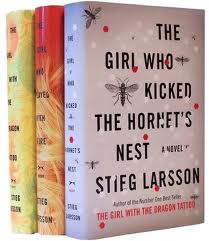
I think another movie and book series that bears discussing here is the very popular Stieg Larsson series, starting with The Girl with the Dragon Tattoo. As a book reviewer, I had an opportunity to read this book when it first came out, and I read the flap and decided it just wasn’t something that would sit well with me. I wondered about it later when it began getting a lot of buzz. After some more investigation, I still concluded that it wouldn’t be something I would enjoy. Then, with my website, I still needed to have a way to provide guidance to readers also trying to decide if the book would be a good fit for them. Finally, someone who reviews for me read the book and was able to give it a rating. She confirmed what I’d heard, that the book was filled with many explicit, disturbing scenes of sexual violence against women. She also linked to an article online I found very useful in giving more insight.

In some ways, I want to leave judging to individuals, to let them make their own decisions about how certain content might affect them. But at the same time, I find it profoundly disturbing that so many readers are embracing these novels. I asked one blogger last week who said she is a Christian what she felt about this content, as she proclaimed how much she enjoyed the Stieg Larsson books. She said, in short, that since Larsson doesn’t “endorse” the assaults, and “warns against” this kind of violence, that she was OK with the content, even though it was very difficult to read.

I found that to be really interesting. I think that is where we all have to make some kind of a judgment on any violent content; is it important to include it if it sends a message? I think so. I think an even more important question is, however, how detailed and explicit should that content be to be able to get across the message? Is it necessary to have multiple scenes of extreme violence, even misogyny? Does the negative impact of a reader (or movie viewer) experiencing that kind of secondhand assault get outweighed by the positive impact of sending a message that these things happen and are wrong, and that we can do something to prevent these acts?

Again, I’d like to say that in most cases, individuals should be able and encouraged to decide for themselves what will be best for them. I created Rated Reads for that very purpose, to give readers extra information so they could judge more accurately for themselves what they would find acceptable, given their own sensitivities and sensibilities.

But on the other hand, I think there truly are cases where too much is simply too much. That doesn’t mean censorship; I would never say that a book shouldn’t be published, period, because of its content. But it does mean that there should be warnings; there should be more information easily available to readers about what they might be facing in picking up a book. There should definitely be some lines drawn about what can be made available to readers who are younger than 18, much like R-rated movies are restricted to younger viewers. I would like to see less gory, explicit and gratuitous violence in movies and video games, as well. I just don’t think enough is being done to limit that violent content that can truly numb sensitivities and even affect violent behavior.

Unfortunately, I don’t think there’s much we can do to limit things in our free-speech society. But I think it’s important for us to talk about these ideas and be more aware of the damage that can be done by a steady diet of violence, or even an occasional sampling of “unnecessary” violent content. Obviously, we all are going to have different ideas of what constitutes the “right amount” of disturbing content or which messages are truly beneficial to remind us of truths about humanity and what’s happening in real life. I already have made clear I am pretty sensitive to violence and have a low tolerance, so I might have a much shorter list of books or movies I think are important for people to see (BUT at the appropriate ages and maturity levels) than others. But let’s make this a national conversation and be more aware of the effects of what we and others in our society are seeing.

My take on “Hunger Games” …

… because I have to weigh in.

I tend to hear about many books that end up being “hot” early in the game thanks to all the ways I stay connected in the publishing world. In the case of The Hunger Games, I heard about it on Stephenie Meyer’s website. I have found that Ms. Meyer has quite good taste in books. She talked about Suzanne Collins’ eventual blockbuster on her website when the first book came out, and I ran out and bought a copy. (She also recommended a fantastic “duo” of books starting with Dreamhunter, which I really liked as well but which isn’t the phenomenon that The Hunger Games has become; in fact, I’ve run across no one else who has read it.) I was thoroughly impressed by the fascinating premise and by the skilled execution of the great idea. I think a lot of what got my attention was the idea that in some messed-up future, the most horrific of survivor reality shows would be enacted. I’ve never been a fan of pretty much any reality shows on TV, preferring well-written, original scripted programs whether they be comedy or drama, so I thought it was brilliant to take our current society’s obsession with the cheaply-produced stuff that passes for entertainment to its gory and worst-case conclusion.

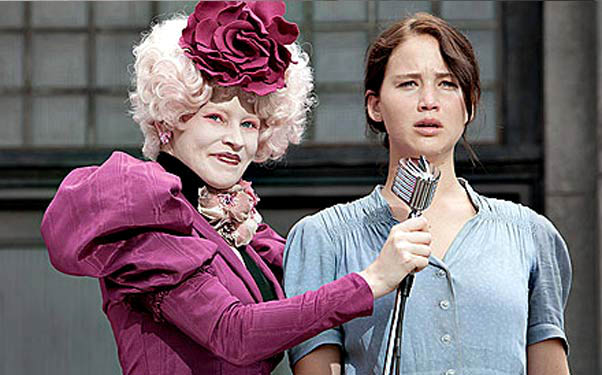
Elizabeth Banks and Jennifer Lawrence star in "The Hunger Games." credit: Lionsgate Films/Murray Close

Of course, since I read the first book when it was newly published, I had to wait a year for Catching Fire. As it happened, I ended up putting my newly purchased copy on a shelf and holding on to it for a year until Mockingjay was published. At that point, I then had two fresh, unread copies of the rest of the series, but it had been two years since I’d read the first book. That meant that I had to reread The Hunger Games so I could refresh my memory. Since the books are so intense, I still had to take a little break between reading the second book and then the third, reading one or two other books in between. From what I hear, this is unusual; everyone else I know, including my husband, who isn’t a BIG-time reader, just sat down and gulped the books down in practically one sitting, reading all three straight through. For me, I just needed to take a step back from the violence and, well, sadness. Either way, though, I was gripped by the story and how it unfolded. I liked how it showed people’s resilience and the need to rebel against an oppressive government. Collins had a wonderful idea for the books and then just showed great talent as a writer in taking the story through to its conclusion. I knew that she wouldn’t tie everything up neatly in a bow and that there wouldn’t be perfect happy endings for every character; I could tell, as most readers probably did, that this would be a gritty, more “realistic” set of books, with messier but mostly true-feeling plot lines. Some were shocked by how she finished the series, but I didn’t find myself completely taken aback or annoyed by it. It worked for me.

Now that I’ve had an opportunity to see the movie adaptation, I can say I’m very satisfied. Books turned into movies can be generally very un-satisfying propositions, so to be able to attend this film and say, “Wow. That was really well done” was a happy ending for me. I wasn’t terribly pleased with the first several Harry Potter film adaptations, feeling that although they did bring to big-budget life main plot points of the first books, they somehow lost a lot of the “feel” of the books. Part of what I loved about J.K. Rowling’s writing was not just the complex world and plot arc over seven books, but the whimsy. They are so clever in the names and in all the little non-crucial, witty touches. They made me laugh. The movies just didn’t do that at first. They felt lifeless. And Twilight… that’s a whole other story altogether.

So I was pleased with the movie because it completely captured the feel and tone of the books, the harshness of the regular citizens’ lives and the hopelessness, and the barbaric nature of the Capitol’s Games, carried out with such pomp and calculated publicity every year, even as 24 teens were brutally encouraged to leave behind their humanity and kill each other to survive, just to go back to their bleak lives.

The acting was superb and the script was deftly adapted. A movie really is a different animal than a book, and much as book lovers hate it, movies must make changes as the story goes from one distinct medium to another. I love good films (my dad taught me how to appreciate the classics), and I enjoy seeing how a director and all the other skilled people who contribute to a film really bring out the best in a story using all the tricks up their sleeves. For instance, the fact that there wasn’t much music in the film was a method that contributed to its tone. When music was used, it was spare and simple, echoing the story lines.

I think what I most appreciated, though, was that the visual nature of film really struck home to viewers the messages of the story even more than the book. The book tells us about totalitarian regimes and what governments do when they have too much power; it tells us about how people still can’t keep their eyes off of watching others fight and suffer, even in larger-than-life color (the rubbernecking, train-wreck mentality). It showed us the obliviousness of the people living in the Capitol to the real lives of the rest of Panem’s citizens. The movie, though, because of its very nature, really made me think about how silly and superficial those in the Capitol were, how they pranced about in their lives of ease and wealth, wearing their ridiculous clothes and crazy makeup and hair, not caring at all that people in their own country were mostly poor and always hungry and struggling. The Hunger Games were really just a game to them, a spectacle. It was disturbing and made me realize yet again how absolutely wealthy I truly am compared to so many people around the world, and so many of us here in the United States are, but even so, most of us complain that there are still others richer than we are, rather than thinking about the many who are poorer. We go around getting plastic surgery and Botox and spend ridiculous amounts of money on electronics and fattening fast food while others are struggling just to have something to eat. We sit in our comfortable living rooms watching big-screen TVs with scenes playing out of “reality” that’s not at all real: people pretending to love each other and women fighting each other for the “love” of one superficial guy, other people supposedly using survival skills to “win” on a remote island that’s been rigged for the show.

I was nervous about the violence of the movie, since the books truly are about violence. I will just briefly say I was pleased not to be too overwhelmed by violent images. The issue of violence in books and movies in general is something I find really interesting and important, but that will be a topic for another day. Suffice it to say for now that I enjoyed both this book and its movie version, and I was pleased that it made the leap between mediums in a satisfying manner.

Exciting book news

I must say there have been some recent announcements about publishing contracts that have caught my particular interest, mainly three that I can think of.

A few weeks ago, the most high-profile story was that J.K. Rowling will be publishing a novel aimed at adults, details of which will be released later this year. Now, I can’t find the reference, but I seem to recall reading that the book is already written, or at least that seems to be the implication. I’m not naive enough to believe that it will “live up to” the Harry Potter books, but there is no doubt that it should at least be worth reading. Rowling is a skilled writer when it comes to plot and characterization, and the wit and warmth with which she infused her stories were most welcome. As long as she brings those talents to the table with the new book, it should be a fine novel. But I don’t expect it to capture the world’s fancy as much as Harry; I don’t think that’s possible. But as a writer, I know that Rowling won’t be content to sit back and do no more writing from here on out. It’s not about earning more money; it’s about the compulsion to write. Once a writer, always a writer. It’s not possible NOT to write.

Now the other two announcements have been exciting for me. One is that Carlos Ruiz Zafón has a third book coming in the “cycle of novels” that began with The Shadow of the Wind and The Angel’s Game. Those two books were delightfully gothic and drew me in utterly to a fantastic world set in post-war Spain. Just the fact that they featured a “Cemetery of Forgotten Books” should be a hook for book lovers. I can’t wait to dive back in to that world in The Prisoner of Heaven. It looks by the Amazon.uk website that it will be released there in June, and apparently, according to the U.S. Amazon site, it will be released on that same date here. Thank goodness! I was afraid I was going to have to wait longer. Sigh. Three more months. I am hoping that the third book is more like the second in terms of strong language (the first had 10-plus uses of the f-word, but the second only had one, which made me scratch my head a bit; authors tend to stay in the same pattern of that kind of stuff).

The last announcement also has me waiting eagerly. Young adult writer Cassandra Clare has written now two series of novels about the world of Shadowhunters, in her Mortal Instruments set and Infernal Devices series. Now I hear that she’ll be writing a third series, The Dark Artifices, about Shadowhunters, set in Los Angeles. One could argue that she’s milking it a bit much and the whole concept is getting old, but her writing is so deliciously entertaining that I’m not going to fault her that. Her characters are so enjoyable, the romance irresistible, and the writing laugh-out-loud funny. So I’ll be happy to belly up to the bar for more. Keep ’em coming, Cassandra!

Anyone else looking forward to some great new books?

Not a book snob, but I do have some standards

As much as I’ve loved reading for almost 40 years now, and other people know how much I have read, I’m still astonished, and other people are astonished, at times to discover that I have not read certain classics. I haven’t read these books, for instance: A Tale of Two Cities (though it’s on my Kindle now and I’ve started it), Les Miserables, Moby-Dick, War and Peace, Gone with the Wind, Don Quixote, Walden, or The Canterbury Tales. Glancing at lists online that various people and organizations suggest as the top-40 or top-100 must-reads, I am even surprised to find there are some books I’ve never heard of! (I didn’t think that would happen for me on a “famous-classics” list.)

Frankly, since I’ve been reviewing books for so many years, I’ve tended to get skewed toward reading mostly new books. This has been especially true since I started Rated Reads in 2008: I’ve wanted to focus on new works that wouldn’t have gotten as much word of mouth as older books so the site can be more useful to visitors. So the upshot has been: fewer classics.

Even so, I think I’ve done a fairly good job over the years covering quite a few classics. And I’ve discovered some new books that should qualify as “new classics” because they’re so well written.

But I’m OK with not reading the classics or the classically literary newer books that are deep and filled with meaning. I don’t see it necessary to be a book snob. I’m perfectly happy just reading fluff sometimes. I will admit, for instance, that I did eat up the Twilight books, before they got really popular and that’s all anyone who was female, ages 13 to 55 or so, was talking about.  I hadn’t planned on reading them (Stephenie Meyer is a fellow BYU graduate, and when I read in our alumni magazine about her book about a vampire who falls in love with a great-smelling girl, I thought it just wasn’t up my alley), but when a trusted reading friend handed a copy of the first book to me and said, “I want to see what you think about this,” I indulged and got hooked. Sure, they’re basically female brain candy, but it’s sure nice to have some tasty Hershey’s kisses to indulge in sometimes, isn’t it? (I say this deliberately because there are also great books out there that are still kind of indulgent but I’d consider more the equivalent of Godiva or Valrhona.) The Twilight series has provided a whole bagful of kisses. I do like a good romance and clean(ish) love scenes. I did get tired of hearing about Edward’s marble chest, though. I just don’t care about muscles and finely chiseled chests, apparently.

Given that I enjoy fluff now and then, I do have standards. I think now might be a good time to share authors I do not like. Yep, I’ve written about some of my favorite books and authors, but now I will write briefly about authors I detest.

  1. James Patterson, at least as part of a writing duo. I read Sundays at Tiffany’s because I thought it was such a clever premise. The writing stunk. It was short and unmemorable and childishly written. I suppose I should try one of his mysteries, but I’m skeptical after being burned with his ridiculous prolific co-authoring. Actually, now that I think of it, I suppose my entire list of “hates” is of authors who churn out books to a loyal fanbase who will fork over $28 for any new tome from their favorite author regardless of the quality of the writing. Me, I’m not that loyal, I guess.
  2. Nicholas Sparks. Another prolific author who writes what I consider to be formulaic crud. I firmly believe that if the only way a writer can elicit an emotional response from readers is by using death as a tool to pull relentlessly on heartstrings, he doesn’t have much talent. I generally appreciate nuance. (OK, I did already say I loved Twilight. I can’t explain that.) I read two books by Sparks, I believe, as a reviewer and have seen a few movies based on his books, so I am pretty sure I can say I don’t need to read/see anymore. SOMEONE ALWAYS DIES. Sorry if this is a spoiler, but it must be said. I figure, you read one Sparks book, you’ve read them all.
  3. Richard Paul Evans. I think he’s a very fine man and has done some real good, and I love his success story. But his writing is sophomoric. Sorry, but it’s true.

It’s fairly safe to say that any author whose writing I find sophomoric or whose plots are formulaic will make this list. Obviously, I make a few exceptions, but in most cases, I’ll avoid this bunk and stick to writers who craft three-dimensional characters, create fascinating worlds, who have amazing imaginations, who can just put together the same old words in the English language in ways that somehow seem new and fresh.

Even when it comes to fluff, I have some standards.

An ode to words

Aren’t words wonderful? Some may argue (and rightly so) that the English language is crazy and difficult and full of rules that are just as often broken as they are adhered to. But I’m in awe of just how much can be said with all the delightful words that our language contains. We’ve adapted and co-opted words from all kinds of places and times and made them work for us. I have an utter reverence for what can be conveyed with the right use of vocabulary.

I think of our language as a toolkit full of a variety of tools, each just the right size and shape and weight to fit any job. But what dismays me is that most of our society today only carries around a mini-kit with a few basics (hammer, screwdriver, a few nails) which they use for every single need. I try to lug around the jumbo version of the toolkit (even the whole garage full of cupboards and shelves, sometimes) so I’ll be able to fit just the right tool to whatever I need to accomplish.

That’s what makes me particularly enamored of certain authors’ writing. Some authors are great storytellers, with vivid imaginations and tons of neat ideas for stories, but they’re not great writers (Stephenie Meyer has said this about herself, for example, and she’s absolutely right). But some authors can tell any story but make it compelling and beautiful because of the words they select from their kits and how they put them together in seemingly fresh ways.

I love to use my thesaurus. It’s full of options to help find just the right word to convey the perfect meaning. But as with any tool, it must be used correctly. Many people have the mistaken notion that they can take out a thesaurus and pick willy-nilly any word out of the synonyms listed. Wrong. Each word in our language has a very precise meaning that, if the writer or speaker and the reader and listener both know it, can communicate meaning as well as is possible with language (of course, communication is a whole other topic; let’s just say that spoken or written language is only a small part of communication, so since that’s the case, we’d better be sure to be careful with the words we do use so we can communicate as effectively as possible). The ideal use of the thesaurus is to stimulate our thinking and allow our brain to go through its options and then select the best one. We still must know the exact meaning of each synonym, because synonyms are merely similar words, not usually exact matches. Even identical twins have slight differences in appearance, voices, and certainly personalities, don’t they?

So as a writer, I like to look at the thesaurus when I have a general idea of what I’m trying to express. Glancing through the list of synonyms of any given word can help my brain to make connections and eventually say, Aha! That’s exactly what I’d like to say. As an editor of other people’s writing, I have to use the thesaurus to help them come up with the word that’s going to say what they obviously mean to say in the context of their topic and sentence or paragraph. I often think as I’m reading someone else’s raw work, I do not think that means what you think it means (thanks to Inigo and Vizzini of “The Princess Bride”). Sometimes their efforts are unwittingly comical; sometimes they could even be potentially offensive, egregiously misleading or just plain wrong.

Given that I do a lot of editing, then, and I see many misuses of language, I am so appreciative of the writers who have honed their craft and lovingly put to use the full toolkit of the language. Each word, carefully chosen, can instantly create a picture in my mind, complete with emotions and sensations. Every word has nuances and layers of meaning, and used well can convey those layers in just one perfect word, allowing a writer to write concisely but elegantly. A writer with a shallow portable toolkit will have to use many more simple words to get a message across that could be portrayed nicely with one or two words in the hands of a skilled writer with an excellent grasp of vocabulary.

I’m not saying that we should all use “hoity-toity” vocabulary at all times or words that are just rarely used and never understood. But there are so many options that are rich in meaning that can communicate effectively that people don’t bother to use. As a parent, I’ve always used my regular vocabulary to speak to my children, rather than trying to “dumb down” what I say in baby talk. I might rephrase something in simpler language so they can understand, but then I’ll also use the richer words so they can hear them in context and learn. And as they read, just as I did growing up and still do now, they (and I) can learn new words just through context and, if they’re so inclined, looking them up in the dictionary.

Even as I write, I’m now self-conscious about how I wrote. Did I convey exactly what I wanted to express? Did I use just the right words? I hope so. I’m not one of the most gifted writers out there, but I hope that I can at least say what I mean to say. And my hat’s off to those amazing writers who have transported me because of their judicious use of language.

Creative juices

Life is full of all kinds of things. Here, I will write about whatever else just strikes my fancy, because, hey, this is my blog. Just expect this page probably to fill up with all kinds of odds and ends and miscellanea. I suppose this is the web version of that catchall drawer everyone has in the kitchen and/or office: you never know what you may find. Here’s hoping that whatever you do find here, you find it to be entertaining, uplifting, inspiring or informative in some way, or a combination of all of the above.

So I’ve been thinking lately again about all the things I’ve found interesting over the years. With my children getting older and finding their own interests and getting involved in activities, I am telling them what I used to do. My oldest, who turns 16 in a few months, plays clarinet in band and has been loving that. She also plays piano and is quite good at it, considering how few official lessons she’s had. She doesn’t really feel passionate about singing, though. She also loves art; she’s loved to draw and paint for years, and her creations are just astonishingly beautiful and true to life. My third daughter, who is going to be 10 in a few months, has decided she wants to run track at her elementary school (they do this for fourth grade!). It cracked me up a bit when she said she wanted to try shotput. My girls are petite little things, willowy and trim. So when the 9-year-old said, “That shotput is heavy! My arm is feeling, well… not very strong,” I had to laugh. I said, “You’re not exactly a beefy kid. The people who do shotput are usually a bit beefier than you. You, well, you’re more veggie.” But, hey, if she wants to try that (and the long jump and high jump), then great.

This younger one also decided that she may very well be interested in drama. I’ve taken her to see some plays, and after the most recent performance, she voiced her interest. Not surprising. My oldest has never shied away from public speaking; in fact, she’s quite good at it. But she’s never wanted the spotlight or wanted to perform in that way. But the 9-year-old, well, she is more of a spotlight gal. I think she’ll be great up on the stage.

These burgeoning interests are reminding me of all that I used to do. I performed in community theater as a young person; in fact, as I informed my 9-year-old, I was the star of a play at the university where my dad taught when I was in 7th grade. It was great fun. I helped out stage-managing and performing at our Playhouse in the Park in high school during the summers; I would have acted more, but I had band camp and other activities during the summer that interfered with the schedule. I marched in band for a couple of years. I played piano. I enjoyed singing.

Talking about those activities now with my girls, I miss those days of involvement. Now, I’m just as heavily involved in life, but with different kinds of pursuits, more “adult,” “responsible” things. I work a little, editing other people’s writing. (That’s at least something I get paid for.) I write and review books (a pursuit for which I am not paid). I volunteer with a variety of organizations, right now the band boosters. Mainly, I run a household, which is pretty demanding and complex work, but it’s not focused on me; it’s focused on my husband and children. But sometimes now I miss holding a French horn in my arms and creating lovely music and being right in the middle of a band that’s surrounding me with all the harmonies of 60 instruments working together as one. I miss standing on a stage and reciting words someone else has written that inspire or amuse because I’m bringing them to life. I miss all the cool stuff I did that brought out all my creative juices.

Now I’m exercising my abilities to bring out my children’s juices (hey, I’m a juicer!); I’m refining my interests and learning to manage my time and resources, exercising restraint. I can’t do it all, not at once, but I can do a few things that really inspire me the most. For now, that works for me.