That traitor the brain

I’ve been fascinated for years by how our own minds can turn inside-out on us. Memories can and often do turn out to be slippery and even downright wrong in any “normal” individual. Brains getting eaten up by dementia lose familiar people and chunks of time entirely. Brains that are schizophrenic or otherwise split can create whole other lives out of nothing.

Stories that take those quirks of the human mind and turn them into horror tales or mysteries are particularly gripping for me. The movie Memento is just one example of a story that turned a character’s reality on its head once it played itself out. Oh, what horrors our own brains can subject us to!

But those stories generally just get me thinking about the mysteries of our minds and the reality of life and its quirks. One tale that shook me and just felt more personal, however, was the true story of mathematician John Nash in the movie A Beautiful Mind. For those who haven’t seen it, skip over this paragraph. But those of you who have will know what I’m talking about: Nash is schizophrenic and ends up realizing that he’s created people and scenarios in his life that are completely fictional — nonexistent. The story here is that Nash, against all advice, decided to just will himself into getting rid of his symptoms, telling himself over and over again that the people he thought were friends simply were not there, even though he could see them.

I love how Ron Howard fashioned this film: he takes the viewers right into Nash’s “reality” and makes us believe that what he sees is real. And it’s not. It’s absolutely shocking, jarring, to find out that what we saw and accepted as truth was not real.

As I’ve learned over the years that some of the feelings I experience — depression, despair, racing thoughts, and so on — are actually just symptoms of out-of-whack brain chemistry, I’ve come to appreciate just how scary it is to be under the control of a brain that is not in itself in control. At times, I’ve been able to kind of step away from my own feelings for a bit and coolly and rationally observe that they are simply constructs of my biology. Some moments I’ve felt extreme sadness or irritability have had no logical basis in reality; they haven’t been caused by any external event that would normally make someone feel sad or angry. I’ve found some comfort in those times I’ve been able to do that; it hasn’t changed entirely how I felt, but it’s made me realize that my biology has hijacked my mind and that I don’t have to be completely a slave to it.

But it’s unnerving nonetheless to know that my brain — basically the seat of who I am — is a traitor. It takes me places I don’t want or need to go. It terrorizes me.

No, I don’t hallucinate. I don’t experience some of the particularly challenging effects of certain brain disorders. But from my own experience, and thanks to that window into Nash’s world that Howard created, I can certainly empathize with those who do experience that. It’s harrowing.

We rely so much on our mind, on our memories, on everything that we’ve stored within and taught our brains. We expect our minds to be infallible, to always tell the truth. We expect them to reflect reality. Because reality is what we think we’ve always lived. But what if our minds aren’t storing memories quite as neatly as we’d thought? What if they are reflecting to us a life in a funhouse mirror?

I guess I’d like to thank my brain for mostly getting it right (I think …). And I’d like to make others aware that some people’s brains just don’t do what they should. That reality is not always real for everyone, that even depression is a state that feels absolutely and terribly real to its sufferer but looks very different on the outside in everyone else’s reality. That sometimes we have to visit someone else’s world so we can help them leave it behind. A bridge must be made between the two realities.

I’m grateful for the people who have taken the time to try to understand my reality, to try to empathize so they can offer the right words or gestures of help. I’m hoping that in writing about my particular mind and where it’s led me, it might help others as they build those bridges.
Romance: real life vs. books

Yet another day when I’ve been thinking about a topic and I end up reading something closely related. Some of the hottest books flying off shelves (or e-shelves) are romances. The latest is not just a romance; it’s erotica: the Fifty Shades of Grey books are at the top of the e-book bestseller lists and feature not just loads of sex but bondage and domination, apparently (nope, I am not going to read them).

And it would be crazy to even discuss this topic without mentioning the insanely popular Twilight saga (which, apparently, in some way is how Fifty Shades was inspired). Not erotica, at least, but heavy on the romance, lust, making-out, etc. Sure, there are action scenes dealing with the bad vampires, but it’s really about intense teen love. The very interesting series I’m reading right now, Outlander and its many sequels, is historical fiction that has lots of great characters in many settings, but the primary focus is the intense attraction between the heroine and her 18th-century husband.

I think many people concentrate on TV and movies when they consider the effects of mass media, and they are right to do so. But books can be overlooked in the kinds of effects their messages have on readers. This Deseret News article, for instance, focuses on film: romantic comedies, specifically, and how viewing them can affect real people in real relationships. I don’t think it comes as much of a surprise to anyone that relationships and love are not portrayed terribly accurately in movies, and I can say as a reader that there are plenty of books that fit that pattern as well. At least in literature, there are many more genres and many more books to choose from, and many can be found that do portray life much more realistically than film, in part just due to their length, honestly. But there are lots of books that are just print versions of rom-coms or trite romances (Nicholas Sparks, you’ve done damage in both print and celluloid!).

I’ve thought many times as I’ve read books that feature romance how so many skirt realities most of us experience. I don’t know about you all, but after 19 years of marriage, I don’t feel the same intensity of nonstop attraction to my dear husband as I did at the very beginning. In fact, I probably never felt the same way as some characters I read about. I remember reading The Time Traveler’s Wife and thinking, Good heavens! These people have sex all the time! Do they not do anything else when the husband isn’t popping off into other time periods? And as much as I am thoroughly enjoying the Outlander series, really: does anyone (or everyone) feel like having sex with their spouse all the time? I’m not saying that isn’t a great thing between husband and wife and vital to a good relationship, but it isn’t the ONLY thing or even 50 percent.

The other main issue, I think, with some of these books is that they often posit that there is one “true love” out there for everyone, that love is destined, fated, that each of us must find THE ONE, our soul mate. This can cause a number of problems; for instance: if a relationship isn’t going smoothly, then our partner must not be THE RIGHT ONE (and we ditch a perfectly good partner and move on to find that elusive person); we might be fooled by temporary chemistry that someone we are crazy about is perfect for us (and we ignore all the signs that show he or she truly may not make a good spouse); we may never find someone who fits the supposed characteristics of a soul mate and end up alone.

One of my church’s leaders, Spencer W. Kimball, said something very wise but not what anyone might consider easy or exciting or the basis of a swoon-worthy story line: “‘Soul mates’ are fiction and an illusion; and while every young man and young woman will seek with all diligence and prayerfulness to find a mate with whom life can be most compatible and beautiful, yet it is certain that almost any good man and any good woman can have happiness and a successful marriage if both are willing to pay the price.”

Still, it’s hard to resist the siren song of these romance stories. They just make everything seem so intense, so easy, so larger-than-life. They’re fantasy. But we like fantasy. We like to read about things that aren’t like real life. At the same time, does reading these unrealistic stories do damage to us as readers as we go about our regular lives once the book is put back on the shelf? Do we end up with unrealistic expectations from our relationships? Research seems to show that the answer is yes, at least in film. I dare say the same is true for similar messages in print.

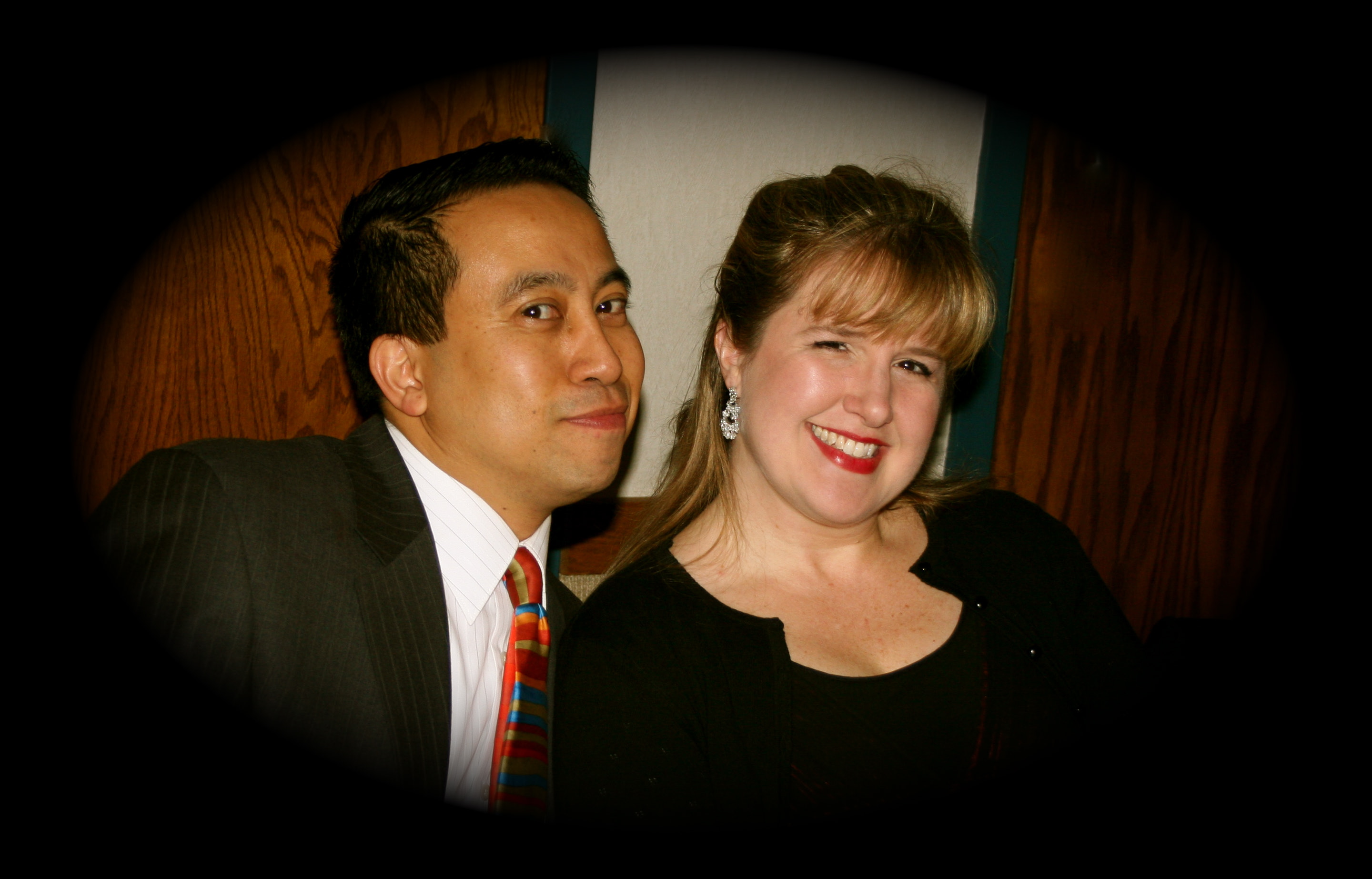
Yep, we look lovey-dovey and dressed-up here, but this is not everyday reality. I don’t care to take a lot of pictures of me (and us) during everyday reality…

Real life is harder, messier, more boring, more frustrating, more mundane, more work. Children can bring joy to our lives, but the work and the commitment involved can easily take away from our relationship as a couple (not that this is a good thing, but it happens easily if we don’t work to stop it from happening). The pressures of just making an everyday living and going about our usual day-to-day business can strip the thrill from our relationships. And time has a way of changing how we relate to each other, mostly for good. Love is a complex, wonderful, deep, multifaceted animal, and romance is only one of those facets. Sexual attraction is just a part of the romance. Infatuation and attraction occur strongly in the early stages of a romance, and real love develops past those, even though it is still desirable and a wonderful thing to still be attracted to our spouse 50 years after those early stages. My husband can still kiss me and make my legs turn to jelly, even 19 years into our relationship. But he doesn’t do it 10 times a day, and … well, I won’t go into any more private details. I don’t always look at him and think, Kiss me! I may just think, Thank heavens he’s home. Or I wish he’d do the dishes. After he’s home, the kids are in bed, and the dishes are done, then I am more disposed to think, Man, I wish he’d kiss me and jelly-fy my legs.

I think I have appreciated Anne Tyler’s books because they feel so much more real. They’re not romances, but they are about love. I was so profoundly moved by The Amateur Marriage, for instance, for its look at a less-than-ideal or smooth relationship. I love how Tyler can just dig right into real life, excavate some broken and dirty old shards, and hold them up to the light for our inspection. Yes, we think, this is how people lived then.

I couldn’t possibly write enough here about all the truths of relationships and longtime marriages. I certainly don’t have it figured out; 19 years is just enough for me and my husband to get in and get serious and tweak some rules so they fit us better. All I know is that media don’t often enough reflect real life. And that’s too bad. The shiny, glittery stuff that’s reflected to us off of film or the pages of books is too often easier for writers to portray and more desirable for us consumers. It’s just nicer or more appealing to consume a quick, too-sweet product than one that’s more subtle and layered. We want escape, all too often, not more of reality. But reality can be wonderful; in fact, it can be much better than the intense but one-sided stuff that comes at us from various media. I thank those amazing writers who have not just transported me to intriguing new places but those who have taken me right back to where I started and made it seem new and interesting in all its reality.