Still thinking about the Sandy Hook Elementary School shootings. Not just for itself, but for all the implications of the tragedy and what our society should take away from it to improve. I’ve also had some family issues that have played into this topic that have weighed on my mind quite heavily. Again, as I wrote about the other day, I am not going to go into issues of gun control versus unfettered gun availability. It’s an incredibly divisive topic and one that both can’t be solved (most likely) and can’t solve all the problems we’ve been seeing in our society.
Individuals’ mental health and happiness is what either makes our society better for everyone or, conversely, makes it more difficult for everyone, if it’s not tended carefully enough. I firmly believe that families are the central unit of society, and I don’t think that there would be too much argument with me when I say that the family is breaking down. We have many single-parent families and many children who simply are not getting the nurturing they need for a LOT of reasons. Families provide an automatic place of refuge and help when any member has a need of any kind. So what happens when families throughout society are broken? Many individuals have no one to go to for help. Fortunately, some have friends and other caring people in their lives who can be a second line of “defense,” but many others do not have that. What’s left is either no one or the government. Neither is an adequate source of complete help. As much as we try to shore up and improve government programs, they simply cannot replace or do as good a job as families, in most cases.
Yeah, yeah, I’m being an idealist here. But what’s wrong with trying to reach for the best, with trying to get our society back to a place where it truly could make people better and happier? Why can’t we improve those lines of defense and help, and shore up families? It would help so much more than anything stopgap we could create through government (and no, I am NOT saying there should be no government programs; I am saying they cannot replace the ideal).
The truth of the matter is that each of us needs a group of people who care for us and about us and who can be depended on in times of need. Sadly (and please, if you are my friends or family, do not take this as an indictment or rebuke but maybe just a little hint of encouragement), there have been times I’ve felt alone and misunderstood, particularly when I’ve been in my worst places mental-health-wise. I know that it can be difficult to understand and really help me at those times, but it’s still worth a try. (I think I’m worth it! 🙂 ) I so appreciate family members and close friends who have reached out at those times to just talk, listen, or do something encouraging and supportive. Every little gesture means a lot.
I suppose that’s why I feel so sensitive to those around me. I can just feel their pain and loneliness and helplessness sometimes, and I want to be able to help. Sometimes I can do something useful; other times I can’t. But I try and I pray.
Each of us needs help, and those in our circles need help, at one time or another. The people who have done the most heinous crimes in society (particularly who have histories of mental illness that’s unchecked/untreated) have needed someone to pay attention and do something. As I wrote before, sometimes even with our best help, because of society’s lack of understanding of mental illness and the current regulations and laws that are in place, the family members and friends of those who are struggling simply have their hands tied and can’t do a darn thing. But in other cases, something could change if a few more people just listened and saw a few signs.
No man is an island. No child, no woman. We’re all connected, and while we can’t possibly help everyone out there (I’ve written about that too!), we can each do a little better to pay attention and be sensitive. We can’t solve others’ problems, but we can provide an idea or two if appropriate or we can simply listen or say something kind or encouraging. We can reach out. Build a bridge to someone else’s island.
That can begin in our families. No doubt that if we are related somehow, we should be there for a family member in need, if at all possible. And those in our other circles can benefit from our improved “radar.”
Just do a little better. Keep your eyes open and your ears listening a bit more. Say something, do something. It’ll benefit our whole society.
After a horrific mass shooting that took the lives of primarily young children, many people’s thoughts turned to the inevitable questions of “why” and “how.” I also noticed, unsurprisingly, many people discussing in social media and analysts addressing on news outlets the issue of gun control. I’ll save my opinions on that topic and address what actually came to my mind immediately after or right before the gun issue: mental health in America.
I read a fine article by a psychiatrist on CNN that was written after school shootings in Ohio, and he made some fine points about major mental illness and how it is handled here in the U.S. He briefly alluded to the changes that occurred in mental health care in the past decades. Basically, people with serious issues were once confined for life to institutions, usually far from home and their families. In trying to change this system, many of these institutions were closed and their inmates sent home for treatment. While this was certainly a more compassionate and family-centered way of helping, it created many holes in the care of those with serious problems.
I want to tread carefully here. As with so many other issues, this is a complex one, with many facets that need to be considered and weighed. I suppose I should backtrack a bit and talk about why mental illness came to mind after these latest shootings: honestly, with most of these events, it is discovered during investigation that the shooter had major problems. Often, these mental problems were insufficiently addressed. I do believe that evil exists and that crimes are committed by evil people and those who are extremely selfish to the point of disregard for others’ lives. But I also have seen in the news just how often these kinds of horrific crimes are committed by people who have major mental illnesses. This isn’t to say that mental illness can’t overlap with evil, but people with mental illness can do some horrible things while basically not in possession of their “right minds.” This is why we have an “insanity defense” in our legal system, and for good reason. Those who truly experience times they are essentially just not themselves or their minds are completely not their own, once treated with medication and therapy, can experience horrible grief and remorse at what they did while under that “alternate influence,” one could say. My heart goes out to not just their victims but themselves because of what they have to live with.
Our society is still not nearly where it could be in not just treating and caring for the mentally ill, but in just understanding it and accepting it as another illness that some encounter in the course of life. I’ve often said it would be a lot easier for others to understand what I go through if I just had diabetes or cancer or something more “straightforward” or strictly “physiological,” rather than something that affects the mind. Too many people simply don’t appreciate what it’s like to experience mental issues, and too many just write them off as something kind of made-up or “all in our head” (that one’s a bit ironic). That creates a society in which those with mental illness don’t really care to admit to themselves that they have problems that could improve with proper treatment, and in which there just isn’t enough support and help for them among the general population and in health care or other parts of society. All too often, those with mental illness fall through the cracks, even more than those with other more “understandable” illnesses (heart disease, diabetes, what have you) don’t get sufficient treatment if they can’t afford it, etc.
I don’t want to see our country go back to institutionalizing everyone with major mental issues far away from society, away from their families and support systems. But I am positive that we need more real help locally, and more firm but compassionate laws that would help those who might be a danger to themselves or others. It just seems that so many who commit crimes that become publicized were schizophrenic or bipolar and weren’t taking medication at the time of the crime. And yes, in these diseases, even those who are receiving care tend to want to quit taking their meds. I hate to say that we should force medication on these people, but sometimes that seems to be one of the best ways to prevent these kinds of crimes. How we do that or at least make tighter regulations on this is, yes, complex and needs to be carefully considered and applied.
My church congregation experienced our own violent crime a mere two years ago, in which a man came into our church building after services and ended up shooting and killing our bishop. It was a horrific tragedy, and one that again showed that these kinds of things can happen anywhere, even safe places like schools and churches. We were all comforted by our faith and pulled together in this event, but it left its mark. And yes, the shooter ended up forcing a confrontation with the police in which he was killed by them, and I’m fairly confident that was his aim, to end up dead. And yes, he had mental illness for which he wasn’t taking medication at the time.
We don’t yet know if this latest mass shooting was tied to a shooter with mental illness. But I’m willing to bet it will be. And while we can rightly discuss gun control, we as a society and government would be very misguided to skip over a well-needed discussion about mental illness in America. This protester may have been addressing guns, but let’s please, please, please apply this to mental illness as well. The fate of more people hangs in the balance.
I am not sure why I am even attempting to broach such a huge and important topic, but since I am often ambitious and stubbornly determined, despite my limitations, I am going to try to at least put in a few words and opinions about this subject.
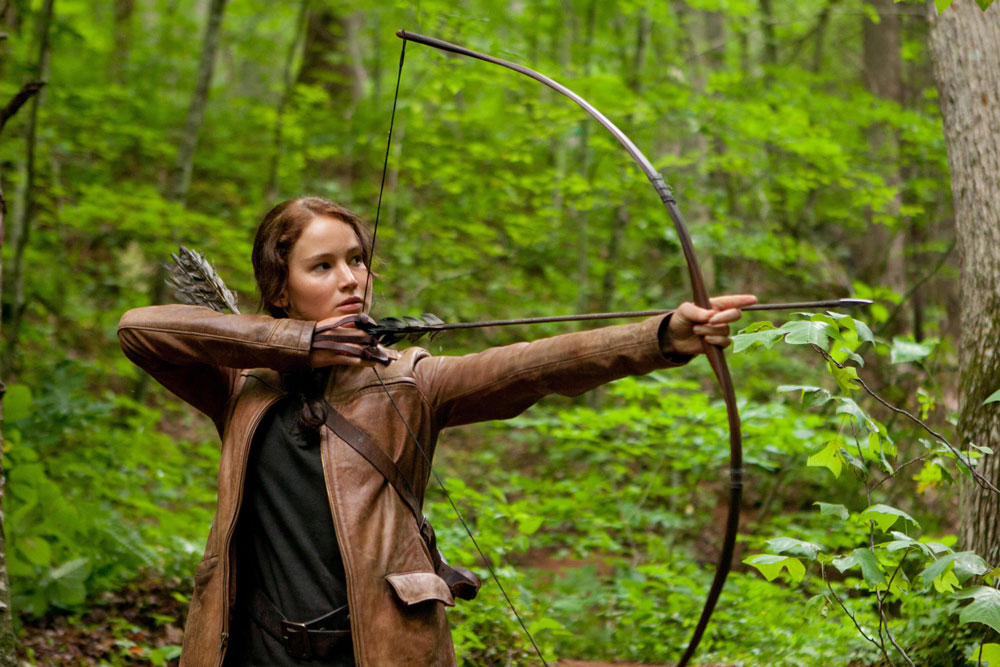
Jennifer Lawrence plays Katniss Everdeen in "The Hunger Games." Credit: Lionsgate/Murray Close
The recent uber-popularity of the book and movie versions of The Hunger Games has brought this topic to mind yet again. I think it is vital that as a society we seriously consider the issues of the kinds of content we view, hear and read in the media, whether it’s TV, movies, books, music or video games. There is a lot of research available about these issues, and there are definitely people who are concerned about these topics, but I think it still bears discussion. Since I have this blog as a forum, I’ll bring it up here.
First, I think it’s safe to say that the media we view/read has gotten steadily more detailed and explicit over the years as a whole. Sure, there have been incidences of movies or books years ago that were heavily sexualized or violent, but I think that overall, more and more of the things we see have become filled with content that could be offensive or outright dangerous. I know I have read about studies that link violent behavior with the levels of violent content viewed in movies or video games, but I won’t attempt to find them or list them here. I’ll leave that for others. This is just a blog post. I’ll talk about my feelings and experiences.
I was raised not watching any movies that were rated R. I also was raised by a father who was a television director. He worked in the TV industry and then moved on to teach about it as a university professor. He and my mother both were sensitive to the ways the media influence us and were somewhat cautious about what we watched, and when we did watch TV and movies, we often talked about them. We even talked about commercials and what messages they were giving. On the other hand, for example, my husband grew up watching R-rated movies, plenty of stuff that was filled with violence and bad language, and didn’t really give it much thought until we were married. So I find it interesting to compare how we react to things we watch.
When I see a film that contains violence, each violent act strikes home to me, and I feel it. I particularly feel affected by the portrayal of just plain evil characters. I appreciate good acting, but I never cease to be bothered by really effective portrayals of characters who are purely wicked, whose sole intent is to cause pain and suffering in others, whether it’s for gain or purely because they enjoy seeing someone else suffer. That feels all too real to me, and I would prefer not to experience that. I often don’t see the point of having to portray those kinds of people or the point of my needing to see/feel it. I flinch and cringe away from the screen. My husband, on the other hand, doesn’t seem to be as affected as I am. I feel it personally, and he views it as just part of the plot of a fictional story.
I know that how much violence we see affects how we continue to experience it. The more violence viewers are exposed to, the less it bothers them. We can actually have our feelings numbed, where difficult images don’t disturb us anymore, if we see a lot of violence. I worry a great deal about people, young men in particular, who are constantly exposed to strongly violent images and acts via movies and video games. It changes their very natures, so they are no longer bothered by acts that should be bothersome. That inevitably translates into real life in some way or another.
Now, I’m talking mostly about what might be termed “gratuitous” violence. Violence, as well as sex and strong language, have become a normal part of many movies and other media. But often they are simply there to “entertain.” I simply do not find those kinds of content entertaining; I find them offensive and soul-scarring. But there are times I think that violence has an appropriate place in media. Good literature and film and other media help to show us how life works and what happens sometimes, to remind us of history and how not to repeat it, for instance, or to remind us about how bad human nature can be and how to overcome our basest natural inclinations. So the question is, how much detail do those “good” media instances need to contain to be effective in their aim? How much evil needs to be shown to remind us to do better, be better, in some way, as individuals and as a society?
The Hunger Games has struck a chord with friends of mine, for instance. I’ve been interested to see what various friends have had to say about the books and the movie. Some have wholeheartedly embraced the positive messages of the series and what it seems to aim to do and say, even just sitting down and reading the series in one big marathon. Some have appreciated what the books are trying to do but have still felt the violence was too intense, too detailed, unnecessary. I already mentioned in my post about the movie and book that I liked them overall but felt that I could only read the books in small doses, not three right in a row, because they are so intense. I just couldn’t swallow them whole, all three in one sitting, without a break of lighter fare. I respect and find interesting and valuable the views of all my friends who have weighed in on the topic. I think that in the case of this series, it’s a valuable book series and movie, but it’s important to know yourself and what you’re comfortable with.
Some people may truly have been numbed by watching lots of other violent fare over the years, so they aren’t as sensitive; some people may just be more sensitive naturally, whether they’ve been exposed to much violence in media or not. In the case of Hunger Games, parents should be careful about knowing their children who might read the series or watch the movie to judge if it would be a good fit for them. But they shouldn’t just abdicate making any judgment on the matter because the movie and books are just so popular and “everyone” is reading/seeing them.
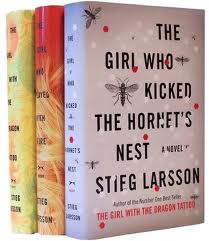
I think another movie and book series that bears discussing here is the very popular Stieg Larsson series, starting with The Girl with the Dragon Tattoo. As a book reviewer, I had an opportunity to read this book when it first came out, and I read the flap and decided it just wasn’t something that would sit well with me. I wondered about it later when it began getting a lot of buzz. After some more investigation, I still concluded that it wouldn’t be something I would enjoy. Then, with my website, I still needed to have a way to provide guidance to readers also trying to decide if the book would be a good fit for them. Finally, someone who reviews for me read the book and was able to give it a rating. She confirmed what I’d heard, that the book was filled with many explicit, disturbing scenes of sexual violence against women. She also linked to an article online I found very useful in giving more insight.
In some ways, I want to leave judging to individuals, to let them make their own decisions about how certain content might affect them. But at the same time, I find it profoundly disturbing that so many readers are embracing these novels. I asked one blogger last week who said she is a Christian what she felt about this content, as she proclaimed how much she enjoyed the Stieg Larsson books. She said, in short, that since Larsson doesn’t “endorse” the assaults, and “warns against” this kind of violence, that she was OK with the content, even though it was very difficult to read.
I found that to be really interesting. I think that is where we all have to make some kind of a judgment on any violent content; is it important to include it if it sends a message? I think so. I think an even more important question is, however, how detailed and explicit should that content be to be able to get across the message? Is it necessary to have multiple scenes of extreme violence, even misogyny? Does the negative impact of a reader (or movie viewer) experiencing that kind of secondhand assault get outweighed by the positive impact of sending a message that these things happen and are wrong, and that we can do something to prevent these acts?
Again, I’d like to say that in most cases, individuals should be able and encouraged to decide for themselves what will be best for them. I created Rated Reads for that very purpose, to give readers extra information so they could judge more accurately for themselves what they would find acceptable, given their own sensitivities and sensibilities.
But on the other hand, I think there truly are cases where too much is simply too much. That doesn’t mean censorship; I would never say that a book shouldn’t be published, period, because of its content. But it does mean that there should be warnings; there should be more information easily available to readers about what they might be facing in picking up a book. There should definitely be some lines drawn about what can be made available to readers who are younger than 18, much like R-rated movies are restricted to younger viewers. I would like to see less gory, explicit and gratuitous violence in movies and video games, as well. I just don’t think enough is being done to limit that violent content that can truly numb sensitivities and even affect violent behavior.
Unfortunately, I don’t think there’s much we can do to limit things in our free-speech society. But I think it’s important for us to talk about these ideas and be more aware of the damage that can be done by a steady diet of violence, or even an occasional sampling of “unnecessary” violent content. Obviously, we all are going to have different ideas of what constitutes the “right amount” of disturbing content or which messages are truly beneficial to remind us of truths about humanity and what’s happening in real life. I already have made clear I am pretty sensitive to violence and have a low tolerance, so I might have a much shorter list of books or movies I think are important for people to see (BUT at the appropriate ages and maturity levels) than others. But let’s make this a national conversation and be more aware of the effects of what we and others in our society are seeing.
I tend to hear about many books that end up being “hot” early in the game thanks to all the ways I stay connected in the publishing world. In the case of The Hunger Games, I heard about it on Stephenie Meyer’s website. I have found that Ms. Meyer has quite good taste in books. She talked about Suzanne Collins’ eventual blockbuster on her website when the first book came out, and I ran out and bought a copy. (She also recommended a fantastic “duo” of books starting with Dreamhunter, which I really liked as well but which isn’t the phenomenon that The Hunger Games has become; in fact, I’ve run across no one else who has read it.) I was thoroughly impressed by the fascinating premise and by the skilled execution of the great idea. I think a lot of what got my attention was the idea that in some messed-up future, the most horrific of survivor reality shows would be enacted. I’ve never been a fan of pretty much any reality shows on TV, preferring well-written, original scripted programs whether they be comedy or drama, so I thought it was brilliant to take our current society’s obsession with the cheaply-produced stuff that passes for entertainment to its gory and worst-case conclusion.
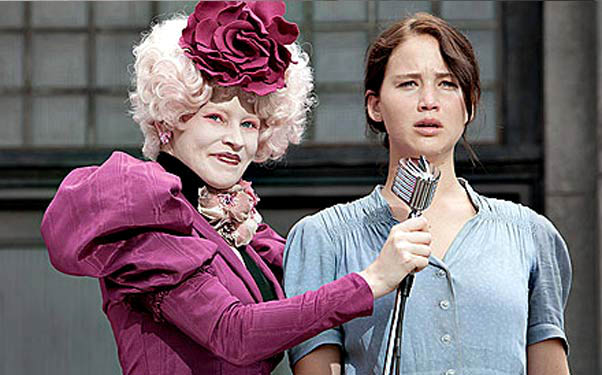
Elizabeth Banks and Jennifer Lawrence star in "The Hunger Games." credit: Lionsgate Films/Murray Close
Of course, since I read the first book when it was newly published, I had to wait a year for Catching Fire. As it happened, I ended up putting my newly purchased copy on a shelf and holding on to it for a year until Mockingjay was published. At that point, I then had two fresh, unread copies of the rest of the series, but it had been two years since I’d read the first book. That meant that I had to reread The Hunger Games so I could refresh my memory. Since the books are so intense, I still had to take a little break between reading the second book and then the third, reading one or two other books in between. From what I hear, this is unusual; everyone else I know, including my husband, who isn’t a BIG-time reader, just sat down and gulped the books down in practically one sitting, reading all three straight through. For me, I just needed to take a step back from the violence and, well, sadness. Either way, though, I was gripped by the story and how it unfolded. I liked how it showed people’s resilience and the need to rebel against an oppressive government. Collins had a wonderful idea for the books and then just showed great talent as a writer in taking the story through to its conclusion. I knew that she wouldn’t tie everything up neatly in a bow and that there wouldn’t be perfect happy endings for every character; I could tell, as most readers probably did, that this would be a gritty, more “realistic” set of books, with messier but mostly true-feeling plot lines. Some were shocked by how she finished the series, but I didn’t find myself completely taken aback or annoyed by it. It worked for me.
Now that I’ve had an opportunity to see the movie adaptation, I can say I’m very satisfied. Books turned into movies can be generally very un-satisfying propositions, so to be able to attend this film and say, “Wow. That was really well done” was a happy ending for me. I wasn’t terribly pleased with the first several Harry Potter film adaptations, feeling that although they did bring to big-budget life main plot points of the first books, they somehow lost a lot of the “feel” of the books. Part of what I loved about J.K. Rowling’s writing was not just the complex world and plot arc over seven books, but the whimsy. They are so clever in the names and in all the little non-crucial, witty touches. They made me laugh. The movies just didn’t do that at first. They felt lifeless. And Twilight… that’s a whole other story altogether.
So I was pleased with the movie because it completely captured the feel and tone of the books, the harshness of the regular citizens’ lives and the hopelessness, and the barbaric nature of the Capitol’s Games, carried out with such pomp and calculated publicity every year, even as 24 teens were brutally encouraged to leave behind their humanity and kill each other to survive, just to go back to their bleak lives.
The acting was superb and the script was deftly adapted. A movie really is a different animal than a book, and much as book lovers hate it, movies must make changes as the story goes from one distinct medium to another. I love good films (my dad taught me how to appreciate the classics), and I enjoy seeing how a director and all the other skilled people who contribute to a film really bring out the best in a story using all the tricks up their sleeves. For instance, the fact that there wasn’t much music in the film was a method that contributed to its tone. When music was used, it was spare and simple, echoing the story lines.
I think what I most appreciated, though, was that the visual nature of film really struck home to viewers the messages of the story even more than the book. The book tells us about totalitarian regimes and what governments do when they have too much power; it tells us about how people still can’t keep their eyes off of watching others fight and suffer, even in larger-than-life color (the rubbernecking, train-wreck mentality). It showed us the obliviousness of the people living in the Capitol to the real lives of the rest of Panem’s citizens. The movie, though, because of its very nature, really made me think about how silly and superficial those in the Capitol were, how they pranced about in their lives of ease and wealth, wearing their ridiculous clothes and crazy makeup and hair, not caring at all that people in their own country were mostly poor and always hungry and struggling. The Hunger Games were really just a game to them, a spectacle. It was disturbing and made me realize yet again how absolutely wealthy I truly am compared to so many people around the world, and so many of us here in the United States are, but even so, most of us complain that there are still others richer than we are, rather than thinking about the many who are poorer. We go around getting plastic surgery and Botox and spend ridiculous amounts of money on electronics and fattening fast food while others are struggling just to have something to eat. We sit in our comfortable living rooms watching big-screen TVs with scenes playing out of “reality” that’s not at all real: people pretending to love each other and women fighting each other for the “love” of one superficial guy, other people supposedly using survival skills to “win” on a remote island that’s been rigged for the show.
I was nervous about the violence of the movie, since the books truly are about violence. I will just briefly say I was pleased not to be too overwhelmed by violent images. The issue of violence in books and movies in general is something I find really interesting and important, but that will be a topic for another day. Suffice it to say for now that I enjoyed both this book and its movie version, and I was pleased that it made the leap between mediums in a satisfying manner.
 Still thinking about the Sandy Hook Elementary School shootings. Not just for itself, but for all the implications of the tragedy and what our society should take away from it to improve. I’ve also had some family issues that have played into this topic that have weighed on my mind quite heavily. Again, as I wrote about the other day, I am not going to go into issues of gun control versus unfettered gun availability. It’s an incredibly divisive topic and one that both can’t be solved (most likely) and can’t solve all the problems we’ve been seeing in our society.
 Life and Lims