Media portrayals of women won’t change until we demand them to

… and that means women need to teach girls to expect better of the media

The latest Photoshopping news item to grab online attention is proof that a magazine tweaked a cover photo of Jennifer Lawrence. Rightly so, people were outraged.

Question is this: will this just die down and go away and be forgotten? It’s already been a couple of days since the story hit the ‘net and I don’t hear much talk about it anymore. People’s attention spans are short, and the next juicy item follows behind so quickly. Today, it’s all about the Duck Dynasty gay-comments issue with Phil Robertson. Tomorrow, who knows?

So, really, since human nature, at least in our 24-hour-news-cycle age, means we’ll forget most outrages in a matter of hours, will this information change anything?

Sadly, I doubt it.

Here’s what needs to happen, though: both women and men need to consciously work to keep this topic in the forefront of their minds. And they need to act. We all need to stop buying and reading the magazines that Photoshop women (which is pretty much all of them, even the health and fitness ones). Stop watching the movies and TV shows that make women secondary characters and, then, feature them only as sexual beings, as scantily-clad “pretty props” or set dressing. With the media, the only way to make a change is to vote with your pocketbook. Stop feeding the beast. And speak out, directly to each media company, and discuss with friends and family.

After years of living in a world saturated with media images portraying women as sex objects and set dressing, it’s taking a while to get older, more experienced women (and men) to realize what’s been happening. We need to keep getting the word out to them (I firmly fall into that category: at 43, I’ve been marinating in this lopsided, demeaning, and oppressive culture for decades).

At the same time, once we older people get the idea, we absolutely must teach our younger family members and friends to see the truth. The media loves the young folks: they’re the ideal demographic, so everything is skewed to their supposed tastes. So if we’re going to get a message out to the media, we must make sure the young people understand it, get it, and act on it.

It would take many, many blog posts to “prove” just how damaging this Photoshopping nonsense is to girls and women, and not only to females, but to males. It changes everyone’s expectations and core beliefs for the worse. There are plenty of resources out there that talk about this. Beauty Redefined is a great one, but there are others (check out BR’s posts related to “recognizing” what’s happening to get a good start). So this little post is just another part of the call to action. Don’t just cheer internally for Jennifer Lawrence’s ideals (not liking Photoshop, wanting to get rid of body shaming, sending a better message to young girls about image) — take a stand and do something. Write to magazines and ask that they stop Photoshopping. Stop watching movies that relegate women to sex objects. Talk about the topic with young people, both boys and girls, and keep it in the forefront.

The media won’t change without huge pressure to do so. Be part of that change. It takes one person at a time, but one person and another and another all add up. Take that first step. Hey, even reblog/post this. Let’s just bombard people with this message. Maybe someday, maybe even by the time my teen daughters are mothers of teens themselves, our culture won’t be marinating us in negative portrayals of women anymore. It could happen.

(For ideas on “resisting” negative body-image messages in the media and our culture at large, read Beauty Redefined posts related to that topic.)

AND AS AN ADDENDUM, another great resource from a woman who’s “been there, done that” when it comes to being ultra-toned. Taryn Brumfitt at Body Image Movement says this (in a blog response to fit mom Maria Kang): “I AM a health advocate. I run, I lift weights, I eat healthily but I also have a cookie with my soy latte and knock back the odd burger or yiros when I feel like it. It’s called balance. And whilst I am getting on my soap box (I’ll just be here for another minute) health is not dictated by your looks. Health is physical, emotional and spiritual and so much more that is not visible and not always obvious to others” (emphasis was added by me). She also told the Daily Mail: “If what you value is your health then you’ll treat your body like a vehicle, not an ornament.” I LOVE that.

Value your body for what it can do, not for how it looks. I think it’s pretty simple.

Whatever her intentions, fit mom’s photo still misguided

I’ve watched the past few days as different people and media observers have discussed the backlash as well as support for the very fit mom of three boys who posted a picture of her scantily clad self with the title “What’s your excuse?” I’ve wanted to say so many things to respond to so many other people who have added their own reactions to the whole thing.

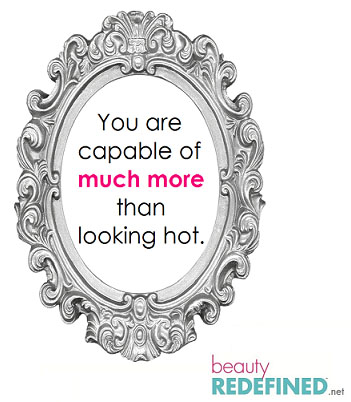
you are capableHere’s the lowdown, though: practically no one has gotten down to the nitty-gritty of the real issue here. There have been two primary reactions: “her story is inspiring, as she meant the post to be” or “it’s shaming.” The latter response has skirted it but hasn’t fully developed it. But the great ladies who started Beauty Redefined and who work tirelessly to spread their message about women have already addressed this topic on their blog and have revisited it many times: We as women are capable of more than just being objects, of just being something to look at.

They discuss the topic of “fitspiration” in a blog post they wrote almost a year and a half ago. Here’s one point: how do you (if you are a woman) feel when you look at this incredibly fit woman? Do you feel inadequate, less than worthy, embarrassed about your own body? Because I think that for the majority of us who aren’t this incredibly toned and fit, that is the real reaction we have immediately, whether or not we talk ourselves through it, even very quickly, to a place where we think the more acceptable “oh, that’s so inspirational.”

Let’s be real here: yes, many of us in the U.S. could do better to take care of our physical health. Too many of us are overweight, don’t eat enough of the healthy foods our bodies need and too much of the foods our bodies don’t need; too many of us don’t exercise regularly, even if it’s just for 20 minutes. HOWEVER, even if all of us did eat healthier and spent 30 minutes exercising four or five times a week, which is essentially what most experts on health recommend, we would not look like this woman. There’s this thing called genetics, and some bodies are just not built that way. But eating right and exercising will make those bodies healthy and strong, which is the real goal of fitness and taking care of ourselves.

What this photo does is tell us that if we don’t look like this, we’re clearly NOT doing the right things. This woman, Maria Kang, has said she spends about an hour each day working out. I don’t know what her diet plan is; it may be healthy and satisfying; it might be pared down to a small number of calories. Whichever it is doesn’t matter here; what does matter is that her eating and hour of exercise lead her to look like a model. I can honestly say that if I eat the number of calories I should (which I admit I have been overdoing a bit for some stressful months here) and continue the hour of exercise that I already do incorporate into my life five to six times per week, I WOULD NOT LOOK LIKE HER.

And that’s OK. Isn’t she saying we’re supposed to make ourselves a priority and exercise? But what the picture tells us is that the point is to LOOK a certain way, not have our own version of good health, which is often correlated with appearance but not entirely. Yes, diets lead to “looking” thinner. But if she and other “fitspiration” advocates, as well as their supporters, truly just wanted us all to be healthier, there would be no need for pictures that make women feel bad.

The truth is this: our society is still firmly entrenched in certain results, in appearances, in what we consider an ideal, which today is being very trim, with firm and hopefully large-ish breasts, not just thin but toned. (Fifty years ago the ideal was different; one hundred years ago it was very different.) Just because this is TODAY’s ideal doesn’t mean it’s some kind of eternal, absolute Truth.

I’m sure that Kang did want to inspire. But she bought right in to our culture’s damaging belief about appearance being paramount. It’s so prevalent that it’s almost invisible. We can’t see that it’s there right in front of our eyes because it’s been “taught” to all us, male and female, since we were born into this world. The only way to notice it is to start taking action, to respond in positive but strong ways that women are more than objects.

How about the radical notion that, rather than stripping down and showing off her abs and thin but toned thighs, Kang posted some information about her actual health: cholesterol levels, healthy blood sugar, etc.? Because that’s what health is about, what the fitspiration posters SAY they want to promote. So stop the shaming photos of ideals that really are not possible for at least half the population (and I’m being conservative here). Talk about health and measure it.

The women who did complain about Kang’s post are experiencing shame twice now, once as they felt bad about themselves when seeing Kang’s perfect body, and a second time by being called “catty” and “jealous.” They should be supported as they remind us all that shame is not an effective motivation, not in the long run. It’s “counterproductive, … debilitating and discouraging,” according to an excellent post on shame at Beauty Redefined. Please take the time to read that post because it is absolutely crucial in understanding what’s going on in our culture. The more that we can talk about this issue, the better. All in our culture, women and men, need to change their mindset, need to totally rewire their brains when it comes to how they think about appearance. Let’s unlink “health” from “appearance.” Let’s stop thinking of our bodies, our appearances, as the most important part of our SELVES. Let’s compliment ourselves and others for more important things than how we look.

Let’s have this conversation and do it right. Be an advocate. Share these “radical” ideas. Kindly challenge and help remind others, wherever you are, whether it’s online (Facebook, Pinterest, Instagram) or in person, that we are capable of being more than looked at. Start changing how YOU think, the horrible messages society has drilled into your brain for years, and help others to do so too. We can all do it if we just speak up.

Speak up about the real value of women

It would be difficult for anyone to argue that women aren’t being demeaned as objects in pretty much every single corner of society. It happens so much and is such a thoroughly pervasive message in media that we’ve almost forgotten to be angry about it. We just take for granted that it’s happening.

Well, I think it’s time for women — and men — to stand up and show some anger about this phenomenon. It’s time to stop the saturation of our culture with images of sexualized women.

You can’t slap a pink ribbon on everything and say it’s “supporting” women.

I’ve been writing off and on about this topic, and I’ve nearly finished the book I’m writing, which focuses on the topic from a faith-based angle. But nearly every day, I see something else that makes me want to shake my fist and just DO something, SAY something. Yesterday it was a USA Today article about how breast cancer is being sexualized. Wha?? Yep, it’s true. I suppose I’d already kind of subconsciously noticed it myself, but the article really clarified the point. I also had just noticed a full-page ad in an in-flight magazine when I was traveling over the weekend: it showed a photo of a very trim, fairly young woman with smallish but nice breasts (a point I feel inclined to note, since most of these kinds of photos show women with larger-than-life breasts) dressed in an itty-bitty white bikini. Flat abs, no fat, no cellulite, no blemishes. And the ad had the nerve to have been run by plastic surgeons touting the message that they can do great reconstruction on women who have had breast cancer. Aaaaiiiieee!

Let’s think about this honestly. Is the average survivor of breast cancer going to look like a 20-something model? Ah, nope. She’s going to have scars, could be some pretty big and ugly ones, depending on how much surgery had to be done. She might be thin (thanks to not being able to eat much during chemo), but not necessarily in the “attractive” way. It might not even be possible for reconstructive surgery to get her back to “normal.” A friend in her 50s recently told me about her experience with breast cancer, and she said that after having a double, radical mastectomy, she was told by surgeons that the process for giving her breasts would be lengthy and, as she put it, “barbaric.” And then she wouldn’t even be able to have normal-looking breasts: they wouldn’t be able to give them nipples. She turned down the surgery; no point in going through all that to have substandard breasts.

Nope, these kinds of demonstrations of support for breast cancer aren’t help. They are simply marketing opportunities painted in pink. The article quotes Karuna Jagger, executive director of advocacy group Breast Cancer Action, as saying, “The implicit message in these campaigns is that it is breasts that are sexy; sexy is what is important; and we should care about breast cancer because it takes those lovely, sexy breasts out of the world . . . Every October, the stunts just gets more bizarre and further removed from what’s needed for this epidemic.”

Why can’t we just stand up and say, ENOUGH, ALREADY!? Sexy, young, thin, well-endowed female models are used to sell almost everything. I work out at the gym every day and can see a bank of about five TV monitors showing different networks while I exercise. I read or listen to music, but I can’t help but glance over at the monitors and see what’s going on. At any given time, I see several images of unrealistically-shaped young women, on commercials or the news or various programs. The anchors on news networks are thin and usually young (at least in comparison to the men, who can be any age). Innocuous game shows feature models showing off the prizes. Soap operas feature cute young girls and some older women who have often had various work done (at the very least, Botox and injections to plump up their lips or cheekbones). All the commercials feature women. Products for men and commercials aimed at men feature sexy models, scantily clad. Products for women and commercials selling those products for women feature women; most of them are for hair color (get rid of gray) or skin creams that aim to reduce wrinkles and make skin look younger and fresher. Car commercials even mostly feature women: young, trim models.

It’s all about sexualization. When will all women say, Enough. No more. I refuse to be sexualized, to be objectified, any more. It starts at home and with our circle of friends, even just on Facebook or Pinterest. Stop pinning the “fitspiration” pins. I don’t. I like to exercise, and it’s a vital part of my daily routine. But I refuse to put another photo in front of me that has a ridiculously skinny teen or 20-something clad in a sports bra and tight boy shorts, touting her amazing workout that will make all of us look just like her. It’s ridiculous. We should be laughing, not trying to emulate those girls! Stop posting about how you feel fat or ugly or that you look old. Don’t expect yourself to look your regular self two weeks post-baby, either. Stop focusing on how you look, period. And don’t focus on how your friends look. Support them as they do great things with their lives, as they work on being their best selves.

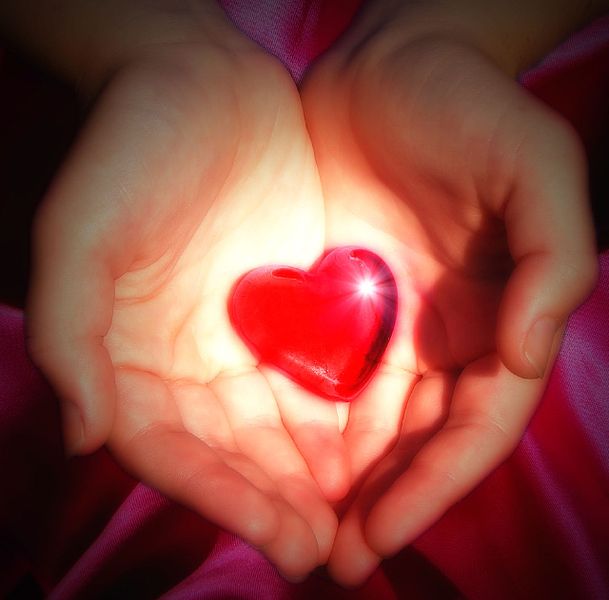
Women’s important body parts aren’t our breasts or backsides. They’re our hearts and hands.
Photo by Louise Docker, via Wikipedia

Focus on YOU, women. Allow the men in your life to focus on who you are inside, too. Teach your daughters to be who they are, and teach your sons positive language about women and not to focus on appearance. Yes, be healthy. Try to eat mostly well. Exercise regularly. But don’t make how you look the end-all, be-all. Don’t let yourself be objectified. Don’t let the media and the marketers and the porn producers dictate how you feel about yourself or how society views you. Gently remind friends that they are “more than eye candy,” as Beauty Redefined enshrines in billboards, or that they are more than just numbers on a scale.

We women are amazing creatures. We nurture future generations. We lead society. We do great things. Let’s show ’em what we’ve got! We’re not about our body parts, unless we talk about our brains, our hearts, or our hands. Let’s join those hands and speak up.

The complex intersection of health, fitness and self-image

I never felt particularly pretty or slim when I was growing up. I always felt like I was a little chubby. When I was about 11 or 12 I actually went on a diet, and at this point I don’t feel I can accurately recall whose idea it was: mine or my mother’s. I cut out sweets, mainly, and ate a little less. My younger sister was taller and slimmer than I and just somehow charismatic and attractive, and I always felt kind of dumpy next to her. When we went on family vacations on occasion, such as the one we made to Florida (Disney World and Daytona Beach) when I was 17, my 15-year-old sister is the one who snagged the attention and admiring looks of the guys. I was just there and along for the ride. It wasn’t until a little later that I came to feel that I was attractive.

My father also had a bad habit of commenting on people’s looks. I adored my dad, and his death in October 2009 was devastating to me, but he did have his quirks and plenty of imperfections, and this obsession with judging others’ outward appearance was one of those. I finally told him the year before he died that it was time he stopped making comments about how people looked. It surely contributed to my constant worry about my own appearance. One of Dad’s infamously terrible remarks happened when I was somewhere around 12 or 13 years old, and we were all listening to music in our living room. My mother was dancing around the room, and my dad observed that she looked like “one of the dancing hippos from ‘Fantasia.'” Silence. I knew it was a bad idea to compare my mom to a hippo, even if it was a very cute animated one, and my mom to this day will sometimes remark about how much it hurt her.

My dad had gotten overweight when he was in his mid-20s and decided to do something about it, so he went on a diet and started running. After that, he stayed super-trim and always exercised and ate healthy foods, even obsessively so. I am sure that his own experience feeling overweight contributed to how he saw things, or the other way around, or both, but it certainly affected my self-image.

We always ate fairly healthy foods when I was growing up, with my mom making homemade wheat bread and putting wheat in every baked good she made. We ate vegetables and fruits in reasonable quantities, and rarely had soda or ate out. So we took care of ourselves pretty well. I never was an athlete, but I did start running my freshman year at college because I was “forced” to in a required fitness class I took my first semester. I dedicated myself to doing it and then just never stopped. Over the past 23 years, I’ve always gone to the gym to work out or gone running or walking, and I’ve only had a hiatus of a year or so total over that time, I think. I just enjoy the feeling of having a good workout, and for a long time, it helped me stay reasonably trim.

At college, too, I didn’t have a car, and my campus was large, so I did a LOT of walking. I could eat all I wanted at my cafeteria and have ice cream galore (I am a fool for ice cream), and with all that exercise, I probably lost a few pounds when I went off to college, rather than gained any. I actually felt pretty good about how I looked, and I felt confident in my attractiveness to all the members of the opposite sex I had the opportunity to meet at that large school.

When I married, graduated college, and got a desk job, however, I quickly put on 20 to 30 pounds. I wasn’t pleased with that and I started eating lower-fat foods and lost a little of it. But I still had most of that extra weight when I got pregnant the first time. After putting on almost 40 pounds with that pregnancy, I left the hospital just under 200 pounds and was shocked at how I looked in the mirror. That was all I needed to limit my calorie intake (I started counting calories for the first time in my life, and I kept it to 1800 since I was nursing), and I managed to take off all the pregnancy pounds plus some. After my second pregnancy, during which I still put on almost 40 pounds, I took off all of that weight and got down to a good size again. I did it again after my third pregnancy, gaining the same amount but getting it all back off 6 months after. I was 32 at that point, and I looked the best I had since I was in college 10-plus years earlier. I was pleased with how I looked, with my good eating habits, with my commitment to exercise, and being able to do all that after three babies.

About five years later, however, I had some pretty stressful experiences and put on about 10 or 15 pounds because I was eating too many sweets. I have always eaten chocolate and ice cream to my heart’s content, so either I started getting a little too old to burn off those calories, or I just ate too much, more than before. I wasn’t pleased with that extra weight and thought I looked chubby in photos. But try as I might, I couldn’t get those 10 or 15 pounds off; all I was able to do was take off maybe 4 pounds and that was all. Two years later, we went through a cross-country move, couldn’t sell our first house (and had lots of financial worries), tried to settle into a new and more stressful life and get to know entirely new people (and miss the old friends where we’d lived for 10 years), lived three months in a house with family (14 of us lived there in one house for that whole time) while we tried to find and buy a new house, and life really put the screws on. I ate and ate and ate. I packed on the pounds and suddenly was 40 pounds heavier. I hadn’t been that weight except right after that first pregnancy, and this time I’d done it without being pregnant, a really embarrassing feat.

As life settled in and eventually got a bit better, and I somehow got motivated, I was able a year later to focus on “dieting,” which for me meant eating fewer calories and cutting out  sweets, a painful thing for me, and I lost 35 pounds over the course of months. I never got to where I wanted to be, but I felt much better about where I was. I tried to lose more but couldn’t, and as life became (and/or stayed) more stressful, I managed to put a few pounds back on.

About a year ago, my doctor told me my cholesterol had inched up. I told her I’d try to lose more weight and see how that affected the numbers; I really don’t want to be on medication that would need monitoring of my liver and have side effects, etc. So I worked really hard for more than a month and still didn’t manage to lose as much as I had anticipated. I was hungry all the time and super-cranky because of it and only lost something like 7 pounds. I didn’t feel I could keep going that way and lose any more, let alone maintain that kind of hungry feeling for very long. So I gave up. Then life got very stressful again in the fall (the long and the short of things is that I simply got far too heavily involved in far too many things), and I put that weight back on and more. I’m back to 10 pounds short of where I started 2 1/2 years ago.

So what is the point of all these details?

First, appearance. I’d like to be able to look in the mirror and not have my first thought be a mixture of shame, disgust, embarrassment, and self-hatred because I weigh more than I would like.

Second, health. Yes, I would like to be healthier, no question. I generally eat healthy food, but then I also eat ice cream and chocolate. I’d like to be able to eat less of the bad things, just to benefit my health and heart.

Third, fitness. I’d like to at least give myself a pat on the back that I have always worked out. I still go to the gym every day of the week except Sunday, with only occasional weeks where I miss another day or two for reasons of illness or vacations (even then, when I travel, I usually find a way to exercise). So this is my one high-five to myself that I am dedicated to fitness. I like how it feels. I like that time to myself that I have at the gym. It’s wonderful. I highly recommend it.

Fourth, mental health. This is the crucial key to my weight issues. I already mentioned how my father was obsessed with appearance. He would make remarks frequently about aging movie stars or singers (he loved Linda Ronstadt but was so disappointed she “let herself go” and got “fat” as she got older; he was sad that Julie Christie had aged when she had been so gorgeous when she was young; the list goes on and on); he would comment about complete strangers who just walked by; he would comment about friends or family members. Naturally, I couldn’t help but wonder what he thought of my heavier weight, though he never said anything to me. It was pretty likely he commented about it to someone else when I wasn’t around.

My mental health issues include my turning to food as a coping mechanism. It’s my drug, I think. My father’s family had a history of alcoholism. The men in my dad’s family drank themselves to death. Dad managed to escape that because he chose in his 20s to join our church, which discourages drinking any alcohol. So he stuck to that and never had another drink in his life, though his own father had given him a taste for beer when he was a toddler and he still missed it. I believe that there is such a thing as addictive personalities; either it is actually hard-wired in our genes or chemical makeup, or it’s a family pattern of behaving. My sister started using drugs and alcohol at a young age and was very likely self-medicating her own mental health issues. Since I also have grown up with the same faith as my father, I have never had a drink of alcohol or a puff of a cigarette, avoiding any possibility of becoming an addict. But I am quite sure I’m addicted to food. I am reasonable with my eating habits when I’m not stressed, but when the screws are on, I turn to the kitchen. Last fall, things were so hard that I literally felt I couldn’t stop eating. I wasn’t hungry; I didn’t even necessarily taste the food anymore; I just couldn’t STOP. And it scared me.

So my goals are twofold: I’d like to look in the mirror and love myself, not immediately see my physical flaws. I’d like to accept who I am, see ME, rather than a body that’s aging and not model-slim, or even slim like I was in my early 30s (I still have those size-6 super-cute dresses I wore a mere six years ago; they’re in a box). I want to love myself, whoever I am.

But I would also like to break my addiction. I would. I’d like to stop my bad habits. But the idea of stopping them scares me. It scares me to even think about not using chocolate or cookies or ice cream as a soothing mechanism. My life can often become so not-my-own (I have four daughters and plenty of other responsibilities) that the food I eat is my only easy fix. I am not proud of this, but at the same time, I am aware that this is not at all uncommon. Those who don’t have this problem think it’s easy to just substitute other soothing mechanisms for the food and those of us who do have this weakness would just be A-OK. It’s just not that simple. I have pretty good “willpower” when I’m not feeling super-stressed or tired, but when I am, I just cannot resist the food. It’s just too easy. I don’t take the easy way out in almost anything in my life. I have come to believe now, after all I’ve experienced and weathered, that I am strong, brave and resilient. I say the honest thing to people even when it’s the harder thing to do; I work hard to achieve my goals, which may sound a little extravagant. But I try. So the food weakness is one spot in which I just too often feel I don’t have the strength or will to resist, when everything else is so hard and I am not taking the easy way out.

I could probably write ad nauseam about this topic. And I will write more. But I’ll just say that weight loss and health can be very complex issues for many people, and there are no quick and easy answers. Again, those who don’t struggle with these things will THINK there are easy solutions, but there are not. I think with everything I address in this blog, this is the case. That is precisely why I’m writing in this blog. Because life can be very difficult, and every person has his or her own set of weaknesses and strengths. If one thing is a strength for one person, it’s a weakness for another, and the two will likely not understand each other’s views on that topic. I’d just like to be able to explore the complexities of life and communication and relationships here, and those who have thoughtful insights they’d like to contribute to the discussion are most welcome to do so. Sensitivity is most welcome, and thinking twice before writing a cliche or simple answer would also be a fine idea. What say all of you?