Not a book snob, but I do have some standards

As much as I’ve loved reading for almost 40 years now, and other people know how much I have read, I’m still astonished, and other people are astonished, at times to discover that I have not read certain classics. I haven’t read these books, for instance: A Tale of Two Cities (though it’s on my Kindle now and I’ve started it), Les Miserables, Moby-Dick, War and Peace, Gone with the Wind, Don Quixote, Walden, or The Canterbury Tales. Glancing at lists online that various people and organizations suggest as the top-40 or top-100 must-reads, I am even surprised to find there are some books I’ve never heard of! (I didn’t think that would happen for me on a “famous-classics” list.)

Frankly, since I’ve been reviewing books for so many years, I’ve tended to get skewed toward reading mostly new books. This has been especially true since I started Rated Reads in 2008: I’ve wanted to focus on new works that wouldn’t have gotten as much word of mouth as older books so the site can be more useful to visitors. So the upshot has been: fewer classics.

Even so, I think I’ve done a fairly good job over the years covering quite a few classics. And I’ve discovered some new books that should qualify as “new classics” because they’re so well written.

But I’m OK with not reading the classics or the classically literary newer books that are deep and filled with meaning. I don’t see it necessary to be a book snob. I’m perfectly happy just reading fluff sometimes. I will admit, for instance, that I did eat up the Twilight books, before they got really popular and that’s all anyone who was female, ages 13 to 55 or so, was talking about.  I hadn’t planned on reading them (Stephenie Meyer is a fellow BYU graduate, and when I read in our alumni magazine about her book about a vampire who falls in love with a great-smelling girl, I thought it just wasn’t up my alley), but when a trusted reading friend handed a copy of the first book to me and said, “I want to see what you think about this,” I indulged and got hooked. Sure, they’re basically female brain candy, but it’s sure nice to have some tasty Hershey’s kisses to indulge in sometimes, isn’t it? (I say this deliberately because there are also great books out there that are still kind of indulgent but I’d consider more the equivalent of Godiva or Valrhona.) The Twilight series has provided a whole bagful of kisses. I do like a good romance and clean(ish) love scenes. I did get tired of hearing about Edward’s marble chest, though. I just don’t care about muscles and finely chiseled chests, apparently.

Given that I enjoy fluff now and then, I do have standards. I think now might be a good time to share authors I do not like. Yep, I’ve written about some of my favorite books and authors, but now I will write briefly about authors I detest.

  1. James Patterson, at least as part of a writing duo. I read Sundays at Tiffany’s because I thought it was such a clever premise. The writing stunk. It was short and unmemorable and childishly written. I suppose I should try one of his mysteries, but I’m skeptical after being burned with his ridiculous prolific co-authoring. Actually, now that I think of it, I suppose my entire list of “hates” is of authors who churn out books to a loyal fanbase who will fork over $28 for any new tome from their favorite author regardless of the quality of the writing. Me, I’m not that loyal, I guess.
  2. Nicholas Sparks. Another prolific author who writes what I consider to be formulaic crud. I firmly believe that if the only way a writer can elicit an emotional response from readers is by using death as a tool to pull relentlessly on heartstrings, he doesn’t have much talent. I generally appreciate nuance. (OK, I did already say I loved Twilight. I can’t explain that.) I read two books by Sparks, I believe, as a reviewer and have seen a few movies based on his books, so I am pretty sure I can say I don’t need to read/see anymore. SOMEONE ALWAYS DIES. Sorry if this is a spoiler, but it must be said. I figure, you read one Sparks book, you’ve read them all.
  3. Richard Paul Evans. I think he’s a very fine man and has done some real good, and I love his success story. But his writing is sophomoric. Sorry, but it’s true.

It’s fairly safe to say that any author whose writing I find sophomoric or whose plots are formulaic will make this list. Obviously, I make a few exceptions, but in most cases, I’ll avoid this bunk and stick to writers who craft three-dimensional characters, create fascinating worlds, who have amazing imaginations, who can just put together the same old words in the English language in ways that somehow seem new and fresh.

Even when it comes to fluff, I have some standards.

Latest discoveries

It’s going to take a whole lot of posts to cover my life and experiences in this department. So I started at the beginning, but I’ve been jumping around since that first post. I’m going to try to explain a bit where I am now.

We moved to California in late summer of 2008 from Alabama, where we had lived in one town for 10 years. We were pretty well settled there, even though we hadn’t expected to stay there for so long. But our children’s needs, primarily, induced us to move cross-country. Though I had some time to plan and prepare for the move, the whole thing didn’t go nearly as smoothly as I would have liked. It took ages to get into a house of our own, during which time we lived with family and had all of our possessions in a storage unit. Then we waited and waited for our house in Alabama to sell, and after a year of waiting and one very low offer that fell through, we decided to rent it out. The stress of all those things, combined with the financial stress of paying two mortgages for a year, made life very difficult. I just felt depressed and frustrated and irritable pretty much all the time.

I had been seeing a psychiatrist in Alabama for a year or two, during which time he’d put me on an antidepressant that seemed to help fairly well. But with the move, it just wasn’t doing enough. So I started surfing the Web one morning and found a site that turned out to be very useful. It’s just a very simple-looking site by a psychiatrist who has shared many of his insights online. He also wrote a book called Why Am I Still Depressed? I pored over the site and then ordered the book. I decided that it was time to see a psychiatrist in my new town, rather than having my general doctor keep writing scripts for the old antidepressant.

The site had really struck a chord with me; its information led me to believe I was experiencing what this doctor (James Phelps) describes as bipolar II. Armed with this bit of information, I found one of the two psychiatrists in town that my health insurance covered and made an appointment. My new doctor and I talked, I shared my opinions, and he prescribed a new medication; he called my condition “atypical bipolar disorder,” but it’s just a slightly different name for what Dr. Phelps called bipolar II. The new medication seemed to work fine, and just knowing I had new information and a new medication gave me hope.

Three years later, this is still the diagnosis I’m working with. I’ve tried some different meds and a different doctor (I’ll write other posts on those topics), but we’re still going with that. Honestly, though, I still wonder how many other factors are at play. Dr. Phelps’ website talks about how thyroid disorders are sometimes tied in with bipolar II, and since I’ve been hypothyroid for about 12 years now (well, that’s when my doctor and I discovered it), I can’t help but think it may play a part in what I experience, even though I have been on thyroid replacement medication for all that time and it’s supposedly controlled (according to blood tests that my current doctor administers every year: and THAT, again, is a whole other topic). I also have noticed that I feel particular sensitivity to hormonal fluctuations, during pregnancy and postpartum and my monthly cycles, and those must be factors as well. I’m fascinated by how things work, and the complex interplay of hormones in the body is so interesting to me (I even wrote a paper about hormones for a research project in English in high school before I knew how personal it was). So I would love to figure out exactly how all these things work together to create my particular issues. Doctors, however, basically don’t seem to care about this (How could they not? Do they not have any curiosity?), at least when it comes to treating me. They just want to know that they’re finding a good medicine to treat me, and that’s all that matters. They have a point, I suppose, but I’d just love to know how all this works inside me. As far as we’ve come in being able to treat mood disorders, it still feels like we’re kind of living in the 19th century treatment-wise compared to all the other feats of medicine that exist.

So I could say now, “Well, this is it. I’m almost 42, and I’ve finally figured out what’s going on with me.” But even though I feel fairly confident that I’m on the right path — and it’s a big relief, I must say — I still wonder if in 10 years my diagnosis might change and I’ll look back and say, “Gee, we were close but not quite there.” At any rate, this is the best we have right now, and we’re going with it. It’s something, and something is better than nothing. I suppose, when it comes down to it, this is really just an extension of my previous post, “What’s in a name?”, because we have a name but that name could very well change. It’s just nice to have a name; it helps me to wrap my mind around what I experience, it helps me on occasion to explain to others if I feel so inclined, and now it might help you.

What’s in a name?

So I’ve thought a lot about how difficult it is to just put a name on what I experience. For years, I really wasn’t sure what I had, as I mentioned before and will need to write more about. So if it was hard for me and doctors to label my condition, then explaining it to others is even more of a challenge, even now. Then, even if there is a name, communicating correctly to others so they will really understand is even more challenging.

For a comparison and introduction to my thoughts on this topic, I have a daughter who has Down syndrome. Over the years as I’ve been involved with organizations that advocate for people with disabilities and have spent time talking with other parents, I have been actually very grateful for the fact that my daughter has a very straightforward diagnosis. I’ve met people whose children obviously have cognitive challenges but who have spent hours and hours in doctors’ offices and with other specialists, trying to determine just what their child is dealing with. It’s vital to have some kind of diagnosis in hand in order to effectively move forward with some kind of treatment and/or (especially) educational plans and specialized services. It’s no doubt sometimes a challenge to have a child with a disability (again, whole other topic here), but it seems to me that it’s even more difficult when you can’t put a name to it. I’ve had 14 years of knowing I have a child who has Down syndrome. She’s received the services she’s needed, by and large, over the years, and it’s been relatively simple to make those happen.

What makes her situation simpler also is that her condition is easy to observe on the outside. The physical characteristics that are signature Down syndrome traits are literally written on her face, and pretty much everyone knows by looking at her that they should have some types of different expectations from her. I don’t want anyone to think that I want people pre-judging my daughter or having low expectations for her because that’s not at all what I’m trying to say. But when she behaves a little differently than most people and hugs everyone and talks with a bit of a speech impediment and so on, I can feel fairly comfortable knowing I don’t have to try to explain away what she’s doing because many people will already know there’s a reason to cut her some slack behavior-wise.

A similar “rule” applies to people who have physical disabilities. Many of those can easily be observed; if someone is in a wheelchair because of paralysis or uses a cane because of a limp or even has a seeing-eye dog because of blindness, that person instantly can communicate without needing to say a word that he or she has a particular challenge to which others might need to be sensitive (although they generally just want to be treated like everyone else, their situations are at least fairly clear to others, and then others can choose how to be most sensitive and kind to them). But mental health issues are completely invisible. No one can tell by looking what someone who struggles with mental illness is having to cope with.

The companion issue is that mental illness simply is not as readily understood as physical illness. Each individual in this world has a package of trials and difficulties (as well as talents and skills and interests) that is unique. Some face tremendous trials in this life. Some are open about some of the things they face, and others prefer to be quite private, sharing details or even basic information with very few others. So some people who are diagnosed with cancer will talk readily about their illness, their treatments, their prognosis, their fears and frustrations. Others will keep quiet. But those who do share more, for instance, a cancer diagnosis, will likely be quickly understood. “Cancer” is a word that is easily communicated in our society; listeners will think “chemo,” “surgery,” “radiation,” “sick,” “death” or “remission” when they hear it. They will feel compassion and a desire to help, perhaps with meals or rides to a doctor or something similar.

On the flip side, however, is mental illness. Mental illness today, with its various diagnoses like schizophrenia, depression, bipolar disorder, and so on, is coming out of the darkness in a way; more people talk about it in society, but it’s still not as easily understood as physical illnesses. There is generally no stigma associated with illnesses like cancer (although, frankly, there can be a bit with some illnesses that can be linked in part to unhealthy habits), but there is lots of misunderstanding, confusion, and stigma associated with mental health. Either people think that mental illness really doesn’t exist and a sufferer is “making things up” or trying to get attention or something else, or they think that their mental problems are bad habits that just need to be broken. Someone with depression could be told to look on the bright side or to just force themselves to get out and about, for example. Or others may simply recoil a little bit from someone who has a mental illness; they may be seen as weak or “crazy” or “scary” or unbalanced. Mental illness can make others feel uncomfortable and nervous, rather than compassionate and eager to help and lend support.

So back to the name. When I have chosen to share with someone, briefly, that I deal with issues of mental health, first, over the years, I wasn’t sure what I did have, and now that I (basically) do, I still can’t just say, “Well, I have atypical bipolar disorder or bipolar II.” No one knows what that means. Communicating requires that both people understand the meaning of a word. Like I said before, if I say, “I have cancer,” I can pretty much leave it at that and someone else would know what I meant. But if I wanted to briefly mention, “I have bipolar disorder,” half of people wouldn’t know what I meant. Even if they did, my version of this “spectrum” is practically unique to me, so it would require several more paragraphs to get across a basic meaning that one or two words couldn’t convey, as “cancer” would for that illness.

What’s the upshot? It’s just a lot easier not to ever tell anyone what I deal with. One, I can’t say it quickly and move on to other topics. Not possible to communicate what I need to quickly. I might find someone who is very sensitive and eager to talk to me about it, but it’s going to lead to at least a 15-minute conversation, and sometimes there’s no time for that. Two, if I do say what I have, and someone else basically understands what I’m talking about, there’s always a possibility they may have a negative connotation in their minds that will lead them to make judgments about me that I’d rather them not make.

On my bad days, I’d be happy to stay at home, keep to my bed, and refrain from human interaction so as not to offend or cause any problems. But many of those days, since I do have four kids and lots of responsibilities, I still have to be out and about, getting things done. I’m then more likely to be impatient or super-irritable or sometimes just want to cry over something dumb that wouldn’t bother a normal person (or me at some other time) at all. It’s those days I wish I had a sign on my forehead that just says, “Please excuse me. I have a mental illness; I do my best to deal with it constructively; I take medication, I see a therapist regularly, I try to relax and take care of myself as much as I can given my limitations. But I have a family; I have responsibilities, and life goes on. I’m standing in this line that has taken forever and it’s making me feel completely at the end of my rope. I’m valiantly doing what I can here, but my best on this kind of day isn’t too great. Please give me some leeway and smile at me encouragingly or just try not to judge me.” But my forehead isn’t as big as a billboard (thank goodness), and this sentiment wouldn’t fit on it.

So no, there is no outward sign of my inward distress to give people around me (strangers or friends) any indication of what I deal with regularly or if I’m having a bad day in particular. (Very close friends will understand if I just say a few words because after years of talking and explaining, some shorthand will work. But this only applies to a handful of individuals in my life. You know who you are.) There are no physical indications, no typical characteristics to tip anyone off. And if I were to say something to someone else, I couldn’t really capture the essence of what I want to convey in just a few quick words. It’s frustrating. Again, this is all part of why I’m writing on this blog. I’d like to extend to others who don’t have my particular challenges the kindness of helping them to see more clearly from my viewpoint, all at their leisure whenever they’d like to read this. And for those who experience similar feelings, I hope you can feel a kindred spirit.

An ordered mind

So I wrote yesterday about how I like things in my home neat. I have thought about this a great deal over the past few years because it at least in part directly correlates to my state of mind. I find that I must clean and organize when my brain is in two different modes: overloaded and in high gear.

I have times when I’m full of ideas and just raring to go, and I just get moving. My mind is spinning but not so fast I feel completely overloaded. Then there are other times when my mind is spinning so fast I can’t possibly keep up and I feel like my circuits are going to short. These two slightly different speeds in my brain (which are separate from my “normal” and “slow” speeds) lead to two different outcomes and emotions, too. When I’m spinning in a “good” way, I’m excited about all the ideas that seem to be popping up out of nowhere. It’s exciting to experience that rush of inspiration, of creativity, and I rush around a bit to try to keep up. When my mind is spinning out of control, though, I can’t possibly rush fast enough to keep up; I also find that this latter situation, which leads to anger, frustration and exhaustion, is also induced by busy-ness that’s outside of my brain and outside of my control. So if my life isn’t too full of appointments, expectations, to-do lists that are foisted on me by others (including my four children and their schedules), and I am free to let my brain spin and give me ideas, it’s all fine. But when the outside expectations and to-dos pile up and I feel, especially, that I have no say in them, my brain just spins like about 100 caffeine-dosed hamsters on 100 wheels, and I short out.

My house benefits from both situations, my family, not so much. When I’m full of ideas of how to make my house more organized and I’m not walking around with those hamsters in my head, I am eager to just get to work and make things nice and neat. When the hamsters are doing their thing, I do some work, but I mainly order my husband and kids around and/or complain about how the house is messy and it’s contributing to my overwhelmed state. The mess in my head is so all-encompassing that any mess in my physical living space just exacerbates the inner clutter a hundredfold. Clutter inside means clutter outside is unacceptable.

So I’ve wondered a bit if I would be so organized and neat if it weren’t for my brain’s tendencies to go into high gear so often. But I think I would. I’ve just always been neat and clean. But that concept brings me to another one: is it even possible to tease out my personality traits from my brain’s chemical issues? My brain simply is who I am. And THAT is a discussion for another day.

Let’s just leave my post here today with this thought: SPIN SPIN SPIN HAMSTERS HAMSTERS HAMSTERS. My house is looking pretty good.

House of order

I have decided that I could probably become a professional organizer if I so chose. But I don’t choose that, so I am strictly staying in the amateur leagues. I go on tears of ultra-organization in my house periodically. Over the course of a couple of months in the fall, I must have gotten rid of 15 medium-sized boxes’ worth of stuff. Well, probably more. And that’s after I’d already gone through and gotten rid of a bunch more stuff in the spring. And that was after going through and getting rid of stuff after we first moved in to this house 3 1/2 years ago, and that was after getting rid of a ton of junk before we made the cross-country move here. I keep asking myself how it’s possible that I have all this junk if I keep getting rid of it. Does it sneak back in to the house like the ants we keep killing off? Or like our female cat, who keeps insisting on going back out? It’s a mystery.

I must admit that I impose order on everyone in my house, my husband and daughters all. I have brought in some boxes from the garage and plunked them down in the office and/or bedroom and instructed my husband that he must go through them and sort and organize them within a short amount of time. He grudgingly obliges. I tell my girls it’s time to sort through their rooms and piles of accumulated stuff every six months or so. When they give me drawings or other doodads, I duly admire and ooh and ahh and then remind them that I will recycle most of them but keep a select few in their special folder. Otherwise, we’d be swimming in pencil and crayon artwork, drowning, really.

I’ve been reminding my husband and daughters, “_____ doesn’t belong there. Please put it where it lives.” Everything must have a place to live that makes sense for its use and for our need for it, and I insist on it going back to its domicile as quickly as possible after our temporary need for it has ended.

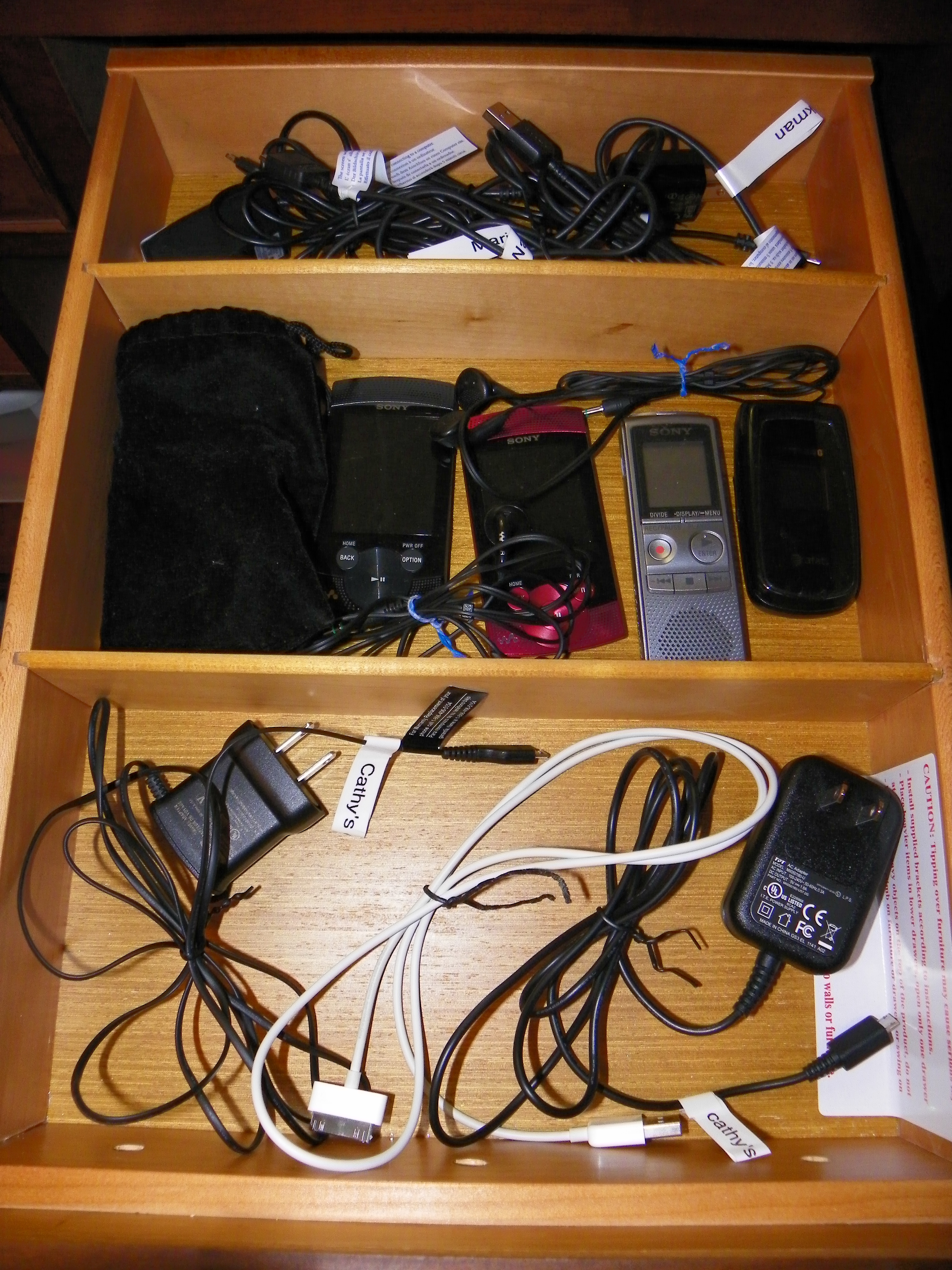
When I get better organized, I always must show off my new setups. For instance, I did this last week with most of the electronics cords and little gadgets that had become tangled up in the small canvas bin they had previously occupied:

As always, I was pleased as punch with the result and made sure my husband had seen it, and that my 15-year-old, who’s old enough to really appreciate these things, had seen it as well. “Doesn’t it look great?” I asked like a child with a freshly-drawn piece of art for the fridge. “It looks so neat and tidy now, doesn’t it? So much better than before, right?”

I cleared out a drawer in my office credenza that previously was a holding bin for stuff I didn’t know what to do with and used the divider that came with that drawer and another drawer, which I didn’t really need to divide. I had thought about using a store-bought utensil divider or something similar, but this worked just fine in the end without a trip to the store. Yay, me!

I also thought I’d add in here my fancy-schmancy way of planning meals. Well, about a third of the time. I decided to print up a list of dinners I make on a regular basis. I put several line spaces between each and made each dinner item in big print. Then I laminated them, cut them into little rectangles, and put magnets on the back. I put them into zip baggies (I decided it would be easier season-wise to separate soups into a different baggie) and placed them in a drawer in my kitchen. I had a small whiteboard that’s magnetic, so I (try to) plan a week’s meals at a time by just going through my baggies and sticking meal magnets onto my white board. Then I can get an idea at a quick glance of what I plan to make for the week, what to shop for, etc. I think it’s pretty clever. Here’s what it looks like:

My husband likes to stop by garage sales when he passes them on a Saturday errand. When he brings things into the house, I have a hard time not snapping at him. “What?? I just gave away a bunch of stuff to the band rummage sale, and you’re bringing in more junk?” I moan. A couple of weeks ago, he managed to get a few things that were fairly useful, but he also got a board game we will likely never use; I just got rid of about five or six we never used. Argh.

Don’t mess up my neat house. Darn. Too late.

An ode to words

Aren’t words wonderful? Some may argue (and rightly so) that the English language is crazy and difficult and full of rules that are just as often broken as they are adhered to. But I’m in awe of just how much can be said with all the delightful words that our language contains. We’ve adapted and co-opted words from all kinds of places and times and made them work for us. I have an utter reverence for what can be conveyed with the right use of vocabulary.

I think of our language as a toolkit full of a variety of tools, each just the right size and shape and weight to fit any job. But what dismays me is that most of our society today only carries around a mini-kit with a few basics (hammer, screwdriver, a few nails) which they use for every single need. I try to lug around the jumbo version of the toolkit (even the whole garage full of cupboards and shelves, sometimes) so I’ll be able to fit just the right tool to whatever I need to accomplish.

That’s what makes me particularly enamored of certain authors’ writing. Some authors are great storytellers, with vivid imaginations and tons of neat ideas for stories, but they’re not great writers (Stephenie Meyer has said this about herself, for example, and she’s absolutely right). But some authors can tell any story but make it compelling and beautiful because of the words they select from their kits and how they put them together in seemingly fresh ways.

I love to use my thesaurus. It’s full of options to help find just the right word to convey the perfect meaning. But as with any tool, it must be used correctly. Many people have the mistaken notion that they can take out a thesaurus and pick willy-nilly any word out of the synonyms listed. Wrong. Each word in our language has a very precise meaning that, if the writer or speaker and the reader and listener both know it, can communicate meaning as well as is possible with language (of course, communication is a whole other topic; let’s just say that spoken or written language is only a small part of communication, so since that’s the case, we’d better be sure to be careful with the words we do use so we can communicate as effectively as possible). The ideal use of the thesaurus is to stimulate our thinking and allow our brain to go through its options and then select the best one. We still must know the exact meaning of each synonym, because synonyms are merely similar words, not usually exact matches. Even identical twins have slight differences in appearance, voices, and certainly personalities, don’t they?

So as a writer, I like to look at the thesaurus when I have a general idea of what I’m trying to express. Glancing through the list of synonyms of any given word can help my brain to make connections and eventually say, Aha! That’s exactly what I’d like to say. As an editor of other people’s writing, I have to use the thesaurus to help them come up with the word that’s going to say what they obviously mean to say in the context of their topic and sentence or paragraph. I often think as I’m reading someone else’s raw work, I do not think that means what you think it means (thanks to Inigo and Vizzini of “The Princess Bride”). Sometimes their efforts are unwittingly comical; sometimes they could even be potentially offensive, egregiously misleading or just plain wrong.

Given that I do a lot of editing, then, and I see many misuses of language, I am so appreciative of the writers who have honed their craft and lovingly put to use the full toolkit of the language. Each word, carefully chosen, can instantly create a picture in my mind, complete with emotions and sensations. Every word has nuances and layers of meaning, and used well can convey those layers in just one perfect word, allowing a writer to write concisely but elegantly. A writer with a shallow portable toolkit will have to use many more simple words to get a message across that could be portrayed nicely with one or two words in the hands of a skilled writer with an excellent grasp of vocabulary.

I’m not saying that we should all use “hoity-toity” vocabulary at all times or words that are just rarely used and never understood. But there are so many options that are rich in meaning that can communicate effectively that people don’t bother to use. As a parent, I’ve always used my regular vocabulary to speak to my children, rather than trying to “dumb down” what I say in baby talk. I might rephrase something in simpler language so they can understand, but then I’ll also use the richer words so they can hear them in context and learn. And as they read, just as I did growing up and still do now, they (and I) can learn new words just through context and, if they’re so inclined, looking them up in the dictionary.

Even as I write, I’m now self-conscious about how I wrote. Did I convey exactly what I wanted to express? Did I use just the right words? I hope so. I’m not one of the most gifted writers out there, but I hope that I can at least say what I mean to say. And my hat’s off to those amazing writers who have transported me because of their judicious use of language.

Balancing act, part one of many

It’s pretty common for women to talk about the tricky proposition of balancing the many elements of their lives. In fact, I know few women who don’t worry about getting a proper balance, let alone maintaining it. But having mental health issues just makes that balancing act that much more difficult. I can say from years of experience that it’s a razor-thin line; right on one side I might feel a little overwhelmed but still OK; on the other side, I’m far past overwhelmed: I’m stressed, I’m drowning, I’m angry and lashing out at whoever comes too close. The latter is not a pretty picture, and I don’t like thinking about the times I’ve been pushed too far on that side of the line.

What my psychiatrists and I are currently calling bipolar II or atypical bipolar disorder causes me to experience a kind of hopeless feeling in which I rarely feel that kind of depression that makes me not want to get out of bed. It’s more of an angry depression. I feel isolated, alone, abandoned by all who should love me and somehow care and know me well enough to be able to see what’s happening and help. When I feel that way, in the very extreme times, I feel that life won’t possibly get better, that I can’t take the psychological pressure that seems to be pressing in on every side of me. I just feel angry at everyone who could possibly be blamed, including God. When the anger kind of dies out, I feel depleted and in despair. So I “swing” back and forth between a sad, hopeless depression and an angry depression, if that makes any sense. I’ll try to explain further in later posts. Suffice it to say, yes, I am a type-A personality, but I’m also typically a fairly cheery, happy person who always has a smile on my face. So when I get backed into these corners where I feel trapped and angry, the rage that almost flares up out of nowhere feels so at odds with who I feel I AM that it upsets me even further.

That brief introduction to my moods is just to somehow try to explain that I can quickly get out of balance. After years of this kind of yo-yo-ing, I can feel when I’m getting close to the brink, and I start feeling desperate. I know I need some down time, alone time, unwinding time to try to swing myself back to a more stable self. The problem is when I feel I don’t have the choice to just say no to activities or pressures or expectations from others.

Some people are more sensitive about this than others. Again, finding balance is always a delicate proposition, and many people understand this for themselves and that it’s the same situation for others. Some are just more empathetic about others’ needs as they bump into their own needs. I admit I get a little irritable when I say, “Well, I can only do ___ because I am pretty busy.” In my mind, that’s me being responsible enough to know my limits and exercise my personal choice to lay down those limits and work around them. When someone else responds, “Well, yes, sure, but we’re ALL busy,” I know they’re not really going to be too respectful of whatever line I’m going to draw for myself. Or they may say, “Yes, well, but (____ organization) really NEEDS you.” Sure, every organization that relies on volunteer help of any kind always needs help and never has enough. But I cannot possibly do enough to fill in those gaps, for that group or any other. Or I might just say flat-out, “No, I simply don’t have the time and energy to do that right now,” and rather than saying, “Oh, of course, don’t worry about it. We’d love your help, but we understand that” they keep pressing on in some way. These responses essentially tell me that these people value their needs above mine. And sure, we tend to be selfish beings and that’s natural. But I certainly appreciate it when someone else rises above those human tendencies and tells me, “That’s fine. You do what you need to do.” I so greatly value when they have the kindness to respect my choice, my right to make decisions for my own life and that of my family.

You see, I know what my limits are, and I’m constantly doing the balancing act. I am a softie at heart, and I want to give my money and time to a whole lot of worthy causes, worthy people. My heart goes out to them. I may even sometimes foolishly say yes or maybe when I should have said no because I’m biting off more than I can chew or even get in my mouth at one time. But when it comes down to it, my mental health must stay intact, so I can be happy, so I can take care of my family (which is paramount in my life above all the other things that matter to me), and so I can in the future continue to give to others. Simply, it rankles me when others don’t respect that I should know best for my own life and my own well-being and continue to push me when I say no. It ticks me off. Big-time. But on the flip side, I feel respected and cared about when someone is kind enough to take me at my word and wish me the best. Perhaps I expect too much out of people, but I would love to see more sensitivity in how people treat each other. There’s just no way of knowing what someone else is going through. I’m being open here on this blog so I can help others understand what I’ve experienced, but I simply can’t go through my whole personal history every time someone demands justification for me saying no. Thank you for being understanding, those of you who have been and continue to be so with me.

Gratitude

So many talks have been given, quotes made into cute signs, and so on about gratitude. I am sure I have absolutely nothing new to say on the topic. Nonetheless, I’d like to take a few minutes to share some of the things that move me and leave me with a sense of gratitude for the abundant, luxurious life I live. I am not wealthy, just fairly middle-class, but I recognize that I am rich compared to so many people across the world, even in our own relatively wealthy country.

First, I am frequently very grateful for the conveniences we take for granted in our first-world life. Aren’t running water and electricity amazing? I love having a climate-controlled home. I don’t like the heat too much, although at this point, I’ve lived 25 years in warm climates where there isn’t much snow and the summers are either very hot and dry or hot and so muggy you might as well be in a steam room. I don’t mind the cold; I like bundling up, but I have come to appreciate not having to navigate around with snow on the roads or sidewalks. I appreciate just being able to go about my business unhindered. So I appreciate air conditioning and heating. When I moved to the South as a 10-year-old from the cold climes of Pennsylvania, I went to an elementary school that still didn’t have air conditioning. I sweated through the first month or two of school (August!) and walked home in a haze from the bus stop to my (finally!) air-conditioned house. Mom would often be waiting with a Popsicle. How sweet and wonderful that was.

And plumbing. To have hot water or cold water whenever we want it, without waiting, without hiking to a well or going outside to a pump. Wowee. And toilets: it’s pretty nice to flush the smelly stuff right out of your house and not have to use an outhouse that always smells (no trips to said stinky wooden shed in the middle of the night either when it’s dark and who-knows-what might get in the way).

Technology never ceases to amaze me. Sure, we’re living in a media- and tech-saturated society, which isn’t always a good thing, but I’m in awe of how much good can be done with what we have. I just think it’s cool if I or one of my children has a question we can just take a quick moment to run to the computer and Google it. When I was a kid, the only immediate sources available were my parents and the encyclopedia. If neither of those all-wise repositories of information had the answer, I was sunk, just stuck with a question and no satisfying solution.

All of these little things are just a sampling of blessings I appreciate on a daily basis. Of course, what matters most to me are my family and friends, my experiences and memories, the things I’ve learned. I have a husband who has his imperfections and little quirks that can make me a little crazy, but he is just overall a kind and unconditionally loving man who has been better to me than I could ever have imagined these past 19 years. My daughters are astonishing in their beauty, their talents, their sweetness, their good natures. I wish I could just sit down and enjoy them non-stop, but my own needs to be alone and do things for myself as well as just the daily needs of a household keep me from doing that. But I do enjoy the moments we have, even the hours, in which we talk, read, play or otherwise have fun and share together. I also have some wonderful friends whom I admire and love a great deal, who I wish could all live on my cul-de-sac and be available all the time for fun and commisseration. There have been many other people who have been kind and good to me over the years, and I hope that any good I do can just “pay forward” in their honor.

Finally, I am grateful for my faith in and assurance of a God in heaven. It is always comforting to know that he loves me and has a plan for my life, in this mortal existence and afterward. I try to live to show him how much I appreciate his goodness to me in so many ways.

Sure, it’s only March, but every day can be Thanksgiving Day, can’t it?

The complex intersection of health, fitness and self-image

I never felt particularly pretty or slim when I was growing up. I always felt like I was a little chubby. When I was about 11 or 12 I actually went on a diet, and at this point I don’t feel I can accurately recall whose idea it was: mine or my mother’s. I cut out sweets, mainly, and ate a little less. My younger sister was taller and slimmer than I and just somehow charismatic and attractive, and I always felt kind of dumpy next to her. When we went on family vacations on occasion, such as the one we made to Florida (Disney World and Daytona Beach) when I was 17, my 15-year-old sister is the one who snagged the attention and admiring looks of the guys. I was just there and along for the ride. It wasn’t until a little later that I came to feel that I was attractive.

My father also had a bad habit of commenting on people’s looks. I adored my dad, and his death in October 2009 was devastating to me, but he did have his quirks and plenty of imperfections, and this obsession with judging others’ outward appearance was one of those. I finally told him the year before he died that it was time he stopped making comments about how people looked. It surely contributed to my constant worry about my own appearance. One of Dad’s infamously terrible remarks happened when I was somewhere around 12 or 13 years old, and we were all listening to music in our living room. My mother was dancing around the room, and my dad observed that she looked like “one of the dancing hippos from ‘Fantasia.'” Silence. I knew it was a bad idea to compare my mom to a hippo, even if it was a very cute animated one, and my mom to this day will sometimes remark about how much it hurt her.

My dad had gotten overweight when he was in his mid-20s and decided to do something about it, so he went on a diet and started running. After that, he stayed super-trim and always exercised and ate healthy foods, even obsessively so. I am sure that his own experience feeling overweight contributed to how he saw things, or the other way around, or both, but it certainly affected my self-image.

We always ate fairly healthy foods when I was growing up, with my mom making homemade wheat bread and putting wheat in every baked good she made. We ate vegetables and fruits in reasonable quantities, and rarely had soda or ate out. So we took care of ourselves pretty well. I never was an athlete, but I did start running my freshman year at college because I was “forced” to in a required fitness class I took my first semester. I dedicated myself to doing it and then just never stopped. Over the past 23 years, I’ve always gone to the gym to work out or gone running or walking, and I’ve only had a hiatus of a year or so total over that time, I think. I just enjoy the feeling of having a good workout, and for a long time, it helped me stay reasonably trim.

At college, too, I didn’t have a car, and my campus was large, so I did a LOT of walking. I could eat all I wanted at my cafeteria and have ice cream galore (I am a fool for ice cream), and with all that exercise, I probably lost a few pounds when I went off to college, rather than gained any. I actually felt pretty good about how I looked, and I felt confident in my attractiveness to all the members of the opposite sex I had the opportunity to meet at that large school.

When I married, graduated college, and got a desk job, however, I quickly put on 20 to 30 pounds. I wasn’t pleased with that and I started eating lower-fat foods and lost a little of it. But I still had most of that extra weight when I got pregnant the first time. After putting on almost 40 pounds with that pregnancy, I left the hospital just under 200 pounds and was shocked at how I looked in the mirror. That was all I needed to limit my calorie intake (I started counting calories for the first time in my life, and I kept it to 1800 since I was nursing), and I managed to take off all the pregnancy pounds plus some. After my second pregnancy, during which I still put on almost 40 pounds, I took off all of that weight and got down to a good size again. I did it again after my third pregnancy, gaining the same amount but getting it all back off 6 months after. I was 32 at that point, and I looked the best I had since I was in college 10-plus years earlier. I was pleased with how I looked, with my good eating habits, with my commitment to exercise, and being able to do all that after three babies.

About five years later, however, I had some pretty stressful experiences and put on about 10 or 15 pounds because I was eating too many sweets. I have always eaten chocolate and ice cream to my heart’s content, so either I started getting a little too old to burn off those calories, or I just ate too much, more than before. I wasn’t pleased with that extra weight and thought I looked chubby in photos. But try as I might, I couldn’t get those 10 or 15 pounds off; all I was able to do was take off maybe 4 pounds and that was all. Two years later, we went through a cross-country move, couldn’t sell our first house (and had lots of financial worries), tried to settle into a new and more stressful life and get to know entirely new people (and miss the old friends where we’d lived for 10 years), lived three months in a house with family (14 of us lived there in one house for that whole time) while we tried to find and buy a new house, and life really put the screws on. I ate and ate and ate. I packed on the pounds and suddenly was 40 pounds heavier. I hadn’t been that weight except right after that first pregnancy, and this time I’d done it without being pregnant, a really embarrassing feat.

As life settled in and eventually got a bit better, and I somehow got motivated, I was able a year later to focus on “dieting,” which for me meant eating fewer calories and cutting out  sweets, a painful thing for me, and I lost 35 pounds over the course of months. I never got to where I wanted to be, but I felt much better about where I was. I tried to lose more but couldn’t, and as life became (and/or stayed) more stressful, I managed to put a few pounds back on.

About a year ago, my doctor told me my cholesterol had inched up. I told her I’d try to lose more weight and see how that affected the numbers; I really don’t want to be on medication that would need monitoring of my liver and have side effects, etc. So I worked really hard for more than a month and still didn’t manage to lose as much as I had anticipated. I was hungry all the time and super-cranky because of it and only lost something like 7 pounds. I didn’t feel I could keep going that way and lose any more, let alone maintain that kind of hungry feeling for very long. So I gave up. Then life got very stressful again in the fall (the long and the short of things is that I simply got far too heavily involved in far too many things), and I put that weight back on and more. I’m back to 10 pounds short of where I started 2 1/2 years ago.

So what is the point of all these details?

First, appearance. I’d like to be able to look in the mirror and not have my first thought be a mixture of shame, disgust, embarrassment, and self-hatred because I weigh more than I would like.

Second, health. Yes, I would like to be healthier, no question. I generally eat healthy food, but then I also eat ice cream and chocolate. I’d like to be able to eat less of the bad things, just to benefit my health and heart.

Third, fitness. I’d like to at least give myself a pat on the back that I have always worked out. I still go to the gym every day of the week except Sunday, with only occasional weeks where I miss another day or two for reasons of illness or vacations (even then, when I travel, I usually find a way to exercise). So this is my one high-five to myself that I am dedicated to fitness. I like how it feels. I like that time to myself that I have at the gym. It’s wonderful. I highly recommend it.

Fourth, mental health. This is the crucial key to my weight issues. I already mentioned how my father was obsessed with appearance. He would make remarks frequently about aging movie stars or singers (he loved Linda Ronstadt but was so disappointed she “let herself go” and got “fat” as she got older; he was sad that Julie Christie had aged when she had been so gorgeous when she was young; the list goes on and on); he would comment about complete strangers who just walked by; he would comment about friends or family members. Naturally, I couldn’t help but wonder what he thought of my heavier weight, though he never said anything to me. It was pretty likely he commented about it to someone else when I wasn’t around.

My mental health issues include my turning to food as a coping mechanism. It’s my drug, I think. My father’s family had a history of alcoholism. The men in my dad’s family drank themselves to death. Dad managed to escape that because he chose in his 20s to join our church, which discourages drinking any alcohol. So he stuck to that and never had another drink in his life, though his own father had given him a taste for beer when he was a toddler and he still missed it. I believe that there is such a thing as addictive personalities; either it is actually hard-wired in our genes or chemical makeup, or it’s a family pattern of behaving. My sister started using drugs and alcohol at a young age and was very likely self-medicating her own mental health issues. Since I also have grown up with the same faith as my father, I have never had a drink of alcohol or a puff of a cigarette, avoiding any possibility of becoming an addict. But I am quite sure I’m addicted to food. I am reasonable with my eating habits when I’m not stressed, but when the screws are on, I turn to the kitchen. Last fall, things were so hard that I literally felt I couldn’t stop eating. I wasn’t hungry; I didn’t even necessarily taste the food anymore; I just couldn’t STOP. And it scared me.

So my goals are twofold: I’d like to look in the mirror and love myself, not immediately see my physical flaws. I’d like to accept who I am, see ME, rather than a body that’s aging and not model-slim, or even slim like I was in my early 30s (I still have those size-6 super-cute dresses I wore a mere six years ago; they’re in a box). I want to love myself, whoever I am.

But I would also like to break my addiction. I would. I’d like to stop my bad habits. But the idea of stopping them scares me. It scares me to even think about not using chocolate or cookies or ice cream as a soothing mechanism. My life can often become so not-my-own (I have four daughters and plenty of other responsibilities) that the food I eat is my only easy fix. I am not proud of this, but at the same time, I am aware that this is not at all uncommon. Those who don’t have this problem think it’s easy to just substitute other soothing mechanisms for the food and those of us who do have this weakness would just be A-OK. It’s just not that simple. I have pretty good “willpower” when I’m not feeling super-stressed or tired, but when I am, I just cannot resist the food. It’s just too easy. I don’t take the easy way out in almost anything in my life. I have come to believe now, after all I’ve experienced and weathered, that I am strong, brave and resilient. I say the honest thing to people even when it’s the harder thing to do; I work hard to achieve my goals, which may sound a little extravagant. But I try. So the food weakness is one spot in which I just too often feel I don’t have the strength or will to resist, when everything else is so hard and I am not taking the easy way out.

I could probably write ad nauseam about this topic. And I will write more. But I’ll just say that weight loss and health can be very complex issues for many people, and there are no quick and easy answers. Again, those who don’t struggle with these things will THINK there are easy solutions, but there are not. I think with everything I address in this blog, this is the case. That is precisely why I’m writing in this blog. Because life can be very difficult, and every person has his or her own set of weaknesses and strengths. If one thing is a strength for one person, it’s a weakness for another, and the two will likely not understand each other’s views on that topic. I’d just like to be able to explore the complexities of life and communication and relationships here, and those who have thoughtful insights they’d like to contribute to the discussion are most welcome to do so. Sensitivity is most welcome, and thinking twice before writing a cliche or simple answer would also be a fine idea. What say all of you?