Special needs AND adolescence? Whoa.

I’ve mentioned a few times I have a daughter with Down syndrome. She has been an utter delight in so many ways, and such a blessing to our family. She smiles and hugs and just shines like the sun around pretty much everyone. She’s silly and goofy and has a great time with everything. She was even an “easy” baby, just so content to sit and observe and smile (a relief after my first baby, who was very demanding and had to be held ALL THE TIME).

Yeah, I had an adjustment period getting used to the idea of having a child with a mental disability. Luckily, I was able to absorb that information before she was even born, thanks to a blood screening test and then an amniocentesis. It is a shock; it’s scary; it’s unnerving. It’s not something you ever expect will happen to you. It changes things. But I came to terms with the new emotions and fears and uncertainties and just embraced the sweet daughter I got.

Honestly, even though for the first few years of her life, she was slower in her development than other kids (and than my first), and she needed special early-intervention services, it wasn’t often I thought that it was just that much different than raising my older daughter. It was mostly just a minor adjustment in expectations and in schedule, sometimes. I thought, “you know, this isn’t too bad. She’s not really different from other kids.” And honestly, she still isn’t.

But as she’s gotten older and is now a teenager, so much has changed. As time has marched forward further and further, it’s become clear just HOW much behind other kids she is, at least in terms of what she is learning (reading is great; comprehension is still not as great; and math? ARGH), and how much younger she really acts than other kids. When your child is only 6 and has lags in development and seems more like a 3- or 4-year-old, compared to other 6-year-olds, it’s still not a big difference. But when she’s now 14 and acts like and has the grade level, basically, of a 7-year-old, that gap is much bigger. It’s a gaping chasm that is obvious to everyone.

I was getting accustomed to that growing distance in development as well. But now she has hit puberty and has started menstruating, and man, that is a whole other story. My 10-year-old, who is bright and intensely curious and conscientious, learned about the whole “female thing” last year and asked me with great concern, “Mom, have you told Marissa about this? ‘Cause she’s going to start this soon.” I replied, “You’re right, kiddo. But how would I explain this to her ahead of time? Would she really understand? How would she react?” I thought it would be easiest to just catch her when it first happened and do a very simple explanation. She was fine with it, too, for a few months, happy to be like a “young woman,” like her older sister and mom.

rainBut then the hormones seemed to kick in. Now she’s been moody and sometimes snappish, completely out of nowhere. She will burst into tears like a sudden cloudburst. I thought it was probably just PMS, as in “pre-” menstrual, but now it happens whenever. Her teacher called today to let me know she’s been bursting into tears in class sometimes too.

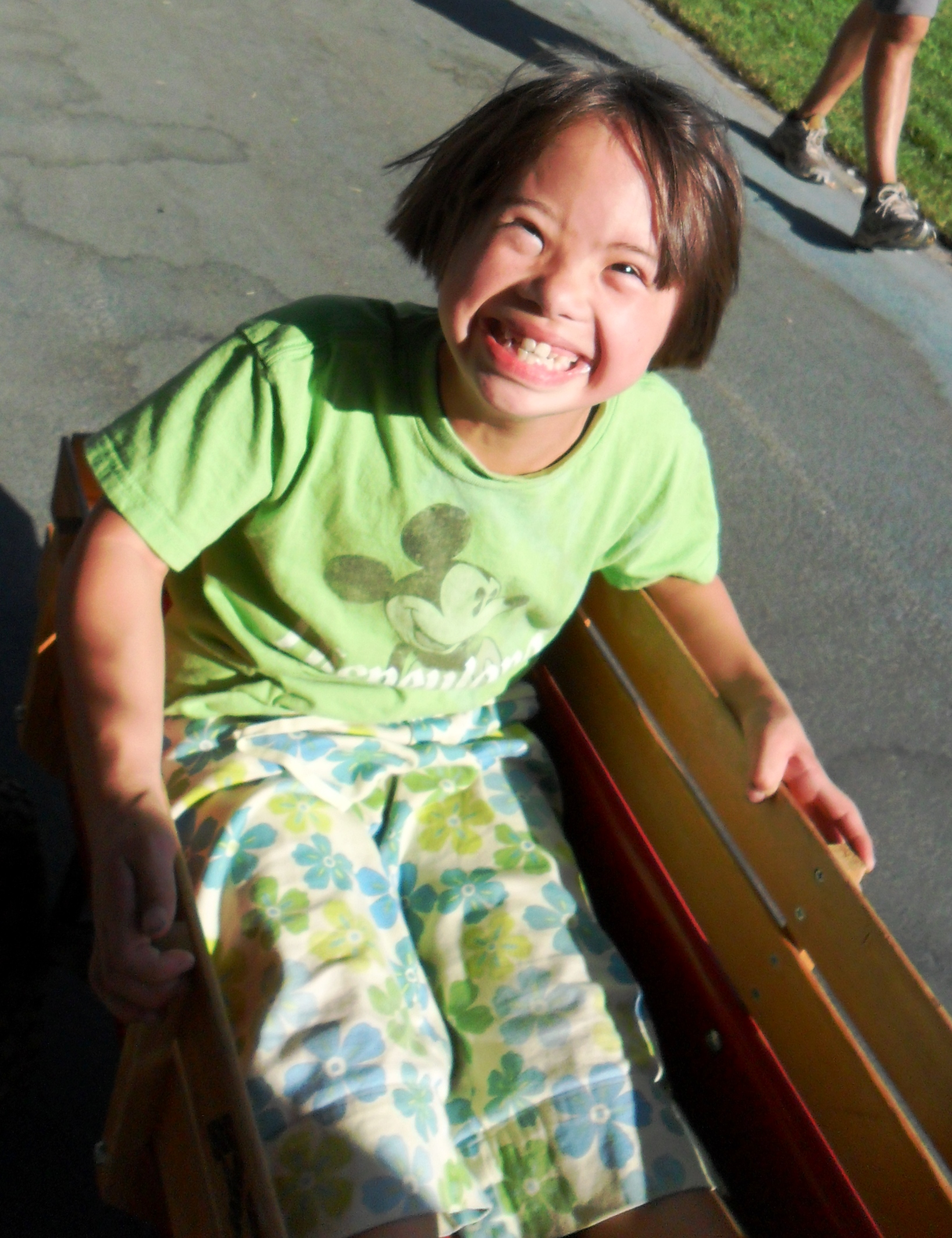
It’s so much easier to explain the how and, especially, the “why” of hormones and moods and all that female stuff to a young woman who understands the nuances and can do a little better at looking inward and analyzing a bit and piecing things together. But I fear those kinds of things are lost on my second child. So it just breaks my heart to see her going through these moods and having no idea why she feels so sad all of a sudden.

Nope, this is a lot trickier than just making sure my toddler is learning to walk properly or hold a pencil well so she can write. Those were walks in the park. Now, life is much more complicated. But isn’t that always the case?

Down syndrome discrimination in the skies

I’ve concluded that I’m not really much of the litigious sort. When I fell down and broke my foot on the DMV sidewalk, I didn’t immediately figure out some way I could sue the state. Whenever I get the little postcards or emails about class action lawsuits involving some company or other I have patronized, I don’t just jump on the bandwagon to “get mine.” Most of the time, those suits seem pretty petty, and I haven’t had any problems with those businesses.

But once in a while, my “sue-’em-for-all-they’ve-got” side gets incited. Yesterday, my husband told me about a story that got me fired up. And it even involves a family in a town near us. The short story is that a teenage boy with Down syndrome was refused access on one airplane and on another wasn’t allowed in first class (which his father had upgraded to), instead being forced to “the back of the plane.” The airline even kept other passengers away from the family, keeping two empty rows between the teen and his parents on the back row and the rest of the passengers.

WHAAAAAT??

Yep, my girl is a great traveler.

As some of you may know from reading my blog, I have a 14-year-old daughter with Down syndrome. I wrote a post about her on World Down Syndrome Day. I’ve also, incidentally, written about traveling with kids and how airlines have been making it more and more difficult. I am quite sure airlines would be very happy to only allow business travelers to fly with them. They’d make more money and have no delicate issues to deal with. But they still do allow everyone to travel, so for now they’re stuck with families and people with disabilities. SORRY, poor little airline businesses. Boo-hoo. So I know what it’s like to be a parent and have to fly with a posse of little ones. It can be tiring and annoying on the best of days and absolutely crazy-making on the worst. I have flown a number of times over the years with all my children, including my child with Down syndrome.

I have also been able to get to know lots of great families with children with Down’s over the years, and I know that parenting a child with DS can sometimes pose some extra challenges. But I have not found the kids I know with DS to generally have lots more behavioral issues than other kids. I know that mine doesn’t. She is extremely eager to help and listen to instructions, sometimes more so than her siblings, and is really well behaved. I’ve been blessed over these years of travel to have other passengers on airplanes gush over how well-behaved she and all my kids were (at the end of a flight).

So it just rankles me to hear that an airline and pilot had the nerve to discriminate against this young man. If people with Down’s really had a known history of having behavior problems, and if this young man had truly been extremely disruptive in the gate area, then maybe I could see their concern. But I know the first isn’t true, and it doesn’t sound as if the second is true.

Yep, if it were my daughter in this situation, I’d be out at my lawyer’s office at dawn the day we were back in town, chomping at the bit.

I hope this family does pursue the case, not to make money, but to raise awareness. I’m all about raising awareness about all kinds of things, and it’s just the principle of the thing. Someone who has a disability (and in this case, what I consider to be a fairly “minor” one) is and should always be protected under the law against this kind of knee-jerk reaction. From this mama bear to another, go out there and show ’em how great our DS kids can be!

Every day with her is special

In honor of World Down Syndrome Day, I’ve decided to post in honor of my own special child, Marissa, who’s 13 1/2. I’ve written a bit about her already, but this post is specifically about my fun little kid.

Fourteen years ago, I found out I would be giving birth to a child with Down syndrome. I felt very blessed to know ahead of time that my baby had this extra chromosome. I’m the type of person who likes to be prepared, so it was nice to have half of my pregnancy to learn more about Down’s and just be ready to have a child with a disability. For me, what made it particularly nice was that her birthday was like any other baby’s birth: a day of joy and welcoming, with lots of photos, phone calls, snuggling with the new little one. If we had been surprised by her extra chromosome that day, I am sure a hush would have fallen over the room and there would have been feelings and reactions other than just pure joy and excitement over a new addition.

Marissa was the sweetest, most content baby I’ve had. She was happy to sit in a car seat or bouncy seat and just sleep or lie awake and watch me and smile back at me. She is still a very happy girl, no matter what. She has moments of frustration or anger or sadness, but they’re so fleeting it’s almost as if they never happened.

We’ve been very blessed that Marissa hasn’t had any health problems, no heart surgeries or anything that we’ve had to monitor. Over the years, she’s had a variety of therapies and extra services through early intervention programs and the school system, and she’s done really well. In fact, for a long time I could practically forget there was anything “different” about her. She walked right before she turned 2, and she has always talked fairly well and mostly clearly. She loves to read and does a great job sounding out new words. She just seems unbelievably bright to me and to others.

It’s now that she’s a teenager that I am more often reminded that she isn’t really in the same peer group as kids her age. She’s always been very small for her age, and the older she gets and the taller and more developed everyone around her gets, the more that distinction is pronounced. She is the size of an 8-year-old and behaves much like a 6- or 7-year-old, really. For a long time, she’s been quite happy playing with her younger sister who’s 4 years her junior; now she seems to be just as content to play with our youngest, who’s almost 5.

She was strictly in a regular classroom at school for some years, up until about 4th grade, when it seemed a better strategy to put her in a class with other students who had some learning disabilities of various kinds. She still gets to interact with her peers in p.e. or in art or computer classes now, but she has a better opportunity to have learning tailored to her needs in a special class. And I’m happy with that, mainly because she gets plenty of attention and seems quite happy with her class.

Marissa is eager to help and do nice things for others and she loves to hug. That actually can become a small problem sometimes because she’ll hug anyone, even someone she’s never met, and we have to keep reminding her not to do that.

At this stage of raising her, I’m honestly most concerned with her biological changes; she’s slowly starting to grow into a womanly shape (even though she’s still really tiny height-wise), and that means she’ll soon be experiencing other womanly changes I’m not sure how to address or warn her about as I did with my oldest. It’s all kind of a trial and error situation, raising her, but that can be said for any kid, I suppose!

There are tons of resources available out there now for parents of children with any disability, and there are many wonderful places to find information and support if you have a child with Down syndrome. The difference between what’s out there now and what was available just 14 years ago boggles my mind. The internet was barely around when she was born, with not nearly as much information as it has now, and my city library was where I turned for some information when I had my amniocentesis. I found a book that had a little useful stuff, but I think I was just looking for some photos of cute kids, and then I didn’t really find any. Now, there are some wonderful sites and resources that feature gorgeous photos of beautiful children and youths with Down’s, and it does my heart good. This organization, Band of Angels, apparently was around in 1998, but it wasn’t as easily found as it is now, and it just has beautiful photos. When I meet someone with a new baby who has Down syndrome, I either buy one of their products to send or tell the parent about it. It’s just reassuring to see other kids with Down’s given the adorable-photo-shoot treatment. I found it comforting, at least, when I learned about it.

In the first months of her life, I was actually given some books and tons of pamphlets and packets of information about Down’s and different resources available and services and ideas of things I could do to give her a stimulating environment and help her develop. Honestly, I barely read any of them. All that information is simply too overwhelming. When you’re just trying in those early days to get some sleep when you have a baby waking up at night for feedings and diaper changes, that’s the last thing you have energy for: reading and researching. And then as she grew, we had some good support systems referred to us, so I didn’t feel the need to go searching for a lot more.

I think it’s that way parenting any child. There’s always more you can do for them, but never enough time and energy. So you just do the best you can to make their life happy, fulfilled and enriched. Now, I just hope and plan for her to have opportunities as she finishes up with the school system to be able to live semi-independently and have some kind of work and a good support system and network of friends. I want her to have a happy life, just as I want for my other three daughters. And she seems well on her way. Marissa is one happy teen.

Happy world Down syndrome day.

What’s in a name?

So I’ve thought a lot about how difficult it is to just put a name on what I experience. For years, I really wasn’t sure what I had, as I mentioned before and will need to write more about. So if it was hard for me and doctors to label my condition, then explaining it to others is even more of a challenge, even now. Then, even if there is a name, communicating correctly to others so they will really understand is even more challenging.

For a comparison and introduction to my thoughts on this topic, I have a daughter who has Down syndrome. Over the years as I’ve been involved with organizations that advocate for people with disabilities and have spent time talking with other parents, I have been actually very grateful for the fact that my daughter has a very straightforward diagnosis. I’ve met people whose children obviously have cognitive challenges but who have spent hours and hours in doctors’ offices and with other specialists, trying to determine just what their child is dealing with. It’s vital to have some kind of diagnosis in hand in order to effectively move forward with some kind of treatment and/or (especially) educational plans and specialized services. It’s no doubt sometimes a challenge to have a child with a disability (again, whole other topic here), but it seems to me that it’s even more difficult when you can’t put a name to it. I’ve had 14 years of knowing I have a child who has Down syndrome. She’s received the services she’s needed, by and large, over the years, and it’s been relatively simple to make those happen.

What makes her situation simpler also is that her condition is easy to observe on the outside. The physical characteristics that are signature Down syndrome traits are literally written on her face, and pretty much everyone knows by looking at her that they should have some types of different expectations from her. I don’t want anyone to think that I want people pre-judging my daughter or having low expectations for her because that’s not at all what I’m trying to say. But when she behaves a little differently than most people and hugs everyone and talks with a bit of a speech impediment and so on, I can feel fairly comfortable knowing I don’t have to try to explain away what she’s doing because many people will already know there’s a reason to cut her some slack behavior-wise.

A similar “rule” applies to people who have physical disabilities. Many of those can easily be observed; if someone is in a wheelchair because of paralysis or uses a cane because of a limp or even has a seeing-eye dog because of blindness, that person instantly can communicate without needing to say a word that he or she has a particular challenge to which others might need to be sensitive (although they generally just want to be treated like everyone else, their situations are at least fairly clear to others, and then others can choose how to be most sensitive and kind to them). But mental health issues are completely invisible. No one can tell by looking what someone who struggles with mental illness is having to cope with.

The companion issue is that mental illness simply is not as readily understood as physical illness. Each individual in this world has a package of trials and difficulties (as well as talents and skills and interests) that is unique. Some face tremendous trials in this life. Some are open about some of the things they face, and others prefer to be quite private, sharing details or even basic information with very few others. So some people who are diagnosed with cancer will talk readily about their illness, their treatments, their prognosis, their fears and frustrations. Others will keep quiet. But those who do share more, for instance, a cancer diagnosis, will likely be quickly understood. “Cancer” is a word that is easily communicated in our society; listeners will think “chemo,” “surgery,” “radiation,” “sick,” “death” or “remission” when they hear it. They will feel compassion and a desire to help, perhaps with meals or rides to a doctor or something similar.

On the flip side, however, is mental illness. Mental illness today, with its various diagnoses like schizophrenia, depression, bipolar disorder, and so on, is coming out of the darkness in a way; more people talk about it in society, but it’s still not as easily understood as physical illnesses. There is generally no stigma associated with illnesses like cancer (although, frankly, there can be a bit with some illnesses that can be linked in part to unhealthy habits), but there is lots of misunderstanding, confusion, and stigma associated with mental health. Either people think that mental illness really doesn’t exist and a sufferer is “making things up” or trying to get attention or something else, or they think that their mental problems are bad habits that just need to be broken. Someone with depression could be told to look on the bright side or to just force themselves to get out and about, for example. Or others may simply recoil a little bit from someone who has a mental illness; they may be seen as weak or “crazy” or “scary” or unbalanced. Mental illness can make others feel uncomfortable and nervous, rather than compassionate and eager to help and lend support.

So back to the name. When I have chosen to share with someone, briefly, that I deal with issues of mental health, first, over the years, I wasn’t sure what I did have, and now that I (basically) do, I still can’t just say, “Well, I have atypical bipolar disorder or bipolar II.” No one knows what that means. Communicating requires that both people understand the meaning of a word. Like I said before, if I say, “I have cancer,” I can pretty much leave it at that and someone else would know what I meant. But if I wanted to briefly mention, “I have bipolar disorder,” half of people wouldn’t know what I meant. Even if they did, my version of this “spectrum” is practically unique to me, so it would require several more paragraphs to get across a basic meaning that one or two words couldn’t convey, as “cancer” would for that illness.

What’s the upshot? It’s just a lot easier not to ever tell anyone what I deal with. One, I can’t say it quickly and move on to other topics. Not possible to communicate what I need to quickly. I might find someone who is very sensitive and eager to talk to me about it, but it’s going to lead to at least a 15-minute conversation, and sometimes there’s no time for that. Two, if I do say what I have, and someone else basically understands what I’m talking about, there’s always a possibility they may have a negative connotation in their minds that will lead them to make judgments about me that I’d rather them not make.

On my bad days, I’d be happy to stay at home, keep to my bed, and refrain from human interaction so as not to offend or cause any problems. But many of those days, since I do have four kids and lots of responsibilities, I still have to be out and about, getting things done. I’m then more likely to be impatient or super-irritable or sometimes just want to cry over something dumb that wouldn’t bother a normal person (or me at some other time) at all. It’s those days I wish I had a sign on my forehead that just says, “Please excuse me. I have a mental illness; I do my best to deal with it constructively; I take medication, I see a therapist regularly, I try to relax and take care of myself as much as I can given my limitations. But I have a family; I have responsibilities, and life goes on. I’m standing in this line that has taken forever and it’s making me feel completely at the end of my rope. I’m valiantly doing what I can here, but my best on this kind of day isn’t too great. Please give me some leeway and smile at me encouragingly or just try not to judge me.” But my forehead isn’t as big as a billboard (thank goodness), and this sentiment wouldn’t fit on it.

So no, there is no outward sign of my inward distress to give people around me (strangers or friends) any indication of what I deal with regularly or if I’m having a bad day in particular. (Very close friends will understand if I just say a few words because after years of talking and explaining, some shorthand will work. But this only applies to a handful of individuals in my life. You know who you are.) There are no physical indications, no typical characteristics to tip anyone off. And if I were to say something to someone else, I couldn’t really capture the essence of what I want to convey in just a few quick words. It’s frustrating. Again, this is all part of why I’m writing on this blog. I’d like to extend to others who don’t have my particular challenges the kindness of helping them to see more clearly from my viewpoint, all at their leisure whenever they’d like to read this. And for those who experience similar feelings, I hope you can feel a kindred spirit.