It’s high time to stop objectifying women and girls

What’s it going to take for our society to just STOP seeing women, and even girls, solely as sex objects?

This past couple of weeks, one woman’s blog post asking Target to stop the miniaturization (i.e. sexy-fication) of young girls’ clothing went viral. Rightly so. I have four daughters, ages 18 down to 7, and I have long chafed over the fact that retailers simply make girls’ clothes shorter, tighter, and smaller than boys’ clothes.

(Unfortunately, the one place this doesn’t seem to apply is in the waist and hips, because it’s dang hard to find a good variety of slim pants sizes for my slim girls. JCPenney makes them; Gap and Old Navy make some slim sizes; online retailer Lands’ End makes them. But this being a slightly-related but not completely-related topic, I’ll just keep it to this: can’t we have more sizing options? Yes, I know that, one, people — including kids — come in all shapes and sizes, and two, there are more and more heavy kids in what’s becoming an obesity epidemic, thus necessitating the plus sizes in kids’ clothes, but there still are some children out there who eat fairly healthy and are naturally slim. Argh.)
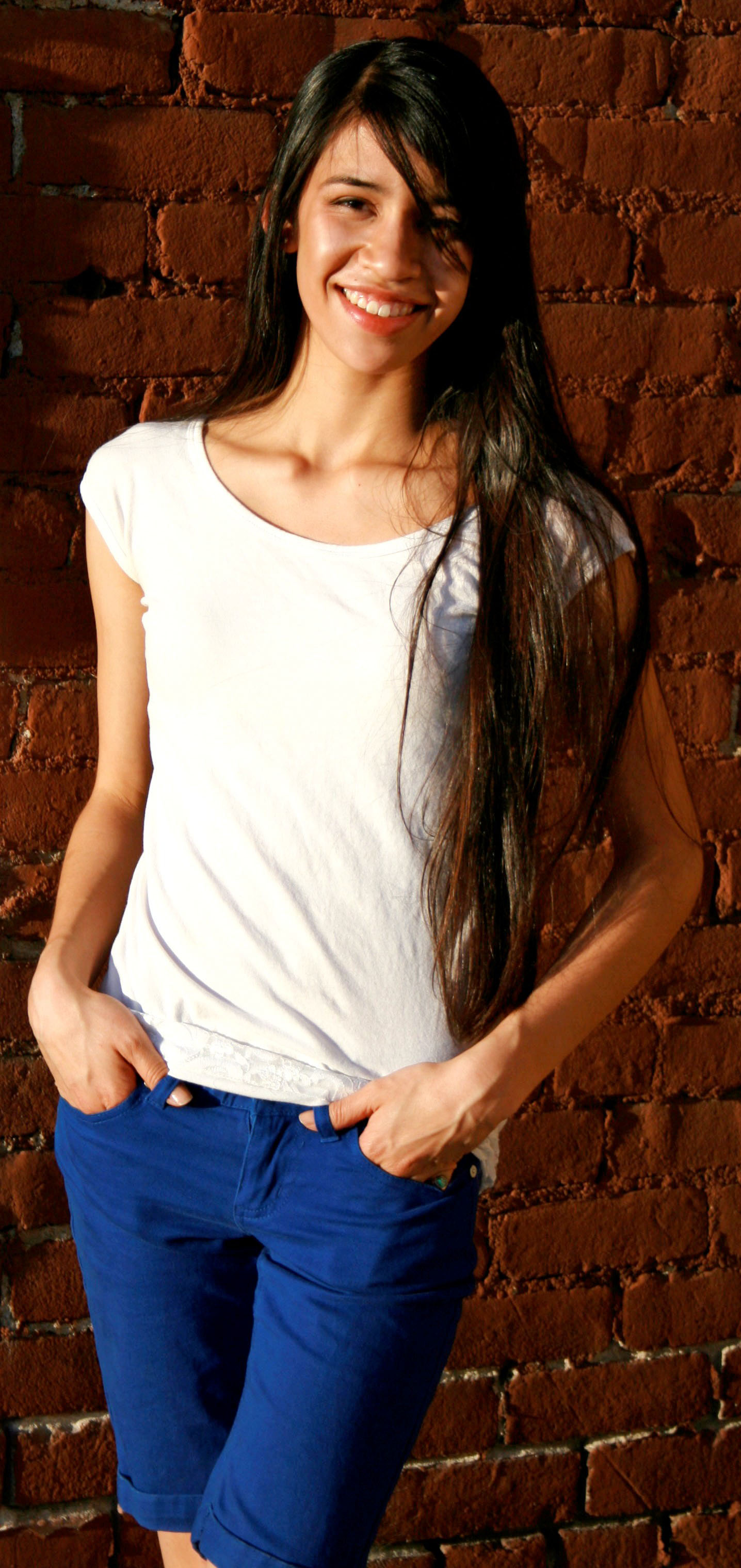
My oldest, in Bermuda shorts.

Anyway, back to the topic: Just because teen girls seemingly prefer short-shorts instead of Bermudas doesn’t mean mothers want to buy Daisy Dukes for their toddlers and elementary-school-age kids.

This goes as well for all the junior-department dresses that are about 16 inches long, particularly formals, that are strapless and end mid-thigh. Pair these with the also-trendy stilettos or huge platforms, and we have the stereotypical image that’s traditionally been reserved for prostitutes.

And look at what a really gorgeous and fun but not-skimpy dress we found for prom.

Mind you, I do like style, particularly dresses. I adore dresses! They’re so fun and girly and there are just SO many styles and interesting looks. I love to shop for myself; I love picking up new frocks for my girls (on sale, naturally; the better the bargain at a nice retailer, the bigger the smile on my face). But there is no reason for such a high proportion of dresses to skimp so much on fabric. And taking the sexy styles of teens (which are too sexy for girls who haven’t even reached adulthood yet) and adapting them into preteen styles is just NOT COOL.

More of us parents and shoppers should be ACTIVELY doing more to contact retailers and demand change. So kudos to this blogger. See? One person asking for change can make a difference.

Then there are the constant stream of images in the media, whether it’s music videos or movies and TV shows (to which our girls are looking for inspiration or, at the very least, simply can’t NOT see in their digital lives). The latest, apparently, is a horrific video by Maroon 5, “Animals,” featuring Adam Levine as a butcher who stalks a female customer. Oh, yeah. Let’s glorify the “fantasy” of a male stalker — a butcher surrounded by bloody carcasses, no less — with an “animal” lust that can’t be controlled.

What continues to elude me is why women who are participants in these blatant displays of demeaning women are willing to sign on. The Maroon 5 video features Levine’s new wife, Behati Prinsloo. No doubt the honeymoon phase hasn’t worn off yet. Otherwise one would hope she would be the first to say, “Look, Adam, honey, I don’t think that’s a great idea. Let’s try something else, shall we?”

Then there are Jennifer Lopez and Iggy Azalea celebrating their barely-clad backsides in “Booty.” (Let me note that I have not watched these videos, just seen a few screenshots. I do NOT care to put any more images in my head of these things.) They are the stars of their own shows; J.Lo, with her clout, arguably does or could control her image and what kind of music she sings and videos she shoots, so I hold her more responsible. I believe the typical argument goes like this: “I’m a strong, empowered woman, and I’m taking control of my own sexuality and am CHOOSING to show my sexual side.”

My only response to this is this: Baloney.

You know that you’ll get lots of attention and more money by using your sexual side to sell your “brand.”

Think what these empowered women could do if they really put their money where their mouths are and CHOSE to send different messages, messages about how richly talented and diverse and interesting women and girls all are, starting with themselves. And think what we as consumers could do if we sent a message the other direction to these celebrities and the media who promote them: What if we truly did not buy their products? What if millions of us rose up in protest and sent emails and letters, showing that we really don’t want what they’re foisting on us?

In an age when many of us really are trying to teach our girls something better, to rise above worries about trivial matters of our appearances, why are the music industry, the film and TV industries, working so hard against us? (Rhetorical question, folks.)

I heartily agree with this sentiment expressed by a parenting researcher and author in The Daily Telegraph: “I am sick of trying to teach my daughters how much they have to offer the world, only to have everything I say undermined by the sleazy, unhealthy messages that someone with no respect for womanhood promotes to the mass market to make some more money. The wellbeing of our wives, sisters, and daughters is worth more than that. It’s not OK.”

Today we recognize the amazing determination of one teen girl in pushing for education for girls in her native Pakistan. Malala Yousafzai was awarded the Nobel Peace Prize: one of the finest achievements anyone could aspire to, and she’s only 17. We aren’t all in awe of her for her booty, her figure, her beauty, or her style; far from it — she covers her head in public with colorful scarves. She bears scars from being shot in the head for campaigning for girls’ right to education. No, everyone is impressed with her convictions and bravery to do the right thing, despite almost being killed.

That’s what matters. That’s what we want to encourage our girls to embrace about themselves: their strength, their bravery, their determination to find the best in themselves and make it better and share it with others, conviction to make the world a better place. They’re all different sizes, different colors, different backgrounds. But they all have so much to give! I speak from experience because I have amazing girls.

It is high time we ALL spoke up for the amazing girls and women of this world and helped them reject being reduced to mere one-dimensional sex objects.

Words DO matter

For the second time this week, I’ve come across a “campaign” to ban a word. Today, it’s the “Ban Bossy” movement, asking people to stop calling young girls “bossy” when they assert themselves, so we can better encourage girls to be leaders. Earlier this week, it was the campaign to ask people to stop using “the R-word.”

I can heartily get behind not just the idea of cutting the overuse and/or misuse of these words, but with the overall goals of the campaigns themselves. As a woman and the mother of four daughters, I am happy to support encouraging girls in their desires to make a difference in whatever community they’re in, whether it’s a classroom, a school, or a group of some kind. And as the mother of a delightful daughter with Down syndrome, I HEARTILY support the request for people to pledge to stop using the word “retarded.” I have never heard someone use it as a neutral descriptor of someone’s development, which is what it was intended to do: it simply means being slower or stopped in intellectual or emotional development or academic progress. What people always use it to mean is “stupid” or “beneath” or “outrageous.” It’s used as an epithet, as a put-down, a derogatory descriptor. I flinch whenever I hear someone use it in casual conversation.

Some may say that language is constantly evolving and that some of these movements are just about semantics. But words have meaning, whether that meaning is different today than it was one year ago or 50 years ago. They pack a punch. I absolutely adore words. I love their power to express thought and feeling, to communicate what sometimes is difficult to translate from abstract notions in one’s head and heart. Their accurate and precise use can feel like a miracle.

The problem is this: many people do not know their own language sufficiently well to be able to articulate correctly what they want to get across. They get by on a pocketful of vocabulary words when a stuffed backpack would do the job much more effectively. They do not understand that their careless use of that limited pocketful can end up coloring a picture in someone else’s mind that does not match at all the picture that originated in their own. That breakdown in transmission of understanding can create hurt feelings at the very least; it can change actions (not in the intended way); it can change attitudes (not for the better).

Since our language currently has evolved to use the word “retarded” to mean the colloquial “lame!” or “stupid” or “ridiculous,” the cat’s out of the bag now and we can’t force it back in, for the word to go back to meaning just its “neutral,” “unloaded” version. It is now a loaded word and will cause people to cringe. It will continue to insult those who have disabilities and those who care about them. So, yes, it’s time to take that loaded word out of our pocket or backpack and just toss it in the trash.

When it comes to empowering girls, who are growing into future women leaders, capable of contributing a great deal to society, we can stop belittling them with words like “bossy.” We can talk to them using words that express our confidence in their abilities, that don’t compare them negatively with boys, that don’t show some underlying expectation that they are lesser. We can value them as females and acknowledge that there are differences between the sexes but not fall back on easy gender stereotypes. “Bossy” may very well be already a loaded word with too many associations attached that we can no longer un-attach. At the very least, we need to be much more careful of how we employ it and in what situation.

Yes, words matter. They’re the building blocks of how we share our opinions, our feelings, our ideas. We need to choose them wisely and assemble them effectively.

A sensitive topic: race and hair

Gabrielle Douglas
Photo by Los Angeles Times

My husband and I were struck particularly this week by some of the talk that swirled around the Web after the amazing Gabby Douglas won all-around gold in gymnastics. We were both dismayed to read how many of her fellow blacks commented not on her performance or her history-making status as the first black woman to win gold in the individual all-around at the Olympics, but on … her HAIR.

Yes. Her hair. Now, I have read a couple of fairly reasoned comments by blacks explaining why the intense focus on her hair and disparaging comments about it, saying that since she is “representing black people” as a whole, who have experienced a clearly bad history of injustice and who now feel they have to essentially overcompensate to be seen just as equal, that even appearance is an important facet of that sense of proving themselves. There is no question that that is sad.

It’s bad enough that women today are being pressured more than ever to look perfect according to current societal norms. These norms are admittedly different (within each community, at least, though not in our society overall) for whites and blacks. And blacks make no secret about how their hair is always a challenge. Comedian Chris Rock put together a very interesting and entertaining documentary about the topic, in fact, called “Good Hair.” It was just a glimpse for those of us who do not have that texture of hair into what it’s like to try to come to terms with it.

I’m only weighing in on this topic because it’s a personal one to me. We have three biological daughters, but we also adopted our youngest daughter, who is black. And from the second we got her (the day after she was born) and took her out in public, we started getting advice from blacks on how to take proper care of her hair. Five years later, we are no less inundated with opinions.

They haven’t been unwelcome. It’s clearly true that I have no experience styling black hair. I have dark blond, smooth, straight hair. Easy-peasy. I wash it and comb it and that’s pretty much it. I’ve got it good even for a white person. So it’s helpful to have people who have experience give me ideas. What’s been interesting, however, is just how varied and sometimes clearly opposite those tidbits of advice have been. My husband had co-workers telling him from the start to use Vaseline in our daughter’s hair. Others said absolutely categorically that Vaseline was NOT what we should use. When it came to products, then, I ended up fairly early buying and using the products made by Carol’s Daughter. I like them, they smell wonderful, and they seem to keep our daughter’s hair mostly smooth and manageable if we use them every single day. So, end of story. The product side is done.

What’s the other even bigger issue is that of STYLING. I’ve been mostly interested in just letting her have a natural style, keeping it oiled nicely and combed, but nice and curly and as-is. I’ve even been bolstered in this opinion by seeing all of the emails and information that Carol’s Daughter is sending out to customers about “transitioning” to more natural hair. I absolutely refuse to straighten her hair with strong chemicals. If she chooses to do that when she’s “of age,” she can, but I am not going to put lye on her tender scalp.

So straightening chemically is out. But what about styles? When I’ve gotten ambitious, and had some time on my hands, I’ve put her fairly short hair in little “poof-balls,” as I call them. They look super-cute. But I have never learned how to do cornrows or other similar styles. This week, however, I decided to try just braiding her hair. We sat down and spent half an hour getting this done. I put about 15 little braids in her hair, and I think it looks cute and, I think, SHOULD be approved by blacks.

Then again, I worry. With five years experience getting blacks’ advice (sought and un-sought, from friends and strangers), I know it can be contradictory, and that it is taken VERY seriously. This is why I am not surprised at how Gabby Douglas’s hair was discussed in what most whites would consider rather mean terms. Blacks are serious about their hair, and it’s a complex issue for them. Many women, thanks again to the not-helpful culture in which we all live, feel self-conscious about their textured, very curly hair. They want to have smooth, straight hair that isn’t so “ethnic.” As with all the other topics I’ve written about so far in the broader issue of beauty and contemporary culture, I find this sad and disappointing. Why in the world can’t we have a whole variety of “ideals”? And why does there have to even be an “ideal” shape or look anyway? Can’t everyone just be who they are, whatever shape, size, color or hair they have?

I suppose now I’m just being idealistic. It’s probably crazy to hope for something so drastic. But it doesn’t hurt to discuss it and remind ourselves that just being our own best selves is desirable. It’s a tough fight because we’re battling against SO MUCH societal pressure and messages, but we can still try to fight it.

I suppose also that I could have spent more time over the past five years going to special salons to get blacks to style my daughter’s hair. But, as with many issues I’m aware will crop up over the course of her life with me being white and her being black, I hope we can strike the right balance between pretending (ridiculously) there are no differences between us and making a big deal out of them (I just want to always acknowledge that, yes, she is adopted, but I am her mommy always and forever, and that, yes, she is black and I am white, and, yes, her hair is different than mine, and then just go about the business of being just who we are). I am just taking this interracial-adoption situation a day at a time, and just being her mom. (And, really, adoption and interracial adoption are just whole other big blog-able topics, aren’t they?) I’m doing the best I can to be a mother, period, and to be a mother to both biological children and an adopted child.

For now, I hope to be true to each of my children, for who they uniquely are. My youngest is black and adopted. My second-oldest has Down syndrome. The older three are half-Caucasian, half-Filipina. And each has her own amazing talents and gifts and personality traits. And each will have her own hair and appearance issues. But I hope that no matter what, each can feel good about herself and not succumb to society’s negative values, especially about image.

Yes, I might be treading on a minefield here. I’m well aware of that. I hope to be respectful but also share my own experience. My daughter’s only five. So I’m sure we have many years ahead in which we will just continue to take one day at a time in dealing with hair or anything else that becomes pertinent.