A shout-out to the blog that started this conversation

Early last month, I saw this lovely post linked from a friend’s Facebook page. It got me thinking about my situation, and I decided it would be useful to start a blog that talked openly about mental illness. So here we are, about six weeks later.

Being Sunday, I will focus today on some faith-related observations. I don’t necessarily intend this blog to be focused entirely around faith and my religion in particular, but from time to time I’d very much like to address belief because it is very important to me and how I experience life.

I am of the opinion that my church, the Church of Jesus Christ of Latter-day Saints, has done a nice job bringing some of these more sensitive topics to the attention of the church membership worldwide. The official magazine of our church is called the Ensign, and it comes to homes monthly with lots of wonderful inspiring articles and first-person experiences of how the gospel of Jesus Christ has changed people’s lives. The magazine has featured over the past decade more and more articles that address special situations like how to parent and teach people with disabilities, for instance, and how to tackle the problem of pornography. It has featured articles about mental illness, as well, from the viewpoints of licensed therapists and from those who have struggled with it personally.

So in no way do I think our church has tried to sweep the issue under the rug or act as if it isn’t a challenge to many people. I have definitely enjoyed the articles about mental illness in the official magazine, and I have appreciated books that have been published about the topic that are aimed at the LDS audience.

But I do think that more can be said, more can be done to bring what was once rather a taboo topic out into the open. I’ve already written about how more people seem to understand physical illness, and I liked how this blogger mentioned the same feeling. Our church women are known for providing meals to those who are sick or who have just had babies. We’re great at delivering casseroles. But while I have been given some meals over the years postpartum, I haven’t been provided much sustenance when it’s come to my mental recoveries. I think that there are basically two reasons for that: 1) few people even know when someone’s suffering from mental illness (in general or a bad episode of it) and 2) our society as a whole still just doesn’t talk about it enough so that it’s something people all feel comfortable with. Sure, not everyone is even good about talking about physical illness, shying away from the “C” word, for example, but even so, I think that the more a topic is addressed, the more people can become comfortable with it and the less it will feel like a taboo.

So here I am, again writing these words out in public so they can feel less strange, less taboo, less “other,” less misunderstood. The topic of mental illness is extremely personal to me, and I could continue being very private about how it’s affected me, or I could do what I’m doing now: just speaking out loud. I think this whole blog has that same purpose: to contribute to a conversation, to raise awareness, to increase sensitivity and understanding. I think that in our day we have been blessed with the gift of technology, and if we use it to improve and uplift people’s lives, we will be giving a gift to others.

A tribute to a one-in-a-million man

Since he turned 45 yesterday, I decided today would be a good day to recognize the superhuman support and love of my husband, Marce. I met him when he was 25, and in a way it doesn’t seem possible we’re in our 40s now, that nearly 20 years have gone by. I’m quite sure when he fell in love with me and decided to propose he had no idea what his married life would have in store for him.

We did have some discussion while we were dating about my mental health. I had returned from my mission, gone through the heartbreak I did with my longtime friend, and been started on lithium after a diagnosis of bipolar disorder. One evening we took a drive to visit my mission president, a man I love a lot and greatly admire, and who was sensitive to my needs. He and his wife sat and chatted with me and Marce; we had only been dating about two weeks at that point, and I didn’t really expect it to get serious. My president asked about how I was doing emotionally, and I told him so far, so good. His dear wife whispered to me, “He is a good young man. Hold on to him!” (She was more right than I could possibly have known that evening.) On the drive back to school, Marce asked me, “What did he mean about taking your medicine?” That gave me the opening to just tell him everything about what I’d experienced and where I was at that point. He listened quietly as he drove, held my hand, and seemed very reassuring and nonjudgmental, which meant a lot to me.

Sometime in the few months after that, I decided to stop taking the lithium because I just didn’t feel I had bipolar (I just didn’t fit the symptoms of the “bipolar I” or the typical disorder, as I think I’ve written about already). The medication could have dangerous side effects, and I needed to have regular blood tests to make sure it wasn’t damaging my liver. I felt since I wasn’t sure about the diagnosis taking a possibly harmful medication didn’t seem like a good idea. Unfortunately, around that same time I got engaged, finished college, and started my new life, and got so busy with a new full-time job and a marriage and new place to live and everything else that I neglected to consider my mental health. If I remember correctly, I didn’t do anything about it immediately (though I know I did find a psychiatrist sometime in that next year). I also started taking birth control medicine, which is chock full of hormones, which I have also learned was probably not a great addition to the cocktail of my personal chemical makeup. Again, unfortunately, I didn’t know any of this at the time.

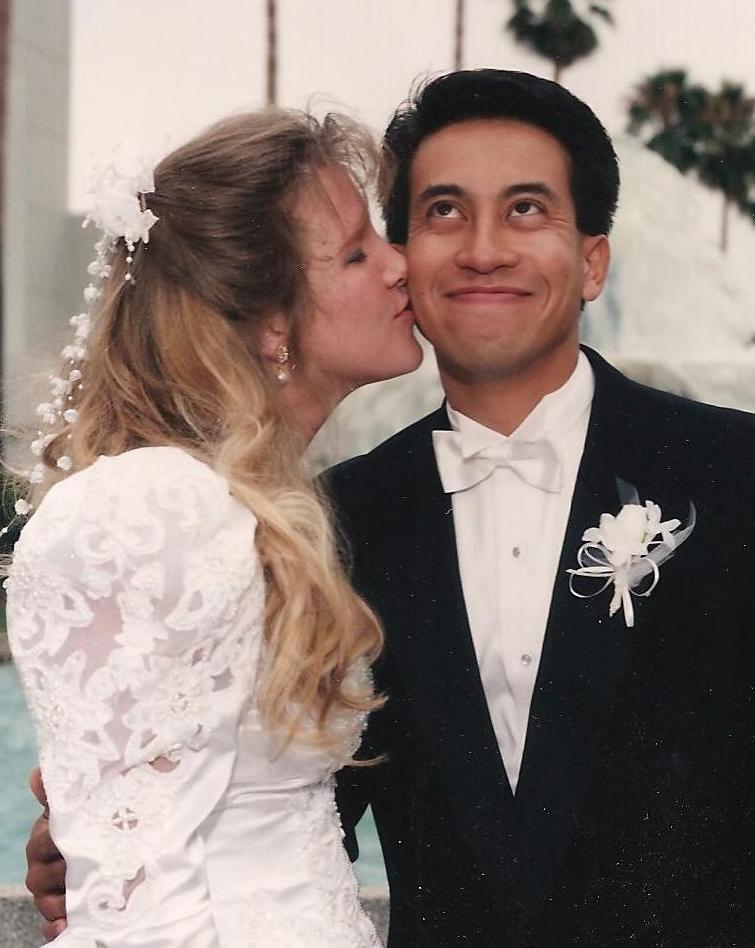
My sweet love on our wedding day.

What my dear groom experienced in the first year of our marriage was a number of occasions of me flying off the handle at nothing. I remember one trip on a day off to an amusement park, where I went ballistic over something someone near us did and shouted at them. I don’t remember the details, and honestly, just thinking about the idea of it anymore and writing it down mortifies me. But it’s what happened. I was a mess. On that occasion and others, Marce would just quietly try to divert my attention and take me away physically. He rarely made any comments or judgments.

The two of us have very different temperaments and backgrounds. My family was very open and didn’t hold back our opinions. We argued and yelled and were loud. His family was a strict Asian family, and the children did not talk back. There was no argument between children and parents, and yelling wasn’t tolerated. On top of those differences, I had a background in speech and some debate and a need to win. Marce played basketball and never debated. I’m sure it mattered to him if he won basketball games, but he just wasn’t (isn’t) a competitive type. Put that together, and you have no arguments, sure, because it takes two to argue. But I’ve certainly hankered for it over the years. If he had been the arguing type, we’d have had some doozies. As it was, I’ve yelled and screamed and done wacky things, and he’s listened in silence with a nearly emotionless face.

I’m not writing any of this because I’m proud of it. Very much the opposite; I’m embarrassed as all get-out. In many ways, my yelling and anger doesn’t fit with what I consider almost my “real” personality. But it’s happened, and it’s impossible to say that it’s __ percent my hormones/brain chemistry and __ percent my personality/upbringing/etc. I’ve already written about how it’s not possible to separate my “true” personality from what’s been caused by my mental disorder. I just am who I am; what I’ve done and experienced makes me who I am now. I hope that all of my flaws (chemical or not) have at least helped to turn me into a better person over the years, rather than cement me into place as a meanie.

It could be accurate to say that Marce may have needed to be more assertive or actually discuss issues with me more rather than just be silent. But that’s an issue for his blog, if he were ever to write one. What’s important and relevant is that over the course of being together for 19 years, he has never yelled at me; he has never left. He has always loved me and been supportive. I don’t think he’s judged me harshly, despite my giving him good reason to do so. He has done that from the very beginning, up until now, when we can at least put some good labels to what we experience together. Because at this point, it’s not just MY mental health issue; it’s OURS. (Although I have said at times when I’ve had the worst moments that he’s lucky he can at least go to work or somewhere else and get away from me for a while, whereas I can’t get away from myself and what’s happening in my head.) We are in this together; we’re a team. What’s his problems are mine and vice versa; what are his strengths could also be mine, and vice versa. I’ve known from fairly early in our dating days that I just felt comfortable, myself, with him, that I didn’t have to pretend to be something or someone I wasn’t. I was at ease; I felt loved. I’ve also known that we complement each other perfectly. We have truly made a great team.

Many other men may have bolted long ago from what I’ve put my husband through. But he is not other men. Sure, he has weaknesses, but he is an unconditionally loving husband who is dedicated to the institution of marriage and to me, personally. He and I believe that our marriage can last forever, and we’re working on it so we can be happy together for eternity. I now have confidence that is truly possible because I have 18 1/2 years of knowing for sure that my husband is committed to that. I am very blessed. His support has made all the difference in what have been some really challenging times. So, happy birthday, my love. I hope that my strengths and commitment to you have shown you how much I love you and appreciate all you’ve been to me.

Latest discoveries

It’s going to take a whole lot of posts to cover my life and experiences in this department. So I started at the beginning, but I’ve been jumping around since that first post. I’m going to try to explain a bit where I am now.

We moved to California in late summer of 2008 from Alabama, where we had lived in one town for 10 years. We were pretty well settled there, even though we hadn’t expected to stay there for so long. But our children’s needs, primarily, induced us to move cross-country. Though I had some time to plan and prepare for the move, the whole thing didn’t go nearly as smoothly as I would have liked. It took ages to get into a house of our own, during which time we lived with family and had all of our possessions in a storage unit. Then we waited and waited for our house in Alabama to sell, and after a year of waiting and one very low offer that fell through, we decided to rent it out. The stress of all those things, combined with the financial stress of paying two mortgages for a year, made life very difficult. I just felt depressed and frustrated and irritable pretty much all the time.

I had been seeing a psychiatrist in Alabama for a year or two, during which time he’d put me on an antidepressant that seemed to help fairly well. But with the move, it just wasn’t doing enough. So I started surfing the Web one morning and found a site that turned out to be very useful. It’s just a very simple-looking site by a psychiatrist who has shared many of his insights online. He also wrote a book called Why Am I Still Depressed? I pored over the site and then ordered the book. I decided that it was time to see a psychiatrist in my new town, rather than having my general doctor keep writing scripts for the old antidepressant.

The site had really struck a chord with me; its information led me to believe I was experiencing what this doctor (James Phelps) describes as bipolar II. Armed with this bit of information, I found one of the two psychiatrists in town that my health insurance covered and made an appointment. My new doctor and I talked, I shared my opinions, and he prescribed a new medication; he called my condition “atypical bipolar disorder,” but it’s just a slightly different name for what Dr. Phelps called bipolar II. The new medication seemed to work fine, and just knowing I had new information and a new medication gave me hope.

Three years later, this is still the diagnosis I’m working with. I’ve tried some different meds and a different doctor (I’ll write other posts on those topics), but we’re still going with that. Honestly, though, I still wonder how many other factors are at play. Dr. Phelps’ website talks about how thyroid disorders are sometimes tied in with bipolar II, and since I’ve been hypothyroid for about 12 years now (well, that’s when my doctor and I discovered it), I can’t help but think it may play a part in what I experience, even though I have been on thyroid replacement medication for all that time and it’s supposedly controlled (according to blood tests that my current doctor administers every year: and THAT, again, is a whole other topic). I also have noticed that I feel particular sensitivity to hormonal fluctuations, during pregnancy and postpartum and my monthly cycles, and those must be factors as well. I’m fascinated by how things work, and the complex interplay of hormones in the body is so interesting to me (I even wrote a paper about hormones for a research project in English in high school before I knew how personal it was). So I would love to figure out exactly how all these things work together to create my particular issues. Doctors, however, basically don’t seem to care about this (How could they not? Do they not have any curiosity?), at least when it comes to treating me. They just want to know that they’re finding a good medicine to treat me, and that’s all that matters. They have a point, I suppose, but I’d just love to know how all this works inside me. As far as we’ve come in being able to treat mood disorders, it still feels like we’re kind of living in the 19th century treatment-wise compared to all the other feats of medicine that exist.

So I could say now, “Well, this is it. I’m almost 42, and I’ve finally figured out what’s going on with me.” But even though I feel fairly confident that I’m on the right path — and it’s a big relief, I must say — I still wonder if in 10 years my diagnosis might change and I’ll look back and say, “Gee, we were close but not quite there.” At any rate, this is the best we have right now, and we’re going with it. It’s something, and something is better than nothing. I suppose, when it comes down to it, this is really just an extension of my previous post, “What’s in a name?”, because we have a name but that name could very well change. It’s just nice to have a name; it helps me to wrap my mind around what I experience, it helps me on occasion to explain to others if I feel so inclined, and now it might help you.

What’s in a name?

So I’ve thought a lot about how difficult it is to just put a name on what I experience. For years, I really wasn’t sure what I had, as I mentioned before and will need to write more about. So if it was hard for me and doctors to label my condition, then explaining it to others is even more of a challenge, even now. Then, even if there is a name, communicating correctly to others so they will really understand is even more challenging.

For a comparison and introduction to my thoughts on this topic, I have a daughter who has Down syndrome. Over the years as I’ve been involved with organizations that advocate for people with disabilities and have spent time talking with other parents, I have been actually very grateful for the fact that my daughter has a very straightforward diagnosis. I’ve met people whose children obviously have cognitive challenges but who have spent hours and hours in doctors’ offices and with other specialists, trying to determine just what their child is dealing with. It’s vital to have some kind of diagnosis in hand in order to effectively move forward with some kind of treatment and/or (especially) educational plans and specialized services. It’s no doubt sometimes a challenge to have a child with a disability (again, whole other topic here), but it seems to me that it’s even more difficult when you can’t put a name to it. I’ve had 14 years of knowing I have a child who has Down syndrome. She’s received the services she’s needed, by and large, over the years, and it’s been relatively simple to make those happen.

What makes her situation simpler also is that her condition is easy to observe on the outside. The physical characteristics that are signature Down syndrome traits are literally written on her face, and pretty much everyone knows by looking at her that they should have some types of different expectations from her. I don’t want anyone to think that I want people pre-judging my daughter or having low expectations for her because that’s not at all what I’m trying to say. But when she behaves a little differently than most people and hugs everyone and talks with a bit of a speech impediment and so on, I can feel fairly comfortable knowing I don’t have to try to explain away what she’s doing because many people will already know there’s a reason to cut her some slack behavior-wise.

A similar “rule” applies to people who have physical disabilities. Many of those can easily be observed; if someone is in a wheelchair because of paralysis or uses a cane because of a limp or even has a seeing-eye dog because of blindness, that person instantly can communicate without needing to say a word that he or she has a particular challenge to which others might need to be sensitive (although they generally just want to be treated like everyone else, their situations are at least fairly clear to others, and then others can choose how to be most sensitive and kind to them). But mental health issues are completely invisible. No one can tell by looking what someone who struggles with mental illness is having to cope with.

The companion issue is that mental illness simply is not as readily understood as physical illness. Each individual in this world has a package of trials and difficulties (as well as talents and skills and interests) that is unique. Some face tremendous trials in this life. Some are open about some of the things they face, and others prefer to be quite private, sharing details or even basic information with very few others. So some people who are diagnosed with cancer will talk readily about their illness, their treatments, their prognosis, their fears and frustrations. Others will keep quiet. But those who do share more, for instance, a cancer diagnosis, will likely be quickly understood. “Cancer” is a word that is easily communicated in our society; listeners will think “chemo,” “surgery,” “radiation,” “sick,” “death” or “remission” when they hear it. They will feel compassion and a desire to help, perhaps with meals or rides to a doctor or something similar.

On the flip side, however, is mental illness. Mental illness today, with its various diagnoses like schizophrenia, depression, bipolar disorder, and so on, is coming out of the darkness in a way; more people talk about it in society, but it’s still not as easily understood as physical illnesses. There is generally no stigma associated with illnesses like cancer (although, frankly, there can be a bit with some illnesses that can be linked in part to unhealthy habits), but there is lots of misunderstanding, confusion, and stigma associated with mental health. Either people think that mental illness really doesn’t exist and a sufferer is “making things up” or trying to get attention or something else, or they think that their mental problems are bad habits that just need to be broken. Someone with depression could be told to look on the bright side or to just force themselves to get out and about, for example. Or others may simply recoil a little bit from someone who has a mental illness; they may be seen as weak or “crazy” or “scary” or unbalanced. Mental illness can make others feel uncomfortable and nervous, rather than compassionate and eager to help and lend support.

So back to the name. When I have chosen to share with someone, briefly, that I deal with issues of mental health, first, over the years, I wasn’t sure what I did have, and now that I (basically) do, I still can’t just say, “Well, I have atypical bipolar disorder or bipolar II.” No one knows what that means. Communicating requires that both people understand the meaning of a word. Like I said before, if I say, “I have cancer,” I can pretty much leave it at that and someone else would know what I meant. But if I wanted to briefly mention, “I have bipolar disorder,” half of people wouldn’t know what I meant. Even if they did, my version of this “spectrum” is practically unique to me, so it would require several more paragraphs to get across a basic meaning that one or two words couldn’t convey, as “cancer” would for that illness.

What’s the upshot? It’s just a lot easier not to ever tell anyone what I deal with. One, I can’t say it quickly and move on to other topics. Not possible to communicate what I need to quickly. I might find someone who is very sensitive and eager to talk to me about it, but it’s going to lead to at least a 15-minute conversation, and sometimes there’s no time for that. Two, if I do say what I have, and someone else basically understands what I’m talking about, there’s always a possibility they may have a negative connotation in their minds that will lead them to make judgments about me that I’d rather them not make.

On my bad days, I’d be happy to stay at home, keep to my bed, and refrain from human interaction so as not to offend or cause any problems. But many of those days, since I do have four kids and lots of responsibilities, I still have to be out and about, getting things done. I’m then more likely to be impatient or super-irritable or sometimes just want to cry over something dumb that wouldn’t bother a normal person (or me at some other time) at all. It’s those days I wish I had a sign on my forehead that just says, “Please excuse me. I have a mental illness; I do my best to deal with it constructively; I take medication, I see a therapist regularly, I try to relax and take care of myself as much as I can given my limitations. But I have a family; I have responsibilities, and life goes on. I’m standing in this line that has taken forever and it’s making me feel completely at the end of my rope. I’m valiantly doing what I can here, but my best on this kind of day isn’t too great. Please give me some leeway and smile at me encouragingly or just try not to judge me.” But my forehead isn’t as big as a billboard (thank goodness), and this sentiment wouldn’t fit on it.

So no, there is no outward sign of my inward distress to give people around me (strangers or friends) any indication of what I deal with regularly or if I’m having a bad day in particular. (Very close friends will understand if I just say a few words because after years of talking and explaining, some shorthand will work. But this only applies to a handful of individuals in my life. You know who you are.) There are no physical indications, no typical characteristics to tip anyone off. And if I were to say something to someone else, I couldn’t really capture the essence of what I want to convey in just a few quick words. It’s frustrating. Again, this is all part of why I’m writing on this blog. I’d like to extend to others who don’t have my particular challenges the kindness of helping them to see more clearly from my viewpoint, all at their leisure whenever they’d like to read this. And for those who experience similar feelings, I hope you can feel a kindred spirit.