So the FOX-TV show with Kevin Bacon, “The Following,” came back a few weeks ago. My Sunday newspaper at the time declared: “Darker days: ‘The Following’ returns.” My immediate thought: Urgh. Is the article saying the show’s going to get even darker? Because that hardly seems necessary (or possible?). It doesn’t look too positive in all the promos.
No, I haven’t watched the show. I am not commenting on its merits because it’s impossible for me to do so. I just am not interested in watching it, given what I can glean about it in the dark and very creepy promos I see while watching other FOX shows.
And yes, I admit, I’m a mostly optimistic, pleasant person. I naturally gravitate toward the sunny and smiley. I LIKE happy endings. I like romantic comedies and chick flicks (although those are not exactly reality; they’re just fun and escapist). And while I don’t expect or want all my media to be shot through a rose-colored lens, I like to see real, imperfect, flawed characters in books and TV shows and movies learn and improve and become better people. I like to see real people I know find happiness and growth.
So given that information about me, it’s natural, I suppose, that I would not be heartily in favor of more dark, scary shows about evil people. Does that mean I should call for fewer of them? Should the viewers who have less sunny dispositions be limited in the dark media they enjoy? Not necessarily.
But I do question why so many shows focus on the dark and evil parts of society and human nature. I think it’s vital that we recognize there are some bad people out there and to be aware and safeguard ourselves. We can’t bury our heads in the sand, stay naive, trust everyone. But is it necessary to spend hours of our time essentially in the company of these kinds of people? Why would we want to wallow in that atmosphere?
I like a great mystery. I like twists and turns and surprises. That’s why I like gothic tales. But I don’t like darkness. I don’t want to spend too much time in it. I want to seek out the light.
So why can’t we have more media that portrays the light? I recently discovered a short-lived (of course) TV show from 2008-2009 called “Eli Stone” that was absolutely delightful. The characters aren’t perfect; they’re learning and do stupid things. But the tone of the show is positive, the characters generally seeking to do better, to be better. What’s even cooler is the show’s exploration of faith. It’s about a man who, in connection with a brain aneurysm, has visions that give him indications about the future and he then seeks out what he can do to make it better, to help other people. He (very) reluctantly sees himself as a kind of “prophet.” The show isn’t necessarily about God or any particular religion or faith system, but it does discuss the challenges of history’s prophets. And every episode considers how difficult it can be to just embrace faith and follow the promptings God sends, without being preachy or religious or cheesy. It’s thoughtful and real and honest. I come away from my viewings feeling hopeful and uplifted.
No, I don’t like the dark. It’s all too real and we’re constantly surrounded by it, in reality and in the media. Why can’t we support more that’s light?
Question is this: will this just die down and go away and be forgotten? It’s already been a couple of days since the story hit the ‘net and I don’t hear much talk about it anymore. People’s attention spans are short, and the next juicy item follows behind so quickly. Today, it’s all about the Duck Dynasty gay-comments issue with Phil Robertson. Tomorrow, who knows?
So, really, since human nature, at least in our 24-hour-news-cycle age, means we’ll forget most outrages in a matter of hours, will this information change anything?
Sadly, I doubt it.
Here’s what needs to happen, though: both women and men need to consciously work to keep this topic in the forefront of their minds. And they need to act. We all need to stop buying and reading the magazines that Photoshop women (which is pretty much all of them, even the health and fitness ones). Stop watching the movies and TV shows that make women secondary characters and, then, feature them only as sexual beings, as scantily-clad “pretty props” or set dressing. With the media, the only way to make a change is to vote with your pocketbook. Stop feeding the beast. And speak out, directly to each media company, and discuss with friends and family.
After years of living in a world saturated with media images portraying women as sex objects and set dressing, it’s taking a while to get older, more experienced women (and men) to realize what’s been happening. We need to keep getting the word out to them (I firmly fall into that category: at 43, I’ve been marinating in this lopsided, demeaning, and oppressive culture for decades).
At the same time, once we older people get the idea, we absolutely must teach our younger family members and friends to see the truth. The media loves the young folks: they’re the ideal demographic, so everything is skewed to their supposed tastes. So if we’re going to get a message out to the media, we must make sure the young people understand it, get it, and act on it.
It would take many, many blog posts to “prove” just how damaging this Photoshopping nonsense is to girls and women, and not only to females, but to males. It changes everyone’s expectations and core beliefs for the worse. There are plenty of resources out there that talk about this. Beauty Redefined is a great one, but there are others (check out BR’s posts related to “recognizing” what’s happening to get a good start). So this little post is just another part of the call to action. Don’t just cheer internally for Jennifer Lawrence’s ideals (not liking Photoshop, wanting to get rid of body shaming, sending a better message to young girls about image) — take a stand and do something. Write to magazines and ask that they stop Photoshopping. Stop watching movies that relegate women to sex objects. Talk about the topic with young people, both boys and girls, and keep it in the forefront.
The media won’t change without huge pressure to do so. Be part of that change. It takes one person at a time, but one person and another and another all add up. Take that first step. Hey, even reblog/post this. Let’s just bombard people with this message. Maybe someday, maybe even by the time my teen daughters are mothers of teens themselves, our culture won’t be marinating us in negative portrayals of women anymore. It could happen.
AND AS AN ADDENDUM, another great resource from a woman who’s “been there, done that” when it comes to being ultra-toned. Taryn Brumfitt at Body Image Movement says this (in a blog response to fit mom Maria Kang): “I AM a health advocate. I run, I lift weights, I eat healthily but I also have a cookie with my soy latte and knock back the odd burger or yiros when I feel like it. It’s called balance. And whilst I am getting on my soap box (I’ll just be here for another minute) health is not dictated by your looks. Health is physical, emotional and spiritual and so much more that is not visible and not always obvious to others” (emphasis was added by me). She also told the Daily Mail: “If what you value is your health then you’ll treat your body like a vehicle, not an ornament.” I LOVE that.
Value your body for what it can do, not for how it looks. I think it’s pretty simple.
I was thinking again about what a stark contrast there is between the kind of lives my kids and those of their generation lead and the childhood I experienced. I can’t help but lament the huge influence of electronics and other gadgets of today.
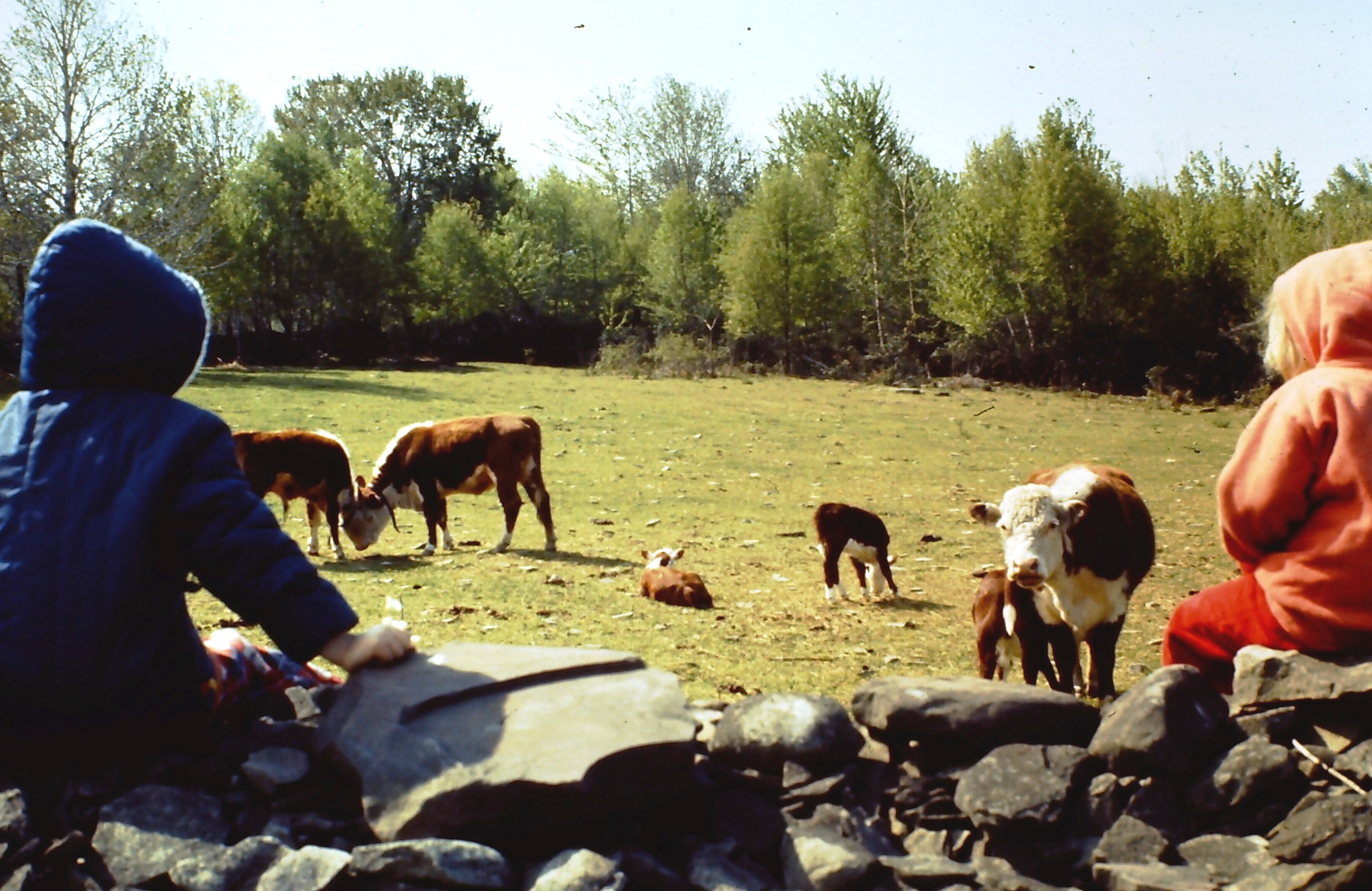
Here I am with my sister just watching the cows near our house in eastern Pennsylvania.
I have fond memories of spending lots of time outdoors. Let me make clear that I am not an “outdoorsy” type now and kind of wasn’t even then. I don’t really enjoy camping, I don’t hike, don’t fish, don’t go on trips out to natural wonders; rather, I really enjoy visiting cities with interesting historical sites, museums, and lots of other cultural wonders; I read, I spend time learning things online, editing, writing, etc. I guess it sounds odd I would then be nostalgic about my outdoorsy childhood. But I am. I’m pretty sure my mom forced me out the door when I was a kid, so I would get some fresh air, take a break from reading, and get out of her hair for a while. But I think back on all the beautiful country that lay around the old houses we lived in in various parts of Pennsylvania and just savor those memories. I made mud pies, incorporating wild little onions and carrots and the moist dirt that lay right along the burbling streams. In the winter, my siblings and I built great igloos and forts out of the snow that was so abundant.
Did I watch TV very much? Nah. Do I have fond memories of sitting around the TV set with my family? Not much. I do have some fond memories of going to see classic films with my dad and sister and brother. We watched “Oliver” and “Fantasia.” When teaching his occasional film class, Dad would bring us in to introduce us to Zeffirelli’s “Romeo and Juliet” and even “Battleship Potemkin.” “Citizen Kane” was on the menu. But day-in, day-out, we didn’t have the option of watching videos in our living room. There were 13 channel options on the TV knob, and not all corresponded to an actual station (half were just static).
I love the scent of lilacs today because we had an amazing lilac bush outside a side door of one house, which had a kind of hollowed-out middle I could crawl into and think while smelling that intoxicating floral scent. While I don’t take the time today to find places to walk in nature, I did enjoy just setting out through woods and trails and seeing what I’d find, thinking about whatever while doing so.
Today, my kids and others have instant entertainment in the forms of hundreds of options of (mostly dreck) on TV; they have DVDs galore; there are computers with the Internet, Facebook, Google, YouTube, what have you; smartphones to access that same fun (and often the same level of dreck) stuff whenever they’re not sitting at a desktop computer, and so on. Even though I try to limit the amount of time they spend in front of any screen, just being entertained, I do lament that they aren’t forced as much to just entertain themselves. (Part of my sadness here is that my husband and I always lived “in town,” as opposed to the old houses out seemingly in the middle of nowhere my parents had us live. I admit I have caved to the convenience of having shopping, school, work, etc. easily and quickly accessible. Plus, my husband is a city boy.)
Yep, so here I am being one of those “old codgers” who talks about the good ol’ days and being sad about what’s happening with the young folk. Most of the time, I just do what I can to make my kids entertain themselves (they do love to read and we have a TON of books around, and we have plenty of paint, crayons, paper, etc. and other raw materials for play/learning) and keep them off the computer or away from the TV. But there are moments I wish they could have enjoyed the “simpler time” I had. Guess I’m just turning into my parents here. It’s bound to happen to all of us eventually.
I obviously care about values, values in the media, and how we teach our children values (and help protect them from some of the value-less media out there). Let’s just say for my purposes here that “values” is shorthand for positive messages and content that is low on vulgarity, harsh language, sex, violence, and other crudeness.
I started my book-review website, Rated Reads, because I wanted to provide useful guidance for readers of all ages and parents of younger readers. The more information we can obtain as media consumers and parents of media consumers before actually viewing movies, TV, books, websites, etc., the better: we can protect ourselves from content we wouldn’t want to have to see/hear. Luckily, there are a good number of websites and other resources available to help us make good, informed decisions about movies and TV shows, as well as music. I started Rated Reads because there weren’t nearly so many resources available with the same kind of information about books.
Naturally, with this mindset and as the mother of four daughters, I want to be able to protect them from seeing and hearing vulgar, obscene, gross, crude content. I don’t want to see/hear that stuff myself, and I certainly don’t want my girls to be inundated with it. I can’t protect them from other people or from other kids at school (much as schools supposedly try to police obscene language, etc., it’s a losing battle in reality, honestly), but I can help them to feel safe at home.
With this as my philosophy, I’ve always been shocked by what I see other parents do/not do for their own children. Sure, all parents are different, and I can’t say that “different” is usually or always bad. But sometimes it’s hard not to judge, such as when I see adults bring tiny kids to PG-13 movies or just movies that are super-scary or intense. Or those who routinely let their young kids watch R-rated movies at home. I just can’t see that that does any good for (and doesn’t harm) these impressionable youngsters.
But what really, really makes me start steaming is seeing vulgar movies or TV starring children. For example, when I went to the movies this week, I saw a preview for a movie I will NEVER go see, called “Bad Grandpa.” An actor dresses up as an old man and takes a young boy cross-country with him on an MTV “Jackass”-inspired trip. They pull all kinds of pranks and film real people’s reactions. One clip in this trailer showed this young boy, who is 9 years old, dressing up as a pole dancer and gyrating in all kinds of crude ways that would make me cringe if it were an adult performing the acts. But this is a CHILD! To expose kids to this stuff is bad enough, but to then make a child PERFORM these acts is beyond irresponsible. It’s heinous. It’s horrible. It goes beyond the pale.
I don’t think I’m a prude. I simply believe in values (and if you don’t, then don’t bother commenting because we come from very different sides and will likely never agree). I believe in teaching values to our kids, in protecting them from as much as we can, in helping them learn ways to protect themselves from vulgarity as they grow older. Again, none of us can possibly shield ourselves completely. But we can take steps to reduce the amount of crudeness we have to ingest. And it’s parents’ responsibility to reduce exposure and teach their children, not douse them in “adult” filth.
We’re living in a world that’s radioactive with crudeness and vulgarity. We’re going to be exposed. Question is: will we take precautions and shield ourselves and our kids, or will we allow ourselves to be constantly irradiated, leading to sickness, cancer and death of the inner self?
So I’ve written a few times about my (mostly happy) love affair with Cassandra Clare’s Shadowhunter books. Most recently, I wrote about the Infernal Devices series, which was completely satisfying and just right. And at the end, you may notice I wrote about my eagerness to see how the movie version of City of Bones turned out.
Here’s what I thought was kind of funny initially, before the movie even started: Since I’m quite a fangirl when it comes to this series (although I refuse to shell out $2.99 per story for the Bane Chronicles; all together, that’s going to be a lot of moolah), I honestly expected to see crowds out front of my local theater when I dashed out to see it last night, right after it opened (but, admittedly, on a Thursday, before weekend busy-ness). After all, Twilight fans were lined up for hours ahead of each show. And honestly, this series is even better: it has action, hot romance, supernatural elements, and wit. But when my husband and I got there, 35 minutes before showtime, there were two other people seated in the theater. Wha? By the time it started, there was a reasonable small group in there for a Thursday night, but I sat there thinking, I hope that audiences do not miss this movie.
So I’m recommending it to everyone.
The movie did not disappoint. It stays true to the story without taking too many liberties but not, however, being so faithful to the book that it bogs down the pace of the action and plot; the action is engaging enough for male viewers to be able to get into it (come on, you know that Twilight the movie wasn’t exactly geared toward the men); the romance is still scorching hot (the great kiss scene in the middle is even better on film than it is in the book, which is saying something); the story and the world building are interesting, as in the book; the sets are great. I loved seeing everything I imagined (and didn’t get around to imagining, apparently) come to big, beautiful life on the screen.
Casting: When it all comes down to it, the most important casting pick was for one crucial character. The actor (Jamie Campbell Bower) who portrays the central character, Jace Wayland, is honestly just about a perfect choice. I admit I don’t think he’s great-looking (and yes, I do think that RPatt is just to die for when it comes to looks, not to mention how funny he is in interviews), but the character isn’t really either. It’s all about presence. Jace is intense, moody, and utterly irresistible because of how he emotes. And Bower nails this. He has screen presence galore. He smolders up there on the screen. His hair looks terrible. But it simply doesn’t matter. His whole body, his face, his eyes show who the character is and what he may or may not feel or believe. And when he looks at Clary, his face near to hers, temperatures rise. Yikes.
Now I did mention in that previous post that my main concern would be the humor. The books are laugh-out-loud funny in the banter between the characters and some of their one-liners. The movie just did an OK job on capturing this wit. There were a few good lines, but still, as I feared, that delicious banter isn’t in constant supply. The action and romance win out, and the wit came in last. Even so, it wasn’t a complete bust. I really felt that the Harry Potter movies suffered in comparison to the books because they really did sacrifice most of what I saw as clever and funny in the books. I didn’t feel that this movie did quite so badly.
Overall, a great adaptation and a movie I’m going to have to watch a few more times on the big screen. I liked it that much. Now pardon me while I get ready to head to the theater, this time with my oldest daughter.
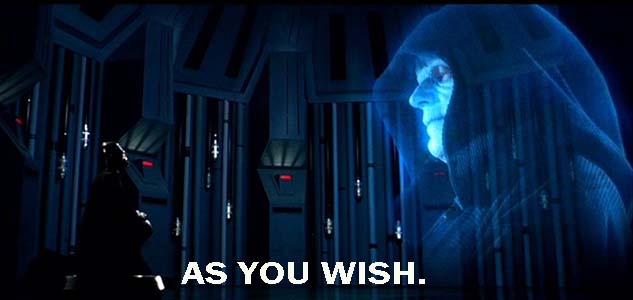
OK, people, this post is purely for fun and just because we are those kinds of people. We love to quote movies, and “Star Wars” and “Princess Bride” are some of the best of them all to quote (well, particularly “Princess Bride”). This little post is the result of a little riffing our family did while driving. Sit back and enjoy, and if you like, email me with suggestions and I’ll make some more mashups.
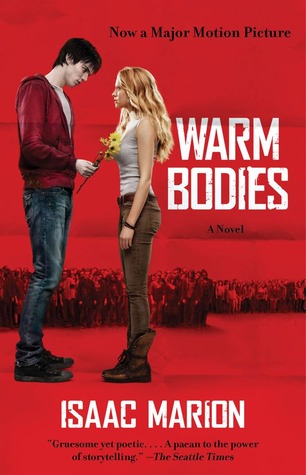
So I recently read Warm Bodies by Isaac Marion, after I’d seen the movie — twice (my teen daughter and I went to see it and then I took my husband for a date night too, since I’d ascertained he’d enjoy it). I was so thoroughly charmed by the movie, by the sweetness of the characters and the love story and the really clever witticisms sprinkled throughout that I was happy to see it in the theater twice. It was particularly a welcome good movie in the midst of what’s usually a film wasteland in January/February.
Naturally, as an avid reader, I had to check out the book. I downloaded it on my Kindle and set to it. I was dismayed primarily to find that there was A LOT of language in it (about 40 f-words: yikes!). But I also found it was a bit harsher and less “innocent” than the movie: the characters were more jaded, the dad really wasn’t a good guy even underneath his protect-everybody toughness, and it just didn’t have quite the level of sweetness and charm that I loved about the movie. Now, some people might find that welcome; I didn’t.
I can only think of one instance in which a movie was better than the book: the horribly cloying, simplistic and poorly written Bridges of Madison County was much better in film version, at least with two talented actors. I might be able to say the same for a couple of Nicholas Sparks movies, which weren’t too bad considering I really dislike his writing (I’ve already mentioned THAT).
I have yet to see “Beautiful Creatures,” but I’m guessing I may very well enjoy the movie better than the book, because I didn’t think the book was great. The supposedly intense love story lacked the sizzle and zing it should have had, and the details of the plot didn’t always come clear as they should. With the acting talent in the movie, I’m thinking it’ll be more enjoyable than the book was. But that’s just a guess.
So I’m going to be eagerly awaiting the DVD release of “Warm Bodies,” whereas I won’t be rereading the book.
Over the past few years, it has really struck me just how strong the power of a story is.
But really, most of us just take for granted how surrounded we are by stories, how they can captivate us, ensnare us, direct us and shape us, without our even realizing that it’s happening.
Of course, as a dedicated reader (and editor and writer), I love to be willingly captured by a good story, whether it’s one that’s been spun completely out of someone’s imagination or one that’s based in reality and been tamed just enough to be put down in words. I’ve come to realize how difficult it is to extricate ourselves from a story once we’ve stepped inside of its boundaries. The story could be shared via any medium: books, film, television, or any other kind of art.
Have you ever noticed that even if you’re watching a movie or reading a book that’s even just mediocre, it’s challenging to walk away? (I can detach myself from a story that’s really poorly told, however.) Something in us yearns to know “the rest of the story.” It’s so against our nature to not find satisfaction in completion. We must know how the story plays out ’til its bitter end.
What’s even more entrancing is to find ourselves enmeshed in stories within stories. One recent example that had me absolutely mind-boggled was the movie “Inception.” There were so many stories layered inside of each other that I wasn’t even satisfied completely with one viewing; I had to go back and let my mind wander those strange passages several times so I could really follow the stories and how every detail fit together. I absolutely adore complexity. And surprises. (I’ve written about that already in my post on gothic tales.)
But books and movies don’t by any means hold a lock on story. Our minds always create stories for us. We lay down memories that are ordered in some kind of story format. We consciously and unconsciously create stories to make sense of information we run across. Yes, story-making is hardwired within us. Some people are just skilled at weaving the stories within them for others’ consumption, but they are not the only storytellers. I recently loaned some of my favorite books to a friend, and she very kindly extricated some wonderful quotes from the second in the set, Carlos Ruiz Zafon’s The Angel’s Game. One goes like this: “Everything is a tale. … What we believe, what we know, what we remember, even what we dream. Everything is a story, a narrative, a sequence of events with characters communicating an emotional content. We only accept as true what can be narrated.”
Yes, story is a powerful thing. It can be dangerous; it can be liberating; it can be instructive. It has the power to move people to action, for good or evil.
I just thank those people who have the gift to create and shape stories and share them with me. I think that’s why books are so beloved, and why even writers pay homage to other writers and to the written word itself. Books and the stories in them can transport us and change us, so much so that they come alive themselves. As Zafon also writes, “As long as there is one person left in the world who is capable of reading [books] and experiencing them, a small piece of God, or of life, will remain.” Thank goodness for that!
Those of you who have paid some attention to my biographical information (if not, take a look at “about”) will know that I run a book review website, Rated Reads. There are quite literally thousands of blogs out there that review books. What there are not nearly so many of are websites that try to provide information about the content of those books reviewed. I have been a book reviewer for probably 15 years now, and I’d say I have done it as “professionally” as is possible; I’ve written for newspaper book pages for all that time, I was the book page editor for one newspaper for a couple of years, and I’ve been a member of the National Book Critics Circle for probably 10 years. So I’d like to feel that I know a little something about book reviewing.
Since it has been well known among my acquaintances what I do in the reading sphere, many people have asked my advice on books, from all kinds of angles. What I concluded some years back was that there was a hole in available information out there about book content. I am a Christian and have been raised in particular being taught that it is wise to avoid using vulgar language or watching movies or TV shows with vulgar content, so it follows that I would want to avoid books with vulgar content as well. And those friends of mine who came from a similar background would often ask me what kinds of books I’d enjoyed that were also mostly “clean” when it came to content.
But there are no ratings systems available for books. There are many reasons for this, but the hole in available information remains nonetheless. I just thought I could do my part to fill in that gap, just a little bit. So I started Rated Reads four years ago. I’ve noticed now more blogs devoted to a similar objective: to just provide some information about book content to readers who care about sexual scenes, violence and offensive language. Some out there in the world today may criticize the movie or TV ratings systems or think they’re silly, but I think most people understand and agree that they have value in providing information that allows viewers and parents of under-18 viewers to make better decisions regarding what they watch. So I would think that logically most people would agree that having information available in a similar fashion for books would be desirable and welcome.
The naysayers have generally left Rated Reads alone. There have been a few occasions, however, when an individual who doesn’t share my values or the values of those who use the site or simply doesn’t appreciate that anyone in the world might have different values than he or she has makes disparaging comments about what I and my reviewers are trying to do. In those few cases, I have gently reminded those commenters that the site exists to provide information for those who would like to limit offensive content in what they read. They can disagree, but some people value what Rated Reads is trying to do.
As a reader, I find it laughable that some writers and readers continue to insist that, in order for their work to be “authentic,” it must contain graphic material. I think that there are a few occasions that this is actually true, but it isn’t true for nearly the number of occasions it becomes a sticking point. Writing about and for teenagers tends to get the most attention here, for some reason.
Let me just say this: I was a teen once. Yes, it was 25 years ago, and yes, it was perhaps a slightly nicer time in which not quite every scary or bad or dangerous or vulgar behavior was out in the open, and media reflected that. (An example: I distinctly remember the big fuss over George Michael’s song “I Want Your Sex.” Some radio stations simply would not play that, so there was a version called “I Want Your Love.”) Today, I am of the opinion that pretty much everything is now out in the open, rather than hidden behind doors, spoken of only in whispers. But I heard bad language when I was growing up; I heard sexual references. So I remember what it was like to be a teen and to hear and see things.
I can also say this: I have two teens. My oldest is almost 16, and she talks to me about everything. She is bombarded by vulgar language and talk about all kinds of dangerous and sad behavior. And even though, technically, students aren’t supposed to be allowed to use vulgar language at school or in the classroom, teachers have mostly given up on trying to reprimand or give any consequences. So my very tender, gentle and sweet child constantly hears peers using “f-” this and “f-” that and sexual language and all kinds of things that she simply doesn’t want to hear. (She doesn’t have a lot of choice in what she hears in class or in passing, but I will make clear that she does have a choice what she hears from friends. She has chosen friends who are like-minded in that they don’t use bad language, and if she does have friends or classmates with whom she interacts regularly who are inclined to use bad language, she has politely asked them to refrain from using it, and they have always graciously tried to honor her wishes because they like and respect her.)
So when it comes to media, including movies and books, yes, I can wholeheartedly agree that “reality” is not pretty in many respects. But just because some teens, or even many teens, are involved in dangerous behaviors or use vulgar language doesn’t mean that ALL do. My daughter has plenty of friends who don’t have sex and who don’t use rough language. This isn’t she or I being unrealistic or seeing through rose-colored glasses; it is a fact. There are plenty of great teens out there who aren’t having sex or using rough language.
Just as we can choose friends who are like-minded, we can choose media that reflects our values as well. My daughter doesn’t want to hear offensive things at school, so she certainly doesn’t want to come home and deliberately choose to read a book that has offensive material, if there are other options. I want her to have a place that she can feel comfortable, where she ISN’T surrounded by vulgarity. That is our home. And our home’s media options reflect that place of comfort and security. I don’t bring offensive media into our home. It is a sanctuary, as much as is possible, from the world of so-called “reality.” And our home life is just as “real” as what’s going on outside it — actually, more so.
So I appreciate the authors who can craft great works of literature without bringing in some of that “reality.” I’ve read many wonderful books with fully-formed characters who interact in a true-t0-life fashion with each other, with stories that are clever, that are witty, that are wise, that transport me, that make me think, that help me experience places and things I wouldn’t get to otherwise. And those books have felt absolutely real. They’ve been authentic; they have struck a chord in my heart and soul. I love those books and I give thanks to the authors who don’t feel the need to insert offensive material to make them more “authentic.” Generally speaking, I have found that the books that have used lots of strong language and detailed sexual scenes could have gotten their messages across equally well without that stuff. And all too often, those “markers of reality” have been poor substitutes for good writing. I don’t want to read a mediocre work, period, let alone by an author who thinks that inserting lots of nasty “reality” will instantly make it real. Why waste my time with that stuff when there’s just SO much good literature out there, so much I can’t possibly ever read it all?
I know well enough what’s out there, what kind of depravity and vulgarity and sadness exists. I am not so isolated or insulated that I’m completely ignorant. But I don’t have to wallow in filth just because I know it exists. Life is difficult enough for everyone that there’s no reason to choose to bring things into our lives that are filthy or degrading. We all have struggles, we all have challenges to work through. And good literature does reflect that fact. But it also can reflect that we as human beings can triumph over the bad, that we have the strength and the light in us to choose good and to be good despite the difficulties we encounter. And I’m going to choose to read books that don’t bring unnecessary vulgarity into my mind. I’m also choosing to run a website that provides necessary information so others who want to make informed choices can do so.
Readers who don’t agree with me can go ahead making their own choices. That’s fine. But respect that not everyone wants to consciously bring filth into their lives. And authors, if you write books with lots of bad language and sexually explicit material, you must appreciate that not everyone will want to read it (and parents have the right to monitor what their younger children or teens read). Most likely, you’ll have a broader audience if you could limit the offensive material you write into your book. The concept holds true just as it does for R-rated movies versus G- or PG-rated movies. More people do go to see those movies with more “family-friendly” content. They don’t have to be “cheesy” or trite or “unrealistic” just because their ratings aren’t “strong.” There have been some excellent “clean” movies, just as there are some excellent, authentic “clean” books. Consider making your writing the best it can be without using offensive material as a crutch to make it “true to life.” I, and many other readers, will thank you for it. Profusely.
I am not sure why I am even attempting to broach such a huge and important topic, but since I am often ambitious and stubbornly determined, despite my limitations, I am going to try to at least put in a few words and opinions about this subject.
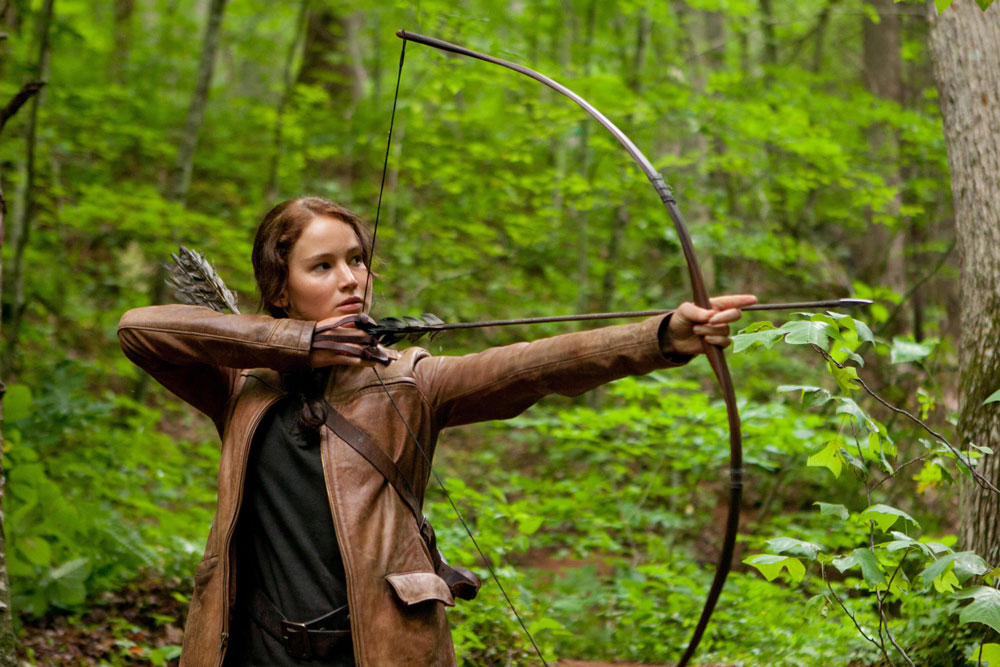
Jennifer Lawrence plays Katniss Everdeen in "The Hunger Games." Credit: Lionsgate/Murray Close
The recent uber-popularity of the book and movie versions of The Hunger Games has brought this topic to mind yet again. I think it is vital that as a society we seriously consider the issues of the kinds of content we view, hear and read in the media, whether it’s TV, movies, books, music or video games. There is a lot of research available about these issues, and there are definitely people who are concerned about these topics, but I think it still bears discussion. Since I have this blog as a forum, I’ll bring it up here.
First, I think it’s safe to say that the media we view/read has gotten steadily more detailed and explicit over the years as a whole. Sure, there have been incidences of movies or books years ago that were heavily sexualized or violent, but I think that overall, more and more of the things we see have become filled with content that could be offensive or outright dangerous. I know I have read about studies that link violent behavior with the levels of violent content viewed in movies or video games, but I won’t attempt to find them or list them here. I’ll leave that for others. This is just a blog post. I’ll talk about my feelings and experiences.
I was raised not watching any movies that were rated R. I also was raised by a father who was a television director. He worked in the TV industry and then moved on to teach about it as a university professor. He and my mother both were sensitive to the ways the media influence us and were somewhat cautious about what we watched, and when we did watch TV and movies, we often talked about them. We even talked about commercials and what messages they were giving. On the other hand, for example, my husband grew up watching R-rated movies, plenty of stuff that was filled with violence and bad language, and didn’t really give it much thought until we were married. So I find it interesting to compare how we react to things we watch.
When I see a film that contains violence, each violent act strikes home to me, and I feel it. I particularly feel affected by the portrayal of just plain evil characters. I appreciate good acting, but I never cease to be bothered by really effective portrayals of characters who are purely wicked, whose sole intent is to cause pain and suffering in others, whether it’s for gain or purely because they enjoy seeing someone else suffer. That feels all too real to me, and I would prefer not to experience that. I often don’t see the point of having to portray those kinds of people or the point of my needing to see/feel it. I flinch and cringe away from the screen. My husband, on the other hand, doesn’t seem to be as affected as I am. I feel it personally, and he views it as just part of the plot of a fictional story.
I know that how much violence we see affects how we continue to experience it. The more violence viewers are exposed to, the less it bothers them. We can actually have our feelings numbed, where difficult images don’t disturb us anymore, if we see a lot of violence. I worry a great deal about people, young men in particular, who are constantly exposed to strongly violent images and acts via movies and video games. It changes their very natures, so they are no longer bothered by acts that should be bothersome. That inevitably translates into real life in some way or another.
Now, I’m talking mostly about what might be termed “gratuitous” violence. Violence, as well as sex and strong language, have become a normal part of many movies and other media. But often they are simply there to “entertain.” I simply do not find those kinds of content entertaining; I find them offensive and soul-scarring. But there are times I think that violence has an appropriate place in media. Good literature and film and other media help to show us how life works and what happens sometimes, to remind us of history and how not to repeat it, for instance, or to remind us about how bad human nature can be and how to overcome our basest natural inclinations. So the question is, how much detail do those “good” media instances need to contain to be effective in their aim? How much evil needs to be shown to remind us to do better, be better, in some way, as individuals and as a society?
The Hunger Games has struck a chord with friends of mine, for instance. I’ve been interested to see what various friends have had to say about the books and the movie. Some have wholeheartedly embraced the positive messages of the series and what it seems to aim to do and say, even just sitting down and reading the series in one big marathon. Some have appreciated what the books are trying to do but have still felt the violence was too intense, too detailed, unnecessary. I already mentioned in my post about the movie and book that I liked them overall but felt that I could only read the books in small doses, not three right in a row, because they are so intense. I just couldn’t swallow them whole, all three in one sitting, without a break of lighter fare. I respect and find interesting and valuable the views of all my friends who have weighed in on the topic. I think that in the case of this series, it’s a valuable book series and movie, but it’s important to know yourself and what you’re comfortable with.
Some people may truly have been numbed by watching lots of other violent fare over the years, so they aren’t as sensitive; some people may just be more sensitive naturally, whether they’ve been exposed to much violence in media or not. In the case of Hunger Games, parents should be careful about knowing their children who might read the series or watch the movie to judge if it would be a good fit for them. But they shouldn’t just abdicate making any judgment on the matter because the movie and books are just so popular and “everyone” is reading/seeing them.
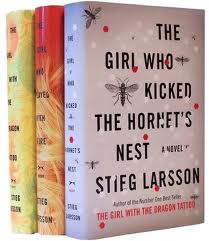
I think another movie and book series that bears discussing here is the very popular Stieg Larsson series, starting with The Girl with the Dragon Tattoo. As a book reviewer, I had an opportunity to read this book when it first came out, and I read the flap and decided it just wasn’t something that would sit well with me. I wondered about it later when it began getting a lot of buzz. After some more investigation, I still concluded that it wouldn’t be something I would enjoy. Then, with my website, I still needed to have a way to provide guidance to readers also trying to decide if the book would be a good fit for them. Finally, someone who reviews for me read the book and was able to give it a rating. She confirmed what I’d heard, that the book was filled with many explicit, disturbing scenes of sexual violence against women. She also linked to an article online I found very useful in giving more insight.
In some ways, I want to leave judging to individuals, to let them make their own decisions about how certain content might affect them. But at the same time, I find it profoundly disturbing that so many readers are embracing these novels. I asked one blogger last week who said she is a Christian what she felt about this content, as she proclaimed how much she enjoyed the Stieg Larsson books. She said, in short, that since Larsson doesn’t “endorse” the assaults, and “warns against” this kind of violence, that she was OK with the content, even though it was very difficult to read.
I found that to be really interesting. I think that is where we all have to make some kind of a judgment on any violent content; is it important to include it if it sends a message? I think so. I think an even more important question is, however, how detailed and explicit should that content be to be able to get across the message? Is it necessary to have multiple scenes of extreme violence, even misogyny? Does the negative impact of a reader (or movie viewer) experiencing that kind of secondhand assault get outweighed by the positive impact of sending a message that these things happen and are wrong, and that we can do something to prevent these acts?
Again, I’d like to say that in most cases, individuals should be able and encouraged to decide for themselves what will be best for them. I created Rated Reads for that very purpose, to give readers extra information so they could judge more accurately for themselves what they would find acceptable, given their own sensitivities and sensibilities.
But on the other hand, I think there truly are cases where too much is simply too much. That doesn’t mean censorship; I would never say that a book shouldn’t be published, period, because of its content. But it does mean that there should be warnings; there should be more information easily available to readers about what they might be facing in picking up a book. There should definitely be some lines drawn about what can be made available to readers who are younger than 18, much like R-rated movies are restricted to younger viewers. I would like to see less gory, explicit and gratuitous violence in movies and video games, as well. I just don’t think enough is being done to limit that violent content that can truly numb sensitivities and even affect violent behavior.
Unfortunately, I don’t think there’s much we can do to limit things in our free-speech society. But I think it’s important for us to talk about these ideas and be more aware of the damage that can be done by a steady diet of violence, or even an occasional sampling of “unnecessary” violent content. Obviously, we all are going to have different ideas of what constitutes the “right amount” of disturbing content or which messages are truly beneficial to remind us of truths about humanity and what’s happening in real life. I already have made clear I am pretty sensitive to violence and have a low tolerance, so I might have a much shorter list of books or movies I think are important for people to see (BUT at the appropriate ages and maturity levels) than others. But let’s make this a national conversation and be more aware of the effects of what we and others in our society are seeing.
 I like a great mystery. I like twists and turns and surprises. That’s why I like gothic tales. But I don’t like darkness. I don’t want to spend too much time in it. I want to seek out the light.





 Life and Lims