Non-appearance-related compliments

Our culture focuses so much on appearance that it can seem like a fact of life. For some decades now, thinness has been considered the ideal for how people should look. Lighter skin tones are still quite honestly considered a basic standard, but not skin that’s very pale: a nice “healthy” tan is desirable. Clear skin is best. Straight hair is currently “in.”

We focus so much on appearance that it can be difficult even to give someone a compliment that’s not looks-based. Take a look at your social media feed and you’ll see what I mean. Anytime someone posts a new selfie or changes their profile picture, there’s a barrage of comments all saying “you look great!” “beautiful!” “haven’t changed a bit!” That’s so common, in fact, that Facebook makes “beautiful” and “gorgeous” automatic reactions on stories. You don’t even have to type it! Just click on the words to react.

But doesn’t the ubiquity of those words ever make you want something different? Do they ever feel a little insincere? Do you want to stand out from the crowd by receiving or giving a compliment/reaction that isn’t the same as usual or that at the very least captures more of who you or someone else is than how your/their face or body looks?

It’s time to up the compliment game. First, challenge yourself to stop commenting on others’ appearances, or at least to make it just a 1 in 10 occurrence. Second, dig deep. If you are reacting to someone’s photo on Facebook or Instagram, for example, you are likely friends. You know something about them and like them (if not, you may want to consider paring down your “friends” list). What are qualities you treasure? My friends are, among them, kind, strong, courageous, faithful, wise, well-read, knowledgeable, patient, generous, loving, outgoing, thoughtful, fun, hilarious, clever, persevering and talented. And that’s just a few of their admirable qualities. They’re great parents, hard workers, experienced in all kinds of work and non-work capacities, dedicated volunteers. In short, they’re people I adore.

I like to say these kinds of things:

  • “I love seeing that big, friendly grin.”
  • “You always do such fun activities with your kids.
  • “The way your eyes light up makes me smile.”
  • “Your style is always so fabulous and reflects you so well.”
  • “Seeing your face reminds me how good it feels to be around you.”
  • “Your goodness just radiates from your face.”
  • “I love the twinkles in your eyes.”
  • “You have such great taste in clothes.”
  • “I’m so blessed to know you.”
  • “Your smile is 100 watts of happiness.”
  • “I admire so much how caring you are.”
  • “I can see that fun mischievousness I like so much reflected in this photo.”

It’s even possible to compliment people you don’t know, out in the real world. You can compliment a harried mom in the supermarket on how kind and patient she is being with her toddler. You can tell someone their scarf is gorgeous or the color of their shirt is stunning. You can compliment a stranger on their smile.

Just think how much you can lift someone’s day by taking a minute (or a few) to figure out a different way of commenting besides saying how beautiful or gorgeous or thin or young they look. Pick a compliment with staying power: it sticks because it’s different, and it sticks because it reflects something about them that is more real and long-lasting than what’s on the surface. Go and have some fun crafting your own. (Or you can use some of my ideas; it’s OK.)

Share some of yours with me, too, if you like.

News media, social media and facts in the time of coronavirus

I’m going to share my take on information/misinformation/freedom of speech and press as a journalist. This is just my take, with my opinions uniquely my own, created by my whole set of personal circumstances but heavily informed by my training and long years of editing/writing experience in the news field (this includes me having to teach and train and work with younger and less experienced writers who were still learning to really appropriately acquire information through research and interviews and then correctly interpret and analyze it and then synthesize it for readers in a way that is clear, informative/understandable to most readers, and accurate).

First, I am generally unlikely to watch a YouTube video that is popular and going around Facebook but that has already been marked as problematic by what I consider to be trusted sources. Almost all the time, the people who created/are the “specialists” in the videos are just one person. They are not drawing on the expertise of multiple experts (the more experts who have studied a particular issue that can weigh in on the topic with generally similar advice or information, the better; that’s science. Science is coming up with hypotheses, testing those through rigorous experiments/studies, and then publishing results and having those peer-reviewed. These videos with a single so-called “expert” do not have that weight of science to back them up.

Another problem that comes up with these videos is that the “experts” have already been shown to be extremists with no evidence to back up their claims or their past claims have been debunked time and time again by scholars in the field who do have the weight of science behind them. No, I’m not going to watch a video made by an extreme anti-vaxxer. I do not agree with those who are anti-vaccination in general and who think that children should not be vaccinated for standard diseases that have in the past wiped out millions and millions. The science does not support anti-vaxxers, and I will not waste time watching a video made by one of them.

Last little point: If I already can see I’m very unlikely to be interested in the videos, I’m not going to click and thereby contribute to these people’s paydays (yes, this is just one reason it’s not “going to hurt anything” if you check some things out that you may initially already be a bit skeptical about).

46E25FD2-A4A1-4793-949F-C48AD4669499

To those who are saying their freedom of speech is being taken away/violated when these videos are removed from certain platforms, I say: Freedom of speech means the government cannot infringe on what you say. Even that, however, has some limitations: not all speech is protected, such as threats, child pornography, plagiarism and defamation. Private individuals and entities may, however, choose to limit your speech. Facebook and YouTube can do what they please in limiting what we share or post. That doesn’t mean that either won’t face consequences for limiting too much, such as if enough of us customers raise a ruckus about it and it makes a difference to their bottom line; it also doesn’t mean the government won’t look into some of these entities’ practices and establish some laws/rules about how these entities must move forward.

But for the moment, if FB or YouTube is removing a video time after time, those entities have reasons for doing so, and those are outlined under their terms and conditions. Facebook, for example, after being investigated by the government (various times about various concerns), has supposedly set out to do better by its users in terms of what information it allows to be disseminated quickly on its platform. It’s set up fact checks to pop up in response to certain popular videos or articles that keep getting shared that have been debunked thoroughly by reputable sources. It’s also reserved the right to remove some. It’s theoretically trying to at least provide some real news so that FB users who hop on quickly to look at their feeds don’t see something shared and hop off FB without at least having a chance to see the “other side” or the facts. I welcome seeing this kind of give-and-take, so at least some of the information that’s been vetted by professionals is quickly available. I also do try to do due diligence myself when I see something that just seems a bit fishy by searching Google for some related information, ideally multiple news articles from trusted media.
7C013E7E-4E44-45AB-B2AC-C8B47F6F49F7_4_5005_c

News media are an important part of our democratic republic and are protected right after free speech, and they do perform a vital role in our country. We need to be able to trust that someone is looking into the facts. (That’s another note for another day, but let’s just say for now the “mainstream media” are still the best source we have to look to for the “truthiest” facts. 😉 )

Social media is pretty dangerous when it comes to “facts” because everyone is on the same level. Anyone can say anything on social media. It’s not backed by science, it’s not the opinion of more than one person, it’s not vetted by anyone trained in anything (let’s just say the “average user” here). And any comment, anything you say, will be out there in seconds. Social media, in this case, are the opposite of news media: any news story takes time. It takes time for a trained journalist to track down the facts, to research, to interview experts. It takes time to put the story together. It takes training to know how to sift through that information gained through research and find what’s at the heart of it, the facts/truth as well as they can be found at that time. It takes a good eye and ear and experience that becomes almost a sixth sense (an earned one) of knowing what’s truth and what’s hooey or even just half-truth.

That being said, you have every right to watch any video you want, wherever it is on the scale of facts or expert insight or science. You have every right to demand that a platform not take down what you want it to keep up. You have a right to gather information any way you see fit. This is such a fascinating beauty of our democracy: you can do what you want most of the time, whether it’s great for you and others or is ill-advised, and anywhere on a spectrum of truth/falsehood. You are very welcome to research any topic you want more information about, whether it starts on Facebook with someone linking to an article or YouTube video, or you go to pretty much anywhere on the internet. You are free to do so in our free country! Go USA!

I may at times watch some videos or read some articles or links to blogs because I think they bring up some important points that maybe we haven’t considered or that haven’t been explored enough in the media yet, and I know a lot of my friends have been watching various videos now for that very reason; I support you as you have mentioned this. There may be some considerations we need to think about that just haven’t been discussed enough in “mainstream media.” And I will draw my own conclusions from what I read/watch according to my own life experience and journalism training. My opinions will be similar to others’ and be something plenty of others disagree with. I’m pretty much moderate-to-conservative politically and socially, and a lot of what I conclude will likely align with my views on that kind of scale. Sometimes not.

The novel coronavirus is sometimes exacerbating our political and social views and exposing how many people just don’t trust the media anymore, which I consider pretty sad, in part because I know that most journalists are still doing the best they can to deliver news in the way it’s supposed to be delivered, and in part because television cable channels have distorted what “the media” look like (the endless hours of very wide spans of opinions and heated arguments on cable news have, in my opinion, sullied the important profession of news delivery, making many people in general just have a sour taste in their mouths when they think “news”). And the most important reason I’m sad about that lack of trust is precisely because our great free country needs a functioning media more than it ever has, and ironically, those who are most vocal about the Bill of Rights and other amendments tend to forget that the press is in that set of amendments for vital reasons.

I do get it, though. Our political parties and leaders have become divided by a huge chasm, and we the people are getting sick of it. Most of us want to see our politicians do what we voted them in to do, to work together, to hammer out solutions to problems, to enact laws, that will benefit all of us in some way because they have been crafted by consensus, collaboration, compromise, and even (gasp!) selflessness. And our media have to report on what’s happening. That’s what’s happening, folks. And in a time that’s uncertain and even the experts tend to be sharing information that comes from a lot of different angles, with plenty of differing conclusions and even statistics, we’re going to turn to information that just makes the most sense to us.

Days and weeks matter in this time of COVID-19. A lot can change in understanding of the virus, in reactions and actions, in policies, in the science, because it’s so new, and in science, more time and more data equals better and more accurate conclusions (and consensus with peer review). The media is reporting on all that, too.

In short, we’re confused, we’re exhausted, we’re strung out, we’re frustrated. We sometimes don’t know exactly whom to trust. Eventually, things will change in this time of novel coronavirus. But I hope that our leaders, the media, and we the people will learn from this experience, because all of us can do better, in either a small degree or larger degree (yes, I’m looking at you especially, politicians). We can be a little smarter about what we share and what we say when we share it. Some healthy skepticism is good, and even some healthy trust is good.


To my pregnant and postpartum friends: take that weight off your shoulders, not your belly

I am about to turn 45 and haven’t been pregnant for almost 13 years now, but I have a number of wonderful younger friends who are still firmly in their childbearing years. I am writing today to them.

Dearest friends, I see your adorable posts on social media and am thrilled with all the sweet experiences you are having now, just as I remember enjoying a decade and a half ago. I can’t help but “like” your comments and pictures of growing bellies and ultrasounds and new babies. What an amazing period of life you are in — and difficult and challenging and exhausting and … the list goes on. The joy is equaled by the fatigue and all the other challenges that can come from pregnancy and taking care of an infant.

But I’m going to say this with all the kindness and tenderness I can show in the mere printed word (hopefully you know me well enough “in real life” to be able to hear me saying this): please stop worrying about your weight.

I have seen your posts over the course of months and been concerned for you when I’ve noted multiple comments about how much weight you’ve gained (in exact number of pounds) and how you were already planning during your pregnancy to lose it post-delivery (yes, I see your Pinterest boards too). I’ve worried a little for you when you talked about your weight a mere two weeks after giving birth.

cathy pregnant
This was me just before giving birth to my third child. Do celebrities ever look like they’ve swallowed a torpedo?

Believe me, I was there. Three times. I gained the exact same number of pounds each pregnancy: 38. And each was different. I started out about 25 pounds overweight with my first and ate pizza almost nonstop and didn’t exercise at all. With my second, I started out maybe 10 pounds overweight and exercised for about the first six months and ate a little better. With the third, I was at just about an “ideal” weight starting out and exercised up until a couple of days before delivery (I looked pretty ungainly, I’m sure, with my huge belly on that elliptical machine, but it felt good). I still gained the same amount of weight each time. And every single time postpartum, I breast-fed my girls and counted calories (keeping them to a reasonable amount for nursing) and exercised after six weeks had passed after delivery. On the last one, I got back down to a really good weight for me six months after my baby was born.

I went into all that detail to show you that, yes, I’ve been there. And for me, losing weight postpartum was work. I felt the pressure. Yes, I hated seeing the pounds pile on during each month of pregnancy, especially after working so hard to take them off during previous ones. I feel bad saying that now because I wish I hadn’t been worrying about something so superficial as how I looked while I was growing the amazing human beings I’m now proud to call my daughters. But the (sad) truth is, I would feel the same way again even now if I were to be pregnant again. I struggle more now with my weight since I’m older; it’s even harder now! And I struggle with the struggle. I want to be healthy but I don’t want to allow myself to be caught up in our society’s “religion” of thinness, of image, of appearance. I am working to be kinder to myself and try to separate myself from the bombardment by media and culture that tells me how I look is a huge component of my worth.

Because this is the truth, one that goes completely opposite to the messages we see and hear all the time in our media-saturated culture: My worth is not tied in any way to how I look, whether it’s how much my body weighs or how many wrinkles I have (or that aging neck that’s manifesting itself) or how gray my hair is.

And that’s true for all of you. Even though society is pretty much shouting from the rooftops (and our ever-present computers and handheld devices) that we’re supposed to be thin, that it is possible (because, hey, look at the celebrities!) during pregnancy, except for a cute “bump,” and then entirely thin (no more bump) immediately after giving birth, and thin all the rest of our lives, that is just A LIE. Pregnancy changes us. Life changes us. And we’re all different anyway. We all have different body shapes and shouldn’t be worrying about trying to fit our square or triangular or hexagonal pegs into round holes. People come in all different shapes and sizes and colors. Make the best of your own shape, size and color. Take good care of your body. Value it for what it can do for you, for the part it plays in who you are as a whole. Treat it kindly and with respect. But don’t spend a disproportionate amount of your time and energy trying to make it what society says it should be. It’s only going to make you more exhausted than you already are, and when you are pregnant or taking care of a baby, you have NO ENERGY TO SPARE. You know this.

So, my dear friends, stop posting about your weight and size. Stop worrying about it. Take gentle loving care of your body and your psyche. Delete your Pinterest “Fitspiration” board. Those things are just plain dangerous. And please keep posting those baby pictures. I can’t get too many of those.

There’s more lying on Pinterest than in any political campaign

So I have enjoyed Pinterest quite a bit since I decided to sign up and start using it earlier this year. It’s definitely handy-dandy for lots of things. My youngest even knows that if we’re trying a new recipe, it’s most likely from Pinterest. I think, like a lot of other Pinterest users, I use the site for recipes, laughs, and just useful ideas about all kinds of things.

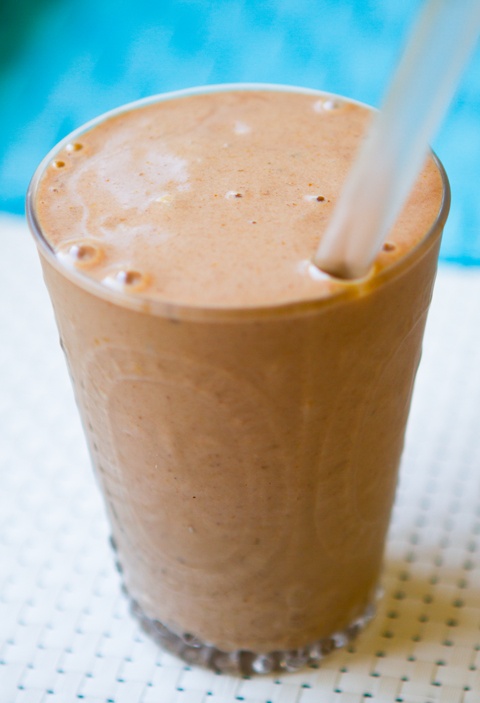
Yes, it is delicious. But NOT 50 calories; no, it’s 500.

But what has really gotten my goat over the months is noticing how much of it is just blatantly false. This is the case with “no-calorie” recipes of various kinds and with “fitspiration” pins. A few examples: the 50-calorie shake. The photo shows a delectable-looking glass filled with a thick, creamy chocolate shake. It always says “50 calorie shake” underneath the photo. I have now seen this repinned by friends at least four or five times. Every time I can’t help but comment on it. Because the truth is that the shake (if the whole recipe is imbibed) is 496 calories. Nearly 500. Not 50. If one wanted to have a 50-calorie version of this shake, that person would have to get out a shot glass, because she’d only be able to drink about 2 ounces. The original site doesn’t say anything about it being “diet” or low-calorie; it’s just a healthier way to have a “shake” than going to an ice-cream shop.

There’s also the “no-calorie slushie.” The photo shows a glass with the final product, and there’s pictures of bananas and strawberries. If anyone were to think about it for just a second, she would know that bananas and strawberries HAVE CALORIES. The blogger admits that “her diet plan” doesn’t count fresh fruit or vegetables, but for those of us who do count everything (which I certainly think is a wise move), it’s about 250 calories. I’m thinking there’s a big difference between NO calories and 250. In fact, if one were to drink that no-calorie slushie every day without changing her diet in other ways, she’d gain half a pound a week.

I think I’ve already mentioned the “fitspiration” pins. Beauty Redefined writes a fab blog post about those. Here’s the thing: it’s great to motivate yourself if you’re trying to take better care of your body by eating better and exercising. But the pins that show a ridiculously thin naked midsection with hip bones protruding, for example, are not going to help anybody. They tend to say “all you have to do to get these abs is follow this plan….” Honestly, I don’t care how much I worked my abs, I would never look like that. I’d also have to cut my calories to less than 1000 per day (not healthy) and get plastic surgery to get rid of the extra skin and the stretch marks to look like that. Can we sit back for a moment here and say, OK, I’d like to get healthier, but repinning this ridiculous photo isn’t going to help me or anyone?

Yep. All lies. Why is it that we perpetuate them? I personally don’t repin these. I just don’t. If the recipe looks tasty and I’d like to try it, then I’ll repin it and give it an accurate title and caption: “fruity slushie,” for instance, or “protein-packed shake.” And even if I would like the tips for exercise, I just flatly refuse to repin those photos of tiny midsections. I’m not gonna do it. I don’t want to send the message out to my friends that image is paramount and flat abs are a holy grail. I don’t want my wonderfully normal friends to feel worried about their abs. Why should they? I also tend to make comments when friends pin some of these, just to correct the erroneous notions that are being sent along via the ever-so-simple pin. I imagine they are annoyed by me. Oh well.

So I ask: if you’re a Pinterest user, are you going to breezily send the lies along for hundreds of other pinners to see, or are you going to stop them in their tracks? When you see a claim that seems “too good to be true,” it most likely is. Think about it for a second. Do some quick calculations. Go to the original post. Do something, but just don’t send it on!