Down syndrome PLUS other challenges, like mental health

I’ve already blogged about having an adult daughter with Down syndrome and how that’s so much different from having a younger child with DS. It’s tougher in many ways: the gap between that child and your other non-DS kids, in addition to the gap between that child and most everyone else, is so much wider than it was when they were little. You’re used to the different life, sure, but there are still plenty of times you’re reminded how things would be if that child didn’t have DS. As your other children become adults or older teens, that gap is starker.

What also makes life more … eh, interesting … is when that child has other challenges on top of all that DS does. We as a family have been so blessed that our daughter, unlike about half of people with DS, never had heart problems. She didn’t require surgery. I have always been appreciative of that. For us, however, what’s been tough has been my daughter’s emotional health challenges. I’ve blogged lots about my own mental health, so look at all that for what I’ve experienced personally. Marissa has exhibited a lot of mood swings and meltdowns for probably about five years, and those have gotten so much more frequent and intense the past six months or year. Over a few years, the doctor and I have tried Prozac on her to see if that could help her feel a little less out of control, but it hasn’t helped. Now, however, with her just having such a hard time, I’ve been trying to figure out just what we can do from here.

Here’s the thing: I’ve already written about how difficult it can be to find a good mental health provider, particularly a medical doctor — psychiatrist — who specializes in these things. It’s hard for EVERYONE who finds themselves in need of a psychiatrist. There simply aren’t enough to address the need. That’s particularly the case in smaller communities or other underserved populations. And it’s a tragedy.

Add that to the difficulty of finding someone who has the extra skill to work well with someone with a learning disability, for whom it is much more difficult to understand and express the nuances of things they’re feeling, and the challenge can be overwhelming.

I’ve felt overwhelmed by various emotions: frustration, sadness, some anger, helplessness, inadequacy … the list goes on. I feel bad for my daughter because I know from personal experience (years of it!) how it is to feel so taken over by your emotions. I also know it must be particularly confusing and scary and sad for her. But then when it just goes on and on, day after day, and the things I try to do just don’t seem to help much, I feel frustrated and angry and depleted and just ready for it to STOP. For at least a little while.

I took her back to her regular physician a few weeks ago, in desperation, hoping that he and I might be able to come up with something to help. Just a start. I told him what I’ve struggled with personally and what medications have now helped me for the past two or three years. I told him how few resources there are. I told him, “I know this isn’t really in your wheelhouse, but…” Luckily, he is a good and kind man who is happy to listen and consider ideas and research them, and I trust him to do what he can. He said he’d look into some things and get back to me.

Meanwhile, I had my own check-in with my psychiatrist (well, she’s technically a nurse practitioner who specializes in psychiatry and she is FANTASTIC), who is at a clinic an hour away from here (and that my insurance doesn’t cover, so I pay out of pocket for each visit: $100 each time I have a check-in). I told her about my daughter and asked for some ideas. I felt it was the best option for M to go to this place, since I know they’re good and they specialize in this. But I was thinking they weren’t taking new patients, which wouldn’t help me at all. Luckily, I had taken her there maybe five years ago, when she wasn’t doing too badly, so I was able to get her in again. She has an appointment in two weeks.

Meanwhile, she is having blow-ups and meltdowns multiple times a day, sometimes, and it’s a strain on me and especially on her youngest sister. I’m just holding on until that appointment. And even then, these things take time. It’s going to be more of a challenge to help her than to just be the patient myself (that is tricky enough, believe me).

I am aware often of the multiple challenges people face. Children and adults with DS, like anyone else, have various needs and overlapping issues. It can just make it that much harder to deal with each of those things. I have such sympathy for the individuals with DS who have these needs, and I definitely understand the needs and feelings of their parents and families. Each of us is going through a unique mix of trials and challenges, and many of us go through those without others realizing. My daughter’s DS is obvious to others. What is not obvious is all the other things we are dealing with. My girl is such a sweetie and so loving and outgoing and friendly and happy, and that’s what most people see. They don’t witness the meltdowns and the moods. That’s reserved just for me and mine (yay! ha). Today, I share this to help others see what happens behind our doors some days, and so others in a similar situation as we are can perhaps find something to latch onto and know that I get it. I feel ya.
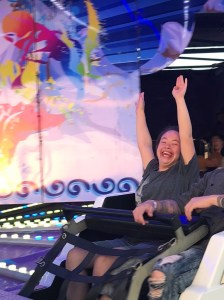
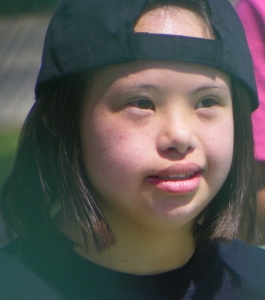
IMG_3896
She’s high and she’s low. Most people see this. I love this face. I love her all the time. But all the complexities and challenges can be exhausting.

New territory: Having an adult child with Down syndrome

Over 18 years ago, I found out through a blood test and amniocentesis that my second child had Down syndrome. Back then, there wasn’t much in the way of the Web, so I went to the library. I found one book that talked a bit about children with DS and had a few pictures that weren’t really flattering. I didn’t feel I had much to turn to in the way of sweet stories, adorable photos of adorable kids and babies, support systems, etc.

That did start changing when I had her. I found out about Band of Angels, which at the time was creating gorgeous calendars featuring models with DS shot in lovely settings. We were officially entered into “early intervention” programs where we lived and she got help with physical and occupational and speech therapy and so on. I got involved in a local Arc.

But for so long, my daughter was little, a child. She was cute, she was the poster girl for the UCP Center’s yearly fundraising campaign. She was a doll, just lovable and outgoing and friendly.

And it’s kinda funny, because for a while now, there’s been more online awareness of younger children with Down syndrome. There are plenty of groups and cute photos that circle social media. But not a whole lot in the way of adults getting attention. (But now there is the A&E reality show “Born This Way,” that follows young adults with DS living their lives, so that is cool progress.)

In short, it was relatively “easy” to have a child with DS. It wasn’t a whole lot different than raising my other children.

She had a great time this spring playing in a local softball league for people with disabilities. SO cool.

What started a change was her adolescence. She hit 14 and started puberty. She got a period. She learned about wearing pads (and not to talk about them all the time in public). She became a teenager. The moodiness that’s hard to talk through, as I have done with my other teen girls; the periods; the observations about cute boys or about seeing her sister or friends at school dating or holding hands or kissing … it wasn’t something I was really prepared for. It wasn’t so “cute” a time as when the DS kids are younger and still sporting the adorableness of babies and preschoolers. So there’s not as many pictures, not as many inspirational stories circulating Facebook and the like. For me, my new situation parenting a DS teen was kind of uncharted territory.

And that’s become even more so now that she is 18. She’s legally an adult today. But unlike my older adult daughter, she doesn’t have a driver’s license, can’t help out driving herself and younger sisters around; doesn’t run errands for me; doesn’t babysit. She needs a bit of babysitting/supervision herself still. She’s emotionally and mentally really more like a 7- or 8-year-old in a lot of respects. But she’s bigger and developed and has a menstrual cycle. It’s harder to discipline her. She’s moody and just mumbles loudly or trounces off to her room and slams the door if I try to tell her, gently and kindly, that she should be nicer in how she speaks to her 9-year-old sister, for instance. I can’t really talk her through things.

In short, it’s not so cute anymore. It’s NOT not that different from parenting my other children, like when she was little. Don’t get me wrong: she is bright in many ways and really helpful and can be incredibly sweet. She’s pretty great. But it’s now really evident that she’s different. She has Down syndrome, and it’s obvious.

We’re getting her a state official I.D., not a driver’s license. We’re talking about some programs that she can do post-high school, next year. We’re starting to think more about what kinds of things she may be good at, what she will enjoy, for work-type opportunities, for socializing, for living arrangements. This is a whole new ballgame.

That story a parent wrote a few decades ago about embracing a new reality called “Welcome to Holland” seems to be hitting me now. The writer compared having a child with a disability as planning (during a pregnancy) on going on a “fabulous trip to Italy.” But then the new reality hits, and you’re going to Holland instead. In the past 18 years, especially, I’d say, the first 12 or 14, I was kind of going to Holland with Marissa, but I still had plenty of experience in Italy, with my other three children, for sure. And then with Marissa, I was kind of in Little Italy in Holland. Now, though, that feeling of visiting Italy at least through restaurants or guidebooks or seeing pictures on the Internet has dropped away. It’s hit me that I’m really in Holland.

It’s OK, just as the story goes. But I didn’t see it coming. Or I kind of did but now it’s hitting me. And I’m going through another adjustment period. And there’s not a lot in the way of cool or cutesy memes or stories or photos going around online — but, like I said, there is “Born This Way,” so that’s a good step in the right direction. Maybe I’ll start seeing more of that. And my sharing my experiences will prompt others to share. Or I’ll just start finding others’ stories more, seeing them amongst all the other stuff that’s online.

So here I am, my cruise ship permanently docked in Holland, at least with one of my children. I’ve got ships in Italy with the other three. It can be jarring a lot of the time to switch between the two countries. But I’ll make it work, and it’s a new adventure.