Ann Romney and moms who ‘don’t work’

Well, the latest crazy statement by a political commentator has made its way through the blogosphere today. Since it is such an integral part of my life, I feel compelled to comment.

Here’s the basic info: Hilary Rosen, a Democratic strategist, said Ann Romney wasn’t qualified to talk about women struggling in the economic downturn because she “hasn’t worked a day in her life.” Naturally, this opinion has ignited the ire of many women, stay-at-home moms or not. Rosen made this comment while trying to make the point that because Ann Romney hasn’t held a job in the paying workplace, she can’t be qualified to have an opinion about economic issues that affect women, and can’t be a useful advisor to her husband. First, I must point out that it isn’t necessary to be the one in the family holding down a paying job to be concerned about how the economy is going and how it affects your family, no matter how much money your primary wage-earner makes. Second, and the real ignition for the fire, the comment then belies Rosen’s derisive attitude toward women who choose to stay home to raise their children.

I always find it a little absurd that women who are generally of a liberal slant, who shout about the need for women to be able to “choose,” such as about their own reproductive lives, then turn up their noses at women who make a different choice than they would in family matters. “Choice” implies that there are varied options available, and that it is an individual’s right and privilege to decide among those very different options. It also implies that any of those options are ones that should be respected by others. But in our society today, if a woman chooses an option that others frown on, that woman is often derided and called “old-fashioned.”

I am a mother of four, and my daughters’ ages are in a wide range, almost 16 down to nearly 5. I have two teenagers, an elementary schooler and a preschooler. They have very different needs and schedules and temperaments. I chose from the beginning of my reproductive life to be a mother who would stay at home with her children, and I have held to that. Over the course of 16 years, I have worked part-time out of the home (15 or 20 hours at the very most) for perhaps 3 years total, when financial realities have indicated that my income would be necessary. Right now, I work from my home office on the computer for pay for maybe 5 hours a week. The opportunity to copy edit online has been quite welcome, has added a little extra income, and has kept my skills fresh. I feel blessed not to have to leave the house to do it. I also have various projects I do in the hopes of earning pay from them in the future and/or because they are intellectually and creatively stimulating and satisfying. I also feel blessed that I have the freedom to be able to pursue these projects.

There is no doubt that our economy right now has forced many families, two-parent or otherwise, to make decisions they wouldn’t otherwise have made. Both parents might have to work outside the home; single parents have to work. Wives may work and laid-off husbands stay home with the kids while they continue to search for employment again. It’s not a happy time. Even in brighter economic times, families made decisions that were either “modern” or more “old-fashioned,” according to their needs and wants and interests. Sure, I’d like to see more women able to stay home with their children, at least not working out of the home 40 hours a week, because I personally believe it benefits the kids when that situation is possible. But I know how it feels to just be home with the kids ALL THE TIME. Getting out of the house to a job where you’re appreciated, patted on the back, given breaks and more immediate gratification than a 20-year-long project is definitely an enticing prospect. And a paycheck? It can mean college tuition for your kids, a car that isn’t 15 years old and in the shop every other week, or just a reflection of a job well done that other people in society relate to and recognize. But mothering at home full time? No paycheck, no regular gratification, no guaranteed breaks, no good reason to put on a nice blouse and makeup.

But we still live in a society in which women are just not that great at respecting each other’s choices. Hilary Rosen is just a case in point. Why can’t we just admit to ourselves that we’re all very different and have very different backgrounds, life experiences, needs and wants, abilities, interests, weaknesses, and capacities? Whether we as women are married or not, have children or not, we are going to see the world in very different ways. We also aren’t just polarized to one “side” or the other: we might be working full time but wanting to stay at home; we might be staying at home with kids but really wanting to get out into the workforce. Or we might be working outside the home part-time or working from our home offices. There are a variety of flexible options available so we don’t have to be “one side” or the other: full-time workers or full-time stay-at-homes. (At the same time, our society definitely needs to figure out ways to make more truly flexible options available to both women and men to support families and children.) So we can’t expect everyone to make the exact same choices we do.

I know it took me ages to get used to being the mother of an infant, then a toddler and an infant and then more. It just made me crazy to be at home 24/7 with a very demanding little human being. I wanted to get out and work, do something for me. Even now, the demands of a home and husband and four daughters of varying ages can at times be super-stressful and overwhelming. And my own expectations of what I’d like for my daughters, what I’d like to be able to do for them, are usually more than I’m possibly capable of fulfilling because of time and energy limitations. I can’t possibly be in the high school band boosters and the elementary school PTA and the middle-school PTA and work from home and do my projects and volunteer in church and be in charge of other things and write a book and make muffins every day for breakfast and four-course meals for dinner and shop for food and clothes and do laundry and clean. I can’t be two places at once, which sometimes comes up with four kids. Choices must be made, and they’re rarely easy ones. It’s all about balance and constantly reprioritizing and rebalancing.

At the same time, despite how different we all are, I know that any mother, working outside the home for any number of hours or not, faces similar concerns and struggles to keep balanced, to keep all her balls in the air. So why in the world should we criticize and demean and make nasty comments, rather than using those energies to support each other in our choices and figure out ways to make our society better for everyone? Let’s let “choice” mean something.

Mothering deja vu

I must have a tendency to brace myself mentally for certain outcomes. When I was preparing to enter college, I had just graduated high school as valedictorian, with stellar grades and test scores and lots of admiration-worthy activities and awards on my university applications. Even so, I already knew that I would no longer be top dog when I got to school, so I kind of worked to switch over my mindset and expectations from being the big fish in a little pond to just an average fish in a very large pond. It worked, apparently; I didn’t feel a need to be top of the class anymore, and I found I was generally comfortable not having that pressure any longer. I finished up college with about a 3.5 GPA and was pleased with that. I did a few activities and extracurriculars and largely made sure to take plenty of time to have fun and enjoy my time at Brigham Young University, in part because I’d been dreaming of going there my whole life and probably in part because I’d not been able to relax and have fun in high school.

Going into parenting, I think I also steeled myself to NOT have certain expectations. I especially did not want to expect my children to look like me or act like me or have the same interests. (Perhaps my husband is going to snicker at this statement, considering how I spend so much time reading with them, but in my heart of hearts I believe it’s true.) I didn’t want them to feel pressure to be a certain way or to live up to expectations that were not their own dreams and interests.

Having said that, I am now finding myself mildly shocked when I find out that they are doing things I did or expressing interests in some things I was interested in long ago but no longer do much with. This morning gave me two opportunities to reflect on my own earlier years.

One is something odd and not even an interest, just a somewhat strange behavior. My oldest was leaving early this morning to go on a long-weekend trip with her high school band. I didn’t really plan to wake up to see her off, but since I did end up opening my eyes at 5:30 a.m., I drifted downstairs to hug my girl and bid her adieu for a few days during which I know I’ll heartily miss her presence. She was making herself some eggs, as she frequently does (a trait she did not get from me; I rarely ate breakfast foods for my morning meal growing up: I preferred leftovers), and she told me, “It was the strangest thing. I started cooking these eggs last night at 12:20. I thought it was 5:20, so I got up and started getting ready. Then I looked at the clock and realized it was only 12:20. I don’t know if I was sleepwalking or what, but it was weird. This morning I wondered if it had been a dream, but I opened the fridge and saw the eggs, and I knew it was real!” I said, “Did I ever tell you I used to do that same thing?” No. “Well, when I was a freshman, I woke up and did that same thing a few times; I would start getting ready, then eventually look at the clock and it would register in my brain that it was only 3 a.m. and I’d go back to bed. One time I washed my hair before realizing, and since I didn’t have a blow dryer and it was the middle of the night, I tried desperately to get it to dry by lying over the heating vent.” I told her that after a few times of that happening, I started to take a moment when I first woke up to REALLY look at the clock to make sure I noticed the real time. Eventually I stopped doing that.

It was just an odd feeling to have my daughter experience the same strange phenomenon.

Later this morning, at a more reasonable hour of the day, I trooped off to the county office of education building to watch a large group of elementary school students gather to participate in the “Poetry and Prose” performances. It wasn’t a competition, but it felt a bit like one; the children were all put into small groups and sent off to rooms with judges who gave them feedback on their recitations of poems. My fourth-grader decided a few months back that she’d like to be involved, so she’s been working on a poem (Shel Silverstein, of course) to perform. (Unfortunately, I have not been as involved as I would have liked, with everything else I’ve had going on; it’s right up my alley, and I could have been helpful to her. This I regret.) Sitting in that room watching her and about 10 other students perform their poems was eerily deja-vu for me. For four years in high school, I participated in the speech team, going to competitions around the state giving speeches and performing snippets of plays either individually or with a partner. What was unnerving was seeing all the same theatrical affectations I used to sit and watch in one classroom after another, four years in a row, for most weekends from October to March. These kids were younger, but it was the same stuff: unnatural, exaggerated gestures that had been taught them and rehearsed and affected speech rhythms that sound somehow “professional.” Some of the kids were genuinely, naturally talented, and it was fun to watch them. But even some of those kids had been coached too much so they were just a bit unnatural. The judge ate it up. And that reaction just got to me like fingernails on a chalkboard. I hadn’t felt that feeling in 20-plus years and it came back to me in a flash: that annoyance at watching those kinds of too-rehearsed performances. Sure, anything like that has to be practiced over and over to be good, but a really, really talented actor or performer makes it look natural, as if they never thought about what they were doing or how they would be moving or saying things. And here these adults are turning these impressionable young kids into unnatural performers. Argggggghhhh. I honestly wanted to run away screaming and never look back.

But this same daughter has just this week told me she’d love to get into acting, and she confessed a few days ago, “I want to be a STAR.” So if she wants that, I’ll help her. But we’re going to stay away from the people who would introduce the far-too-exaggerated stuff into her repertoire. I think it’s time to start looking forward to next year and talking about how to make things entertaining but natural.

At any rate, it’s not just the fact that my girls have now, against all expectations, done things I’ve done; what’s interesting are my reactions. I was amused and surprised by my oldest’s nocturnal preparations, and at my 9-year-old’s activity I was just viscerally kicked in the gut by memories of how I felt at speech competitions. It’s amazing how memories can be so strong, the emotions attached so vivid, after being buried for decades.

I suppose I shouldn’t be too surprised; after all, a decade ago, I did write a whole book about how my little girl was reminding me of moments from my childhood. How life comes full circle still astonishes me, though, and it will again and again while I live it.

Every day with her is special

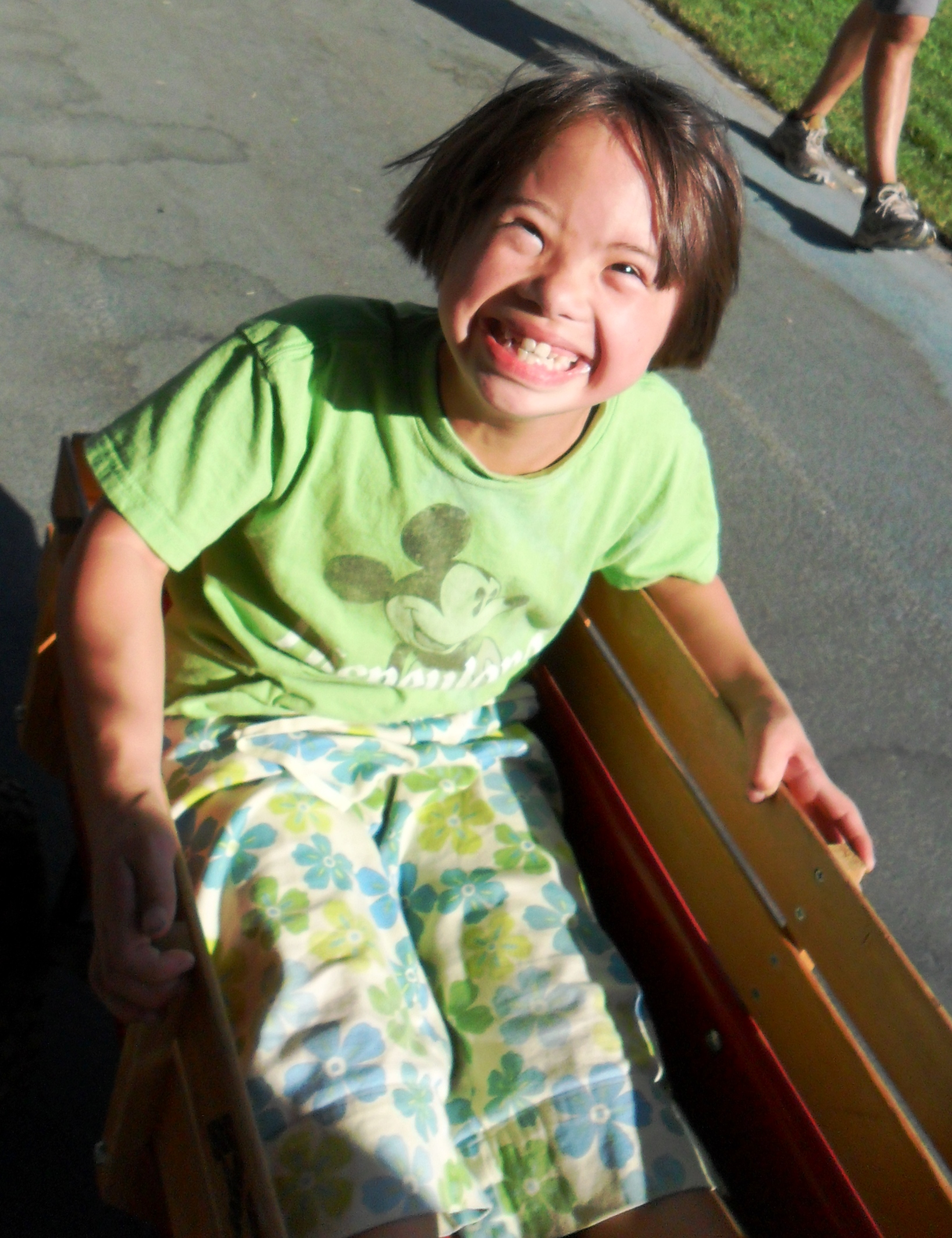
In honor of World Down Syndrome Day, I’ve decided to post in honor of my own special child, Marissa, who’s 13 1/2. I’ve written a bit about her already, but this post is specifically about my fun little kid.

Fourteen years ago, I found out I would be giving birth to a child with Down syndrome. I felt very blessed to know ahead of time that my baby had this extra chromosome. I’m the type of person who likes to be prepared, so it was nice to have half of my pregnancy to learn more about Down’s and just be ready to have a child with a disability. For me, what made it particularly nice was that her birthday was like any other baby’s birth: a day of joy and welcoming, with lots of photos, phone calls, snuggling with the new little one. If we had been surprised by her extra chromosome that day, I am sure a hush would have fallen over the room and there would have been feelings and reactions other than just pure joy and excitement over a new addition.

Marissa was the sweetest, most content baby I’ve had. She was happy to sit in a car seat or bouncy seat and just sleep or lie awake and watch me and smile back at me. She is still a very happy girl, no matter what. She has moments of frustration or anger or sadness, but they’re so fleeting it’s almost as if they never happened.

We’ve been very blessed that Marissa hasn’t had any health problems, no heart surgeries or anything that we’ve had to monitor. Over the years, she’s had a variety of therapies and extra services through early intervention programs and the school system, and she’s done really well. In fact, for a long time I could practically forget there was anything “different” about her. She walked right before she turned 2, and she has always talked fairly well and mostly clearly. She loves to read and does a great job sounding out new words. She just seems unbelievably bright to me and to others.

It’s now that she’s a teenager that I am more often reminded that she isn’t really in the same peer group as kids her age. She’s always been very small for her age, and the older she gets and the taller and more developed everyone around her gets, the more that distinction is pronounced. She is the size of an 8-year-old and behaves much like a 6- or 7-year-old, really. For a long time, she’s been quite happy playing with her younger sister who’s 4 years her junior; now she seems to be just as content to play with our youngest, who’s almost 5.

She was strictly in a regular classroom at school for some years, up until about 4th grade, when it seemed a better strategy to put her in a class with other students who had some learning disabilities of various kinds. She still gets to interact with her peers in p.e. or in art or computer classes now, but she has a better opportunity to have learning tailored to her needs in a special class. And I’m happy with that, mainly because she gets plenty of attention and seems quite happy with her class.

Marissa is eager to help and do nice things for others and she loves to hug. That actually can become a small problem sometimes because she’ll hug anyone, even someone she’s never met, and we have to keep reminding her not to do that.

At this stage of raising her, I’m honestly most concerned with her biological changes; she’s slowly starting to grow into a womanly shape (even though she’s still really tiny height-wise), and that means she’ll soon be experiencing other womanly changes I’m not sure how to address or warn her about as I did with my oldest. It’s all kind of a trial and error situation, raising her, but that can be said for any kid, I suppose!

There are tons of resources available out there now for parents of children with any disability, and there are many wonderful places to find information and support if you have a child with Down syndrome. The difference between what’s out there now and what was available just 14 years ago boggles my mind. The internet was barely around when she was born, with not nearly as much information as it has now, and my city library was where I turned for some information when I had my amniocentesis. I found a book that had a little useful stuff, but I think I was just looking for some photos of cute kids, and then I didn’t really find any. Now, there are some wonderful sites and resources that feature gorgeous photos of beautiful children and youths with Down’s, and it does my heart good. This organization, Band of Angels, apparently was around in 1998, but it wasn’t as easily found as it is now, and it just has beautiful photos. When I meet someone with a new baby who has Down syndrome, I either buy one of their products to send or tell the parent about it. It’s just reassuring to see other kids with Down’s given the adorable-photo-shoot treatment. I found it comforting, at least, when I learned about it.

In the first months of her life, I was actually given some books and tons of pamphlets and packets of information about Down’s and different resources available and services and ideas of things I could do to give her a stimulating environment and help her develop. Honestly, I barely read any of them. All that information is simply too overwhelming. When you’re just trying in those early days to get some sleep when you have a baby waking up at night for feedings and diaper changes, that’s the last thing you have energy for: reading and researching. And then as she grew, we had some good support systems referred to us, so I didn’t feel the need to go searching for a lot more.

I think it’s that way parenting any child. There’s always more you can do for them, but never enough time and energy. So you just do the best you can to make their life happy, fulfilled and enriched. Now, I just hope and plan for her to have opportunities as she finishes up with the school system to be able to live semi-independently and have some kind of work and a good support system and network of friends. I want her to have a happy life, just as I want for my other three daughters. And she seems well on her way. Marissa is one happy teen.

Happy world Down syndrome day.

The writing blues

This post is dedicated to all the writers out there.

I have been published quite a bit in newspapers, I write for my own book review website, and I’ve contributed to other websites and book review publications here and there. But some other outlets have eluded me. I’ve written two articles for our church magazines (one for the Ensign and one for the children’s Friend) that the magazines have accepted and paid me for, but which have yet to see actual publication. Over the course of probably 5 to 10 years, I frequently tried to pitch story ideas to magazines but never got one to bite (except for once, and that was at the very beginning of the journey and I didn’t realize what had just happened, so I somehow dropped the ball and never followed through: perhaps I’m being punished karma-wise for that…). So I’ve essentially stuck to newspapers and their online counterparts more recently.

And then there’s the book project. I started working on a nonfiction book about mothering when my now-almost-16-year-old was about 3. Over the course of a year, I would get an idea and rush to my computer in the same hurried manner as one who is nauseated would rush to a toilet. The book is a series of vignettes that tie together my observations of how my little girl saw the world and how I remember being as a child myself, and then connecting my realization that I could understand finally what my mother had always related to me about her feelings and experiences raising me. For me, raising this amazing preschooler and her infant sister, it was all revelatory. I hoped that perhaps the ways I phrased these insights and the positive message would resonate with other women, whether they were mothers or grandmothers.

Well, I’m not the type of person to write strictly for the pleasure of writing. I mean, I do love the process, but I’m a goal-oriented, type-A personality gal. I don’t just dive into the creative process and emerge refreshed and satisfied with my work; I feel it must have some sort of audience (Along the lines of the truism if a tree falls in the forest and no one hears it, does it make a sound?, one could say I think, if a writer puts pen to paper or fingers to keyboard and those words never see human eyes, did they ever exist?).  Someone must read my words.

So. Getting the words to an audience is the hard part. Writing is generally fun, occasionally frustrating, to be sure, but mostly a pleasant creative burst and satisfying work. Even editing is fun for me. But putting them in a forum where those sentences can be appreciated by other humans is a most unsatisfying business. It entails poring over websites, Writer’s Market tomes, and so on trying to find publishers or agents that will even consider my genre of writing. Then a perfect query letter that captures the essence of what I’ve tried to say in my book has to be crafted and sent to carefully vetted editors and agents. It entails a good number of trips to the post office. (I was on a first-name basis with some of the postal service workers in the office close to my house in Alabama while I was sending out packets in the push for publication of this book.)

Over the course of a year, I wrote the body of my grand oeuvre. Then I edited and reworked and re-edited. I changed the title. I overhauled. I went to a writers conference and had the manuscript looked at by a well-known agent. I reworked. I submitted countless query letters; I read books and articles and posts giving tips on how to craft the perfect query. In short, I was consumed by trying to get published.

There were a few bright spots in which a couple of agents requested more material after a query, but overall, I collected an astonishing number of rejection letters. They stuffed a file folder full. It was depressing, frustrating work into which I poured my whole soul and countless hours and stamps and got pretty much nowhere.

After those few years of work, I finally decided to self-publish. This was nearly 10 years ago, before the ebook, but at a time when you could easily self-publish using print on demand. But I had seen some “self-published” books that had gone through this quick and cheap process and I was not impressed with the result. They looked cheap and unprofessional, and if I was going to do this, I planned to do it right. So I decided to do it the “old-fashioned” way. I hired a book cover designer to create my cover; I investigated printers and finally selected one; I chose paper and materials. I edited and re-edited and did the layout myself. I ended up with a pretty nice-looking product. I chose to have 2000 copies printed because it wasn’t much different in cost to 1000.

I then researched how to market. I did the best I could to find outlets for my book and tried to snag a distributor, but that was just as difficult as finding a publisher! So I carried my book to some stores that were local and independent and were willing to consign the books or buy them outright. I did book signings in Birmingham and the Gulf Coast at cute indie stores. I set up a website and sent out tons of emails and put my book on Amazon.

I think I sold 200 copies. Now, I have boxes of books sitting in my garage in a neat stack in a far corner. I wonder if I should torch them. Or just recycle them.  Because honestly, when I go back and read my writing, I hate it. It sounds trite and goofy. It sounds like the cheesy, earnest books that somehow did get published that I generally disparage. Some people really did enjoy my book and my writing in general. But not nearly enough to empty all those boxes. I’d love to make room in my garage and clear those books out, but it just seems like I’d be throwing away money. Those boxes represent a few years’ worth of my life, of toil and sweat and (copious) tears, of unpaid work and investment of my husband’s hard-earned money. So I’ve kept them through one move to a different house in the same town and then a move all the way across the country. There they sit.

I’ve moved on. That project is behind me. I suppose I learned a lot from it. I’ve been able to help some friends who write and hope to get published as well; I’ve learned how the system works through my own trial and error and know how to help them. I am probably the harshest critic of my own work, as well, but from what I read, that’s not uncommon for any writer. I remember reading somewhere when J.K. Rowling published one of her Harry Potter books that she commented something like, “Well, it’s done, and it’s been sent to my editor, but I’m not really satisfied with it. I just know I’m not editing it anymore.” We as writers get sick of the same passage and still may not like it, but there comes a point we’re just done.

I’ve worked on a few other projects; I wrote a children’s book I thought was pretty clever and went through the whole process of query letters and rejections yet again (talk about soul-sucking and draining and depressing) with no result. My 9-year-old loves the story, though. I thought perhaps that was supposed to be my niche. Apparently not. I tried writing a young adult novel, and dedicated a month and about 70 pages to it and then took a break when my dad died. I never resumed because I just thought it was crap.

I’ve since decided my real talent is in writing nonfiction. I love to research and interview people. So I wrote a couple of articles for a large online news organization and have tried to do more research to make it a book. But that’s stalled because I haven’t found more people to interview.

And so goes the life of a frustrated writer. I absolutely must write. I must create. The urge to set ideas down on paper (or screen), to distill, to organize, to make something out of raw materials, is all-consuming. It just is who I am. I feel empty when I don’t write. The keyboard is an extension of my fingers and allows me to set in stone what are just swirling ideas in my consciousness. I don’t just enjoy writing; it is who I am. I’ve managed to write the whole time I’ve been a mother, despite interruptions and crazy schedules and the important needs of my family, because I wouldn’t feel whole if I didn’t.

So the process satisfies that part of my self, my personality. But the publishing is still something that eludes me. I desperately want to traditionally publish a real book. It is my end-all, be-all, pie-in-the-sky dream and goal. I’m almost 42 years old and I’m still stretching and striving toward it, shedding tears of frustration and wanting to hit walls with my fist (or head…) because it hasn’t happened yet. But I keep trying.

Here’s to goals. And dreams. And a toast to all those who are still striving for their own, whatever they may be. You writers, my fellow travelers, this tear’s for you.

A tribute to a one-in-a-million man

Since he turned 45 yesterday, I decided today would be a good day to recognize the superhuman support and love of my husband, Marce. I met him when he was 25, and in a way it doesn’t seem possible we’re in our 40s now, that nearly 20 years have gone by. I’m quite sure when he fell in love with me and decided to propose he had no idea what his married life would have in store for him.

We did have some discussion while we were dating about my mental health. I had returned from my mission, gone through the heartbreak I did with my longtime friend, and been started on lithium after a diagnosis of bipolar disorder. One evening we took a drive to visit my mission president, a man I love a lot and greatly admire, and who was sensitive to my needs. He and his wife sat and chatted with me and Marce; we had only been dating about two weeks at that point, and I didn’t really expect it to get serious. My president asked about how I was doing emotionally, and I told him so far, so good. His dear wife whispered to me, “He is a good young man. Hold on to him!” (She was more right than I could possibly have known that evening.) On the drive back to school, Marce asked me, “What did he mean about taking your medicine?” That gave me the opening to just tell him everything about what I’d experienced and where I was at that point. He listened quietly as he drove, held my hand, and seemed very reassuring and nonjudgmental, which meant a lot to me.

Sometime in the few months after that, I decided to stop taking the lithium because I just didn’t feel I had bipolar (I just didn’t fit the symptoms of the “bipolar I” or the typical disorder, as I think I’ve written about already). The medication could have dangerous side effects, and I needed to have regular blood tests to make sure it wasn’t damaging my liver. I felt since I wasn’t sure about the diagnosis taking a possibly harmful medication didn’t seem like a good idea. Unfortunately, around that same time I got engaged, finished college, and started my new life, and got so busy with a new full-time job and a marriage and new place to live and everything else that I neglected to consider my mental health. If I remember correctly, I didn’t do anything about it immediately (though I know I did find a psychiatrist sometime in that next year). I also started taking birth control medicine, which is chock full of hormones, which I have also learned was probably not a great addition to the cocktail of my personal chemical makeup. Again, unfortunately, I didn’t know any of this at the time.

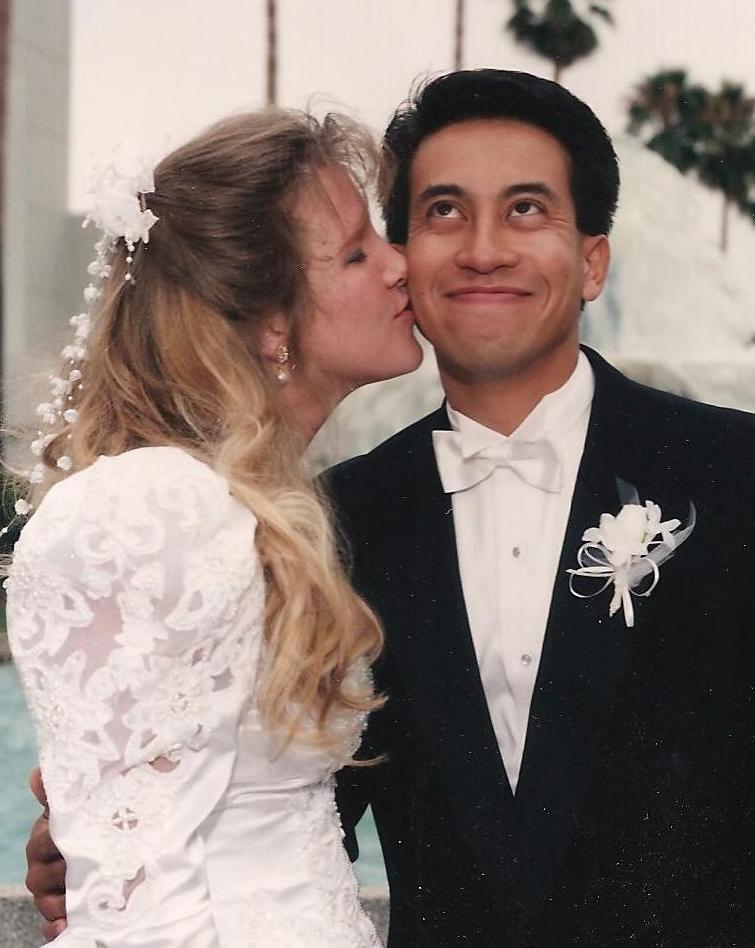
My sweet love on our wedding day.

What my dear groom experienced in the first year of our marriage was a number of occasions of me flying off the handle at nothing. I remember one trip on a day off to an amusement park, where I went ballistic over something someone near us did and shouted at them. I don’t remember the details, and honestly, just thinking about the idea of it anymore and writing it down mortifies me. But it’s what happened. I was a mess. On that occasion and others, Marce would just quietly try to divert my attention and take me away physically. He rarely made any comments or judgments.

The two of us have very different temperaments and backgrounds. My family was very open and didn’t hold back our opinions. We argued and yelled and were loud. His family was a strict Asian family, and the children did not talk back. There was no argument between children and parents, and yelling wasn’t tolerated. On top of those differences, I had a background in speech and some debate and a need to win. Marce played basketball and never debated. I’m sure it mattered to him if he won basketball games, but he just wasn’t (isn’t) a competitive type. Put that together, and you have no arguments, sure, because it takes two to argue. But I’ve certainly hankered for it over the years. If he had been the arguing type, we’d have had some doozies. As it was, I’ve yelled and screamed and done wacky things, and he’s listened in silence with a nearly emotionless face.

I’m not writing any of this because I’m proud of it. Very much the opposite; I’m embarrassed as all get-out. In many ways, my yelling and anger doesn’t fit with what I consider almost my “real” personality. But it’s happened, and it’s impossible to say that it’s __ percent my hormones/brain chemistry and __ percent my personality/upbringing/etc. I’ve already written about how it’s not possible to separate my “true” personality from what’s been caused by my mental disorder. I just am who I am; what I’ve done and experienced makes me who I am now. I hope that all of my flaws (chemical or not) have at least helped to turn me into a better person over the years, rather than cement me into place as a meanie.

It could be accurate to say that Marce may have needed to be more assertive or actually discuss issues with me more rather than just be silent. But that’s an issue for his blog, if he were ever to write one. What’s important and relevant is that over the course of being together for 19 years, he has never yelled at me; he has never left. He has always loved me and been supportive. I don’t think he’s judged me harshly, despite my giving him good reason to do so. He has done that from the very beginning, up until now, when we can at least put some good labels to what we experience together. Because at this point, it’s not just MY mental health issue; it’s OURS. (Although I have said at times when I’ve had the worst moments that he’s lucky he can at least go to work or somewhere else and get away from me for a while, whereas I can’t get away from myself and what’s happening in my head.) We are in this together; we’re a team. What’s his problems are mine and vice versa; what are his strengths could also be mine, and vice versa. I’ve known from fairly early in our dating days that I just felt comfortable, myself, with him, that I didn’t have to pretend to be something or someone I wasn’t. I was at ease; I felt loved. I’ve also known that we complement each other perfectly. We have truly made a great team.

Many other men may have bolted long ago from what I’ve put my husband through. But he is not other men. Sure, he has weaknesses, but he is an unconditionally loving husband who is dedicated to the institution of marriage and to me, personally. He and I believe that our marriage can last forever, and we’re working on it so we can be happy together for eternity. I now have confidence that is truly possible because I have 18 1/2 years of knowing for sure that my husband is committed to that. I am very blessed. His support has made all the difference in what have been some really challenging times. So, happy birthday, my love. I hope that my strengths and commitment to you have shown you how much I love you and appreciate all you’ve been to me.

Balancing act, part one of many

It’s pretty common for women to talk about the tricky proposition of balancing the many elements of their lives. In fact, I know few women who don’t worry about getting a proper balance, let alone maintaining it. But having mental health issues just makes that balancing act that much more difficult. I can say from years of experience that it’s a razor-thin line; right on one side I might feel a little overwhelmed but still OK; on the other side, I’m far past overwhelmed: I’m stressed, I’m drowning, I’m angry and lashing out at whoever comes too close. The latter is not a pretty picture, and I don’t like thinking about the times I’ve been pushed too far on that side of the line.

What my psychiatrists and I are currently calling bipolar II or atypical bipolar disorder causes me to experience a kind of hopeless feeling in which I rarely feel that kind of depression that makes me not want to get out of bed. It’s more of an angry depression. I feel isolated, alone, abandoned by all who should love me and somehow care and know me well enough to be able to see what’s happening and help. When I feel that way, in the very extreme times, I feel that life won’t possibly get better, that I can’t take the psychological pressure that seems to be pressing in on every side of me. I just feel angry at everyone who could possibly be blamed, including God. When the anger kind of dies out, I feel depleted and in despair. So I “swing” back and forth between a sad, hopeless depression and an angry depression, if that makes any sense. I’ll try to explain further in later posts. Suffice it to say, yes, I am a type-A personality, but I’m also typically a fairly cheery, happy person who always has a smile on my face. So when I get backed into these corners where I feel trapped and angry, the rage that almost flares up out of nowhere feels so at odds with who I feel I AM that it upsets me even further.

That brief introduction to my moods is just to somehow try to explain that I can quickly get out of balance. After years of this kind of yo-yo-ing, I can feel when I’m getting close to the brink, and I start feeling desperate. I know I need some down time, alone time, unwinding time to try to swing myself back to a more stable self. The problem is when I feel I don’t have the choice to just say no to activities or pressures or expectations from others.

Some people are more sensitive about this than others. Again, finding balance is always a delicate proposition, and many people understand this for themselves and that it’s the same situation for others. Some are just more empathetic about others’ needs as they bump into their own needs. I admit I get a little irritable when I say, “Well, I can only do ___ because I am pretty busy.” In my mind, that’s me being responsible enough to know my limits and exercise my personal choice to lay down those limits and work around them. When someone else responds, “Well, yes, sure, but we’re ALL busy,” I know they’re not really going to be too respectful of whatever line I’m going to draw for myself. Or they may say, “Yes, well, but (____ organization) really NEEDS you.” Sure, every organization that relies on volunteer help of any kind always needs help and never has enough. But I cannot possibly do enough to fill in those gaps, for that group or any other. Or I might just say flat-out, “No, I simply don’t have the time and energy to do that right now,” and rather than saying, “Oh, of course, don’t worry about it. We’d love your help, but we understand that” they keep pressing on in some way. These responses essentially tell me that these people value their needs above mine. And sure, we tend to be selfish beings and that’s natural. But I certainly appreciate it when someone else rises above those human tendencies and tells me, “That’s fine. You do what you need to do.” I so greatly value when they have the kindness to respect my choice, my right to make decisions for my own life and that of my family.

You see, I know what my limits are, and I’m constantly doing the balancing act. I am a softie at heart, and I want to give my money and time to a whole lot of worthy causes, worthy people. My heart goes out to them. I may even sometimes foolishly say yes or maybe when I should have said no because I’m biting off more than I can chew or even get in my mouth at one time. But when it comes down to it, my mental health must stay intact, so I can be happy, so I can take care of my family (which is paramount in my life above all the other things that matter to me), and so I can in the future continue to give to others. Simply, it rankles me when others don’t respect that I should know best for my own life and my own well-being and continue to push me when I say no. It ticks me off. Big-time. But on the flip side, I feel respected and cared about when someone is kind enough to take me at my word and wish me the best. Perhaps I expect too much out of people, but I would love to see more sensitivity in how people treat each other. There’s just no way of knowing what someone else is going through. I’m being open here on this blog so I can help others understand what I’ve experienced, but I simply can’t go through my whole personal history every time someone demands justification for me saying no. Thank you for being understanding, those of you who have been and continue to be so with me.

Gratitude

So many talks have been given, quotes made into cute signs, and so on about gratitude. I am sure I have absolutely nothing new to say on the topic. Nonetheless, I’d like to take a few minutes to share some of the things that move me and leave me with a sense of gratitude for the abundant, luxurious life I live. I am not wealthy, just fairly middle-class, but I recognize that I am rich compared to so many people across the world, even in our own relatively wealthy country.

First, I am frequently very grateful for the conveniences we take for granted in our first-world life. Aren’t running water and electricity amazing? I love having a climate-controlled home. I don’t like the heat too much, although at this point, I’ve lived 25 years in warm climates where there isn’t much snow and the summers are either very hot and dry or hot and so muggy you might as well be in a steam room. I don’t mind the cold; I like bundling up, but I have come to appreciate not having to navigate around with snow on the roads or sidewalks. I appreciate just being able to go about my business unhindered. So I appreciate air conditioning and heating. When I moved to the South as a 10-year-old from the cold climes of Pennsylvania, I went to an elementary school that still didn’t have air conditioning. I sweated through the first month or two of school (August!) and walked home in a haze from the bus stop to my (finally!) air-conditioned house. Mom would often be waiting with a Popsicle. How sweet and wonderful that was.

And plumbing. To have hot water or cold water whenever we want it, without waiting, without hiking to a well or going outside to a pump. Wowee. And toilets: it’s pretty nice to flush the smelly stuff right out of your house and not have to use an outhouse that always smells (no trips to said stinky wooden shed in the middle of the night either when it’s dark and who-knows-what might get in the way).

Technology never ceases to amaze me. Sure, we’re living in a media- and tech-saturated society, which isn’t always a good thing, but I’m in awe of how much good can be done with what we have. I just think it’s cool if I or one of my children has a question we can just take a quick moment to run to the computer and Google it. When I was a kid, the only immediate sources available were my parents and the encyclopedia. If neither of those all-wise repositories of information had the answer, I was sunk, just stuck with a question and no satisfying solution.

All of these little things are just a sampling of blessings I appreciate on a daily basis. Of course, what matters most to me are my family and friends, my experiences and memories, the things I’ve learned. I have a husband who has his imperfections and little quirks that can make me a little crazy, but he is just overall a kind and unconditionally loving man who has been better to me than I could ever have imagined these past 19 years. My daughters are astonishing in their beauty, their talents, their sweetness, their good natures. I wish I could just sit down and enjoy them non-stop, but my own needs to be alone and do things for myself as well as just the daily needs of a household keep me from doing that. But I do enjoy the moments we have, even the hours, in which we talk, read, play or otherwise have fun and share together. I also have some wonderful friends whom I admire and love a great deal, who I wish could all live on my cul-de-sac and be available all the time for fun and commisseration. There have been many other people who have been kind and good to me over the years, and I hope that any good I do can just “pay forward” in their honor.

Finally, I am grateful for my faith in and assurance of a God in heaven. It is always comforting to know that he loves me and has a plan for my life, in this mortal existence and afterward. I try to live to show him how much I appreciate his goodness to me in so many ways.

Sure, it’s only March, but every day can be Thanksgiving Day, can’t it?

Creative juices

Life is full of all kinds of things. Here, I will write about whatever else just strikes my fancy, because, hey, this is my blog. Just expect this page probably to fill up with all kinds of odds and ends and miscellanea. I suppose this is the web version of that catchall drawer everyone has in the kitchen and/or office: you never know what you may find. Here’s hoping that whatever you do find here, you find it to be entertaining, uplifting, inspiring or informative in some way, or a combination of all of the above.

So I’ve been thinking lately again about all the things I’ve found interesting over the years. With my children getting older and finding their own interests and getting involved in activities, I am telling them what I used to do. My oldest, who turns 16 in a few months, plays clarinet in band and has been loving that. She also plays piano and is quite good at it, considering how few official lessons she’s had. She doesn’t really feel passionate about singing, though. She also loves art; she’s loved to draw and paint for years, and her creations are just astonishingly beautiful and true to life. My third daughter, who is going to be 10 in a few months, has decided she wants to run track at her elementary school (they do this for fourth grade!). It cracked me up a bit when she said she wanted to try shotput. My girls are petite little things, willowy and trim. So when the 9-year-old said, “That shotput is heavy! My arm is feeling, well… not very strong,” I had to laugh. I said, “You’re not exactly a beefy kid. The people who do shotput are usually a bit beefier than you. You, well, you’re more veggie.” But, hey, if she wants to try that (and the long jump and high jump), then great.

This younger one also decided that she may very well be interested in drama. I’ve taken her to see some plays, and after the most recent performance, she voiced her interest. Not surprising. My oldest has never shied away from public speaking; in fact, she’s quite good at it. But she’s never wanted the spotlight or wanted to perform in that way. But the 9-year-old, well, she is more of a spotlight gal. I think she’ll be great up on the stage.

These burgeoning interests are reminding me of all that I used to do. I performed in community theater as a young person; in fact, as I informed my 9-year-old, I was the star of a play at the university where my dad taught when I was in 7th grade. It was great fun. I helped out stage-managing and performing at our Playhouse in the Park in high school during the summers; I would have acted more, but I had band camp and other activities during the summer that interfered with the schedule. I marched in band for a couple of years. I played piano. I enjoyed singing.

Talking about those activities now with my girls, I miss those days of involvement. Now, I’m just as heavily involved in life, but with different kinds of pursuits, more “adult,” “responsible” things. I work a little, editing other people’s writing. (That’s at least something I get paid for.) I write and review books (a pursuit for which I am not paid). I volunteer with a variety of organizations, right now the band boosters. Mainly, I run a household, which is pretty demanding and complex work, but it’s not focused on me; it’s focused on my husband and children. But sometimes now I miss holding a French horn in my arms and creating lovely music and being right in the middle of a band that’s surrounding me with all the harmonies of 60 instruments working together as one. I miss standing on a stage and reciting words someone else has written that inspire or amuse because I’m bringing them to life. I miss all the cool stuff I did that brought out all my creative juices.

Now I’m exercising my abilities to bring out my children’s juices (hey, I’m a juicer!); I’m refining my interests and learning to manage my time and resources, exercising restraint. I can’t do it all, not at once, but I can do a few things that really inspire me the most. For now, that works for me.