Speak up about the real value of women

It would be difficult for anyone to argue that women aren’t being demeaned as objects in pretty much every single corner of society. It happens so much and is such a thoroughly pervasive message in media that we’ve almost forgotten to be angry about it. We just take for granted that it’s happening.

Well, I think it’s time for women — and men — to stand up and show some anger about this phenomenon. It’s time to stop the saturation of our culture with images of sexualized women.
You can’t slap a pink ribbon on everything and say it’s “supporting” women.

I’ve been writing off and on about this topic, and I’ve nearly finished the book I’m writing, which focuses on the topic from a faith-based angle. But nearly every day, I see something else that makes me want to shake my fist and just DO something, SAY something. Yesterday it was a USA Today article about how breast cancer is being sexualized. Wha?? Yep, it’s true. I suppose I’d already kind of subconsciously noticed it myself, but the article really clarified the point. I also had just noticed a full-page ad in an in-flight magazine when I was traveling over the weekend: it showed a photo of a very trim, fairly young woman with smallish but nice breasts (a point I feel inclined to note, since most of these kinds of photos show women with larger-than-life breasts) dressed in an itty-bitty white bikini. Flat abs, no fat, no cellulite, no blemishes. And the ad had the nerve to have been run by plastic surgeons touting the message that they can do great reconstruction on women who have had breast cancer. Aaaaiiiieee!

Let’s think about this honestly. Is the average survivor of breast cancer going to look like a 20-something model? Ah, nope. She’s going to have scars, could be some pretty big and ugly ones, depending on how much surgery had to be done. She might be thin (thanks to not being able to eat much during chemo), but not necessarily in the “attractive” way. It might not even be possible for reconstructive surgery to get her back to “normal.” A friend in her 50s recently told me about her experience with breast cancer, and she said that after having a double, radical mastectomy, she was told by surgeons that the process for giving her breasts would be lengthy and, as she put it, “barbaric.” And then she wouldn’t even be able to have normal-looking breasts: they wouldn’t be able to give them nipples. She turned down the surgery; no point in going through all that to have substandard breasts.

Nope, these kinds of demonstrations of support for breast cancer aren’t help. They are simply marketing opportunities painted in pink. The article quotes Karuna Jagger, executive director of advocacy group Breast Cancer Action, as saying, “The implicit message in these campaigns is that it is breasts that are sexy; sexy is what is important; and we should care about breast cancer because it takes those lovely, sexy breasts out of the world . . . Every October, the stunts just gets more bizarre and further removed from what’s needed for this epidemic.”

Why can’t we just stand up and say, ENOUGH, ALREADY!? Sexy, young, thin, well-endowed female models are used to sell almost everything. I work out at the gym every day and can see a bank of about five TV monitors showing different networks while I exercise. I read or listen to music, but I can’t help but glance over at the monitors and see what’s going on. At any given time, I see several images of unrealistically-shaped young women, on commercials or the news or various programs. The anchors on news networks are thin and usually young (at least in comparison to the men, who can be any age). Innocuous game shows feature models showing off the prizes. Soap operas feature cute young girls and some older women who have often had various work done (at the very least, Botox and injections to plump up their lips or cheekbones). All the commercials feature women. Products for men and commercials aimed at men feature sexy models, scantily clad. Products for women and commercials selling those products for women feature women; most of them are for hair color (get rid of gray) or skin creams that aim to reduce wrinkles and make skin look younger and fresher. Car commercials even mostly feature women: young, trim models.

It’s all about sexualization. When will all women say, Enough. No more. I refuse to be sexualized, to be objectified, any more. It starts at home and with our circle of friends, even just on Facebook or Pinterest. Stop pinning the “fitspiration” pins. I don’t. I like to exercise, and it’s a vital part of my daily routine. But I refuse to put another photo in front of me that has a ridiculously skinny teen or 20-something clad in a sports bra and tight boy shorts, touting her amazing workout that will make all of us look just like her. It’s ridiculous. We should be laughing, not trying to emulate those girls! Stop posting about how you feel fat or ugly or that you look old. Don’t expect yourself to look your regular self two weeks post-baby, either. Stop focusing on how you look, period. And don’t focus on how your friends look. Support them as they do great things with their lives, as they work on being their best selves.
Women’s important body parts aren’t our breasts or backsides. They’re our hearts and hands.
Photo by Louise Docker, via Wikipedia

Focus on YOU, women. Allow the men in your life to focus on who you are inside, too. Teach your daughters to be who they are, and teach your sons positive language about women and not to focus on appearance. Yes, be healthy. Try to eat mostly well. Exercise regularly. But don’t make how you look the end-all, be-all. Don’t let yourself be objectified. Don’t let the media and the marketers and the porn producers dictate how you feel about yourself or how society views you. Gently remind friends that they are “more than eye candy,” as Beauty Redefined enshrines in billboards, or that they are more than just numbers on a scale.

We women are amazing creatures. We nurture future generations. We lead society. We do great things. Let’s show ’em what we’ve got! We’re not about our body parts, unless we talk about our brains, our hearts, or our hands. Let’s join those hands and speak up.
That traitor the brain

I’ve been fascinated for years by how our own minds can turn inside-out on us. Memories can and often do turn out to be slippery and even downright wrong in any “normal” individual. Brains getting eaten up by dementia lose familiar people and chunks of time entirely. Brains that are schizophrenic or otherwise split can create whole other lives out of nothing.

Stories that take those quirks of the human mind and turn them into horror tales or mysteries are particularly gripping for me. The movie Memento is just one example of a story that turned a character’s reality on its head once it played itself out. Oh, what horrors our own brains can subject us to!

But those stories generally just get me thinking about the mysteries of our minds and the reality of life and its quirks. One tale that shook me and just felt more personal, however, was the true story of mathematician John Nash in the movie A Beautiful Mind. For those who haven’t seen it, skip over this paragraph. But those of you who have will know what I’m talking about: Nash is schizophrenic and ends up realizing that he’s created people and scenarios in his life that are completely fictional — nonexistent. The story here is that Nash, against all advice, decided to just will himself into getting rid of his symptoms, telling himself over and over again that the people he thought were friends simply were not there, even though he could see them.

I love how Ron Howard fashioned this film: he takes the viewers right into Nash’s “reality” and makes us believe that what he sees is real. And it’s not. It’s absolutely shocking, jarring, to find out that what we saw and accepted as truth was not real.

As I’ve learned over the years that some of the feelings I experience — depression, despair, racing thoughts, and so on — are actually just symptoms of out-of-whack brain chemistry, I’ve come to appreciate just how scary it is to be under the control of a brain that is not in itself in control. At times, I’ve been able to kind of step away from my own feelings for a bit and coolly and rationally observe that they are simply constructs of my biology. Some moments I’ve felt extreme sadness or irritability have had no logical basis in reality; they haven’t been caused by any external event that would normally make someone feel sad or angry. I’ve found some comfort in those times I’ve been able to do that; it hasn’t changed entirely how I felt, but it’s made me realize that my biology has hijacked my mind and that I don’t have to be completely a slave to it.

But it’s unnerving nonetheless to know that my brain — basically the seat of who I am — is a traitor. It takes me places I don’t want or need to go. It terrorizes me.

No, I don’t hallucinate. I don’t experience some of the particularly challenging effects of certain brain disorders. But from my own experience, and thanks to that window into Nash’s world that Howard created, I can certainly empathize with those who do experience that. It’s harrowing.

We rely so much on our mind, on our memories, on everything that we’ve stored within and taught our brains. We expect our minds to be infallible, to always tell the truth. We expect them to reflect reality. Because reality is what we think we’ve always lived. But what if our minds aren’t storing memories quite as neatly as we’d thought? What if they are reflecting to us a life in a funhouse mirror?

I guess I’d like to thank my brain for mostly getting it right (I think …). And I’d like to make others aware that some people’s brains just don’t do what they should. That reality is not always real for everyone, that even depression is a state that feels absolutely and terribly real to its sufferer but looks very different on the outside in everyone else’s reality. That sometimes we have to visit someone else’s world so we can help them leave it behind. A bridge must be made between the two realities.

I’m grateful for the people who have taken the time to try to understand my reality, to try to empathize so they can offer the right words or gestures of help. I’m hoping that in writing about my particular mind and where it’s led me, it might help others as they build those bridges.

A soft spot in my heart for … houses

Last summer, my daughter’s friend moved out of the country and had a cat who unexpectedly gave birth to a litter of kittens right before they left. My softie heart bled for those poor little kittens, and I decided that we should take the mother cat and all six kittens so they could have a chance at life. We fed the mama, let her feed her babies, and cleaned up after them. A lot. We gave the kittens baths at the outset and treated them for fleas so they wouldn’t be “exsanguinated” by the nasty little bugs, as a vet friend warned could happen otherwise. We cleaned some more. We had fun with those kitties and got exasperated as well. About two and a half months later, after finding homes for a few and not succeeding with the others, I took them in to the SPCA, fairly confident that they could be adopted, healthy as they were and still cute but able to eat and use a litter box. I had done my best by them, by golly.

I’ve found myself experiencing the same tug at my heart as I drive by homes in my town, particularly old ones, that have been left by their owners or occupants, most likely all because of foreclosure. They look so forlorn, their windows boarded up, their lawns growing tall. It doesn’t take long at all for a house to look derelict. I just want to buy them, somehow, and refurbish them. I’m not a house flipper; I happen to own one rental house, only because we lived in it, moved across country, and then couldn’t sell it. But I’m not an “investor.” I don’t look at houses and see investments or dollar signs or income. I see history and lives and stories.

My early years set me up for this love of mine. My parents ended up buying or renting old homes when I was a child in Pennsylvania. I remember all the neat nooks and crannies of the houses and the land they sat on (we invariably lived out in the country somewhere). So many locations for hiding, for exploring, so many stages for my imagination to create wonderful sets on.

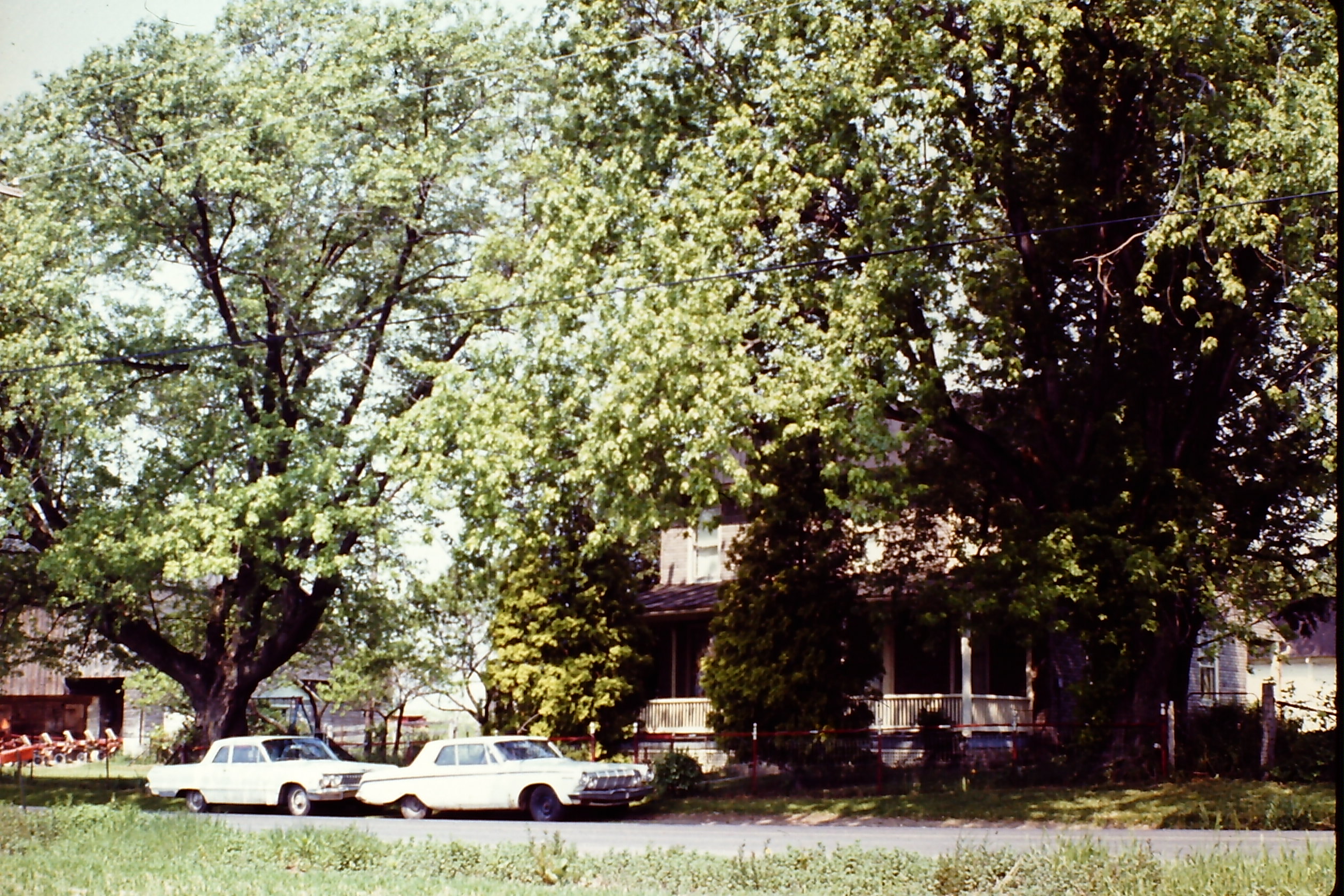
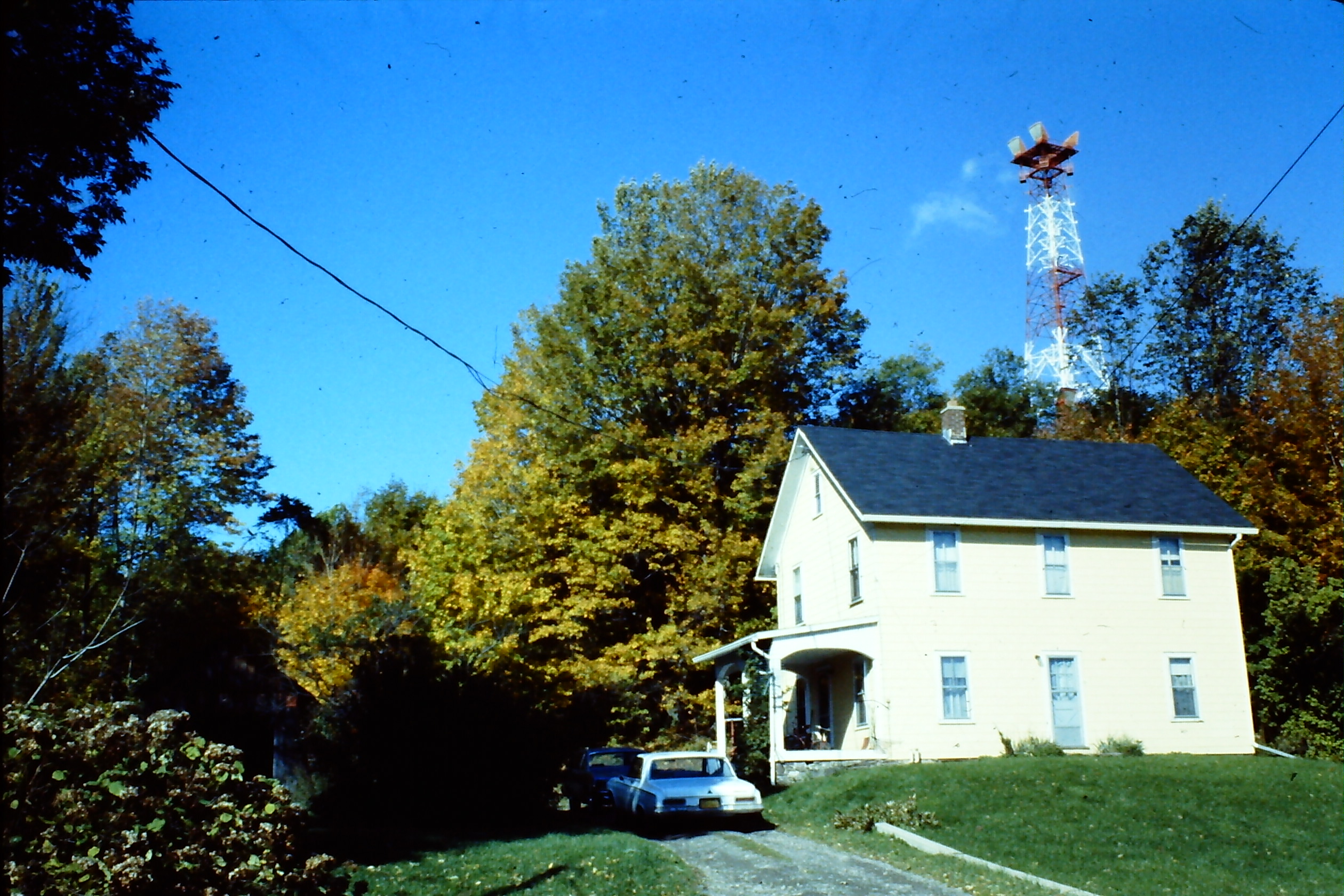
I wish I could find another picture of this house without it being so hidden behind trees. It was wonderful. Now it’s gone, only living in my memory and the memories of whoever else lived there and still is alive today.

I remember just looking at this house before we moved in and being in awe of its age, all the stories that somehow seemed to be hiding within its walls, bits of the plots or characters almost seeping out before my eyes. It had a wonderful hallway/landing at the top of the stairs around which clustered the bedrooms. If you walked all the way around the landing to the right, you’d be standing immediately above the downstairs entryway. And there was a door to the attic. The first room at the top of the stairs was originally a bedroom, but somewhere along the way it had been “modernized” to become a plumbed bathroom. So it was a good-sized room, with a clawfoot tub just sitting on one side and a sink and toilet deposited there as well. Ah, the space! The house was so old it either didn’t have closets, or they were tiny, so we had to use armoires. I did enjoy that house. It broke my heart when 20 years later I drove up to that area with my husband and first two daughters and tried to find the house, only to discover it had been replaced by a subdivision (shudder!). How dreadfully boring and unoriginal! I felt so sorry for the people who lived in those dull new houses and for those who would never get to explore the old homestead.

After that, we moved into the house “on the mountain,” only reachable via dirt and gravel roads which were nearly unnavigable in wintertime. Dirt roads covered with slick ice and snow that go up and up do not make for safe driving. The house itself wasn’t quite as cool as our previous house, but the whole mountain was our playground, and it was just as fun in snowy conditions as it was when all was green.

My husband grew up, however, in suburbia, in tract housing that was, frankly, boring and generic compared to what I had grown up with. Over time, I converted him to my way of thinking. We were very excited to be able to find a wonderful old place to rent for our first house as a married couple.

It was Tudor style and a solid 70 years old and had such neat touches: there was a milk-delivery slot on one side of the home. Useless to us nowadays, but cool! It was just a reminder of what the house had seen, what life had been like in its early days. It had hardwood floors and lovely built-ins and a very old but pretty wool carpet in the living/dining room area. I did love that house. It reminded me of my childhood homes and just the notion that something made of wood and plaster can feel like it’s a living, breathing thing, full of history and character.

We moved out of California back East, away from the land of layers of big-city suburbs and stucco, to small towns and wood/vinyl siding or brick. There we were able to buy our first house. It was modest in size but was older, with hardwood throughout and nice character. After eight years there, we just happened to drive by a house that had a little “for sale by owner” sign in the front. We weren’t planning on moving; hadn’t even thought about getting a different house. But I just couldn’t help but look. When I walked up the staircase and got a glimpse of the rooms upstairs, it just gave me the same feeling I’d had walking up the stairs of that old, long-gone house I lived in as a child. I couldn’t help but buy the place.

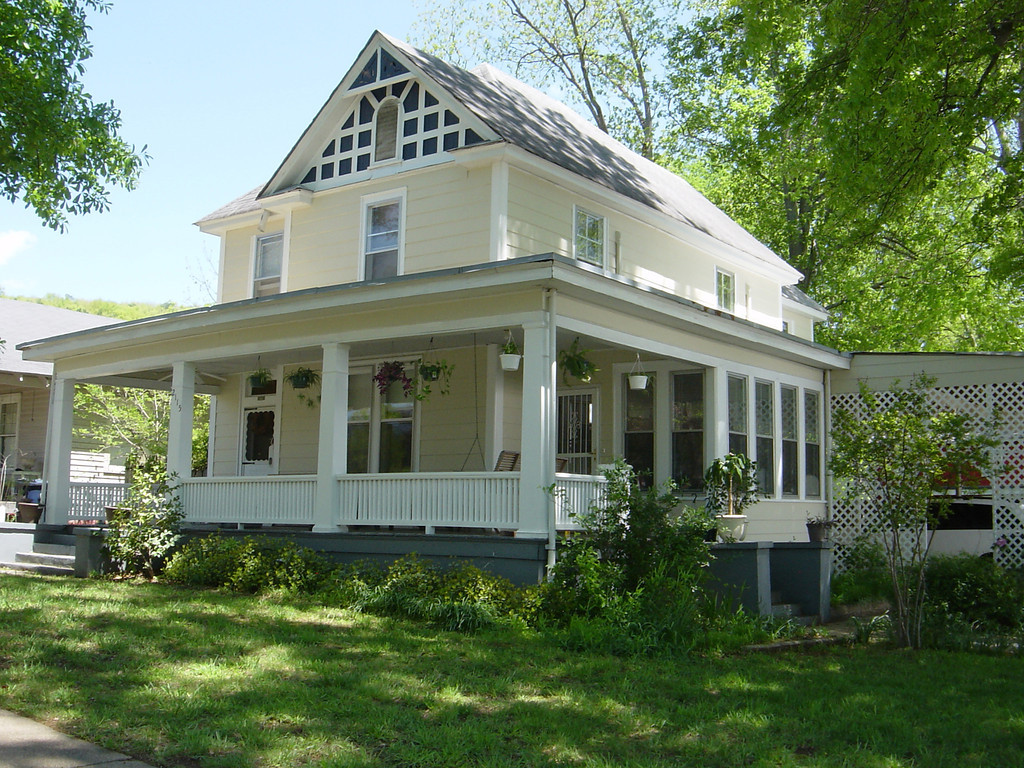
It was 100 years old when we bought it, with all kinds of wonderful touches. It had a porch all the way along the front and a barn in the back, even though it was “in town” on a main road. Everything else just grew up around it over the years, I suppose. We got in there and just rehabbed it. We painted all the rooms inside and then redid the two bathrooms, adding an antique clawfoot tub to the downstairs bath, which was large enough but somehow only had a toilet and sink (and just cried out for a clawfoot). We painted the outside eventually. We did so much to it and for it. It was beautiful, and it had such character.

But we left it behind. Now we live in a wonderful house that has some neat touches and isn’t a tract; it’s a 20-year-old custom home. It’s needed some work, too, which we’ve lovingly provided, a bit at a time. But as I drive around town and see some of the older houses here, I think, Oh, come to Momma, let me take care of you! I’ll give you the treatment you deserve.

But one can only take in so many kittens. I couldn’t possibly buy and make over all the wonderful old houses that sit so alone and desperately in need of TLC and good families to build memories and create new stories in them. Even so, the heart isn’t practical. That soft center inside my heart will always reach out to every boarded-up, uninhabited house, wanting so much to give it a new lease on life. No, I don’t get (too) excited about clearance signs in shopping malls. But my pulse accelerates at every “for sale” sign in the front of a classic home. Maybe, I think, I could just buy it and rent it out so someone else could enjoy it… 

Backtracking here … some official words about mental illness

I realized the other day that though I started this blog in part to share my experiences with mental illness, I haven’t necessarily given some good definitions of the term or the different kinds of illness that people may experience. As I have written about how I feel and continued to get feedback from friends, I realize that I haven’t made clear enough what exactly “official” mental illnesses do, and how they are different from the regular ups and downs that everyone experiences in normal life. So here goes.

From the National Alliance on Mental Illness comes this information about depression:

Unlike normal emotional experiences of sadness, loss or passing mood states, major depression is persistent and can significantly interfere with an individual’s thoughts, behavior, mood, activity and physical health. …

Depression occurs twice as frequently in women as in men, for reasons that are not fully understood. For more please visit NAMI’s section for Women and Depression. More than one-half of those who experience a single episode of depression will continue to have episodes that occur as frequently as once or even twice a year. Without treatment, the frequency of depressive illness as well as the severity of symptoms tends to increase over time. Left untreated, depression can lead to suicide.

Major depression, also known as clinical depression or unipolar depression, is only one type of depressive disorder. Other depressive disorders include dysthymia (chronic, less severe depression) and bipolar depression (the depressed phase of bipolar disorder). People who have bipolar disorder experience both depression and mania. Mania involves unusually and persistently elevated mood or irritability, elevated self-esteem and excessive energy, thoughts and talking.

Now for a definition of bipolar disorder, also from NAMI:

Bipolar disorder is a chronic illness with recurring episodes of mania and depression that can last from one day to months. This mental illness causes unusual and dramatic shifts in mood, energy and the ability to think clearly. Cycles of high (manic) and low (depressive) moods may follow an irregular pattern that differs from the typical ups and downs experienced by most people. The symptoms of bipolar disorder can have a negative impact on a person’s life. Damaged relationships or a decline in job or school performance are potential effects, but positive outcomes are possible.

Two main features characterize people who live with bipolar disorder: intensity and oscillation (ups and downs). People living with bipolar disorder often experience two intense emotional states. These two states are known as mania and depression. A manic state can be identified by feelings of extreme irritability and/or euphoria, along with several other symptoms during the same week such as agitation, surges of energy, reduced need for sleep, talkativeness, pleasure-seeking and increased risktaking behavior. On the other side, when an individual experiences symptoms of depression they feel extremely sad, hopeless and loss of energy. Not everyone’s symptoms are the same and the severity of mania and depression can vary.

More than 10 million Americans have bipolar disorder. Because of its irregular patterns, bipolar disorder is often hard to diagnose. Although the illness can occur at any point in life, more than one-half of all cases begin between ages 15 and 25. Bipolar disorder affects men and women equally.

As I do believe I have mentioned, it seems apparent (as much as is possible with these complex brain issues) that I have a form of bipolar disorder. One doctor, who has written a fine book and puts information on a website as well, has a great explanation that is quite detailed showing what a broad “spectrum” of symptoms people can experience anywhere between the “unipolar” extreme of clinical depression and the other extreme of “bipolar I,” which includes manic episodes and full delusional mania. For a really detailed explanation, visit Dr. Phelps’ site on this particular topic. In other words, I’m somewhere in the “middle of the spectrum.”

I’d say I’m typically a fairly “normal” person. When I’m feeling pretty normal, I manage to weather ups and downs of life with maybe a little complaining and some irritability. I think most people understand what THAT’s like! But when I’m pushed outside of those “normal” chemical boundaries, then I find it either impossible or much more challenging to weather the regular ups and downs with my regular coping tools. I am on medication that makes it much easier for me to stay in the “normal” frame of mind most of the time. But even so, medication doesn’t put me in that “normal” place 100% of the time. I still end up in an extreme irritable state or depressive place every so often.

One point I’d like to make clear is this: as Dr. Phelps says:

Depression is Not a Moral Weakness.

It Has a Biological Basis. 

He shows there are real proofs to back up this statement.

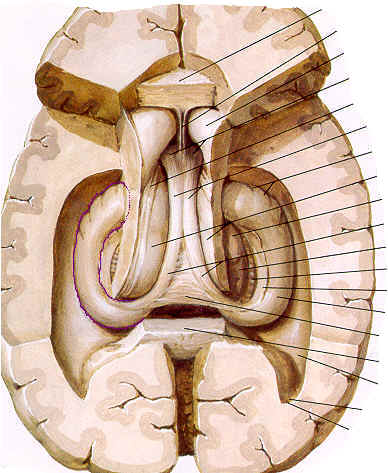
A view of the hippocampus from Psycheducation.org

The other point to make clear is this: doing the normal things that “normal” people do who are facing some sadness or frustration won’t kick someone who has a brain chemistry problem back into healthy chemistry and normal ways of seeing things. Trying to put a smile on your face or just counting your blessings or looking at all the positives won’t do the trick entirely. I’m not saying they’re not worthwhile, but if someone has gotten into clinical depression, those “tips” won’t fix it.

That’s why I am writing about this topic. I’d like more people to understand what it feels like, what it means, to grapple with a mental illness. If you haven’t grappled with it yourself, it’s hard to grasp what it’s like. So I hope that by writing here, I can bring more understanding to those of you who know me or someone else who does have a chemical/biological issue. I’d like to feel that when I say I’m getting depressed, I’m not just complaining about how life is a little extra hard. I’m actually saying I’m struggling and I need support. I’m asking for help. (And honestly, I don’t do that very often, I think. I like to go out and help other people, but I hate feeling “weak.”) And I think this is what many others in my situation are trying to express as well. I don’t want to be seen as a whiny complainer who needs to just buck up and get a stiff upper lip and understand that life can be hard. I just want to be understood a bit more as someone who has a particular biological problem that sometimes makes life a little more challenging to deal with than usual.

I don’t know how successful I’ll be. I just hope that I can reach a few people. If I do, I suppose that’ll be success. Thanks for trying to learn more and understand!

On life: possibilities, choices, and opening and closing doors

As I have gotten older, I’ve realized just how much it means that we as human beings have choices in our lives. I believe God put us all here on this earth for a certain number of years for a reason, and he gave us the gift of choice. He allows us to do what we want to do, and we get to learn from what we decide to do and be.

In saying that, I think much gets made of that part of the equation: hey, we have free choice! Whee! We can do what we please!   It sounds so exciting, so liberating. And it is. But the flip side of that “free” coin is this: once we make a decision, we are faced with the consequences of that decision, be they “good,” “bad,” or “neutral” consequences. And part of those consequences is that once we open a door and go through it, we can’t go back through it the other way. Life is constantly moving forward. Once the door opens, it closes behind us, and here’s the kicker … if we’re standing looking at choosing among ten different doors, or just two, we can only pick one. And we can’t go back and pick one of the other doors once we’ve gone through the one we chose.

Let me try to explain and qualify: yes, we may face many doors during our lives that are pretty much the same ones we had to choose among previously, but they’re not exactly the same doors; time is always moving forward, and things change in small and big ways. We’ll never choose again, at age 18, 3 months and 5 days, which college to attend. We may decide a year later, at age 19, 3 months and 10 days, to switch to a different college, but it’s not the exact same choice. We’re not the same people, and we don’t have the exact same options as before.

I think of life as this path along which I walk. The path is constantly branching off, and there are forks always. Some are big, with large roads to choose among, and some are just little footpaths with grass tamped down by a few travelers. But we’re always at some kind of crossroads. And at each of those decision points lies a door we pass through, which closes behind us.

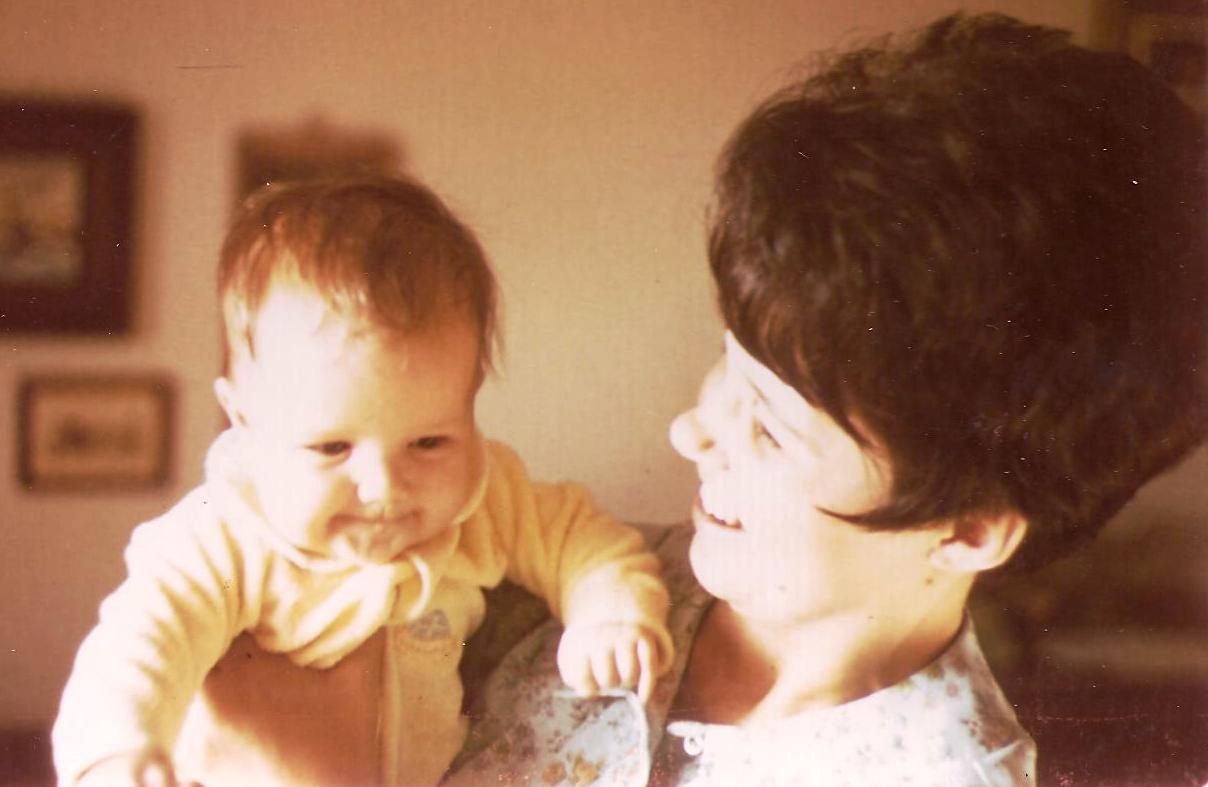
Me as a baby, with my mom: my whole life was ahead of me.

There are infinite numbers of paths the younger we are, from my experience. And as we choose paths and corresponding doors, we tend to have fewer big paths to choose among, and doors tend to shut more permanently the older we get. Sure, we hear “success” stories about people becoming athletes at decidedly older ages than usual, or becoming famous painters at 80, or some such thing, but those are well-known stories precisely because they are rare and unusual. (News means something out of the ordinary, and that’s what stories like this are: news.) For most of us, once we choose at 20 to pursue a career in business as opposed to chasing a dream of becoming a pro baseball player, the sports door is shut tightly behind us, and we won’t see it ahead again.

I think back on all the things I did as a young person. I acted in plays, sang, played piano, played French horn in band, went to various competitions for different academic pursuits, took all kinds of classes, dabbled in drawing, wrote, read like crazy, and baked and decorated cakes. I went to college as a chemistry major. I stood on the threshold of university life full of hope and excitement and the thrill of embarking on a grand adventure, a dream.

1988: My dad and I on our way to the airport to get me to college.

But once I was out of college, I had shut many doors behind me. Acting, playing French horn, academic competitions, drawing, even chemistry were all behind me. I still baked, I still read and wrote. I just changed my mind about being a chemistry major and focused on journalism. As life progressed and I made decisions to major in journalism, my other minor interests had to be sacrificed as I took more and more classes in my major. Then when I graduated, I worked 40 hours a week as a copy editor, further narrowing my journalistic interests, at least for the time, on editing rather than writing. As an adult and a college graduate, I had work to do. I had less time to explore and be general. Of a necessity, some interests had to be sacrificed.

My life further was changed when I decided to marry and when I decided to have each of my four daughters. Each of those choices opened up gorgeous paths with all kinds of interesting and beautiful plants along the road (not to mention some thorns and hills, let me add). But when I chose those doors, many others closed behind me. There were just certain things I would never do.

As a mother with children all at home, some teens, one just about to start school, and one in the middle, I have a road full of carriages to push along or to supervise. I can’t leave this path and try another one. When they’re all grown, I’ll have some different paths open up to me, some different doors to try out. But they won’t be the exact ones I might have tried before I went down those paths at ages 18, 23 and 26, for instance.

Sometimes I feel the loss of those paths never taken, considered but left behind. I admit I do envy others on different roads, on occasion, when my choices and their choices have put us past very different doors. Some have what I might consider “exciting” or “glamorous” lives. No, I am not talking about celebrities or anything like that. But I might have really enjoyed going into the foreign service as one friend did. I love to be in different places and get to know them, as well as the people populating them. I love languages and find different cultures fascinating. I would have loved to be a book editor at a big publishing house in New York. But either of those options would have been very difficult either with children or with the lifestyle I have decided is the way I’d like to raise my children, and where and how. (Yes, there are diplomats with kids or editors with kids, but I don’t see myself doing either of those jobs the way I’d like to do them at the same time as raising my children the way I’d like to do it. It’s as simple as that.)

I know there are still some interesting doors ahead of me, and I look forward to them. But I am now trying to really come to terms with the fact that the doors coming up are not going to be as plentiful or the same options as the doors I had ahead of me 20 years ago. I think that’s much of what aging and maturing and growing up really means. We come to grips with the naked truth that we are not who we were when we were young. Life is not an endless stream of possibilities anymore. We’ve already chosen many of those possibilities, and they are no longer dreams ahead of us but memories behind us. Our bodies are not the same as they were, our faces and hair not the same, our hearts and minds are not the same. On the first count, our society today, unfortunately, doesn’t allow us to gracefully accept that our bodies and faces are going to age and not look “fresh and young” anymore. In fact, society is urging us to do all we can to fight that fact. But all we can do is postpone it for a bit, not ignore it or stave it off entirely. On the count of our hearts and minds, however, I would like to think that despite missing some of those fun things I dabbled in as a young person, and just having the entire panorama of possibilities still ahead, that now I can be mostly satisfied with the paths I’ve chosen and where I am now. I got a good education, I’ve done some interesting work, I’ve traveled and lived in a variety of places and met many wonderful people, I’ve raised (so far) some amazing daughters. I’ve loved and been loved. I’ve experienced life, and I’ve been happy.

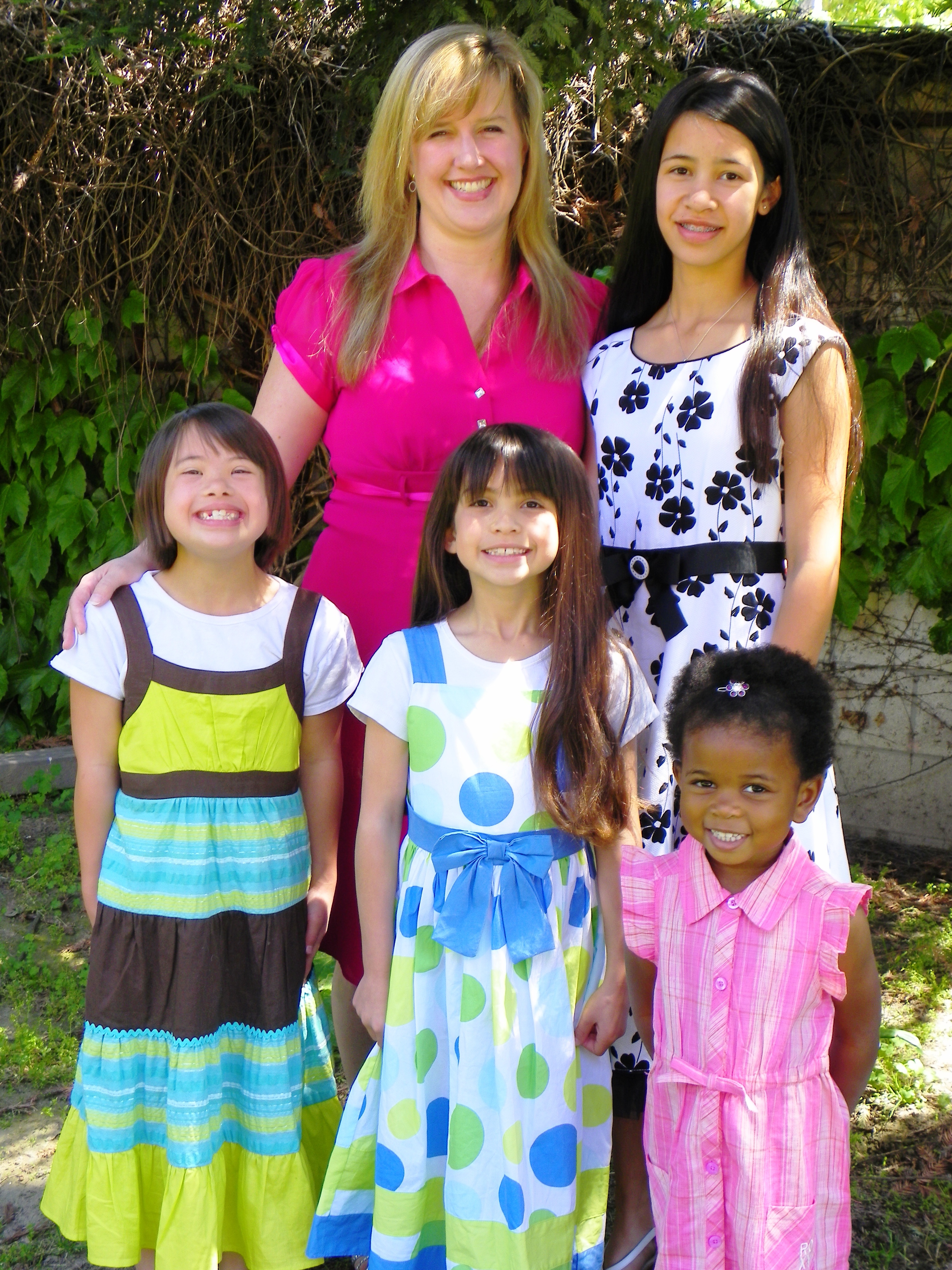
Me and my daughters, 2010. So much promise, so many doors.

Now, I see all the doors standing open to my daughters and feel pangs of memory of how it feels to be in their shoes. But I am excited for them and all that lies ahead in their young lives. I’m doing what I can not just to make interesting choices among the options available for me, but to support my girls as they make their own choices. What a gift that is.