Issue of body image is not a trivial one

So I’ve noted a few occasions recently in which I’ve just felt I had to explain why I feel strongly about the topic of body image (particularly as it pertains to women). Those occasions have been offhand comments or posts or cartoons or what-have-you that indicate that the desire to change how our society perceives women (as objects or bodies) is trivial or silly or not as important as other issues that could garner support or activism, etc. (such as some of the ignorant comments I saw about the Representation Project’s “NotBuyingIt” campaign and hashtags that call out sexism and demeaning portrayals of women in the media, most recently during the Super Bowl, and don’t get me started on Sports Illustrated teaming with Barbie this year!).

I’m not saying there aren’t SERIOUS, very troubling things happening all around the world (wars, disease, repression, abuse, sex trafficking, crimes specifically against women and particular ethnic or religious groups) and that we in the United States and other less-troubled places can’t mobilize to do something to help. But even as we may realize that our problems in the West are “first-world” troubles, it doesn’t mean they are trivial or not worthy of attention and activism.

I’ve never considered myself “a feminist” (a word that over the years has certainly accrued a lot of not-necessarily-positive connotations and associations), nor am I a “liberal.” I tend to be mostly conservative politically. I care deeply about social justice and helping to improve people’s lives but I have more conservative views as to how those things should be accomplished (because my experience has shown certain methods to be more useful and successful than others). I am a stay-at-home mom who does some freelance work from home and haven’t worked outside the home full-time since the early years of my now 20-year-plus-long marriage. Those facts, along with my religious beliefs, might indicate to outsiders that I am not big into “women’s issues.” Those outsiders, though, if coming to that conclusion, would be wrong.
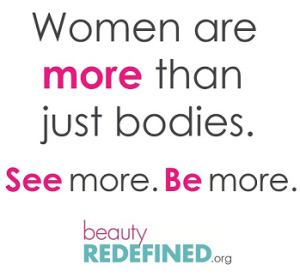
Beauty Redefined is a great resource for learning more and fighting back.

I care very much about my fellow women and how we get to function as real people in society. (I care about men being allowed to be fully functioning members of society as well, but historically in our culture, they’ve been given these rights for centuries, so they’re mostly “all set.”) The fact of the matter is that our Western, 21st-century culture diminishes the wholeness of women every single day, everywhere we turn. Media from every angle throw back very limited, definitely-not-varied, two-dimensional views of the ideal female, reducing 50% of the population to mere objects. These images and opinions are so deeply embedded in our psyches that we essentially have all tacitly agreed that they are truths. These beliefs lead men to treat women they know on some level and in some degree as less-thans, expecting their wives/girlfriends/daughters/sisters to be shaped and sized a certain way at the very least, and they lead women to act as if they are 75% (or more) what they look like and 25% a collection of their personality traits and actions.

These false beliefs have been and are continuing to be so thoroughly perpetuated that though we may pay lip service to the notion that they are false, we act as if they are true. Extreme examples are the continuing massive growth in cosmetic surgeries, particularly among “normal,” “average,” everyday women (not celebrities, not the rich, not people you might consider to be particularly vain). In the interviews I conducted with women in Utah who are moms and generally have a strong foundation of faith and have always been taught they are daughters of God worthy of love and respect for who they innately are, I was amazed how many felt bad enough about their “outsides” to undergo surgery, which is always risky, costs a pretty penny, and is just unnecessary. While I understood the feelings that led them to make the decisions they did (for getting breast augmentations or full “mommy makeovers,” for instance), I felt sad that our culture creates, fosters and intensifies those feelings of insecurity — all over their breast size or perkiness or the size of their waist or hips.

Yes, this may seem a minor issue: what does it matter if we care a lot about how we look? Here’s a short breakdown: it causes us as women to spend precious time and energy and brainpower on something that simply doesn’t matter very much. It takes those resources away from the things that really matter: our spouses, our children, our friends, our families, our work, our joys, our passions, our life purposes. And how many of us have time and energy to spare?

Focusing on our appearance reduces us to objects. Statues and photographs and machines are objects. They’re nice to look at and they might even get things done, but they aren’t human beings, with glorious origins and endless potential and utter uniqueness. Humans are imperfect, frustrating, very different from each other. But we’re so interesting and fascinating and have so much to offer! Is that true, can it be true, about mere objects? No way.

When we consider each other (or ourselves) objects, we treat each other (or ourselves) differently. We don’t expect the best, we don’t reach towards our limitless potential, we don’t care for each other as precious souls who deserve respect and love and fair and equal treatment. Men in our society, who are swimming in this media ocean of images and objects, are prone to some level of treating women as less-than themselves, because men aren’t reduced to objects nearly as often or as prevalently as women. Pornography is one more extreme example of how women are reduced to being objects, even parodies of womanhood, and it skews men’s attitudes and actions toward the women in their lives even further.

I can’t possibly explore all the angles here. There are tons of scientific studies, books, etc. that speak with authority on this subject. Suffice it to say, this is not a silly or trivial topic. It’s one that must be shared and discussed and changed. How women view themselves and how they are treated (as whole, real, full and complex individuals with unique gifts and talents and attributes) is at stake. I wouldn’t call that minor. It’s a huge battle to fight because the messages that pick women apart and reduce us to body parts, that make us less valuable than men, are constant, ubiquitous, and insidious. They’re so prevalent as for us not to even notice them anymore. If you pass the same billboard featuring a bikini-clad woman biting into a huge, juicy hamburger every single day, you’ll begin to tune it out and not even realize the damage it’s doing. But that message is still burrowing its way deep into your every cell.

I would love to make things better in so many ways, in so many places, for so many people. Right now, what I can do is write and speak up. I can say, “Hey, look at that billboard. Isn’t that insulting? Maybe we can even get it taken down. Maybe we can get the advertiser to stop objectifying women.” I can’t change the world. But maybe I can change your mind and remind you that you are far more than just what you look like.

Wanted: more ‘light’ media

So the FOX-TV show with Kevin Bacon, “The Following,” came back a few weeks ago. My Sunday newspaper at the time declared: “Darker days: ‘The Following’ returns.” My immediate thought: Urgh. Is the article saying the show’s going to get even darker? Because that hardly seems necessary (or possible?). It doesn’t look too positive in all the promos.

No, I haven’t watched the show. I am not commenting on its merits because it’s impossible for me to do so. I just am not interested in watching it, given what I can glean about it in the dark and very creepy promos I see while watching other FOX shows.

And yes, I admit, I’m a mostly optimistic, pleasant person. I naturally gravitate toward the sunny and smiley. I LIKE happy endings. I like romantic comedies and chick flicks (although those are not exactly reality; they’re just fun and escapist). And while I don’t expect or want all my media to be shot through a rose-colored lens, I like to see real, imperfect, flawed characters in books and TV shows and movies learn and improve and become better people. I like to see real people I know find happiness and growth.

So given that information about me, it’s natural, I suppose, that I would not be heartily in favor of more dark, scary shows about evil people. Does that mean I should call for fewer of them? Should the viewers who have less sunny dispositions be limited in the dark media they enjoy? Not necessarily.

But I do question why so many shows focus on the dark and evil parts of society and human nature. I think it’s vital that we recognize there are some bad people out there and to be aware and safeguard ourselves. We can’t bury our heads in the sand, stay naive, trust everyone. But is it necessary to spend hours of our time essentially in the company of these kinds of people? Why would we want to wallow in that atmosphere?

light TVI like a great mystery. I like twists and turns and surprises. That’s why I like gothic tales. But I don’t like darkness. I don’t want to spend too much time in it. I want to seek out the light.

So why can’t we have more media that portrays the light? I recently discovered a short-lived (of course) TV show from 2008-2009 called “Eli Stone” that was absolutely delightful. The characters aren’t perfect; they’re learning and do stupid things. But the tone of the show is positive, the characters generally seeking to do better, to be better. What’s even cooler is the show’s exploration of faith. It’s about a man who, in connection with a brain aneurysm, has visions that give him indications about the future and he then seeks out what he can do to make it better, to help other people. He (very) reluctantly sees himself as a kind of “prophet.” The show isn’t necessarily about God or any particular religion or faith system, but it does discuss the challenges of history’s prophets. And every episode considers how difficult it can be to just embrace faith and follow the promptings God sends, without being preachy or religious or cheesy. It’s thoughtful and real and honest. I come away from my viewings feeling hopeful and uplifted.

No, I don’t like the dark. It’s all too real and we’re constantly surrounded by it, in reality and in the media. Why can’t we support more that’s light?

Media portrayals of women won’t change until we demand them to

… and that means women need to teach girls to expect better of the media

The latest Photoshopping news item to grab online attention is proof that a magazine tweaked a cover photo of Jennifer Lawrence. Rightly so, people were outraged.

Question is this: will this just die down and go away and be forgotten? It’s already been a couple of days since the story hit the ‘net and I don’t hear much talk about it anymore. People’s attention spans are short, and the next juicy item follows behind so quickly. Today, it’s all about the Duck Dynasty gay-comments issue with Phil Robertson. Tomorrow, who knows?

So, really, since human nature, at least in our 24-hour-news-cycle age, means we’ll forget most outrages in a matter of hours, will this information change anything?

Sadly, I doubt it.

Here’s what needs to happen, though: both women and men need to consciously work to keep this topic in the forefront of their minds. And they need to act. We all need to stop buying and reading the magazines that Photoshop women (which is pretty much all of them, even the health and fitness ones). Stop watching the movies and TV shows that make women secondary characters and, then, feature them only as sexual beings, as scantily-clad “pretty props” or set dressing. With the media, the only way to make a change is to vote with your pocketbook. Stop feeding the beast. And speak out, directly to each media company, and discuss with friends and family.

After years of living in a world saturated with media images portraying women as sex objects and set dressing, it’s taking a while to get older, more experienced women (and men) to realize what’s been happening. We need to keep getting the word out to them (I firmly fall into that category: at 43, I’ve been marinating in this lopsided, demeaning, and oppressive culture for decades).

At the same time, once we older people get the idea, we absolutely must teach our younger family members and friends to see the truth. The media loves the young folks: they’re the ideal demographic, so everything is skewed to their supposed tastes. So if we’re going to get a message out to the media, we must make sure the young people understand it, get it, and act on it.

It would take many, many blog posts to “prove” just how damaging this Photoshopping nonsense is to girls and women, and not only to females, but to males. It changes everyone’s expectations and core beliefs for the worse. There are plenty of resources out there that talk about this. Beauty Redefined is a great one, but there are others (check out BR’s posts related to “recognizing” what’s happening to get a good start). So this little post is just another part of the call to action. Don’t just cheer internally for Jennifer Lawrence’s ideals (not liking Photoshop, wanting to get rid of body shaming, sending a better message to young girls about image) — take a stand and do something. Write to magazines and ask that they stop Photoshopping. Stop watching movies that relegate women to sex objects. Talk about the topic with young people, both boys and girls, and keep it in the forefront.

The media won’t change without huge pressure to do so. Be part of that change. It takes one person at a time, but one person and another and another all add up. Take that first step. Hey, even reblog/post this. Let’s just bombard people with this message. Maybe someday, maybe even by the time my teen daughters are mothers of teens themselves, our culture won’t be marinating us in negative portrayals of women anymore. It could happen.

(For ideas on “resisting” negative body-image messages in the media and our culture at large, read Beauty Redefined posts related to that topic.)

AND AS AN ADDENDUM, another great resource from a woman who’s “been there, done that” when it comes to being ultra-toned. Taryn Brumfitt at Body Image Movement says this (in a blog response to fit mom Maria Kang): “I AM a health advocate. I run, I lift weights, I eat healthily but I also have a cookie with my soy latte and knock back the odd burger or yiros when I feel like it. It’s called balance. And whilst I am getting on my soap box (I’ll just be here for another minute) health is not dictated by your looks. Health is physical, emotional and spiritual and so much more that is not visible and not always obvious to others” (emphasis was added by me). She also told the Daily Mail: “If what you value is your health then you’ll treat your body like a vehicle, not an ornament.” I LOVE that.

Value your body for what it can do, not for how it looks. I think it’s pretty simple.

Hair-raising school policies

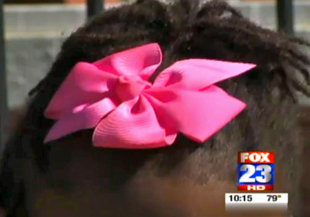
Photo from Fox 23 News

So I saw this Yahoo news item about a little black girl whose parents withdrew her from a charter school whose dress and grooming policy forbids dreadlocks. Here’s what happened: Tiana, age 7, sometimes wears her hair styled in short, skinny dreadlocks. The school told her she didn’t look “presentable.” She cried on camera about it. The parents chose to take her out of the school and send her to a different neighborhood school, where there is no policy against dreads.

Of course, as the parent of a little 6-year-old black girl, I had some immediate knee-jerk reactions: “How dare they?!” “They must not know how difficult it can be to style black hair.” “That poor little girl!”

But here are the facts: the school is a charter school, which can set whatever policies it feels are best. The policies have been in place for a while, and parents have read them and are aware of them. According to comments from other readers, the school has mostly black students, as well as an “all-black” school board.

So that rules out racism, as well as school leaders not understanding what it’s like to style black hair. What this boils down to now is a parent knowing full well what the policies are (ludicrous as some seem to many of us, including me), ignoring them, and throwing his child to the wolves. When he sent his daughter to school in violation of the rules, he was the one who exposed her to school leadership telling her that she couldn’t wear that hairdo and it wasn’t “presentable.” His actions led to her crying.

Also to note: the school didn’t toss her out; her parents chose to withdraw her because of that hair policy.

Honestly, I don’t quite understand what the school board’s problem is with that particular way of styling hair; it seems neat and not “faddish” to me (a big “fro,” however, I can see as being faddish and more likely to attract attention and therefore distract from schoolwork). But the board must have some reasons for the decision they made. If Tiana’s parents disagreed with the policy, their first responsibility was to go discuss it with the board and even rally support to possibly have that particular part of the policy changed. Then, if the board still stood its ground, the parents would have had a decision to make: either follow the policy, disobey it, or leave the school. In this case, they just went straight to disobeying it.

Schools can be crazy, and school policies can seem completely random. And so many things about rules and school leadership can make ME crazy. But the only thing we as parents can do is to address the policies we disagree with with school leadership and try to make change. If the problems are bigger, we can address those with political leaders. We can then try to raise awareness in the community, in part by bringing the item to the attention of news outlets.

I think in this case, the parents went straight to disobedience of a policy and then whining to the media. I definitely understand their concerns, but they didn’t handle them well.

Worse than exposing kids to vulgarity: making them part of it

I obviously care about values, values in the media, and how we teach our children values (and help protect them from some of the value-less media out there). Let’s just say for my purposes here that “values” is shorthand for positive messages and content that is low on vulgarity, harsh language, sex, violence, and other crudeness.

I started my book-review website, Rated Reads, because I wanted to provide useful guidance for readers of all ages and parents of younger readers. The more information we can obtain as media consumers and parents of media consumers before actually viewing movies, TV, books, websites, etc., the better: we can protect ourselves from content we wouldn’t want to have to see/hear. Luckily, there are a good number of websites and other resources available to help us make good, informed decisions about movies and TV shows, as well as music. I started Rated Reads because there weren’t nearly so many resources available with the same kind of information about books.

Naturally, with this mindset and as the mother of four daughters, I want to be able to protect them from seeing and hearing vulgar, obscene, gross, crude content. I don’t want to see/hear that stuff myself, and I certainly don’t want my girls to be inundated with it. I can’t protect them from other people or from other kids at school (much as schools supposedly try to police obscene language, etc., it’s a losing battle in reality, honestly), but I can help them to feel safe at home.

With this as my philosophy, I’ve always been shocked by what I see other parents do/not do for their own children. Sure, all parents are different, and I can’t say that “different” is usually or always bad. But sometimes it’s hard not to judge, such as when I see adults bring tiny kids to PG-13 movies or just movies that are super-scary or intense. Or those who routinely let their young kids watch R-rated movies at home. I just can’t see that that does any good for (and doesn’t harm) these impressionable youngsters.

But what really, really makes me start steaming is seeing vulgar movies or TV starring children. For example, when I went to the movies this week, I saw a preview for a movie I will NEVER go see, called “Bad Grandpa.” An actor dresses up as an old man and takes a young boy cross-country with him on an MTV “Jackass”-inspired trip. They pull all kinds of pranks and film real people’s reactions. One clip in this trailer showed this young boy, who is 9 years old, dressing up as a pole dancer and gyrating in all kinds of crude ways that would make me cringe if it were an adult performing the acts. But this is a CHILD! To expose kids to this stuff is bad enough, but to then make a child PERFORM these acts is beyond irresponsible. It’s heinous. It’s horrible. It goes beyond the pale.

I don’t think I’m a prude. I simply believe in values (and if you don’t, then don’t bother commenting because we come from very different sides and will likely never agree). I believe in teaching values to our kids, in protecting them from as much as we can, in helping them learn ways to protect themselves from vulgarity as they grow older. Again, none of us can possibly shield ourselves completely. But we can take steps to reduce the amount of crudeness we have to ingest. And it’s parents’ responsibility to reduce exposure and teach their children, not douse them in “adult” filth.

We’re living in a world that’s radioactive with crudeness and vulgarity. We’re going to be exposed. Question is: will we take precautions and shield ourselves and our kids, or will we allow ourselves to be constantly irradiated, leading to sickness, cancer and death of the inner self?

Sure, the new prince is getting attention, but so is the royal post-baby belly

royal baby bumpYes, the world has gone crazy over the royal baby. And people have plenty to say about how this very soft news has eclipsed some other very important news. I could say lots about that, being a journalist myself, but for right now let me just say that even as a journalist who does like to stay informed about vital news events, who doesn’t like to take a little break from all that is depressing and frustrating to enjoy a cute little baby? My own four daughters are now getting sadly far past the baby stage, the youngest now going into first grade (!), and I find myself missing a little bit those sweet days of their infancies. So yeah, I’m feeling a little nostalgic and enjoying the baby photos.

A secondary focus of talk around the blogosphere has been Kate’s post-baby belly. There are many who are applauding her willingness to just let everyone see the reality that is a woman’s belly right after birth: it’s still quite large. I remember looking down at my own belly after giving birth each time and thinking it looked like a huge lump of bread dough (enough for probably four loaves) that had risen for hours and then just been punched down. Soft, squishy, lined and utterly non-sexy. I honestly have to join in and say, thanks, Kate, for not trying to hide that belly. I’m sure with all her resources, she could have minimized its size or shape by dressing a certain way or wearing Spanx or… something. But she didn’t.

On the other hand, other observers have noted it’s sad any of us are focused on the Duchess’s appearance at all. The fact we’re applauding her for her “honesty” just shows we’re still focused as a society on a woman’s appearance rather than other much more important attributes. And I have to say I agree with that as well. (Another point made within this same observation is that aside from the belly, Kate looks pretty darn good: her hair and makeup look great. And not many new moms get that kind of beauty treatment the day after giving birth. Sure, that’s true. But at the same time, how many of us have to step out of the hospital a day after giving birth to show off our baby to billions of people? The fact is, Kate and the whole royal family have a role to play, and when it comes down to it, she’s doing it with a lot of grace. So if she gets stylists to spiff her up a bit for photo ops, so be it.)

But my conclusion is this: we still live in an appearance-obsessed society. I think most of us would like to see that change. I know I would like to make people more aware of just how much we all think about looks, so that’s why I write occasionally about the topic. But I don’t think our society is going to change overnight. I’m OK with “baby steps.” And if Kate, playing the role she does in British society and even on the world stage, feels best about fixing her hair and donning nice makeup and a pretty but simple dress to show off the newest heir to the throne, even while feeling comfortable enough to show off the reality of the post-pregnancy belly, more power to her. The belly is a baby step. I say, focus on the ways we’re making progress, celebrate and applaud those, and then still remember that we can make more progress in the future.

Yes, ‘family’ channels have a responsibility to families

I wrote an article two summers ago for the Deseret News about “family friendly” TV shows. At the time, I was feeling particularly annoyed by the Disney Channel, especially the show “Good Luck Charlie.” Two years later, I still feel just as annoyed, and I’m pretty much banning the channel from our house.

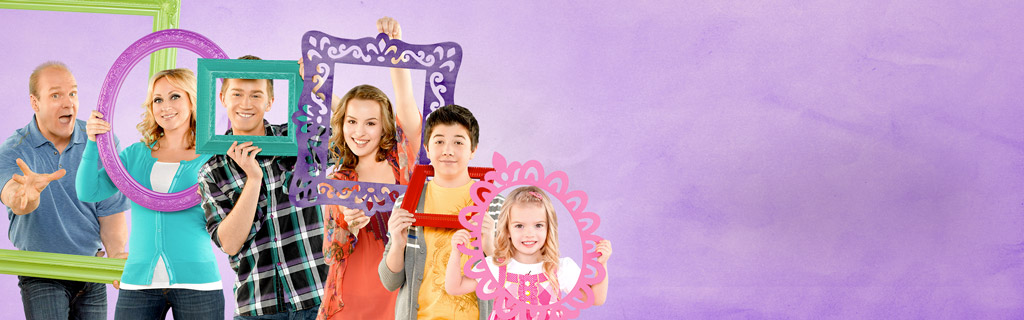
Good Luck

I’m reminded again of this because of the latest information about the channel and this particular show, stating that the show will be adding a set of lesbian moms and their child to the show next year. Now, I’m not going to get into my stance on homosexual unions or parenting or anything like that. I will simply say that this is a hot-button issue and that the country is fairly close to evenly split on opinions about it. What’s at issue here is that probably half of the parents in this country (I’m just very roughly going to guess on this since the opinions still tend to be 50-50 on the topic of same-sex marriage) might have some reservations about this issue and may not be excited that a channel geared at young children is introducing this kind of controversial topic.

Now I got a comment on my original article two years ago, with the commenter saying that I’m essentially expecting all shows to reflect what I think reality should be, rather than what it is. And, of course, that’s not at all what I’m saying. Any channel out there can run whatever kind of programming it wants to. It doesn’t “have” to be responsible to any set of people or values or expectations of any kind. And I’m OK with all kinds of wacky non-realities in TV shows. I love fantasy and lots of situations that are far different from my own or what is “ideal.” Watching those can either just be fun or entertaining or acceptably escapist, or they can be informative and worldview-expanding. That’s great.

However, when a network is essentially setting itself up to be known for being “family friendly” or, in the case of Disney, building on a long tradition of expectations for that quality, I do believe it has some responsibilities. If you don’t agree with me about this, just stop reading now. You won’t agree with anything I say further. In the case of being responsible about portraying families to young children, I think it’s irresponsible to introduce some of these more mature concepts that parents would prefer to address themselves. I also think it’s irresponsible to portray parents who are mean, parents who are immature and just goofy, and parents who don’t seem to care about their kids’ welfare — NOT because these scenarios don’t reflect reality, but because on the DC, they’re played just for the purpose of getting cheap laughs.

I cringe every time I see the mom on that show put down one of her kids or plot against them or do anything else that belittles them. It angers me when they act like little kids themselves rather than responsible adults. (Again, this is not to say that parents can’t have fun and act childlike; it’s AWESOME when parents get down in the mud and play with the kids or color alongside them or swing with them at the park. I am saying that when they act like brats to get laughs, it diminishes the meaning and value of parenting and the importance of love and trust in family relationships.)

I’m putting our satellite service on pause for the summer, and when I take it off pause in the fall, I plan to block the Disney network. I don’t want my girls seeing that stuff anymore. And I doubt that Disney will care. The folks there clearly plan to continue on the path toward putting parents in a position of goofiness and un-respectability. I just won’t support them.

Christmas: Saturday Night versus Sunday morning live

I’m not a HUGE Christmas nut. I don’t start fantasizing about the holiday in July; I don’t listen to carols in October; I don’t decorate before Thanksgiving. (My husband’s the one chomping at the bit about those things before Thanksgiving rolls around.) But that doesn’t mean Christmas doesn’t mean something to me. I have good memories of the holiday growing up, involving family, gifts, and treats, among many other things. Especially, I like to remember the significance of why we celebrate: Christ. I’m a Christian, and I love the spiritual messages that remind me of Him during this season. At the same time, I have nothing against Santa and the commercial stuff that’s not exclusively centered on Christ. It’s fine to enjoy all the other trappings of the holiday, too.

I don’t even have a problem with people who aren’t Christian celebrating the holidays in general, all the trappings but not Christ. That’s fine.

martin shortBut I’ll draw the line at what I saw last night on TV: I happened to have the set on when Saturday Night Live came on, and it showed Martin Short hosting. That, I thought, was worth my time watching for a while to see what he would say and do. He’s done and said some very funny things in the past, so it was fun to see him again.


Honestly, though, he did almost nothing to make me laugh. He was straining. Then he mentioned that “a lot of babies are conceived at Christmas.” OK. Fine. But then, rather than moving on, he and the SNL cast turned that into a huge production number. The tune of “It’s the Most Wonderful Time of the Year” was turned into a crass and completely tasteless number about sex, and Short used lots and lots and lots of synonyms: lascivious, lusty, … well, I don’t really care to think about it anymore. But it went on for four or five minutes, probably. I kept thinking it would end quickly. It didn’t. I don’t know why I didn’t turn off the TV sooner than I did. Perhaps it was like a train wreck.

I can’t express how tacky and tasteless and offensive it was. Sure, I expect there to be lots of that kind of thing on SNL. That’s part of why I haven’t watched it regularly since, well … ever. But to hijack Christmas, a day on which as a believer, I do try to remember the Savior of the world, well, I just found this one particularly bad.

It’s all been said before, so nothing I can say here will be new. I just hate to see it happen: the insensitivity of others who would call me intolerant if I were to express my views on subjects they wouldn’t agree with me about, but who have no problem taking a subject I consider deserving of some reverence and respect and just dashing it to pieces with, yes, blasphemy.

Needless to say, I didn’t watch any more of that show. I’m sure the SNL folks won’t care that they missed me. Yes, they have a right to do and sing and say everything they did, but was it right? Was it respectful? Was it tolerant? Me, I’m thinking no.

Contrast that “holiday” scene with the one I encountered today during our church service. Two young men sang, one played cello, a friend played her flute, and another woman played piano, coming together on a simply divine arrangement of “Away in a Manger.” For five minutes, I was entranced, transported, absolutely enchanted. The music truly focused on everything that’s best and most important about Christmas, and it was done so well and with such reverence and care. The feeling in the room was of rapt attention and holiness. I wanted it to go on and on. That was absolutely the spirit of Christmas, and I’ll keep it in my heart a good long while. The several minutes I was held captive (somehow) by Martin Short’s completely non-funny routine are minutes I’m trying to scrub from my memory.

I love to laugh, I love to feel reverence, I love to appreciate talent. Today gave me the opportunity for the second and third, and there will be some other wonderful opportunities in coming days with friends and family to experience the first. I am just sorry that SNL insulted me rather than allowing me to laugh.

Here’s to all the wonderful gifts of the season.

Speak up about the real value of women

It would be difficult for anyone to argue that women aren’t being demeaned as objects in pretty much every single corner of society. It happens so much and is such a thoroughly pervasive message in media that we’ve almost forgotten to be angry about it. We just take for granted that it’s happening.

Well, I think it’s time for women — and men — to stand up and show some anger about this phenomenon. It’s time to stop the saturation of our culture with images of sexualized women.

You can’t slap a pink ribbon on everything and say it’s “supporting” women.

I’ve been writing off and on about this topic, and I’ve nearly finished the book I’m writing, which focuses on the topic from a faith-based angle. But nearly every day, I see something else that makes me want to shake my fist and just DO something, SAY something. Yesterday it was a USA Today article about how breast cancer is being sexualized. Wha?? Yep, it’s true. I suppose I’d already kind of subconsciously noticed it myself, but the article really clarified the point. I also had just noticed a full-page ad in an in-flight magazine when I was traveling over the weekend: it showed a photo of a very trim, fairly young woman with smallish but nice breasts (a point I feel inclined to note, since most of these kinds of photos show women with larger-than-life breasts) dressed in an itty-bitty white bikini. Flat abs, no fat, no cellulite, no blemishes. And the ad had the nerve to have been run by plastic surgeons touting the message that they can do great reconstruction on women who have had breast cancer. Aaaaiiiieee!

Let’s think about this honestly. Is the average survivor of breast cancer going to look like a 20-something model? Ah, nope. She’s going to have scars, could be some pretty big and ugly ones, depending on how much surgery had to be done. She might be thin (thanks to not being able to eat much during chemo), but not necessarily in the “attractive” way. It might not even be possible for reconstructive surgery to get her back to “normal.” A friend in her 50s recently told me about her experience with breast cancer, and she said that after having a double, radical mastectomy, she was told by surgeons that the process for giving her breasts would be lengthy and, as she put it, “barbaric.” And then she wouldn’t even be able to have normal-looking breasts: they wouldn’t be able to give them nipples. She turned down the surgery; no point in going through all that to have substandard breasts.

Nope, these kinds of demonstrations of support for breast cancer aren’t help. They are simply marketing opportunities painted in pink. The article quotes Karuna Jagger, executive director of advocacy group Breast Cancer Action, as saying, “The implicit message in these campaigns is that it is breasts that are sexy; sexy is what is important; and we should care about breast cancer because it takes those lovely, sexy breasts out of the world . . . Every October, the stunts just gets more bizarre and further removed from what’s needed for this epidemic.”

Why can’t we just stand up and say, ENOUGH, ALREADY!? Sexy, young, thin, well-endowed female models are used to sell almost everything. I work out at the gym every day and can see a bank of about five TV monitors showing different networks while I exercise. I read or listen to music, but I can’t help but glance over at the monitors and see what’s going on. At any given time, I see several images of unrealistically-shaped young women, on commercials or the news or various programs. The anchors on news networks are thin and usually young (at least in comparison to the men, who can be any age). Innocuous game shows feature models showing off the prizes. Soap operas feature cute young girls and some older women who have often had various work done (at the very least, Botox and injections to plump up their lips or cheekbones). All the commercials feature women. Products for men and commercials aimed at men feature sexy models, scantily clad. Products for women and commercials selling those products for women feature women; most of them are for hair color (get rid of gray) or skin creams that aim to reduce wrinkles and make skin look younger and fresher. Car commercials even mostly feature women: young, trim models.

It’s all about sexualization. When will all women say, Enough. No more. I refuse to be sexualized, to be objectified, any more. It starts at home and with our circle of friends, even just on Facebook or Pinterest. Stop pinning the “fitspiration” pins. I don’t. I like to exercise, and it’s a vital part of my daily routine. But I refuse to put another photo in front of me that has a ridiculously skinny teen or 20-something clad in a sports bra and tight boy shorts, touting her amazing workout that will make all of us look just like her. It’s ridiculous. We should be laughing, not trying to emulate those girls! Stop posting about how you feel fat or ugly or that you look old. Don’t expect yourself to look your regular self two weeks post-baby, either. Stop focusing on how you look, period. And don’t focus on how your friends look. Support them as they do great things with their lives, as they work on being their best selves.

Women’s important body parts aren’t our breasts or backsides. They’re our hearts and hands.
Photo by Louise Docker, via Wikipedia

Focus on YOU, women. Allow the men in your life to focus on who you are inside, too. Teach your daughters to be who they are, and teach your sons positive language about women and not to focus on appearance. Yes, be healthy. Try to eat mostly well. Exercise regularly. But don’t make how you look the end-all, be-all. Don’t let yourself be objectified. Don’t let the media and the marketers and the porn producers dictate how you feel about yourself or how society views you. Gently remind friends that they are “more than eye candy,” as Beauty Redefined enshrines in billboards, or that they are more than just numbers on a scale.

We women are amazing creatures. We nurture future generations. We lead society. We do great things. Let’s show ’em what we’ve got! We’re not about our body parts, unless we talk about our brains, our hearts, or our hands. Let’s join those hands and speak up.

Romance: real life vs. books

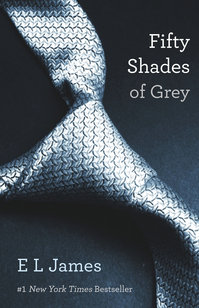
Yet another day when I’ve been thinking about a topic and I end up reading something closely related. Some of the hottest books flying off shelves (or e-shelves) are romances. The latest is not just a romance; it’s erotica: the Fifty Shades of Grey books are at the top of the e-book bestseller lists and feature not just loads of sex but bondage and domination, apparently (nope, I am not going to read them).

And it would be crazy to even discuss this topic without mentioning the insanely popular Twilight saga (which, apparently, in some way is how Fifty Shades was inspired). Not erotica, at least, but heavy on the romance, lust, making-out, etc. Sure, there are action scenes dealing with the bad vampires, but it’s really about intense teen love. The very interesting series I’m reading right now, Outlander and its many sequels, is historical fiction that has lots of great characters in many settings, but the primary focus is the intense attraction between the heroine and her 18th-century husband.

I think many people concentrate on TV and movies when they consider the effects of mass media, and they are right to do so. But books can be overlooked in the kinds of effects their messages have on readers. This Deseret News article, for instance, focuses on film: romantic comedies, specifically, and how viewing them can affect real people in real relationships. I don’t think it comes as much of a surprise to anyone that relationships and love are not portrayed terribly accurately in movies, and I can say as a reader that there are plenty of books that fit that pattern as well. At least in literature, there are many more genres and many more books to choose from, and many can be found that do portray life much more realistically than film, in part just due to their length, honestly. But there are lots of books that are just print versions of rom-coms or trite romances (Nicholas Sparks, you’ve done damage in both print and celluloid!).

I’ve thought many times as I’ve read books that feature romance how so many skirt realities most of us experience. I don’t know about you all, but after 19 years of marriage, I don’t feel the same intensity of nonstop attraction to my dear husband as I did at the very beginning. In fact, I probably never felt the same way as some characters I read about. I remember reading The Time Traveler’s Wife and thinking, Good heavens! These people have sex all the time! Do they not do anything else when the husband isn’t popping off into other time periods? And as much as I am thoroughly enjoying the Outlander series, really: does anyone (or everyone) feel like having sex with their spouse all the time? I’m not saying that isn’t a great thing between husband and wife and vital to a good relationship, but it isn’t the ONLY thing or even 50 percent.

The other main issue, I think, with some of these books is that they often posit that there is one “true love” out there for everyone, that love is destined, fated, that each of us must find THE ONE, our soul mate. This can cause a number of problems; for instance: if a relationship isn’t going smoothly, then our partner must not be THE RIGHT ONE (and we ditch a perfectly good partner and move on to find that elusive person); we might be fooled by temporary chemistry that someone we are crazy about is perfect for us (and we ignore all the signs that show he or she truly may not make a good spouse); we may never find someone who fits the supposed characteristics of a soul mate and end up alone.

One of my church’s leaders, Spencer W. Kimball, said something very wise but not what anyone might consider easy or exciting or the basis of a swoon-worthy story line: “‘Soul mates’ are fiction and an illusion; and while every young man and young woman will seek with all diligence and prayerfulness to find a mate with whom life can be most compatible and beautiful, yet it is certain that almost any good man and any good woman can have happiness and a successful marriage if both are willing to pay the price.”

Still, it’s hard to resist the siren song of these romance stories. They just make everything seem so intense, so easy, so larger-than-life. They’re fantasy. But we like fantasy. We like to read about things that aren’t like real life. At the same time, does reading these unrealistic stories do damage to us as readers as we go about our regular lives once the book is put back on the shelf? Do we end up with unrealistic expectations from our relationships? Research seems to show that the answer is yes, at least in film. I dare say the same is true for similar messages in print.

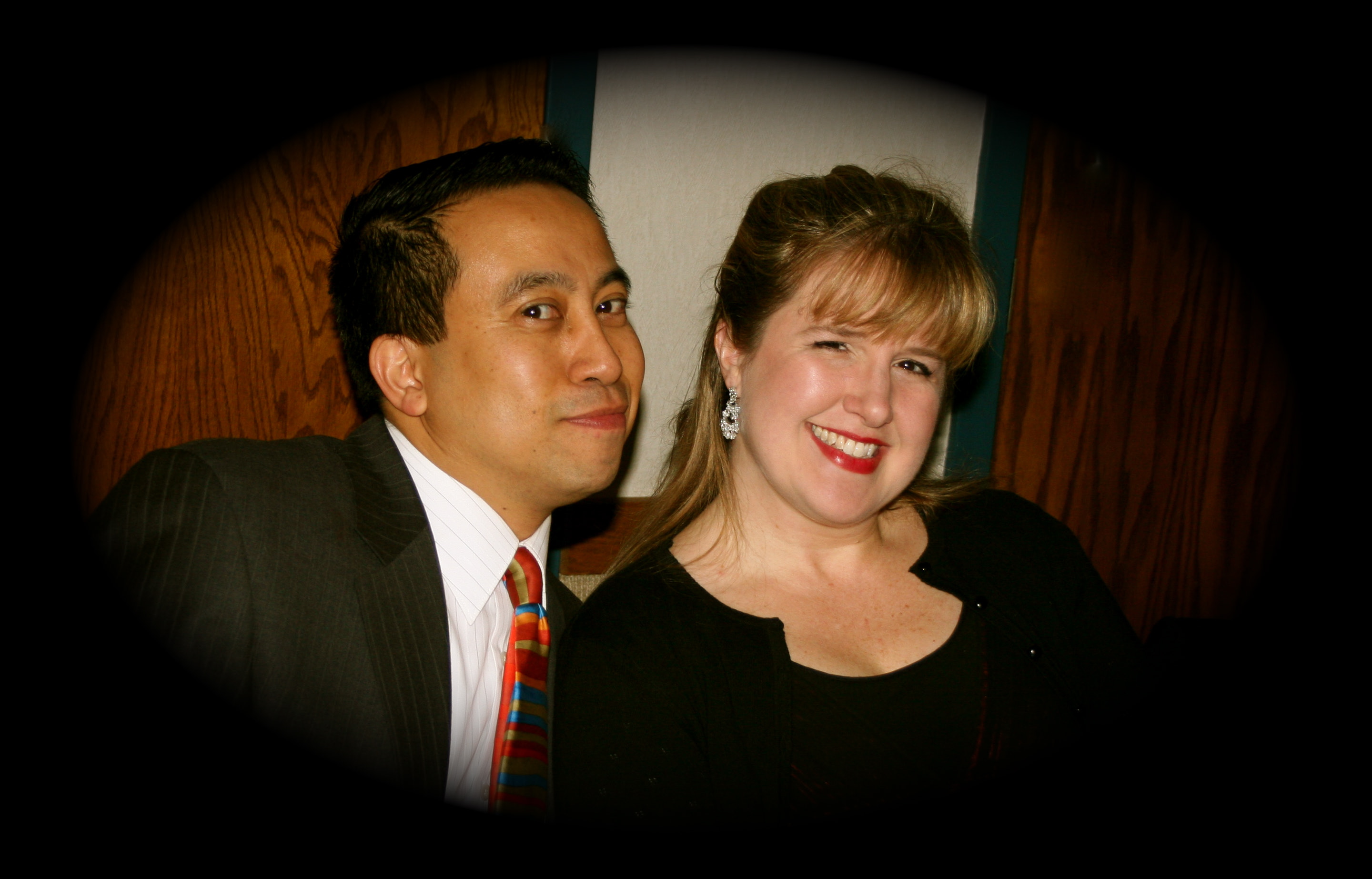
Yep, we look lovey-dovey and dressed-up here, but this is not everyday reality. I don’t care to take a lot of pictures of me (and us) during everyday reality…

Real life is harder, messier, more boring, more frustrating, more mundane, more work. Children can bring joy to our lives, but the work and the commitment involved can easily take away from our relationship as a couple (not that this is a good thing, but it happens easily if we don’t work to stop it from happening). The pressures of just making an everyday living and going about our usual day-to-day business can strip the thrill from our relationships. And time has a way of changing how we relate to each other, mostly for good. Love is a complex, wonderful, deep, multifaceted animal, and romance is only one of those facets. Sexual attraction is just a part of the romance. Infatuation and attraction occur strongly in the early stages of a romance, and real love develops past those, even though it is still desirable and a wonderful thing to still be attracted to our spouse 50 years after those early stages. My husband can still kiss me and make my legs turn to jelly, even 19 years into our relationship. But he doesn’t do it 10 times a day, and … well, I won’t go into any more private details. I don’t always look at him and think, Kiss me! I may just think, Thank heavens he’s home. Or I wish he’d do the dishes. After he’s home, the kids are in bed, and the dishes are done, then I am more disposed to think, Man, I wish he’d kiss me and jelly-fy my legs.

I think I have appreciated Anne Tyler’s books because they feel so much more real. They’re not romances, but they are about love. I was so profoundly moved by The Amateur Marriage, for instance, for its look at a less-than-ideal or smooth relationship. I love how Tyler can just dig right into real life, excavate some broken and dirty old shards, and hold them up to the light for our inspection. Yes, we think, this is how people lived then.

I couldn’t possibly write enough here about all the truths of relationships and longtime marriages. I certainly don’t have it figured out; 19 years is just enough for me and my husband to get in and get serious and tweak some rules so they fit us better. All I know is that media don’t often enough reflect real life. And that’s too bad. The shiny, glittery stuff that’s reflected to us off of film or the pages of books is too often easier for writers to portray and more desirable for us consumers. It’s just nicer or more appealing to consume a quick, too-sweet product than one that’s more subtle and layered. We want escape, all too often, not more of reality. But reality can be wonderful; in fact, it can be much better than the intense but one-sided stuff that comes at us from various media. I thank those amazing writers who have not just transported me to intriguing new places but those who have taken me right back to where I started and made it seem new and interesting in all its reality.