I will not admonish you to ‘enjoy this stage’

I think one of the worst things to hear as a parent, at least of young children and definitely of kids still at home, is “Enjoy this stage: they’re going to grow up before you know it!” Honestly, any unsolicited advice or “pseudo-advice,” which is what I’d call this admonishment, is generally unwelcome. Adjusting to parenting is hard enough — finding your own groove, your own way of handling all the changes, all the individual factors that combine to make your parenting experience unique in some ways — that getting told how to do better, or, worse, how to “think” or “feel” better about it, is a tough pill to swallow. You pretty much just wanna smack the well-intended but not-thinking person who dared to say it, perhaps with a squishy used diaper (OK, this is my reaction when I get ridiculously tired and cranky: I tend to overlook how people really can say things in well-meaning ways). Here’s my advice to improve that advice: be encouraging, give specific tips you’ve found useful, and provide a meal or babysitting if you really wanna make ’em smile!

Here’s what I know after 18 years of being a mom and being still in the middle of raising four daughters: parenting is tough. It’s physically and mentally and emotionally draining. It takes everything that’s in you and more. It makes you double- and triple-question yourself. And each stage of raising kids has its own set of challenges that exhaust your reserves (or try to) in various ways.

But I have come to appreciate that each parent, thanks to his or her particular backgrounds and skills, may be better at, more suited to, or at least enjoy certain stages more than others. I am pretty sure I was not a natural at parenting babies and toddlers, although by the time I got to my third, I was better prepared and, thus, more interested in it and wanting to “enjoy” it, “savor” it, more (as much as is possible). But with my first, who was honestly a very needy, demanding baby and gave me not a second to myself, to gather my thoughts or even shower, without fussing for me, I was always on edge. Tired is not an adequate adjective to describe how it feels to take care of a newborn in any circumstance, anyway. (This is why I reiterate: do NOT tell the mom or dad of a newborn to “just relax and enjoy it.” Enjoyment requires a level of consciousness that is precluded by the exhaustion that fogs up the brain and life in general. One can just catch snippets of enjoyment.) I did enjoy my subsequent babies more because I knew a little better what I was doing and they weren’t as demanding, naturally; plus, I had other kids by then to help with them. But I still just couldn’t dive in and fully enjoy because, like I said, that requires a lack of haziness.

What I have come to enjoy so far are the school years, in some small part because I generally get a full night’s sleep every night. Mostly, though, I love to teach my kids and help them learn, and read with them (and since I love reading, I must admit I’d rather read a book that at least has a rudimentary PLOT, rather than a long selection of letters or numbers, I don’t care how adorably illustrated and brightly colored those letters may be). I also like having them be gone for part of the day, so I can have a little time to gather my thoughts, be myself, and get some things done without their assistance or accompaniment. Yes. I admit that. When they are then home I can really have more fun with them. I like teaching them as part of our everyday life, not as a “lesson.” I chatted with my nearly-12-year-old last night about mathematics, physics, chemistry and biology, including my interest in subatomic particles and my desire to eventually make time to stop at the (fairly close-by to me) Lawrence Livermore lab (ooh… particle acceleration!). I mean, really, who wouldn’t be excited by the tiniest, unobservable pieces of matter being slung around inside a tube for a mile to see what they’ll do?

My girls are just great fun.

I found myself grateful yesterday by the simple fact that I could run inside the library for a couple of minutes and tell the same nearly-12-year-old that, yes, since she has a good stack of books for the moment, she could stay in the locked car and (probably read while doing so) wait for me. You can’t do that with littler ones. I am grateful for this stage of parenting, with a daughter who’s about to graduate high school (but hasn’t yet) and younger ones down to a nearly-7-year-old who can all open and close the car doors, buckle and unbuckle themselves and get in and out themselves. They can walk with me in the store rather than have to be stuck in a cart (although it’s still generally preferable, because it’s faster and quieter, for me to shop at Target or the grocery store by myself). They’re all potty-trained and can give themselves baths and do all the other self-care. They can even prepare food for themselves, at various levels. Yep, I’m glad to be past the stage where I have to do every detail to keep them alive and healthy. Now it’s more fine-tuning and the heftier matter of getting them properly educated and prepared for the world. It’s daunting, but it’s a stage I mostly enjoy.

I have friends who adore when their children are out of school and can pursue all kinds of things; I have friends who are/were amazing in all the cute projects they did with their toddlers and preschoolers. I know some amazing grandparents. But I no longer feel bad about not having been more like them, for instance, when my kids were at earlier stages. I am liking where we are now, despite the raging female hormones and completely unfounded crying spells. It’s fun. They’re easier to talk to, to share things with, to joke with. No, I do not treat my kids like “equals” or “friends” in that I do not expect them to be respectful of adults and do what I ask since I’m the parent. But they are so fun and so interesting that I consider them friends now. And isn’t that the greatest thing in the world: to raise your own friends?

Beyond compare

The past months have just seemed nonstop stressful (well, to be completely honest and accurate, they’ve been nearly-nonstop stressful; I’ve had a few days here and there that weren’t). With the holidays and some big projects wrapped up, I now stand at the beginning of a new year.

While I’m not striving for a “new year, new me” (I cringe every time I see that in any media source the first few weeks of any January), I really have been searching within to figure out what I can do a bit better for myself, so I can feel less stressed even as life is most definitely going to continue to be hectic. After all, I’m launching an adult into the world in mere months, to provide just one example of the life experiences I’m going through. (Giving birth is a big job and one that launches a new person into the world after nine months of gestation; at this stage, I’ve been actively parenting for 18 years to make sure this person can be a full-fledged independent being. It’s exhilarating and all of a sudden terrifying.)

I’ve noted, not for the first time, that I compare myself, my strengths, weaknesses, abilities, energies, visible-to-others “products” (children, writing and editing projects, volunteering efforts), etc., to those of others all the time. Social media is a blessing in many ways, connecting me at least in small part with far-flung friends who bring various gifts into my life, but it can also be a nasty tool for comparison. Day in and day out, I see photos of friends my age who still have the same figure (at least what I can see) they had 20 years ago; I see perfect family portraits; I see kids of these friends who are doing unbelievably impressive things in music or sports. It’s easy to look askance at my own figure, which is now no longer the one I had even a decade ago; to briefly (and, honestly, selfishly) wish I’d put my kids in more activities and lessons so they could do more with their own talents; to wonder why I cannot get just four kids to smile normally all at the same time.

Even worse, I compare my current self, at age 43 years and 8 months, to the self I was (or at least imagined I was, which might be more accurate) a decade or two ago. This body is 50 pounds heavier than it was at those times, when I wore a size-6 dress and had a great figure and pretty, shapely calves. To be honest, my habits aren’t much different. I have exercised an hour every day for 20 years. I have generally eaten healthy. But I now struggle mightily with my weight. (I emotionally eat and always have, and at times it’s worse than others, but it hits me harder now.)

In examining myself, I feel weak, impatient, tired, not nearly as capable as I used to be. I almost felt I had the parenting thing down somewhere in the middle of this 18-year mothering journey I’ve been on so far: I had fewer worries for my girls and felt I’d hit my stride. Now that they’re older and the stakes feel higher somehow, it’s a whole new world and I once again feel inadequate more than I’d like.

I mostly pinpointed maybe 10 years ago the kinds of mental challenges that are my particular “cross to bear” and have been on medication pretty much ever since, have consistently gone to counseling, have tried to stay aware of where I am so I can stay or get balanced. But even with the awareness, the knowing, I am honestly terrible at balancing out my capacity to give and do with what I think I need to do and be. My mental mouth is always bigger than my emotional stomach: I put so much on my plate and live to regret it. (I either metaphorically stuff myself or throw the plate against the wall…)

I guess I feel frustrated with myself because I still somehow don’t get it yet. I don’t feel a whole heck of a lot different, stronger, wiser, than I did when I was younger. I’m just older and tireder and flabbier.

I see people around me who have double the number of kids I do. I see peers who have experienced the death of a child or a spouse, who have gone through cancer, who have what I’d term other real crises or catastrophic events. One part of me thinks when considering those things, “I should feel more appreciative of what I have” (and I really am appreciative and grateful), and another part speaks up: “I can barely handle the challenges I have, and they don’t seem nearly as ‘big’ or ‘bad’ as those others’ challenges. Man, I’m a mess if I fall apart at stupid little things.” I compare my trials to others’ trials and come up feeling inadequate! Now that’s pretty ridiculous.

So that’s where I’m at. At least part of me is an optimist, someone who’s very grateful and happy for all I have and get to experience in life. I readily smile; it truly is the natural and comfortable way for my facial muscles to arrange themselves. Even so, I can easily feel disappointed in myself for just not “getting it,” even after what should be plenty of opportunities to do so.

I guess the truth is that I really have grown stronger and more resilient as life has thrown me the same kinds of trials, just constantly tweaked, over and over. I just can’t tell. It’s not obvious. Maybe if I were able to put my current self back into what I thought was a difficult time 15 or 20 years ago, I’d sail right through without batting an eyelash. But life doesn’t usually give us that kind of opportunity. It keeps upping the ante, tightening the screws, adding on five pounds of weight to the stack as we lift.

Meantime, I keep lifting. I will also keep working on rewording my thoughts and inner instantaneous reactions so I don’t compare my right-now self to my earlier self or anyone else. I suspect I won’t be completely successful in this life, but I’ll edge ever so closer.

I’m that kind of mom

As I pulled the peanut butter muffins from the oven the other night at 9 p.m., I thought, “Now, this is the kind of mom I am.”

Yes, I am that mom who bakes. I’m also the mom who cooks dinner every night. I “spoil” my family a bit by making them breakfast, too. Sometimes.

muffins
Yes, I bake. A lot. Muffins are a breakfast favorite.

But I don’t make breakfast every day, at least on school days. And I do NOT get up early so it can be fresh. No, if I feel like making breakfast on a school day for my husband and kids, I make it the night before so I can sleep in. Muffins will still be tasty but not hot from the oven, guys. Either you eat them cold, or you can have them warm if you give ’em 12 seconds in the microwave.

I’m the kind of mom who does things on my own schedule, at least when it’s possible.

I’m not the kind of mom who does everything I find on Pinterest. It’s fun to browse and get ideas for cool projects or decoration or holidays or … whatever. But I’m not fool enough to think I need to actually DO all that stuff. Honestly, I think Pinterest has just upped the ante yet another 10 notches on what seems to have become competitive parenting.

I am the kind of mom who reads to my kids, or has read to them for much of their young lives. I can’t help it; I love books. I have shelves and shelves of them. There are bookshelves in all the bedrooms, as well as the living room and office.

I’m not the kind who schleps my kids to all kinds of activities and lessons. Two of my girls take piano lessons. And that’s it on the scheduled stuff. My philosophy is the old-school one that holds that kids need plenty of free time to find their own way, be creative, play, figure things out on their own. Plus, I just don’t have the money to pay for gymnastics, dance, etc., and I don’t have time and energy to taxi them around nonstop after 3 p.m. They don’t play organized sports, either. I love to exercise, and I want them to be active, but I admit I’m personally not very good at sports. So, yeah, that’s kind of influenced my parenting. But my girls have plenty of opportunity to play and be active. We have a pool in the back yard, a swingset and slide, a basketball hoop, and other outdoor play stuff.

I’m a mama bear when I need to be. Some things that happen to my kids (at school, primarily) make me instantaneously morph into werebear. But the rest of the time, I try to let them figure things out themselves. I am not going to step in and take care of little details. I don’t have time and energy for that, and they need to learn. Simple as that.

I’m the kind of mom who still spends plenty of time reading. If dinner’s half an hour later than our “usual” time sometimes, so be it. If I’m sitting at the computer writing or doing my freelance editing, they know they will not get a welcoming response if they ask me something that isn’t truly urgent. And it almost never is, believe me.

It’s difficult to have a “life of my own” (which is still a fluid concept, open for definition and tricky to pin down) with four daughters, from a high school senior down to a first-grader. But I certainly do try. If I don’t get some free time, some quiet time, some space to myself to regenerate and let my mind wander and my body rest, I am a prickly, mean mom. So for the happiness of everyone, I need that time to myself. Balancing the right amounts of that is, again, tricky. But they know that I need it and I know they feel the difference in the atmosphere when I haven’t had “me” time.

I’m that kind of mom. I nearly wear myself out for my family much of the time. I’d do whatever is necessary to do what’s best for them. I absolutely ADORE my girls. I am in awe of them. They are beautiful inside and out and amazing and talented and funny and sweet.

But I’m the kind of mom who will never say “my children are my life.”

Right now, of necessity for their well being, their needs take up much of my time and energy, but I am still ME and have a SELF that’s not defined by being their mom. I have a life, and my children are a big part of it. I love that. I chose that. It’s seriously hard work. But I’m the kind of mom who values my individuality and still has goals that don’t directly involve my kids.

Yep, I’m all kinds of things. On some fronts, I’m the kind of mom who “does it all.” On others, I might seem to do too little. But I’m a great kind of mom.

Letter to a child who’s grown up too fast

Dear oldest daughter,

So. Here we are, you with only one semester left of high school. I think this one semester has given me more grief than it has you. For years, I’ve vowed that I would not, would NOT, have specific expectations for you that were based more on my own experiences than on what should be your own. But this last month has certainly tested that vow. First, I was concerned about your unacceptably low grades in one admittedly very difficult class. Then the deadlines came and went for priority admissions to several universities you were interested in, and you hadn’t completed half of what needed to be done. Last was this past week: that challenging class ended with a very low grade, despite my (unsuccessful) efforts to reach the teacher earlier in the semester to ask what you could be doing to make it better. Yep, I admit I ended up coming home on that last day of school after trying to talk to the teacher and your counselor and collapsing into a puddle on my bedroom floor. Of course, it had more to do with all the other things I’ve been doing for you and the rest of my children, but that was the topper.

So I’ve succeeded pretty well in just letting you live your own life, with support and some guidance from me, without me choosing things for you (pretty much) or imposing my own will or interests on your plans. But now that it’s crunch time, it’s been very hard.

Marce, Cathy and baby BI think back to the day I gave birth to you, my first child, and how absolutely at a loss I was for knowing what to do next. I’d successfully navigated a pregnancy, but holding you in my arms left me gaping into a future that I had no idea how to handle. I barely knew what to do with a baby. In photos holding you, I can just see the look in my eyes of “what now?” Luckily, your dad was much more adept with handling baby stuff: changing diapers, swaddling, clipping tiny but sharp little fingernails that had scratched up your delicate face before birth. At least you took to breast-feeding pretty well; I could feed you.

I’ve become much more skilled at taking care of baby and kid stuff over the past 17 1/2 years, and I diapered and fed and toilet-trained three others after you with aplomb. Now, though, I’m feeling that same feeling I haven’t felt in so many years: “what now?” How do I let you loose on the world? How do I balance not taking over details (I would have just been on top of those priority applications, no question, when I was younger; I was a very focused and driven high school student) with giving some gentle guidance and continuing support? As a young woman who’s about to be a legal adult, you have to make your own mistakes and learn from them the way you need to. But as your parent, it’s my job to help you navigate your way, maybe minimize the number of those mistakes a bit, even tweak natural consequences a tad when I can.

Because this is transition time. I’ve always wanted my kids to grow up working hard and being confident and independent, much like my parents did for me. (My mom says it was tough, but there’s no question my sister and brother and I were independent. Rueful chuckle.) I’ve never wanted to step in and take over, to not let you carry much of your own life loads, because then you’d be in shock when you were forced to do that later in life. But it does kill me to see you bloody your knees too badly.

So if someone were to take a photo of me standing next to you right now, I suspect the look in my eyes is going to be that deer-in-the-headlights look again. “What do I do with this fledgling adult?” I have to let you fly more outside the nest, but you’re getting scraped up a bit much lately and I feel it keenly.

So forgive me for my freak-out moments; be patient as I try to navigate a new time in my life of parenting. Try to come to me for help before things get out of control so I can really help. But that’s a lesson I’m still learning too (ask for help; say no; learn your limits), so I guess it’s just the start for you.

We’ll do this together, and we’ll come through with flying colors. In the meantime, though, the colors might be a little muddled.

Love, your adoring and dedicated mom

Running too fast makes you … tired.

The older I get, the more I realize there are certain lessons I’m just not learning, despite life’s intentions otherwise. One big one is this: I fall victim to one of the classic blunders—the most famous of which is, “Never get involved in a land war in Asia”—

Oh, whoops. I mean, I fall victim to one of my own classic blunders: trying to race through a marathon when I should be walking steadily, turtle-like. A scripture I find quite true but somehow manage to keep ignoring says to serve others, feed the hungry, clothe the naked, visit the sick, etc. But very wisely it goes on to say, “And see that all these things are done in wisdom and order; for it is not requisite that a man should run faster than he has strength.”

Lately, all in the name of doing good for others, I have been running mental and emotional marathons, at the rate of probably 50 miles a day, and stopping only very briefly for breaks. A little water and food here and there, maybe a quick bathroom stop. I’ve almost managed to keep running at this crazy and unwise pace. I’ve powered through walls, I’ve kept going in hopes of second winds, I’ve told myself that I’m “almost there” a hundred times, only to find that the race is far from over. And sure enough, I’ve now managed to spectacularly flame out. I’ve collapsed in the middle of the road, nearly getting trampled by other runners, and I’m just getting myself over to the sidelines, where I can continue to heave and pant and moan.

empty track
The road’s looking a little fuzzy from where I am right now…

Yes, I have four daughters — plus an exchange student — living at home. One is a senior in high school and is in the middle of applying to colleges. The second has Down syndrome and certainly causes some excitement (see my previous post if you don’t know what I mean). The third is a precocious sixth-grader, the fourth a six-year-old who has very definite ideas about how she wants to live her life, which tend to run contrary to how the rest of us see things. My responsibilities toward these growing people are certainly demanding enough, so when you add in my own interests (editing for pay, writing for fun, running a book-review website for the benefit of other like-minded readers, reading, exercising, spending time with my husband of 20 years) PLUS the commitments that I’ve perhaps foolishly made (the past couple of years it’s been a hefty investment of time and energy to the band boosters, to just name one), it’s more than this one woman can carry.

People who don’t know me well (maybe) keep telling me they “don’t know how I do it.” Others who do know me well keep telling me I need to start saying “no.” The answers: I’m not doing it: I’m coming apart at the seams. To those who tell me to say no, I’ve only been able to reply (wail?), “But how???” Because that has been the question of the year. I’ve had no idea how to stop what I’ve already started.

So what’s happened now is I’ve fallen apart and found myself unable to continue. So instead of even walking slowly along the race route, I’m splayed out on the ground. I’m hoping that soon I can regain my wits and strength and start limping again, slowly making some progress.

I’ve had to quit the band boosters mid-year because I simply can’t function anymore; someone else will have to step in. Today, I went to see my therapist a week and a half earlier than I had scheduled because I had to have someone to talk to, to think aloud with, to vent to; to tell about my frustration, my disappointment, my exhaustion. I have an appointment in two days with my psychiatrist, who monitors the medication that keeps me (mostly) “normal” or what I would call on a baseline with others who don’t have the mental-health challenges I have. Perhaps I’ll find some ways to really recuperate and regain my strength so I can once again take up the baton and jog a little down the race course.

I’d like to think I’ll learn something from this latest flame-out. I know I’m trying. Balancing all the responsibilities in life and my desires to do good and make a difference with my own body’s mental and physical needs is a very, very delicate job, and it’s one I’m far from mastering. The problem is when I have some spare energy, I immediately want to use it to do something good for someone else, when perhaps I should be keeping some in reserve. I have to remember the rainy days and save for them in my mental-health bank even when the skies are perfectly clear and blue right now. That’s hard.

I’m likely going to need the rest of my life to learn how to balance, to keep energy in reserve, to really carefully exercise wisdom to gauge when to say yes and when to say no, to keep running or kick in a burst of speed or slow down to a trot or a walk. But I’m going to keep trying.

Social “rules” and special kids

There are days I don’t think much about raising a child with a disability, and there are others that it seems overwhelming. I’ve written about a few of each of these kinds of days, I think, but today’s is going to be in the latter camp.

It’s funny: most posts I see online now that address Down syndrome are those “they are very special” or “they have impacted our family and others,”  etc. etc., inspirational kind. And they’re generally lovely and inspirational. At the same time, there are certain realities that come in between all that (just as with all child-rearing: the highlights are worth writing about, the so-crazy-they’re-funny-in-retrospect moments are worth a blog post, but the everyday stuff in between gets glossed over). In my case, as the mother of a 15-year-old daughter with Down syndrome, I have learned that there can be many, many moments of frustration and some embarrassment.

Here’s the thing: people with mental and emotional disabilities have a much more difficult time learning the social niceties. We take for granted that all of us after a pretty young age “get” the “rules” of appropriate behavior in our particular culture. But those who don’t “get” them stand out pretty starkly. Toddlers are excused from these rules, though their parents may smile ruefully. And, yes, people with obvious disabilities are kind of “excused” from the rules as well, or at least those who are mostly kind and observant are fairly understanding and downplay whatever’s said or done. But a toddler learns quickly and grows out of that stage and becomes another person who expects others to follow the rules.

My teen hasn’t grown out of that stage. She’s 15 now and still kisses people when she shouldn’t, pokes their belly buttons or other body parts, and shares all kinds of information that we deem to be private. Since she’s a young woman now, she has been menstruating for about a year or year and a half. That means we had to deal with her grasping the concept that she would bleed on a regular basis and it isn’t something to worry about. It also means we get to deal with her fluctuating hormones and moodiness, which isn’t quite as easy to explain or help her understand. And it means that she will say to anyone that “she has her pad.” Aiiieee! Whereas most teen girls would be mortified for anyone to know that they are having their period, even though chances are a quarter of the females around them are experiencing the same thing, mine is perfectly fine with declaring that information in any mixed company.

Here's the 17-year-old with the 15-year-old.
Here’s the patient older sister with the 15-year-old.

Then there’s the issue of boys and girls interacting. She’s at an age where her peers naturally are fixated on their relationships with the opposite sex. Her older sister and our exchange student, both older than she, are dating and sometimes kissing their boyfriends. All cute and sweet and perfectly innocent. Unfortunately, it’s another new and interesting phenomenon that Marissa has to talk about. She shared in Sunday School the other day to the whole class and the teacher that her sister had kissed her boyfriend. Older sister was there, wasn’t embarrassed about the information being known, but that it was being shared publicly at church. Just not the place or time, as most of the rest of us know per “the rules.”

Another issue: 15-year-old either insinuates herself between sister-and-boyfriend and exchange-student-and-boyfriend when they’re sitting or standing next to each other and possibly holding hands, OR she tries to push the two apart, even smacking the guy around a bit. Gah! I’m just hearing about all this secondhand, mind you; my 17-year-old is the kind and patient soul who is having to experience it firsthand regularly.

The latest: today, the elementary school office called to tell me my 6-year-old told a classmate a couple of days ago that she “has sex after school with her boyfriend.”

SILENCE.

I think you can imagine how appalled I was to hear that. First, I don’t think the child has any idea what she’s talking about. Second, we are comfortable with the topic in the right conditions, but this isn’t one of them. I then found out that the youngest said she’d heard it from her sister. That would be the 15-year-old. All I can guess at this point is that she’s heard kids at school talk about the topic in some fashion, because high school students do talk. She somehow then shared that topic with the youngest, and the recipe for an embarrassing and frustrating incident was created.

We’ll be having a chat with the 15-year-old and 6-year-old to talk again about what’s appropriate to say in public. The youngest was told this briefly by the lady at school.

Here’s the problem: the 6-year-old probably won’t talk about that again. But the older one will. With all of the above incidents, we have said OVER AND OVER and OVER … AND OVER … and over… you get the idea… “Don’t say ________ around other people.” Or “don’t touch other people. Hug and kiss your family and maybe hug some people, but DON’T TOUCH THEIR BODY PARTS.” Or “don’t bother Sister and Exchange Student while they’re sitting/standing with their boyfriends.” It’s not that we’ve avoided the topics or just said these things a few times. We must mention them several times a week.

I just don’t know if it’ll ever sink in.

Nope, these are the things we don’t read about in the sweet, inspirational blog posts or the news stories about a girl with Down syndrome being crowned prom queen or the boy with Down’s being allowed to make a touchdown in the football game. Those moments are ones their parents will cherish forever, I am sure. But the thousand, million, other moments of real life are likely much like the ones I’ve just chronicled.

Parenting is tough. It’s rewarding. And parenting a child with a disability is even tougher and sometimes even more rewarding. I think I’ve mentioned before that it’s getting more interesting and challenging the older my daughter gets. I guess we’ll see just how much more so, but I’m hoping the teen years will be the trickiest. We’ll just have to wait and see.

Marriage is for all of us

When the “Marriage Isn’t for You” blog post by Seth Adam Smith started appearing on friends’ Facebook feeds the last week or so, I didn’t really read it, just took a quick look. It just seemed so simplistic and obvious that I thought it was kind of silly people were making a big deal out of it. Yes, marriage is about selflessness. It doesn’t work too well when two people are selfish. OK.

I suppose I’m still a little flabbergasted by how big it’s gotten. I mean, 24 million views (as of two days ago)? That’s ridiculous.

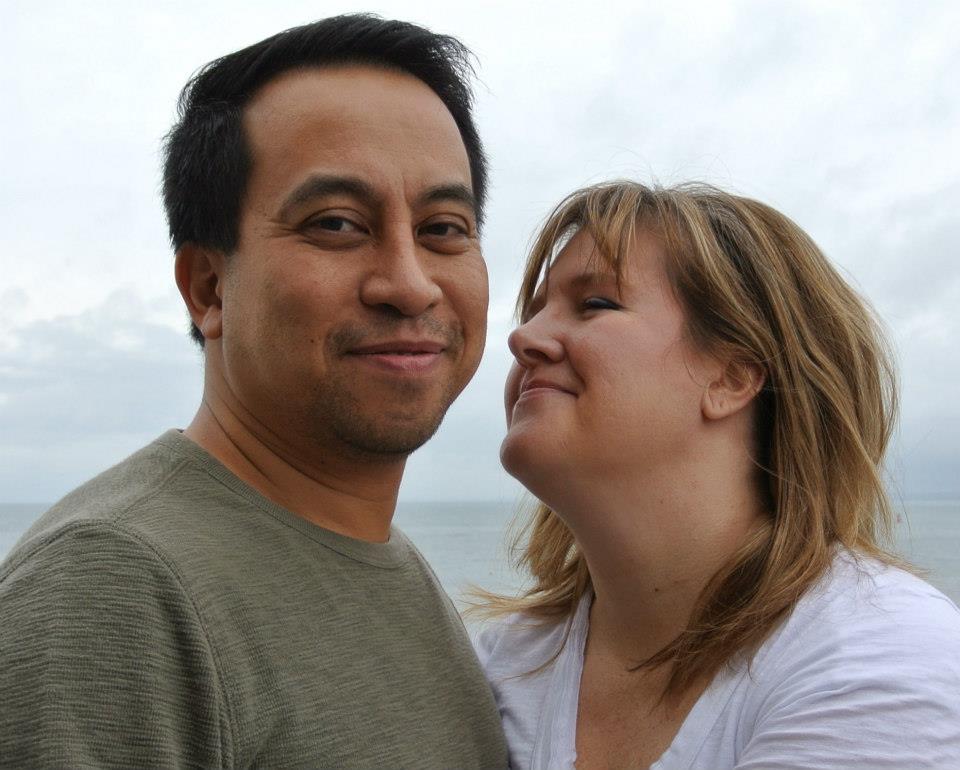
Here I am with my husband. He's often more self-sacrificing than I am, but we've taught each other.
Here I am with my husband. He’s often more self-sacrificing than I am, but we’ve taught each other.

I think what the success of this post tells us is that people in our society have lots of differing views of marriage, in addition to just wanting to clarify a couple of things in this simple post. One point is this: the post was written by a man, and as one woman wrote on Bustle, that’s kind of why it’s gotten so much attention. Women generally have been expected to be the ones to sacrifice, to give all of themselves, for their spouses and families. Men have been asked to provide. So for a man to say he needs to remember to be self-sacrificing is news (as goes the old journalism trope: it’s not news if a dog bites a man; it is news if a man bites a dog).

Another big point people are wanting to make is to clarify that we can’t do well in marriage if we ONLY focus on our spouse; we still have to do what’s important for our own well-beings. I don’t think that Smith meant to say that we shouldn’t be whole, mostly mentally sound people on our own or that we shouldn’t continue to make ourselves the best we can be as individuals; he just was making the point that in our society today, too many of us probably worry too much about ourselves without taking sufficient care to be selfless. This brings up a point I’ve thought about frequently after reading it in a book years ago: when someone is given advice, it’s tailored specifically for them and what they lack and could be totally wrong for someone else.

As an example, my parents never needed to lecture me about being more responsible. I was so overly responsible and focused on planning for the future that they had to encourage me to relax and have some fun in the moment. When I went to prom, they stood at the door and admonished, “Do NOT come home before midnight!” Now this would have been the opposite of what they would have done for my sister, who was more of a have-fun-in-the-moment kind of gal. She was better (and still is, I think) at carpe diem-ing. She’s been a good example to me in that way.

So what I am saying is that this young man needed to hear the advice his dad told him to stop with the anxiety about whether his upcoming marriage would be right for him and to consider more how he could give to his future wife. That’s what he needed to hear and it made such an impact on him that he felt the need to share it on his blog. And there are rightly going to be plenty of people who read his blog who are like him and will need that reminder; others will not need it for themselves because they are already very self-sacrificing. Those readers need a different, almost opposite, reminder that they should take time to make themselves more well-rounded, more complete, etc. And those people (or those who know and love them, it seems), who may very well be primarily female, are those who responded so strongly that Smith shouldn’t forget that point of view.

At the same time, I suppose I shouldn’t have been surprised to read from other bloggers that marriage isn’t about family and children. One guy writing for SFGate.com said this: “Many people enter marriages without a desire to procreate and this just doesn’t hold water for the ever-growing numbers of childless by choice couples.” I can only say that I essentially consider this to be just plain sad. I am still of the belief that marriage really is about creating families, about having children and rearing them to be great people and contributing members of society. (I won’t even get into the problems that this attitude is having on society, just one of which is that countries with low birthrates are now facing serious issues with there being too many elderly and not enough young people.) Yes, I do believe that a very few people really are not cut out to be parents, it seems, but far more who choose never to have children thinking that they fall into this category very likely would be the ones shocked to find themselves enjoying, appreciating, and learning from the experience of parenthood. Through parenting, we contribute to society and we grow as people through both the challenges and the joys we experience. I am one of those who really does consider those who choose deliberately never to have children to be a bit too selfish.

So marriage is for all of us. It’s for husbands and wives, it’s for children, it’s for society. Each of us can stand to do a little better to be selfless and help others; some of us can do a little better in developing ourselves as individuals.

My family dinner time is sacred

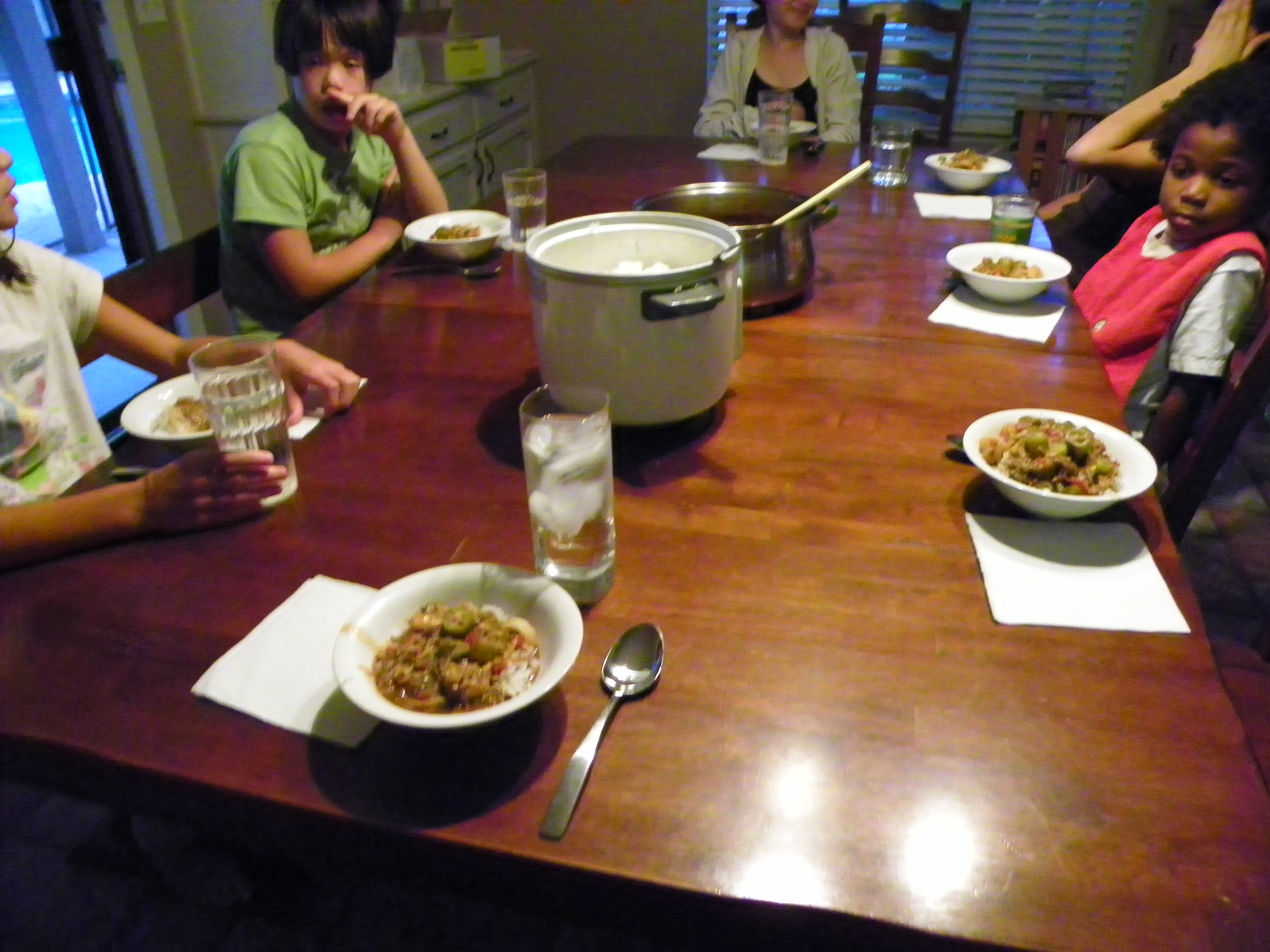
Here's my family gathered around the table to enjoy some homemade gumbo.
Here’s my family gathered around the table to enjoy some homemade gumbo.

Because of my involvement in some community organizations, I realized recently just how odd it is that my family actually gathers around the table for dinner. EVERY NIGHT. Yes, it’s true. I already knew that my practice of cooking homemade meals for my family was more than a little unusual, that many people don’t cook anymore but do some form of take-out most of the time instead (whether it’s fast food, mostly prepared food from groceries, etc.), but it just hadn’t hit me how few people eat meals together at home.

After running a few minutes late for a number of meetings for a booster club I volunteer for, I realized the reason I was the only one not there a few minutes early was that I was also the only one coming from home, from our dinner table (or maybe one of two). Our meetings have been at 6 or 6:30 p.m., right in the middle of mealtime. But rather than letting my family fend for themselves, even, I’ve just prepared meals earlier (though it’s been a little more stressful).

Everyone had told me for years that “once my kids got into high school,” they’d be so busy with extracurriculars that we’d stop our practice of mealtimes together. But my oldest is a senior in high school, and the one extracurricular that requires her to have an evening away (band practices in the evening) is only one night a week, and at 6:30. So we eat dinner together before she leaves. And our weekly youth church activity is at 7 p.m., so we all eat together before that. Other extracurriculars are late afternoon, before dinner. So, despite the dinner doomsday preachers, we have still eaten together as a family.

Yes, it’s taken some extra planning and a little extra work on my part. But it has been so worth it. I don’t think I need to point out that studies show how vital it is to eat together as a family, that each meal together bolsters teens’ emotional strength and happiness. I don’t really strive for meals together because of research. I do it because it’s fun, it’s enjoyable, it’s family bonding time. It contributes to our strength and happiness as a family unit. We’re not perfect or always happy, but we’re mostly happy together, and my kids feel secure and loved at home. Being together for dinner every night is just a part of the puzzle that makes home their refuge, their happy, secure place.

We talk about our days, we make jokes, we laugh as we quote from movies (we do that ALL the time; it’s just “our thing”: if we don’t slip in a quote from “The Princess Bride” at least a few times a week, something’s wrong). It’s all about togetherness, building and fortifying our camaraderie, our family identity.

Yeah, I think we’re now in the minority of families who eat together every night. I understand why many others have a hard time doing that; there are lots of good reasons for it. But I have fought to keep us together at dinner, and I will continue to do so, despite it being sometimes like swimming upstream, because it makes me happy. It makes us all happy. I hope I keep it up until our last little one has flown the coop, even when it’s just three of us sharing that camaraderie nightly.

American black babies being adopted outside the U.S.

So I read another article that just made my jaw drop. It said that while international adoptions are becoming more difficult, and thus are dropping in numbers, would-be parents from other countries are finding it fairly easy to adopt babies from here in the U.S. — and many of those are black babies, because there are more of them in the “waiting child” category.

Yikes. The article actually reminds readers that racial prejudice is still an issue here in the U.S. and that some black birth parents hope that by letting foreigners adopt their babies, that their children might face fewer racial issues in other countries, such as the Netherlands.

Here I am the first time I met my gorgeous baby Charlotte, the day after her birth.

As the wife of an Asian man and the mother of three biological children who are mixed-race (Caucasian and Filipino) and one adopted black daughter, I am certainly sensitive to racial issues. Most of the time, however, since I personally just don’t see any difference in who people truly ARE at their core regardless of what they might look like on the outside (and I suppose this also extends to disabilities, since one daughter has Down syndrome…), I tend to not think about racial issues too much. I’m not saying I’m being insensitive; I guess I just don’t think about it frequently because of my attitude about people and race.

But this article, though a bit shocking, isn’t a complete surprise; when we adopted our daughter, we heard that some other prospective parents weren’t interested in adopting a baby who didn’t share their race (i.e., since many were white, they wanted a white baby). And I knew there were some agencies and services out there that specifically work on finding homes for black or mixed-race babies (in addition to children with special needs), because they’re harder to place.

Again, as with so many issues today, even though we’ve come a long way as a country when it comes to race, we’re not color blind yet. And don’t even get me started on the hateful comments some people made about one of Mitt Romney’s sons adopting a black baby (as if it were for political purposes!). I just wish that prejudice and all the assorted other hatefulness out there didn’t have to affect babies.

Re-grieving

They say that when you have a child with a disability, you must grieve the loss of the “normal” child you expected to have. I did this for a few days when I first found out through amniocentesis that my unborn baby would have Down syndrome. After that, I was as eager as any mother to give birth to a new baby. And her birth day was lovely and exciting and “normal.”

As I’ve adjusted expectations over the years and figured out at different stages what she has needed to aid her in developing and growing and achieving her potential, I’ve mostly rolled with the punches. But even as she walked and talked much later than my older daughter and did lots of things her very own way and at her own speed, I was mostly unconcerned. And she was so CUTE, and everyone she was around adored her.

Here she is at the high school, just a few days after starting.

I didn’t anticipate the interesting dilemmas that would face me as she reached adolescence and age out of elementary school. I certainly hadn’t given much thought to puberty (wha??!). Now, as of a few weeks ago, she is a freshman in high school. Just having her enter high school gave me a few little late aftershocks of grief; my oldest is a senior, and I’m right in the midst of being thrilled and excited for her and everything that’s ahead while simultaneously being struck smack in the chest with loss knowing she’ll be leaving home. I’m reflecting on the weeks three years ago, seemingly just yesterday, when SHE started high school and had all these new adventures and experiences awaiting her. How could my talented, sweet, fun little bird now be so close to flying out of our cozy nest?

So you see the stark contrast in experiences, in feelings, I’m facing as my second-born enters high school. She has a very different future ahead of her, not bad, but just different. It’s one I am unsure of, that is not nearly as clear as that of my oldest, because it’s not a path I’ve already forged myself.

Yesterday I had the yearly IEP (individualized education plan) meeting with the teachers and other interested parties at the school. But this time felt so different than every single IEP I’ve attended for the past 15 years. I was struck again by how far behind she is academically, that given her abilities, she simply will not graduate high school with a diploma, will not master algebra, even, which I’m informed is the “lowest” math class they have available at the high school. We still struggle with simple addition. But that wasn’t too surprising; I hadn’t really expected her to “graduate;” she can receive a certificate of completion, though, and that was an outcome I was already aware of.

No, what cut to the core was hearing that the classes she’s in right now are probably not where she needs to be, not because they’re too difficult academically (even though they’re the really basic versions geared for those who need extra help) but because they still are not attended by her true peers. The kids in these classes have struggles, but they perceive my sweet little girl as weaker, as a target, and they tease her. She’s on the outside. And I HAD NO IDEA. Sure, it’s only a few weeks in, and I imagine the teachers were just waiting to broach this topic at this IEP meeting, but knowing that my daughter has been treated just a little badly by classmates BROKE MY HEART.

(I did find out about another option for her class-wise that will probably be the better place for her when it comes to both academics and peers/potential friends, and I am going to look into it, visit, probably switch her, but that’s another story.)

I got through the rest of that meeting, signed paperwork, listened some more, asked questions, and considered, but I was really just hoping it would end so I could leave and not burst into tears there in the classroom. I came home and grieved for a few hours. Even as my oldest went to her band rehearsal and attended an open house on college options and scholarships and did all the kinds of things I did 25 years ago myself, I grieved that my second-born would not do these same things.

Did I think I’d already accepted that outcome? Yes, indeed. But it just started becoming reality, and it was such a stark contrast. I still am unsure of exactly what my daughter will do; she probably will eventually leave home and live on her own, with others in an apartment or in a group place that’s fun and friendly and warm; she will most likely have a job that’s simple for her to do that she enjoys. But it’s different. And will she always be able to find a place where she has peers, where she can make friends who are like her? Because right now that hasn’t been happening these past weeks. Will I miss something again in the future where she’s being teased or not fitting in? I can’t bear to think of it.

Sometimes grief comes anew and we must revisit what we thought we’d already “dealt with.” We must adjust expectations again and face the reality we could only see through the hazy, murky lens of an uncertain future. And it’s OK to do so. As I grieve, I know I will come out of it with clearer vision and a renewed determination to help forge a happy, workable life for my second child. No matter what, I do know that she will be happy and will make others around her happy as well. She’s already done that for 15 years.