Till we meet again

Earlier this year, I learned that a man who’s like a second father to me had cancer. He was doing so well for so long this year (from my standpoint of living at a distance from him) that I’d almost forgotten the clock was ticking on my time with him.

I was able to visit him for about an hour when I was in his state for a family event. I cherished those moments sharing him once again with two of my children, letting them spend a little time with this great man. I did know it was possible it was my last visit with him, but I hoped it wasn’t.

Now, his time on Earth is over, and he’s moving on to a new stage of life, one where he will be reunited with his sweet, sweet wife who died some years ago.

I met Robert Harbertson when I was assigned as a missionary for my church to the visitors centers at Temple Square in Salt Lake City. Rather than spending 18 months going “door to door,” as many are familiar with our church’s missionaries, I had the unusual volunteer opportunity of basically being a tour guide, of showing visitors from all over the world around Temple Square and introducing them to some of the history and beliefs of The Church of Jesus Christ of Latter-day Saints. This amazing, dear man was assigned to be in charge of all of us young volunteers (as well as the older ones, retired couples serving together). As such, he was an authority figure and a parental figure, who watched out for us and made sure we were safe and happy and thriving and getting along with each other. I saw him every day and knew he had absolutely my best interests at heart.

My 12-year-old says now her favorite story about him (I’ve told my children — and anyone else who will listen — plenty of good stories) is his opinion on the thickness of the peanut butter in my daily sandwich. Mind you, this same man handed down a rule that we young missionaries were not to comment on others’ food choices; we had missionaries serving there from countries all around the world, and sometimes they ate some strange-looking things to us Americans (or maybe vice versa). He didn’t want any comments on the “weirdness” of cultural food options to make anyone feel hurt. Even so, one day I was sitting at our lunch table and about to sink my teeth into a perfect peanut butter sandwich: it was made from the homemade whole grain bread provided in our break room and a very thick layer of creamy, gooey peanut butter. He reached around me and actually handled my sandwich, squished it, and said, “Sister Carmode! How much peanut butter did you put in that sandwich?!” I told him to mind his own business. Well, basically. We still had a good laugh.

President, as we just tended to call him, had a stern facade, which could be mighty intimidating if you didn’t know him, and if he had the need to make a point. But after just a short time of knowing him, I was wise to his game: just ready to pop out from behind the stern face was a huge, impish grin. He was also competitive, reminding us that he played college basketball, and we learned at the beginning of a spiritual address from a top church leader that President and this apostle regularly played a serious game of racquetball. I’m sure it was take-no-prisoners.

Here we are together at a 20-year reunion.

But at the heart of this stern, rule-making, authoritarian figure was a warm, gooey heart that held a spot for little ol’ me. He was in charge of probably 100 or more young women during his volunteer time, but he could make me feel I was the only one he had to take care of. Honestly, I love and miss my dad a great deal, but thanks to a very tough upbringing, Dad wasn’t a naturally, unconditionally-loving kind of person. So being in President’s care, having that place in his big heart, not just during the time he was assigned to watch out for me but in the two decades since, was a window into an experience I hadn’t quite had. It gave me a better understanding of what it means to be loved unconditionally and a boost to my feelings for myself.

When I was dating my husband, I took him to visit President and his wife, and he got their stamp of approval. It just so happened that was 2 1/2 months before my parents got to meet my then-future husband. I visited President on my way across country during one of our long-distance moves, with my firstborn baby girl. I’ve visited many times over the years and had little booster shots of that man’s love, all the while giving my girls the opportunity to experience it a little themselves.

We met in a place where a famous choir often sings “God Be With You Till We Meet Again.” Now, I sing it to President. I look forward to meeting you again.

Tips on preserving family memories

I’m presenting a class for a family history workshop on how to preserve various family memories: audio, video, documents, and photos. I thought some of my friends online might appreciate the information I’m sharing, so here are the basics:

Video

You can use a service to transfer film or VHS/Beta tapes to DVDs or do it yourself. Services are certainly easier but they’re costly.

First, the services I’ve found: Mail your materials in to MyMovieTransfer.com, ScanCafe.com, DigMyPics.com, iMemories.com, LegacyBox.com, or YesVideo.com.

Or go to Costco, Walmart, Walgreens, or CVS (these all use YesVideo service) to drop off your videos for transfer.

Next, DIY methods:

For VHS tapes, you can use a VHS-DVD burner combo player, an analog-to-digital adapter for your computer, or a separate VHS player and DVD recorder. These require various levels of know-how and equipment that might be pricey, but it might be cheaper even with pricey equipment if you have a lot to transfer. Plus, you can re-sell the equipment when you’re done to recoup some of the costs.

Digital Trends provides a nice online tutorial for DIY methods.

Once you’re finished getting your video onto DVD, then you can move on to getting it onto your computer hard drive in MP4 or similar format. For the future, it looks as if everything is going digital, so just go ahead and do it now. This also means you can have all your memories in one place. You can store on your computer and also keep a copy on a backup hard drive for safekeeping, along with all of your other digital copies of photos and audio, etc. I’ve used Xilisoft’s DVD Ripper and it’s fairly simple if you have some computer experience; standard version is $39.99. Other software includes Wondershare Video Converter starting at $39.95.

Digital Trends provides instructions for some free options.

Audio

Transferring cassette tapes onto your computer hard drive and into MP3 or similar digital audio formats is less complex than transferring video. It’s also pretty inexpensive. You just need a cassette player and an auxiliary cord to plug it into your computer, as well as software. The primary software I’ve seen (and used myself) is Audacity. Bonus: it’s free! Here are a couple of online tutorials:

http://www.cnet.com/how-to/how-to-turn-a-cassette-tape-into-mp3s/

http://www.wikihow.com/Transfer-Cassette-Tape-to-Computer

Photos

If you have photos in slide format, you can use a service, which can be quite expensive if you have a lot of them, or you can do it yourself. DIY is pretty easy and just requires a slide scanner, which can be purchased for around $80 to $120.

Loose photos or photos in albums are easy to scan with a regular scanner. Many of us now have combo printer/scanners. If you don’t have one yet, you can purchase a good-quality one for as little as $50. Only drawback is it’s time-consuming. If you’re trying to scan in photos that are still in old albums, you’ll have to scan in each page, make copies of the image on your computer, then crop down to each photo. Afterward, you can use your favorite photo-editing software to clean them up.

There are also apps for this project, such as Pic Scanner, which can be downloaded from the iTunes app store. It’s free for the first 10 scans of album pages and $2.99 after that. Pros: Makes it easy to just “take a picture,” and it isolates the separate photos for you without you having to copy and crop. Con: I liked the quality of my scanner better.

If you do want to use a service, there are lots out there, such as ScanCafe.com, DigMyPics.com, FotoBridge.com, iMemories.com, LegacyBox.com, and YesVideo.com.

Documents

Don’t forget to scan in old family documents as well. Same process goes here for photos. Use a scanner.

Now, going the other direction: many of us have photos from the past 5 to 10 years strictly in digital format. That’s great for storage, but you’ll also want to have some actually in hard copy form. I’ve found it’s nice and pretty easy to make photo albums on my computer using various photo-album services and then just have them printed and bound for me. No printing of individual photos and then assembling into albums. I’ve used Shutterfly, MiniBox, and MyPublisher and have been satisfied with their products. There are also a number of other services I haven’t tried: PhotoBook America, Peggy Bank, and AdoramaPix, for a few examples.

Deals

If you’re going to do any of these projects with services available, make sure you get the best deal you can! Groupon and LivingSocial are handy for this. Sign up for their emails and you’ll get heads-up on the various deals that might involve these kinds of services. I’ve gotten good ones from MyPublisher and am up to date on all my family photo albums thanks to them.

I also like to use Ebates to get cash back and coupons for services. Create an account and you can search for all their participating merchants.

Some current deals (local to my area in California):

ScanMyPhotos.com

Digital media services from Southtree

Video and image digitization services from Peggy Bank 

Groupon for 40-page photo books from PhotoBookAmerica

Groupon for photo books from AdoramaPix


It’s high time to stop objectifying women and girls

What’s it going to take for our society to just STOP seeing women, and even girls, solely as sex objects?

This past couple of weeks, one woman’s blog post asking Target to stop the miniaturization (i.e. sexy-fication) of young girls’ clothing went viral. Rightly so. I have four daughters, ages 18 down to 7, and I have long chafed over the fact that retailers simply make girls’ clothes shorter, tighter, and smaller than boys’ clothes.

(Unfortunately, the one place this doesn’t seem to apply is in the waist and hips, because it’s dang hard to find a good variety of slim pants sizes for my slim girls. JCPenney makes them; Gap and Old Navy make some slim sizes; online retailer Lands’ End makes them. But this being a slightly-related but not completely-related topic, I’ll just keep it to this: can’t we have more sizing options? Yes, I know that, one, people — including kids — come in all shapes and sizes, and two, there are more and more heavy kids in what’s becoming an obesity epidemic, thus necessitating the plus sizes in kids’ clothes, but there still are some children out there who eat fairly healthy and are naturally slim. Argh.)

My oldest, in Bermuda shorts.

Anyway, back to the topic: Just because teen girls seemingly prefer short-shorts instead of Bermudas doesn’t mean mothers want to buy Daisy Dukes for their toddlers and elementary-school-age kids.

This goes as well for all the junior-department dresses that are about 16 inches long, particularly formals, that are strapless and end mid-thigh. Pair these with the also-trendy stilettos or huge platforms, and we have the stereotypical image that’s traditionally been reserved for prostitutes.

And look at what a really gorgeous and fun but not-skimpy dress we found for prom.

Mind you, I do like style, particularly dresses. I adore dresses! They’re so fun and girly and there are just SO many styles and interesting looks. I love to shop for myself; I love picking up new frocks for my girls (on sale, naturally; the better the bargain at a nice retailer, the bigger the smile on my face). But there is no reason for such a high proportion of dresses to skimp so much on fabric. And taking the sexy styles of teens (which are too sexy for girls who haven’t even reached adulthood yet) and adapting them into preteen styles is just NOT COOL.

More of us parents and shoppers should be ACTIVELY doing more to contact retailers and demand change. So kudos to this blogger. See? One person asking for change can make a difference.

Then there are the constant stream of images in the media, whether it’s music videos or movies and TV shows (to which our girls are looking for inspiration or, at the very least, simply can’t NOT see in their digital lives). The latest, apparently, is a horrific video by Maroon 5, “Animals,” featuring Adam Levine as a butcher who stalks a female customer. Oh, yeah. Let’s glorify the “fantasy” of a male stalker — a butcher surrounded by bloody carcasses, no less — with an “animal” lust that can’t be controlled.

What continues to elude me is why women who are participants in these blatant displays of demeaning women are willing to sign on. The Maroon 5 video features Levine’s new wife, Behati Prinsloo. No doubt the honeymoon phase hasn’t worn off yet. Otherwise one would hope she would be the first to say, “Look, Adam, honey, I don’t think that’s a great idea. Let’s try something else, shall we?”

Then there are Jennifer Lopez and Iggy Azalea celebrating their barely-clad backsides in “Booty.” (Let me note that I have not watched these videos, just seen a few screenshots. I do NOT care to put any more images in my head of these things.) They are the stars of their own shows; J.Lo, with her clout, arguably does or could control her image and what kind of music she sings and videos she shoots, so I hold her more responsible. I believe the typical argument goes like this: “I’m a strong, empowered woman, and I’m taking control of my own sexuality and am CHOOSING to show my sexual side.”

My only response to this is this: Baloney.

You know that you’ll get lots of attention and more money by using your sexual side to sell your “brand.”

Think what these empowered women could do if they really put their money where their mouths are and CHOSE to send different messages, messages about how richly talented and diverse and interesting women and girls all are, starting with themselves. And think what we as consumers could do if we sent a message the other direction to these celebrities and the media who promote them: What if we truly did not buy their products? What if millions of us rose up in protest and sent emails and letters, showing that we really don’t want what they’re foisting on us?

In an age when many of us really are trying to teach our girls something better, to rise above worries about trivial matters of our appearances, why are the music industry, the film and TV industries, working so hard against us? (Rhetorical question, folks.)

I heartily agree with this sentiment expressed by a parenting researcher and author in The Daily Telegraph: “I am sick of trying to teach my daughters how much they have to offer the world, only to have everything I say undermined by the sleazy, unhealthy messages that someone with no respect for womanhood promotes to the mass market to make some more money. The wellbeing of our wives, sisters, and daughters is worth more than that. It’s not OK.”

Today we recognize the amazing determination of one teen girl in pushing for education for girls in her native Pakistan. Malala Yousafzai was awarded the Nobel Peace Prize: one of the finest achievements anyone could aspire to, and she’s only 17. We aren’t all in awe of her for her booty, her figure, her beauty, or her style; far from it — she covers her head in public with colorful scarves. She bears scars from being shot in the head for campaigning for girls’ right to education. No, everyone is impressed with her convictions and bravery to do the right thing, despite almost being killed.

That’s what matters. That’s what we want to encourage our girls to embrace about themselves: their strength, their bravery, their determination to find the best in themselves and make it better and share it with others, conviction to make the world a better place. They’re all different sizes, different colors, different backgrounds. But they all have so much to give! I speak from experience because I have amazing girls.

It is high time we ALL spoke up for the amazing girls and women of this world and helped them reject being reduced to mere one-dimensional sex objects.

5 years of missing a giant personality

Next week will mark five years since my dad’s death. I expected I’d write a post then to observe the occasion, but I’m finding I’m missing him a great deal right now, so that anniversary post is happening now.

Dad’s death was unexpected and a completely devastating experience I was wholly unprepared for. I felt sure I had a good decade or more with him so I wasn’t at all ready to face the possibility of him not being in my life. His loss upended me, changed me utterly, and created a crater in my very self, as if a fiery asteroid had crash-landed in my torso. Time passing and the reality of no more phone calls or visits or little notes or pictures in the mail have forced me to accept his absence, but the crater is still there. Only problem is that it’s somehow been covered up over time by the accumulating detritus of life, so few observers have any idea it’s there, this charred chasm.

Dad and Cathy LOVEDad and I were close. I have come to appreciate that calling him one of my best friends is not an exaggeration. He really was. He also could be completely exasperating and sometimes annoyingly clueless. He was a hypochondriac and an over-sharer, and loving completely unconditionally did not come naturally to him, thanks to a difficult upbringing. He was obsessed with taking care of his health and was a bit underweight, and he focused overmuch on other people’s appearances. Thanks to that, in part, I am overly concerned with how I look, a frustrating shortcoming that can sometimes take me away from what’s truly important in this short life. Honestly, I could write a few more paragraphs about how he could make me crazy, sometimes even angry.

Nonetheless, I adored him. I have so many treasured memories of time with him, daddy-daughter time. He taught me so much and transferred so many of his own “likes” and preferences to me that I feel sometimes I can just channel him. Dad took me to cultural events: orchestra and band concerts, ballet performances, plays (because he was a university professor we had access to some great performances at the various universities where he worked. And if they were free or a very low price, all the better: he really disliked spending money). He instilled his love of music and his humor. I can still almost hear him laugh. Just … almost … the sensation, the sound, is just out of reach, like a word on the tip of my tongue. I can imagine his reactions to just about anything. He loved card games and was quite competitive. He had so many distinctly-him mannerisms. I can practically bring him to life any moment by repeating something he’d typically say or by aping a habit. My oldest daughter in particular remembers those things pretty well and can accurately mimic him too, repeating how he’d bug the poor front-line workers in a McDonald’s about “What kind of oil exactly do you use in your fries?” or deliberately and dramatically placing a card down on the table when playing a game.

I’ve read over the years how those who are grieving do want to talk about their loved one who has left this mortal existence, that asking questions or talking to them about the person who’s died is actually a welcome activity, not an intrusion or painful reminder. No, we already know that the person we love is gone. We can’t possibly be “reminded” any more. It’s SO true that what I want to do is just talk about him. I want to tell everyone about him, to just talk endlessly about all his quirks, all his high notes, all characteristics in between. In talking about him, I’m bringing him to life for someone else, keeping his memory alive for myself.

I am at peace entirely with my beliefs on where he is now and what he is doing. I’m happy for him to be in this next stage of what I know is an eternal existence. He gleaned what he needed to from this stage of life, and he’s learning more and doing more where he is now. But that peace, knowledge, and happiness that I have for him doesn’t change how desperately I miss him being here, with me. I still miss him every day. I still wish I could pick up the phone and talk to him, maybe get his advice and input, just hear his voice. He was such a vibrant, oversize personality: he was impossible to miss. He spoke loudly and commanded attention (he taught TV broadcasting and spoke accordingly). He was funny and appreciated good humor. Not having that presence around now creates a Dad-size hole that won’t go away until I am reunited with him someday.

I miss you, Dad. It’s as simple as that. My heart will ever be broken till we meet again.

Parents who don’t hover are the ones in danger, not their kids

I’ve read a couple of articles lately that have reminded me just how tough it is to parent these days. And not in the ways you might think.

First, I read a great column about one woman’s experience, When kids were unbreakable, remembering her “dangerous” childhood and giving her kids some more opportunities for freer play. I think most of us who are in our 40s and up fondly recall hours of free play when we were growing up. I was particularly lucky to live “out in the country” most of the time before I turned 10, after which point I was more in neighborhoods. In both living situations, though, I was away from my house (and my watching mom) for hours at a time, playing in the dirt and in creeks, exploring the woods, walking along dirt roads, riding bikes along suburban streets or cutting through unfenced yards to walk to friends’ houses. I rode my bike with no hands a number of times, and once I ended up needing stitches in my elbow because of it (and I didn’t do it again). I don’t remember a lot of other dangerous things I must have done, just that I had lots of fun, was mostly smart about it, and paid attention to what was going on around me. Dad taught me to shoot a rifle in the backyard a few times (in the country); Mom taught me how to use a knife (and lots of other tools) in the kitchen.

The short story is this: my mom and dad didn’t watch my every move. I wasn’t penned inside my house; I wasn’t watching TV or any other screens very much. I ran and played. I breathed fresh air. I invented all kinds of fun games by myself and with friends and (if forced 🙂 ) my younger siblings. I made something fun out of “nothing,” the materials at hand. My mom felt fine — and was a perfectly great parent — letting me go outside her supervision for those hours.

Today, things are far different. We live in a hyper-vigilant society, in which we have 24-hour news coming at us from TV and the Internet and smartphones. Every instance of bad things happening to kids is reported to us. We fear strangers and are sure if we aren’t watching our kids every moment, that someone will likely snatch them. We live in a time when we are told to know the signs of child abuse. This is a good thing; abuse is not pushed under the rug as much and is better reported. But it’s made us all wary of being the kinds of parents who let our kids have free creative time to explore and imagine and play, without being within 10 yards of them at all moments. We fear that our kids might get kidnapped and/or abused. We fear that we’re not being “engaged” with our kids, providing them lots of fun play options. We fear we’re not good enough. I’m fairly sure that these weren’t concerns for our parents.

Which brings me to the second, and very disturbing but not surprising, article, Woman Calls CPS After Seeing Kid Play Outside. It upsets me to read it because I’ve been in a similar position. When my first two were only 2 years old and a few months old, I was reported (anonymously, though I was able to piece together who it was because I knew her personality and modus operandi) to CPS because someone was concerned they were undernourished and one had a raw, chapped rash between her lips and her nose. Here’s what the circumstances were: my kids were and still are, many years later, petite. The infant had Down syndrome, and many people don’t realize that children with Down’s have their own growth chart. My pediatrician measured her growth against other DS kids. She was fine and perfectly healthy. In fact, we’ve always been blessed that she’s been remarkably healthy, with no heart problems, no digestive problems, almost no ear infections, even. But she looked, to one too-sensitive observer, to be “too small.” My 2-year-old just had a bad (and difficult to break) habit of licking above her lips and that small area was for a fairly short period of time just red and chapped, and I did everything I could think of to make it better. This apparently also made me an object of concern.

A case worker came out to our house and questioned me and looked at the kids, and I was lucky enough that that was the end of it. My kids also were too young to know anything was going on. But it was extremely upsetting for me. I was scared and just sick to my stomach. Raising my kids was hard, and I was always grateful for a break and me-time, but I certainly didn’t want them taken from me!

It was also my introduction to the brave new world of Big Brother: everyone is watching you. And they are given the power over your life to call a number and anonymously report the possibility of you being a Bad Parent. Then you are thrown into what I have discovered is not just a flawed system, but one that’s in some places openly hostile and dangerous to normal, good parents. I don’t have space to tell all the stories, but I could relate a number of them, of good and loving parents who have ended up having to take time-consuming and unnecessary parenting classes, hire attorneys, and be in genuine fear for their parenting and working lives because someone misconstrued something they did in public. It is terrifying.

We have become a nation of helicopter parents, it’s true. And we’ve become a nation of people who are quick to jump to conclusions, who are quick to call “the authorities” on the basis of a tiny possibility of a problem, who don’t know their neighbors from Adam, who have no idea of any context of the lives of the people they’re reporting on. If we knew each other better, knew that our neighbors were good parents who love their kids, whose parenting styles assuredly are different from ours but are NOT BAD, who support their kids and teach them and are making them into responsible adults, we’d be far less likely to go straight to the government with a concern rather than talk to our neighbors first, if we do anything. But we don’t. We are very connected with disembodied people via smartphones and tablets and computer screens, and with talking heads on the news, but not truly interconnected with a community of real, living, breathing people. We’re taking a quick way out to call the authorities and assuage some kind of guilty conscience (for not being better involved, for not knowing Mr. and Mrs. Smith and their two kids next door) or to pat ourselves on the back for “doing the right thing,” as the government and news outlets repeatedly tell us.

Would it be possible at this point to go back a little, to recapture the sense of community we had as neighbors, to support each other in the tough job that is parenting, and to let our kids have the space they so desperately need (as studies keep proving) for free play and imagination and learning how to navigate the world? I’m a little worried that it’s not, that we’ve gone too far. But I desperately hope we haven’t.

Education problems? Families are the solution

If you’ve read my blog much at all, you may have noticed that I have a few passions: I care about and advocate for mental health issues, education, and other issues related to the media (content that’s suitable for families and kids, better accountability on issues like image and portrayals of women).

In the 14 years or so I’ve had kids in school, I’ve been involved in different aspects of education. At times, I’ve attended school board meetings and advisory meetings; at other times, I’ve been involved with specific organizations like the band boosters. I’ve always gone to my kids’ parent-teacher conferences and back-to-school nights and open houses and so on. I’ve helped out in classes sometimes and gone to activities. In all this time, I’ve observed all kinds of problems, some of which I’ve written about.

But in all I’ve done to participate, read, ask questions, and educate myself about education in the United States today, I’ve realized one thing underlies most of the problems and concerns: families aren’t playing the role they should in the development of children and their overall education.

I’ll say that again: Taken on the whole, families (i.e. parents) in this country aren’t teaching, supporting, and nurturing their kids. Why? Lots of reasons. But to be brief and try to get at a core issue, families simply aren’t “whole” anymore. I read a great overview of how there is no “average American family” anymore and it provides a few revealing statistics, taken from a new book: “Take 100 children who are representative of American life, … and 22 live in families where mom stays home and dad earns the income — the ‘typical’ family experience of 65 percent of kids in the 1950s. Another 23 live with a single mother; it’s a 50-50 proposition whether that single mom was ever married. Seven live with a cohabiting single parent and three each are being raised by a single dad or grandparent.”

If many kids are living with just one parent, and that parent has to do the job of two parents, and is necessarily away from the home working to provide for the family, it follows that those kids won’t have the level of involvement in their day-to-day lives and school lives as a household in which there are two parents. And in those households in which both parents are working (because that’s their choice or because of economic necessity), kids will have more involvement in their lives than the families with one parent around, but they simply won’t have the time dedicated to them that a family has with two parents with only one parent working outside the home. I’m not casting blame here at all; I’m simply looking at the realities of time constraints and what kind of actual QUANTITY time kids have with parents, as opposed to the oft-talked-about “quality” time.

The reality is that quality is great, but a certain amount of quantity is vital. As a stay-at-home parent (I do editing work from home on my own schedule, which is a luxury I really appreciate), I get lots of face time with my kids, who are all in formative periods of their lives. They come home from school and have questions or comments or needs, and I’m there for them. They are lucky to have a parent there to help them with needs and to do informal teaching. Kids’ learning really happens during moments they have questions and someone can answer tailored to their interests.

So with the new reality being kids living in homes with single parents who must be absent and with two parents who are both often absent (during those crucial times of afternoon into early evening), kids aren’t getting as much time for informal learning from their parents. That learning includes all kinds of topics: building character, learning to manage finances, learning about interesting topics that schools don’t necessarily provide classes in, getting opportunities for family “field trips.”

Schools are places to learn the sciences, literature, math, writing, history, etc. I was quite good in all the school subjects when I was growing up, but I wouldn’t feel comfortable teaching advanced math or sciences to my kids; I’d rather they have teachers who specialize in each subject and who are particularly adept in those to help them learn about those topics.

I guess I sound rather old-fashioned. But the reality is that it’s not the job of schools to teach character, for instance. Schools can’t take my kids on trips very often at all to learn about different areas of our state or country. Schools can’t teach faith, and they don’t often have time to focus on basic life skills that are more easily learned informally at home.

Character Counts is a nice program, but it isn't enough to replace parents teaching their kids about character 24/7.
Character Counts is a nice program, but it isn’t enough to replace parents teaching their kids about character 24/7.

Time in school is finite, and as I’ve observed at a variety of meetings with other parents and educators, it’s becoming more and more difficult to fit in during a school day all the core subjects, let alone other things schools are having to teach kids because their families aren’t doing it very well or at all. In our town, elementary schools focus on a different character trait every month to teach students: respect, responsibility, caring, trustworthiness, fairness, citizenship. Why? The “Character Counts” program was started to “combat youth violence, irresponsibility and dishonesty” by stressing positive character traits. This means that the community and schools were finding that kids and teens were acting badly and needed to be taught values; families weren’t doing the job.

Over the past dozen-plus years I’ve been actively participating in community education, I’ve seen all the problems that exist. I’ve also seen all the programs school systems have started or turned to to combat the problems. I’ve seen how little time and money exist for schools to be able to surmount all these issues by themselves. And the simple fact of the matter is this: no matter how much schools try to do to “raise” kids into good, contributing members of society, they simply can’t parent kids. Parents parent. And no one else can do that very challenging, intense, nonstop, VITAL job.

I’ll continue to be involved in school meetings and advisory panels and so on. I’ll continue to give ideas on how better to teach and support all kids, mine and everyone else’s. But nothing I or the schools can do will take the place of the home. The solution is to support families and homes. Our nation, our communities, absolutely must find ways to strengthen families. In the article I mentioned earlier, Brad Wilcox, director of the National Marriage Project at the University of Virginia, says this: “Kids raised by their own intact, married parents are more likely to flourish. Given that, public policy should help strengthen both the economic and the married foundations of family life for kids in the United States.”

Until we change our attitudes about marriage and family life, our children (including their education) will continue to suffer.

One of Robin Williams’ final gifts? Getting us talking about mental health

I love this tribute to Williams by Disney.

Four days after the devastating news of Robin Williams’ suicide, I’m still feeling the loss of someone I never even knew personally. Perhaps it’s because his genius acting work has been a part of my life pretty much ever since I can remember (oh, yes, I was watching when he first hit the airwaves with “Mork and Mindy”). I can mark important times in my life with what movie he was doing at the time; for instance, my husband and I saw “Aladdin” on our first date nearly 22 years ago. Even now, our family quotes from that movie.

But another part of the reason this event has affected me so deeply is that it strikes close to home. I started this blog to write, in part, about mental illness, to just put my own experience out there. And Williams’ death has had me thinking a great deal in relation to how I can understand it and how I want to be able to continue to share my feelings with others. There have been some poignant tributes and some spot-on blog posts and articles about suicide, about depression, about the almighty struggle some experience with their mental health. I don’t think I can do any better, but I can just share my viewpoint.

Just a few weeks ago, I participated in a study focusing on cognitive issues in women who have breast cancer (I was part of the control group). I was happy to do my part for science, even if I had to drive a few hours away to get to Stanford University. Since the study is looking at cognitive effects of cancer or the treatment for it, it included questions and assessments not only about impairment of cognitive processes overall but also about emotional status. Since I had indicated on the questionnaires and intake forms that I take medication for depression, the researcher who worked with me asked me at the end of our time a little bit about my feelings and opinions on it. She said she focuses on psychology and has noticed in her time studying it that there are still not nearly enough treatments available for depression and other mental illnesses. Some people in the blogosphere and media have wondered why Williams, for example, didn’t just “get help.”

Here’s the sad truth: there isn’t nearly enough adequate “help” out there, whether it’s in the form of medications and other medical interventions and treatments or it’s in the form of professionals and non-professionals who really are good at what they do and can give superior guidance.

There is still an epic shortage (in my experience and opinion) in the number of qualified professionals who can treat people from all economic and health-care-coverage situations. This is particularly true in the case of the number of doctors or other practitioners who specialize in and are licensed to provide medications. In my experience, for instance, there are three psychiatrists covered by my health insurance (which might also be the total of all the psychiatrists in my city), and only one is taking new patients. That one I didn’t particularly like, and it’s crucial to have a certain level of rapport with someone who’s treating you for your brain chemistry. So I was lucky enough to hear about another provider who ended up being a better fit for me, but her office is an hour’s drive from my home, and her practice is not covered by my insurance. I am also lucky enough to be able to afford paying out of pocket for her care. But what about those who don’t have insurance at all, who can’t afford out-of-pocket costs, who don’t have access to transportation, etc.? There are a LOT of people not being served.

Then we move on to the issue of actual treatments available, even when one has unlimited access to doctors, therapists, and whatever medical intervention is available. And as the researcher and I discussed a few weeks ago, there are far too few options. I’m on an antidepressant that’s worked well enough for me the past couple of years to get me to where I can cope adequately with life’s challenges without being taken down completely. But there have been times medications weren’t doing enough for me, and it was hard.

There have been at least the number of times I can count on one hand, and possibly up to two hands, moments I’ve been in the blackest and deepest abyss and felt suicidal, even if it was only briefly. And I could go on and on about how if you haven’t been there, you can’t possibly know what it’s like. Logically, in a part of my brain, I knew I didn’t want to hurt my loved ones, didn’t want to deprive them of me. (That’s addressing the “selfish act” observation…) But it was a very distant part of my brain and one that was clouded over by the overwhelming despair and hopelessness of my feelings. As I’ve written before, it’s those times and others that I now feel my brain chemistry betrayed me. And it’s a very weird, unnerving feeling to have your brain working against itself and yourself. Even though I could logically call to mind times I enjoyed life and felt fulfilled and useful and vital and important to others, to the world, I just didn’t FEEL it. And it became impossible to imagine or believe I would feel that way again.

No amount of love and support and encouraging words from others (assuming the best, that one does have that kind of support system — believe me, there are plenty who don’t have that, making things even worse) can make that feeling go away. If your brain chemistry is off, it’s off. And that’s why we absolutely MUST find more options to treat that chemistry. There are far too few options now.

I appreciated this one article on Mashable, for example, that asserted, “Finally, We’re Talking About Mental Illness Like Adults.” People have generally been very thoughtful this week as they’ve discussed Williams. I sincerely and strongly hope that this discussion can continue, that a few important good things may come from this tragedy: 1) Let’s stamp out the stigma for good. Let’s work towards a culture in which people who experience any kind of mental illness can talk openly about it without fear of being judged or misunderstood or mistreated. Let’s make it as easy to talk about as any other illness that’s more “physical.” 2) We need to push for more research into more varied medications. There are a number of drugs out there (but not nearly enough) that are made for the treatment of mental illnesses, but a lot of them are similar to each other and work the same way. Pharmaceutical companies need to branch out and work on far more kinds of medications that attack mental illnesses in different ways, from different directions, etc. 3) We need more doctors. We need more prescribing practitioners available everywhere to everyone. This will not only be the kind thing to do, but one that will contribute to reducing many other existing societal problems: homelessness, joblessness, some violent crimes.

These aren’t easily attainable goals. But we certainly need to work towards them. It will make a world of difference to millions.

Rolling on in to middle age

Recently I took my girls roller skating. The 12-year-old had been going somewhat frequently of late and had gotten pretty good but the 7-year-old and 15-year-old (my child with Down syndrome) hadn’t been in ages and were like baby deer out on the rink. But they got better and enjoyed themselves during our two-hour visit.

As for me, I love donning the wheels and racing around the rink. It was my weekend social activity when I was a tween, and decades later, I still can hold my own. It’s an interesting/frustrating kind of challenging to “race” around when the rink is full of little kids — it’s like a slowly shifting obstacle course. So I was excited when the DJ announced it was backwards-skate time. I can still do it, after all these years, and since most of the little people jamming the floor could barely move forward, let alone go backwards, the time meant I had a much emptier space for skating. Yes! Only difference at this stage in my life is that I wasn’t just focused on my skating: I was also looking around to see where my kids went. And that meant loss of focus on the specialized form of backwards skating. As Queen sang so often when I was skating socially, I bit the dust. Big-time. And falling when going backwards means a particularly spectacular, unbroken-by-arms fall. OUCH. I got up and kept on going and my lack of focus had me back on the hard floor pretty quickly. I could feel my brain shaking around in my head, so I decided it was time to remove myself from the floor for a while.

A little while later, my perceptive and sensitive 12-year-old looked at me with concern and said, “Mom, people were laughing at you.” I realized then that it just didn’t matter. It didn’t bother me at all. I told her so. Maybe it’s because they’re a bunch of kids and it doesn’t matter to me if a bunch of snotty kids are laughing at me, or maybe I’ve finally started reaching a point where it doesn’t bother me quite as much what other people think. I just told my daughter, “You know what? It doesn’t matter to me. I was having fun. Don’t you worry about what people think about me.”

It’s made me think more about how I’m at an age where I can and should stop worrying about what other people think. I’ve read so often about how older women say they live so much more freely and contentedly because they just don’t care about how they look or what other people think, and it seems like a great thing to me. But as our society holds on so tightly to youth and beauty, allowing/encouraging women my age and even into their 50s and 60s to still look “traditionally” young and beautiful, i.e., desirable, sexy, etc., I wonder if that transition into that delightfully free mindset will take even longer.

‘Cause here’s the thing: how long do any of us really need to be beautiful, to have that be one of our defining characteristics? On one hand, I felt uncomfortable in my skin, didn’t feel thin and pretty, when I was growing up, but then around the age of 17 or so I grew to appreciate that I was attractive, that a fair number of guys considered me pretty. And I realized I could use that, I could “work” it. I could flirt, I could be cute and attractive. I could just have fun dating. My attractiveness was a tool, one of the arrows in my quiver. The quiver also included my smarts, my talents, my wit, my personality, my character. But my “beauty” was almost of equal value at that stage in my life as any of my other arrows. I carried around that awareness of its presence for a long time, even past its “usefulness” in “securing a mate.” (That’s a topic for a whole other blog post, methinks.) Two decades into my marriage and my parenting life, it’s honestly just not necessary or important, definitely not like the other valuable arrows I have cultivated. But everywhere I look in our society, I still see messages that tell me my beauty should be treasured above all, should be curated, should be preserved. There are plenty of options for that preservation, after all, and whole multi-billion-dollar industries begging for my attention and money.

No, society today is not at all supportive of a gracious and peaceful acceptance of aging, of losing youth and “beauty.” We don’t get to just comfortably slide into older age. We fight it, we see others fighting it, we are encouraged to fight it. But eventually, whether we get to slide comfortably and willingly, or we fight it the whole way, all of us who make it to old age will be old. We will lose our youthful appearance. What if we actually just accept and embrace the inevitable instead of fighting it tooth (yellowing) and nail (thinning and cracking)? What if we came to appreciate all the other things that make us who we are and stop worrying about the thin veneer of attractiveness, of appearance? What a world that would be! Think of the inner peace! Think of all we could do in the world without using up our (yes, finite) energies on something ridiculous like how we look!

So I’m encouraged a bit by my reaction to my ridiculous-looking falls at the roller rink. Maybe I am just starting to accept the fact that I’m middle-aged. Maybe I’m starting to not worry so much about how I look and how I think others think about me. Maybe. Because I’d like to use my limited energies on the things that matter the most to me, and there are lots. My family, my friends, worthy causes deserve my full attention. And all they need of my appearance is my smile. I still have that, and the only thing I need to do to keep it in top condition is keep using it.

Book endings and authors’ obligations to readers

Deborah Harkness provided me some useful information but no answers.

It’s been several weeks since I finished reading the final book in the “All Souls” trilogy by Deborah Harkness, The Book of Life, and after writing a few reviews of it for various sites and chewing on my ideas for some time, I had the opportunity to attend Harkness’ book signing in San Francisco a couple of days ago. After asking the author two questions during the open Q&A and then one “spoiler” question while she signed my books, I still have mixed feelings about how the series concluded.

I’ll just say that this observation is a little spoiler-ish but not in detail, so if you have not read the final book, then skip over this paragraph: I felt that many of the questions I had about Ashmole 782, the elusive and strange magical manuscript introduced in the very beginning of A Discovery of Witches, were not answered. And while some of my questions may be just “my own” or somewhat indirect, some were directly brought up by the characters in the book quite early on. And THEY WERE NOT RESOLVED. ARRRGGGGH. Considering that this was a huge part of the plot of the series, I felt gypped as a reader (of 1700 pages, no less) that they were left open. Talk about unsatisfactory. So I asked Harkness this: “Do YOU know where the book came from, who made it, etc.?” And she immediately and firmly responded with a “yes.”

She KNOWS, and she did not tell readers? Whaaaat?

Harkness told me this: “Everything readers know in the book comes from the point of view of Diana and the other characters. She doesn’t really know (at the end of the series) yet the answers to these questions, so readers don’t.”

During the hour of the author reading from the book, talking about it and herself, and then doing Q&A, she said a few things that are relevant: One, she really intended to keep the series as a trilogy, so as she explored the story while writing, she had to limit herself so it wouldn’t get unwieldy. Two (and I’m piecing this together a bit), I think she said, essentially, that anyone’s full story is never contained in a book. Things happen before and things happen after. The book is then a part of the whole story. And (after someone observed that the last book was the darkest of the series) she was trying to show what happens in a relationship after the fun, easy, falling-in-love part, where it gets trickier and is more work, and so on. So I’m going to extrapolate that she doesn’t intend for her writing to “tie everything up in a bow” at the end. But the part of their lives that is the pertinent story is captured and pinned down a bit within the pages of the series.

Now here’s where this gets interesting. Some readers can get up in arms when a story doesn’t end the way they expect, or it doesn’t end “happily” or it doesn’t tie up all the loose strings. And it may show a sign of reader immaturity when one gets mad that a story doesn’t end with a happily ever after — life, after all, is never that simple and “satisfying,” and books are best when they reflect the messiness and realities of life. So at what point should readers rightly expect some kind of conclusion?

Here’s my take: it depends on the type of book (genre) and how thoroughly expectations were set up in the book and plot. In a mystery, for example, it’s understood that various disparate elements are going to be introduced and then the mystery “solved” at the end, with those elements put together in certain ways to provide a satisfactory ending, leaving the reader with the “aha!” feeling of “That’s why all those items were important.” In a memoir, one may fairly reasonably expect the author to recount parts of his or her life that relate to a certain theme, a story arc that includes pertinent facts, experiences, and observations, because it would be impossible and undesirable for that person to just sit down and write everything that’s happened without giving it shape, form, or meaning.

Regarding the expectations, if a few things are simply mentioned as facts that might give a better idea of characters’ personalities, motivations, expectations, development, etc., they don’t require further attention by the author. But if the book frequently mentions certain plot elements and has the characters and readers questioning them as a large part of the book and plot, they need to be answered.

In the case of the All Souls series, as Harkness put it in her talk, the three “main characters” are Diana, the historian and witch; Matthew, the vampire and researcher; and Ashmole 782, the manuscript. Since she herself said that explicitly and since all of the book’s promotional materials and synopses focus on those three characters, one rightly expects to get questions answered about them. We learn quite a lot about Matthew and Diana’s histories (where they came from), their personalities, and their fates. We don’t know all the details about what will happen to them in the long term, but their stories as presented in the books are concluded well and make sense. But Ashmole 782, as a “main character,” gets short shrift. We know where it ends up, but we still have no idea where it came from and why. I appreciate that Harkness says readers only know what Diana and the other characters know, and that she had to keep the series to a manageable size, but I still feel she did not do her job as an author and conclude that part of the story. If she had to cut out other things to still keep it manageable, or if she had to make it a little longer so readers could come along to the point Diana knew more, then so be it.

Harkness did make one comment that gave me some hope for future satisfaction: I said, “I’d really like to know what you know!” and she responded something along the lines of “You will.” But since she said she won’t be writing more about Diana and Matthew, but may revisit the “world” of the books to explore other characters and stories, I’m not sure how that might come about. So we shall see.

What do you say? How much should readers expect in these situations?

A wide-open summer: great for kids — and Mom

This past year has been an incredibly busy one for me and my family, full of activities, travel, work, volunteering, and everything else expected of a mom with kids at home. Our family had a daughter who was a senior in high school, who stayed busy with extracurriculars, and I was involved in many ways myself. We also decided to host an exchange student, and she lived with us for the entire school year. Thus, we had an extra teen and high school student in the house in addition to all our usual stuff. It was busy but fun and great in many ways.

Now that the school year is over, the senior daughter has graduated high school, and the exchange student has returned to her home, it’s summer, and a very quiet and empty one, uncharacteristically so. We have nothing planned! It’s a wonderful feeling. And whereas last summer I had some (what I thought were) modest goals, which I didn’t really achieve, this summer I have none. Well, aside from getting through it with my sanity intact. And that can be a biggie.

My parenting philosophy has always been taken from that of my mom and my own childhood: Mom isn’t responsible for keeping kids from being bored. That includes not scheduling stuff, or at least not much. I’ve always felt it was important for kids in many ways to be reared with this kind of parenting, mainly because it teaches them responsibility for themselves from an early age. They learn the world doesn’t exist to make them happy or fulfilled. It’s on them. And it allows them to just develop their creativity and thinking skills, given a sufficiently “stocked” environment. (In my feeling, this includes a mom who’s willing to spend some time reading with them, taking them to the library, and providing them some raw materials for play.)

I am not at all surprised when I read that studies bear out my (my mom’s) philosophy. This article on The Atlantic mentions several benefits for kids, such as learning “self-direction” and “self-regulation.” My job as a mom is to grow independent adults. It takes ’em a while, but I want them to be able to take care of themselves when they leave the nest. That is the idea, isn’t it?

I’ve never been a big “scheduler,” in part because I don’t want my kids to not have free time and this opportunity to self-direct, and in part because I don’t want to overschedule myself and our family as a whole. I admit that I did “schedule” my younger girls to have some summer classes in the mornings to give myself a little guaranteed time to myself and to give them the feeling that they have some balance of scheduled (but both fun and educational things) and nice wide-open afternoons. It’s a nice balance for us all so far, as I’m finding here at the end of “summer week 3.”

100_5213
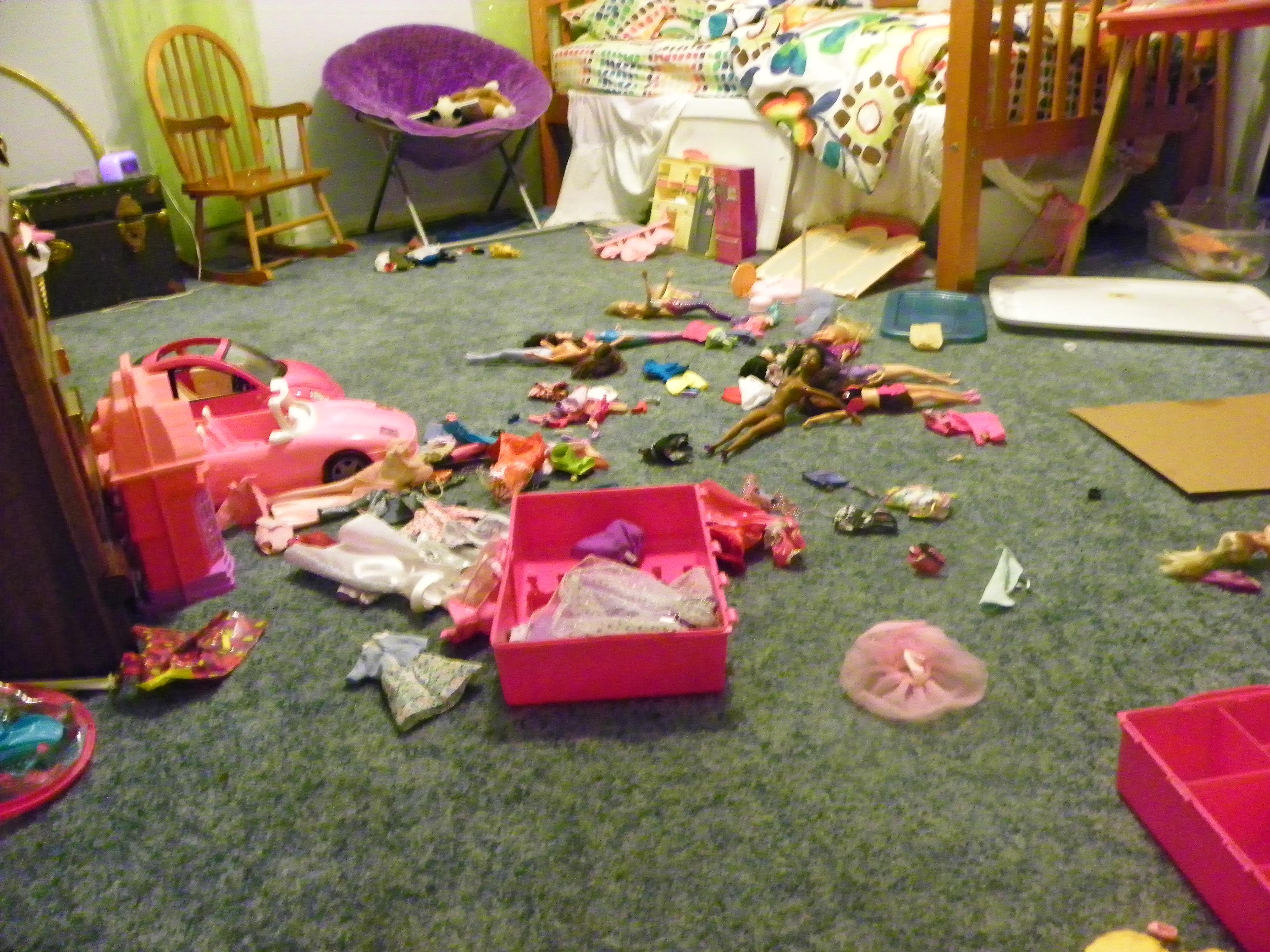
Yes, they have toys with which to keep themselves busy.

Here’s what I said at the beginning of the summer, and which I occasionally repeat as a gentle reminder of the “rules”: “I have generously paid for you to enjoy some fun things in the mornings (for five weeks). In the afternoons, and on weekends and other days you’re not in school, I have provided you plenty of options for things to do. Your rooms are now organized and reasonably stocked with art supplies, books, and toys; there are board games; we have things to do in the yard. I will go outside with you for some time most afternoons and watch you so you can swim. You have the responsibility of figuring out exactly what you’re going to do and when during all those off hours. I will not choose for you. Now, go and have fun!”

So far, the rules are working fairly well. I’m getting my paid freelance work done, I’m finally getting to the “eventually-to-do” lists (woot!!!), and everyone is mostly happy and well adjusted. I think my parenting philosophy is benefiting my kids, whether the studies bear me out or not. But they do. Ha!