Safety nets and support systems

A few weeks ago, an outspoken acquaintance was ranting about public education, among other social issues. The married man in his mid-30s (who has no children, mind you) said, “Anyone who sends their kids to public school is a neglectful parent.” Bold — but undeniably hyperbolic — words. And while I appreciated the kernels of insight (far) below them, with many frustrations of my own about public education, I had to disagree for a number of reasons, aside from the obvious point that there are plenty of us very good parents who still are sending our kids to public schools.

Then I was talking with my mom about my grandma, who’s 97 and in probably better health than I’m in, and living in a nice retirement community. She recently fell a couple of times and got an infection, so she spent a few days in the hospital and now is in transitional care and needing a bit more attention, rather than being pretty much independent. My mom has been with her there (visiting from the town she lives in about a 6-hour drive away) and has been outraged at the lack of attentive care she’s been witnessing — and this is with my mom there near her, at a highly ranked facility, and my grandma has very good insurance and financing. We’re not even talking about a not-so-great facility paid for by Medicare.

I won’t go into all my concerns about public education, about health care, about elder care. They’re each deserving of thousands and thousands of words. What strikes me, though, is that as a 40-something woman who has children at home, one daughter about to attend college, and a mother who’s retired and a grandma who’s quite old, I am in that spot of life where there are plenty of people to worry about and take care of on some level. And as much as I’d love to be the kind of person who could home-school my kids, I’m just not. Plus, I still want them to have the opportunities for learning about the world that exist outside my home. And I wish my mom and grandma could live with (or nearer to) me and I could help watch out for them.

We all need safety nets.

Here’s the thing: none of us in our society today is capable of doing it all. In fact, no one ever has been able to “do it all” as we see it in our contemporary society. We have so many opportunities for self-actualization and fulfillment (which can be “bad” or “good,” depending on to what lengths we go to achieve them) and for involvement in the world around us today. But we depend on our public-sector system to provide certain services to take care of our wide and varied needs, like education and health care. Decades ago, extended families lived either in one home or very close by, and they worked together, sharing all the duties. Communities were truly communal; everyone did something to take care of someone else, essentially. Today, extended families are often distant. My mother is 2000 miles away from me, as well as most of my siblings. It’s my job and my husband’s to take care of my children; he provides most of the money from his 40-hour-a-week job to buy what we need, and I carry out many of the functions at home (another blog post entirely, too…). I feel we’re actually blessed to be able to have that setup (I am pleased with it, let’s make a note of that, too); I have flexibility to be able to be there for my girls when they need me throughout the day and to be involved in educational and extracurricular activities. I also am able to pursue some of my own interests, which makes me feel “me” and better able to take care of my family.

“It takes a village” has now become a bit of a trope, but it’s still true. Individuals need systems around them to allow them to live and thrive. Nuclear families best provide individuals with what they need, and extended families best support nuclear families.

So what’s wrong now? I am positive much of it is the breakdown of nuclear families; we have so many single-parent families today. Extended families are just as broken in many respects; some aren’t broken, just distant because of necessity. The basic solution is twofold: do all we can as a society to support the nuclear family, helping and encouraging the formation and permanency of families, and then to make sure the public-sector services are good and dependable. Everyone, every family, needs to know that education is well funded and well run. And families who are responsible for their elder members need to know they will be supported in those vital endeavors as well.

I’m not “for” government running everything. I am “for” programs that will provide help to families, who are the backbone of our society. I am “for” making sure there are safety nets and support systems in place, not to replace the work of families, but to help them do their work better. Because if our families are struggling, our whole society is in a real pickle.

Words DO matter

For the second time this week, I’ve come across a “campaign” to ban a word. Today, it’s the “Ban Bossy” movement, asking people to stop calling young girls “bossy” when they assert themselves, so we can better encourage girls to be leaders. Earlier this week, it was the campaign to ask people to stop using “the R-word.”

I can heartily get behind not just the idea of cutting the overuse and/or misuse of these words, but with the overall goals of the campaigns themselves. As a woman and the mother of four daughters, I am happy to support encouraging girls in their desires to make a difference in whatever community they’re in, whether it’s a classroom, a school, or a group of some kind. And as the mother of a delightful daughter with Down syndrome, I HEARTILY support the request for people to pledge to stop using the word “retarded.” I have never heard someone use it as a neutral descriptor of someone’s development, which is what it was intended to do: it simply means being slower or stopped in intellectual or emotional development or academic progress. What people always use it to mean is “stupid” or “beneath” or “outrageous.” It’s used as an epithet, as a put-down, a derogatory descriptor. I flinch whenever I hear someone use it in casual conversation.

Some may say that language is constantly evolving and that some of these movements are just about semantics. But words have meaning, whether that meaning is different today than it was one year ago or 50 years ago. They pack a punch. I absolutely adore words. I love their power to express thought and feeling, to communicate what sometimes is difficult to translate from abstract notions in one’s head and heart. Their accurate and precise use can feel like a miracle.

The problem is this: many people do not know their own language sufficiently well to be able to articulate correctly what they want to get across. They get by on a pocketful of vocabulary words when a stuffed backpack would do the job much more effectively. They do not understand that their careless use of that limited pocketful can end up coloring a picture in someone else’s mind that does not match at all the picture that originated in their own. That breakdown in transmission of understanding can create hurt feelings at the very least; it can change actions (not in the intended way); it can change attitudes (not for the better).

Since our language currently has evolved to use the word “retarded” to mean the colloquial “lame!” or “stupid” or “ridiculous,” the cat’s out of the bag now and we can’t force it back in, for the word to go back to meaning just its “neutral,” “unloaded” version. It is now a loaded word and will cause people to cringe. It will continue to insult those who have disabilities and those who care about them. So, yes, it’s time to take that loaded word out of our pocket or backpack and just toss it in the trash.

When it comes to empowering girls, who are growing into future women leaders, capable of contributing a great deal to society, we can stop belittling them with words like “bossy.” We can talk to them using words that express our confidence in their abilities, that don’t compare them negatively with boys, that don’t show some underlying expectation that they are lesser. We can value them as females and acknowledge that there are differences between the sexes but not fall back on easy gender stereotypes. “Bossy” may very well be already a loaded word with too many associations attached that we can no longer un-attach. At the very least, we need to be much more careful of how we employ it and in what situation.

Yes, words matter. They’re the building blocks of how we share our opinions, our feelings, our ideas. We need to choose them wisely and assemble them effectively.

I will not admonish you to ‘enjoy this stage’

I think one of the worst things to hear as a parent, at least of young children and definitely of kids still at home, is “Enjoy this stage: they’re going to grow up before you know it!” Honestly, any unsolicited advice or “pseudo-advice,” which is what I’d call this admonishment, is generally unwelcome. Adjusting to parenting is hard enough — finding your own groove, your own way of handling all the changes, all the individual factors that combine to make your parenting experience unique in some ways — that getting told how to do better, or, worse, how to “think” or “feel” better about it, is a tough pill to swallow. You pretty much just wanna smack the well-intended but not-thinking person who dared to say it, perhaps with a squishy used diaper (OK, this is my reaction when I get ridiculously tired and cranky: I tend to overlook how people really can say things in well-meaning ways). Here’s my advice to improve that advice: be encouraging, give specific tips you’ve found useful, and provide a meal or babysitting if you really wanna make ’em smile!

Here’s what I know after 18 years of being a mom and being still in the middle of raising four daughters: parenting is tough. It’s physically and mentally and emotionally draining. It takes everything that’s in you and more. It makes you double- and triple-question yourself. And each stage of raising kids has its own set of challenges that exhaust your reserves (or try to) in various ways.

But I have come to appreciate that each parent, thanks to his or her particular backgrounds and skills, may be better at, more suited to, or at least enjoy certain stages more than others. I am pretty sure I was not a natural at parenting babies and toddlers, although by the time I got to my third, I was better prepared and, thus, more interested in it and wanting to “enjoy” it, “savor” it, more (as much as is possible). But with my first, who was honestly a very needy, demanding baby and gave me not a second to myself, to gather my thoughts or even shower, without fussing for me, I was always on edge. Tired is not an adequate adjective to describe how it feels to take care of a newborn in any circumstance, anyway. (This is why I reiterate: do NOT tell the mom or dad of a newborn to “just relax and enjoy it.” Enjoyment requires a level of consciousness that is precluded by the exhaustion that fogs up the brain and life in general. One can just catch snippets of enjoyment.) I did enjoy my subsequent babies more because I knew a little better what I was doing and they weren’t as demanding, naturally; plus, I had other kids by then to help with them. But I still just couldn’t dive in and fully enjoy because, like I said, that requires a lack of haziness.

What I have come to enjoy so far are the school years, in some small part because I generally get a full night’s sleep every night. Mostly, though, I love to teach my kids and help them learn, and read with them (and since I love reading, I must admit I’d rather read a book that at least has a rudimentary PLOT, rather than a long selection of letters or numbers, I don’t care how adorably illustrated and brightly colored those letters may be). I also like having them be gone for part of the day, so I can have a little time to gather my thoughts, be myself, and get some things done without their assistance or accompaniment. Yes. I admit that. When they are then home I can really have more fun with them. I like teaching them as part of our everyday life, not as a “lesson.” I chatted with my nearly-12-year-old last night about mathematics, physics, chemistry and biology, including my interest in subatomic particles and my desire to eventually make time to stop at the (fairly close-by to me) Lawrence Livermore lab (ooh… particle acceleration!). I mean, really, who wouldn’t be excited by the tiniest, unobservable pieces of matter being slung around inside a tube for a mile to see what they’ll do?

My girls are just great fun.

I found myself grateful yesterday by the simple fact that I could run inside the library for a couple of minutes and tell the same nearly-12-year-old that, yes, since she has a good stack of books for the moment, she could stay in the locked car and (probably read while doing so) wait for me. You can’t do that with littler ones. I am grateful for this stage of parenting, with a daughter who’s about to graduate high school (but hasn’t yet) and younger ones down to a nearly-7-year-old who can all open and close the car doors, buckle and unbuckle themselves and get in and out themselves. They can walk with me in the store rather than have to be stuck in a cart (although it’s still generally preferable, because it’s faster and quieter, for me to shop at Target or the grocery store by myself). They’re all potty-trained and can give themselves baths and do all the other self-care. They can even prepare food for themselves, at various levels. Yep, I’m glad to be past the stage where I have to do every detail to keep them alive and healthy. Now it’s more fine-tuning and the heftier matter of getting them properly educated and prepared for the world. It’s daunting, but it’s a stage I mostly enjoy.

I have friends who adore when their children are out of school and can pursue all kinds of things; I have friends who are/were amazing in all the cute projects they did with their toddlers and preschoolers. I know some amazing grandparents. But I no longer feel bad about not having been more like them, for instance, when my kids were at earlier stages. I am liking where we are now, despite the raging female hormones and completely unfounded crying spells. It’s fun. They’re easier to talk to, to share things with, to joke with. No, I do not treat my kids like “equals” or “friends” in that I do not expect them to be respectful of adults and do what I ask since I’m the parent. But they are so fun and so interesting that I consider them friends now. And isn’t that the greatest thing in the world: to raise your own friends?

Here’s something radical: We disagree. We can still be friends.

Civil discourse. Sometimes it seems like an impossibility, a utopia, a thing of the past. In the age of instant publication of everyone’s thoughts to a potentially huge audience, and with no way of taking back a rash, thoughtless statement once it’s escaped one’s texting or posting fingers, it feels as if cyberspace (and, thence, real space) is clogged with outrage, name-calling, and sometimes straight-up mean-spiritedness, all because we are drawing battle lines over a variety of hot topics. New blog posts that go viral, legislation, personal experiences all get hashed out in great detail as toes and fingers dig into the lines in the cybersand.

Friendship and lines in the sand: do they mix?

Again, though I don’t write about the really controversial topics on this blog or go into detail about my opinions on some of them, it may be fairly simple to figure out where I stand on certain things. I am religious and conservative. As I said in my previous post, about body image and “feminism,” sometimes people’s conclusions about what I think might be different from what I actually believe, but in general, they’re probably going to be mostly right. But the reasoning and the emotion and compassion and time I’ve taken to draw my conclusions are almost NEVER going to be as cut-and-dried and automatic as some might assume, which is a point I’d really like to make clear.

The past years, for instance, have brought same-sex marriage to center stage in the national consciousness and in legislation. And it’s been interesting to have discussions with friends (and acquaintances and their acquaintances) about the various issues that tie into that hot topic. Various states are still in the process of approving or banning it (or having their voters’ decisions overturned); attorneys general are weighing in; states are introducing legislation that deals with related issues to gay marriage (Arizona’s current potential law trying to safeguard business owners who would like to exercise religious opinions on it is a biggie this week). As all these legalities make their way through the various systems to some kind of eventual, kind-of-final resolution, many still have mighty strong opinions about all the ins and outs.

Again, I won’t talk about all my opinions on this topic. There are some truly good sites out there that do better than I could for all the sides. What’s interesting to me, however, is HOW we present these ideas. And in many ways, it is NOT a pretty picture. It’s ugly out there, folks. Discourse is so far from civil it’s not even on the spectrum sometimes (is it DATcourse? ha ha).

But when I’ve talked about this topic, for example, with friends I adore and respect and think the world of in cyberspace, mostly Facebook, I’ve found that though the discussion can still get a touch heated, it’s still pretty respectful. And so far I’m talking about people who are all of my same religious persuasion and similar backgrounds, I’d roundly say. And we still have very different and strong opinions about all the issues-within-the-issue. Here’s what I love, though: that it stays respectful and devoid of name-calling or (mostly) generalizing. I’ve not changed my mind, and I am sure they haven’t, but we’ve had some interesting discussions and even insights and ideas that were generated. And we walk away still liking and loving each other.

I think about this when I drive sometimes: when there’s a driver who’s been doing something that’s “making me crazy” on the road, it’s once or twice been someone I ended up knowing! And when I know who it is, then my frustration just dribbles right out of me. I think twice now when someone’s really going slowly or ___(fill in the blank) because I wonder, “Could it be someone I really like?”

I wonder if it’s possible to do this more in public discourse. Could we imagine that the people we’re “talking” with in cyberspace, for example, are decent human beings, ones we might be friends with in real life? Can we treat them with the respect due to that kind of relationship? This isn’t a new idea: it’s all about not de-humanizing people. (In extreme situations, severe de-humanization — or objectification, if you will — has led to slavery and genocide.)

I’ve been taught from these discussions and hope I’ve said something that might give someone else “on the other side” a new insight or understanding. And if we were all together in person, I imagine us smiling, shaking hands, and heading out for a nice dinner together, laughing, joking, and just enjoying time together as friends. Now THAT’s pretty radical.

Issue of body image is not a trivial one

So I’ve noted a few occasions recently in which I’ve just felt I had to explain why I feel strongly about the topic of body image (particularly as it pertains to women). Those occasions have been offhand comments or posts or cartoons or what-have-you that indicate that the desire to change how our society perceives women (as objects or bodies) is trivial or silly or not as important as other issues that could garner support or activism, etc. (such as some of the ignorant comments I saw about the Representation Project’s “NotBuyingIt” campaign and hashtags that call out sexism and demeaning portrayals of women in the media, most recently during the Super Bowl, and don’t get me started on Sports Illustrated teaming with Barbie this year!).

I’m not saying there aren’t SERIOUS, very troubling things happening all around the world (wars, disease, repression, abuse, sex trafficking, crimes specifically against women and particular ethnic or religious groups) and that we in the United States and other less-troubled places can’t mobilize to do something to help. But even as we may realize that our problems in the West are “first-world” troubles, it doesn’t mean they are trivial or not worthy of attention and activism.

I’ve never considered myself “a feminist” (a word that over the years has certainly accrued a lot of not-necessarily-positive connotations and associations), nor am I a “liberal.” I tend to be mostly conservative politically. I care deeply about social justice and helping to improve people’s lives but I have more conservative views as to how those things should be accomplished (because my experience has shown certain methods to be more useful and successful than others). I am a stay-at-home mom who does some freelance work from home and haven’t worked outside the home full-time since the early years of my now 20-year-plus-long marriage. Those facts, along with my religious beliefs, might indicate to outsiders that I am not big into “women’s issues.” Those outsiders, though, if coming to that conclusion, would be wrong.

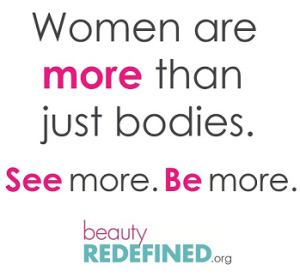
Beauty Redefined is a great resource for learning more and fighting back.

I care very much about my fellow women and how we get to function as real people in society. (I care about men being allowed to be fully functioning members of society as well, but historically in our culture, they’ve been given these rights for centuries, so they’re mostly “all set.”) The fact of the matter is that our Western, 21st-century culture diminishes the wholeness of women every single day, everywhere we turn. Media from every angle throw back very limited, definitely-not-varied, two-dimensional views of the ideal female, reducing 50% of the population to mere objects. These images and opinions are so deeply embedded in our psyches that we essentially have all tacitly agreed that they are truths. These beliefs lead men to treat women they know on some level and in some degree as less-thans, expecting their wives/girlfriends/daughters/sisters to be shaped and sized a certain way at the very least, and they lead women to act as if they are 75% (or more) what they look like and 25% a collection of their personality traits and actions.

These false beliefs have been and are continuing to be so thoroughly perpetuated that though we may pay lip service to the notion that they are false, we act as if they are true. Extreme examples are the continuing massive growth in cosmetic surgeries, particularly among “normal,” “average,” everyday women (not celebrities, not the rich, not people you might consider to be particularly vain). In the interviews I conducted with women in Utah who are moms and generally have a strong foundation of faith and have always been taught they are daughters of God worthy of love and respect for who they innately are, I was amazed how many felt bad enough about their “outsides” to undergo surgery, which is always risky, costs a pretty penny, and is just unnecessary. While I understood the feelings that led them to make the decisions they did (for getting breast augmentations or full “mommy makeovers,” for instance), I felt sad that our culture creates, fosters and intensifies those feelings of insecurity — all over their breast size or perkiness or the size of their waist or hips.

Yes, this may seem a minor issue: what does it matter if we care a lot about how we look? Here’s a short breakdown: it causes us as women to spend precious time and energy and brainpower on something that simply doesn’t matter very much. It takes those resources away from the things that really matter: our spouses, our children, our friends, our families, our work, our joys, our passions, our life purposes. And how many of us have time and energy to spare?

Focusing on our appearance reduces us to objects. Statues and photographs and machines are objects. They’re nice to look at and they might even get things done, but they aren’t human beings, with glorious origins and endless potential and utter uniqueness. Humans are imperfect, frustrating, very different from each other. But we’re so interesting and fascinating and have so much to offer! Is that true, can it be true, about mere objects? No way.

When we consider each other (or ourselves) objects, we treat each other (or ourselves) differently. We don’t expect the best, we don’t reach towards our limitless potential, we don’t care for each other as precious souls who deserve respect and love and fair and equal treatment. Men in our society, who are swimming in this media ocean of images and objects, are prone to some level of treating women as less-than themselves, because men aren’t reduced to objects nearly as often or as prevalently as women. Pornography is one more extreme example of how women are reduced to being objects, even parodies of womanhood, and it skews men’s attitudes and actions toward the women in their lives even further.

I can’t possibly explore all the angles here. There are tons of scientific studies, books, etc. that speak with authority on this subject. Suffice it to say, this is not a silly or trivial topic. It’s one that must be shared and discussed and changed. How women view themselves and how they are treated (as whole, real, full and complex individuals with unique gifts and talents and attributes) is at stake. I wouldn’t call that minor. It’s a huge battle to fight because the messages that pick women apart and reduce us to body parts, that make us less valuable than men, are constant, ubiquitous, and insidious. They’re so prevalent as for us not to even notice them anymore. If you pass the same billboard featuring a bikini-clad woman biting into a huge, juicy hamburger every single day, you’ll begin to tune it out and not even realize the damage it’s doing. But that message is still burrowing its way deep into your every cell.

I would love to make things better in so many ways, in so many places, for so many people. Right now, what I can do is write and speak up. I can say, “Hey, look at that billboard. Isn’t that insulting? Maybe we can even get it taken down. Maybe we can get the advertiser to stop objectifying women.” I can’t change the world. But maybe I can change your mind and remind you that you are far more than just what you look like.

Wanted: more ‘light’ media

So the FOX-TV show with Kevin Bacon, “The Following,” came back a few weeks ago. My Sunday newspaper at the time declared: “Darker days: ‘The Following’ returns.” My immediate thought: Urgh. Is the article saying the show’s going to get even darker? Because that hardly seems necessary (or possible?). It doesn’t look too positive in all the promos.

No, I haven’t watched the show. I am not commenting on its merits because it’s impossible for me to do so. I just am not interested in watching it, given what I can glean about it in the dark and very creepy promos I see while watching other FOX shows.

And yes, I admit, I’m a mostly optimistic, pleasant person. I naturally gravitate toward the sunny and smiley. I LIKE happy endings. I like romantic comedies and chick flicks (although those are not exactly reality; they’re just fun and escapist). And while I don’t expect or want all my media to be shot through a rose-colored lens, I like to see real, imperfect, flawed characters in books and TV shows and movies learn and improve and become better people. I like to see real people I know find happiness and growth.

So given that information about me, it’s natural, I suppose, that I would not be heartily in favor of more dark, scary shows about evil people. Does that mean I should call for fewer of them? Should the viewers who have less sunny dispositions be limited in the dark media they enjoy? Not necessarily.

But I do question why so many shows focus on the dark and evil parts of society and human nature. I think it’s vital that we recognize there are some bad people out there and to be aware and safeguard ourselves. We can’t bury our heads in the sand, stay naive, trust everyone. But is it necessary to spend hours of our time essentially in the company of these kinds of people? Why would we want to wallow in that atmosphere?

light TVI like a great mystery. I like twists and turns and surprises. That’s why I like gothic tales. But I don’t like darkness. I don’t want to spend too much time in it. I want to seek out the light.

So why can’t we have more media that portrays the light? I recently discovered a short-lived (of course) TV show from 2008-2009 called “Eli Stone” that was absolutely delightful. The characters aren’t perfect; they’re learning and do stupid things. But the tone of the show is positive, the characters generally seeking to do better, to be better. What’s even cooler is the show’s exploration of faith. It’s about a man who, in connection with a brain aneurysm, has visions that give him indications about the future and he then seeks out what he can do to make it better, to help other people. He (very) reluctantly sees himself as a kind of “prophet.” The show isn’t necessarily about God or any particular religion or faith system, but it does discuss the challenges of history’s prophets. And every episode considers how difficult it can be to just embrace faith and follow the promptings God sends, without being preachy or religious or cheesy. It’s thoughtful and real and honest. I come away from my viewings feeling hopeful and uplifted.

No, I don’t like the dark. It’s all too real and we’re constantly surrounded by it, in reality and in the media. Why can’t we support more that’s light?

Celebrate love on Valentine’s Day and every day

So it’s that time of year that happy couples generally enjoy and singles either ignore or protest. Me, I’ve been married to a pretty great man for more than 20 years, and I’m a celebratory type of person, so I embrace it.

I found myself a bit sad the other day to read a Dear Abby letter in our newspaper from a young woman who’s been with her serious boyfriend for more than 2 years and who is disappointed that he refuses to celebrate the day with her. He says that it’s a trumped-up holiday that exists solely for businesses to make money. And get this, Abby actually told her to leave him alone. She said it’s true about the origins of the holiday, and if she were being pressured to give a present, she’d feel annoyed too. What?!

Here’s my take: pretty much every holiday has become commercialized. Christmas? Hello? It’s a religious holiday that celebrates the birth of the Savior, and its date is set around a pagan holiday. And it’s the biggest merchandizing season of the year. Easter is similarly a religious holiday and has been overtaken by the bunny and baskets full of candy and other gifts. So using the excuse that a holiday’s origins and/or commercialization negates its value ain’t gonna fly.

Excuses aside, here’s what I think is the real crux of the matter: if you love someone, you will do whatever you can (within reason and whatever’s healthy) to make the other person happy. If she enjoys gifts, you’ll get her gifts on special days and even other times for no occasion whatsoever. If he just loves hugs and kisses, you’ll hug and kiss him. If she likes to be told she’s beautiful and smart, you’ll tell her that. And so on. (Just read The Five Love Languages: it’s simple and absolutely true.) You won’t begrudge her what makes her happy.

In our society today, we should celebrate happy relationships and families every chance we get. I am of the conviction that society’s success rests on the backs of successful families. Marriages that endure and are happy are the backbone of those strong families. So just give in and share the love on Valentine’s Day and every other day. It doesn’t have to be expensive, fueling the economy and those “greedy businesses.” I love to celebrate every chance I get because it just makes life sweeter. Celebration at its heart is just gratitude, and every expert says that being more grateful makes us happier.

So today, Feb. 12, as I have for the past 20 years, I celebrate the anniversary of the first kiss I shared with my husband. 21 years ago, we had a date at my apartment, just eating a meat lovers’ pizza from Pizza Hut and watching “The Princess Bride.” And every year on this date, we watch that movie and usually eat pizza. (Small wonder our family quotes so much from it. See the fun we had making mashups of PB and “Star Wars” on a previous post….)

Eat your heart out this year.

If you’re in a relationship, celebrate it. Have fun. Share the love. Do something special. If you’re single, then show gratitude for the successful relationships that are in your life and help make you who you are. Don’t be a love Grinch. Let your heart grow three sizes this holiday.

Silence isn’t emptiness; it’s potential

Ever noticed how uncomfortable silence makes most people? It’s as if any unfilled space is a vacuum they must rush in to fill. People abhor it, indeed.

I’ve come to appreciate silence, those golden but seemingly interminable seconds between what most people consider the “active” moments. Because so much really does happen in those quiet spaces between.

I’ll use a church setting as an example. Sunday School teachers often ask questions, because they’re told that’s part of being a good teacher. Typically, however, they’ll make one of two mistakes: they’ll ask a yes/no question or one with only one short “right answer” that’s so obvious and “easy” that everyone feels silly answering it, or they’ll ask a really great thought-provoking question and then shut down any potential for discussion if no one raises their hand within about three seconds. The best teachers, however, are comfortable with waiting and letting their listeners’ minds work, even as silence descends on the group. If given a moment, participants can really create an invigorating or inspiring (or both) discussion.

Think about time you’ve shared with someone you’re either trying to get to know better or with someone you do know well but with whom you’d like to have a kind of serious or challenging talk. When you ask a question, do you sit patiently and quietly, showing with your facial and body language that you support them and respect them enough to give them some time to think and respond in a way that they’ll feel comfortable with? Or do you rush to reframe or redirect or say, “Oh, never mind” or “Don’t worry about it”?

My oldest daughter and I have talked about how many people tend to talk to us and share things with us. I think it’s because we’re active listeners. We’re comfortable with quiet and that space that is silent but most definitely not empty. We’re interested in what others have to say and don’t always have to respond to give our two cents’ worth. And maybe it’s nice to know that people feel comfortable confiding in us, trusting us with their “secrets.”

I’ve also realized that keeping my mouth shut for an extra minute or two when I might be inclined to respond quickly with an easy answer or snap judgment can yield some surprising results and make me glad I didn’t say anything. Just yesterday, my little 6-year-old, who can easily cause some frustration and annoyance in her older siblings (and parents), said to me, “So, there’s this new girl in my class, and she’s really annoying!” I admit I immediately thought, “Oh, really!? Pot, meet kettle.” But I held my tongue. Then she went on to say, “Yeah, she goes around choking people.” What? (Still not sure what exactly “choking” entails, and we’ve made sure to impress on her that if anyone at school is trying to hurt her, etc., to immediately tell a teacher; my point here is that “annoying” in her mind wasn’t quite the meaning I usually attach to it.) If I had responded what I’d been thinking rather than just continuing to listen, she might not have shared that last vital bit of information that allowed us as parents to teach her something important.

Keeping silent has value and can allow us to learn much we wouldn’t know otherwise. Unfortunately, it’s a skill that we don’t emphasize nearly enough in our culture of nonstop information. Turning off the TV, the computer, the smartphone, and other devices has power; turning off our tongues does as well.

I’m no book critic

It’s no secret I adore reading. I’ve been a book reviewer for a solid 15 years, for newspapers and, more recently, a book-review publication that has done print and e-versions. For a long time, I kept up a membership in the National Book Critics Circle. A few years ago, I just stopped sending in yearly membership checks; I intended to get around to it but never did. Oh well. But in all honesty, I don’t see myself as a critic. I’m just a reviewer.

Here’s the thing: I don’t read a ton of literary fiction. For those of you who aren’t really aware of the distinction among different genres, there’s “literary fiction” and there’s “popular fiction,” among other things. To put it simply, the literary version of fiction is highbrow. It’s what you’d read and dissect in an English 353 college class. It has Meaning. Popular fiction is fun and far more accessible.

Now, literary fiction can be fun, and pop fiction can have plenty of discuss-able elements. But I’m just keeping it simple here. And honestly, I often do not get the literary stuff. I’ll say it straight-up. I consider myself an intelligent person, one who enjoys dissecting and discussing. But when a book I’m reading requires heavy concentration and a professor to help me figure out what it’s supposed to be About, then I’m inclined to chuck it.

So while I do skim through the New York Times Book Review, I don’t read a lot of the books featured in its lofty pages. I don’t typically read many Nobel winners, either. Pulitzers, sometimes. What I do end up reading are the Newbery and Caldecott winners, though. I find those wonderful library awards to be right up my alley. The books honored are targeted at young readers, and they can be absolutely charming, insightful, and even Meaningful. But they’re still absolutely accessible. So I sit up and pay attention when those are announced, as they were today.

Nah, I’m not a snobby reader. I guess I’m just a middle-of-the-road reviewer. Yes, I have standards: if you’ve read my other book posts, you’ll know I do not like certain churn-’em-out writers, and I am still mostly wary of self-pubs. I like to feast my eyes and mind on books that give me something to consider, to ponder, to chew on. I like to be transported. I love to sink my mental teeth into some delicious metaphors and beautifully arranged words that describe a feeling or an experience to a T. I can be pretty picky. But I am not a Literature reader or critic.

I think, though, that’s a good thing, because most other readers aren’t, either. (Literature fans will likely bemoan the sorry state of the reading populace, but bah humbug on them.) What I can do as a mostly middle-of-the-road reader and reviewer who has standards is present some wonderful reading options (and with content ratings on my Rated Reads site, as an added bonus) that will satisfy most other middle-of-the-road readers with similar standards. As with anything, it’s always handy to find like-minded people when you’re looking for a recommendation, whether it’s for books, movies, TV or restaurants. I’m happy to offer up my mind to those who like it. Here’s to us non-critics.

Partnering with and struggling against at the same time

The Gilbert Arizona Temple, photo courtesy of lds.org

I just came across this brief article about a Jewish rabbi visiting a newly built temple of my faith, The Church of Jesus Christ of Latter-day Saints: “What I learned from visiting the new Mormon temple.” I am always interested to hear what others think about visiting our sacred sites, and I enjoy discussion and interaction with other people of faith, regardless of their doctrines or denominations. I heartily agree that we can all learn from each other, which is hardly a revelation, but a simple but important reminder. What struck me tonight was this sentence from his article: “My Jewish beliefs are strongly built on the Jewish idea of covenant (humans as partners with God) and Israel (humans wrestling with God).”

This really encapsulates what I’ve been experiencing myself, today alone, and the past weeks. I’ve been going back and forth, sometimes within minutes or hours, between the partnering with God and the wrestling with God. I have moments of clarity, of Spirit, of confidence that I can keep moving forward, of just-enough-hope, and then moments of frustration, anger, sadness, fear, and not-enough-hope. I’m seesawing.

I am all too aware of my firm belief that we lived as spirit beings with God before coming to this life. We knew we were coming here, and it was part of a plan for us to grow from spiritual toddlers to at least spiritual adolescents (that last bit is my little twist). I believe that I accepted and understood, at least in some measure, that life would be challenging, most of the time. But for some reason, right now, with whatever mixture of things that are working on me (a series of particularly challenging events, my particular chemical balances or imbalances, my background, my expectations, my hopes for my own future and those of my children …), I’m finding it difficult to feel consistently optimistic about my ability to just keep up, to keep pushing forward, “enduring to the end,” as scripture puts it. I’m wondering just how much faith I had in myself back in that time I can’t remember right now, when I was eager to come to this life, even knowing some degree of how difficult it would be. The question always is: how much did I really know then? How could I really know without having experienced it yet?

I’m really digging down deep to try to change some ingrained mental habits, and they’re fighting back hard. I know that my faith is both getting me through/should be getting me through. I’m trying to figure out how to truly rely on God at a level I most surely have not yet attained. I am all too aware that I’m trying to do too much on my own without being yoked with the Savior. But getting from point A, where I am, to point B, where I know I could/should be, is a bit of a mystery to me at this very moment.

My spirit soars when I experience those moments of covenant, of successfully partnering with God to do something good, to serve and uplift someone else, to create, to make something or someone better. But I’m still struggling mightily. I’m coming to appreciate more fully the concept of wrestling.

So this evening, I thank this good rabbi for his simple words. He probably had no idea what sharing a brief blurb about his beliefs would do for my thinking. I’m still going to be wrestling for a while, but it’s a mitzvah to have new insights.