Envying the sinners and oppressors

I was reading some scriptural passages over the weekend that really stood out to me relating to beauty and self-image. They all spoke about envy and how dangerous it is. In my church’s canon is a wonderful chapter that allows us to ask ourselves questions about how prepared we are to meet God. One poses this question: Are you “stripped of envy”? (Alma 5:29)

So I began searching for other scriptural references to envy, as it relates to individuals. At one point, a prophet told his people, “And I know that ye do walk in the pride of your hearts; and there are none save a few only who do not lift themselves up in the pride of their hearts, unto the wearing of very fine apparel, unto envying, and strifes, and malice, and persecutions, and all manner of iniquities.” (Mormon 8:36)

In Galatians 5:26, we are admonished: “Let us not be desirous of vain glory, provoking one another, envying one another.” And in 1 Peter 2:1, that prophet tells us: “Wherefore laying aside all malice, and all guile, and hypocrisies, and envies, and all evil speakings.”

What struck me particularly were these references in Proverbs about who in particular we don’t want to envy: sinners and oppressors. Proverbs 3:31 exhorts: “Envy thou not the oppressor, and choose none of his ways.” Proverbs 23:17 similarly says:  “Let not thine heart envy sinners: but be thou in the fear of the Lord all the day long.”

Today, we might not be oppressed by government or worldly leadership; we’re not in bondage to other people. But we can easily be oppressed by the images and messages that are constantly bombarding us. If we allow them, those who are behind these messages can oppress us in mind and in spirit. Advertisers do all they can to make us feel bad about ourselves, mainly how we look. Cosmetics companies want us to feel bad about our skin’s youthfulness, shine and clearness; clothing manufacturers want us to feel bad about how our clothes fit, how stylish they are, what fine materials they aren’t made out of. Everyone out there wants us to feel fat and ugly in some way so we will buy their products to make ourselves look better somehow, in some way. And it’s SO easy to accept and internalize those messages and to just feel bad about ourselves. And that leads us to envy. We’re envying those who oppress us. When you think about it, isn’t that crazy? Shouldn’t we be rejecting those messages and just laughing at the absurdity of it all?

At the same time, we’re also envying those in society who are sinners. So many celebrities are held up as the icons of beauty and style. But they’re also making headlines as people who are driving drunk, committing adultery, and just plain being immodest and immoral in lots of ways. I don’t think I need to give a whole lot of details to support this statement. Just pick up a magazine or glance at celebrity news on Yahoo. The next time you wish your waistline could look like that of one of the ridiculously talentless but still ubiquitous Kardashian sisters (which is easy to do while standing in a supermarket checkout line), take a second to think about them as people and what they stand for.

Peter goes on in chapter 2 to tell us who we really are: “But ye are a chosen generation, a royal priesthood, an holy nation, a peculiar people; that ye should shew forth the praises of him who hath called you out of darkness into his marvellous light. … Dearly beloved, I beseech you …, abstain from fleshly lusts, which war against the soul.”

No, we shouldn’t be like everyone else; we shouldn’t be envying our oppressors and the sinners in our society. Those of us who are faithful believers in God are a “peculiar” people, which means we’re set apart from others. We’re God’s special people, and He loves us. He doesn’t want us to envy and try to emulate those in our society who only want to hurt us and make us feel bad about ourselves. Envy starts with comparing ourselves with others, and then finding ourselves wanting, in both ways. I think the first step in stopping this cycle is not comparing. As soon as you find yourself seeing a picture (inevitably it’s some kind of image), just stop and think about where your thought processes are going. And don’t go there. Don’t compare. Don’t envy. You’ll find yourself much happier.

Motherhood: from pack animal to beauty queen and everything in between

As I hit 42 yesterday and pretty much suffered the “epicenter” of a nervous breakdown that’s been brewing for a few weeks, I had a few epiphanies. One was this: I can totally understand why a woman my age would want cosmetic surgery.

Why? At this age, I’ve given birth to four kids and don’t expect to give birth any more. What’s done is done, baby-wise. Now I’m into a different stage of mothering, one I didn’t expect to make me as crazy as the stage of early childhood (and I really thought that was tough): having kids of varying ages, able to fend for themselves in survival-type ways, but dependent on me in completely different ways, ones that are actually somehow more important to who they are and who they will be. They need guidance, not just food and clean bottoms. My girls range from ages 16 down to 5, and each has specific needs related to her age and unique personalities and interests. None are heavily involved in lots of activities, but just having a few activities all together, along with the usual things to support them in, adds up to a lot of work on my shoulders, a lot of expectations and four precious, amazing young people relying on me to help them grow and develop as good human beings.

Yep, that’s me. Anyone need to add on another bag?

So lately, what with it being “birthday month” at the Lim household, and near the end of the school year, and all the things that go along with those events, I have felt like I am merely a donkey, laden with a huge pile of heavy packs, trudging along, trying to knock off a pack or two at a time. Even as I do so, more packs keep getting laid on my back. I’m about to collapse under the strain, my hairy donkey legs splayed out to all sides at cartoonish angles, my belly and chin flat on the ground.

Every mother has these kinds of obligations, especially at this stage of parenting, and they never fully lift. But every mother is also a woman who just wants to feel pretty and special and … womanly. Sure, I’m not 21 anymore, and I don’t turn guys’ heads, and that’s OK. But I’d like to feel occasionally that I can still turn one man’s head, that I am an object of desire and fascination to him, not just the pack burro who takes care of his home and four kids. It’s really easy for life to get so unbalanced with scheduled events and obligations that each parent becomes an automaton, fulfilling those obligations but losing themselves and their “hearts” in the process.

In interviewing doctors and others, I have learned that most women who have cosmetic surgery are either at the beginning of their reproductive lives or the end. The surgical improvements are done either before childbearing and, often, before attracting a mate or after giving birth to a whole brood and closing up shop in the womb. I’ve talked mostly to women who are in the latter category. They’re mostly parents to children of varying ages and are often stay-at-home moms. I suspect that they’re feeling overwhelmed, out of balance and pretty donkey-like, much as I am feeling right now. I can imagine the siren call of surgery would be very tempting right at this point, when a mother can easily feel very undesirable physically — not necessarily even because she really does look significantly older or plumper or scarred because of giving birth, but because she just doesn’t have time to feel attractive and be a woman, rather than a mom.

Every mother needs to explore and regularly experience that side of herself that is simply a woman, with her own unique beauty and personality. If she doesn’t have time to feel feminine and admired somehow, it’s going to throw her off her game everywhere else. Unfortunately, I don’t have a whole lot of answers as to how to solve this very common problem of unbalance (if I did, I’d probably be a millionaire). I just know that somehow it’s vital to find that balance, to find some time to be pretty, to be oneself, to feel one’s husband turn and look appreciatively, even if that admiring gaze must skim right over a toddler with a smelly diaper and a high school student who needs help with homework or finding a modest prom dress. I know that husband and wife both need to find the time to be themselves, to be just a man and woman who still find each other interesting and attractive. I doubt that plastic surgery can permanently solve these issues, but it certainly would sound tempting as a temporary measure.

Me, I’m just trying to figure out how to stand back up, shoulder my load and trudge on, and balance my life a bit better so I can at least sometimes put down all my packs and revert to my womanly form for at least a little while. Fairy godmother: can you wave your wand for me, please?

Time magazine, moms and sensationalism

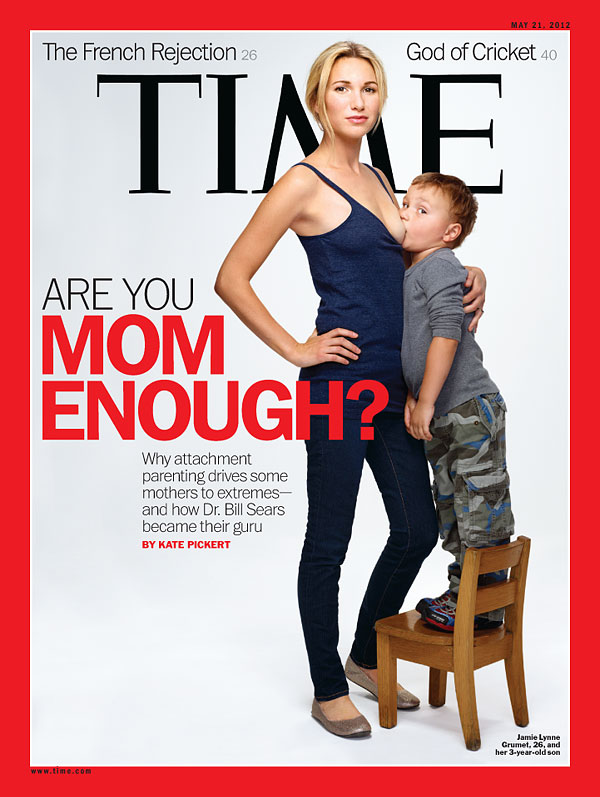
I’m beginning to think that most news outlets are forgetting their news roots. I’ve long since given up on watching any kind of TV “news” programs. Those seem to have left behind reporting news and facts, replacing journalism with who-can-shout-louder editorializing. Magazines don’t seem much better. Time magazine has just proved that with its newest sensational cover about attachment parenting, asking “Are you mom enough?”

I’m not going to dispute that reporting about the practice of attachment parenting, and some facets of it that seem “extreme” to many parents out there, is a fascinating idea. But I am not happy with the cover, and many people are not, but there are all kinds of reasons that it’s getting attention, mostly negative.

Some are finding the cover to be offensive because it is partially showing a woman’s breast; many find it repulsive because it shows a young boy with his mouth on that woman’s breast. I’ve seen some people calling it “child porn.”

I’ll try to express why the cover bothers me, but first I’ll explain what doesn’t offend me about it. I don’t mind seeing a child suckling on its mother’s breast. I don’t mind seeing that in public, perhaps even in print.

I’d like to express also why it is not “child porn.” Pornography is the explicit portrayal of sexual subject matter. Child pornography is the portrayal of sexual activities involving a child. For this cover to be porn, it would require sexual activity to be occurring. A child breastfeeding is not sexual activity. More on this later.

Now. On to why the cover does bother me. Time has deliberately chosen subjects to portray that will garner attention, and the artist has posed them in a way that will grab viewers. First, I think it’s interesting the magazine chose a very thin mother who looks like she should be a lingerie model to demonstrate breastfeeding in the preschooler years. Even though this is a real mother and child who are still nursing, the mother has been chosen to reflect a sexualized image of a model. Second, the way the photo is posed isn’t what I would guess is the usual way this mother and child (or others) would take some time to nurse. Having the mom standing up, posed like a model in an advertisement, with her son standing on a stool is pretty unusual. Most likely, this mother takes a few minutes at the end of the day to sit or lie down to snuggle with her son to allow him to nurse, and it’s part of some quiet, private, mother-child personal bonding time. And neither would be looking away from each other, especially not at a camera.

What bothers me in addition to how Time has chosen to represent this topic is the reaction that it is guaranteed to cause, a negative one about breastfeeding. Even though the topic is about an “extreme” version of parenting that many of us don’t choose, this photo is essentially painting nursing with the same wide brush, and it’s going to be a setback in the still-needed push forward to make nursing more understood and more accepted in public society. That bugs me.

Having given birth to three children and nursed them all for periods of about 10 months up to about 13, I think, I know what it’s like to be a nursing mom. It’s a challenge because you’re ALWAYS on call, always needed, and this particular duty cannot be handed off to the dad or anyone else who could help. (Let’s leave out the topic of breast pumps right now and keep this simple.) I know the difference, too, because I adopted our last daughter, so we fed her formula, and man, was it nice to be able to let everyone in the family take turns feeding her. I was so free, compared to when I was tethered to the previous three by my milk supply! Add in issues that may come up with nursing — sore breasts, sore nipples, infections, what-have-you — and it’s tough work, on top of all the other things that are hard about mothering a baby or toddler.

At the same time, breastfeeding is pretty cool. I wasn’t the “natural mom” type who always gushed about how great it was to nurse, sometimes just complaining about that constant on-call thing, but I did appreciate the benefits. It was the neatest thing to know that my body was producing exactly what my babies needed, just at the right times. I was happy to make the sacrifice to nurse because I knew it was the absolute healthiest thing I could do for them. And snuggling up with them and having it just be their little soft mouths on my breast was a gift. It was just the two of us, skin to skin, and I treasured (some of) that time. (Sometimes/most of the time I just got it over with because it was feeding time and I had to move on to something else. No, I don’t treasure every single moment of life, parenting or anything.) When I gave birth to my last daughter, I knew that would be the last time I’d breastfeed, and having her latch on that first time in the hospital almost brought tears to my eyes because I knew that it was special, and not too long in the future would be the last time I ever nursed a baby.

I also know just how tough it is to nurse a baby when you’re not at home. I was raised to be modest, and still teach my own children to be modest and not show too much skin, so the idea of the possibility of any of my breast showing even for a split second in public was one that was completely opposite to that notion that was so ingrained in me. Plus, I’d never seen almost anyone out and about just nursing a baby, so doing that myself while out shopping or eating at a restaurant or running any of the myriad of errands most people do in the course of everyday life felt strange. I felt like everyone would be staring at me, no matter how discreet I was. Even in my church, where we have more children than average per woman, and where many of us breastfeed, there’s one small room set aside for nursing and taking care of babies, and I’d never seen anyone nurse a baby outside of that room, even when we were in a meeting that was just women. Thinking about it now, I still think it strange. Why in the world do young mothers surrounded by other women of various ages, most of whom probably did nurse, feel the need to leave a room full of other women to isolate themselves in a tiny room in a corner and miss out on uplifting messages? Modesty? Self-consciousness?

Nope, our society is not at ease with the idea of women nursing their babies where anyone can see. Ask any of us women who have had to try to nurse a baby in a bathroom stall (can you say ick? Would you want to eat your lunch in the bathroom?) because there was nowhere else private to do so if we’d like to see more acceptance of breastfeeding in public, and we’ll respond with a very loud and hearty YES!

I find this all so ironic because our society is so highly sexualized. Women of all ages, teen girls, and even 9-year-olds wear revealing clothing without almost anyone batting an eye anymore. Scanty tank tops are certainly normal, and sleeveless dresses are the standard for any fancy occasion. (Try finding a dress for a nice occasion with sleeves that doesn’t look like a grandma dress. Good luck to ya.) Not only celebrities sport revealing clothes: everyday people wear plunging necklines and show a lot of cleavage and breast skin. Yet women who are feeding their babies the way nature intended, with the healthiest possible food made JUST FOR THEM, are stared at and marginalized if they accidentally show any skin for a split second, or (heaven forbid) show part of their breast at all while nursing (I always preferred to be completely covered, and there are some really handy nursing cover-ups, but what’s wrong with letting a little of the top of a breast show while the baby’s head is covering most of it?).

Breasts have become, in our society, simply an object of sexualization. Women have breasts so they can feed their babies, and, yes, they are alluring and exciting for men. That’s natural as well, and part of the whole important biological process that brings new people into the world and feeds them in the early stages of life. Breasts are really useful for feeding, but they’re also fun for men and women as they come together to feel close to one another and to reproduce. But we have lost sight of the fact of their usefulness, seeing them ONLY as sexual objects. So if we see women with a baby attached to them, because of this cultural pattern today, we think “eww” because we think of them exclusively in sexual contexts.

So Time has not done nursing mothers any favors with this magazine cover. Nope, with the choices it made that I already mentioned, it has shocked viewers and made them feel revulsion. What we need as a society is to do better to educate everyone, male and female, about nursing and the great usefulness of breasts, to encourage women to use them as they need to with their babies wherever they are, and however they feel comfortable nursing. Our society has everything backward, upside-down and inside-out. Let’s help encourage women to be more modest and show less skin on an everyday basis, saving sexual behavior for the privacy of the bedroom. But let’s also encourage women to feel free to use their breasts to feed their babies, even in public, and not force them to stay at home or run for cover (especially not to a bathroom!). Parents can teach their sons and daughters about nursing and how the body works in so many amazing ways, and women who are nursing can show their other children and friends how it’s done. It’s just going to take lots of women being comfortable enough in public to feed their babies so everyone can get more comfortable to the sight of nursing moms and babies.

Time, you let us all down and did a great disservice. Stop sensationalizing and show us how things are really done.

The Most Interesting Woman in the World

I’m not a beer drinker, nor do I hope in any way to promote drinking. But when I watch commercials, I have to admit I do get a kick out of beer ads.

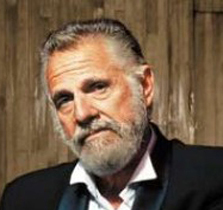
I’ve been thinking about Dos Equis’ popular character, The Most Interesting Man in the World. The ad agency’s idea was that this man would be “rich in stories and experiences:” so says Wikipedia. But I’d like to elaborate and list a set of characteristics of this fascinating male specimen.

  • “Man’s man”: the epitome of masculinity
  • Ruggedly handsome
  • Experienced, well-educated, well-traveled
  • Sophisticated
  • Suave
  • Ladies’ man (implied he could have or has had as many women in his bed as he’d like)
  • Sexually desirable
  • Discerning, tasteful
  • Well-dressed, sense of style
  • Strong, well-built
  • Everything he says is compelling, so people hang on his every word
  • Accomplished — at everything
  • Sought-after — by everyone
  • Mature, even “old” (the actor is 73): gray-haired, wrinkled, bags under his eyes

Now. Let’s look at these set of qualities as applied to a “most interesting woman.”

  • Beautiful
  • Experienced, well-educated, well-traveled
  • Sophisticated
  • Feminine, ladylike
  • Sexually desirable
  • Great taste in everything, whether it be home furnishings, cars or houses, jewelry, clothing, etc.
  • Impeccable sense of style
  • Lean, takes care of her body by going to the gym every day or, better yet, working out in her home gym with her exclusive personal trainer (yoga, Pilates, Zumba, etc.)
  • Compelling person to listen to
  • Accomplished
  • Sought-after
  • Mature, even “old”: a 70-year-old woman with gray hair, wrinkles, and bags under her eyes
  • Sexually experienced, bedding hundreds of men over the years

And here is where I have a hard time finding a photograph that would work, that any advertising agency would grasp onto as a winner, as a surefire way to get positive attention and loyal followers. The sticking point is age. Yes, there are a few women still busy as actors, but most of them are being cast as someone’s grandma or as a hilarious old lady who shoots off one-liners but is still endearing and mostly happy to hand out hugs. My husband told me, “Betty White, of course.” Yep, that amazing woman is still getting lots of work and making millions laugh. But she is not held out as a universal sex symbol, even though she does like to make naughty jokes. Can you really see Ms. White being used in an equivalent Dos Equis commercial (NOT for laughs; think the Snickers commercials)?

Here is where it really hits me just how much of a double standard there is in our culture regarding age. For men, age is desirable because it makes them wiser, more experienced, more fascinating, even mysterious. Some gray hair and wrinkles make men appear “distinguished,” not “old.” Men who look distinguished and have experience are sexually desirable, and even young women will hang all over them. (Are there any 50-year-old or 70-year-old women surrounding the Dos Equis man? Noooo. Those females are all in their 20s.)

Women, however, are not allowed, let alone encouraged, to grow old naturally. There are plenty of women in Hollywood who are being praised for “aging well,” which generally means they are touted for looking 30 when they are biologically 50. They modestly proclaim that their regimes of a vegan diet, drinking lots of water, avoiding the sun, never missing Pilates, and faithfully moisturizing have kept their faces and figures looking youthful. The women who look 50 when they’re 50 end up either being pushed out of the profession or playing someone’s grandma because looking your age is NOT “aging well;” it’s embarrassing and shameful. And 70? That’s a small club of actresses indeed. They never get to be surrounded by young, hot men hanging on their every word, hoping they’ll bed them (maybe for comedic purposes, but not in any seriousness.)

I’d like to propose that we women fight back. Let’s make ourselves the Most Interesting Women. I’ll use myself for an example, but I’d encourage each of you female readers to put a photo of yourselves somewhere with a list of your best qualities (or post that list on your mirror).

  • 40-something, middle-aged, wiser than I was at 20
  • More stylish than I was at 20, I have a better sense of what I like, what reflects “me” and what looks good on me.
  • Great, authentic, winning smile. That hasn’t changed, no matter how old I am. I love to smile and I love to make other people a little happier by shining it on them.
  • Attractive, especially to my husband, who thought I looked beautiful even when I was about to give birth and looked like I’d swallowed a torpedo.
  • Well-traveled, at least throughout the United States
  • Well-educated and well-read
  • Accomplished and well-rounded
  • A very talented cook and baker, I feed everyone well, and I do it on a budget. (“We eat well aboard the Tweedledee.” Guess the movie.)
  • Musical
  • Humorous (well, in a geeky way)
  • Not as lean as I once was, but softer and more classically beautiful, I still love to exercise. It just feels good.
  • Versatile
  • Sought-after (for getting things done)
  • Desirable (and you are not getting any details here)

What do you say, ladies? Tell me how you are fascinating.

Beauty and the backlash

A few months ago, I started interviewing women who elected to have cosmetic surgery. Today KSL.com published my compilation of (a little of) what I learned from them.

I knew it would certainly get people’s attention — as well as opinions and comments. As I’ve read the comments left on the article, I’ve wanted to respond to many of them. Since I can’t really do that there, I’ll take a couple of points here.

My first response is that this article is only a little piece of the story. The previous articles I’ve researched and published are also pieces that contribute to a whole picture, which is still only slowly forming, about what might be a trend of elective surgeries happening in Utah. So as people say, “Well, what about the influence of media?”, for instance, or “What about how men see and treat women (including the huge problem of pornography)?” I say, those are  good points. I’d like to get to those  in future articles or a book or just on this blog.

My second reaction to many commenters is that this issue is more complex than it may seem at first glance. Many either say, “Why worry about what people’s personal choices are? Let them do whatever they want” or “Those women are so vain! They should accept who they are.” It’s easy to just pick one of those two opinions. But in speaking to these individuals, I found myself empathizing and just enjoying our conversations. In addressing the second widely held opinion, for example, I would say, You know, I liked these gals. We’d probably hang out or be in a book club together. We could be sitting in a gym locker room or a mothers lounge or any number of places, commiserating about how giving birth has drastically altered our bodies, how we’re dissatisfied with our soft, squishy bellies or our stretch marks. I get it. I am not happy with how I look, and honestly, I’m having a slightly difficult time coming to terms with what aging is doing to my body.

I didn’t find these women to be shallow, vain, or self-centered in the 30 or 45 minutes I spent talking to each of them. One of them specifically told me how she’s tried very carefully not to wear revealing or tight clothing or act any differently since she had her mommy makeover. She doesn’t want to change how she acts or looks or puts herself across to others. She doesn’t want to become immodest, or, heaven forbid, immoral. She just wants to feel more comfortable in her own skin (now less saggy than it was).

Having spoken with them and empathized, I don’t want them to be seen as some kind of poster children for vain women who care only about their appearance. They’re not all that different from the rest of us who have complained about how we look. The big difference, however, between them and those of us who have merely complained is that they have gone far enough to invest a sizable amount of money in a change and to take the risk of subjecting themselves to surgery, which always carries the possibility of harm. Granted, in the hands of a certified plastic surgeon and with many procedures now “routine,” the risk of death or other serious harm is fairly low, but it is definitely a risk and something one must seriously take into account. This seems particularly of concern when the patient in question is a mother of children still at home, and if she does die on the table, she’d leave them without a mother. These women did consider those issues and still chose their course.

What I’d like to come of all this is a conversation. Our culture in America today encourages women to think of themselves as objects, to look first at how much we weigh, if we jiggle in good or bad ways, if we are sexually attractive, if we still look young and as fresh as we did before giving birth. Our society worships youth, there is no doubt about that. What started as a trend in Hollywood and among the rich and famous has now become commonplace among the masses: to fix any body issues with surgery and other procedures. We are awash in images of perfection, so much so that it’s impossible not to compare ourselves with those images, unreal as they may be.

Let’s look at the factors that contribute to this trend, such as pervasive media influence, our expectations of ourselves, our comparisons with each other, and the way men are socialized to respond to women, to name a few. Let’s admit that though we may not choose to do what some of these women chose to do, that we may have thought how nice it would be to magically look better.

This doesn’t have to be a trend that continues to go the same direction. We can halt the ever-increasing percentages of people who are having cosmetic procedures done. We can change how society looks at women in particular and glorifies a perfect image, male or female, which now means thin bodies and full breasts for women and lean, muscled lines for men. Maybe we can get back to the days when full-bodied women were glorified. Even better, maybe, just maybe, we can progress far enough where there is no ONE ideal, where all kinds of looks are appreciated. Now that sounds perfect.

Divinely beautiful

I’d like to address beauty today from the standpoint of faith. I grew up in a religion that taught me that I am a daughter of God, of infinite worth, that he created me as a spirit daughter and then sent me here to this earth life, mortality, for a time to gain a body and learn faith while not in his presence. I hope to return to him someday. I am now teaching those same truths to my own four daughters, on loan to me from my Heavenly Father.

I have been struck many times by how much we as females are worth, how amazing we are, how much we can do, how strong we are. If we are truly created by God, and he loves us as children, we must be pretty wonderful and worthwhile.

But here’s the kicker: I also believe there is an adversary out there, a fallen spirit son who chose to rebel, and now this evil one is out and about trying to make us all miserable, just like he is. And he is pretty smart and very determined to bring us all down. He’s quite successful at what he does, too, sadly enough.

He knows just how amazing women are. He knows our potential, and he knows what we can do right now. He knows our power, strength, and beauty. So he is working really hard to fool us into believing that we are ugly, weak, unloved, and unimportant, that we don’t deserve all the best that God can give us. And many of us are happy to let his pernicious lies enter our ears and our thoughts and affect how we feel and how we act and live.

I think one of his tools in our society today is sending a constant message that we are not good enough unless we look good. We must have perfect bodies, perfect faces, perfect hair. We must wear the latest fashions covering (or barely covering) our perfect, thin bodies that sport flat abs and finely toned muscles and perky, full bosoms. If we have flabby arms or flat chests or a little bit of fat anywhere on our bodies, we are not good enough, not worthy of love. He whispers to us that we’re not even worthy of our own love.

In our society today, we are constantly steeped in images. Images of women who are impossibly thin, who have no flaws on their figures or skin. Images of women who wear scanty clothes that reveal every square inch of perfection. Those images shout at us from billboards, from magazine covers at the grocery store, from ads that pop up online, from movies and TV shows, from commercials. Even if we don’t watch TV or movies, we can’t avoid the onslaught.

And most of us are allowing the messages from those images to permeate our very beings, down to the very center of who we are. We are allowing those evil, twisted messages from a miserable being to convince us that we aren’t beautiful, that beauty is simply about being a size 2 and having perfect features. We are forgetting who we truly are, what our royal lineage is, and where we are bound.

In my interviews with women who have elected to have cosmetic surgeries, I have been moved by their feelings of insecurity before their surgeries. I don’t condemn them or want them to feel bad because of the message I hope to convey through this blog. I understand. I can’t look in the mirror without feeling, EVERY SINGLE TIME, that my body is ugly and fat, that it’s unacceptable. I used to be thin, and now I feel I’ve failed. I’m weak, I’m a disappointment. I do understand.

But I want to fight back. My purpose in writing this is to try to remind my fellow daughters of God who we are, and what our real worth is. It’s not about how we look. It’s about who we ARE, who we have always been, and who we are meant to be. We’re far from perfect, in looks or behavior or anything, right now. But we’re works in progress, and that’s OK. It’s more than OK. It’s exciting. We have so much ahead of us, and we’re on the path toward greatness.

We can spend a few hours a week at church, being reminded of who we truly are; we can spend half an hour a day praying and reading scripture. Those things are helpful, indeed, and crucial. But when during the rest of our days and weeks we are bombarded with messages telling us we’re not good enough, that we’re ugly and fat, and that our worth is tied up in our looks, then we must fight back. We must remind each other how important we are, how loved we are. We must take a stand against all those negative messages that are completely opposite of what the truth is: that we are truly of divine, infinite worth. We are daughters of God. Let’s do all we can to go out and spread these true, positive messages, to find ways to wallpaper our lives with them, to cover over those untrue messages.

Stand tall! Remember who you really are, and take the time every day to remind the women and girls in your life who they are, and just how precious and beautiful they are. We can make a difference.

The complex intersection of health, fitness and self-image

I never felt particularly pretty or slim when I was growing up. I always felt like I was a little chubby. When I was about 11 or 12 I actually went on a diet, and at this point I don’t feel I can accurately recall whose idea it was: mine or my mother’s. I cut out sweets, mainly, and ate a little less. My younger sister was taller and slimmer than I and just somehow charismatic and attractive, and I always felt kind of dumpy next to her. When we went on family vacations on occasion, such as the one we made to Florida (Disney World and Daytona Beach) when I was 17, my 15-year-old sister is the one who snagged the attention and admiring looks of the guys. I was just there and along for the ride. It wasn’t until a little later that I came to feel that I was attractive.

My father also had a bad habit of commenting on people’s looks. I adored my dad, and his death in October 2009 was devastating to me, but he did have his quirks and plenty of imperfections, and this obsession with judging others’ outward appearance was one of those. I finally told him the year before he died that it was time he stopped making comments about how people looked. It surely contributed to my constant worry about my own appearance. One of Dad’s infamously terrible remarks happened when I was somewhere around 12 or 13 years old, and we were all listening to music in our living room. My mother was dancing around the room, and my dad observed that she looked like “one of the dancing hippos from ‘Fantasia.'” Silence. I knew it was a bad idea to compare my mom to a hippo, even if it was a very cute animated one, and my mom to this day will sometimes remark about how much it hurt her.

My dad had gotten overweight when he was in his mid-20s and decided to do something about it, so he went on a diet and started running. After that, he stayed super-trim and always exercised and ate healthy foods, even obsessively so. I am sure that his own experience feeling overweight contributed to how he saw things, or the other way around, or both, but it certainly affected my self-image.

We always ate fairly healthy foods when I was growing up, with my mom making homemade wheat bread and putting wheat in every baked good she made. We ate vegetables and fruits in reasonable quantities, and rarely had soda or ate out. So we took care of ourselves pretty well. I never was an athlete, but I did start running my freshman year at college because I was “forced” to in a required fitness class I took my first semester. I dedicated myself to doing it and then just never stopped. Over the past 23 years, I’ve always gone to the gym to work out or gone running or walking, and I’ve only had a hiatus of a year or so total over that time, I think. I just enjoy the feeling of having a good workout, and for a long time, it helped me stay reasonably trim.

At college, too, I didn’t have a car, and my campus was large, so I did a LOT of walking. I could eat all I wanted at my cafeteria and have ice cream galore (I am a fool for ice cream), and with all that exercise, I probably lost a few pounds when I went off to college, rather than gained any. I actually felt pretty good about how I looked, and I felt confident in my attractiveness to all the members of the opposite sex I had the opportunity to meet at that large school.

When I married, graduated college, and got a desk job, however, I quickly put on 20 to 30 pounds. I wasn’t pleased with that and I started eating lower-fat foods and lost a little of it. But I still had most of that extra weight when I got pregnant the first time. After putting on almost 40 pounds with that pregnancy, I left the hospital just under 200 pounds and was shocked at how I looked in the mirror. That was all I needed to limit my calorie intake (I started counting calories for the first time in my life, and I kept it to 1800 since I was nursing), and I managed to take off all the pregnancy pounds plus some. After my second pregnancy, during which I still put on almost 40 pounds, I took off all of that weight and got down to a good size again. I did it again after my third pregnancy, gaining the same amount but getting it all back off 6 months after. I was 32 at that point, and I looked the best I had since I was in college 10-plus years earlier. I was pleased with how I looked, with my good eating habits, with my commitment to exercise, and being able to do all that after three babies.

About five years later, however, I had some pretty stressful experiences and put on about 10 or 15 pounds because I was eating too many sweets. I have always eaten chocolate and ice cream to my heart’s content, so either I started getting a little too old to burn off those calories, or I just ate too much, more than before. I wasn’t pleased with that extra weight and thought I looked chubby in photos. But try as I might, I couldn’t get those 10 or 15 pounds off; all I was able to do was take off maybe 4 pounds and that was all. Two years later, we went through a cross-country move, couldn’t sell our first house (and had lots of financial worries), tried to settle into a new and more stressful life and get to know entirely new people (and miss the old friends where we’d lived for 10 years), lived three months in a house with family (14 of us lived there in one house for that whole time) while we tried to find and buy a new house, and life really put the screws on. I ate and ate and ate. I packed on the pounds and suddenly was 40 pounds heavier. I hadn’t been that weight except right after that first pregnancy, and this time I’d done it without being pregnant, a really embarrassing feat.

As life settled in and eventually got a bit better, and I somehow got motivated, I was able a year later to focus on “dieting,” which for me meant eating fewer calories and cutting out  sweets, a painful thing for me, and I lost 35 pounds over the course of months. I never got to where I wanted to be, but I felt much better about where I was. I tried to lose more but couldn’t, and as life became (and/or stayed) more stressful, I managed to put a few pounds back on.

About a year ago, my doctor told me my cholesterol had inched up. I told her I’d try to lose more weight and see how that affected the numbers; I really don’t want to be on medication that would need monitoring of my liver and have side effects, etc. So I worked really hard for more than a month and still didn’t manage to lose as much as I had anticipated. I was hungry all the time and super-cranky because of it and only lost something like 7 pounds. I didn’t feel I could keep going that way and lose any more, let alone maintain that kind of hungry feeling for very long. So I gave up. Then life got very stressful again in the fall (the long and the short of things is that I simply got far too heavily involved in far too many things), and I put that weight back on and more. I’m back to 10 pounds short of where I started 2 1/2 years ago.

So what is the point of all these details?

First, appearance. I’d like to be able to look in the mirror and not have my first thought be a mixture of shame, disgust, embarrassment, and self-hatred because I weigh more than I would like.

Second, health. Yes, I would like to be healthier, no question. I generally eat healthy food, but then I also eat ice cream and chocolate. I’d like to be able to eat less of the bad things, just to benefit my health and heart.

Third, fitness. I’d like to at least give myself a pat on the back that I have always worked out. I still go to the gym every day of the week except Sunday, with only occasional weeks where I miss another day or two for reasons of illness or vacations (even then, when I travel, I usually find a way to exercise). So this is my one high-five to myself that I am dedicated to fitness. I like how it feels. I like that time to myself that I have at the gym. It’s wonderful. I highly recommend it.

Fourth, mental health. This is the crucial key to my weight issues. I already mentioned how my father was obsessed with appearance. He would make remarks frequently about aging movie stars or singers (he loved Linda Ronstadt but was so disappointed she “let herself go” and got “fat” as she got older; he was sad that Julie Christie had aged when she had been so gorgeous when she was young; the list goes on and on); he would comment about complete strangers who just walked by; he would comment about friends or family members. Naturally, I couldn’t help but wonder what he thought of my heavier weight, though he never said anything to me. It was pretty likely he commented about it to someone else when I wasn’t around.

My mental health issues include my turning to food as a coping mechanism. It’s my drug, I think. My father’s family had a history of alcoholism. The men in my dad’s family drank themselves to death. Dad managed to escape that because he chose in his 20s to join our church, which discourages drinking any alcohol. So he stuck to that and never had another drink in his life, though his own father had given him a taste for beer when he was a toddler and he still missed it. I believe that there is such a thing as addictive personalities; either it is actually hard-wired in our genes or chemical makeup, or it’s a family pattern of behaving. My sister started using drugs and alcohol at a young age and was very likely self-medicating her own mental health issues. Since I also have grown up with the same faith as my father, I have never had a drink of alcohol or a puff of a cigarette, avoiding any possibility of becoming an addict. But I am quite sure I’m addicted to food. I am reasonable with my eating habits when I’m not stressed, but when the screws are on, I turn to the kitchen. Last fall, things were so hard that I literally felt I couldn’t stop eating. I wasn’t hungry; I didn’t even necessarily taste the food anymore; I just couldn’t STOP. And it scared me.

So my goals are twofold: I’d like to look in the mirror and love myself, not immediately see my physical flaws. I’d like to accept who I am, see ME, rather than a body that’s aging and not model-slim, or even slim like I was in my early 30s (I still have those size-6 super-cute dresses I wore a mere six years ago; they’re in a box). I want to love myself, whoever I am.

But I would also like to break my addiction. I would. I’d like to stop my bad habits. But the idea of stopping them scares me. It scares me to even think about not using chocolate or cookies or ice cream as a soothing mechanism. My life can often become so not-my-own (I have four daughters and plenty of other responsibilities) that the food I eat is my only easy fix. I am not proud of this, but at the same time, I am aware that this is not at all uncommon. Those who don’t have this problem think it’s easy to just substitute other soothing mechanisms for the food and those of us who do have this weakness would just be A-OK. It’s just not that simple. I have pretty good “willpower” when I’m not feeling super-stressed or tired, but when I am, I just cannot resist the food. It’s just too easy. I don’t take the easy way out in almost anything in my life. I have come to believe now, after all I’ve experienced and weathered, that I am strong, brave and resilient. I say the honest thing to people even when it’s the harder thing to do; I work hard to achieve my goals, which may sound a little extravagant. But I try. So the food weakness is one spot in which I just too often feel I don’t have the strength or will to resist, when everything else is so hard and I am not taking the easy way out.

I could probably write ad nauseam about this topic. And I will write more. But I’ll just say that weight loss and health can be very complex issues for many people, and there are no quick and easy answers. Again, those who don’t struggle with these things will THINK there are easy solutions, but there are not. I think with everything I address in this blog, this is the case. That is precisely why I’m writing in this blog. Because life can be very difficult, and every person has his or her own set of weaknesses and strengths. If one thing is a strength for one person, it’s a weakness for another, and the two will likely not understand each other’s views on that topic. I’d just like to be able to explore the complexities of life and communication and relationships here, and those who have thoughtful insights they’d like to contribute to the discussion are most welcome to do so. Sensitivity is most welcome, and thinking twice before writing a cliche or simple answer would also be a fine idea. What say all of you?

My initial reflections on beauty and self-image

I’ve recently become passionate about the concepts of self-image and beauty. I was drawn into this topic by writing a few articles about cosmetic surgery among the population of Utah, and as I’ve interviewed women who have had elective surgeries to improve the look of their bodies, I have become dismayed at how much we as women (it happens with men, as well, but I’m going to focus on women here) internalize our society’s preoccupation with image and youth and beauty.

What started my interest was during a visit during the summer to Salt Lake and Utah Valley, I noticed a LOT of billboards advertising cosmetic procedures. I decided to investigate the phenomenon and see if anything was going on. Since I’m a journalist and I’ve always enjoyed research, I got home and got to searching for information that would back up my suspicions about there being a trend or not. What I was able to substantiate, numbers-wise, was that there are a lot of plastic surgeons in Utah, more than what would be expected per capita. I interviewed some surgeons, and their opinions were that there were just a lot of doctors who wanted to live in Utah; there’s a medical school in Salt Lake City as well, so a lot of doctors stay in the area after graduation. My opinion was that there was more going on. But first, I put together the information at hand in this article for KSL.com: “Utah No. 8 in the U.S. in numbers of plastic surgeons per capita.”

I decided to follow it up with another facet of the phenomenon: what therapists had to say about it. So I wrote this: “Factors contributing to high rates of cosmetic surgery in Utah plentiful, complex.”

I must say, given the information I have researched over the months, I have to agree with the counselors and psychological opinion. And I’m contributing to work on the topic. I have been interviewing women who have elected to have cosmetic procedures, and they have told me time and again that they just felt really self-conscious about their bodies. Their husbands, they have told me, didn’t want them to have surgery, but they did it for themselves. They simply felt bad about how they looked, and surgery seemed to be the only way to fix it.

My involvement in this topic is still in the early stages. I’d like to interview many more women, and even men, about this issue. My faith is similar to that of many in Utah, who are predominantly members of The Church of Jesus Christ of Latter-day Saints, and in the six months I’ve been reading about this issue and interviewing, I’ve just been dismayed by the fact that these beautiful women who by and large believe they are created in the image of divinity feel it necessary to sculpt themselves by a surgeon’s knife. How have we come to this point? We are actively teaching our daughters that they are daughters of God and they have individual worth and a divine nature. How do we come to this disconnect, then, where we believe we can only feel truly good about our bodies if they are perfect, or nearly so, by society’s standards?

This is a complex issue indeed. I sympathize a great deal with the women I’ve talked to; I’ve given birth, my belly is soft and mushy and not even close to flat, and it’s lined by silver stretch marks. I’m the older side of 40, and my youth is not as close as it used to be. I’m only getting older and softer. But I’d like to rally myself and these other women to fight back against the devilishly prevalent media images and societal beliefs that are so insistent and constant that it is truly a battle within to keep them from becoming a part of our mindsets and self-images. Let’s fight. Let’s win this battle. Let’s remember who we are. Yes, let’s keep fit and healthy. Let’s eat well and exercise regularly and get sufficient sleep as much as is possible. But let’s not internalize these societal images to the point we feel it necessary to go under anesthesia and have someone cut into our bodies.

I heartily support the work of Beauty Redefined, a wonderful website and organization that “is dedicated to taking back ‘beauty’ for girls and women everywhere” and rejecting harmful media messages. I’ll be writing more about the media in other posts, because I am a journalist and because my parents taught me as I was growing up about media and its influences. My father focused his work at the end of his career in television and teaching on the idea of “media literacy,” making sure that all of us who are such heavy consumers (willing or not) of media would learn to critically analyze the messages that are being given to us regularly. I’m going to do my part to help educate and remind us all about how we can fight back and think in a healthy way about what we’re seeing and hearing.