Every mom needs a stand-in

Last weekend, my family and I drove up to Utah to visit with some family members and friends, among them two sisters and a nephew. We got to hang out with them and just have fun. The girls really enjoy spending time with their family members. We spent the most time, about three solid days all together, with my oldest nephew, whom we only get to see maybe once a year. He’s a fun guy. My third daughter has been a huge fan of his since she was about six years old. Now she’s ten and she adores him more than ever; I think she could sew herself to him permanently and be completely happy.

For a whole weekend, Cami was rarely apart from her oldest cousin.

The lovely thing about this situation isn’t just that it’s really cute and sweet to see them together; it warms my heart. But an added bonus is that I get a reprieve for a while from being the one person that my children glom onto. We have about 2200 square feet in our house, and five whole bedrooms. Each daughter gets her own room. But if I’m in the kitchen, all the children surround me there. If I’m in my bedroom or even the master bathroom, the children are swarming me there. If I sit down on the couch, at least three people set their little bottoms down on the couch too. The whole rest of the house becomes wasted space, because we’re inhabiting about 12 square feet. I often feel as if I’m encircled by a swarm of gnats much like those that beleaguered me as a child in muggy summertime Pennsylvania.

Don’t get me wrong: I love my girls. I love hugs and kisses and talking to them and listening to the cute and smart things they say. They awe me. But sometimes every person, including a mother, needs some quiet time, some personal space. Children aren’t very adept at respecting personal space.

This is where it’s fun to see someone else being swarmed by my cute little gnats. Over the weekend, it was my nephew. The second he walked in the door, they all zoomed to his immediate vicinity and cried out in one loud, enthusiastic chorus: “Craig!!!” They glommed onto him like flies to sticky paper. At mealtimes, they all wanted to sit next to him. I became a distant memory. It was wonderful to watch and it was wonderful to all of a sudden have some personal space. It was magic.

Every mom needs a Cousin Craig, someone their kids will flock to, someone they adore and will follow around. I just wish my nephew were closer. I could use some personal space more often than once a year. Thanks for being my stand-in!

I’m no superwoman

I always have a mixture of feelings and reactions when someone else refers to me as a superwoman or supermom. First, to be honest, I’m a bit pleased. I mean, who wouldn’t be when called super? It’s a compliment. It’s an affirmation that all that I try to do for myself and my family is recognized and appreciated. And in a tough, unrelentingly demanding job like mothering, there’s just never enough appreciation along the way.

Plus, I’m a bit of an overachiever. I won most of the academic awards I could possibly win throughout my school years and was valedictorian. I had my academic career pretty well mapped out, and I got the full-tuition scholarship I wanted to the university I’d wanted to attend for practically my whole life. I even got the best internship in my field that I could get. I got a job out of college. I suppose it wouldn’t be wrong to say I had been accustomed to being rewarded and recognized for the hard work I did for a long time.

That is, until I got married and started having children. I decided to be a stay-at-home mom, and I haven’t worked outside the home full time for about 17 years. The overachiever part of me has been starved. The accolades have shriveled up, and I have found myself seeking some kind of positive feedback for what I’ve been doing, which has been much more difficult than any academic work I ever decided to undertake.

So, yeah, my starving little inner overachiever has gobbled up any little morsel of recognition, any kind comments. So if someone says I’m a superwoman, I enjoy it a bit.

But I have to admit that it comes with a price. First, I have to have a week like this: sew four items of clothing, fix homemade breakfasts and dinners for my family, wash seven loads of laundry, shop, help my husband lay tile in the master bathroom, get my high schooler signed up for an online summer class so she can take art in the fall (since she’s unbelievably talented at it), make phone calls for the band booster club (since I’m secretary), play piano at church, tell the newspaper daily editor about a great photo opportunity at our church’s area youth activity (since I volunteer in public affairs), plan for a family vacation, plan a new-student gathering for my university’s local alumni chapter (since I’m the chair of the chapter), get the paperwork together to refinance our house (since I’m the family financial planner), do some editing work, and keep my book review website and blog updated.

Pant, pant. Whew!

Yep, my superwoman status takes its toll. First, I’m exhausted and sometimes at the end of my rope. Second, I end up losing a grip on a few things, such as my memory. (What was I writing about?…) The worst thing, I think, that I’ve lost hold of these past 9 months or so is my health. I love to exercise, and I go to the gym every day. But I also like to bake, and eat. Unfortunately, when I’m stressed (super-stressed, shall we say?), I tend to eat. And eat. Not carrots or celery, of course, but junk food. Ice cream, cookies, cake. The problem that has now developed is that I’ve gained about 30 pounds in the past year, pounds I worked hard to take off a few years ago after another year of super-super-stress. I no longer can wear the cute size-8 dresses that have been exiled to boxes at the top of my closet; I wear size-16 pants and size-14 dresses. It’s super-depressing.

Those are kind of obvious things. Another side effect of being a superwoman that I and others don’t often think about is that people expect it from me. They expect me to continue doing the things I already do — AND they expect I can just add in MORE things! If I can do all this, I can apparently just do more and more and more, ad infinitum. I come across as endlessly capable and a bottomless pit of energy and ability. The problem with this, obviously, is that I am NOT endlessly capable, and my energies are most definitely limited. Others don’t see the price that comes from my superwomanhood, but I do. My family does. What I want when I get this ridiculously busy and overwhelmed is for others to stop asking me to do things. But what happens instead is that others CONTINUE to ask me to do MORE. Logically, it makes no sense in a way to ask people who are really busy to do more.

What I’d like to do right now, in the middle of a superhuman year, is to retire like Superman did in the second movie. He fell in love with Lois Lane, she knew who he really was and loved him back, and he decided to forgo his superpowers and become a regular man and be with her. Most of you will probably know how that ended up. But I certainly understand what he was looking for, a little peace and quiet and a normal life. I can’t relinquish my powers or my responsibilities, nor would I want to. But I would like for the requests to stop coming in for a while. I’d like some genuine and heartfelt affirmation of what I’ve done and a pass on doing more for a bit, until I catch my breath and catch up on my to-do lists and am able to take care of myself a bit (like lose 30 or 40 pounds for my health’s sake).

No, I’m no superwoman. I have a super family and super friends, though, and my life is mostly super. But I really am going to try to lay aside the cape for a while and enjoy what I have.

Honoring my father from afar

My dad has been dead for 2 1/2 years, which makes this my third Father’s Day without him, I guess. After this kind of time has passed, I can walk past the Father’s Day card display at the store without crying, which is nice. I don’t think I’ll ever walk past it without thinking of him, though.

Dad died suddenly and unexpectedly at the age of 71. It tore my heart out to lose him like that. I think about him every day and miss all kinds of different things about him. We spent a lot of time together, so not having him around is strange. That space he filled in my life, which was a pretty big one, is still empty. Nothing else and no one else has seeped in to fill in any of that gap. It’s still a hole. But, again, thanks to the passing of time, it’s a hole that generally doesn’t leave me gasping and crying about anymore. It’s one I notice and think about; the hole now reminds me of all that used to fill it. I just think about all the things we did together, all we had in common, and all we would talk about.

As a mother, I understand pretty well how my mom felt years ago when she was a stay-at-home mom to three kids. I know exactly why she had to get us out of the house sometimes to JUST BE ALONE, for crying out loud. But what’s funny now is that because she sent my dad out with us kids to give her some quiet time, I now have all kinds of great memories of spending time with Dad. In her efforts to get us out of her hair, she gave us a gift.

Dad took us all kinds of places. We never lived in any big towns, mainly rural areas, so there probably wasn’t a lot to choose from in the way of cool ready-made activities, but my dad found the seeds of treasured memories. He took us to a nature preserve we just called “the deer park,” near Penn State’s Beaver Stadium.

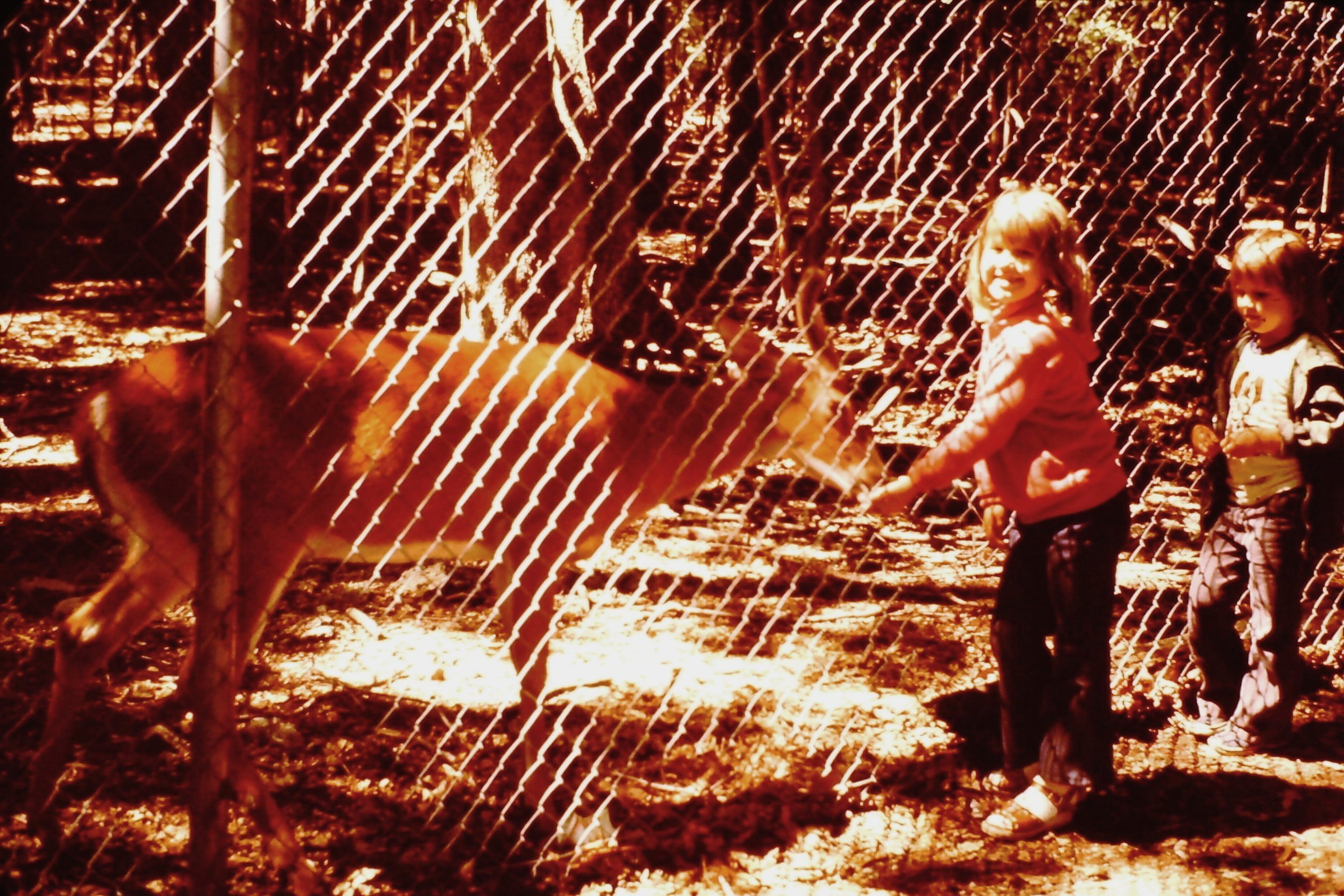
My dad took this picture of me and my little sister at the “deer farm” during one of our many trips there.

It was this wonderful wooded area that had a large fenced-off area within the trees that was dotted with deer. Mom would give us some supplies from our food storage, and off we’d go to stick our hands inside the fence and feed the deer some dried corn or wheat or something. We’d feel the roughness of their tongues as they licked the food right off our palms. In my memory, the area seemed quite large; walking around the whole perimeter was a long distance. There’s no telling how big it really was, but it still seems vast to me inside my head.

Dad also took us to little local museums and to parks and creeks. On one trip to a creek, he took some photos that document forever how he put my little sister’s bikini top on upside down. He took lots of photos, which he developed as slides. So we don’t have family albums; we have boxes full of slide trays. I even have good memories of sitting with our family in the quiet and dark of an evening watching the slides. I can hear the whir of the fan on the old slide projector and smell its mechanical smell as I think about it now, even.

All those rural areas gave us so many places to roam and play. We lived in Pennsylvania, where there was plenty of snow. Dad would take us sledding, steering us on our big Flexible Flyer down hills packed with snow. It was wonderful. We would also go on walks, hiking around through the woods and lanes where we lived on farms, observing and talking. He took pictures of those times, too.

Dad took this picture of me on a path near where we lived in rural Pennsylvania. I loved it there. Dad was very pleased with how this photo turned out. I like it too, except for 1) he’s not in it too and 2) my hair is hideously chopped off. Ah, well.

I could go on and on about all the memories I have of Dad, but it would take up a book, and it would probably bore you. What’s important is that I have memories to treasure. Now that he’s gone and I won’t see him for a while, I can pick those little gems out of my mind and browse them at my leisure, keeping myself company with what we had together while I wait to see him again. It’s Father’s Day today, and I remember him and honor his memory. But every single day he’s gone is just another opportunity for me to think back, to treasure those memories, and to thank him within myself for what he left behind. And Mom, thanks for making him leave the house with us.

Electronics, little hands and church services

While this topic may potentially offend some people or make me seem like a zealot or a super-strict mom or any number of other things, I think I’d still like to approach it because I think in our world of ever-dominant electronics devices, it’s a good idea to take a step back and think carefully about how we use them, where, and when.

This weekend we had a large gathering at church, one we do about twice a year, where all the members of our church in our area came together to listen to inspirational messages. As with most of our weekly meetings, the Sunday-morning meeting included adults and all ages of young people: babies, toddlers, teens and all in between. With a gathering this large, I had occasion to glance around me during the meeting to see how the young people were occupying themselves. Two- and three-year-olds were invariably snacking on Cheerios or other bite-size goodies or looking through quiet books; six- or eight-year-olds were either sitting mostly quietly or sometimes looking at books or drawing. Teens were listening to the speakers or sometimes supervising younger siblings. And in the hands of kids of any age I saw quite a few smart phones. Little kids were playing simple games; teens might be doing the same or texting. No matter the age, bright little screens were being employed in every row.

This is for illustration purposes only; the second I was done taking the photo, she had to give up the game. (ha!)

I had a few reasons for feeling dismayed at this sight. But first, I will explain my expectations, having four daughters myself. I definitely do not expect toddlers to sit still and do nothing but listen during any kind of church meeting. Three- and four-year-olds can often sit mostly still, however, and occupy themselves with books or coloring. And any kid older than eight is usually capable of sitting still and listening to speakers without needing distractions or toys. No, they won’t necessarily get a LOT out of the meeting, but they can pick up bits and pieces of truths that are imparted over the pulpit, and they can practice sitting still and being patient during a time they may still at that age consider to be “boring.” After all, they are at the age of eight already in school and heading toward a stage where they will frequently be sitting and listening to teachers “lecture,” at least for an hour at a time.

I can also make clear that I’m not a big fan of electronics for kids. Period. I do love gadgets (see my kitchen gadgets post and my ode to my Kindle), so I’m by no means a Luddite. I think that we have some amazing technology, and it’s very helpful in its way, at the proper places and times. But I also believe that children still need fairly limited times interacting with any kind of screens, be they TVs or computers or portable devices. Young children need time to be free and have opportunities to create and imagine and use their own minds to keep busy. It’s vital for their healthy development. Giving them a gadget of some type to stay busy with just trains them to turn to electronics whenever they’re bored. I try to limit the time my kids spend watching TV or movies or using the computer or playing on the Wii or Xbox, and they don’t get to play with my iPod Touch.

Now back to the church setting. It dismays me a bit to see iPhones or other little games in the hands of small children because it’s training them to turn to electronics rather than draw or create or read. But it doesn’t bother me a great deal because I respect that for some parents, it’s one of the tools in their arsenals to keep those little ones quiet and busy during a church meeting. Even though I haven’t chosen to have my little ones play on electronics devices, I appreciate it is useful for some other parents.

What bothers me the most is seeing teens or tweens using these gadgets at church. Kids of these ages are perfectly capable of sitting still and listening and getting something from a religious service, and allowing them to distract themselves via video games or texting or surfing the Web is depriving them of the opportunities to learn patience, sit still for an hour, and experience the peace and soul-satisfying feelings of religious worship. Some people out there may not consider faith or organized religion to be important, so they can probably just disregard this whole post. But for those parents who value the role of religion in their lives and the lives of their children, I say, make sure your children aren’t distracted so they can actually feel the good feelings that come from being in a religious meeting. I personally think it’s absolutely crucial that my daughters learn to feel the Holy Spirit, and understand how it can guide them in their lives. I want them to know that God and Jesus Christ are there and that they know them and want to help. Our family devotions of reading scripture and praying are part of that process of helping them to know those things and to turn to God for help. Church services are another piece of that important puzzle. I wouldn’t dare to distract them when they have the opportunity to experience peace and the Holy Ghost at church, and electronics are an easy distraction.

I don’t want to be judgmental, but at the same time, I wonder how many parents have given serious thought to how much  electronics can take away from valuable experiences that require quiet and contemplation. Computers and the Internet and games and all of those things can be real sources of distraction, and it’s not a minor issue. I thoroughly enjoyed an article by David A. Bednar called “Things As They Really Are,” which addressed the issue of “cyberspace” interactions and experiences. In it, he said, “Sadly, some young men and young women in the church today ignore ‘things as they really are’ and neglect eternal relationships for digital distractions, diversions, and detours that have no lasting value. … A young man or woman may waste countless hours, postpone or forfeit vocational or academic achievement, and ultimately sacrifice cherished human relationships because of mind- and spirit-numbing video and online games.” And I think those last words are revealing: these devices are numbing. They do not challenge us or encourage us to grow in any way; they simply numb us and prevent us from feeling or thinking too much at all. And why do we attend church? To grow, to ponder, to commune with the divine. We go to be inspired. How can we do that when our minds and spirits are being numbed by electronics? Bednar went on to say: “Please be careful of becoming so immersed and engrossed in pixels, texting, earbuds, twittering, online social networking, and potentially addictive uses of media and the Internet that you fail to recognize the importance of your physical body and miss the richness of person-to-person communication. Beware of digital displays and data in many forms of computer-mediated interaction that can displace the full range of physical capacity and experience.”

As parents, let’s not get enmeshed ourselves in these potentially destructive uses of technology, which can really be a great blessing in so many ways. And let’s not allow and encourage our children, who are in such tender, formative stages of development, to be distracted and numbed, especially when they are in a sacred place like church, when they could be feeling the best of feelings and influences. Let’s think more carefully about how we use our electronics, when, and where.

Traveling with kids: airlines gleefully making it harder and harder

So this past week has seen a number of unpleasant developments for families who need to fly with children. Last week, I read that many airlines are taking away the “perk” of early boarding for families with young children. If someone would like to get on early, it’ll cost. Of course. Everything costs an extra fee now when flying. Sure, you might be able to fly for $400, but then you pay $50 for checking a bag both ways, $10 for snacks, and now about $10 per person for early boarding.

Today, it’s about WHERE you sit. If you want to sit in a middle seat, fine. But if you want an aisle or window seat, you’ll be paying dearly for that privilege, $25 or more. If you’re flying alone and don’t mind sitting in the middle, great. But if you’re flying as a family of even just three, one of you can sit in the middle, but then the other two will be paying $25 extra per person, just so you can all sit in a row together. Holy cow, man!

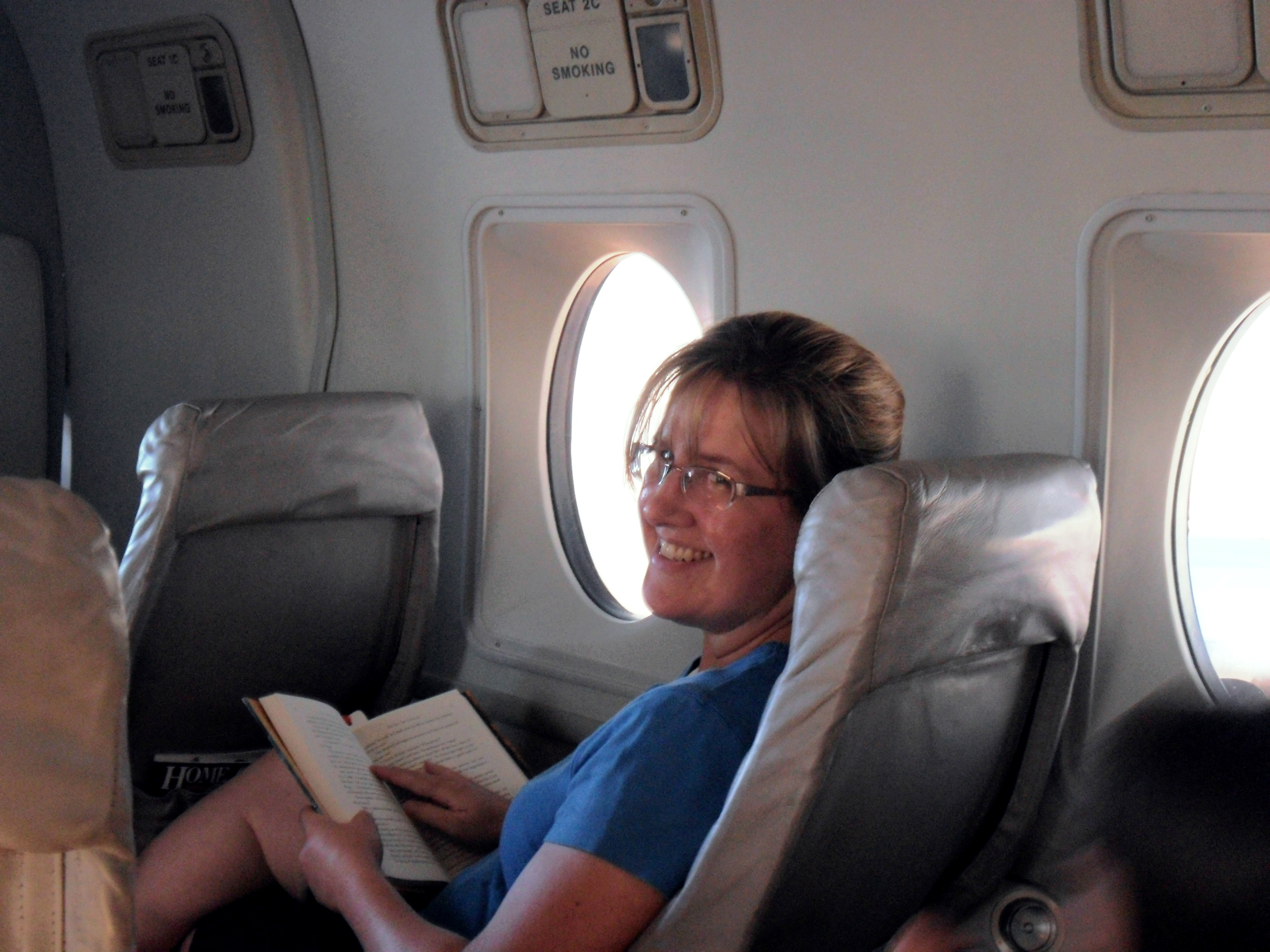
Combining two great loves: reading AND flying.

I used to love flying. I still kind of do. Just driving up to the airport gives me a thrill of anticipation as I think about getting on an airplane and speeding into the sky and then landing somewhere completely different an hour or a few later. It’s like magic. I love being up in the air and looking down on the clouds and the varied landscapes I see below. Amazing. But over the years, a variety of things have chipped away at the thrill I get from the whole experience. One acronym says much: TSA. Yes, I know it’s important. Yes. But standing in the lines and taking off the shoes and moving things around in my bags so they’ll meet all the guidelines (which change a little every time I fly, it seems) and now having my body scanned … it just saps a lot of the fun out of the flying experience. Then there’s just the stress involved in making sure you’re there on time and you jump through all the hoops in time for the flight. Ick. Add to that the stress of trying to find a flight that gets you where you want to go without connecting in two completely wacky places, adding in all kinds of extra time, and then getting it for a reasonable price … argh. If they even existed anymore, I could probably be a travel agent. I’ve had to research and set up flights for my mom because it’s too complex for her to do herself anymore, what with where we live, how far we are from major airports, and the distance between us. It’s just not simple or straightforward, at least if you don’t want to pay $800 for a flight. If you want to just pay an arm rather than a leg as well, it takes some serious Web wrangling.

And flying with kids… that’s its own special kind of hell. I’ve done it quite a bit over the years. In 19 years of marriage, and 16 years of having children, we’ve always lived across the country from one side of the family or the other, so we have to fly to visit some grandparent. And honestly, it’s just not practical to drive 2500 miles. It’s primarily about the time involved; my husband can’t really take the two or three weeks off it would require to make that kind of a round trip. And driving in a car for THAT LONG with two or three or four kids? I can’t think of many things I’d rather do less. Not to say that we haven’t done a big car trip a few times, regionally, for a total of about a week and 3000 miles, but I wouldn’t really want to go across country and back, totaling 5000 miles. Eeeeek!

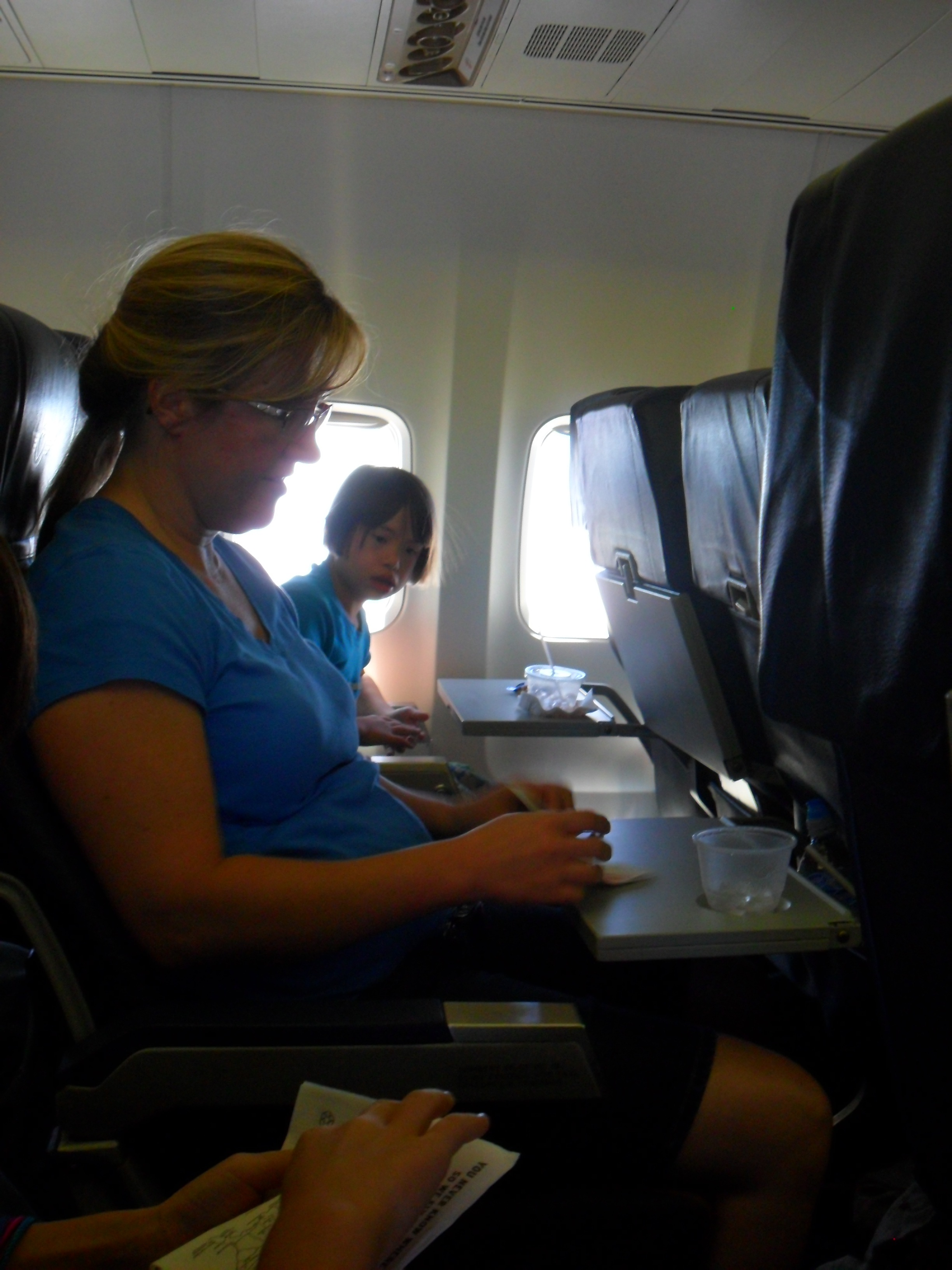
In 2010, our last big flying trip with the 4 kids, my oldest was 14 and the youngest 3. All things considered, it went pretty well, even though I flew home with them alone, while hubby was at work.

So we’ve done a lot of flying with our children. I’ve done it sometimes with my husband, sometimes without. Either way isn’t easy. We actually have been blessed with kids who are pretty good travelers, and every time we’ve flown we’ve been complimented by other people on flights on how well our girls behaved. But they never knew about the time that one pooped in her panties (far past the age of diapers or pullups) and she had to wear one of the youngest’s diapers instead of a fresh pair of underwear, wrapped around by her baby blanket because her pants were wet and messy too, or how I once pleaded with a flight attendant to just let my six-year-old get up for a minute to go pee, even though there was a little turbulence. The attendant told me she would clean up the mess if my daughter ended up losing it. Right. Where would she find new clothes for her during the flight? Luckily, my daughter courageously held her water. (And don’t talk to me about safety. I do understand. It doesn’t make the situation any less stressful or frustrating.)

The airlines are trying to stay above water (ha!) financially; I get that. I suppose that yes, they can make much better money from business travelers, whose companies can just pay up for whatever the airlines require. Everything would be calmer in the skies without any crying children who are tired, stuck in a seat, or experiencing painfully popping ears. But there really aren’t any other options for traveling long distances, and at least once every few years, a family far away from grandparents or other relatives or friends will want to visit them. It’s simply bullying for the airline companies to keep adding in new reasons for families not to fly. Because there aren’t really other options for traveling distances, the airlines have an obligation of sorts to provide that option for people other than just the lucrative business travelers. To nickel-and-dime us to death to prevent us from flying is just mean and a form of monopolizing.

Until there are other viable options (high-speed rail, wizard-style apparating, Star-Trek-style transporting), airlines are going to have to figure out a way to fairly and kindly transport families across large distances, without ticking us off before we even get to the gate.

Romance: real life vs. books

Yet another day when I’ve been thinking about a topic and I end up reading something closely related. Some of the hottest books flying off shelves (or e-shelves) are romances. The latest is not just a romance; it’s erotica: the Fifty Shades of Grey books are at the top of the e-book bestseller lists and feature not just loads of sex but bondage and domination, apparently (nope, I am not going to read them).

And it would be crazy to even discuss this topic without mentioning the insanely popular Twilight saga (which, apparently, in some way is how Fifty Shades was inspired). Not erotica, at least, but heavy on the romance, lust, making-out, etc. Sure, there are action scenes dealing with the bad vampires, but it’s really about intense teen love. The very interesting series I’m reading right now, Outlander and its many sequels, is historical fiction that has lots of great characters in many settings, but the primary focus is the intense attraction between the heroine and her 18th-century husband.

I think many people concentrate on TV and movies when they consider the effects of mass media, and they are right to do so. But books can be overlooked in the kinds of effects their messages have on readers. This Deseret News article, for instance, focuses on film: romantic comedies, specifically, and how viewing them can affect real people in real relationships. I don’t think it comes as much of a surprise to anyone that relationships and love are not portrayed terribly accurately in movies, and I can say as a reader that there are plenty of books that fit that pattern as well. At least in literature, there are many more genres and many more books to choose from, and many can be found that do portray life much more realistically than film, in part just due to their length, honestly. But there are lots of books that are just print versions of rom-coms or trite romances (Nicholas Sparks, you’ve done damage in both print and celluloid!).

I’ve thought many times as I’ve read books that feature romance how so many skirt realities most of us experience. I don’t know about you all, but after 19 years of marriage, I don’t feel the same intensity of nonstop attraction to my dear husband as I did at the very beginning. In fact, I probably never felt the same way as some characters I read about. I remember reading The Time Traveler’s Wife and thinking, Good heavens! These people have sex all the time! Do they not do anything else when the husband isn’t popping off into other time periods? And as much as I am thoroughly enjoying the Outlander series, really: does anyone (or everyone) feel like having sex with their spouse all the time? I’m not saying that isn’t a great thing between husband and wife and vital to a good relationship, but it isn’t the ONLY thing or even 50 percent.

The other main issue, I think, with some of these books is that they often posit that there is one “true love” out there for everyone, that love is destined, fated, that each of us must find THE ONE, our soul mate. This can cause a number of problems; for instance: if a relationship isn’t going smoothly, then our partner must not be THE RIGHT ONE (and we ditch a perfectly good partner and move on to find that elusive person); we might be fooled by temporary chemistry that someone we are crazy about is perfect for us (and we ignore all the signs that show he or she truly may not make a good spouse); we may never find someone who fits the supposed characteristics of a soul mate and end up alone.

One of my church’s leaders, Spencer W. Kimball, said something very wise but not what anyone might consider easy or exciting or the basis of a swoon-worthy story line: “‘Soul mates’ are fiction and an illusion; and while every young man and young woman will seek with all diligence and prayerfulness to find a mate with whom life can be most compatible and beautiful, yet it is certain that almost any good man and any good woman can have happiness and a successful marriage if both are willing to pay the price.”

Still, it’s hard to resist the siren song of these romance stories. They just make everything seem so intense, so easy, so larger-than-life. They’re fantasy. But we like fantasy. We like to read about things that aren’t like real life. At the same time, does reading these unrealistic stories do damage to us as readers as we go about our regular lives once the book is put back on the shelf? Do we end up with unrealistic expectations from our relationships? Research seems to show that the answer is yes, at least in film. I dare say the same is true for similar messages in print.

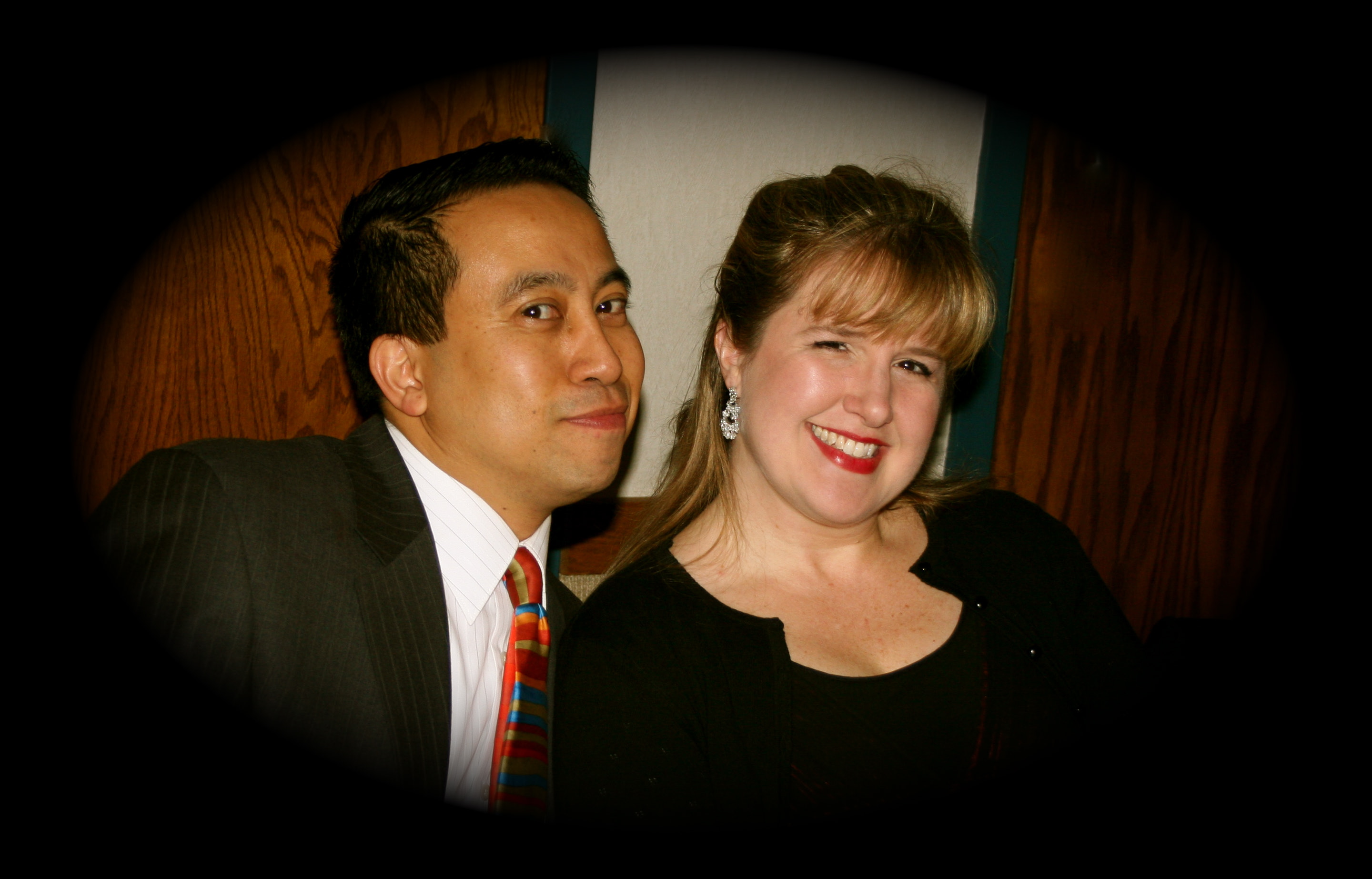
Yep, we look lovey-dovey and dressed-up here, but this is not everyday reality. I don’t care to take a lot of pictures of me (and us) during everyday reality…

Real life is harder, messier, more boring, more frustrating, more mundane, more work. Children can bring joy to our lives, but the work and the commitment involved can easily take away from our relationship as a couple (not that this is a good thing, but it happens easily if we don’t work to stop it from happening). The pressures of just making an everyday living and going about our usual day-to-day business can strip the thrill from our relationships. And time has a way of changing how we relate to each other, mostly for good. Love is a complex, wonderful, deep, multifaceted animal, and romance is only one of those facets. Sexual attraction is just a part of the romance. Infatuation and attraction occur strongly in the early stages of a romance, and real love develops past those, even though it is still desirable and a wonderful thing to still be attracted to our spouse 50 years after those early stages. My husband can still kiss me and make my legs turn to jelly, even 19 years into our relationship. But he doesn’t do it 10 times a day, and … well, I won’t go into any more private details. I don’t always look at him and think, Kiss me! I may just think, Thank heavens he’s home. Or I wish he’d do the dishes. After he’s home, the kids are in bed, and the dishes are done, then I am more disposed to think, Man, I wish he’d kiss me and jelly-fy my legs.

I think I have appreciated Anne Tyler’s books because they feel so much more real. They’re not romances, but they are about love. I was so profoundly moved by The Amateur Marriage, for instance, for its look at a less-than-ideal or smooth relationship. I love how Tyler can just dig right into real life, excavate some broken and dirty old shards, and hold them up to the light for our inspection. Yes, we think, this is how people lived then.

I couldn’t possibly write enough here about all the truths of relationships and longtime marriages. I certainly don’t have it figured out; 19 years is just enough for me and my husband to get in and get serious and tweak some rules so they fit us better. All I know is that media don’t often enough reflect real life. And that’s too bad. The shiny, glittery stuff that’s reflected to us off of film or the pages of books is too often easier for writers to portray and more desirable for us consumers. It’s just nicer or more appealing to consume a quick, too-sweet product than one that’s more subtle and layered. We want escape, all too often, not more of reality. But reality can be wonderful; in fact, it can be much better than the intense but one-sided stuff that comes at us from various media. I thank those amazing writers who have not just transported me to intriguing new places but those who have taken me right back to where I started and made it seem new and interesting in all its reality.

Parenting … joy or misery?

Apparently, the world needs studies to “prove” just about anything. Troll the Internet and you’ll find some great examples, both “duh” ones and ridiculous ones (“clothing keeps you warm” or “soap operas lack accuracy”). The latest I read about today regards parenting.

New studies now refute some previous studies (and isn’t THAT typical as well?) that indicated that parenting made couples unhappier than their childless peers. Now, several are saying that “parenting makes you (relatively) happier.”

I’ve thought about this for, well, about 16 years now. First, I think I can say as a parent, I can speak from both perspectives: as a wife without children and a wife with children, because I was married for almost three years before I had my first child. So I know the difference. Honestly, can people who have chosen not to have children speak from both perspectives? No.

But on to my opinions on this subject. I think that there are days I’d say, yep, parenting can be the pits. It’s sometimes miserable. I was just talking with my 16-year-old a few days ago about the stage of parenting infants and how it can just drive you to sheer desperation. Those early months in which you’re constantly being awakened at night and during the naps you MIGHT be able to try to take during the day are miserable. They’re foggy and hazy and overcast by exhaustion. I don’t do well on small amounts of sleep, and while I was eager to get up and take care of my babies for the first few weeks, my energy and enthusiasm dimmed a bit over time as my sleep meter went down into negative numbers. The sleep loss alone can turn you into a zombie, hungry for energy. Add to that the irritants of incessant crying or fussiness and the huge demand one little baby can create, and yeah, I felt desperate. I can still remember that feeling even now, it was just so strong and overpowering, so much that I simply can’t put it into words. Holding and putting down and picking up again an infant who’s overtired or gassy or just doesn’t like to be put down can make one go quickly insane. Doing that four times? Insanity, indeed.

And that’s only the first months of each new life. Then there are the “terrible twos” and the days they say “no” over and over and throw fits or scratch pictures into the surface of your new wood table with the little tab from an aluminum can (that was merely a week ago with my 5-year-old…). There are the years where you’re in and out of the car, ferrying children to and from school and activities. … I couldn’t possibly keep this post to a reasonable length if I went into even a few examples of each age and stage. Other parents know what I’m talking about here, and non-parents have heard many of the “horror” stories.

But at the same time, I have felt my most sublime joy holding or watching my children. Just this week, I stretched out in my recliner on a Sunday evening after the younger three kids were in bed and invited my oldest to climb in next to me. We cuddled and talked for an hour, which wasn’t what I had planned, but it was wonderful. I don’t consider myself a super-emotional person, but just thinking about it right now makes me a little teary-eyed, it was so perfect. And as much as I remember those days of exhaustion and desperation with that same kid a mere 15 to 15 1/2 years ago (she was a very demanding baby, and there were many times I thought I couldn’t wait for her to grow up), I would not trade away that hour in the cozy chair to save myself those many, many hours of struggle.

I think frequently of a scripture in my faith. A father is talking to his sons and explaining life, starting with the story of Adam and Eve. That first couple could have stayed in the Garden of Eden (in fact, many people think they should have), but if they had, they would have not known the transcendent joys of life. As this prophet put it: “And they would have had no children; wherefore they would have remained in a state of innocence, having no joy, for they knew no misery; doing no good, for they knew no sin. But behold, all things have been done in the wisdom of him who knoweth all things. Adam fell that men might be; and men are, that they might have joy.”

Yep, the studies are right: parenting can induce misery. And the studies that show parenting can lead to great happiness are right too. As that same chapter says, very wisely: “For it must needs be, that there is an opposition in all things.” You can’t experience true joy without experiencing misery. You can’t be happy to eat if you’ve never been hungry. And on and on.

Smack in the middle of parenting, if a researcher comes in and asks a few questions on any given day, in one slice of time, the odds are that researcher is going to find that parent frazzled. It’s unlikely he or she will find that mom or dad right in the middle of a sublime moment of happiness. But just because there are more moments of craziness than not doesn’t diminish the importance and amazingness of the moments of joy. And that’s true with everything in life; parenting is just one example. Anything great that requires hard work and sacrifice is worth that work and sacrifice, but don’t ask those people about how great it is while they’re in the middle of buckling down and sweating and crying and pouring their whole selves into the work.

No, I’m not going to go on and on about how amazing parenting is, and be a rah-rah cheerleader about it. I’m a realist in many ways, but I’m also an optimist. I’m not going to sugar-coat, but I will be happy to share both sides of the parenting coin, the hard work and the beauty. If others choose not to go through the experience because they don’t want the bad parts, that’s their choice. But they will surely be deprived of a kind of joy that they couldn’t possibly experience any other way. That’s their choice too. For me, I’ll take the good and the bad, the misery and the joy, just to be able to savor those moments out of time that are almost beyond normal happiness. And I’ll try to laugh about the misery, because that’s the best I can do with it.

The gift that keeps on not giving

So I wrote yesterday about how I’ve been overwhelmed by all the huge obligations and responsibilities of mothering four growing girls. I’ve been feeling low on the coping scale for a few weeks, so by the time my birthday hit the other day, I wasn’t steadied by very many more reserves of patience or understanding.

I knew my “special day” would be crazy, so I expected that. What I also knew, after 19 years of experience, is that my husband is nearly completely unable to surprise me with anything, including gifts. I have to tell him ahead of time for any kind of occasion what I would like. Either he goes out and gets it and wraps it for me to unwrap and exclaim, “Oh, that’s great! I love it!” or we sit down to order it online together (he’ll click the “order” button so it’s from him), or we’ll go out shopping together after the fact.

I’ve largely grown accustomed to this setup, and I do appreciate that 1) I am difficult to buy for because my mood is always changing and 2) not everyone is a great gift-giver. I like to think I’m pretty good at selecting presents for others. I mostly really enjoy it, in fact. It’s so fun to always keep my eyes peeled for little ideas that come up in the course of conversations and then seeing something in a store or online that just matches up. It’s then so fun to see how the person reacts to what I found. I really love it. But no, not everyone can do that very well.

So my dear hubby really tried to come up with some fun things for me on my birthday (the other big problem for him at this time of year is that my birthday and Mother’s Day are always very close together: two big occasions to honor me right in a row, or even on the same day). He came up with a couple of ideas, one of which was one we’ve already done a few times, and which I do enjoy, but in this case, I wasn’t really in the mood and wanted something different. The second ended up being ridiculously expensive, therefore, out of the question. The upshot: on my birthday, as I was racing around doing mommy stuff and wearing myself out, I ended up with not a single present to open.


This drawing and the new header for the site are actually gifts from my oldest daughter. She’s my amazing, in-house talented artist.


It was not a pretty combination. In fact, that snafu ended up being the match that lit the powder keg. I won’t go into detail on my reactions.

What I keep trying to tell my husband is that I really like gifts. I was informed a couple of years ago about the Five Love Languages, and what I really appreciate are Words of Affirmation and Receiving Gifts. Like the website says, gifts are not about getting “stuff” or anything fancy or expensive; it’s about what goes into it. I love just little tokens that say something meaningful, or even semi-meaningful. I want to be thought about and have that thought go into that kind of action. My husband and I have discussed the love languages a few times since our introduction to them, and he knows exactly what I really like. Has he succeeded in learning and applying that knowledge? Not so much. (Let me even quote from the site: “A missed birthday, anniversary, or a hasty, thoughtless gift would be disastrous — so would the absence of everyday gestures.” Ha! See?!)

My mom says that most men are terrible at gift-giving and that I should just accept that my husband, as great as he is in so many ways, will never be able to surprise me or give me good gifts. I wonder if that’s true. If it is, then why would the people behind the love languages encourage couples to do better at speaking their spouses’ languages? It would be a lost cause. I still have hope it’s possible to change or at least improve a little.

I’d like to simply say, no, I’m not selfish or self-centered; I don’t think I have high expectations. I just want a simple but fairly meaningful gift on special occasions and just cute, sweet little tokens to surprise me throughout the rest of the year. I think I’m worth it. In fact, I need those expressions of love and appreciation to feed me, to fill up my tank so I can keep going, keep super-mothering. I simply can’t run on emotionally empty.

What say you? Are gifts important to you or someone you care about?

Motherhood: from pack animal to beauty queen and everything in between

As I hit 42 yesterday and pretty much suffered the “epicenter” of a nervous breakdown that’s been brewing for a few weeks, I had a few epiphanies. One was this: I can totally understand why a woman my age would want cosmetic surgery.

Why? At this age, I’ve given birth to four kids and don’t expect to give birth any more. What’s done is done, baby-wise. Now I’m into a different stage of mothering, one I didn’t expect to make me as crazy as the stage of early childhood (and I really thought that was tough): having kids of varying ages, able to fend for themselves in survival-type ways, but dependent on me in completely different ways, ones that are actually somehow more important to who they are and who they will be. They need guidance, not just food and clean bottoms. My girls range from ages 16 down to 5, and each has specific needs related to her age and unique personalities and interests. None are heavily involved in lots of activities, but just having a few activities all together, along with the usual things to support them in, adds up to a lot of work on my shoulders, a lot of expectations and four precious, amazing young people relying on me to help them grow and develop as good human beings.

Yep, that’s me. Anyone need to add on another bag?

So lately, what with it being “birthday month” at the Lim household, and near the end of the school year, and all the things that go along with those events, I have felt like I am merely a donkey, laden with a huge pile of heavy packs, trudging along, trying to knock off a pack or two at a time. Even as I do so, more packs keep getting laid on my back. I’m about to collapse under the strain, my hairy donkey legs splayed out to all sides at cartoonish angles, my belly and chin flat on the ground.

Every mother has these kinds of obligations, especially at this stage of parenting, and they never fully lift. But every mother is also a woman who just wants to feel pretty and special and … womanly. Sure, I’m not 21 anymore, and I don’t turn guys’ heads, and that’s OK. But I’d like to feel occasionally that I can still turn one man’s head, that I am an object of desire and fascination to him, not just the pack burro who takes care of his home and four kids. It’s really easy for life to get so unbalanced with scheduled events and obligations that each parent becomes an automaton, fulfilling those obligations but losing themselves and their “hearts” in the process.

In interviewing doctors and others, I have learned that most women who have cosmetic surgery are either at the beginning of their reproductive lives or the end. The surgical improvements are done either before childbearing and, often, before attracting a mate or after giving birth to a whole brood and closing up shop in the womb. I’ve talked mostly to women who are in the latter category. They’re mostly parents to children of varying ages and are often stay-at-home moms. I suspect that they’re feeling overwhelmed, out of balance and pretty donkey-like, much as I am feeling right now. I can imagine the siren call of surgery would be very tempting right at this point, when a mother can easily feel very undesirable physically — not necessarily even because she really does look significantly older or plumper or scarred because of giving birth, but because she just doesn’t have time to feel attractive and be a woman, rather than a mom.

Every mother needs to explore and regularly experience that side of herself that is simply a woman, with her own unique beauty and personality. If she doesn’t have time to feel feminine and admired somehow, it’s going to throw her off her game everywhere else. Unfortunately, I don’t have a whole lot of answers as to how to solve this very common problem of unbalance (if I did, I’d probably be a millionaire). I just know that somehow it’s vital to find that balance, to find some time to be pretty, to be oneself, to feel one’s husband turn and look appreciatively, even if that admiring gaze must skim right over a toddler with a smelly diaper and a high school student who needs help with homework or finding a modest prom dress. I know that husband and wife both need to find the time to be themselves, to be just a man and woman who still find each other interesting and attractive. I doubt that plastic surgery can permanently solve these issues, but it certainly would sound tempting as a temporary measure.

Me, I’m just trying to figure out how to stand back up, shoulder my load and trudge on, and balance my life a bit better so I can at least sometimes put down all my packs and revert to my womanly form for at least a little while. Fairy godmother: can you wave your wand for me, please?

Time magazine, moms and sensationalism

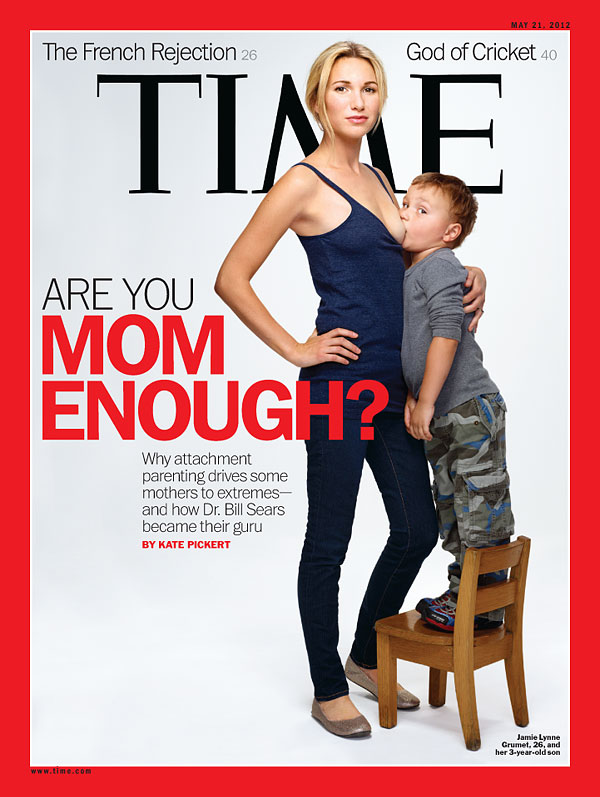
I’m beginning to think that most news outlets are forgetting their news roots. I’ve long since given up on watching any kind of TV “news” programs. Those seem to have left behind reporting news and facts, replacing journalism with who-can-shout-louder editorializing. Magazines don’t seem much better. Time magazine has just proved that with its newest sensational cover about attachment parenting, asking “Are you mom enough?”
I’m not going to dispute that reporting about the practice of attachment parenting, and some facets of it that seem “extreme” to many parents out there, is a fascinating idea. But I am not happy with the cover, and many people are not, but there are all kinds of reasons that it’s getting attention, mostly negative.

Some are finding the cover to be offensive because it is partially showing a woman’s breast; many find it repulsive because it shows a young boy with his mouth on that woman’s breast. I’ve seen some people calling it “child porn.”

I’ll try to express why the cover bothers me, but first I’ll explain what doesn’t offend me about it. I don’t mind seeing a child suckling on its mother’s breast. I don’t mind seeing that in public, perhaps even in print.

I’d like to express also why it is not “child porn.” Pornography is the explicit portrayal of sexual subject matter. Child pornography is the portrayal of sexual activities involving a child. For this cover to be porn, it would require sexual activity to be occurring. A child breastfeeding is not sexual activity. More on this later.

Now. On to why the cover does bother me. Time has deliberately chosen subjects to portray that will garner attention, and the artist has posed them in a way that will grab viewers. First, I think it’s interesting the magazine chose a very thin mother who looks like she should be a lingerie model to demonstrate breastfeeding in the preschooler years. Even though this is a real mother and child who are still nursing, the mother has been chosen to reflect a sexualized image of a model. Second, the way the photo is posed isn’t what I would guess is the usual way this mother and child (or others) would take some time to nurse. Having the mom standing up, posed like a model in an advertisement, with her son standing on a stool is pretty unusual. Most likely, this mother takes a few minutes at the end of the day to sit or lie down to snuggle with her son to allow him to nurse, and it’s part of some quiet, private, mother-child personal bonding time. And neither would be looking away from each other, especially not at a camera.

What bothers me in addition to how Time has chosen to represent this topic is the reaction that it is guaranteed to cause, a negative one about breastfeeding. Even though the topic is about an “extreme” version of parenting that many of us don’t choose, this photo is essentially painting nursing with the same wide brush, and it’s going to be a setback in the still-needed push forward to make nursing more understood and more accepted in public society. That bugs me.

Having given birth to three children and nursed them all for periods of about 10 months up to about 13, I think, I know what it’s like to be a nursing mom. It’s a challenge because you’re ALWAYS on call, always needed, and this particular duty cannot be handed off to the dad or anyone else who could help. (Let’s leave out the topic of breast pumps right now and keep this simple.) I know the difference, too, because I adopted our last daughter, so we fed her formula, and man, was it nice to be able to let everyone in the family take turns feeding her. I was so free, compared to when I was tethered to the previous three by my milk supply! Add in issues that may come up with nursing — sore breasts, sore nipples, infections, what-have-you — and it’s tough work, on top of all the other things that are hard about mothering a baby or toddler.

At the same time, breastfeeding is pretty cool. I wasn’t the “natural mom” type who always gushed about how great it was to nurse, sometimes just complaining about that constant on-call thing, but I did appreciate the benefits. It was the neatest thing to know that my body was producing exactly what my babies needed, just at the right times. I was happy to make the sacrifice to nurse because I knew it was the absolute healthiest thing I could do for them. And snuggling up with them and having it just be their little soft mouths on my breast was a gift. It was just the two of us, skin to skin, and I treasured (some of) that time. (Sometimes/most of the time I just got it over with because it was feeding time and I had to move on to something else. No, I don’t treasure every single moment of life, parenting or anything.) When I gave birth to my last daughter, I knew that would be the last time I’d breastfeed, and having her latch on that first time in the hospital almost brought tears to my eyes because I knew that it was special, and not too long in the future would be the last time I ever nursed a baby.

I also know just how tough it is to nurse a baby when you’re not at home. I was raised to be modest, and still teach my own children to be modest and not show too much skin, so the idea of the possibility of any of my breast showing even for a split second in public was one that was completely opposite to that notion that was so ingrained in me. Plus, I’d never seen almost anyone out and about just nursing a baby, so doing that myself while out shopping or eating at a restaurant or running any of the myriad of errands most people do in the course of everyday life felt strange. I felt like everyone would be staring at me, no matter how discreet I was. Even in my church, where we have more children than average per woman, and where many of us breastfeed, there’s one small room set aside for nursing and taking care of babies, and I’d never seen anyone nurse a baby outside of that room, even when we were in a meeting that was just women. Thinking about it now, I still think it strange. Why in the world do young mothers surrounded by other women of various ages, most of whom probably did nurse, feel the need to leave a room full of other women to isolate themselves in a tiny room in a corner and miss out on uplifting messages? Modesty? Self-consciousness?

Nope, our society is not at ease with the idea of women nursing their babies where anyone can see. Ask any of us women who have had to try to nurse a baby in a bathroom stall (can you say ick? Would you want to eat your lunch in the bathroom?) because there was nowhere else private to do so if we’d like to see more acceptance of breastfeeding in public, and we’ll respond with a very loud and hearty YES!

I find this all so ironic because our society is so highly sexualized. Women of all ages, teen girls, and even 9-year-olds wear revealing clothing without almost anyone batting an eye anymore. Scanty tank tops are certainly normal, and sleeveless dresses are the standard for any fancy occasion. (Try finding a dress for a nice occasion with sleeves that doesn’t look like a grandma dress. Good luck to ya.) Not only celebrities sport revealing clothes: everyday people wear plunging necklines and show a lot of cleavage and breast skin. Yet women who are feeding their babies the way nature intended, with the healthiest possible food made JUST FOR THEM, are stared at and marginalized if they accidentally show any skin for a split second, or (heaven forbid) show part of their breast at all while nursing (I always preferred to be completely covered, and there are some really handy nursing cover-ups, but what’s wrong with letting a little of the top of a breast show while the baby’s head is covering most of it?).

Breasts have become, in our society, simply an object of sexualization. Women have breasts so they can feed their babies, and, yes, they are alluring and exciting for men. That’s natural as well, and part of the whole important biological process that brings new people into the world and feeds them in the early stages of life. Breasts are really useful for feeding, but they’re also fun for men and women as they come together to feel close to one another and to reproduce. But we have lost sight of the fact of their usefulness, seeing them ONLY as sexual objects. So if we see women with a baby attached to them, because of this cultural pattern today, we think “eww” because we think of them exclusively in sexual contexts.

So Time has not done nursing mothers any favors with this magazine cover. Nope, with the choices it made that I already mentioned, it has shocked viewers and made them feel revulsion. What we need as a society is to do better to educate everyone, male and female, about nursing and the great usefulness of breasts, to encourage women to use them as they need to with their babies wherever they are, and however they feel comfortable nursing. Our society has everything backward, upside-down and inside-out. Let’s help encourage women to be more modest and show less skin on an everyday basis, saving sexual behavior for the privacy of the bedroom. But let’s also encourage women to feel free to use their breasts to feed their babies, even in public, and not force them to stay at home or run for cover (especially not to a bathroom!). Parents can teach their sons and daughters about nursing and how the body works in so many amazing ways, and women who are nursing can show their other children and friends how it’s done. It’s just going to take lots of women being comfortable enough in public to feed their babies so everyone can get more comfortable to the sight of nursing moms and babies.

Time, you let us all down and did a great disservice. Stop sensationalizing and show us how things are really done.