Here’s something radical: We disagree. We can still be friends.

Civil discourse. Sometimes it seems like an impossibility, a utopia, a thing of the past. In the age of instant publication of everyone’s thoughts to a potentially huge audience, and with no way of taking back a rash, thoughtless statement once it’s escaped one’s texting or posting fingers, it feels as if cyberspace (and, thence, real space) is clogged with outrage, name-calling, and sometimes straight-up mean-spiritedness, all because we are drawing battle lines over a variety of hot topics. New blog posts that go viral, legislation, personal experiences all get hashed out in great detail as toes and fingers dig into the lines in the cybersand.
Friendship and lines in the sand: do they mix?

Again, though I don’t write about the really controversial topics on this blog or go into detail about my opinions on some of them, it may be fairly simple to figure out where I stand on certain things. I am religious and conservative. As I said in my previous post, about body image and “feminism,” sometimes people’s conclusions about what I think might be different from what I actually believe, but in general, they’re probably going to be mostly right. But the reasoning and the emotion and compassion and time I’ve taken to draw my conclusions are almost NEVER going to be as cut-and-dried and automatic as some might assume, which is a point I’d really like to make clear.

The past years, for instance, have brought same-sex marriage to center stage in the national consciousness and in legislation. And it’s been interesting to have discussions with friends (and acquaintances and their acquaintances) about the various issues that tie into that hot topic. Various states are still in the process of approving or banning it (or having their voters’ decisions overturned); attorneys general are weighing in; states are introducing legislation that deals with related issues to gay marriage (Arizona’s current potential law trying to safeguard business owners who would like to exercise religious opinions on it is a biggie this week). As all these legalities make their way through the various systems to some kind of eventual, kind-of-final resolution, many still have mighty strong opinions about all the ins and outs.

Again, I won’t talk about all my opinions on this topic. There are some truly good sites out there that do better than I could for all the sides. What’s interesting to me, however, is HOW we present these ideas. And in many ways, it is NOT a pretty picture. It’s ugly out there, folks. Discourse is so far from civil it’s not even on the spectrum sometimes (is it DATcourse? ha ha).

But when I’ve talked about this topic, for example, with friends I adore and respect and think the world of in cyberspace, mostly Facebook, I’ve found that though the discussion can still get a touch heated, it’s still pretty respectful. And so far I’m talking about people who are all of my same religious persuasion and similar backgrounds, I’d roundly say. And we still have very different and strong opinions about all the issues-within-the-issue. Here’s what I love, though: that it stays respectful and devoid of name-calling or (mostly) generalizing. I’ve not changed my mind, and I am sure they haven’t, but we’ve had some interesting discussions and even insights and ideas that were generated. And we walk away still liking and loving each other.

I think about this when I drive sometimes: when there’s a driver who’s been doing something that’s “making me crazy” on the road, it’s once or twice been someone I ended up knowing! And when I know who it is, then my frustration just dribbles right out of me. I think twice now when someone’s really going slowly or ___(fill in the blank) because I wonder, “Could it be someone I really like?”

I wonder if it’s possible to do this more in public discourse. Could we imagine that the people we’re “talking” with in cyberspace, for example, are decent human beings, ones we might be friends with in real life? Can we treat them with the respect due to that kind of relationship? This isn’t a new idea: it’s all about not de-humanizing people. (In extreme situations, severe de-humanization — or objectification, if you will — has led to slavery and genocide.)

I’ve been taught from these discussions and hope I’ve said something that might give someone else “on the other side” a new insight or understanding. And if we were all together in person, I imagine us smiling, shaking hands, and heading out for a nice dinner together, laughing, joking, and just enjoying time together as friends. Now THAT’s pretty radical.


Issue of body image is not a trivial one

So I’ve noted a few occasions recently in which I’ve just felt I had to explain why I feel strongly about the topic of body image (particularly as it pertains to women). Those occasions have been offhand comments or posts or cartoons or what-have-you that indicate that the desire to change how our society perceives women (as objects or bodies) is trivial or silly or not as important as other issues that could garner support or activism, etc. (such as some of the ignorant comments I saw about the Representation Project’s “NotBuyingIt” campaign and hashtags that call out sexism and demeaning portrayals of women in the media, most recently during the Super Bowl, and don’t get me started on Sports Illustrated teaming with Barbie this year!).

I’m not saying there aren’t SERIOUS, very troubling things happening all around the world (wars, disease, repression, abuse, sex trafficking, crimes specifically against women and particular ethnic or religious groups) and that we in the United States and other less-troubled places can’t mobilize to do something to help. But even as we may realize that our problems in the West are “first-world” troubles, it doesn’t mean they are trivial or not worthy of attention and activism.

I’ve never considered myself “a feminist” (a word that over the years has certainly accrued a lot of not-necessarily-positive connotations and associations), nor am I a “liberal.” I tend to be mostly conservative politically. I care deeply about social justice and helping to improve people’s lives but I have more conservative views as to how those things should be accomplished (because my experience has shown certain methods to be more useful and successful than others). I am a stay-at-home mom who does some freelance work from home and haven’t worked outside the home full-time since the early years of my now 20-year-plus-long marriage. Those facts, along with my religious beliefs, might indicate to outsiders that I am not big into “women’s issues.” Those outsiders, though, if coming to that conclusion, would be wrong.

Beauty Redefined is a great resource for learning more and fighting back.

I care very much about my fellow women and how we get to function as real people in society. (I care about men being allowed to be fully functioning members of society as well, but historically in our culture, they’ve been given these rights for centuries, so they’re mostly “all set.”) The fact of the matter is that our Western, 21st-century culture diminishes the wholeness of women every single day, everywhere we turn. Media from every angle throw back very limited, definitely-not-varied, two-dimensional views of the ideal female, reducing 50% of the population to mere objects. These images and opinions are so deeply embedded in our psyches that we essentially have all tacitly agreed that they are truths. These beliefs lead men to treat women they know on some level and in some degree as less-thans, expecting their wives/girlfriends/daughters/sisters to be shaped and sized a certain way at the very least, and they lead women to act as if they are 75% (or more) what they look like and 25% a collection of their personality traits and actions.

These false beliefs have been and are continuing to be so thoroughly perpetuated that though we may pay lip service to the notion that they are false, we act as if they are true. Extreme examples are the continuing massive growth in cosmetic surgeries, particularly among “normal,” “average,” everyday women (not celebrities, not the rich, not people you might consider to be particularly vain). In the interviews I conducted with women in Utah who are moms and generally have a strong foundation of faith and have always been taught they are daughters of God worthy of love and respect for who they innately are, I was amazed how many felt bad enough about their “outsides” to undergo surgery, which is always risky, costs a pretty penny, and is just unnecessary. While I understood the feelings that led them to make the decisions they did (for getting breast augmentations or full “mommy makeovers,” for instance), I felt sad that our culture creates, fosters and intensifies those feelings of insecurity — all over their breast size or perkiness or the size of their waist or hips.

Yes, this may seem a minor issue: what does it matter if we care a lot about how we look? Here’s a short breakdown: it causes us as women to spend precious time and energy and brainpower on something that simply doesn’t matter very much. It takes those resources away from the things that really matter: our spouses, our children, our friends, our families, our work, our joys, our passions, our life purposes. And how many of us have time and energy to spare?

Focusing on our appearance reduces us to objects. Statues and photographs and machines are objects. They’re nice to look at and they might even get things done, but they aren’t human beings, with glorious origins and endless potential and utter uniqueness. Humans are imperfect, frustrating, very different from each other. But we’re so interesting and fascinating and have so much to offer! Is that true, can it be true, about mere objects? No way.

When we consider each other (or ourselves) objects, we treat each other (or ourselves) differently. We don’t expect the best, we don’t reach towards our limitless potential, we don’t care for each other as precious souls who deserve respect and love and fair and equal treatment. Men in our society, who are swimming in this media ocean of images and objects, are prone to some level of treating women as less-than themselves, because men aren’t reduced to objects nearly as often or as prevalently as women. Pornography is one more extreme example of how women are reduced to being objects, even parodies of womanhood, and it skews men’s attitudes and actions toward the women in their lives even further.

I can’t possibly explore all the angles here. There are tons of scientific studies, books, etc. that speak with authority on this subject. Suffice it to say, this is not a silly or trivial topic. It’s one that must be shared and discussed and changed. How women view themselves and how they are treated (as whole, real, full and complex individuals with unique gifts and talents and attributes) is at stake. I wouldn’t call that minor. It’s a huge battle to fight because the messages that pick women apart and reduce us to body parts, that make us less valuable than men, are constant, ubiquitous, and insidious. They’re so prevalent as for us not to even notice them anymore. If you pass the same billboard featuring a bikini-clad woman biting into a huge, juicy hamburger every single day, you’ll begin to tune it out and not even realize the damage it’s doing. But that message is still burrowing its way deep into your every cell.

I would love to make things better in so many ways, in so many places, for so many people. Right now, what I can do is write and speak up. I can say, “Hey, look at that billboard. Isn’t that insulting? Maybe we can even get it taken down. Maybe we can get the advertiser to stop objectifying women.” I can’t change the world. But maybe I can change your mind and remind you that you are far more than just what you look like.

Partnering with and struggling against at the same time

The Gilbert Arizona Temple, photo courtesy of lds.org

I just came across this brief article about a Jewish rabbi visiting a newly built temple of my faith, The Church of Jesus Christ of Latter-day Saints: “What I learned from visiting the new Mormon temple.” I am always interested to hear what others think about visiting our sacred sites, and I enjoy discussion and interaction with other people of faith, regardless of their doctrines or denominations. I heartily agree that we can all learn from each other, which is hardly a revelation, but a simple but important reminder. What struck me tonight was this sentence from his article: “My Jewish beliefs are strongly built on the Jewish idea of covenant (humans as partners with God) and Israel (humans wrestling with God).”

This really encapsulates what I’ve been experiencing myself, today alone, and the past weeks. I’ve been going back and forth, sometimes within minutes or hours, between the partnering with God and the wrestling with God. I have moments of clarity, of Spirit, of confidence that I can keep moving forward, of just-enough-hope, and then moments of frustration, anger, sadness, fear, and not-enough-hope. I’m seesawing.

I am all too aware of my firm belief that we lived as spirit beings with God before coming to this life. We knew we were coming here, and it was part of a plan for us to grow from spiritual toddlers to at least spiritual adolescents (that last bit is my little twist). I believe that I accepted and understood, at least in some measure, that life would be challenging, most of the time. But for some reason, right now, with whatever mixture of things that are working on me (a series of particularly challenging events, my particular chemical balances or imbalances, my background, my expectations, my hopes for my own future and those of my children …), I’m finding it difficult to feel consistently optimistic about my ability to just keep up, to keep pushing forward, “enduring to the end,” as scripture puts it. I’m wondering just how much faith I had in myself back in that time I can’t remember right now, when I was eager to come to this life, even knowing some degree of how difficult it would be. The question always is: how much did I really know then? How could I really know without having experienced it yet?

I’m really digging down deep to try to change some ingrained mental habits, and they’re fighting back hard. I know that my faith is both getting me through/should be getting me through. I’m trying to figure out how to truly rely on God at a level I most surely have not yet attained. I am all too aware that I’m trying to do too much on my own without being yoked with the Savior. But getting from point A, where I am, to point B, where I know I could/should be, is a bit of a mystery to me at this very moment.

My spirit soars when I experience those moments of covenant, of successfully partnering with God to do something good, to serve and uplift someone else, to create, to make something or someone better. But I’m still struggling mightily. I’m coming to appreciate more fully the concept of wrestling.

So this evening, I thank this good rabbi for his simple words. He probably had no idea what sharing a brief blurb about his beliefs would do for my thinking. I’m still going to be wrestling for a while, but it’s a mitzvah to have new insights.

Faith, intellect, and Big Issues

I have for a long time considered myself an “intellectual.” I enjoy learning about various topics, researching them, learning different viewpoints, and forming opinions. I like to be able to use my mind to consider the facts as I know them and draw rational, reasonable and considered conclusions based on what I do know (which is always going to be limited given my capacity for understanding and the limitations on my time and energy and even priorities). I still do appreciate listening to others’ own conclusions and having some respectful discussions, even disagreements, about the various topics.

I also am a person of faith. I have come to realize and appreciate just how much faith informs my life, my opinions, my decisions, my goals and entire worldview. It provides me a solid foundation, an inner compass, that keeps me grounded and at peace. I firmly disagree with any ideas that this is just because it “fills some void” or that religion is something made up by weak people to comfort ourselves. I have had too many personal, private, sacred experiences to confirm to myself that faith is real, although sometimes a little elusive or hard to understand. At the same time, I definitely appreciate just how different my faith can make me from others who either do not have faith in religious beliefs or do not share a similar religious belief system as I have.

Lately, it has struck me that sometimes it is impossible to form what other intellectuals will consider a reasonable argument to discuss matters that are truly based “on faith.” Religion and religious beliefs can often actually be reasoned in some way, based on some information. But on some beliefs and principles, we “of faith” truly go pretty much entirely “on faith.” And it can be frustrating as at least a “part-time intellectual,” maybe, to not be able to express clearly to others of that like mind what goes on in the chambers of the soul.

Generally, I have not found these two aspects of my being to clash; rather, I believe they complement each other, work together, to make me the person I am, to make me better, to make me take the time to thoughtfully consider issues in my mind but also in my heart. I like the conclusions that I come to using these parts of myself.

But sometimes, as I said, I simply cannot use both parts equally. Sometimes, the reason part is honestly a much lower portion of the process, and the issue goes almost entirely through the heart, through the faith “processor” inside. And with some really big, even very divisive, issues that are current in today’s society, it is impossible for me to be able to have a rational, reasoned discussion with someone else who is processing their thoughts and ideas through an entirely different section of themselves.

That’s faith. I am a writer, a wordsmith; I value language and all it can express. But there are a few things that I find very difficult to put into words. And then there are others that I just KNOW, through that “gut” part of me, that I have to let go of my need to have an explanation. I have to accept that some things we may never know, at least not as mortals living in this brief life (which, again, given my worldview, is just a tiny fraction of an eternal existence). And I’m actually OK with that. I’m OK with believing that some things are either not for us to know now, or not possible for us to understand now, for any number of reasons because we are eternal beings essentially in embryo, barely grasping the Big Truths from our limited understanding at this stage of our lives. Someday we’ll have enough understanding, wisdom, knowledge, faith, experience — what have you — to finally be able to get “it” … whatever “it” is that seems to confound us right now (fill in the blank with Big Issues).

I do have strong opinions about certain moral and societal issues right now. I know that others will definitely disagree with me. I try to disagree respectfully and hope they do the same.  But some issues have progressed even to divide people within my own faith community, and I have found that particularly perplexing. Though we share faith, religious tenets, and some ideals, somehow we are processing our ideas through very different “processors” or at least in very different ratios. I would like very much to have a great discussion about one or two of these really important issues with these friends who share my religious belief, but I find I simply cannot bring together a rational argument that will stand up to theirs. It is simply because I am using my faith “processor” more.

All I can say is this: I disagree, but I can’t possibly have a reasoned discussion. Too much of my ideas are tied to my faith, to my “gut,” to my feelings. Perhaps some come from adherence to tradition; perhaps I am just very orthodox. Either way, I wish I could say with words just what I want to say. But I’ve been racking my brain, and I just CAN’T. I fear that I will be derided a bit because I’m relying so strongly on feelings, on my faith. Either way, I simply cannot turn away from what I feel.

I will be curious to see how these issues resolve themselves. In the meantime, I’ll continue to exercise both my intellect and my faith in all matters that matter to me and to the world around me.

20 years and counting

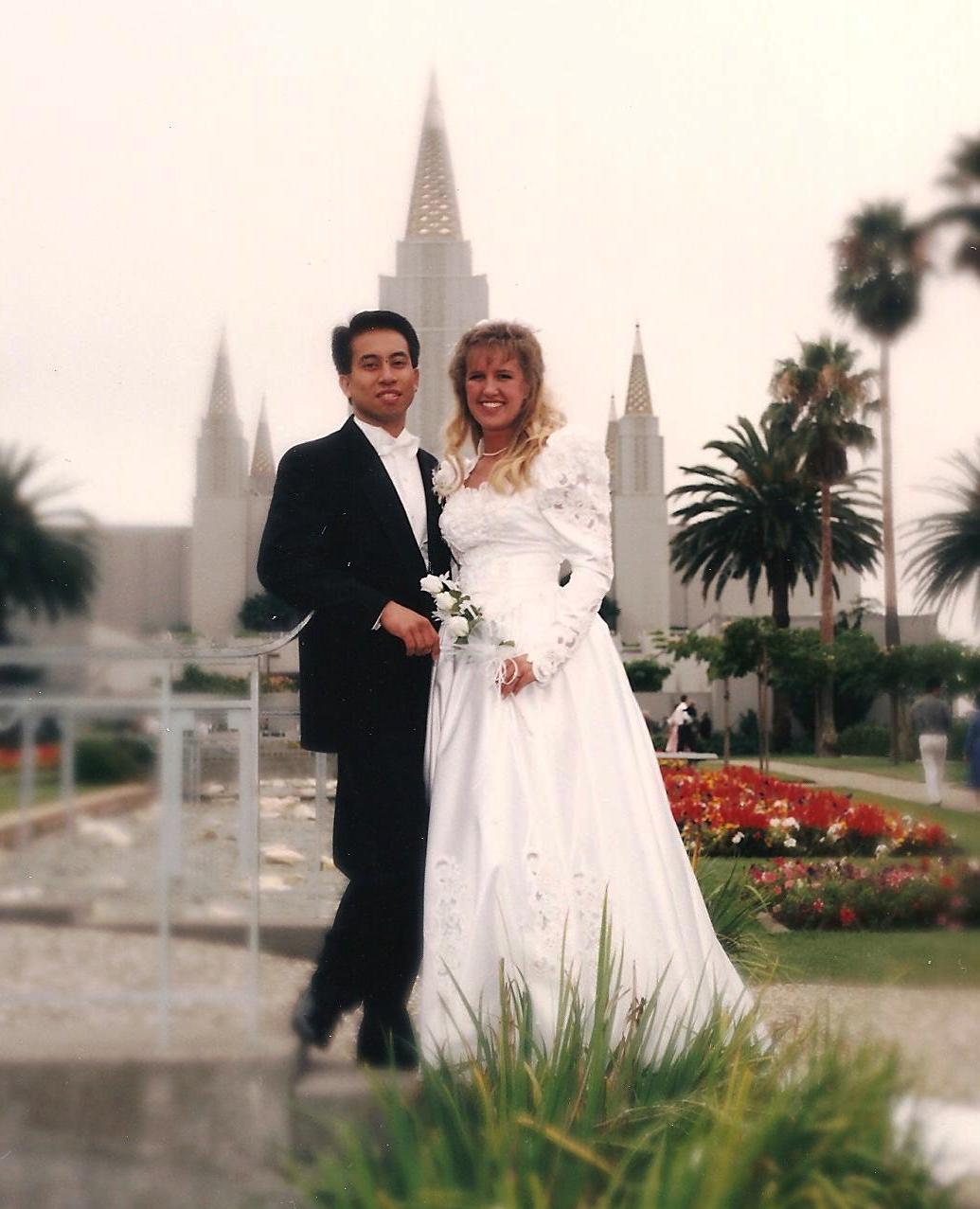
Wedding 1

What to say about 20 years of happy married life? If it’s true that all happy families are alike, as Tolstoy put it, perhaps all happy marriages are alike and I have nothing to write about.

Perhaps I’ll write about what our marriage isn’t, to start. I hear so many people saying they are so lucky that they married their best friend. To be completely honest, I don’t know if my husband is my absolute bestie. Sure, I tell him pretty much everything, and we spend the most time together talking of anyone else in my life, but I think a couple of my female friends are still who I’d call my “best friends.”

I definitely don’t consider my husband my “soul mate.” There may very well be people out there who truly are married to their soul mates, and I guess I consider them lucky. But that’s not me.

My husband isn’t who I always dreamed of marrying, either. I didn’t picture myself with an Asian guy (I guess it never occurred to me); I suppose I assumed I’d end up with another Caucasian like myself, dirty blond, maybe, perhaps on the tall side, but not more than 6 feet. Maybe hazel or blue eyes. Nope, that didn’t happen either.

The person I did end up choosing to marry is 5-foot-8, Filipino, trim, good-looking but probably not someone who stops traffic. He has a laugh that cracks me up, and I love when he really smiles and it makes his eyes crinkle. I don’t get to catch this real smile in most photos because usually he strikes a funny pose (gah!), but when I do, I love to go back and look at the picture again and again. He has strong hands, very masculine.

I chose my husband not because I was hopelessly in love with him (though I definitely am in love with him, even 20 years later), but because I knew he would be a GOOD HUSBAND. After other dating experiences that disappointed me, I knew from dating Marce that he would do all he could to take care of me, to be kind to me, to try to do better when he did something that hurt or frustrated me. He was dedicated to being a husband, to someday being a father. He was excited for those roles. I had every confidence that he would always be there for me.

Twenty years later, I can say that I was right. He has worked hard to provide for our family, he has listened to my frustrations about all kinds of things and tried to do what he can to help, he has fully participated in taking care of our children (he changed diapers before I even did with our firstborn!).

We’ve had struggles; we’ve gone through trials. I’ve had moments, even days, where I’ve been angry at him. Our love story has sometimes been romantic enough for a movie; other times, it’s been laying low in the background as we’ve just gotten by, gotten through, raised our kids, tried to work, tried to sleep, tried to just make do. Some days I’ve disliked him a bit; most of the time, though, I’ve been reminded of just how much I do like him, for how fun he is, how laid-back, how pleasant to be around he is. He hasn’t made me laugh out loud a lot, but he’s made me smile far more times than I could possibly count. We’ve shared thoughts; we’ve completed sentences; we’ve understood each other well enough we haven’t had to say anything out loud. (At the same time, though, I’m flabbergasted by how he can somehow not hear and/or forget what I’ve told him three times or have absolutely no idea what I might like for a gift. Go figure.)

I don’t consider our married life any kind of fairy tale. Pretty much no part of our courtship was; the proposal left me wanting more (don’t get me started on that story). But we have shared a lovely 20 years and I expect many more in this life. Even better, I expect to spend eternity with him, because we believe that a marriage performed by the proper authority in our temples can truly last forever. (This short explanation from Mormon.org may be of help:)

Most people think of a marriage made in heaven as a rare occurrence in which both parties are deeply in love and highly compatible. We like to think that all our marriages are made in heaven. When a man and woman enters one of our holy temples to be married, they covenant (or promise) they will stay together forever—on earth and in heaven after they die, if they are faithful to each other and their promises to the Lord. A temple marriage doesn’t include phrases like, “Till death do you part” or “So long as you both shall live.” If we keep these promises, our children also become part of this heavenly promise—sealed to us forever. Read more about the importance of family at Mormon.org.

In short, it’s been an eventful 20 years. It’s not been easy, it hasn’t been a fairy tale; it’s been hard work. But I am grateful for every moment and for this good man who has been so good to me.

Perspective is everything

I’ve always known that each of us has a different way of seeing life and the world based on our own unique background. Our opinions come from what we’ve read, seen, heard and learned, all steeped in our own self-hoods, our childhoods, our family and friends, what we’ve had or not had. So I definitely respect the fact that we won’t all see life very much the same at all. And that’s OK. It makes life and interactions with each other interesting.

sunsetBut a pertinent layer of the package of beliefs that each of us carries is that of how we see our life in an even bigger potential picture. Some of us have no belief whatsoever that anything exists outside of the 20, 40, 60, 80, or 101 years we might live on this Earth. But others of us believe that mortal life is just a part of our whole existence. For instance, I believe in the doctrine of the Church of Jesus Christ of Latter-day Saints, which is that we were created as spirits by a loving God and we lived as spirits with Him and learned what we could before we were born on Earth, which is a vital and necessary part of our learning and growing process as people. And after we die, we have a whole eternity ahead of us. This life may be 10 or 100 years long (and whatever it is, it can feel like a very long time), but it’s still a tiny portion of our whole life. Not to say that it’s not very, very important, but it’s short when you look at the big picture.

I’ve definitely come to appreciate recently just what a huge difference just this one facet of belief about life, which we all experience but experience differently, makes in who we are and how we approach life and other people in our world. We may debate about politics or moral issues and have vastly different ideas about how things should be legislated — or not. But if we don’t appreciate even a little each other’s backgrounds, it makes it impossible to understand the other’s point of view. It also sometimes means that, once we learn and understand a little about the “other side,” we likely will still stay in our own corner, sure of our own way of thinking. But at least we will have had the time to “travel,” to walk in someone else’s shoes.

I know many people don’t agree with some of my opinions, just as I don’t agree with theirs. That’s OK. But I know where I belong in the “big picture,” and having an eternal perspective makes all the difference for me.

The light feeling of forgiving

Several experiences and conversations lately have reminded me of just how much good forgiving others can do for our own hearts, and, conversely, how much holding on to anger, hurt, and blame can just drag us down, mire us in bad feelings, and darken our hearts and minds. It harms relationships and our own worldviews.

I won’t elaborate on the situations, but there have been a few instances in my life that have led to some serious anger and heartache on my part. The ways I was treated certainly “justified” my feelings, and they were natural reactions to the things that were said and done to me. And honestly, I didn’t want to forgive and let those hurt feelings go. It’s just so much easier (and oh-so-satisfying) to point a finger at someone else and say (either to someone else or just internally), “Look what that horrid person did!”

But there did come a point I realized I didn’t want to carry around that baggage anymore. It just wasn’t doing me any good, and I didn’t like the visceral reaction I had inside every time I just heard the perpetrator’s name or some other reminder brought them to mind. Not only that, I consider myself a follower of Christ, and holding on to truly ugly feelings against someone else (no matter their crimes against me) certainly didn’t make me Christ-like.

I did find, though, that the lightening of that burden of hurt and anger didn’t just happen overnight. In one case, it’s taken me several years to find that I must have, somehow, really forgiven someone. But that realization did strike me fairly recently, and I was amazed to have confirmed to me that it really had happened. I remember reading this beautiful description of that dissipation in Khaled Hosseini’s fine book The Kite Runner, and I was so happy to find that it had come to my life:

forgiveness

Because I never noticed the night it slipped away, I didn’t realize it had happened. But it had. And that right there is a miracle, no question.

It takes a village to keep me (mostly) sane

Life can sometimes be stressful. Life can sometimes be sublime. It can also, on rarer occasions, be unrelenting in its attacks, throwing punches from the left, right, above and below and behind — any which way — to try to knock one out, making the simple adjective “stressful” woefully inadequate.

It’s been like that for me the past month or two: life has nearly knocked me out. I suppose that any of the somewhat small things that has happened to me could just be easily shaken off; it would be laughable to think that any would really make me want to walk a ledge. But the constant barrage has cumulatively made me angry, frustrated, exhausted, utterly drained and significantly less able to function.

As time has worn on and I’ve become worn out, but I’ve still had to just keep on moving forward because circumstances have simply not allowed me to stop moving, I have come to appreciate just how much I appreciate those who are willing and ready to step in and help lend a hand or just offer moral support as I try to put one foot in front of the other.

This past week I’ve been traveling, visiting family and friends and attending the college graduation of a nephew and his wife. I was already at my wits’ end before the traveling began, so being in the car for hours on end (with three of my four children all cooped up in the small space with me and my husband) and sleeping in different places and all the other things that go along with road trips have made me even more tired and nearly feeling rather out-of-body.

Even so, seeing these special people has been a little boost. We visited for a short time with my husband’s oldest niece, a sweet young woman who was just a kindergartener when we married 20 years ago. Seeing her reminded me just how much I am grateful for her influence in my husband’s life: when she was an infant, he had just returned from a two-year LDS mission and was starting to get back to school and work. But he had plenty of time to help baby-sit her while his sister worked. He loved the experience. By the time we had our first child, I was still adjusting to the whole concept of parenting and all that went with it. But he was just ready to go. He changed diapers and clipped tiny fingernails before I even did. He held her and rocked her in the middle of the night to try to get her to sleep. Even for me, spending time with her as a five- and six-year-old was so enjoyable that I began to look forward to having a small child of my own to do things with.

Spending time with my grown nephew was rewarding because he fits in so well with my little family: my children adore him and his wife, and we enjoy their company so much. It also gives me great hope for his generation of our family and makes me want to be the best influence I can be. I don’t want to disappoint him.

Sitting with my wonderful, dear friend who lives a day’s drive away is always a blessing. We get to have so little time together, but when we do, it’s renewing and enriching. I can be utterly myself with her; I never fear how I may come across. I can unburden myself and she will listen and support without judgment and with love and compassion. She can encourage me to have hope and to do better without making me feel chastised or preached to or lacking or bad about myself. She has a real gift. She’s like my friend soul mate, and I am absolutely blessed to have her.

Last, I’ve had a great deal of practical help from friends in our hometown while we’ve been gone. My oldest had to stay behind because of a school commitment, and our absence, combined with all the things that had already gone wrong before our trip, required us to ask for a lot of help for her with rides, a place to stay so she won’t be alone, and lots of other little things. A number of friends have gladly and willingly stepped in to take care of her and figure out how to solve little problems while we’re gone. Their help has eased my mind greatly on her account. My mind has been racing so much and has been so burned out by all I’ve had to keep track of and fix, etc., that I don’t know if I could have done what needed to be done for her had people not just volunteered and helped her without my even being involved.

Sure, it does take a village to raise a child (a child just thrives and learns the best with a mom and dad and extended family and friends and teachers and all kinds of other people in a community). But it also takes a village to keep an adult functioning. We’re really all interdependent. The better connected we are, the better we can keep on keepin’ on. I’m just incredibly blessed to have some good people in my life and incredibly grateful to them for helping me to survive the toughest periods of my life.

Witty librarian writes a strong memoir

So I finished reading Josh Hanagarne’s excellent memoir last week and am still feeling the urge to gush. This book just works on so many levels that I feel compelled to recommend it to a lot of friends, for all kinds of reasons. I’ve written a full review on my review website, Rated Reads, but I’ll share a bit more here.

First, I like to laugh, and this book made me laugh. Check. Second, I felt I had a bit of insider’s knowledge because Hanagarne was raised Mormon and talks a lot about Mormonism, such as scripture stories, the experience of serving a mission for the Church of Jesus Christ of Latter-day Saints, and a lot of other little cultural touchstones. Since I’m LDS myself, I felt I could really appreciate what he was talking about. At the same time, he explains things so well that readers who aren’t Mormon won’t miss out. I think he handles that really nicely. But I got a big kick out of some of his stories, like the one when he’s a young boy talking about Ammon and all the cut-off arms in his Sunday school class. (See my review on Rated Reads for more information or the original account in the Book of Mormon, Alma 17: 18-39, and you can better appreciate the humor).

I also enjoy learning about what it’s like to deal with particular life challenges. In this case, Hanagarne helps readers get a little idea of what it’s like to live with Tourette Syndrome. He explains it really well and makes it funny as well as informative. His way of telling his personal experience with this syndrome helps readers appreciate what it’s like without feeling sorry for him. We just get to know Josh, who has these annoying tics and outbursts.

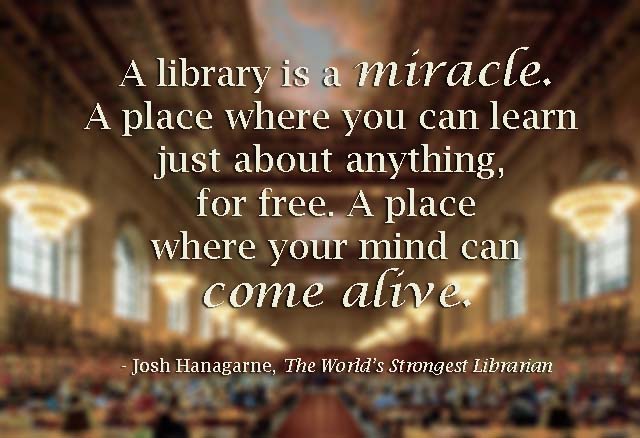
He has loved to read for pretty much his whole life, his mom being the great kind of mom who took him to the library at a really early age and read to him and with him. So he talks about favorite books and authors. He is now obviously a librarian, and he shares stories about all the wacky people and situations he encounters working at a large library in downtown Salt Lake City. He so clearly loves books and being able to work in a stronghold of information (despite the wackiness) that it’s just great fun to read what he writes about books and libraries. Great quote from the book:

A library is a miracle

Last, and this ties in to my previous point about his faith background: he has struggled with faith off and on for a lot of his life, wanting to have the strong faith that his mother so clearly has and wants to instill in her family, but just not always “feeling it.” Faith involves both knowledge and feelings, essentially, and he talks a lot about how he has often wondered about what he feels and doesn’t feel in that regard. I liked that rather than being at a point of anger at God or bitterness about organized religion or the LDS faith in particular, he is at a point of just not knowing, of being uncertain. He wants to “feel it” and can cite several specific (and beautiful) examples of when he did have a prayer answered or a concern addressed by God, but for much of his day-to-day life, he just doesn’t feel a connection with the divine when seeking it through prayer or other religious activity.

Hanagarne shows no antagonism but expresses more of a sense of loss, of the “pieces of his life” not “fitting together” and meaning the big thing they used to mean. He worried that his mother, especially, would be angry or distraught (“I’d pictured a maternal rebuke, disappointment and tears, … a guilt trip…”) when he told her he was going to stop going to church because he wasn’t “getting anything out of it anymore,” but she just told him, “The older I get, the more I see that people just have to live their own lives and make their own choices. I’d be lying if I said I like this. I don’t. … But you’re my son and whatever happens, we’ll all still love you and that won’t change.”

I love how he expresses his search, his experiences, his feelings and non-feelings, and his uncertainties. I love his dialogue with his mother. It’s all so honest and real, and what I’d say is a view on an ongoing process. I love how supportive and still hopeful (I thought) and faithful his mother is as they talk.

I feel hopeful for him, too. He is blessed, and we’re all lucky enough to be able to read about his story, the warmth, the wonderful family love, the fun, all mixed in with the challenges of regular life and the specific challenges of Tourette’s.

Glad to read about others’ experiences with mental illness

So I was appreciative this week to receive a book to review called Pros of Prozac: A Faith-Based Memoir of Overcoming the Stigma. Given my experience in book reviewing and my personal interest in mental health issues, this book was a welcome read.

Pros of Prozac

It’s a little slip of a book, just over a hundred pages, which the author says is mostly intentional, so someone interested in the topic can just get a quick overview of her experience. So I read it in one sitting this afternoon. Beca Mark writes about her experience with postpartum depression after the birth of her first child, struggling with mood and depression, and finally deciding to seek professional help and take medication for her depression. It took 15 months to choose to take Prozac, and Mark discovered two things: one, why did she wait so long while suffering so much? and two, she realized that she had actually been struggling with depression her whole life but hadn’t known it until Prozac made her feel really good and really herself.

Mark’s experience is actually what I would call fairly straightforward. She was really struggling, and then struggled with just the concept of taking medication because of the stigma it has in our society (and the real lack of open discussion of the topic in her otherwise close-knit, very large family), and then finally decided to give in and take the medicine. And in fairly short order, she just felt a whole lot better. And she has felt consistently better in the years she’s been taking it, which I’m guessing is probably about five. She makes clear that it hasn’t made her life easy-peasy or super-simple or solved all her problems. It has simply made her more able to think clearly and be motivated and to just be her best self. As I put it, it’s helped her to be able to cope in the way that most “normal” people (i.e. those who don’t have depression or other mental-health struggles) do.

Mark says this is a faith-based memoir, but it’s really not very heavy on the faith angle. I think her beliefs and the culture that surrounds those faith beliefs give a frame to her story, but even those who don’t consider themselves very religious can find a lot of value in her story. All in all, this is really a simple tale, and one that seeks simply to provide some basic information and encouragement to those who may find themselves struggling emotionally but feeling hesitant to accept that there might be a “label” for what they’re experiencing and that medication might help. Our culture at large still places stigma on mental health issues, as well as taking psychiatric medication. And individuals within faith communities may very well sometimes compound that stigma by saying that if a sufferer could just be more self-reliant or more faithful, they wouldn’t suffer.

I heartily support Mark’s goal to contribute to the general discussion and bring this topic “out of the darkness” into the light of day. The more those of us who do struggle with emotional challenges really talk openly about this and show that we’re pretty normal, typical, “good” people, and not weird or weak or something negative, the more others will be better educated, aware, and accepting — and supportive. And, even better, the fewer the number of people who do suffer from mental health issues will feel marginalized or hesitant to seek treatment. Mark really doesn’t want more people to suffer in silence and without treatment. Why should they? It’s pointless to suffer when there is help.

In applying Mark’s story to my experience, I find that mine is a bit more complex. (She does say that mental illnesses are complex in cause, etc.) Because I have bipolar issues, finding medications and treatments to keep me on an even keel can be trickier. Antidepressants help the most, but they tend to “poop out” after a year or two. I’m in that spot right now, I think. I have been on a number of different medications over the years, and it hasn’t been as “simple” (that’s relative, I know) as being able to get on Prozac and stick with it for years. I would like that a lot if it were that comparatively simple.

When it comes to the faith angle, I just wrote that there really isn’t a lot of it in here, so this book is really accessible for everyone. I wouldn’t have minded seeing more, personally. I have written about how my faith informs and is affected by my mental issues, too, and I don’t think Mark really digs into that as much as I have, even.

But bottom line: a good read, particularly for those who are “new” to the idea of having possible emotional struggles, and one that’s simple and straightforward and encouraging. Kudos to Beca Mark for putting her story out there and just being honest. The more of us who do so, the better.