How did this tragic news item slip by me?

It’s been six months since this incident but somehow I have managed to miss any news of it. And it’s certainly the type of story that should have lit up my Facebook newsfeed and the blogosphere: a man in his 20s with Down syndrome died of asphyxiation after a scuffle with off-duty sheriff’s deputies who tried to forcibly remove him from a second showing of a movie. Just reading this makes my heart seize up and fall a few inches within my chest and makes me want to scrub the knowledge of it from my mind.

Robert Ethan Saylor is the young man with Down syndrome who died after an encounter with off-duty deputies; this family photo ran in the Washington Post.

How is it that in the intervening months this hasn’t been passed around more? How did I miss it? Somehow I know that Kanye and Kim named their baby girl North West (just confirming yet again why I do not watch their shows/buy their products or support them in any way, monetarily or with my viewing/listening time), but I didn’t know that a young man with mental disabilities who idolized the police died because of people’s lack of training or sensitivity or understanding or … I don’t know what. I love this editorial from the Washington Post: where’s the outrage, indeed?

As the mother of a nearly-15-year-old daughter with Down’s, who is getting to be a full-size adolescent (still quite short, which isn’t unusual, but a solid 85 pounds), and who certainly has her own opinions and desires that sometimes don’t quite mesh with mine (which isn’t unusual for an adolescent, either!), I am honestly just sickened by this.

I can totally see this happening to her if she were in the same situation: went to see a movie she really liked, decided to just stay seated for a second show, makes a bit of a fuss about being asked to leave. Even if I have explained to her some of the societal norms and expectations for this, she either may have forgotten, not understood, or just chosen to forget. So she stays. Some security officers at the mall who happen to also be sheriff’s deputies or police officers (who in this case aren’t even in any kind of recognizable uniform) tell her to leave; she stubbornly digs in her heels and stays. They pick her up and she resists (wouldn’t you?), and she somehow ends up asphyxiated. It’s a nightmare scenario, all the more so because it’s so easy to imagine happening.

What’s more sickening is knowing that if just one of those officers/deputies had any experience spending time with someone with a mental disability, they might have just simply quietly sat and waited. Waited for someone in uniform, talked to someone who knew the young man, taken a moment to make a phone call, just waited for him to stop panicking or being scared, throwing a fit, whatever. Even just let it pass; was it worth tossing him out of the theater? My daughter, even in situations at home where she’s throwing a little tantrum, tends to recover within a couple of minutes and then just nicely go about doing what I’ve asked, as if she never resisted. So simple, so safe.

So, as the Post asks: Why did Robert Ethan Saylor die? Where is the outrage? Here’s the Post’s editorial on the topic that just ran a couple of weeks ago: I know I’d like to make this news more widely known.

Witty librarian writes a strong memoir

So I finished reading Josh Hanagarne’s excellent memoir last week and am still feeling the urge to gush. This book just works on so many levels that I feel compelled to recommend it to a lot of friends, for all kinds of reasons. I’ve written a full review on my review website, Rated Reads, but I’ll share a bit more here.

First, I like to laugh, and this book made me laugh. Check. Second, I felt I had a bit of insider’s knowledge because Hanagarne was raised Mormon and talks a lot about Mormonism, such as scripture stories, the experience of serving a mission for the Church of Jesus Christ of Latter-day Saints, and a lot of other little cultural touchstones. Since I’m LDS myself, I felt I could really appreciate what he was talking about. At the same time, he explains things so well that readers who aren’t Mormon won’t miss out. I think he handles that really nicely. But I got a big kick out of some of his stories, like the one when he’s a young boy talking about Ammon and all the cut-off arms in his Sunday school class. (See my review on Rated Reads for more information or the original account in the Book of Mormon, Alma 17: 18-39, and you can better appreciate the humor).

I also enjoy learning about what it’s like to deal with particular life challenges. In this case, Hanagarne helps readers get a little idea of what it’s like to live with Tourette Syndrome. He explains it really well and makes it funny as well as informative. His way of telling his personal experience with this syndrome helps readers appreciate what it’s like without feeling sorry for him. We just get to know Josh, who has these annoying tics and outbursts.

He has loved to read for pretty much his whole life, his mom being the great kind of mom who took him to the library at a really early age and read to him and with him. So he talks about favorite books and authors. He is now obviously a librarian, and he shares stories about all the wacky people and situations he encounters working at a large library in downtown Salt Lake City. He so clearly loves books and being able to work in a stronghold of information (despite the wackiness) that it’s just great fun to read what he writes about books and libraries. Great quote from the book:

A library is a miracle

Last, and this ties in to my previous point about his faith background: he has struggled with faith off and on for a lot of his life, wanting to have the strong faith that his mother so clearly has and wants to instill in her family, but just not always “feeling it.” Faith involves both knowledge and feelings, essentially, and he talks a lot about how he has often wondered about what he feels and doesn’t feel in that regard. I liked that rather than being at a point of anger at God or bitterness about organized religion or the LDS faith in particular, he is at a point of just not knowing, of being uncertain. He wants to “feel it” and can cite several specific (and beautiful) examples of when he did have a prayer answered or a concern addressed by God, but for much of his day-to-day life, he just doesn’t feel a connection with the divine when seeking it through prayer or other religious activity.

Hanagarne shows no antagonism but expresses more of a sense of loss, of the “pieces of his life” not “fitting together” and meaning the big thing they used to mean. He worried that his mother, especially, would be angry or distraught (“I’d pictured a maternal rebuke, disappointment and tears, … a guilt trip…”) when he told her he was going to stop going to church because he wasn’t “getting anything out of it anymore,” but she just told him, “The older I get, the more I see that people just have to live their own lives and make their own choices. I’d be lying if I said I like this. I don’t. … But you’re my son and whatever happens, we’ll all still love you and that won’t change.”

I love how he expresses his search, his experiences, his feelings and non-feelings, and his uncertainties. I love his dialogue with his mother. It’s all so honest and real, and what I’d say is a view on an ongoing process. I love how supportive and still hopeful (I thought) and faithful his mother is as they talk.

I feel hopeful for him, too. He is blessed, and we’re all lucky enough to be able to read about his story, the warmth, the wonderful family love, the fun, all mixed in with the challenges of regular life and the specific challenges of Tourette’s.

Yes, ‘family’ channels have a responsibility to families

I wrote an article two summers ago for the Deseret News about “family friendly” TV shows. At the time, I was feeling particularly annoyed by the Disney Channel, especially the show “Good Luck Charlie.” Two years later, I still feel just as annoyed, and I’m pretty much banning the channel from our house.

Good Luck

I’m reminded again of this because of the latest information about the channel and this particular show, stating that the show will be adding a set of lesbian moms and their child to the show next year. Now, I’m not going to get into my stance on homosexual unions or parenting or anything like that. I will simply say that this is a hot-button issue and that the country is fairly close to evenly split on opinions about it. What’s at issue here is that probably half of the parents in this country (I’m just very roughly going to guess on this since the opinions still tend to be 50-50 on the topic of same-sex marriage) might have some reservations about this issue and may not be excited that a channel geared at young children is introducing this kind of controversial topic.

Now I got a comment on my original article two years ago, with the commenter saying that I’m essentially expecting all shows to reflect what I think reality should be, rather than what it is. And, of course, that’s not at all what I’m saying. Any channel out there can run whatever kind of programming it wants to. It doesn’t “have” to be responsible to any set of people or values or expectations of any kind. And I’m OK with all kinds of wacky non-realities in TV shows. I love fantasy and lots of situations that are far different from my own or what is “ideal.” Watching those can either just be fun or entertaining or acceptably escapist, or they can be informative and worldview-expanding. That’s great.

However, when a network is essentially setting itself up to be known for being “family friendly” or, in the case of Disney, building on a long tradition of expectations for that quality, I do believe it has some responsibilities. If you don’t agree with me about this, just stop reading now. You won’t agree with anything I say further. In the case of being responsible about portraying families to young children, I think it’s irresponsible to introduce some of these more mature concepts that parents would prefer to address themselves. I also think it’s irresponsible to portray parents who are mean, parents who are immature and just goofy, and parents who don’t seem to care about their kids’ welfare — NOT because these scenarios don’t reflect reality, but because on the DC, they’re played just for the purpose of getting cheap laughs.

I cringe every time I see the mom on that show put down one of her kids or plot against them or do anything else that belittles them. It angers me when they act like little kids themselves rather than responsible adults. (Again, this is not to say that parents can’t have fun and act childlike; it’s AWESOME when parents get down in the mud and play with the kids or color alongside them or swing with them at the park. I am saying that when they act like brats to get laughs, it diminishes the meaning and value of parenting and the importance of love and trust in family relationships.)

I’m putting our satellite service on pause for the summer, and when I take it off pause in the fall, I plan to block the Disney network. I don’t want my girls seeing that stuff anymore. And I doubt that Disney will care. The folks there clearly plan to continue on the path toward putting parents in a position of goofiness and un-respectability. I just won’t support them.

How to make a bubble table. You’re welcome.

So it is the first day of the first full week of my daughters’ summer vacation. If you’re a parent, you may very well be like me in that just thinking about having the house full of children all day, every day, with no school or other activities to engage their attention makes you feel … well, nutty. I decided that this summer I would provide a few more fun things for them to do to keep them out of my hair and me outside the loony bin. First off, I went to Hobby Lobby and bought nine bottles of tempera paint in the good basic colors as well as two 100-foot rolls of paper, as well as a bag of assorted brushes. We’ve rolled out that paper on the tile in the entryway and the girls have had a good ol’ time. Now, granted, I’ve kept the paint and pretty much all non-Color Wonder crayons, paints, markers, etc. out of the room of the 6-year-old because even up until very recently she has not proved herself to be at all responsible with their use. So these paints are still not in her room, but stepping up to letting her use them was a bit of a leap of faith for me (control and clean freak that I sometimes can be). So far, so good.

Next idea: making a bubble table. Now, my girls were entertained for a good long time at San Francisco’s Exploratorium last fall just at the big bubble table. Exploratorium bubble table

They could probably have stayed there for the whole of our visit, but there were other children who wanted to use it. So I’ve been trying to find somewhere online that describes how to make one for home use. I searched on Pinterest and had no luck. So I came up with my own version. Here’s what we did:

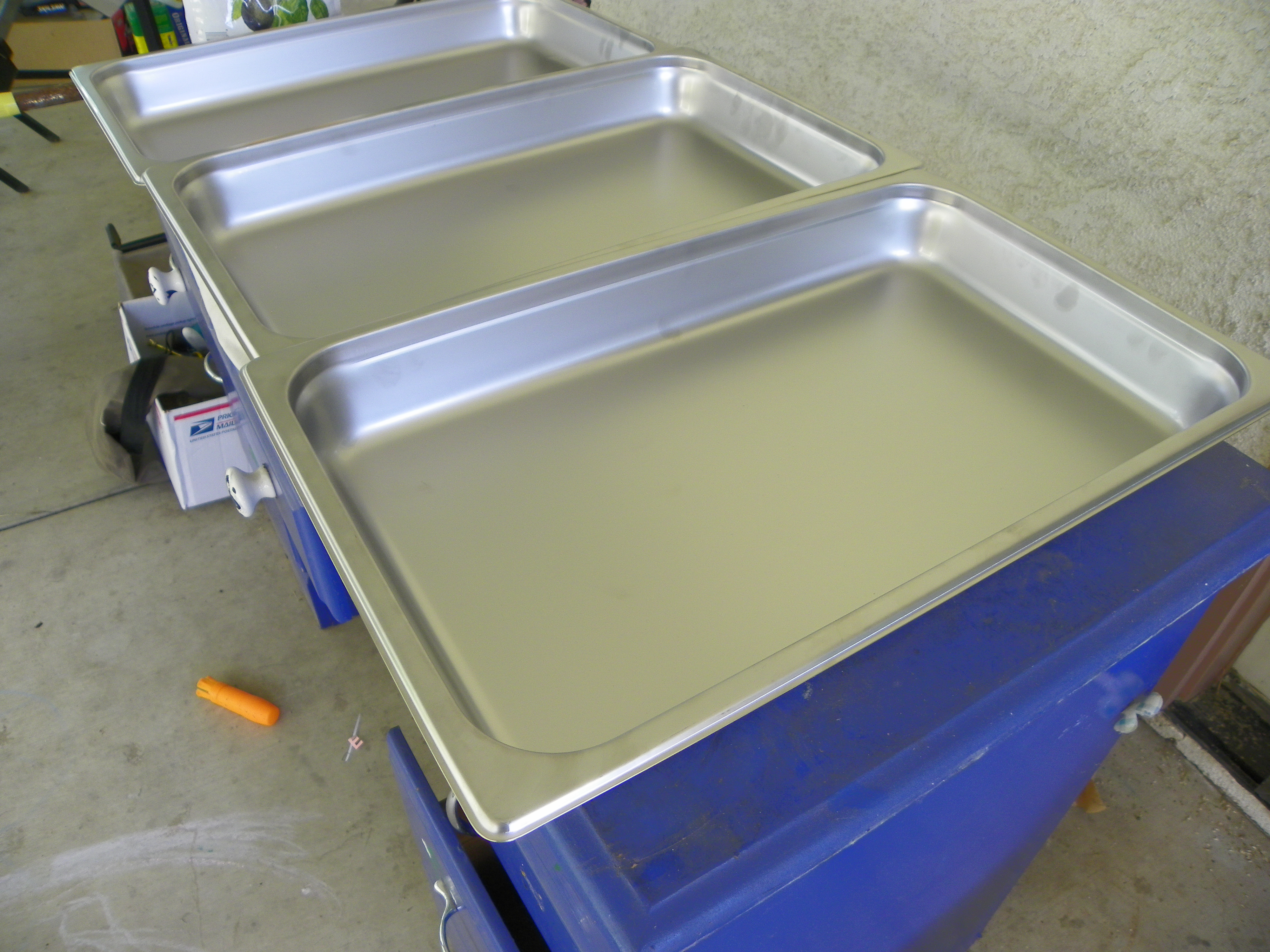
First, for the “table” part: I wanted to have some kind of large but shallow metal containers that could hold the bubble solution. I finally hit upon using restaurant-grade serving containers, the kind that are used in big buffet tables. I was lucky enough to find three of a good size at our local Smart and Final. Buying three at a time also reduced the price for me on this visit, so each one was $12. Now, if you’d like to keep this DIY cheaper, you could use the $2 foil containers of similar size, but I figured I’d end up replacing those a lot, so the $12 per container was a good investment. I also had to have three because I have four kids, one of whom is old enough to not really need/want to use the bubble table. The younger three, though, definitely each need their own.

metal serving containers

Next, I wondered what in the world I’d use for large rings. The Exploratorium had big rings with handles on them, which I figured I wouldn’t find anywhere. My husband then became the genius when he came up with the idea of using tomato cages, like this one at the right: tomato cage


Using his wire cutters, he clipped off the circle parts of the cages from the long straight “stick” parts of the cage and left just a few inches of those straight pieces on the circles. Then he bent each down into a little curlicue that the girls could hold.

making a tomato cage into rings

Last is the bubble solution. I’ve found a few recipes online, including one that’s been circulating on Pinterest and Facebook that uses corn syrup. So far, I think I like the recipe that uses glycerin. But since I just set it up an hour ago, it may well be that any of the bubble solutions will work better tomorrow after having time to sit and mix nicely and evaporate just so. Here is a link to some recipes. As I said, I think I like the one that uses 1 gallon of water, 2/3 cup of dish detergent liquid, and 2 or 3 tablespoons of glycerin.

I set up my three metal serving containers on an old desk that’s on our back patio that my oldest uses for her art projects. It’s not pretty back there, but it’s fun and useful. At any rate, now that desk is the bubble table.

bubble table setup

bubble tableAnd I’ve been hearing a whole lot of happy squealing from three girls for an hour now. Yes! Score one for summertime mama.

Motherhood: Growing your own friend from scratch

Being out of the country and away from my four daughters for 8 days recently, I was struck anew by how much I not just love them — because of course I love my offspring — but how much I like them. I’ve never been gone from them this long, and in the past when my husband and I went on trips together, they were younger. I missed them, but when they were little and the days were endless cycles of feeding, diapering, clothing, and just keeping them alive and well, I was largely relieved to have a break from that caretaking cycle.

Now they keep me just as busy, but in completely different ways. They can be their own caretakers in most ways: they can go potty by themselves now (diapers are a distant memory), they can feed themselves (even cook), get dressed, and even get themselves places on their own (oldest has a driver’s license). Now my job is to make sure they’re learning and becoming who they should and could be. It’s to make sure they are nurtured in so many more complex ways as they make their way through tricky adolescent and pre-adolescent years. It’s to support them in their activities, volunteering as a band booster and so on. The job title is the same — Mother — but the duties and job description are very different and much more complicated and nuanced. I don’t have to just show up and go through the motions; I have to bring my A game.

What’s happened, though, in the course of their becoming these independent selves, morphing from little eating and pooping machines who cry to communicate or just repeat “no” or “why?” ad nauseam is that they have become people. They are completely their own selves, with amazing personalities and unique mixtures of traits, talents, and quirks. What’s more, we have become friends in many ways. Sure, I’m not one of those parents who is more of a pal to their children than a parent, but it’s absolutely true that my daughters are my friends. My oldest in particular, who’s turning 17 this week and will fly out of the nest next year (cue the leaky eyes), is such a fun person. She’s nearly an adult, and she is mature in so many ways and simply fun to be around. We have all kinds of inside jokes and we can look at each other and grin at something we just know we’re both thinking. She is so delightful and pleasant to be around that I miss her presence when she’s not.

brianna as flower

And I felt that keenly while in another country. I didn’t talk to my girls for more than a week. I emailed and Facebook-ed a little, with one short chat session. (Even then, though, they were all using my mom’s account, but I could tell when a different child started typing. I knew exactly who I was “talking” to because of just how they phrased things.) But as much as I enjoyed my time alone with my husband and loved all the great scenery we soaked in and famous sites we visited, I missed my friends back at home. There were so many times I thought, “Oh, Brianna would like this. Oh, Cami would love that.” I was sure one would respond a certain way with a certain phrase to something we saw.

And as much as I loved (but often just plain endured) the different phases of mothering, I am loving this one, in which I can see how the little seeds I sowed have grown into full-size plants. They’re still here in my own garden, but in not too long they will be transplanted to other gardens. Right now, though, I marvel at how much I like them, how simply miraculous it is that I was growing my own friends all this time and didn’t quite realize it. I love them, but, even better, I really, really like them. Today, I will celebrate Mother’s Day with some really amazing friends. I can’t imagine life without them.

So glad I could help

Few things give me greater satisfaction than having friends (or even just acquaintances) come to me as a resource when faced with questions relating to mental health. Perhaps in part it’s nice to know that, despite my sometimes quirks or slightly “off” behavior, they still consider me a valuable source of information and even wisdom. It’s nice to be valued, to be needed, to be seen as able to dispense tidbits of guidance. It’s even better to feel that maybe, just maybe, everything I’ve gone through can help someone else, that I can maybe help cut short the long journey for them just a little, provide a quicker route that still gets them to a good destination.

I can tell you about my therapists, my psychiatrists (i.e., medicine-dispensers) and medications, the books I’ve read, the ups and downs and ins and outs. I can talk about the wacky ways my mind is able to play tricks on me, despite my hyper-awareness that it can, and a sort of vigilance about trying to think clearly and navigate life from a kind of emotionally handicapped state. I can share the surreal-ness of dealing with others who have been in worse shape than I have ever been, of their living in (and trying to reason from within) realities that just don’t line up with the reality the rest of us know. I can look back on my own experiences and say, “I wish I could have seen the whole picture from the beginning, because I would have gone right to ___.” Man, does it feel good to think that I might be helping someone jump over hurdles with relative ease and speed that I’ve had to walk around, re-jump, and move around countless times.

Again, in this latest discussion, a friend and I agreed that it would make life so much better for everyone if all of us could just open up about our real challenges. Most of us have something, a weakness or an addiction or a habit or an illness, whatever, that we find embarrassing or shameful somehow, that we would really rather NOT talk about. And there are plenty of stigmas left in our culture about lots of problems, including mental illness. It just doesn’t help that there aren’t really clear-cut answers (let alone even questions) about how our minds and emotions, etc., work. The science is much clearer with other health problems. So it makes mental illness still hazy and misunderstood and even a little scary for people who don’t have to face it head-on regularly. If just more of us SPOKE UP! Whatever your shame, your stigma, your weakness, your difficulty, just talk about it. Yeah, unfortunately, you’re probably still going to be judged and misunderstood by some, maybe many. But you could help so many others.

oven mitt

I feel so weak and so isolated sometimes, and then nervous about talking about my experience. Because like most everyone, I just want to be liked, to be understood, to be respected and appreciated. And that stigma can put a big roadblock in the way of that satisfying goal. But I want to help other people. I want to pave the way for less stigma, for more understanding, even for better science (somehow). So, I talk. I write. I blog. I’m open. It can be nerve-wracking and painful. But I’m doing it anyway. Because I’m glad I can help. So call me or write if you have questions or need advice for a family member or friend. Reach out. Sometimes you might need oven mitts, but pretty much I’ll always be happy to talk, if I can help someone else.

Don’t use my mental illness as an excuse to write off everything I say or do

I’ve been thinking about this idea for a long, long, LONG while, and I’ve put it in words now after reading some others’ blogs. Here it is: My mental illness is NOT an excuse for people with whom I interact to just write off anything I say or do that they disagree with. And yes, this extends to opinions that I have that are carefully considered, based on life experiences and, yes, even my interactions with YOU, who are so eager to chalk up my opinions to craziness.

I’m not going to say that in my darkest moments (and the times I feel most ashamed of myself and my behavior) I never say something I regret or that I don’t even completely, 100%, mean. I do. But, honestly, DON’T WE ALL? We all get tired, angry, frustrated, annoyed, irritated, strung out and worn out, and say and do things we don’t mean or that we just regret. So in this way, I’m really no different than any “normal” person, if you’d like to use that easy but non-precise terminology.

Here’s what really, really, REALLY bugs me: when I choose to discuss an issue with someone who is treating me poorly, in an effort to improve the relationship or our necessary interactions, and then that person essentially throws up a wall and refuses to talk because they don’t like what I have to say. People do that a lot anyway, sure. But I am convinced that some people through the course of my life have been all too quick to throw out the baby with the bathwater when it comes to anything I say. If it’s something they don’t want to hear, they say, “You’re overwrought. You don’t know what you’re saying.” and then either studiously ignore me or what I tried to discuss, or they react with righteous indignation, even putting a burden of guilt and shame on me for daring to be open. They might even point the finger at me outright and denounce me to others. Not cool, people, not cool.

Because I’m that type of person. I don’t like having any kind of relationship with someone, whether it’s family, friends or acquaintances, or even work associates, that essentially forces me to bury any hurts or problems. I like to TRY, at least, to resolve the issue, to bring it to light and talk about it and free all from the burden of darkness. I think it’s much kinder to everyone. It does generally involve the peeling back of a scab, but then that sore is much more likely to heal over and not scar or get infected. It’s worth the initial discomfort.

But it angers me when my efforts are met with derision, nastiness, and blame. I have also tried to be somewhat open about the mental illness with which I struggle on occasion. And that, unfortunately, is seen by some people as a free pass, as a way to characterize my opinions as simply the effects of a frenzied mind. And they’re not. I might end up being not as soft and kind as I generally am (I think I’m pretty good at phrasing things well most of the time), and I do regret that. But that doesn’t mean that what I have to say is wholly without merit. If there’s a problem festering in our relationship, it’s NOT ALL ON ME. Face it: it might be you. Or at least partly you.

Let’s not be too quick to peel blame off ourselves and throw it back on another person, especially someone who is an easy target like one afflicted with mental illness. Let’s stand courageous and brave and compassionate and stop deflecting. Please just don’t write me off. My thoughts, opinions, and concerns have value. Please treat them accordingly.

We never fully know what we’re getting into, do we?

In some of my most challenging hours, I’ve told my husband I feel it’s unfair to him he’s had to deal with me and my mental health issues. (This cuts both ways, though, since I’ve also told him during similar moments that if he thinks it’s hard to deal with me — which he’s never said but which I assume he must think, since that’s how I roll [and we know what they say about assuming] — that it’s even more difficult to be me and to deal with me because I have to be with myself 24/7. Wouldn’t it be nice if I could just leave the room or the house and leave myself behind sometimes? Sigh.)

Sure, we’d talked about my issues before we married. Sure, he seemed to be OK with them. But honestly, how much experience did he really have with them? Even I hadn’t had a whole lot of experience with them — at 23, looking back, at least, I was just in the early years. Yes, I’d had some bad episodes, but in part I think I felt they were behind me because they came after some really big challenges, including a major heartbreak and beyond-disappointing treatment by the best friend I thought I’d marry. I really had no idea just how much a part of me those episodes would become, that they’d keep visiting, keep creeping down on me from the darkened attic in which I’d locked them away. But as in those gothic tales I love, the crazy wives in the attic never stay away permanently. Mine screams and yells and sometimes escapes, even setting fire to my life on occasion. No, I might lock her up again, but I can hear her every so often up there, pacing the floorboards and sometimes even moaning.

Nope, if I had no idea what I was in for, there is no way my husband did. And my heart aches for him because of that. At those times of difficulty, when I’m overtaken by darkness and crying hopeless, bitter sobs, I wish he could have a wife who’s not incapacitated for hours or a few days at a time. I just feel bad for him. He’s a great guy. He’s a great husband and has been unflaggingly supportive. I know he’s felt utterly helpless, unable to do anything for me, but he’s there, always hovering and ready to do whatever he can. I always appreciate that. Lesser mortals would have packed up and left long ago, I feel.

But it makes me realize that none of us ever has any idea what life will hold. We can make the best plans, predicated on our best educated guesses and experience, and we can move forward with certain expectations. But life always has surprises up its sleeve. At this stage of my life, I know that spouses can be unfaithful; they can leave; they can change their personalities and life goals entirely; they can even die far too young. Despite great education and job training, unemployment can strike for months, even a couple of years. Illness or disability can effectively rob someone of a functioning spouse. Things happen. And not just little things.

I had no idea what hand I’d be dealt in life when I was still growing up in my parents’ home; I still had little idea when I was a young adult. Even now, I’ve got a better idea, but I also am much more aware that plenty can life ahead of me, supposedly halfway through this mortal existence. Yeah, I wish my husband hadn’t gotten handed the mentally-ill me. But he did also get the really amazing me, who’s capable and really useful and fun and cute to boot. I’m not as thin as I’d like, but I look pretty young still and I’m attractive. Not bad, I think! 🙂 Plus, I cook, I bake, I am a great gift-giver, I’m clever and creative, I pay bills, the list goes on … I’m really handy to have around.

So life has its challenges. It delivers a lot of unpleasant surprises. That’s the case for both me and my husband. But life has also been really good to us in so many ways, and we still have each other. There are yet many good and bad surprises ahead. In some ways, I’m not really eager to find out what they are. Yep, the disturbed wife in the attic will keep re-emerging; I’ll keep locking her up. And all kinds of strange things will emerge from the closets and from behind the bushes outside, even. But I’m just going to keep going and do the best I can to handle whatever comes a-knockin’. ‘Cause that’s life. And since I’ve made it this far, I’ll just try to make it further. 

When I’m boiling over, just grab some oven mitts

I’ve just had another week (couple of weeks? month?) that ended horribly for me mentally. I ended up nearly incapacitated with hurt, anger, and hopelessness, curled up on my bed in a puddle of tears and surrounded by tissues that I’d flung wherever. And something that has struck me (yet again) is how difficult it is to explain this outcome and all the little triggers, inner and outer, that lead to it. I still am convinced that most people do not have the least idea how to deal with someone in this situation, or clearly on their way to it. This even (maybe especially?) includes family members, who have known me for years and have varying levels of knowledge about the struggles I face periodically, but who still just don’t KNOW what it’s like to be me at those moments or how to be WITH me.

I can’t blame them, most of the time, honestly. In their place, I might be unsure what to do or say (and how to handle any lightning bolts that come zinging my way out of the storm) and possibly just find it easier (safer?) to wait until that storm was over, the clouds all blown away, until I came near again. But when it comes down to it, in my own place, I can’t help at those times but feel angry and resentful that few people do know how to approach, how to offer support. And if family members, who are supposed to love me and be there for me, just as I’ve always tried to do the same for them, cannot be there for me, what does that say about them, or even about me? Those moments leave me mostly alone, feeling abandoned. I mentioned on Facebook, to friends, that that medium is a dicey place for trying to reach out for true support. How in the world do we use the one medium that keeps us in touch most readily to really connect, to really help each other, when it generally is limited to use as a place for sharing mundane details of day-to-day life, news of our kids’ accomplishments, and photos that show us in vacation spots or in our best moments? I do appreciate that when I put out that little message, some friends offered their support and care, just saying they were thinking about me. That did mean something. A lot, really.

But in real life, how in the world do I get support from those whom I need when I’m giving off a really bad, hopeless, negative, angry, and, yeah, even “crazy,” vibe? Most normal people would run away, far and fast. This is been one of my biggest concerns over the years as I’ve struggled with this beast of mental illness. I’m a pretty “normal” person most of the time, and people say they find me to be upbeat, happy, blessed with a great smile. I care and really put myself out there to help others. I do spend a lot of my time and energies trying to help those around me. But sometimes life just gets to me or I end up spending too much of my energies on others and then run dry in my own well.

boiling waterIt’s kind of like I’m boiling water on the stove, and as long as there’s still water in the pot, even if it’s only a half-inch of water, everything’s fine. But the second that water boils off, the pan is in big trouble. And despite my best efforts to balance my life (ha!) over the years, it’s still a really tricky act to pull off successfully, and I burn out sometimes. The pan bursts into flames as soon as it gets dry, and I need to be removed from the burner, cooled down, and filled back up again with water. Those are the times I need loving friends and family who, armed with oven mitts, are willing to help me cool off and refill my reserves. I sit on the stove sometimes and whistle like crazy, wondering where my mitted friends are, because it’ll take a lot longer to get myself filled up on my own merits. If left for too long, I stay hot and just get angry.

I know it’s hard to come near me at those times. I realize that. But I know I’m worth the effort. I know that I am a good, genuinely caring person who uses my talents and resources to be helpful to others. I’m fun, I’m generally kind, I’m pretty handy to have around in a lot of ways. So I give. Even just in a balance-sheet kind of way, I’m worth the investment. But during all those good moments, I still fear that those I care about aren’t taking the time to find out more about the few really bad, challenging moments that are my reality just as much as they are the good ones. I want my friends and family to want to really get to know me, to understand me a little better, so when the storms come, they’re ready for a little lightning. Because when the sun comes back out again, it will warm them even more radiantly.

All in all, this is probably true for every single one of us, whether we have mental illness or not. We need people in our lives who really get to know the whole us so they’re ready for the times we’re not our best selves. But it’s just magnified a lot more with mental illness, and society still places a stigma on it, where many people misunderstand and avoid in their ignorance. I wish we could all do better to stop this from happening. I would be happy to keep all this to myself. I’m not proud of who I am in my dark times. But that’s my reality, one I’m trying to mitigate and improve, bit by bit. So in the interest of increasing awareness and helping others, just by being open and sharing information, here I am, baring my soul. And thanks, from the bottom of my hot saucepan, to those dear friends who have braved the storms and held me until they’ve cleared. The world is brighter in so many ways because of you. Thank you, my dear ones.

My resolution? Not to make any resolutions

I triumphantly announced a couple of days ago that I’d managed to check a couple of major items off my to-do list. Rather than being excited for me, my husband countered, “Well, are you going to add any more things onto the list?” Sadly, he knows me all too well.

2013I am a type-A personality, capital A. I have always been goal-oriented, planning and working for the future. That personality served me well in school, leading me to be valedictorian of my high school class and earn a full-tuition scholarship to my desired university. Since then, it’s not been quite as useful, at least in day-to-day life. In fact, it’s probably downright detrimental when raising children. ‘Cause honestly, it’s pretty difficult to get things done efficiently when the house is full of children. They do not care that I have a list of things to do. Their raison d’etre is to prevent me from doing anything for myself, having any quiet time, or reaching goals.

Even so, I don’t know any different way of doing things, so I forge through every day with kids, taking care of them and squeezing in my goals and to-do’s and trying to think straight in the moments they’re not asking me for something. It’s like swimming upstream in molasses. But since I am so programmed to check things off a list, I just keep swimming, regardless of how thick the water is.

So making resolutions at the beginning of a calendar year is completely pointless. One, I make goals (aka resolutions) every single day. I simply CAN’T HELP MYSELF! Two, I’m already so busy with the goals I’ve already set for myself that coming up with new ones simply because it’s January means I don’t have time to work on the new ones; I barely have time for the old ones.

Therefore, I am resolving to not make any more goals, at least until I’m caught up on the lists that are scribbled on scratch paper on my desk, on the yellow sticky-note program on my computer desktop, and the ones that just crowd my head. Perhaps I can demote myself from a capital-A type-A personality to a lowercase-a. We’ll see. That’s the most grandiose resolution I’ve ever considered.