Interacting with the world

I was thinking again about what a stark contrast there is between the kind of lives my kids and those of their generation lead and the childhood I experienced. I can’t help but lament the huge influence of electronics and other gadgets of today.
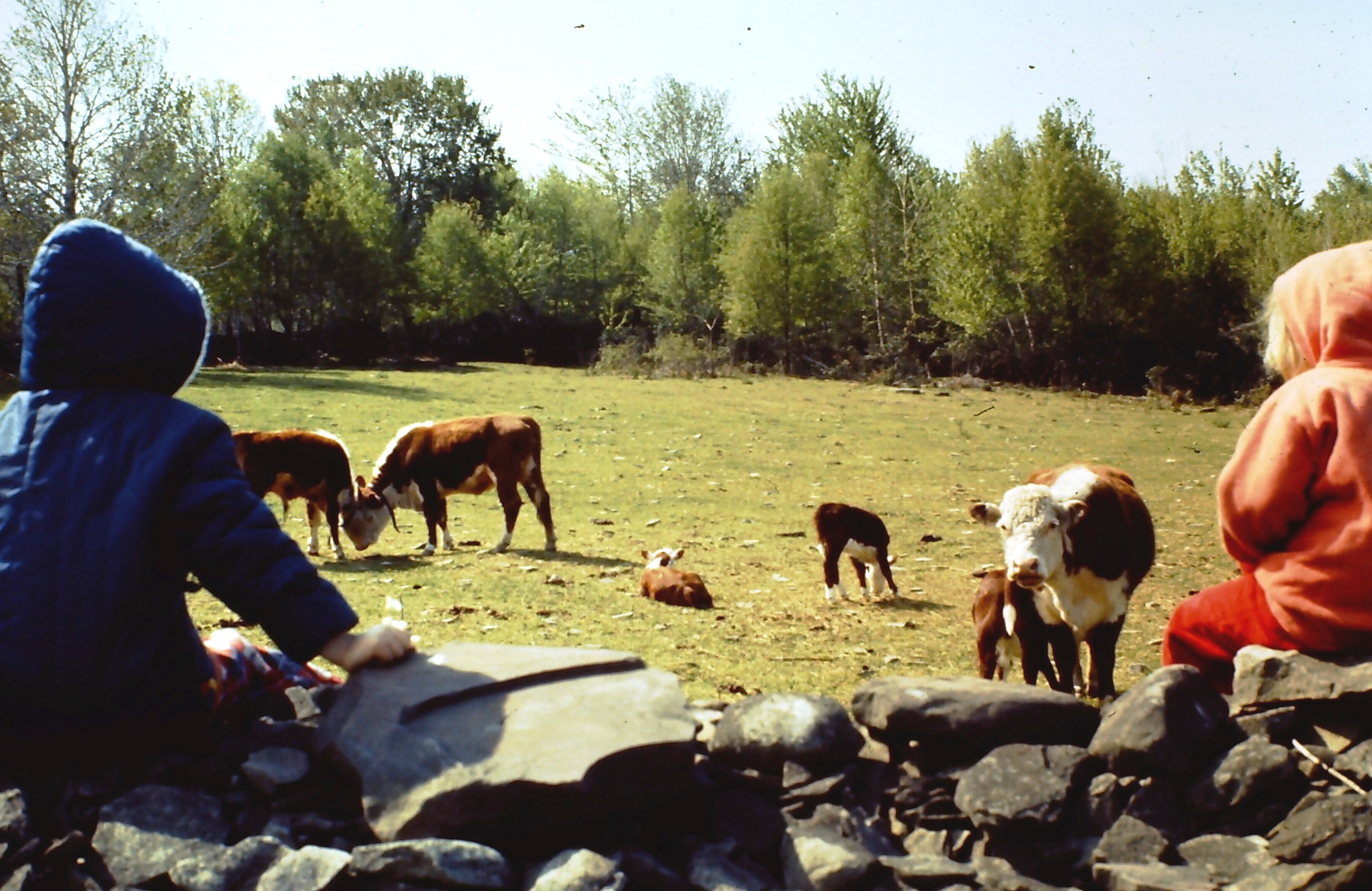
Here I am with my sister just watching the cows near our house in eastern Pennsylvania.

I have fond memories of spending lots of time outdoors. Let me make clear that I am not an “outdoorsy” type now and kind of wasn’t even then. I don’t really enjoy camping, I don’t hike, don’t fish, don’t go on trips out to natural wonders; rather, I really enjoy visiting cities with interesting historical sites, museums, and lots of other cultural wonders; I read, I spend time learning things online, editing, writing, etc. I guess it sounds odd I would then be nostalgic about my outdoorsy childhood. But I am. I’m pretty sure my mom forced me out the door when I was a kid, so I would get some fresh air, take a break from reading, and get out of her hair for a while. But I think back on all the beautiful country that lay around the old houses we lived in in various parts of Pennsylvania and just savor those memories. I made mud pies, incorporating wild little onions and carrots and the moist dirt that lay right along the burbling streams. In the winter, my siblings and I built great igloos and forts out of the snow that was so abundant.

Did I watch TV very much? Nah. Do I have fond memories of sitting around the TV set with my family? Not much. I do have some fond memories of going to see classic films with my dad and sister and brother. We watched “Oliver” and “Fantasia.” When teaching his occasional film class, Dad would bring us in to introduce us to Zeffirelli’s “Romeo and Juliet” and even “Battleship Potemkin.” “Citizen Kane” was on the menu. But day-in, day-out, we didn’t have the option of watching videos in our living room. There were 13 channel options on the TV knob, and not all corresponded to an actual station (half were just static).

I love the scent of lilacs today because we had an amazing lilac bush outside a side door of one house, which had a kind of hollowed-out middle I could crawl into and think while smelling that intoxicating floral scent. While I don’t take the time today to find places to walk in nature, I did enjoy just setting out through woods and trails and seeing what I’d find, thinking about whatever while doing so.

Today, my kids and others have instant entertainment in the forms of hundreds of options of (mostly dreck) on TV; they have DVDs galore; there are computers with the Internet, Facebook, Google, YouTube, what have you; smartphones to access that same fun (and often the same level of dreck) stuff whenever they’re not sitting at a desktop computer, and so on. Even though I try to limit the amount of time they spend in front of any screen, just being entertained, I do lament that they aren’t forced as much to just entertain themselves. (Part of my sadness here is that my husband and I always lived “in town,” as opposed to the old houses out seemingly in the middle of nowhere my parents had us live. I admit I have caved to the convenience of having shopping, school, work, etc. easily and quickly accessible. Plus, my husband is a city boy.)

Yep, so here I am being one of those “old codgers” who talks about the good ol’ days and being sad about what’s happening with the young folk. Most of the time, I just do what I can to make my kids entertain themselves (they do love to read and we have a TON of books around, and we have plenty of paint, crayons, paper, etc. and other raw materials for play/learning) and keep them off the computer or away from the TV. But there are moments I wish they could have enjoyed the “simpler time” I had. Guess I’m just turning into my parents here. It’s bound to happen to all of us eventually.

Marriage is for all of us

When the “Marriage Isn’t for You” blog post by Seth Adam Smith started appearing on friends’ Facebook feeds the last week or so, I didn’t really read it, just took a quick look. It just seemed so simplistic and obvious that I thought it was kind of silly people were making a big deal out of it. Yes, marriage is about selflessness. It doesn’t work too well when two people are selfish. OK.

I suppose I’m still a little flabbergasted by how big it’s gotten. I mean, 24 million views (as of two days ago)? That’s ridiculous.

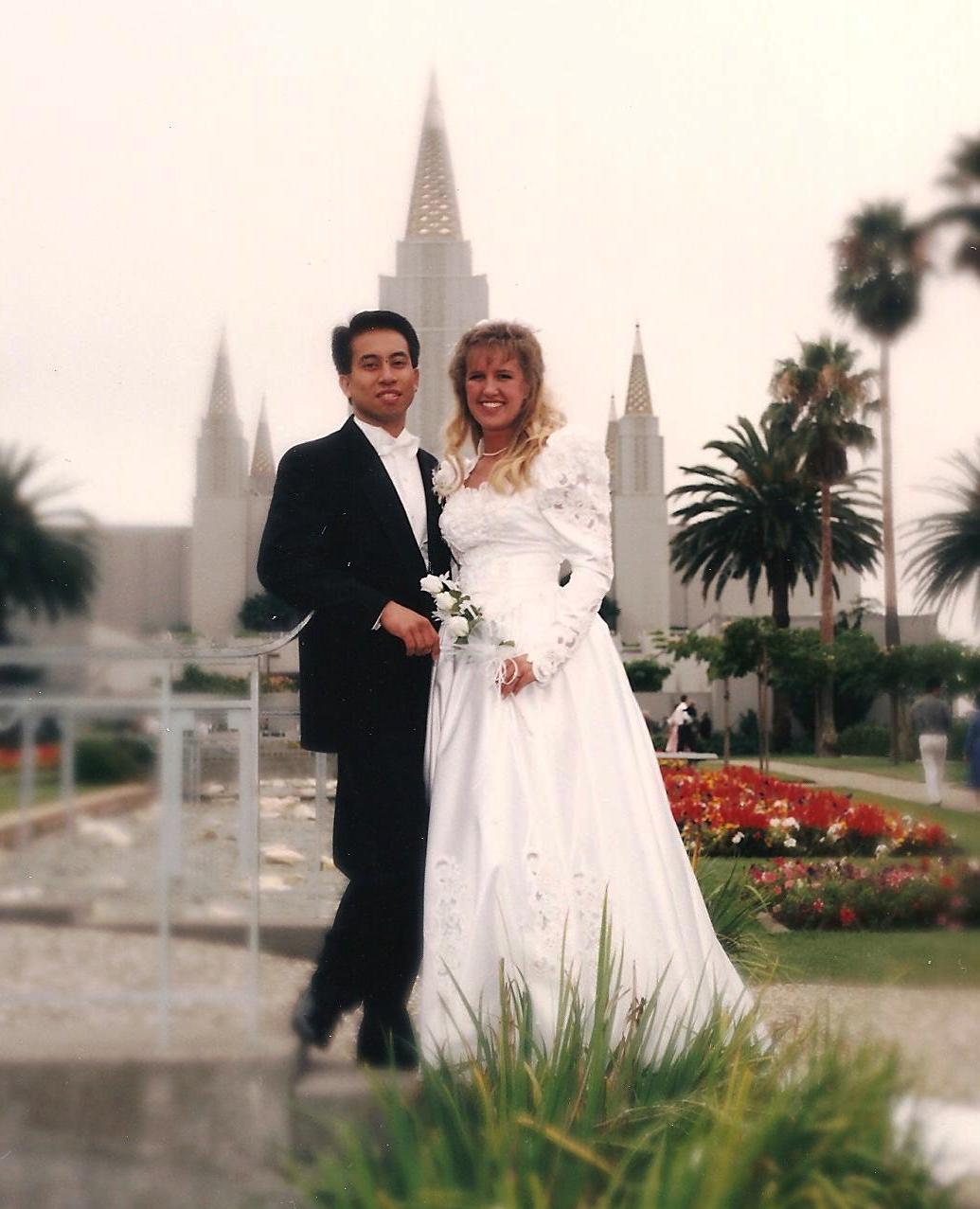
Here I am with my husband. He's often more self-sacrificing than I am, but we've taught each other.
Here I am with my husband. He’s often more self-sacrificing than I am, but we’ve taught each other.

I think what the success of this post tells us is that people in our society have lots of differing views of marriage, in addition to just wanting to clarify a couple of things in this simple post. One point is this: the post was written by a man, and as one woman wrote on Bustle, that’s kind of why it’s gotten so much attention. Women generally have been expected to be the ones to sacrifice, to give all of themselves, for their spouses and families. Men have been asked to provide. So for a man to say he needs to remember to be self-sacrificing is news (as goes the old journalism trope: it’s not news if a dog bites a man; it is news if a man bites a dog).

Another big point people are wanting to make is to clarify that we can’t do well in marriage if we ONLY focus on our spouse; we still have to do what’s important for our own well-beings. I don’t think that Smith meant to say that we shouldn’t be whole, mostly mentally sound people on our own or that we shouldn’t continue to make ourselves the best we can be as individuals; he just was making the point that in our society today, too many of us probably worry too much about ourselves without taking sufficient care to be selfless. This brings up a point I’ve thought about frequently after reading it in a book years ago: when someone is given advice, it’s tailored specifically for them and what they lack and could be totally wrong for someone else.

As an example, my parents never needed to lecture me about being more responsible. I was so overly responsible and focused on planning for the future that they had to encourage me to relax and have some fun in the moment. When I went to prom, they stood at the door and admonished, “Do NOT come home before midnight!” Now this would have been the opposite of what they would have done for my sister, who was more of a have-fun-in-the-moment kind of gal. She was better (and still is, I think) at carpe diem-ing. She’s been a good example to me in that way.

So what I am saying is that this young man needed to hear the advice his dad told him to stop with the anxiety about whether his upcoming marriage would be right for him and to consider more how he could give to his future wife. That’s what he needed to hear and it made such an impact on him that he felt the need to share it on his blog. And there are rightly going to be plenty of people who read his blog who are like him and will need that reminder; others will not need it for themselves because they are already very self-sacrificing. Those readers need a different, almost opposite, reminder that they should take time to make themselves more well-rounded, more complete, etc. And those people (or those who know and love them, it seems), who may very well be primarily female, are those who responded so strongly that Smith shouldn’t forget that point of view.

At the same time, I suppose I shouldn’t have been surprised to read from other bloggers that marriage isn’t about family and children. One guy writing for SFGate.com said this: “Many people enter marriages without a desire to procreate and this just doesn’t hold water for the ever-growing numbers of childless by choice couples.” I can only say that I essentially consider this to be just plain sad. I am still of the belief that marriage really is about creating families, about having children and rearing them to be great people and contributing members of society. (I won’t even get into the problems that this attitude is having on society, just one of which is that countries with low birthrates are now facing serious issues with there being too many elderly and not enough young people.) Yes, I do believe that a very few people really are not cut out to be parents, it seems, but far more who choose never to have children thinking that they fall into this category very likely would be the ones shocked to find themselves enjoying, appreciating, and learning from the experience of parenthood. Through parenting, we contribute to society and we grow as people through both the challenges and the joys we experience. I am one of those who really does consider those who choose deliberately never to have children to be a bit too selfish.

So marriage is for all of us. It’s for husbands and wives, it’s for children, it’s for society. Each of us can stand to do a little better to be selfless and help others; some of us can do a little better in developing ourselves as individuals.

Books that spark the imagination

It’s no secret I love to read. I am in awe of the amazing imagination of so many writers. But some books aren’t just imaginative in and of themselves; some actually stimulate and feed imaginative thought. For some reason, I’ve found these books tend to be ones aimed at middle readers (maybe it’s because that was a time in my life I felt most free to explore and imagine: now that might be another topic to consider). A couple of cases in point:

Chasing VermeerAnything by Blue Balliett. Reading her books is like attending a class for gifted students. I can say this because I myself had the privilege of going to special “gifted and talented” classes when I was in my middle-school years, and they were fun and fascinating and inspired us to think “outside the box.” I LOVED them. Balliett’s books feature protagonists who either attend a special school that focuses on inspiring kids to think differently while learning (in Chasing Vermeer, The Wright 3, and The Calder Game) or whose parents inspire them to imagine and think creatively (Hold Fast). She introduces all kinds of fun and interesting concepts to young readers, many of whom might not have had the opportunity to attend these kinds of enrichment classes. Her writing truly gets those brain juices flowing and makes all of the topics come alive, whether it’s art or architecture or the rhythms of poetry or the things you can do with pentominoes. She uses puzzles and riddles and hidden messages and makes readers do a little work, though it’s too fun to really think of it as such. Reading these books makes me feel like a kid again, set loose in a gifted-classroom setting.

The other book that gave me that same wonderful feeling is one a friend reviewed for my website, Rated Reads. As soon as I read the review of Chris Grabenstein’s Escape from Mr. Lemoncello’s Library, I knew I had to get a copy from my city library, first for my 11-year-old to read, and then for me to escape into.

LemoncelloThis one centered around the amazing resource that is a library, and it incorporated similar mind-expanding elements: riddles, puzzles, mysteries and clues to piece together. It featured the most amazing library that any kid (or kid at heart) could pretty much just live in, if given the opportunity. Just reading about the cool gadgets and state-of-the-art electronics incorporated into this fictional library made me almost drool with jealousy for the kids in the book who got to use it. And it features a rich, eccentric game-manufacturing benefactor who makes it all possible, á la Willy Wonka. Only this is better — as much as I love chocolate, this library sounds far more like a dream come true to me. Games, prizes, and a night spent locked in an amazing library? Yes, yes!

If you want to reawaken the creative kid in yourself, read these books. If you want to do so for your child, hand the book over to him or her.

My family dinner time is sacred

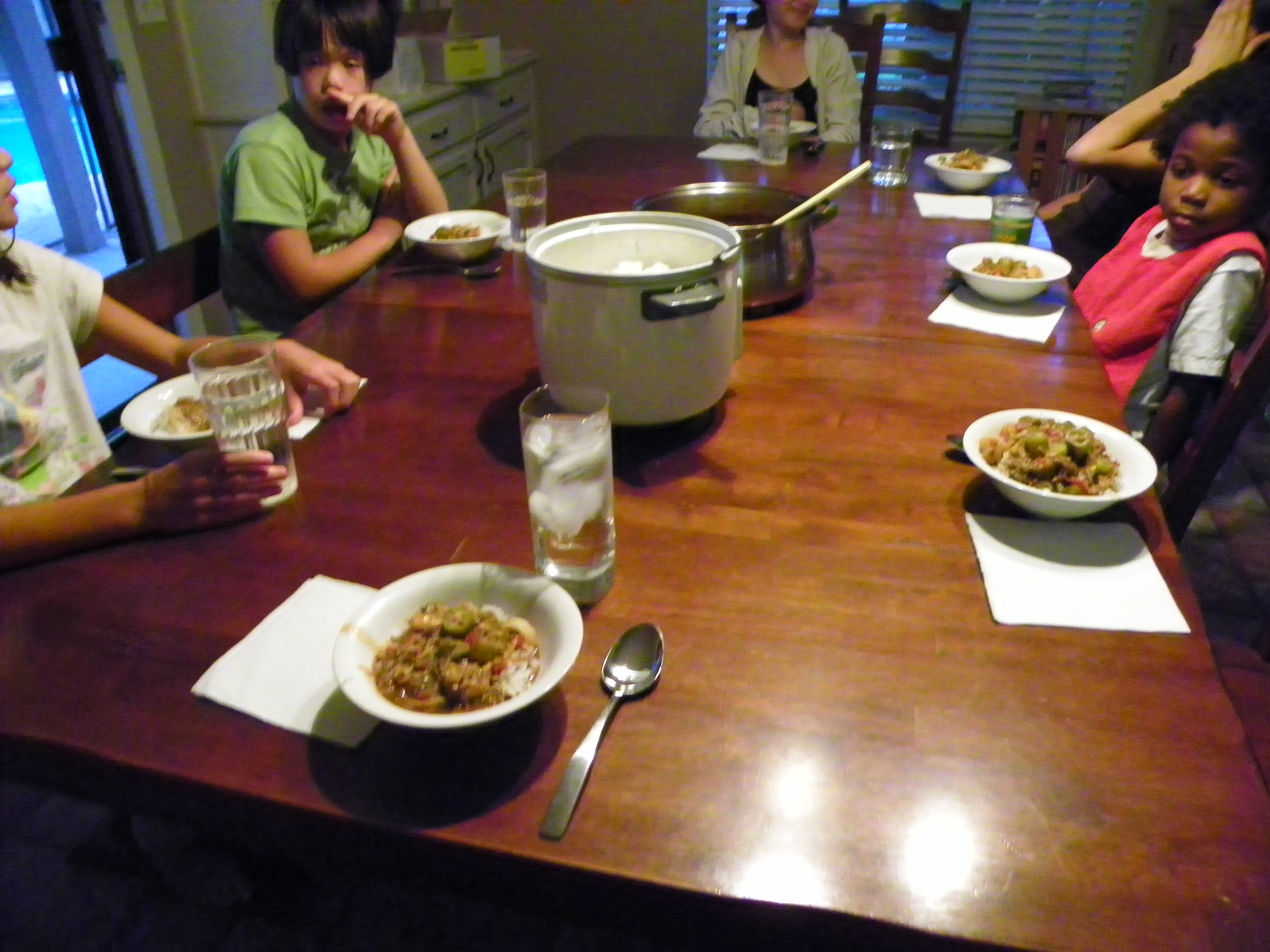
Here's my family gathered around the table to enjoy some homemade gumbo.
Here’s my family gathered around the table to enjoy some homemade gumbo.

Because of my involvement in some community organizations, I realized recently just how odd it is that my family actually gathers around the table for dinner. EVERY NIGHT. Yes, it’s true. I already knew that my practice of cooking homemade meals for my family was more than a little unusual, that many people don’t cook anymore but do some form of take-out most of the time instead (whether it’s fast food, mostly prepared food from groceries, etc.), but it just hadn’t hit me how few people eat meals together at home.

After running a few minutes late for a number of meetings for a booster club I volunteer for, I realized the reason I was the only one not there a few minutes early was that I was also the only one coming from home, from our dinner table (or maybe one of two). Our meetings have been at 6 or 6:30 p.m., right in the middle of mealtime. But rather than letting my family fend for themselves, even, I’ve just prepared meals earlier (though it’s been a little more stressful).

Everyone had told me for years that “once my kids got into high school,” they’d be so busy with extracurriculars that we’d stop our practice of mealtimes together. But my oldest is a senior in high school, and the one extracurricular that requires her to have an evening away (band practices in the evening) is only one night a week, and at 6:30. So we eat dinner together before she leaves. And our weekly youth church activity is at 7 p.m., so we all eat together before that. Other extracurriculars are late afternoon, before dinner. So, despite the dinner doomsday preachers, we have still eaten together as a family.

Yes, it’s taken some extra planning and a little extra work on my part. But it has been so worth it. I don’t think I need to point out that studies show how vital it is to eat together as a family, that each meal together bolsters teens’ emotional strength and happiness. I don’t really strive for meals together because of research. I do it because it’s fun, it’s enjoyable, it’s family bonding time. It contributes to our strength and happiness as a family unit. We’re not perfect or always happy, but we’re mostly happy together, and my kids feel secure and loved at home. Being together for dinner every night is just a part of the puzzle that makes home their refuge, their happy, secure place.

We talk about our days, we make jokes, we laugh as we quote from movies (we do that ALL the time; it’s just “our thing”: if we don’t slip in a quote from “The Princess Bride” at least a few times a week, something’s wrong). It’s all about togetherness, building and fortifying our camaraderie, our family identity.

Yeah, I think we’re now in the minority of families who eat together every night. I understand why many others have a hard time doing that; there are lots of good reasons for it. But I have fought to keep us together at dinner, and I will continue to do so, despite it being sometimes like swimming upstream, because it makes me happy. It makes us all happy. I hope I keep it up until our last little one has flown the coop, even when it’s just three of us sharing that camaraderie nightly.

American black babies being adopted outside the U.S.

So I read another article that just made my jaw drop. It said that while international adoptions are becoming more difficult, and thus are dropping in numbers, would-be parents from other countries are finding it fairly easy to adopt babies from here in the U.S. — and many of those are black babies, because there are more of them in the “waiting child” category.

Yikes. The article actually reminds readers that racial prejudice is still an issue here in the U.S. and that some black birth parents hope that by letting foreigners adopt their babies, that their children might face fewer racial issues in other countries, such as the Netherlands.

Here I am the first time I met my gorgeous baby Charlotte, the day after her birth.

As the wife of an Asian man and the mother of three biological children who are mixed-race (Caucasian and Filipino) and one adopted black daughter, I am certainly sensitive to racial issues. Most of the time, however, since I personally just don’t see any difference in who people truly ARE at their core regardless of what they might look like on the outside (and I suppose this also extends to disabilities, since one daughter has Down syndrome…), I tend to not think about racial issues too much. I’m not saying I’m being insensitive; I guess I just don’t think about it frequently because of my attitude about people and race.

But this article, though a bit shocking, isn’t a complete surprise; when we adopted our daughter, we heard that some other prospective parents weren’t interested in adopting a baby who didn’t share their race (i.e., since many were white, they wanted a white baby). And I knew there were some agencies and services out there that specifically work on finding homes for black or mixed-race babies (in addition to children with special needs), because they’re harder to place.

Again, as with so many issues today, even though we’ve come a long way as a country when it comes to race, we’re not color blind yet. And don’t even get me started on the hateful comments some people made about one of Mitt Romney’s sons adopting a black baby (as if it were for political purposes!). I just wish that prejudice and all the assorted other hatefulness out there didn’t have to affect babies.

Re-grieving

They say that when you have a child with a disability, you must grieve the loss of the “normal” child you expected to have. I did this for a few days when I first found out through amniocentesis that my unborn baby would have Down syndrome. After that, I was as eager as any mother to give birth to a new baby. And her birth day was lovely and exciting and “normal.”

As I’ve adjusted expectations over the years and figured out at different stages what she has needed to aid her in developing and growing and achieving her potential, I’ve mostly rolled with the punches. But even as she walked and talked much later than my older daughter and did lots of things her very own way and at her own speed, I was mostly unconcerned. And she was so CUTE, and everyone she was around adored her.

Here she is at the high school, just a few days after starting.

I didn’t anticipate the interesting dilemmas that would face me as she reached adolescence and age out of elementary school. I certainly hadn’t given much thought to puberty (wha??!). Now, as of a few weeks ago, she is a freshman in high school. Just having her enter high school gave me a few little late aftershocks of grief; my oldest is a senior, and I’m right in the midst of being thrilled and excited for her and everything that’s ahead while simultaneously being struck smack in the chest with loss knowing she’ll be leaving home. I’m reflecting on the weeks three years ago, seemingly just yesterday, when SHE started high school and had all these new adventures and experiences awaiting her. How could my talented, sweet, fun little bird now be so close to flying out of our cozy nest?

So you see the stark contrast in experiences, in feelings, I’m facing as my second-born enters high school. She has a very different future ahead of her, not bad, but just different. It’s one I am unsure of, that is not nearly as clear as that of my oldest, because it’s not a path I’ve already forged myself.

Yesterday I had the yearly IEP (individualized education plan) meeting with the teachers and other interested parties at the school. But this time felt so different than every single IEP I’ve attended for the past 15 years. I was struck again by how far behind she is academically, that given her abilities, she simply will not graduate high school with a diploma, will not master algebra, even, which I’m informed is the “lowest” math class they have available at the high school. We still struggle with simple addition. But that wasn’t too surprising; I hadn’t really expected her to “graduate;” she can receive a certificate of completion, though, and that was an outcome I was already aware of.

No, what cut to the core was hearing that the classes she’s in right now are probably not where she needs to be, not because they’re too difficult academically (even though they’re the really basic versions geared for those who need extra help) but because they still are not attended by her true peers. The kids in these classes have struggles, but they perceive my sweet little girl as weaker, as a target, and they tease her. She’s on the outside. And I HAD NO IDEA. Sure, it’s only a few weeks in, and I imagine the teachers were just waiting to broach this topic at this IEP meeting, but knowing that my daughter has been treated just a little badly by classmates BROKE MY HEART.

(I did find out about another option for her class-wise that will probably be the better place for her when it comes to both academics and peers/potential friends, and I am going to look into it, visit, probably switch her, but that’s another story.)

I got through the rest of that meeting, signed paperwork, listened some more, asked questions, and considered, but I was really just hoping it would end so I could leave and not burst into tears there in the classroom. I came home and grieved for a few hours. Even as my oldest went to her band rehearsal and attended an open house on college options and scholarships and did all the kinds of things I did 25 years ago myself, I grieved that my second-born would not do these same things.

Did I think I’d already accepted that outcome? Yes, indeed. But it just started becoming reality, and it was such a stark contrast. I still am unsure of exactly what my daughter will do; she probably will eventually leave home and live on her own, with others in an apartment or in a group place that’s fun and friendly and warm; she will most likely have a job that’s simple for her to do that she enjoys. But it’s different. And will she always be able to find a place where she has peers, where she can make friends who are like her? Because right now that hasn’t been happening these past weeks. Will I miss something again in the future where she’s being teased or not fitting in? I can’t bear to think of it.

Sometimes grief comes anew and we must revisit what we thought we’d already “dealt with.” We must adjust expectations again and face the reality we could only see through the hazy, murky lens of an uncertain future. And it’s OK to do so. As I grieve, I know I will come out of it with clearer vision and a renewed determination to help forge a happy, workable life for my second child. No matter what, I do know that she will be happy and will make others around her happy as well. She’s already done that for 15 years.

20 years and counting

Wedding 1

What to say about 20 years of happy married life? If it’s true that all happy families are alike, as Tolstoy put it, perhaps all happy marriages are alike and I have nothing to write about.

Perhaps I’ll write about what our marriage isn’t, to start. I hear so many people saying they are so lucky that they married their best friend. To be completely honest, I don’t know if my husband is my absolute bestie. Sure, I tell him pretty much everything, and we spend the most time together talking of anyone else in my life, but I think a couple of my female friends are still who I’d call my “best friends.”

I definitely don’t consider my husband my “soul mate.” There may very well be people out there who truly are married to their soul mates, and I guess I consider them lucky. But that’s not me.

My husband isn’t who I always dreamed of marrying, either. I didn’t picture myself with an Asian guy (I guess it never occurred to me); I suppose I assumed I’d end up with another Caucasian like myself, dirty blond, maybe, perhaps on the tall side, but not more than 6 feet. Maybe hazel or blue eyes. Nope, that didn’t happen either.

The person I did end up choosing to marry is 5-foot-8, Filipino, trim, good-looking but probably not someone who stops traffic. He has a laugh that cracks me up, and I love when he really smiles and it makes his eyes crinkle. I don’t get to catch this real smile in most photos because usually he strikes a funny pose (gah!), but when I do, I love to go back and look at the picture again and again. He has strong hands, very masculine.

I chose my husband not because I was hopelessly in love with him (though I definitely am in love with him, even 20 years later), but because I knew he would be a GOOD HUSBAND. After other dating experiences that disappointed me, I knew from dating Marce that he would do all he could to take care of me, to be kind to me, to try to do better when he did something that hurt or frustrated me. He was dedicated to being a husband, to someday being a father. He was excited for those roles. I had every confidence that he would always be there for me.

Twenty years later, I can say that I was right. He has worked hard to provide for our family, he has listened to my frustrations about all kinds of things and tried to do what he can to help, he has fully participated in taking care of our children (he changed diapers before I even did with our firstborn!).

We’ve had struggles; we’ve gone through trials. I’ve had moments, even days, where I’ve been angry at him. Our love story has sometimes been romantic enough for a movie; other times, it’s been laying low in the background as we’ve just gotten by, gotten through, raised our kids, tried to work, tried to sleep, tried to just make do. Some days I’ve disliked him a bit; most of the time, though, I’ve been reminded of just how much I do like him, for how fun he is, how laid-back, how pleasant to be around he is. He hasn’t made me laugh out loud a lot, but he’s made me smile far more times than I could possibly count. We’ve shared thoughts; we’ve completed sentences; we’ve understood each other well enough we haven’t had to say anything out loud. (At the same time, though, I’m flabbergasted by how he can somehow not hear and/or forget what I’ve told him three times or have absolutely no idea what I might like for a gift. Go figure.)

I don’t consider our married life any kind of fairy tale. Pretty much no part of our courtship was; the proposal left me wanting more (don’t get me started on that story). But we have shared a lovely 20 years and I expect many more in this life. Even better, I expect to spend eternity with him, because we believe that a marriage performed by the proper authority in our temples can truly last forever. (This short explanation from Mormon.org may be of help:)

Most people think of a marriage made in heaven as a rare occurrence in which both parties are deeply in love and highly compatible. We like to think that all our marriages are made in heaven. When a man and woman enters one of our holy temples to be married, they covenant (or promise) they will stay together forever—on earth and in heaven after they die, if they are faithful to each other and their promises to the Lord. A temple marriage doesn’t include phrases like, “Till death do you part” or “So long as you both shall live.” If we keep these promises, our children also become part of this heavenly promise—sealed to us forever. Read more about the importance of family at Mormon.org.

In short, it’s been an eventful 20 years. It’s not been easy, it hasn’t been a fairy tale; it’s been hard work. But I am grateful for every moment and for this good man who has been so good to me.

How much should we really say ‘anything is possible’?

I’ve thought about this idea a lot, but seeing this little article reminded me: “Do we really want cartoons telling our kids they can do anything?

Now, I haven’t been thinking a lot about the idea in terms of cartoon or movie themes, but the media portrayal of this concept is one facet to consider. I can’t count how many times I’ve seen motivational posters, pins, memes, etc. online or somewhere out and about that say something to the effect of, “If you work hard enough, you can do anything you can dream of!” In the case of this article, it addresses the related but even less likely trope, “If you dream it and believe hard enough, it can happen.”

I don’t believe either one is right, true, or even healthy. Let’s just think about this: how many people do you know of who dreamed of being NBA stars or actors? How many of them actually achieved their dreams? My husband played basketball in high school and was pretty talented. Problem: he’s only 5’8″. I think there have only been a handful of players in the past few decades of NBA history who have been that short. So my husband still sighs sometimes: “If only I’d been taller.”
I also happen to know a couple of people personally who became actors. And they’re not even particularly well known. But they are making a living in the movie business.

pie in skyI’m in no way saying we shouldn’t encourage each other, particularly children and teens, to dream big. But at the same time, we’re doing them a disservice if we tell them “all they have to do” is believe hard enough or work hard enough and their dreams will come true. Because in reality, those kinds of pie-in-the-sky dreams don’t usually come true for most regular people. Even those who dream of going to a particular university (which isn’t quite as lofty or nearly-unattainable) quite often can’t, no matter how talented or hard-working they may be. Sometimes we may try and try and work really hard, but things just don’t fall into place; there are mountains in the way that we simply can’t climb over or move.

Even as I write this, I must clarify that I’m an optimist. I love to encourage people and to shoot for the stars myself. But I’m also midway through my life, and through personal experience and plenty of observation, I know what reality tends to be. What the odds are. Sure, we hear of stories of people who “beat the odds.” But the nature of “the odds” is that one person is the exception to the rule, while the rule comprises a million others. Only a few win a million bucks in the lottery; the rest lose lots of hard-earned cash.

Let’s still encourage each other and young people to work hard, to do their best, to dream, to envision futures that will please them. But let’s also help them to shape goals and futures that are realistic, that have a touch of “dream” to them but still a good chunk of attainability. Because don’t we want more people to really be able to achieve their goals and find that glowing, wonderful satisfaction in reaching that star, even if it’s still in our own galaxy?

Another summer over, another to-do list undone

My four girls all started back to school today. It’s a delightful year in which the two older ones are both now at the same high school and the two younger ones are both at the same elementary school. (Next year, though, the oldest will be at college and the three others will all be in different schools.) It’s the last year of free, living-at-home education for my oldest, and I dread her flying the coop. But for now I have her for this one last year. All in all, good things.

Again, as always happens come August, I am relieved to have the school break over with and my children back at school. Honestly, they are too. They had a fun summer, but they really do enjoy being in school. They enjoy the learning and the socialization.

But I find myself with mixed feelings. I’m not just jumping up and down that my kids are no longer constantly underfoot. I feel regret about not having done anything I’d hoped to do with them (aside from the trips we planned to take and actually went on). Even though I know in reality my best shot is just to get through two and a half months with four children always around with my sanity mostly intact by the end, I still foster these high hopes of doing extra things for and with them.

For instance, this year, as I also had thought of last year, I wanted to teach the oldest and the third one, who’s ready for it, the rules of grammar. They’re great at English and always do well on tests because they naturally “know” how everything should sound and be, but they have no idea what most of the rules are. I don’t think schools are really teaching that so much anymore, so I’d hoped to go over some rules and even do some sentence diagramming. Did we? No.

I’d also hoped to take a little time here and there to introduce some basic piano concepts to my youngest. She’s not ready for real lessons, but I had thought I could teach her some basics. Did I sit down at the piano with her once? Nope.

I had thought I might take some time to learn a bit more about how best to grow herbs here in our area and finally successfully grow a few out my back door. Did I grow a single one? No, indeed.

I think I actually had fewer expectations and plans for this summer than I did last summer. But I still feel I got absolutely nothing ticked off that fairly short but apparently grandiose list. As always, I just survived. I feel so much happier and can do more (including more with my kids) when I get regular blocks of time to myself. And it’s so much harder to get any time to myself during the summer; it’s so hit and miss and not nearly enough. I need regular refills of time and when I don’t get them, I am running on empty, and it’s not a pretty sight. You can just smell the burning.

With a lot of summers under my parenting belt now, you’d think I’d learn from the experience not to have any expectations for doing anything cool with the kids. It’s sad, but it’s true. We went on our family trips, and we went to the library every week. We read together. I made breakfasts and dinners. I made them a bubble table (which they used for about a week) and bought them a bunch of paints and rolls of paper (which they used for about two weeks). That’s the extent of my mothering fabulousness. But I’m just not one of those moms who relishes every single moment with the kids and who loves to get down in the dirt with them or … whatever looks so great on someone else’s Facebook wall or Pinterest boards. I enjoy them sometimes; I do cool things with them sometimes; other times, I just want to be left alone. And that’s OK.

Perhaps next year I’ll finally ease up on my expectations for myself. But, knowing myself, I probably won’t. But I guess it’s time to just let my regrets go and just start celebrating the start of a new school year and some very welcome and necessary time for myself.

Down syndrome ‘cure’ research creates flurry of questions

Yes, she lights up our lives just as she is, but any improvement for her would be great too.

I have a child with Down syndrome, but I’m not involved in the “community” in any way at this stage of our lives. (When she was little, I was on the board of directors of the local Arc, which advocates for and serves people with disabilities, but that’s pretty much been the extent of my activism or involvement.) I get a monthly email from the National Down Syndrome Society (or is it Congress? see: I don’t pay a lot of attention), and I sometimes read it. But generally, I don’t pay a lot of attention to the latest news.

This month, I’m late to the party in hearing about this latest bombshell of research: scientists have found a way to “silence” the extra chromosome that causes trisomy 21 in the lab.

Whoa, dude.

I’m still trying to get a handle on what the research really means. But essentially, it could mean there could be some kind of treatment developed in the future to help reverse some of the symptoms associated with people having a whole extra chromosome. Biggies: maybe reducing the likelihood of heart problems or even the cognitive delays that affect all people with Down’s. Apparently, it couldn’t “cure” DS before birth, but it would be a treatment sometime during a person’s life.

Of course, people who have children or other family members with Down syndrome, or who are self-advocates, have varying opinions about this news. Some worry that “curing” DS would remove a valuable segment of the population that arguably helps teach others about love and understanding.

Here’s my take: if it’s possible to give my daughter a better life, I’m all for it. Of course, I love her just the way she is, and I love how she is just herself and how she contributes in her unique way to our family. But I have every confidence she would be just as wonderful and a delightful contribution to our family and to the community if she didn’t have Down’s. I am not actively seeking or hoping for a cure. No, but if this research were to lead to some improvement in her life, even a drastic change, I’d still take it. If it allowed her to be able to (finally) understand math, for heaven’s sake, I’d take it. Why not?

I don’t expect that this research will lead to any real change or treatment within her lifetime, really. But in the land of what-if’s, I’m firmly on the side of taking a cure. I don’t think Down’s makes her the delightful, amazing kid she is; I think she’s just that person anyway. And if she could lead an even more productive and healthy life, I’d let her. Doesn’t every parent want the best for their child? I know I do.

As for the idea of taking away a whole “culture,” I still feel there are plenty of other people with disabilities of varying types that still teach us that extra love and compassion. I don’t see us curing any of those things wholesale. It would just be a strange kind of selfish to just keep people with a disability disabled if they didn’t have to be, just so we could have another way to help people be compassionate. That just seems upside-down and weird to me.

I’ll be interested to see what comes of this research. I won’t hold my breath for a cure or any real life-changing treatment from it. But it’ll certainly be interesting to see what happens.