Clean romance: does anyone want to read it?

So as those of you who pay attention to my “reading life” posts know, I review books. I have for years now. I run a website, Rated Reads, that exists to help readers know about the potential offensive content of books they might like to read. I think it goes almost without saying that I tend to prefer and appreciate books that don’t have lots of offensive material, be it vulgar language or sexual situations or even violence. I just clap my hands with joy when I find a book that’s just great in every way AND doesn’t have offensive content. Yay!

There are all kinds of genres and sub-genres out there: sci-fi, fantasy, paranormal fantasy, historical fiction, memoir, biography, young adult, romance, self-help, science, business … the list goes on forever. But certain types of genres sell particularly well overall, and some get extra attention during “fads.” Ever since Twilight, vampire love stories are very of-the-moment. And now it’s Fifty Shades of Grey. No vampires, but the protagonist is still super-hot and super-rich, just like the Twilight hero. In the case of this uber-popular new series, the love story isn’t necessarily about forbidden or supernatural love, but it’s about kinky sex, explicitly detailed in the book.

Um, no thanks.

So while those books are flying off the shelves and, most of all, being furtively downloaded onto e-readers, where no one else can tell what the purchaser is reading, I still say, Publishers and authors, please give me some great clean romance. Men often wonder why in the world so many of us women swoon over the Regency-era books, where the happy couple don’t even necessarily get a single kiss. I’ll tell you why: because the fun of romance is in the chase, in the slow buildup of longing looks and quiet exchanges of meaningful glances and words. It’s amazing to have a man treat us with respect and chivalry. I just don’t want to read about some gallant hero spanking a bound woman. Gah.

One of my review contributors, Teri Harman of Book Matters, talked about good clean romances on today’s KSL-TV Studio 5 segment:

 

She asked me a month ago what books I recommended that would fit the parameters. I pored over all the reviews I’ve written over the past four or five years and posted on Rated Reads and, sadly enough, came up with an extremely short list. This is what I wrote to her:


  • Major Pettigrew’s Last Stand is a delightful romance about an older English gentleman and a widowed Pakistani woman. I rated it mild for some language.
  • I really enjoyed all of Carrie Bebris’s books continuing the story of Darcy and Elizabeth Bennet. They’re mysteries, but they’re love stories as well in Austen mode. I like that she does a good job with them and feels true to the originals.
  • I loved Erin McMahon’s I Now Pronounce You Someone Else, a sweet YA book that I rated moderate for teens but mild for adults. Nice bonus: main character is saving sex for marriage, and she sticks to it.
  • I did enjoy Edenbrooke, the first in a new set of books that will be published by Deseret Book called “Proper Romances.”
  • Flipped is a very charming middle-grade book about two eighth-graders. Very cute.
  • Of course, I liked Austenland, but I’m sure other people know about that one by Shannon Hale.

What’s striking is that three of them are either Regency/Austen-type books or are patterned after them. Two are written by authors who are members of The Church of Jesus Christ of Latter-day Saints. Though they aren’t the Christian genre, their authors are going to decidedly keep their writing fairly clean because of their religious beliefs. So, sure, it might be easy enough to find a decent enough clean romance because it’s either a classic or patterned after a classic or because it’s in the Christian genre, but finding just any other romantic books out there in general fiction that aren’t some type of genre that demands or expects clean content is a tricky task.

So, yeah, authors and publishers. The dirty stuff apparently does sell. But so does the clean stuff. If you’re going to hop on a bandwagon, can you please hop on the latter one? ‘Cause I’m not riding the dirty wagon or patronizing it in any way. Thanks.

My starfish friends

Thanks to my girls, I’m pretty familiar with the tween movie “Aquamarine,” about a teen mermaid who gets some time out of the water. In one scene, she introduces her new girlfriends on land to the earrings she wears, small starfish that “compliment her.” And no, she doesn’t mean “complement her.” She says, “They literally give me compliments. They talk to me. Starfish are notorious suck-ups. They love to give me compliments.” She picks out a few great specimens from the sea and proceeds to attach them to her earlobes and those of her friends. The starfish latch on and very pleasingly spout many sweet sayings into the girls’ ears. “Aquamarine is soooo lovely. She is awesome. And she is so smart, yes, like tuna.”

I’ve often thought it would be perfectly wonderful to have my own set of starfish earrings. Every woman, especially busy, harried mothers, needs that kind of encouragement on a very regular basis. Some men are good at being starfish for their wives or girlfriends; many are not. This doesn’t mean that women don’t need to hear good things to buoy them up through their busy days.

Me, I like to hear that I’m still pretty, though I’m older and thicker around the waist. I like to hear that I’m smart and talented and capable. I especially need to hear that I’m doing OK, that my efforts for my family and my community and my own interests aren’t unappreciated or just going to waste. I want to know that I’m needed, that what I do matters, that my choices have been good ones, even though sometimes the outcomes haven’t been what I’d anticipated. I need those encouraging words like … well, like a fish needs water.

I have some friends who are particularly great starfish. They give me that encouragement, those sincere words of appreciation and caring that keep me going. I just wish that I could carry those wonderful friends around with me in my pocket or attached to my earlobes! But I’ll take what I can get. Their love and support keep me breathing, keep me moving on, keep me strong enough, just barely, to persevere through busy and frustrating days and weeks. I salute you, my dear starfish. You are my lifeblood. I hope I can be as useful and loving a starfish to you as you have been to me.

Motherhood: from pack animal to beauty queen and everything in between

As I hit 42 yesterday and pretty much suffered the “epicenter” of a nervous breakdown that’s been brewing for a few weeks, I had a few epiphanies. One was this: I can totally understand why a woman my age would want cosmetic surgery.

Why? At this age, I’ve given birth to four kids and don’t expect to give birth any more. What’s done is done, baby-wise. Now I’m into a different stage of mothering, one I didn’t expect to make me as crazy as the stage of early childhood (and I really thought that was tough): having kids of varying ages, able to fend for themselves in survival-type ways, but dependent on me in completely different ways, ones that are actually somehow more important to who they are and who they will be. They need guidance, not just food and clean bottoms. My girls range from ages 16 down to 5, and each has specific needs related to her age and unique personalities and interests. None are heavily involved in lots of activities, but just having a few activities all together, along with the usual things to support them in, adds up to a lot of work on my shoulders, a lot of expectations and four precious, amazing young people relying on me to help them grow and develop as good human beings.

Yep, that’s me. Anyone need to add on another bag?

So lately, what with it being “birthday month” at the Lim household, and near the end of the school year, and all the things that go along with those events, I have felt like I am merely a donkey, laden with a huge pile of heavy packs, trudging along, trying to knock off a pack or two at a time. Even as I do so, more packs keep getting laid on my back. I’m about to collapse under the strain, my hairy donkey legs splayed out to all sides at cartoonish angles, my belly and chin flat on the ground.

Every mother has these kinds of obligations, especially at this stage of parenting, and they never fully lift. But every mother is also a woman who just wants to feel pretty and special and … womanly. Sure, I’m not 21 anymore, and I don’t turn guys’ heads, and that’s OK. But I’d like to feel occasionally that I can still turn one man’s head, that I am an object of desire and fascination to him, not just the pack burro who takes care of his home and four kids. It’s really easy for life to get so unbalanced with scheduled events and obligations that each parent becomes an automaton, fulfilling those obligations but losing themselves and their “hearts” in the process.

In interviewing doctors and others, I have learned that most women who have cosmetic surgery are either at the beginning of their reproductive lives or the end. The surgical improvements are done either before childbearing and, often, before attracting a mate or after giving birth to a whole brood and closing up shop in the womb. I’ve talked mostly to women who are in the latter category. They’re mostly parents to children of varying ages and are often stay-at-home moms. I suspect that they’re feeling overwhelmed, out of balance and pretty donkey-like, much as I am feeling right now. I can imagine the siren call of surgery would be very tempting right at this point, when a mother can easily feel very undesirable physically — not necessarily even because she really does look significantly older or plumper or scarred because of giving birth, but because she just doesn’t have time to feel attractive and be a woman, rather than a mom.

Every mother needs to explore and regularly experience that side of herself that is simply a woman, with her own unique beauty and personality. If she doesn’t have time to feel feminine and admired somehow, it’s going to throw her off her game everywhere else. Unfortunately, I don’t have a whole lot of answers as to how to solve this very common problem of unbalance (if I did, I’d probably be a millionaire). I just know that somehow it’s vital to find that balance, to find some time to be pretty, to be oneself, to feel one’s husband turn and look appreciatively, even if that admiring gaze must skim right over a toddler with a smelly diaper and a high school student who needs help with homework or finding a modest prom dress. I know that husband and wife both need to find the time to be themselves, to be just a man and woman who still find each other interesting and attractive. I doubt that plastic surgery can permanently solve these issues, but it certainly would sound tempting as a temporary measure.

Me, I’m just trying to figure out how to stand back up, shoulder my load and trudge on, and balance my life a bit better so I can at least sometimes put down all my packs and revert to my womanly form for at least a little while. Fairy godmother: can you wave your wand for me, please?

The Most Interesting Woman in the World

I’m not a beer drinker, nor do I hope in any way to promote drinking. But when I watch commercials, I have to admit I do get a kick out of beer ads.

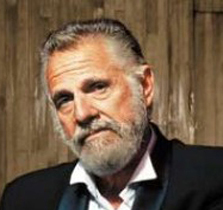
I’ve been thinking about Dos Equis’ popular character, The Most Interesting Man in the World. The ad agency’s idea was that this man would be “rich in stories and experiences:” so says Wikipedia. But I’d like to elaborate and list a set of characteristics of this fascinating male specimen.

  • “Man’s man”: the epitome of masculinity
  • Ruggedly handsome
  • Experienced, well-educated, well-traveled
  • Sophisticated
  • Suave
  • Ladies’ man (implied he could have or has had as many women in his bed as he’d like)
  • Sexually desirable
  • Discerning, tasteful
  • Well-dressed, sense of style
  • Strong, well-built
  • Everything he says is compelling, so people hang on his every word
  • Accomplished — at everything
  • Sought-after — by everyone
  • Mature, even “old” (the actor is 73): gray-haired, wrinkled, bags under his eyes

Now. Let’s look at these set of qualities as applied to a “most interesting woman.”

  • Beautiful
  • Experienced, well-educated, well-traveled
  • Sophisticated
  • Feminine, ladylike
  • Sexually desirable
  • Great taste in everything, whether it be home furnishings, cars or houses, jewelry, clothing, etc.
  • Impeccable sense of style
  • Lean, takes care of her body by going to the gym every day or, better yet, working out in her home gym with her exclusive personal trainer (yoga, Pilates, Zumba, etc.)
  • Compelling person to listen to
  • Accomplished
  • Sought-after
  • Mature, even “old”: a 70-year-old woman with gray hair, wrinkles, and bags under her eyes
  • Sexually experienced, bedding hundreds of men over the years

And here is where I have a hard time finding a photograph that would work, that any advertising agency would grasp onto as a winner, as a surefire way to get positive attention and loyal followers. The sticking point is age. Yes, there are a few women still busy as actors, but most of them are being cast as someone’s grandma or as a hilarious old lady who shoots off one-liners but is still endearing and mostly happy to hand out hugs. My husband told me, “Betty White, of course.” Yep, that amazing woman is still getting lots of work and making millions laugh. But she is not held out as a universal sex symbol, even though she does like to make naughty jokes. Can you really see Ms. White being used in an equivalent Dos Equis commercial (NOT for laughs; think the Snickers commercials)?

Here is where it really hits me just how much of a double standard there is in our culture regarding age. For men, age is desirable because it makes them wiser, more experienced, more fascinating, even mysterious. Some gray hair and wrinkles make men appear “distinguished,” not “old.” Men who look distinguished and have experience are sexually desirable, and even young women will hang all over them. (Are there any 50-year-old or 70-year-old women surrounding the Dos Equis man? Noooo. Those females are all in their 20s.)

Women, however, are not allowed, let alone encouraged, to grow old naturally. There are plenty of women in Hollywood who are being praised for “aging well,” which generally means they are touted for looking 30 when they are biologically 50. They modestly proclaim that their regimes of a vegan diet, drinking lots of water, avoiding the sun, never missing Pilates, and faithfully moisturizing have kept their faces and figures looking youthful. The women who look 50 when they’re 50 end up either being pushed out of the profession or playing someone’s grandma because looking your age is NOT “aging well;” it’s embarrassing and shameful. And 70? That’s a small club of actresses indeed. They never get to be surrounded by young, hot men hanging on their every word, hoping they’ll bed them (maybe for comedic purposes, but not in any seriousness.)

I’d like to propose that we women fight back. Let’s make ourselves the Most Interesting Women. I’ll use myself for an example, but I’d encourage each of you female readers to put a photo of yourselves somewhere with a list of your best qualities (or post that list on your mirror).

  • 40-something, middle-aged, wiser than I was at 20
  • More stylish than I was at 20, I have a better sense of what I like, what reflects “me” and what looks good on me.
  • Great, authentic, winning smile. That hasn’t changed, no matter how old I am. I love to smile and I love to make other people a little happier by shining it on them.
  • Attractive, especially to my husband, who thought I looked beautiful even when I was about to give birth and looked like I’d swallowed a torpedo.
  • Well-traveled, at least throughout the United States
  • Well-educated and well-read
  • Accomplished and well-rounded
  • A very talented cook and baker, I feed everyone well, and I do it on a budget. (“We eat well aboard the Tweedledee.” Guess the movie.)
  • Musical
  • Humorous (well, in a geeky way)
  • Not as lean as I once was, but softer and more classically beautiful, I still love to exercise. It just feels good.
  • Versatile
  • Sought-after (for getting things done)
  • Desirable (and you are not getting any details here)

What do you say, ladies? Tell me how you are fascinating.

Ann Romney and moms who ‘don’t work’

Well, the latest crazy statement by a political commentator has made its way through the blogosphere today. Since it is such an integral part of my life, I feel compelled to comment.

Here’s the basic info: Hilary Rosen, a Democratic strategist, said Ann Romney wasn’t qualified to talk about women struggling in the economic downturn because she “hasn’t worked a day in her life.” Naturally, this opinion has ignited the ire of many women, stay-at-home moms or not. Rosen made this comment while trying to make the point that because Ann Romney hasn’t held a job in the paying workplace, she can’t be qualified to have an opinion about economic issues that affect women, and can’t be a useful advisor to her husband. First, I must point out that it isn’t necessary to be the one in the family holding down a paying job to be concerned about how the economy is going and how it affects your family, no matter how much money your primary wage-earner makes. Second, and the real ignition for the fire, the comment then belies Rosen’s derisive attitude toward women who choose to stay home to raise their children.

I always find it a little absurd that women who are generally of a liberal slant, who shout about the need for women to be able to “choose,” such as about their own reproductive lives, then turn up their noses at women who make a different choice than they would in family matters. “Choice” implies that there are varied options available, and that it is an individual’s right and privilege to decide among those very different options. It also implies that any of those options are ones that should be respected by others. But in our society today, if a woman chooses an option that others frown on, that woman is often derided and called “old-fashioned.”

I am a mother of four, and my daughters’ ages are in a wide range, almost 16 down to nearly 5. I have two teenagers, an elementary schooler and a preschooler. They have very different needs and schedules and temperaments. I chose from the beginning of my reproductive life to be a mother who would stay at home with her children, and I have held to that. Over the course of 16 years, I have worked part-time out of the home (15 or 20 hours at the very most) for perhaps 3 years total, when financial realities have indicated that my income would be necessary. Right now, I work from my home office on the computer for pay for maybe 5 hours a week. The opportunity to copy edit online has been quite welcome, has added a little extra income, and has kept my skills fresh. I feel blessed not to have to leave the house to do it. I also have various projects I do in the hopes of earning pay from them in the future and/or because they are intellectually and creatively stimulating and satisfying. I also feel blessed that I have the freedom to be able to pursue these projects.

There is no doubt that our economy right now has forced many families, two-parent or otherwise, to make decisions they wouldn’t otherwise have made. Both parents might have to work outside the home; single parents have to work. Wives may work and laid-off husbands stay home with the kids while they continue to search for employment again. It’s not a happy time. Even in brighter economic times, families made decisions that were either “modern” or more “old-fashioned,” according to their needs and wants and interests. Sure, I’d like to see more women able to stay home with their children, at least not working out of the home 40 hours a week, because I personally believe it benefits the kids when that situation is possible. But I know how it feels to just be home with the kids ALL THE TIME. Getting out of the house to a job where you’re appreciated, patted on the back, given breaks and more immediate gratification than a 20-year-long project is definitely an enticing prospect. And a paycheck? It can mean college tuition for your kids, a car that isn’t 15 years old and in the shop every other week, or just a reflection of a job well done that other people in society relate to and recognize. But mothering at home full time? No paycheck, no regular gratification, no guaranteed breaks, no good reason to put on a nice blouse and makeup.

But we still live in a society in which women are just not that great at respecting each other’s choices. Hilary Rosen is just a case in point. Why can’t we just admit to ourselves that we’re all very different and have very different backgrounds, life experiences, needs and wants, abilities, interests, weaknesses, and capacities? Whether we as women are married or not, have children or not, we are going to see the world in very different ways. We also aren’t just polarized to one “side” or the other: we might be working full time but wanting to stay at home; we might be staying at home with kids but really wanting to get out into the workforce. Or we might be working outside the home part-time or working from our home offices. There are a variety of flexible options available so we don’t have to be “one side” or the other: full-time workers or full-time stay-at-homes. (At the same time, our society definitely needs to figure out ways to make more truly flexible options available to both women and men to support families and children.) So we can’t expect everyone to make the exact same choices we do.

I know it took me ages to get used to being the mother of an infant, then a toddler and an infant and then more. It just made me crazy to be at home 24/7 with a very demanding little human being. I wanted to get out and work, do something for me. Even now, the demands of a home and husband and four daughters of varying ages can at times be super-stressful and overwhelming. And my own expectations of what I’d like for my daughters, what I’d like to be able to do for them, are usually more than I’m possibly capable of fulfilling because of time and energy limitations. I can’t possibly be in the high school band boosters and the elementary school PTA and the middle-school PTA and work from home and do my projects and volunteer in church and be in charge of other things and write a book and make muffins every day for breakfast and four-course meals for dinner and shop for food and clothes and do laundry and clean. I can’t be two places at once, which sometimes comes up with four kids. Choices must be made, and they’re rarely easy ones. It’s all about balance and constantly reprioritizing and rebalancing.

At the same time, despite how different we all are, I know that any mother, working outside the home for any number of hours or not, faces similar concerns and struggles to keep balanced, to keep all her balls in the air. So why in the world should we criticize and demean and make nasty comments, rather than using those energies to support each other in our choices and figure out ways to make our society better for everyone? Let’s let “choice” mean something.

“Love by assignment”

My church has a women’s organization called the Relief Society that was established in 1842 with just a small group of women. Now there are millions who belong to the organization, all around the world, from all kinds of backgrounds and life situations.

I think one facet of the organization I have always appreciated is a program called visiting teaching. The woman who has been assigned to be the president of the Relief Society in each congregation, or “ward,” takes the list of all the women in her group and divvies it up so that two women generally are given maybe four or five other women to watch over and, ideally, to visit every month. I once read about it being “love by assignment,” and I think that’s a great description.

I have enjoyed the program because it has allowed me to get to know many really great women I might not otherwise have had the opportunity to get to know so well. I have become acquainted with women by being assigned to visit them and by being visited by others. What’s been most rewarding is knowing that I have a simple way of being able to help someone else in whatever ways they might need. If someone I visit has a baby, I can take in some food. Or I can send a card and goodies when she celebrates a birthday. Or I can just pray for her especially if she’s facing a problem I can’t do anything else about. And I always hope that each woman I’m assigned to feels comfortable to call me if something comes up in her life she might need help with somehow, without me having to ask all the time if there is something.

This program has also allowed me to make some fast friends. I have a very dear friend now who has been a constant in my life, a source of strength and just fun, whom I met because she was assigned to be my visiting teacher some 16-plus years ago. It’s very possible we would have connected if we hadn’t been put together that way, but maybe we wouldn’t have. I shudder to think what my life would be like without her.

And I’m making new friends all the time. Often, we don’t get the chance to cross paths in our congregations because we might be assigned to teach children’s classes or something and we might end up at opposite ends of our church building during our meetings. And we might not think to sit near each other at a potluck or other activity. So when I get to visit someone new I haven’t gotten to really talk to before, I am often very pleased to find I’m making a new dear friend. Our assigned visits then turn into two- or three-hour “hangouts” where we just chat and bond. What’s not to love?

People outside my church may just consider this a nice program. I, however, see it as one that’s inspired from a God who loves me and his other daughters and wants us to be able to serve and be there for one another. I am always grateful for the great friends I’ve made because of this inspired opportunity.

Beauty and the backlash

A few months ago, I started interviewing women who elected to have cosmetic surgery. Today KSL.com published my compilation of (a little of) what I learned from them.

I knew it would certainly get people’s attention — as well as opinions and comments. As I’ve read the comments left on the article, I’ve wanted to respond to many of them. Since I can’t really do that there, I’ll take a couple of points here.

My first response is that this article is only a little piece of the story. The previous articles I’ve researched and published are also pieces that contribute to a whole picture, which is still only slowly forming, about what might be a trend of elective surgeries happening in Utah. So as people say, “Well, what about the influence of media?”, for instance, or “What about how men see and treat women (including the huge problem of pornography)?” I say, those are  good points. I’d like to get to those  in future articles or a book or just on this blog.

My second reaction to many commenters is that this issue is more complex than it may seem at first glance. Many either say, “Why worry about what people’s personal choices are? Let them do whatever they want” or “Those women are so vain! They should accept who they are.” It’s easy to just pick one of those two opinions. But in speaking to these individuals, I found myself empathizing and just enjoying our conversations. In addressing the second widely held opinion, for example, I would say, You know, I liked these gals. We’d probably hang out or be in a book club together. We could be sitting in a gym locker room or a mothers lounge or any number of places, commiserating about how giving birth has drastically altered our bodies, how we’re dissatisfied with our soft, squishy bellies or our stretch marks. I get it. I am not happy with how I look, and honestly, I’m having a slightly difficult time coming to terms with what aging is doing to my body.

I didn’t find these women to be shallow, vain, or self-centered in the 30 or 45 minutes I spent talking to each of them. One of them specifically told me how she’s tried very carefully not to wear revealing or tight clothing or act any differently since she had her mommy makeover. She doesn’t want to change how she acts or looks or puts herself across to others. She doesn’t want to become immodest, or, heaven forbid, immoral. She just wants to feel more comfortable in her own skin (now less saggy than it was).

Having spoken with them and empathized, I don’t want them to be seen as some kind of poster children for vain women who care only about their appearance. They’re not all that different from the rest of us who have complained about how we look. The big difference, however, between them and those of us who have merely complained is that they have gone far enough to invest a sizable amount of money in a change and to take the risk of subjecting themselves to surgery, which always carries the possibility of harm. Granted, in the hands of a certified plastic surgeon and with many procedures now “routine,” the risk of death or other serious harm is fairly low, but it is definitely a risk and something one must seriously take into account. This seems particularly of concern when the patient in question is a mother of children still at home, and if she does die on the table, she’d leave them without a mother. These women did consider those issues and still chose their course.

What I’d like to come of all this is a conversation. Our culture in America today encourages women to think of themselves as objects, to look first at how much we weigh, if we jiggle in good or bad ways, if we are sexually attractive, if we still look young and as fresh as we did before giving birth. Our society worships youth, there is no doubt about that. What started as a trend in Hollywood and among the rich and famous has now become commonplace among the masses: to fix any body issues with surgery and other procedures. We are awash in images of perfection, so much so that it’s impossible not to compare ourselves with those images, unreal as they may be.

Let’s look at the factors that contribute to this trend, such as pervasive media influence, our expectations of ourselves, our comparisons with each other, and the way men are socialized to respond to women, to name a few. Let’s admit that though we may not choose to do what some of these women chose to do, that we may have thought how nice it would be to magically look better.

This doesn’t have to be a trend that continues to go the same direction. We can halt the ever-increasing percentages of people who are having cosmetic procedures done. We can change how society looks at women in particular and glorifies a perfect image, male or female, which now means thin bodies and full breasts for women and lean, muscled lines for men. Maybe we can get back to the days when full-bodied women were glorified. Even better, maybe, just maybe, we can progress far enough where there is no ONE ideal, where all kinds of looks are appreciated. Now that sounds perfect.

Divinely beautiful

I’d like to address beauty today from the standpoint of faith. I grew up in a religion that taught me that I am a daughter of God, of infinite worth, that he created me as a spirit daughter and then sent me here to this earth life, mortality, for a time to gain a body and learn faith while not in his presence. I hope to return to him someday. I am now teaching those same truths to my own four daughters, on loan to me from my Heavenly Father.

I have been struck many times by how much we as females are worth, how amazing we are, how much we can do, how strong we are. If we are truly created by God, and he loves us as children, we must be pretty wonderful and worthwhile.

But here’s the kicker: I also believe there is an adversary out there, a fallen spirit son who chose to rebel, and now this evil one is out and about trying to make us all miserable, just like he is. And he is pretty smart and very determined to bring us all down. He’s quite successful at what he does, too, sadly enough.

He knows just how amazing women are. He knows our potential, and he knows what we can do right now. He knows our power, strength, and beauty. So he is working really hard to fool us into believing that we are ugly, weak, unloved, and unimportant, that we don’t deserve all the best that God can give us. And many of us are happy to let his pernicious lies enter our ears and our thoughts and affect how we feel and how we act and live.

I think one of his tools in our society today is sending a constant message that we are not good enough unless we look good. We must have perfect bodies, perfect faces, perfect hair. We must wear the latest fashions covering (or barely covering) our perfect, thin bodies that sport flat abs and finely toned muscles and perky, full bosoms. If we have flabby arms or flat chests or a little bit of fat anywhere on our bodies, we are not good enough, not worthy of love. He whispers to us that we’re not even worthy of our own love.

In our society today, we are constantly steeped in images. Images of women who are impossibly thin, who have no flaws on their figures or skin. Images of women who wear scanty clothes that reveal every square inch of perfection. Those images shout at us from billboards, from magazine covers at the grocery store, from ads that pop up online, from movies and TV shows, from commercials. Even if we don’t watch TV or movies, we can’t avoid the onslaught.

And most of us are allowing the messages from those images to permeate our very beings, down to the very center of who we are. We are allowing those evil, twisted messages from a miserable being to convince us that we aren’t beautiful, that beauty is simply about being a size 2 and having perfect features. We are forgetting who we truly are, what our royal lineage is, and where we are bound.

In my interviews with women who have elected to have cosmetic surgeries, I have been moved by their feelings of insecurity before their surgeries. I don’t condemn them or want them to feel bad because of the message I hope to convey through this blog. I understand. I can’t look in the mirror without feeling, EVERY SINGLE TIME, that my body is ugly and fat, that it’s unacceptable. I used to be thin, and now I feel I’ve failed. I’m weak, I’m a disappointment. I do understand.

But I want to fight back. My purpose in writing this is to try to remind my fellow daughters of God who we are, and what our real worth is. It’s not about how we look. It’s about who we ARE, who we have always been, and who we are meant to be. We’re far from perfect, in looks or behavior or anything, right now. But we’re works in progress, and that’s OK. It’s more than OK. It’s exciting. We have so much ahead of us, and we’re on the path toward greatness.

We can spend a few hours a week at church, being reminded of who we truly are; we can spend half an hour a day praying and reading scripture. Those things are helpful, indeed, and crucial. But when during the rest of our days and weeks we are bombarded with messages telling us we’re not good enough, that we’re ugly and fat, and that our worth is tied up in our looks, then we must fight back. We must remind each other how important we are, how loved we are. We must take a stand against all those negative messages that are completely opposite of what the truth is: that we are truly of divine, infinite worth. We are daughters of God. Let’s do all we can to go out and spread these true, positive messages, to find ways to wallpaper our lives with them, to cover over those untrue messages.

Stand tall! Remember who you really are, and take the time every day to remind the women and girls in your life who they are, and just how precious and beautiful they are. We can make a difference.

Balancing act, part one of many

It’s pretty common for women to talk about the tricky proposition of balancing the many elements of their lives. In fact, I know few women who don’t worry about getting a proper balance, let alone maintaining it. But having mental health issues just makes that balancing act that much more difficult. I can say from years of experience that it’s a razor-thin line; right on one side I might feel a little overwhelmed but still OK; on the other side, I’m far past overwhelmed: I’m stressed, I’m drowning, I’m angry and lashing out at whoever comes too close. The latter is not a pretty picture, and I don’t like thinking about the times I’ve been pushed too far on that side of the line.

What my psychiatrists and I are currently calling bipolar II or atypical bipolar disorder causes me to experience a kind of hopeless feeling in which I rarely feel that kind of depression that makes me not want to get out of bed. It’s more of an angry depression. I feel isolated, alone, abandoned by all who should love me and somehow care and know me well enough to be able to see what’s happening and help. When I feel that way, in the very extreme times, I feel that life won’t possibly get better, that I can’t take the psychological pressure that seems to be pressing in on every side of me. I just feel angry at everyone who could possibly be blamed, including God. When the anger kind of dies out, I feel depleted and in despair. So I “swing” back and forth between a sad, hopeless depression and an angry depression, if that makes any sense. I’ll try to explain further in later posts. Suffice it to say, yes, I am a type-A personality, but I’m also typically a fairly cheery, happy person who always has a smile on my face. So when I get backed into these corners where I feel trapped and angry, the rage that almost flares up out of nowhere feels so at odds with who I feel I AM that it upsets me even further.

That brief introduction to my moods is just to somehow try to explain that I can quickly get out of balance. After years of this kind of yo-yo-ing, I can feel when I’m getting close to the brink, and I start feeling desperate. I know I need some down time, alone time, unwinding time to try to swing myself back to a more stable self. The problem is when I feel I don’t have the choice to just say no to activities or pressures or expectations from others.

Some people are more sensitive about this than others. Again, finding balance is always a delicate proposition, and many people understand this for themselves and that it’s the same situation for others. Some are just more empathetic about others’ needs as they bump into their own needs. I admit I get a little irritable when I say, “Well, I can only do ___ because I am pretty busy.” In my mind, that’s me being responsible enough to know my limits and exercise my personal choice to lay down those limits and work around them. When someone else responds, “Well, yes, sure, but we’re ALL busy,” I know they’re not really going to be too respectful of whatever line I’m going to draw for myself. Or they may say, “Yes, well, but (____ organization) really NEEDS you.” Sure, every organization that relies on volunteer help of any kind always needs help and never has enough. But I cannot possibly do enough to fill in those gaps, for that group or any other. Or I might just say flat-out, “No, I simply don’t have the time and energy to do that right now,” and rather than saying, “Oh, of course, don’t worry about it. We’d love your help, but we understand that” they keep pressing on in some way. These responses essentially tell me that these people value their needs above mine. And sure, we tend to be selfish beings and that’s natural. But I certainly appreciate it when someone else rises above those human tendencies and tells me, “That’s fine. You do what you need to do.” I so greatly value when they have the kindness to respect my choice, my right to make decisions for my own life and that of my family.

You see, I know what my limits are, and I’m constantly doing the balancing act. I am a softie at heart, and I want to give my money and time to a whole lot of worthy causes, worthy people. My heart goes out to them. I may even sometimes foolishly say yes or maybe when I should have said no because I’m biting off more than I can chew or even get in my mouth at one time. But when it comes down to it, my mental health must stay intact, so I can be happy, so I can take care of my family (which is paramount in my life above all the other things that matter to me), and so I can in the future continue to give to others. Simply, it rankles me when others don’t respect that I should know best for my own life and my own well-being and continue to push me when I say no. It ticks me off. Big-time. But on the flip side, I feel respected and cared about when someone is kind enough to take me at my word and wish me the best. Perhaps I expect too much out of people, but I would love to see more sensitivity in how people treat each other. There’s just no way of knowing what someone else is going through. I’m being open here on this blog so I can help others understand what I’ve experienced, but I simply can’t go through my whole personal history every time someone demands justification for me saying no. Thank you for being understanding, those of you who have been and continue to be so with me.