Great divides

Humans tend to be pretty divisive. We can be divided between individuals or, it seems even more commonly, between groups. We group ourselves in all kinds of ways, and then we cling to our groups and hiss and claw at other groups (yeah, I have cats). I’ve written about this before, and here I am thinking about it and writing about it again.

I just finished reading, for example, a compelling and fascinating book, The Good Spy by Kai Bird, about Bob Ames, a CIA agent in the 1960s and 1970s who worked tirelessly to build and maintain relationships, even friendships, with key players in the Middle East, some of whom the U.S. would have considered enemies, so he could contribute to peace between some very, very divided groups in the Holy Land and its environs. He did make great contributions to the peace process, and then he was killed in the 1983 bombing of the American embassy in Beirut. The book’s examination of the complex, longstanding issues and conflicts in that area and of the passionate, extremist beliefs and actions of individuals and their groups reminded me just how bad things can get among us very flawed humans. And before anyone thinks, “Well, that’s just one small area,” let me remind them that this small area’s conflicts deeply affect the entire world.

The most recent divisiveness I’ve seen has involved a group I’m a part of, this one my religious group. The Church of Jesus Christ of Latter-day Saints has been in the news for some time now, for a variety of reasons, but very recently it has been the focus of discussions about women’s place in the church. A very small group of LDS women felt that women were being marginalized in our church, so they ultimately decided a straightforward way to solve this problem was to ask, then demand, that women in the church be granted the priesthood, which for the church’s whole history has been granted only to men. I do not have the space to discuss the doctrine involved here, but I can only say briefly that my understanding, my study, my experience, my feelings about the topic lead me to conclude that giving the priesthood to women is not the answer to certain problems that may exist (and I word it this way to recognize that some individuals in the church, human as they are, are definitely not perfect — none of us are!! — and have made some poor decisions or behaved in ways they shouldn’t have, thus making some women feel marginalized, and that does need to change).

From what I have read, the leader of this group finally made some choices that were too far out of the boundaries that have been set for and by the LDS Church, and she was excommunicated, or put out of the organization, according to its own rules, well known to its members. It is sad, for many reasons. But from everything I’ve learned over the years, this seemed to have become a necessary action for the church to take. It is not permanent; anyone who is “disciplined” in any way by church leaders is given opportunities and time to resolve their problems and concerns and find their way back, with support and help from these same leaders.

What I have found particularly distressing is the divisiveness this has caused within our church group. Because, the thing is, there are plenty of other groups within this large group, and these groups are now rallied against each other to some degree. Some — again, human and imperfect as they are, somewhere along the long path to being more like Jesus Christ, whom we strive to emulate — have made unkind comments on news stories online or have posted negative things on social media about the issue. Whichever “side” they’re on, their approaches are wrong.

I have many dear friends I admire greatly who disagree with me on this issue and other topics that relate to “groups” within this larger group we all share. I wish we didn’t disagree, but that’s the nature of things: we all have different life experiences and different ways of interpreting and seeing issues. Usually, we can simply remember that each “adversary” is a friend, a fellow human being, a fellow child of God, and treat them with compassion and kindness, even as we respectfully disagree on opinions. And sometimes, yes, sometimes, division will happen and sever people permanently. Jesus himself spoke of this happening. When he sent out his apostles to teach his doctrine, he told them, “I came not to send peace, but a sword. For I am come to set a man at variance against his father, and the daughter against her mother, and the daughter in law against her mother in law. And a man’s foes shall be they of his own household.”

I believe as part of the doctrine of my faith that we are living in a time close to the Second Coming of Jesus Christ. These latter days are ones that will be difficult for everyone, on many, many levels and for many reasons. I do believe we are being “sifted” and “tried,” to see where we stand, as we prepare for Jesus’s return. That’s my belief. I do make judgments about issues and where I stand on them; I cannot stand by and not make a judgment call, a decision, on most topics because Jesus has also said we cannot be lukewarm. We can’t sit on the fence. We have to choose a side, and we must do so as wisely and thoughtfully as possible, weighing things, considering, praying, seeking inspiration for ourselves. My friends and other groups may very well end up on the different side of the fence from me. Strangers I read about may end up on a different side. All I can do is state what I believe and possibly why, and still be kind and compassionate even as I disagree. I do have to judge an issue for myself, but I don’t have to judge a person who disagrees. I don’t have to be mean. I certainly don’t have to be mean and nasty online.

I do not know the future or the details of the big picture. Only God does. In the meantime, I can follow my Savior’s teachings as well as his example, by making choices that are the best ones I know how to make, trusting that we all will someday understand more of the big picture in which these issues fit, and by being loving and compassionate to all, even as I stand firm in my beliefs and decisions. I appreciate and support the statements made in a video by one female church leader:

Those who are struggling for whatever reason should be able to find within our sisterhood a spirit of warmth, inclusion, and love.

Occasionally, some of our brothers and sisters may find themselves away from the fold because of personal choices. Without condoning those choices, it is important to remember the Savior’s message of leaving the ninety and nine safely in the fold and reaching out with love, with kindness, and with compassion to the one. We can demonstrate that compassion by ensuring that our communications with one another are respectful and kind.


Not Everyone Is Beautiful

This article is beautiful! This guy is an amazing writer, whether he knows it or not. 🙂
I’m reblogging, which I’ve never done before, because this is valuable. I love the points he makes, and I love that it’s a man doing it. Men and women both in our culture need to take the time to think about and discuss these topics. Awareness is an important first step toward change, and we still, unfortunately, have a low awareness level of just how much our society is focused on looks, on image, especially for women. We are definitely not “one-note instruments,” but we certainly have to wade around in a society that considers us as such. Let’s talk about our value, our characteristics, the talents and gifts and unique combination of personality traits that makes each of us who we are, worthwhile and important members of society. Everyone has something to contribute and everyone is worth receiving something back.

nathanbiberdorf's avatarMindless Productivity

Every two or three days, I see an article or blog post or forwarded inspirational quote about beauty. It’s usually something affirming like

“You are beautiful, whether you know it or not.”

“We are all beautiful.”

“Everyone is beautiful to somebody.”

It’s cheerful stuff. It builds the self-esteem, makes people feel valued, and spreads joy and happiness across the internet.

It’s also bullshit.

angry face enraged

And you know it’s bullshit, because you really wanted to laugh at that picture.

Everyone is not beautiful. Some people have tumors the size of a second head growing out of their ears. Some people have skin like the Michelin man. Some people lose fingers, legs, or eyes in horrific assembly-line machine accidents. People have warts and blemishes and hair loss and dead teeth and lazy eyes and cleft palates and third nipples and unibrows.

There are plenty of people that are not physically appealing to look at, the…

View original post 655 more words

A wedding is a promise of best days to come

The wedding of my littlest sister gave me the opportunity to remember the start of "best days" in my life.
The wedding of my littlest sister gave me the opportunity to remember the start of “best days” in my life.

This weekend I had the privilege of witnessing a wedding. Weddings are such happy occasions, filled with love, friendship and support and the opportunity to further cement ties of various kinds. At one point after this wedding, someone commented that the day would be the “happiest day” of this young couple’s lives. I thought immediately, “You know, it is a great day, but there will be many more and even happier days to come.” I can definitely say my wedding day was not the happiest or best day of my life; it was 21 years ago, and I was 23, and I loved my husband and was excited for the day and all it meant, but I have had so many wonderful days, better days, since.

The groom in this scenario was the next-to-youngest of eight children, and his parents were blessed to have all their older children married already, and these couples were all in attendance. I’d venture to say, from my own experience, that this day may very well have been one of the best days of the groom’s parents’ lives to date, as they were able to celebrate a beautiful, meaningful occasion not just as a couple, but as a family: the family they themselves created and nurtured.

My view is that marriage isn’t just about putting a legal or cultural stamp of approval on a romantic relationship. It’s meant to be the start of a family. And my faith teaches that families are forever: that marriage is a vow between a man and a woman that can be “sealed” in the presence of God in a temple and last forever, more than just “till death do you part.” And that promise to be faithful to each other and support each other and grow together includes having children and teaching them and loving them. That big picture, the years spent growing together as a couple in love and being able to rear children, is what brings the best days of all.

I definitely appreciate the sentiment expressed by Bruce Hafen in one of his excellent books, The Broken Heart: “One new bride reportedly said to her mother on her wedding day, “Oh, Mom, I’m so happy! I’m at the end of my troubles.’ ‘Yes, dear,’ replied the wise mother, ‘but which end?'”

A wedding day may seem the culmination or the end of a courtship, the fulfillment and denouement of romantic love. But it’s really just the start of something much bigger, deeper, and wider. I’ve enjoyed some wonderful days with my love of 21 years, as well as a bunch of stinky ones. We’ve had our share of troubles and stresses and real difficulties. We’ve had our share of disagreements and I’ve had moments or even hours during which I’ve been very frustrated with him (and I’m sure he’s been in the same boat with feelings about me), to the point where I was beside myself and unsure where to go next, how to resolve our problems, how to feel less angry or disappointed. But I’ve had moments of pure contentment, absolute satisfaction, utter bliss. I’ve been satisfied that despite the difficulties, I made a good choice of spouse and that despite everything, I still just LIKE him a lot almost all of the time.

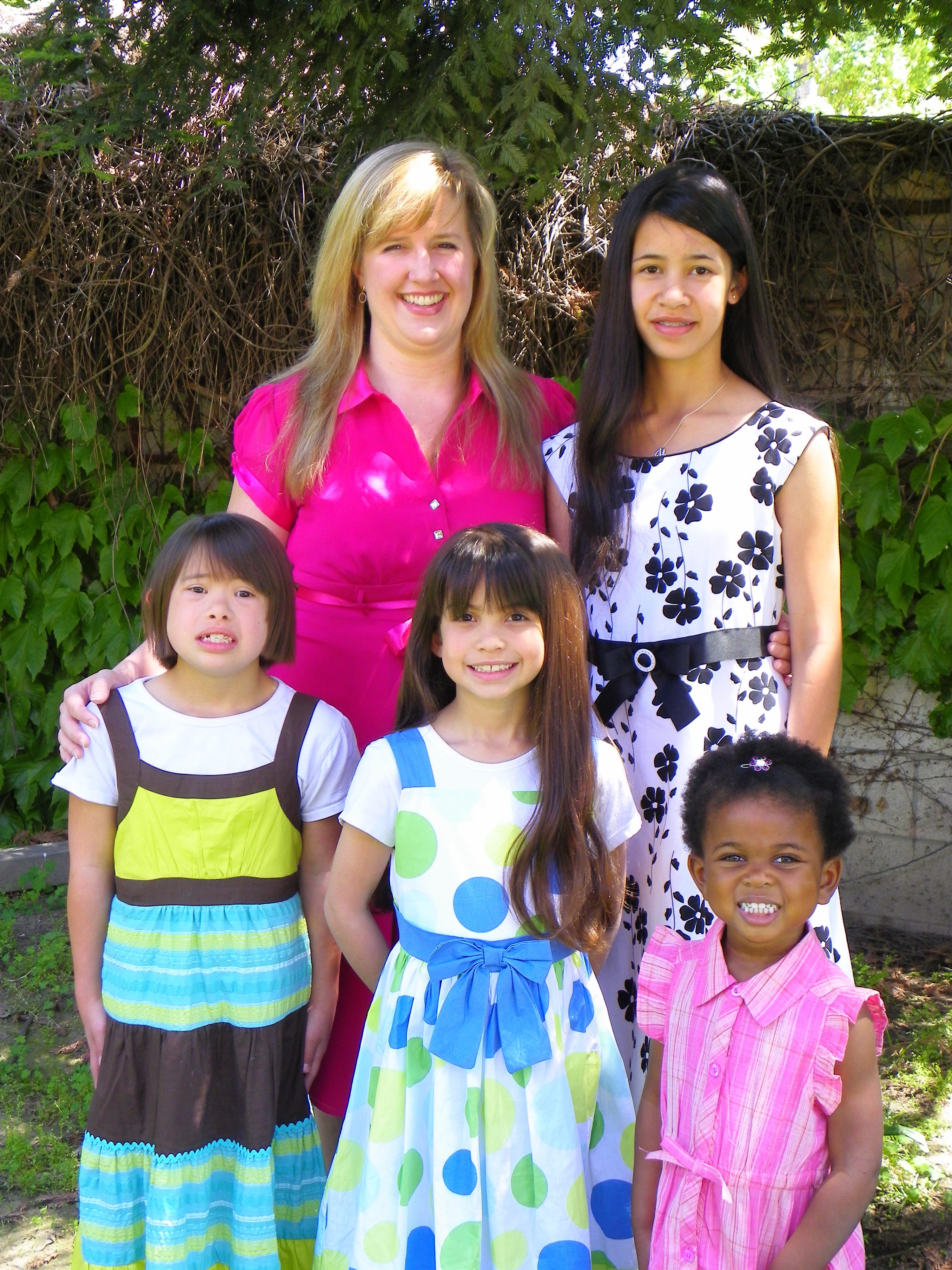
We’ve been blessed to have four daughters, three biological and one adopted. And we’ve had days and weeks of frustration in parenting, of being at wits’ end, of not knowing how to proceed with parenting challenges. As our kids have gotten older, these moments have become more frequent and intense, because they’re more and more their own people with distinct personalities and very definite plans to exert independence. They can and do make their own decisions, and it’s our job to guide them and provide meaningful consequences, discipline and teaching, combined with big doses of love and compassion. But the whole job has gotten almost exponentially harder and more challenging with each year each gets older.

At the same time, these independent people we’re rearing are also sources of immense joy and happiness. At the best of times, when everyone is getting along, when we’re just having fun, simply being ourselves together and laughing and being distinctly us, the unit that is uniquely the Marce and Cathy Lim family, it is the best of anything I’ve ever experienced. It really does feel like heaven on earth, the best version you can dream up.

Here’s why these years can contain the best days I’ve ever had: there are more of us than just the two we started out with. Our little couple expanded into a sixsome composed of some amazing people who are wonderful to be around as individuals but even better when combined. I cherish our wedding day as the start of what we have now. But it was just a seed, an embryo, of what we were meant to be and to have. And as time goes on past today, past this year, past these moments where I can enjoy other young couples’ “seed” days of weddings, our Lim tree is growing and growing. There are far more “best days” ahead, and I look forward to them with great anticipation.

Guilt and mothering: like peanut butter and jelly

So Mother’s Day in the United States has just passed, a day in which millions of women received handmade cards with paint-stamped body parts in shapes of hearts and various forms of breakfast, either in bed or at the table. It was a day in which mothers smiled and were gracious about the efforts of their young progeny, same as pretty much every other day of the year.

It was also a day that induced or amplified all kinds of emotions in women of all ages and stages of life, ones who have children and those who do not. So let me address one of those emotions that tends to rise to the surface yet again for some mothers on the second Sunday in May: guilt.

Yep, one of my obligatory Mother's Day photos, in which at least one kid is making a funny face.
Yep, one of my obligatory Mother’s Day photos, in which at least one kid is making a funny face.

Here’s one scenario of feelings that can play out that Sunday, particularly if one attends church, where people stand at the pulpit and talk about their angel mothers: I am not good enough. As a mother, I do not sound at all like the description often made of those amazing moms whose stories go down in the history books of being completely self-sacrificing, completely loving and giving, completely kind and always up for listening to a child’s ramblings, no matter how constant or stream-of-consciousness they may be. These women never seem to snap, never seem to request a break just for some peace and quiet, never ask for “me” time, never tell a kid to come back later.

If, for some reason, a woman doesn’t hear those kinds of talks or they just don’t bother her, then there’s still the rest of the day to barrel through, which invariably also means her husband and children are eager to make her happy. If you’re like me, someone who can get overloaded and overstimulated seemingly far too easily, and you just made a T-shirt quilt for the high school band director so her senior daughter and fellow seniors could have a personalized gift to give him before graduation, and you hosted a before-prom dinner for 16 students at her house the night before Mother’s Day (just as two examples), you probably just want to be left alone for an afternoon and evening to sleep and collect your thoughts again (and gear up for more events and to-do-list items begging for your attention). But your children and husband know it is their DUTY to MAKE YOU HAPPY that day. To them, just leaving you alone and letting you sleep, etc., translates into profound failure on their part, because MAKING YOU HAPPY means being with you every moment, attending to your every supposed need and loving on you.

So as a mother, you’re stuck. Either you take the needed time to just be alone and manage to rest up enough so you can forge on with your selfless mothering duties for the rest of the week, month, year, and lifetime, for all those other days for which you are supposedly celebrated and venerated on the one Sunday, OR you suck it up and spend time with the kiddos doing things they enjoy because they think it’s stuff you enjoy and that will make them happy.

Let’s just say that mothering guilt will inevitably occur. No matter what, you’re back at that familiar rock and hard place.

Let’s just posit this idea: women generally are and want to be selfless when it comes to their families, except for those women who truly are just bad mothers (they do exist, you know). They do make sacrifices, some seemingly bigger or more story-worthy than others, at different levels that are unique and personal and necessary for each (some even sacrifice too much, honestly, more than is good for their own mental and emotional health). So the reality is that there’s going to be at least some level of guilt on the day they’re celebrated, at some moment or hour during that day. There’s going to be guilt because there’s guilt 365 days a year; there are just a few new twists on it on Mother’s Day, in addition to the regular ol’ garden-variety guilt.

How about we just declare the day “Mom, don’t feel guilty” day? How about we ban guilt for one day? It’s a bold and wacky idea, but maybe we can give it a try. It might be very liberating.

I’ll never have a thigh gap, but I am experiencing a big gap between ideals and reality

You know when you dream about eating something off-diet and demanding of some complete (thin) strangers walking by, “Do you ever eat?!”, you’re self-conscious (and frustrated) about your weight.

I’m half-proud, half-embarrassed for myself that I embarked on a strict diet last week, mainly because, yes, I want to look better. And I want it to happen fast. Here’s the thing: I have felt very self-conscious about my weight in photos of late, and I have several big events coming up for which I’ll be in numerous photographs, and I don’t want to look fat.

Yep, there it is.

Yep, my self-image is pretty distorted right now.

As much as I talk about self-image and how bad our society is about focusing on looks, whether it’s regarding weight, age, or relative size of body parts, I still struggle with it myself. Sometimes not so much, other times mightily. As I most recently mentioned to my therapist, “I feel horrible about how I look.” Her response: “Right now you’re very stressed and not feeling good about yourself in lots of other ways, so that’s not surprising.” Meaning, essentially, try not to worry about it; it’ll pass when you manage to process everything else that’s had you down.

So I kind of feel like a hypocrite when I’m urging everyone, male and female, to be more aware of how media and society all around us dose us liberally and continually with the religion of thinness and image, of airbrushed (impossible-to-achieve) perfection, and I am struggling with it so much still.

It’s complicated by the matter of health: when I’m stressed, I eat sweets. I overeat. That’s simply not good for my body, and that’s important. So I do also want to work on that. I want to break my physical and emotional addiction to sugar and my reliance on food as a crutch. But I would like to figure out how to separate that out from my worries about how those habits affect my LOOKS.

Here’s another thing: plenty of people out there have far worse eating habits than I do, but they’re thin. So their health might be in need of improvement, but they either don’t worry about it, or they don’t worry about others seeing them as fat. Because don’t we tend to judge people who are overweight? We automatically think, They need to eat less. They need to have better self-control. They need to take better care of themselves. But health and thinness are not always directly correlated.

That’s not to say I excuse myself for slipping into bad habits. I can do better by my body sometimes. But our society judges on appearance, and I judge myself. I have a lifetime of negative messages to overcome. And that simply makes it much more difficult to just take care of myself the way I should because I’m devoting so much emotional energy to the image part of the equation, which is NOT the important part; overall health is.

I have had a lot to deal with the past months, the past year, with a few breaks in the onslaught of expectations, responsibilities, and struggles to catch my breath. I anticipate having some breaks to catch my breath and focus more accurately on taking care of my health — emotional, mental, spiritual and physical — fairly soon, but in the meantime, I’m just getting through it as well as I can.

And dieting. Like I said, I’m a little embarrassed because I’m doing it almost exclusively for the reward of looking better in pictures. It’s not the example I’d like to set but I’m doing it anyway, just because right now so much has beaten me down I don’t feel good about myself in many ways; I feel weak and run-down and just not up to snuff. I feel like I’m letting people down left and right because I simply can’t do everything everyone needs me to do at all times. So that feeling extends to how I look.

I’m going to keep working on my self-image, my self-esteem, the ways I look at myself and talk to myself. I’m going to do better. Just forgive me the lapses right now in my actions and how they don’t match my ideals. It’s a process for me, and it’s a process for us all as individuals and as a society. For me, this topic mixes my mental health awareness-raising with my awareness-raising about society and image. The intersection is a little delicate, and I’m navigating it as well as I can in this tricky time. I hope I’m making progress in it all because all I can do is just hope I’m slowly doing better. I’m going to just try to remember to pat myself on the back for what I’m doing better: life isn’t about improving overnight. It’s a journey with all kinds of intertwined paths leading to a place where we’re our best selves in all aspects.

‘Color-blind’ relations have a long way to go, especially in the South

I was appalled, but not surprised, to read this morning about Alabama state Rep. Alvin Holmes’ comments during an abortion-related debate last month. As Yahoo Shine wrote, “In addition to claiming that 99 percent of white legislators would force their daughters to have an abortion if impregnated by a black man, Holmes also said, ‘I will bring you $100,000 cash tomorrow if you show me a whole bunch of whites that adopted blacks in Alabama.’ … Now he may need to head to the bank, as families who have done just that staged a press conference at the Alabama State House Wednesday.”

Mothers Day 2007As a family who ourselves lived in Alabama for 12 years and, while living there, adopted a black baby (born in North Carolina), I have so much to say about this topic (and all the topics branching out from it) that it’d fill pages and pages of blog posts. But I think what I’d like to focus on today is racism. That’s at the core of this.

Here’s where I come from on race: I am white. I come from a very white family raised in the Northern United States. My parents are from Ohio and I lived the first 10 years of my life in Pennsylvania, where I remember seeing so few blacks that each “sighting” was cause for actually remembering each incident. This was in the 1970s, mind you, and things likely have shifted since then, but this, again, is my story. Then I moved to Mississippi when I was 10 and then on to Kentucky. But I had plenty of opportunities to spend time with blacks from then on. My take was this: hey, they’re people, and they have a different skin color. OK. So? On to other things.

My husband is Filipino. Asian. Not white. He felt keenly enough at certain points in his life the fact that he was a “minority” in the United States in the places he lived, particularly his two years in Utah, where we met at college. He stood out among the majority of whites there and was all too aware of that. Funny note about that: when we met, he owned and frequently wore a black cap with an X on it in reference to Malcolm X. Suffice it to say because of his minority status, he empathized with African-Americans in America and their history and status. When we dated, I read The Autobiography of Malcolm X and Coretta Scott King’s story, My Life with Martin Luther King, Jr. and found them fascinating and informative.

My husband was always a bit surprised that I just didn’t “care” or “notice” that he wasn’t white like me. Despite my Northern, white, homogeneous background, my parents had still taught us that people’s race just didn’t matter: we’re all people and deserve to be treated as such, equal human beings.

Then he and I moved to the South together. We ended up spending 12 years in Alabama, mostly in a small-ish town called Anniston. There, my husband had his first experience living in a place where the so-called “minority” was actually in equal numbers to the “majority.” Don’t ask me census numbers, but there were plenty of blacks.

There, we saw how separate the races still were in many ways, how many of the poorer, not-middle-class blacks lived on one side of town and the whites on the other. How the schools had essentially become segregated again because the middle-class whites had moved to different areas and were joined by some blacks who were also middle class and well-off enough to do so. We lived “in town” and went to those schools that were majority black. And I was fine with that. I refused to be part of “white flight” for a number of reasons.

But we also saw the other side of the story, one few people talk about, that blacks themselves are far from being immune to racism. On far too many occasions, blacks would look at my husband, the Asian who was truly a minority there, and call him names related to his race. I was absolutely shocked. How could these people who had been so horribly mistreated and still were largely in worse shape economically than whites in that area of the country not have more compassion, more understanding, more empathy, for the feelings and perspective of someone also a minority? When given the opportunity, they acted just as badly.

It’s great that there are black leaders in government. That’s the whole idea, that the U.S. has a representative government. But if black representatives, who supposedly speak for their constituents and act on their behalf, have such ridiculous notions of race relations as Rep. Holmes (and believe me, this is not an isolated incident), what are their constituents thinking and feeling and saying? (No, I don’t think all his constituents agree with him, but I doubt it’s just a really tiny number that do.)

Yes, the United States, particularly the American South, has an abominable history when it comes to race relations and the treatment of blacks. I just happen to be in the middle of reading Sue Monk Kidd’s latest novel about slavery in the early 1800s, The Invention of Wings, and the unspeakable things that were done to humans then still astonish me and cut me to the core. There are no words for how I feel about those things. But human beings, with our capacity for love and goodness and wonder, still have ugly capacities as well. And those capacities did not end with the abolition of slavery or with the Civil Rights laws enacted in the 1960s or anything that has improved since. Whites and blacks and any other race still have the capacity for ignorance and prejudice and saying and doing ridiculously stupid things. Holmes is just the latest example of this. When we push and hope for a “color-blind” society, our efforts can’t be focused just on whites; blacks and any other minorities need to be included as well.

Financial advice to a kid who’s getting ready to be an adult

In talking about education, and many of public education’s failings, the notion that kids simply aren’t taught about real-world, practical personal finance has come up a few times. I know people who are really great at handling money, regardless of how much they make. They make wise decisions in budgeting, spending, and saving, and they feel secure. Then I know plenty of others who really don’t know how to handle money, and it’s cost them, literally. The problem is usually this: no one ever taught them how to do it right. I don’t think many people really WANT to be “bad” at handling their money, but they just didn’t learn basic skills and rules.

I was blessed to be taught by my parents about wisely using my resources. For instance, I am a really great shopper (just ask me about all the dresses and other clothes I’ve gotten for myself and my kids at top-notch stores for totally cheap!). I also have been very careful going into any situation that might require me to take out a loan. My husband and I are now on our third house, and I think we’ve done pretty well each time we’ve purchased a home (with a mortgage, mind you). I don’t follow Dave Ramsay; I do respect the advice he gives when I read it and am thrilled he is a source of basic information for many who just didn’t know any better up until they came across him.

dollar light bulbSo I’ve been working over the years to make sure I consistently talk to my girls about money, with appropriate information at appropriate ages. With the oldest in high school, I’ve definitely given her very specific information and directions. I’ve talked to her about how banks work, about how loans and interest work. I’ve shown her how I budget for the month and how I pay bills. I am not sure how much she remembers, so I need to follow up again. But here I’m going to share a few of the top pieces of advice I hammer home to her.

  1. Learn how to make a budget, at least a fairly simple one. First, figure out what you have to spend monthly or yearly or at other regular intervals, and then break those things down to per-month units. If you don’t know how much you spend on food or incidentals or entertainment, keep a little booklet and write down every time you spend in whatever category you want to track. After a month (one that’s an “average” one, ideally, and try two, even, to get a better idea), tally it up. Enter that into your budget. You can use just a list in a Word program; you can use Excel or any other kind of software that makes you happy. You can have a paper list in a file folder. Doesn’t matter the type; just do it, whatever you like the best. And then — ONLY SPEND WHAT’S IN THE BUDGET (or less).
  2. Do not get a loan for anything you don’t absolutely need. Houses, cars, and education qualify. Pretty much everything else does not. Whenever someone gives you the option of paying for something on an installment plan, just firmly say “no, thanks.” If an appliance is more than you can afford with cash you’ve saved for a certain amount of time, for example, buy a simpler one or start with a used one. When I was first in a rental townhouse that provided washer/dryer hookups, for instance, I was thrilled just to not have to go to a laundromat. But I didn’t go and buy a new washer and dryer. I bought used ones at a local store that sold used appliances, and they worked great. In fact, I had used washer/dryers for probably a decade.
  3. Going along with point 2, if you’re buying a big-ticket item, do not allow the salesperson to give you numbers broken down according to “installment thinking.” If you have the money to pay for the item up-front, just say so and buy it. If you do need a loan, negotiate on the full price of the item (let’s think “used car” here, because that’s an acceptable option for something you can buy with a loan) and get the lowest possible interest rate. Shop around for this: there are plenty of options, like local credit unions, your bank, or even sometimes the credit available through the sales place (car dealership, for instance). Don’t let the person sweet-talk you by using monthly payment numbers. Tell him firmly you want interest rate deals and settle on the price of the item. If after all that, you find that the monthly payment is too much, you need to get a different car, one that costs less. Sorry if it has to be kind of a junker.
  4. Used cars are almost always the best deal. Even if you’re far enough along in your adult financial life that you have cash to pay for a car up-front, buying one that’s just a year old will likely be your best bet over the long haul. Homes generally hold their value or go up in value. You can buy one for $100,000 and sell it later for a profit, especially if you’re in it for a long time and there’s no recession. Cars automatically lose their value. New cars lose value the moment you drive them home. You can’t turn around and sell a car you bought new on the lot a month later for the price you paid for it, or even close. You’ll lose a lot.
  5. Don’t feel you have to have the newest of anything, particularly technology. Like cars, which depreciate immediately, brand-new technology immediately is eclipsed by better models. You can shop around and compare and figure out just what you need in a new TV or computer, and a month later you’ll wish you’d waited because technology evolves that quickly. But it’s OK. You don’t NEED those improvements. In fact, you’ll be fine without them for a good number of years. Unless your paid work is in the technology field, you don’t need to have or use the latest stuff at home.
  6. Watching money pile up in savings is a thrill. Spending can certainly be a thrill, too. But consciously socking away money you could have spent on something you didn’t need, for a particular purpose, whether it’s saving for something fun like a vacation or something necessary like a newer, better-running car or a newer appliance, is long-term satisfying. Nowadays, it’s easy to just go online at home and transfer money you were thinking about spending from your checking account into savings. And just enjoy watching your own dollars do a little work for you. That’s where interest comes in. …
  7. Interest can be your worst enemy. Or it can do your bidding. Unfortunately, the sad truth is that today, you don’t get paid much in interest for savings accounts. But at least you’re letting it work for you rather than being its slave. Loans always come with interest attached (unless you’re buying a brand-new car with a deal of 0% interest, which might sometimes be OK, but in general let’s stick with used, shall we?). And that interest keeps building the longer you have the loan, the longer you draw it out by paying the bare minimum or as little as possible. The concept of “compound interest” is essentially this: over time, a $1000 loan (let’s say) accrues interest, which then is added on to the original $1000, and then interest builds again over that sum that’s greater than the original. If you pay the tiniest amount (this is the worst when it comes to credit cards or consumer loans such as those at stores rather than banks), your $1000 will only decrease by that small amount you pay, even while interest is adding back onto it. Then interest is calculated on that. And on that bigger number. And so on. (Note that I am not a financial expert and am not trying to explain this from that kind of viewpoint. This is just basic advice.)
  8. Make sure you learn how to balance a checkbook/checking account/savings account. Whenever you write a check or take money out of the account by debit card (which are linked to checking accounts, by the way, and are not like credit cards except that they are the same size and shape) or transfer (hopefully to savings!!), WRITE IT DOWN and do the math. Subtract right then and there, or do it every evening if you make purchases/pay bills regularly during the day. If you get a deposit, then add! (Even better!) But then every month you need to do the double-checking. Your bank will give you a statement. Make sure you check off your own register, comparing it with the items on the bank’s statement. Sometimes you might have forgotten to write something down, you might have made a math error, or the bank might actually have made a mistake. So check as soon as you get the statement and compare and “balance.” You can avoid a lot of problems this way.
  9. Buy used for big items when you’re getting started. But in certain cases, when you have to buy something new, buy a good-quality (even more expensive) item. Then shop for a deal. Certain items are cheaper over the long run, when you have a little more money available in your budget, if you get a higher quality item now and then you won’t have to spend again to replace the item too soon. Shoes work this way; some kitchen items and technology work this way. It might be worth paying double or at least 50% more to get a really good-quality item that will last and perform better in the meantime than a cheaper one that is less well made and will need to be replaced sooner (and more frequently).
  10. The shopping strategy of buying higher quality goes along with this advice that might shock a lot of people: it is often cheaper to shop at nicer department stores that run regular sales than at cheaper all-purpose stores that don’t run sales. For example, I am a huge fan of Macy’s. It’s long been my go-to store for clothing and shoes. I’ve been able to come out of Macy’s with some nice-quality dresses or shirts for a quarter or less of their original “regular” price. (That leads to another note: most “regular” prices are just listed as a way for people to think they’re getting a great deal when the item is discounted, so don’t go too crazy.) What’s more, the final price is far less than I would have paid for a similar item at a store like Target or even discounters like Marshall’s or Ross. Sure, the latter stores are “always” discounted, but if you pay attention to sales, you can get a nicer item that’s not been run through the mill or was destined for a discounter from the beginning. And you have a much more pleasant shopping environment! 🙂 (Let me also note that I very rarely shop outlet stores for this very reason: the “discounts” aren’t any better than what you’d get by good shopping at the regular store, and often the products have never actually been in the real store; they’ve been made cut-rate specifically to sell at outlets.)
  11. When buying any item, keep track of the regular, everyday prices for things you buy on a regular basis (I just know in my head the usual prices for everything I buy regularly, but if you can’t do this, write it down!). This mostly applies to food and toiletries and cleaning supplies. But it works for clothes (note No. 10 above). This is important because when you’re shopping and see something you use a lot and can stock up on (pantry items, cleaning supplies, for instance) on sale and discounted significantly, you already know it’s a good deal and can buy a bunch and save yourself money in the longer run. I find this is far simpler than keeping track of coupons. Most coupons anymore don’t apply to my regular purchases, so I end up clipping very few coupons from the newspaper and mailed flyers.
  12. Credit cards aren’t necessarily bad. But this really depends on your personality. If you know you’re going to go crazy and just spend because it’s easy when you have “plastic,” then don’t use them. If you are pretty careful, though, they’re a valuable tool. They are (somewhat unfortunately, in reference to those who aren’t careful with their use) a vital part of building credit, which is important if you do need to take out a loan (for house or car or education…) in the future. They are also pretty handy for emergencies, traveling, or other situations where you need to pay for something but didn’t expect to need to do so. But don’t let “exceptions to the rule” become the rule and mess up your budget and/or credit. Make sure you budget a certain amount for the items you get regularly and can use a credit card for. Then pay that balance EVERY MONTH IN FULL. I do this. I have a budget with my couple of main credit cards and know I will buy certain things with them (toiletries and cleaning supplies and some food at places like Target and Wal-Mart; gasoline for the cars; online purchases; gifts, etc.). I know what I need to buy and how much I spend monthly on average, and I stick within that. Then, I get points for my purchases, and I can get cash back. I’m not paying any interest but I get extras. I also can keep my check register from being full. I really like simplicity in there. But that’s just me.

Last, when in doubt, ASK FOR HELP! Ask your parents if they’re good at finances. Ask someone you know from school or a church or community group. If you have enough connections, it’s highly likely you can pretty easily find someone who’s willing to give you some input before you make, particularly, a big decision.

Safe, healthy food a must for everyone

I wrote recently about how we as individuals and families need safety nets and support from extended family and society around us. What’s on my mind the most is that of all the issues we as families (and in my case, being the mother and “home manager” of a family of six) face, it’s impossible to fix them all or deal with them all on our own.

As just one example, I have many concerns about public education, but I can’t change them alone; I can only try to speak up when I can and get involved in the big picture (higher levels) in what are fairly limited ways at this stage of life. I also have decided I am not capable (mentally, mostly) of home-schooling my kids, so I send them to public school and try to be involved and aware at the school level.

Health is another big topic. Health care and health coverage systems are a part of that. I’ve written a little about that and found one book really a great overview and resource: Catastrophic Care, by David Goldhill. Another issue we face that is part of our health is that of our food supply. Obesity in the U.S. and in other developed nations is a huge problem, and one I’ll admit I personally struggle with. (And might I point out that I exercise daily and cook healthy meals at home almost daily, and I’m STILL significantly overweight. What about all those out there who don’t exercise at all, who don’t cook, who eat junk food, etc.?) Yes, there are some “obvious” issues, such as the easy availability of food that’s bad for us, sedentary habits, and the heavy marketing and research done by large food corporations (just read Salt, Sugar, Fat by Michael Moss: Yikes!). But there are also more insidious things going on with our food supply that are affecting everyone: hormones and antibiotics and other fatteners being fed to the animals that we eat for meat, pesticides, and even sugar substitutes (just to get a taste of these problems, read a recent article on Salon).

If we’re having a hard time as a country educating individuals and families about healthier ways to eat, just putting together balanced meals at home with vegetables and lean proteins, etc., as well as getting people to just move more, it’s going to be a pretty hard sell to get everyone to eat organic and/or locally produced food, including dairy and meat, which either costs more money and/or takes an extra trip (or two or three), to get to farmers markets or specialty stores. Again, I consider myself to have the motivation, interest, and time (as well as a decent income) to be able to shop well and cook well on the first count. But I admit I balk at spending three times or more the amount on produce and meats and dairy to get foods that supposedly come without coatings of pesticides or added hormones or antibiotics, though that would certainly be ideal.

I'm working on being more involved in our backyard garden and learning more about it. This way, we get fresh, healthy food we like right from our own yard.
I’m working on being more involved in our backyard garden and learning more about it. This way, we get fresh, healthy food we like right from our own yard.

There are possibly some alternatives to the above pricey/time-consuming options for me and others who might have the time and at least a little extra cash to put towards them, such as growing your own food (if you have the time, the space, the know-how, etc.), contributing to raising a community garden, or just shopping local. But these options, again, are ones that are going to work when education efforts get past just the simple things of getting people to eat better, cook, and exercise.

No, this goes back to our society as a whole, including how our government is involved in regulating (or not overseeing) our food supply. It’s becoming more clear and more substantiated that these pesticides, hormones, antibiotics, plastics, etc., are contaminating our food and introducing all kinds of chemical problems into our bodies, making us fatter and just less healthy, maybe causing cancer. But government is slow to regulate and corporations are certainly not going to change of their own accord unless we as consumers really get educated and speak up with letters/phone calls to these companies or at the very least speak with our wallets by not buying their products. But that latter option leads again to this issue: what are average Americans going to buy if most of the big food producers aren’t providing healthy food? Most can’t afford organic or specialty stores.

As a mom and home manager, I am daunted and sometimes overwhelmed by all that is wrong and all I have to “protect” my family from, all that I need to “fix” or address in some way. What about all those others who don’t have even the luxuries of time and some extra money that I have? I feel a responsibility to do all I can not just to make life better for my own family, but for them. But I don’t have THAT much time or extra cash.

Yes, government can and must do better. Companies can and MUST do better to be responsible to consumers. Those with greater wealth and time to do good can do better to help those who don’t have what they have. Each of us can do a little something to spread the word, to raise awareness about whatever issues we’re facing, and to just speak up and let our voices be heard: voice our discontent, ask for specific things to be changed and improved. It comes back to my starfish post: I can’t save everyone, but by doing a few small things, they might add up to saving at least a few others. Give back by doing just a little, just whatever you can do.

It’s true! ‘College isn’t for everyone.’

Just as I happened to be thinking about education this week, I came across an excellent article on Slate called “College isn’t for everyone.” For me, this wasn’t a new idea or a revelation, though it may be shocking or weird for other readers. My parents have been saying this for years. My father was a college professor and lamented for ages the push to get everyone to college. Here’s what happened from what I remember him saying (and mind you, he’s no longer around to correct me if I’m wrong, so hopefully I’m remembering right): having students at the university level who weren’t prepared for it or weren’t “college material” dumbed down the classes for everyone. A university education isn’t necessarily job training; it’s further education. Many people who ended up being pushed to go to college would have been better off in a good job-training program.

Since this idea is one that my parents have talked about for ages and ages, and I’m just now seeing more about it in the media, maybe it means it will finally get some attention and traction and we can start rethinking what’s turned out to be a bad idea. I’m just going to throw out a few of the bad consequences I’ve seen coming from this push: since college classes have to accommodate many students who are ill prepared or simply not able to handle them, they’ve been “dumbed down” and don’t teach or expect from students as much as they used to. Cumulatively, this means a university degree isn’t worth what it used to be. Interestingly, I just saw an article today talking about a study from CareerBuilder.com: employers want college grads now for jobs that used to just need high school grads. Companies also are requiring more degrees, so master’s are necessary where bachelor’s used to do. I’ve noticed this, ironically perhaps, in the school systems: teachers are more and more required to have master’s degrees. Has this improved education for young students? I think not. So we’re requiring more and more degrees, perhaps because lower degrees mean less. This is simply degree inflation.

And think about how much, then, it costs to go to college now, let alone finish a degree, one that is then not worth what it used to be! We have a huge problem with tons of college grads out there holding huge student loans. And many aren’t being able to find jobs. College costs are definitely too high, while at the same time university degrees are worth less. Yeah, that makes sense.

This has all come to pass because of studies that show that college grads on average make more over their lifetimes than those who just graduate high school. OK, so yes, if we want people to be more prosperous, then it seems like a simple solution: send them to college. But the writer of the Slate article makes some excellent points: we’re not doing any favors for those who are just not ready for a university education. As he says:

Imagine that you’re finishing ninth grade at a large comprehensive urban high school. The year hasn’t gone very well; because you are reading and doing math at a sixth-grade level, much of your coursework is a struggle. … A rational system would acknowledge that, with just three years until graduation, the likelihood of you getting to a true “college readiness” level by the end of 12th grade is extremely low. Even if all the pieces come together in dramatic fashion—you get serious help with your basic skills, someone finds you a great mentor, your motivation for hitting the books increases significantly—you probably aren’t going to make it. … To be sure, your long-term earnings will probably be lower than if you squeak out a college degree. But that’s a false choice, because you’re almost surely not going to get that college degree anyway. The decision is whether to follow the college route to almost certain failure, or to follow another route to significant success.

Why don’t we actually give high school students more options for careers, rather than saying, “OK, go to college and you’ll be fine”? We’ve had a French exchange student this year and learned that France gives students more choices when they start high school. The Slate writer references Germany, which seems to be similar (don’t quote me on this; this is an educated guess). Why not provide really useful vocational training, with a true variety of real-world choices, earlier in school? Basically, now all we have is maybe a few very limited choices for voc-tech. And it’s frowned upon because we really want kids to all get to college; we don’t want to discourage any from not going. But why can’t we set kids up with vocations they’ll enjoy, have natural aptitudes for, and will still earn them a good middle-class living? Plumbing, electrical, food service, what-have-you? Our exchange student chose the hotels/hospitality industry and is going to a high school that already is leading her down that path. I think that’s pretty smart, actually. Here, she’s learning English so she’ll be better equipped to deal with foreigners who visit her at work there in France.

I understand why we got where we are today. We were trying to give disadvantaged young people a leg up and options. But we’ve doomed many of them to disappointment, failure, and student loans they won’t have college degrees to go with. As the Slate writer said so well:

But our system isn’t rational, and it doesn’t like to acknowledge long odds. Perhaps it used to, but this sort of realism was judged to be deterministic, racist, and classist. And for sure, when judgments were made on the basis of ZIP code or skin color, the old system was exactly that. Those high school “tracks” were immutable, and those who wound up in “voc-ed” (or, at least as bad, the “general” track) were those for whom secondary schooling, in society’s eyes, was mostly a custodial function.

But making sure that there are real options for our young people—options that include high-quality career and technical education—is a totally different proposition. We shouldn’t force anyone into that route, but we also shouldn’t guilt kids with low odds of college success—regardless of their race or class—to keep trudging through academic coursework as teens. 

So here we are, a nation full of college graduates, whose degrees are worth less and less, who will be paying off huge loans for decades, as well as plenty of college dropouts who went, didn’t have success, and who STILL have loans to pay off, with no degree to show for it. How about we really help people find the work that will suit them, that will be cost-effective and will target their skills and interests? Crazy idea. It might just work.

Education system leaves kids behind left and right

I haven’t been a fan of “No Child Left Behind” since it started. It’s clear to me that essentially saying, “We’re going to make education the same for all kids and make them all perform well” isn’t going to work. I have two major gripes, addressing kids on both ends of the spectrum — and I know whereof I speak. I have a child with Down syndrome whose IQ and certain academic abilities are far below normal. Yes, she is a bright, alert and involved girl who’s eager to work and do lots of things, but she will never grasp certain concepts, at least not well enough to pass a test on par with her non-disabled peers. Though I do want to push a little to see where my daughter’s boundaries (and full capacities) lie, that doesn’t mean there aren’t some real limits to what she can do compared with people who don’t have her intellectual disabilities.

On the other end of the spectrum, I have daughters who do not have that genetic limitation, and they are very intelligent and talented. Problem is, though they have been tested and shown to have high capacities (IQ, academic abilities, creativity, what-have-you), there are no active programs to encourage them as they develop those skills. Our school system in this city has what’s called a Gifted and Talented program (GATE), but it’s essentially just a pretty, shiny sticker to put on my girls’ academic folders. It means absolutely nothing because it has no funding and no activities besides maybe a field trip once a year to see colleges or something similar.

I have to chuckle when I think about the contrast here with my experience in the great gifted program I enjoyed in my middle school years. Here’s why: it was in Mississippi, which many basically consider the educational laughing-stock of the country. But despite the truths and/or misconceptions in that assumption, it provided for the gifted students. We spent a good part of one day per week exploring other parts of our brains, creating and thinking differently. It was challenging, interesting, and lots of fun.

My oldest daughter has enjoyed the fun and creative challenge of the Odyssey of the Mind program.

Now I find it extremely frustrating to have children who have the need to explore, create and “think outside of the box” but have no program that addresses those needs. My oldest has been lucky the past two years to get involved with a program called Odyssey of the Mind — but only because she had a friend who was already involved at another school. She was allowed to participate in the program by special arrangement, because she attends a different high school in the district. Thank goodness that was allowed to happen. This is a really neat opportunity for her to create, stretch herself, think outside the box, and so on. Now I would like to see my younger daughters involved. But I’m thinking the only way that’s going to happen is if I pay for the program and take charge of it myself. (I may very well do that.) It fits very nicely into what I envision as being a perfect GATE program. Why doesn’t our district use it?

So this has been on my mind for years, literally, and for the past few weeks I’ve been thinking about how to improve things a bit just here in my younger girls’ schools (middle school, elementary). But, again, this is a much bigger problem that’s not affecting just my kids; it’s affecting all the high achievers throughout the country. I read a great piece in the Boston Globe on the topic today, and I sat here nodding my head, shaking with frustration. Why can’t we actually tailor education to different kinds of students with differing natural abilities? Why do we have to act as if students all can be equal if we just say it’s so or should be so? (That’s another topic as well….)

Here’s a great excerpt from the article:

In 2002, President George W. Bush signed the No Child Left Behind Act, which penalizes public schools that don’t bring the lowest-performing students up to grade level. The federal Individuals with Disabilities Education Act regulates special education and provides schools with more than $11 billion annually. A provision of federal education law called Title I allocates some $14 billion to schools that have a higher proportion of students from low-income families, to pay for programs designed to keep them from falling behind.

The smartest kid in class, by contrast, is not an expensive problem. A boy or girl who finishes an assignment early can be handed a book and told to read quietly while the teacher works on getting other children caught up. What would clearly be neglect if it happened to a special-needs child tends to look different if the child is gifted: Being left alone might even feel like a reward, an acknowledgment of being a fast learner.

Not surprisingly, programs oriented toward gifted children get barely any federal funding.

Once again, we see a problem that affects kids from varying economic and social backgrounds. There are bright, capable kids from immigrant families, from families that are poor, from families that aren’t well educated. But they could really over-achieve and give back to society in a big way if given extra attention. Problem in our current climate is this: if they were underachieving, they’d get more attention. ISN’T THAT INSANE?

I am lucky to be able to give my daughters lots of enrichment because I’m college educated and well-to-do enough to have the funds to introduce them to museums, good classic films, art, books, etc. I also have time to spend with them. That’s great for my girls. But, as I said in my previous post, it would sure be nice if I didn’t feel I HAD to provide all their enrichment because the schools are shorting them. Given these issues, again, Why can’t education be tailored to kids with different abilities? Why can’t we say, Yes, these kids could use some enrichment and encouragement in their naturally gifted ways? And other kids who have disabilities need special help and concessions, and we need to help them reach their highest potential, but not expect that potential to necessarily be the same as kids who don’t have those intellectual disabilities?

Gah! It’s enough to make a mom and concerned citizen scream.