There’s no ‘big reason’ behind every hard experience

After a very full week of driving three days cross country to get my husband settled in for a new job, hunting for a house in a CRAZY sellers’ market, arriving to our new city to a very sketchy AirBNB (then having to switch to staying in an Extended Stay hotel and contacting AirBNB to get a refund), getting my youngest switched over to a new school in California now that schools in are doing in-person learning (knowing also that soon we’ll just have to switch her to Alabama, but there it was), making sure we had what we needed for my husband’s job and the last bit for licensure, … and other things, I was eager to get back to California to be in my own bed and hit the ground to prepare for MORE things to do. 

I had a one-way flight from Birmingham to Fresno on Friday afternoon, with two legs, layover in Dallas. Weather delayed the first flight and I speed-walked from gate B4 to C31 in Dallas, no easy feat. I was late, but a number of other people were as well. We finally were let onto the plane. Well, long story short, at least three issues caused three hours of delays on that flight, and we ended up having to deplane at 10 p.m. because there were maintenance problems that couldn’t be fixed. It was stressful for us all. We waited in line after line, and I ended up in a hotel 15 miles away from the airport around midnight without my suitcase. Luckily, our flight the next morning took off without any delay and I was very happy and relieved to be home.

The flight from you-know-where

What I noticed several times were people trying to make the best of the situation late that stressful night by saying, “Well, I’m sure we’re better off not being on the plane. God must be protecting us.” Or “God has a plan, so it’s all for the best.” And while they’re not wrong that God has a plan, I felt in my heart a truth making itself more known in my heart: Not everything that goes wrong has a particular purpose. In fact, a lot of things that go wrong have no reason whatsoever. 

Let me explain. 

I believe that God, our Heavenly Father, created us as spirits before we were born here on Earth. He had and still has a plan for us, which included us being born here and receiving physical bodies to join with our spirits, as well as having lots of opportunities to grow and learn in this mortal existence. And generally speaking, while I believe and know that He is absolutely mindful of every detail of our lives and is watching over us, He doesn’t control or micromanage everything we go through. We’ve been put into this experience of living in a fallen world, and we learn through all the things that happen naturally in this world. And a lot is difficult, stressful, tragic, worrisome, heartbreaking. On the flip side, a lot can also be joyous and happy and beautiful. But we are truly subjected to all that life has to throw at us, and I don’t believe God will remove most of those natural difficulties, just as He generally won’t protect us from the results of other people’s choices. Sometimes He intervenes. But most of the time, we must learn and grow through this experience just as it is.

I’ve learned a lot about this from being a parent and grandparent. I’ve watched my little ones (and then older ones too) struggle mightily with navigating life. I’ve always been there, watching and making sure they weren’t in serious danger, but many times as they’ve struggled to do something they just have to learn on their own, I’ve had to just watch and let them struggle — and then triumph. That’s how they needed to learn. But I’ve been available for hugs and love and a listening ear. I think that our Heavenly Parent does the same thing: He’s there, He’s watching and available and ready to intervene if needed, He’s listening. But He doesn’t rescue us from everything. 

So while God was aware that about 200 of us in a plane in Dallas were stressed and waiting for hours and then had to wait overnight to get where we were going, I don’t necessarily think there was a particular purpose. It’s POSSIBLE that plane was going to have a serious issue and He saved us from it. But more likely, a bunch of stuff just went wrong, as it tends to do in life, and that’s that. The situation didn’t need to be orchestrated by God for us to learn something, nor were we saved from a potential danger. 

However, each of us had the opportunity to learn whatever lessons we needed to learn from what took place. 

For me, the lesson was that our loving Father in Heaven isn’t going to take away most of what life naturally throws at us. Sometimes He tempers things that happen, sometimes He does save us from something; but mostly, He’s watching over us and always listening. And He’s cheering us on. I’ve gone through a lot this past year, on top of all that’s resulted from Covid. My mental health is generally helped well by medications, but in the extreme pressure cooker of one thing on top of another, it’s slipped a lot. I’ve felt myself crying out to God, “Why?? Why are you letting this happen? You know how precarious my situation is. You know. Why aren’t you doing something?” 

And too often, I’ve felt He wasn’t. And in a way, that’s been true. He hasn’t removed these trials from me. Life has continued. I’ve been angry and railed at Him. But I’ve also grown and become stronger. And I know He’s there, saying, “OK, see? You did it! I knew you could. And you did. I’ve been here the whole time.” 

Life will continue to be stressful, heartbreaking, and challenging. And I’ll continue to have moments or days when I question why God isn’t doing more. But I know that there is an overall purpose and plan, even while each situation doesn’t necessarily have a reason. And as I’ve learned, I remember in my toughest times the experiences I’ve had where I’ve known for sure that God was telling or teaching me something very clearly, answering a prayer, or filling me with love and joy beyond my natural capacity. Because I do know for sure that He has done those things for me many times.


I still believe in ‘traditional’ marriage

I believe in what’s now referred to as “traditional” marriage. I strongly believe it should be between a man and a woman. And I believe this because of my faith.

So I am not celebrating today’s Supreme Court ruling.

I realize that many are, and that this is now the law of the land. I respect others’ choices and strong beliefs that go opposite of my own, and I DO NOT HATE them. I have never been unkind to friends and acquaintances or strangers who are homosexual. I do not believe in hate speech. But I do believe I have a right to disagree, respectfully, and not have my personal belief labeled “bigotry” or “hate speech.” I also feel it is now important for me to explain briefly why I believe the way I do.

Contrary to what some may expect, I am not a “traditionalist.” I don’t believe AT ALL that anything should continue just because “that’s the way it’s always been.” Many, many negative behaviors, beliefs, practices and laws have been perpetuated because too many people did not have the courage to change them to what would be better, or just plain right.

I do believe that if something is right, it should be supported. I could make all the arguments about why I believe that changing the definition of marriage is not going to be good for society or for children. But those have been made in many places and I do not need (or have space) to repeat them here. Besides, those are arguments, and there are many arguments that go the opposite way. We could all (and certainly have been) go around in circles, debating and arguing and ramping up the anger. I do not like that idea at all.

I support marriage between a man and a woman because I believe what my church teaches. And here’s where it gets radical: my church doesn’t teach this doctrine because of some references in the Bible or some somewhat vague ideas on what Jesus may have taught about the practice of homosexuality. My church teaches this doctrine because we believe that revelation happens today. I read and learn from the Bible. But The Church of Jesus Christ of Latter-day Saints was founded two centuries ago on a foundation of being the restored church that Jesus founded two millennia ago. That means we have a president who is a prophet, a designation that means all that has meant historically. He has two “assistants,” called counselors, and there is a group of 12 apostles, just as in ancient days. And these people aren’t just “called” apostles and prophets. They truly receive inspiration, revelation, PROPHECY from Jesus Christ. It’s His church, and it’s led by Him. He directs it on the Earth through his mortal leaders.

The LDS Church has made very clear through these people we call prophets and apostles that the doctrine of marriage is an eternal one, that marriage between a man and a woman is not only made for us here in this period of mortal life, but is meant to continue after this life: forever.

The church has also stood behind and continued to promote strongly the document revealed and agreed upon by all these apostles 20 years ago called the Proclamation on the Family. We believe it is an inspired and vital document that proclaims basic truths about the family, about marriage, parents and children, that are now being changed and disputed by others.

My 40-plus years of life have shown me time and again that faith is a crucial part of life. It’s one of the big reasons we are here in this existence of mortality. We lived before and we will live after. Here, now, we are meant to learn faith, to believe in a God we cannot see right now and to cultivate taking things on faith that might not always “make sense.” I have had my faith affirmed time and again, and I hold it dear. It guides my life and has blessed me a great deal. I KNOW things to be true because of my faith.

I know that prophets speak today and have affirmed the importance of marriage in the “traditional” sense. I recognize and respect the beliefs of others that contrast so much with my own; I also recognize that some others, friends I admire greatly, who are even members of my church, have differing opinions on this issue. I have and will continue to hope we can simply agree to disagree on this topic and continue to enjoy our friendships for all the fun reasons we are friends.

I simply ask that my strong beliefs on this topic can be respected and that I will not be called a bigot. I do not know the “whys” of many, many things. I like to search out answers, but sometimes answers cannot be found in this life, or for a long time. So far, I do not know “why” some experience same-sex attraction. Science still has no answers for that. I do know that sometimes we must act on faith, and I ask for respect for my faith. I will respect the law and others who disagree with me. But we can certainly all be civil; we can be kind; we can get along.

Great divides

Humans tend to be pretty divisive. We can be divided between individuals or, it seems even more commonly, between groups. We group ourselves in all kinds of ways, and then we cling to our groups and hiss and claw at other groups (yeah, I have cats). I’ve written about this before, and here I am thinking about it and writing about it again.

I just finished reading, for example, a compelling and fascinating book, The Good Spy by Kai Bird, about Bob Ames, a CIA agent in the 1960s and 1970s who worked tirelessly to build and maintain relationships, even friendships, with key players in the Middle East, some of whom the U.S. would have considered enemies, so he could contribute to peace between some very, very divided groups in the Holy Land and its environs. He did make great contributions to the peace process, and then he was killed in the 1983 bombing of the American embassy in Beirut. The book’s examination of the complex, longstanding issues and conflicts in that area and of the passionate, extremist beliefs and actions of individuals and their groups reminded me just how bad things can get among us very flawed humans. And before anyone thinks, “Well, that’s just one small area,” let me remind them that this small area’s conflicts deeply affect the entire world.

The most recent divisiveness I’ve seen has involved a group I’m a part of, this one my religious group. The Church of Jesus Christ of Latter-day Saints has been in the news for some time now, for a variety of reasons, but very recently it has been the focus of discussions about women’s place in the church. A very small group of LDS women felt that women were being marginalized in our church, so they ultimately decided a straightforward way to solve this problem was to ask, then demand, that women in the church be granted the priesthood, which for the church’s whole history has been granted only to men. I do not have the space to discuss the doctrine involved here, but I can only say briefly that my understanding, my study, my experience, my feelings about the topic lead me to conclude that giving the priesthood to women is not the answer to certain problems that may exist (and I word it this way to recognize that some individuals in the church, human as they are, are definitely not perfect — none of us are!! — and have made some poor decisions or behaved in ways they shouldn’t have, thus making some women feel marginalized, and that does need to change).

From what I have read, the leader of this group finally made some choices that were too far out of the boundaries that have been set for and by the LDS Church, and she was excommunicated, or put out of the organization, according to its own rules, well known to its members. It is sad, for many reasons. But from everything I’ve learned over the years, this seemed to have become a necessary action for the church to take. It is not permanent; anyone who is “disciplined” in any way by church leaders is given opportunities and time to resolve their problems and concerns and find their way back, with support and help from these same leaders.

What I have found particularly distressing is the divisiveness this has caused within our church group. Because, the thing is, there are plenty of other groups within this large group, and these groups are now rallied against each other to some degree. Some — again, human and imperfect as they are, somewhere along the long path to being more like Jesus Christ, whom we strive to emulate — have made unkind comments on news stories online or have posted negative things on social media about the issue. Whichever “side” they’re on, their approaches are wrong.

I have many dear friends I admire greatly who disagree with me on this issue and other topics that relate to “groups” within this larger group we all share. I wish we didn’t disagree, but that’s the nature of things: we all have different life experiences and different ways of interpreting and seeing issues. Usually, we can simply remember that each “adversary” is a friend, a fellow human being, a fellow child of God, and treat them with compassion and kindness, even as we respectfully disagree on opinions. And sometimes, yes, sometimes, division will happen and sever people permanently. Jesus himself spoke of this happening. When he sent out his apostles to teach his doctrine, he told them, “I came not to send peace, but a sword. For I am come to set a man at variance against his father, and the daughter against her mother, and the daughter in law against her mother in law. And a man’s foes shall be they of his own household.”

I believe as part of the doctrine of my faith that we are living in a time close to the Second Coming of Jesus Christ. These latter days are ones that will be difficult for everyone, on many, many levels and for many reasons. I do believe we are being “sifted” and “tried,” to see where we stand, as we prepare for Jesus’s return. That’s my belief. I do make judgments about issues and where I stand on them; I cannot stand by and not make a judgment call, a decision, on most topics because Jesus has also said we cannot be lukewarm. We can’t sit on the fence. We have to choose a side, and we must do so as wisely and thoughtfully as possible, weighing things, considering, praying, seeking inspiration for ourselves. My friends and other groups may very well end up on the different side of the fence from me. Strangers I read about may end up on a different side. All I can do is state what I believe and possibly why, and still be kind and compassionate even as I disagree. I do have to judge an issue for myself, but I don’t have to judge a person who disagrees. I don’t have to be mean. I certainly don’t have to be mean and nasty online.

I do not know the future or the details of the big picture. Only God does. In the meantime, I can follow my Savior’s teachings as well as his example, by making choices that are the best ones I know how to make, trusting that we all will someday understand more of the big picture in which these issues fit, and by being loving and compassionate to all, even as I stand firm in my beliefs and decisions. I appreciate and support the statements made in a video by one female church leader:

Those who are struggling for whatever reason should be able to find within our sisterhood a spirit of warmth, inclusion, and love.

Occasionally, some of our brothers and sisters may find themselves away from the fold because of personal choices. Without condoning those choices, it is important to remember the Savior’s message of leaving the ninety and nine safely in the fold and reaching out with love, with kindness, and with compassion to the one. We can demonstrate that compassion by ensuring that our communications with one another are respectful and kind.

Partnering with and struggling against at the same time

The Gilbert Arizona Temple, photo courtesy of lds.org

I just came across this brief article about a Jewish rabbi visiting a newly built temple of my faith, The Church of Jesus Christ of Latter-day Saints: “What I learned from visiting the new Mormon temple.” I am always interested to hear what others think about visiting our sacred sites, and I enjoy discussion and interaction with other people of faith, regardless of their doctrines or denominations. I heartily agree that we can all learn from each other, which is hardly a revelation, but a simple but important reminder. What struck me tonight was this sentence from his article: “My Jewish beliefs are strongly built on the Jewish idea of covenant (humans as partners with God) and Israel (humans wrestling with God).”

This really encapsulates what I’ve been experiencing myself, today alone, and the past weeks. I’ve been going back and forth, sometimes within minutes or hours, between the partnering with God and the wrestling with God. I have moments of clarity, of Spirit, of confidence that I can keep moving forward, of just-enough-hope, and then moments of frustration, anger, sadness, fear, and not-enough-hope. I’m seesawing.

I am all too aware of my firm belief that we lived as spirit beings with God before coming to this life. We knew we were coming here, and it was part of a plan for us to grow from spiritual toddlers to at least spiritual adolescents (that last bit is my little twist). I believe that I accepted and understood, at least in some measure, that life would be challenging, most of the time. But for some reason, right now, with whatever mixture of things that are working on me (a series of particularly challenging events, my particular chemical balances or imbalances, my background, my expectations, my hopes for my own future and those of my children …), I’m finding it difficult to feel consistently optimistic about my ability to just keep up, to keep pushing forward, “enduring to the end,” as scripture puts it. I’m wondering just how much faith I had in myself back in that time I can’t remember right now, when I was eager to come to this life, even knowing some degree of how difficult it would be. The question always is: how much did I really know then? How could I really know without having experienced it yet?

I’m really digging down deep to try to change some ingrained mental habits, and they’re fighting back hard. I know that my faith is both getting me through/should be getting me through. I’m trying to figure out how to truly rely on God at a level I most surely have not yet attained. I am all too aware that I’m trying to do too much on my own without being yoked with the Savior. But getting from point A, where I am, to point B, where I know I could/should be, is a bit of a mystery to me at this very moment.

My spirit soars when I experience those moments of covenant, of successfully partnering with God to do something good, to serve and uplift someone else, to create, to make something or someone better. But I’m still struggling mightily. I’m coming to appreciate more fully the concept of wrestling.

So this evening, I thank this good rabbi for his simple words. He probably had no idea what sharing a brief blurb about his beliefs would do for my thinking. I’m still going to be wrestling for a while, but it’s a mitzvah to have new insights.

Faith, intellect, and Big Issues

I have for a long time considered myself an “intellectual.” I enjoy learning about various topics, researching them, learning different viewpoints, and forming opinions. I like to be able to use my mind to consider the facts as I know them and draw rational, reasonable and considered conclusions based on what I do know (which is always going to be limited given my capacity for understanding and the limitations on my time and energy and even priorities). I still do appreciate listening to others’ own conclusions and having some respectful discussions, even disagreements, about the various topics.

I also am a person of faith. I have come to realize and appreciate just how much faith informs my life, my opinions, my decisions, my goals and entire worldview. It provides me a solid foundation, an inner compass, that keeps me grounded and at peace. I firmly disagree with any ideas that this is just because it “fills some void” or that religion is something made up by weak people to comfort ourselves. I have had too many personal, private, sacred experiences to confirm to myself that faith is real, although sometimes a little elusive or hard to understand. At the same time, I definitely appreciate just how different my faith can make me from others who either do not have faith in religious beliefs or do not share a similar religious belief system as I have.

Lately, it has struck me that sometimes it is impossible to form what other intellectuals will consider a reasonable argument to discuss matters that are truly based “on faith.” Religion and religious beliefs can often actually be reasoned in some way, based on some information. But on some beliefs and principles, we “of faith” truly go pretty much entirely “on faith.” And it can be frustrating as at least a “part-time intellectual,” maybe, to not be able to express clearly to others of that like mind what goes on in the chambers of the soul.

Generally, I have not found these two aspects of my being to clash; rather, I believe they complement each other, work together, to make me the person I am, to make me better, to make me take the time to thoughtfully consider issues in my mind but also in my heart. I like the conclusions that I come to using these parts of myself.

But sometimes, as I said, I simply cannot use both parts equally. Sometimes, the reason part is honestly a much lower portion of the process, and the issue goes almost entirely through the heart, through the faith “processor” inside. And with some really big, even very divisive, issues that are current in today’s society, it is impossible for me to be able to have a rational, reasoned discussion with someone else who is processing their thoughts and ideas through an entirely different section of themselves.

That’s faith. I am a writer, a wordsmith; I value language and all it can express. But there are a few things that I find very difficult to put into words. And then there are others that I just KNOW, through that “gut” part of me, that I have to let go of my need to have an explanation. I have to accept that some things we may never know, at least not as mortals living in this brief life (which, again, given my worldview, is just a tiny fraction of an eternal existence). And I’m actually OK with that. I’m OK with believing that some things are either not for us to know now, or not possible for us to understand now, for any number of reasons because we are eternal beings essentially in embryo, barely grasping the Big Truths from our limited understanding at this stage of our lives. Someday we’ll have enough understanding, wisdom, knowledge, faith, experience — what have you — to finally be able to get “it” … whatever “it” is that seems to confound us right now (fill in the blank with Big Issues).

I do have strong opinions about certain moral and societal issues right now. I know that others will definitely disagree with me. I try to disagree respectfully and hope they do the same.  But some issues have progressed even to divide people within my own faith community, and I have found that particularly perplexing. Though we share faith, religious tenets, and some ideals, somehow we are processing our ideas through very different “processors” or at least in very different ratios. I would like very much to have a great discussion about one or two of these really important issues with these friends who share my religious belief, but I find I simply cannot bring together a rational argument that will stand up to theirs. It is simply because I am using my faith “processor” more.

All I can say is this: I disagree, but I can’t possibly have a reasoned discussion. Too much of my ideas are tied to my faith, to my “gut,” to my feelings. Perhaps some come from adherence to tradition; perhaps I am just very orthodox. Either way, I wish I could say with words just what I want to say. But I’ve been racking my brain, and I just CAN’T. I fear that I will be derided a bit because I’m relying so strongly on feelings, on my faith. Either way, I simply cannot turn away from what I feel.

I will be curious to see how these issues resolve themselves. In the meantime, I’ll continue to exercise both my intellect and my faith in all matters that matter to me and to the world around me.

Perspective is everything

I’ve always known that each of us has a different way of seeing life and the world based on our own unique background. Our opinions come from what we’ve read, seen, heard and learned, all steeped in our own self-hoods, our childhoods, our family and friends, what we’ve had or not had. So I definitely respect the fact that we won’t all see life very much the same at all. And that’s OK. It makes life and interactions with each other interesting.

sunsetBut a pertinent layer of the package of beliefs that each of us carries is that of how we see our life in an even bigger potential picture. Some of us have no belief whatsoever that anything exists outside of the 20, 40, 60, 80, or 101 years we might live on this Earth. But others of us believe that mortal life is just a part of our whole existence. For instance, I believe in the doctrine of the Church of Jesus Christ of Latter-day Saints, which is that we were created as spirits by a loving God and we lived as spirits with Him and learned what we could before we were born on Earth, which is a vital and necessary part of our learning and growing process as people. And after we die, we have a whole eternity ahead of us. This life may be 10 or 100 years long (and whatever it is, it can feel like a very long time), but it’s still a tiny portion of our whole life. Not to say that it’s not very, very important, but it’s short when you look at the big picture.

I’ve definitely come to appreciate recently just what a huge difference just this one facet of belief about life, which we all experience but experience differently, makes in who we are and how we approach life and other people in our world. We may debate about politics or moral issues and have vastly different ideas about how things should be legislated — or not. But if we don’t appreciate even a little each other’s backgrounds, it makes it impossible to understand the other’s point of view. It also sometimes means that, once we learn and understand a little about the “other side,” we likely will still stay in our own corner, sure of our own way of thinking. But at least we will have had the time to “travel,” to walk in someone else’s shoes.

I know many people don’t agree with some of my opinions, just as I don’t agree with theirs. That’s OK. But I know where I belong in the “big picture,” and having an eternal perspective makes all the difference for me.

The light feeling of forgiving

Several experiences and conversations lately have reminded me of just how much good forgiving others can do for our own hearts, and, conversely, how much holding on to anger, hurt, and blame can just drag us down, mire us in bad feelings, and darken our hearts and minds. It harms relationships and our own worldviews.

I won’t elaborate on the situations, but there have been a few instances in my life that have led to some serious anger and heartache on my part. The ways I was treated certainly “justified” my feelings, and they were natural reactions to the things that were said and done to me. And honestly, I didn’t want to forgive and let those hurt feelings go. It’s just so much easier (and oh-so-satisfying) to point a finger at someone else and say (either to someone else or just internally), “Look what that horrid person did!”

But there did come a point I realized I didn’t want to carry around that baggage anymore. It just wasn’t doing me any good, and I didn’t like the visceral reaction I had inside every time I just heard the perpetrator’s name or some other reminder brought them to mind. Not only that, I consider myself a follower of Christ, and holding on to truly ugly feelings against someone else (no matter their crimes against me) certainly didn’t make me Christ-like.

I did find, though, that the lightening of that burden of hurt and anger didn’t just happen overnight. In one case, it’s taken me several years to find that I must have, somehow, really forgiven someone. But that realization did strike me fairly recently, and I was amazed to have confirmed to me that it really had happened. I remember reading this beautiful description of that dissipation in Khaled Hosseini’s fine book The Kite Runner, and I was so happy to find that it had come to my life:

forgiveness

Because I never noticed the night it slipped away, I didn’t realize it had happened. But it had. And that right there is a miracle, no question.

It takes a village to keep me (mostly) sane

Life can sometimes be stressful. Life can sometimes be sublime. It can also, on rarer occasions, be unrelenting in its attacks, throwing punches from the left, right, above and below and behind — any which way — to try to knock one out, making the simple adjective “stressful” woefully inadequate.

It’s been like that for me the past month or two: life has nearly knocked me out. I suppose that any of the somewhat small things that has happened to me could just be easily shaken off; it would be laughable to think that any would really make me want to walk a ledge. But the constant barrage has cumulatively made me angry, frustrated, exhausted, utterly drained and significantly less able to function.

As time has worn on and I’ve become worn out, but I’ve still had to just keep on moving forward because circumstances have simply not allowed me to stop moving, I have come to appreciate just how much I appreciate those who are willing and ready to step in and help lend a hand or just offer moral support as I try to put one foot in front of the other.

This past week I’ve been traveling, visiting family and friends and attending the college graduation of a nephew and his wife. I was already at my wits’ end before the traveling began, so being in the car for hours on end (with three of my four children all cooped up in the small space with me and my husband) and sleeping in different places and all the other things that go along with road trips have made me even more tired and nearly feeling rather out-of-body.

Even so, seeing these special people has been a little boost. We visited for a short time with my husband’s oldest niece, a sweet young woman who was just a kindergartener when we married 20 years ago. Seeing her reminded me just how much I am grateful for her influence in my husband’s life: when she was an infant, he had just returned from a two-year LDS mission and was starting to get back to school and work. But he had plenty of time to help baby-sit her while his sister worked. He loved the experience. By the time we had our first child, I was still adjusting to the whole concept of parenting and all that went with it. But he was just ready to go. He changed diapers and clipped tiny fingernails before I even did. He held her and rocked her in the middle of the night to try to get her to sleep. Even for me, spending time with her as a five- and six-year-old was so enjoyable that I began to look forward to having a small child of my own to do things with.

Spending time with my grown nephew was rewarding because he fits in so well with my little family: my children adore him and his wife, and we enjoy their company so much. It also gives me great hope for his generation of our family and makes me want to be the best influence I can be. I don’t want to disappoint him.

Sitting with my wonderful, dear friend who lives a day’s drive away is always a blessing. We get to have so little time together, but when we do, it’s renewing and enriching. I can be utterly myself with her; I never fear how I may come across. I can unburden myself and she will listen and support without judgment and with love and compassion. She can encourage me to have hope and to do better without making me feel chastised or preached to or lacking or bad about myself. She has a real gift. She’s like my friend soul mate, and I am absolutely blessed to have her.

Last, I’ve had a great deal of practical help from friends in our hometown while we’ve been gone. My oldest had to stay behind because of a school commitment, and our absence, combined with all the things that had already gone wrong before our trip, required us to ask for a lot of help for her with rides, a place to stay so she won’t be alone, and lots of other little things. A number of friends have gladly and willingly stepped in to take care of her and figure out how to solve little problems while we’re gone. Their help has eased my mind greatly on her account. My mind has been racing so much and has been so burned out by all I’ve had to keep track of and fix, etc., that I don’t know if I could have done what needed to be done for her had people not just volunteered and helped her without my even being involved.

Sure, it does take a village to raise a child (a child just thrives and learns the best with a mom and dad and extended family and friends and teachers and all kinds of other people in a community). But it also takes a village to keep an adult functioning. We’re really all interdependent. The better connected we are, the better we can keep on keepin’ on. I’m just incredibly blessed to have some good people in my life and incredibly grateful to them for helping me to survive the toughest periods of my life.

Christmas: Saturday Night versus Sunday morning live

I’m not a HUGE Christmas nut. I don’t start fantasizing about the holiday in July; I don’t listen to carols in October; I don’t decorate before Thanksgiving. (My husband’s the one chomping at the bit about those things before Thanksgiving rolls around.) But that doesn’t mean Christmas doesn’t mean something to me. I have good memories of the holiday growing up, involving family, gifts, and treats, among many other things. Especially, I like to remember the significance of why we celebrate: Christ. I’m a Christian, and I love the spiritual messages that remind me of Him during this season. At the same time, I have nothing against Santa and the commercial stuff that’s not exclusively centered on Christ. It’s fine to enjoy all the other trappings of the holiday, too.

I don’t even have a problem with people who aren’t Christian celebrating the holidays in general, all the trappings but not Christ. That’s fine.

martin shortBut I’ll draw the line at what I saw last night on TV: I happened to have the set on when Saturday Night Live came on, and it showed Martin Short hosting. That, I thought, was worth my time watching for a while to see what he would say and do. He’s done and said some very funny things in the past, so it was fun to see him again.
Honestly, though, he did almost nothing to make me laugh. He was straining. Then he mentioned that “a lot of babies are conceived at Christmas.” OK. Fine. But then, rather than moving on, he and the SNL cast turned that into a huge production number. The tune of “It’s the Most Wonderful Time of the Year” was turned into a crass and completely tasteless number about sex, and Short used lots and lots and lots of synonyms: lascivious, lusty, … well, I don’t really care to think about it anymore. But it went on for four or five minutes, probably. I kept thinking it would end quickly. It didn’t. I don’t know why I didn’t turn off the TV sooner than I did. Perhaps it was like a train wreck.

I can’t express how tacky and tasteless and offensive it was. Sure, I expect there to be lots of that kind of thing on SNL. That’s part of why I haven’t watched it regularly since, well … ever. But to hijack Christmas, a day on which as a believer, I do try to remember the Savior of the world, well, I just found this one particularly bad.

It’s all been said before, so nothing I can say here will be new. I just hate to see it happen: the insensitivity of others who would call me intolerant if I were to express my views on subjects they wouldn’t agree with me about, but who have no problem taking a subject I consider deserving of some reverence and respect and just dashing it to pieces with, yes, blasphemy.

Needless to say, I didn’t watch any more of that show. I’m sure the SNL folks won’t care that they missed me. Yes, they have a right to do and sing and say everything they did, but was it right? Was it respectful? Was it tolerant? Me, I’m thinking no.

Contrast that “holiday” scene with the one I encountered today during our church service. Two young men sang, one played cello, a friend played her flute, and another woman played piano, coming together on a simply divine arrangement of “Away in a Manger.” For five minutes, I was entranced, transported, absolutely enchanted. The music truly focused on everything that’s best and most important about Christmas, and it was done so well and with such reverence and care. The feeling in the room was of rapt attention and holiness. I wanted it to go on and on. That was absolutely the spirit of Christmas, and I’ll keep it in my heart a good long while. The several minutes I was held captive (somehow) by Martin Short’s completely non-funny routine are minutes I’m trying to scrub from my memory.

I love to laugh, I love to feel reverence, I love to appreciate talent. Today gave me the opportunity for the second and third, and there will be some other wonderful opportunities in coming days with friends and family to experience the first. I am just sorry that SNL insulted me rather than allowing me to laugh.

Here’s to all the wonderful gifts of the season.

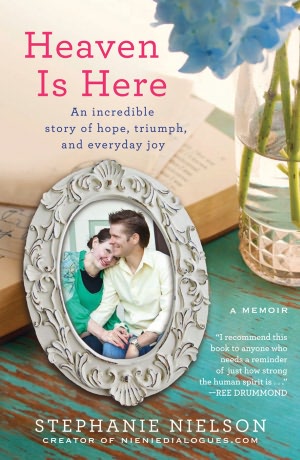
Review and thoughts on ‘Heaven Is Here’

It’s funny; I simply don’t read a ton of “inspirational” books; I do read memoirs and biographies on occasion as part of the wide mix of things I do like to read. But I don’t read a lot that’s really intended as inspirational, except for some official religious/church books, which I consider more reading for spiritual/religious purposes. So it was a little unusual for me to decide to read popular blogger Stephanie Nielson’s Heaven Is Here. And the main reason I did read it is I wanted to include it as part of my overall research into the topic of beauty and self-image, which I blog about sometimes here; in this case, I was curious to see what she had to say about how she felt about her appearance after a horrific plane crash that burned 80% of the skin on her body.

It’s also an interesting and different experience reading a book by a Mormon written for a general audience. As a member of The Church of Jesus Christ of Latter-day Saints myself, I’m very used to the Mormon culture and way of talking and thinking about things, and I’m used to listening to speakers and reading books by Mormons aimed at other Mormons. But it’s rarer to read something one of “my own” has written that will be read mostly by people who aren’t familiar with some of our terminology, beliefs, and culture.

That said, it was such a fascinating experience reading this book. It actually elicited all kinds of interesting feelings and reactions as I went along. I will admit that we Mormons tend to have some interesting cultural quirks that may seem unusual to others; we marry young, for instance, typically after very short courtships, and have more children than the average. Some of our cultural quirks are particularly pronounced in the state of Utah and a few other pockets of concentrated Mormon population (note: I’m not a “Utah Mormon”: I grew up East of the Mississippi and only lived in Utah when I went to Brigham Young University). So it wasn’t surprising to me to read that Stephanie married at 19 after less than a year of knowing Christian Nielson. Or that she started having babies right away. Or that she was just thrilled at that young age to just get started with being a stay-at-home mom. At the same time, even though it was familiar territory, it was still different from what I chose to do (marry at 23, get a college degree, have first child at 26, work part-time off and on and freelance while raising kids). And there’s still just enough of cultural expectations and a kind of cultural divide that those (what outsiders may consider slight) differences just kind of grate a little somehow sometimes.

Nielson starts with telling about her very large, happy and tight-knit family in Utah and her fairy-tale courtship with Christian. She lays the groundwork of her happy, idyllic life before she moves on to the plane crash that changed it all — well, temporarily. No matter how you look at it, not everyone (well, rarely anyone) has that kind of idyllic upbringing, love story or marriage. And that’s OK. Even in our church, unmarried young people and adults are reminded not to expect an “easy” and “obvious” courtship that leads to marriage. Sometimes it is not clear if the person you’re dating is “the right one” (itself a myth). You mostly have to make sure you date good people and then choose wisely, marrying someone who has solid good qualities and should make a good partner. The answer is rarely written in the stars or with fireworks. And most of us know that idyllic families happen far less often than we’d like. (We can’t change our own upbringings, let’s just say, but we can do the best we can to provide our own children with solid, happy homes.) So reading about Nielson’s happy-happy-happy life can honestly make one feel a little over-sugared.

But knowing going into the book what Nielson is going to experience makes that early part of the book palatable — it’s all too clear that she’s going to need every ounce of strength, idyllic family support system, and reserves of happiness and faith that she has stored up to be able to survive the ordeal that she does go through. Heaven Is Here doesn’t necessarily provide many details of the plane crash or the injuries she sustained, but it definitely shares the emotions she went through after the crash — the story is no longer idyllic. Nielson is painfully honest about her fears, her anxiety, and the many scary feelings she experienced in the months after she woke up from the 10-week medically-induced coma in which she stayed shielded from unbearable pain. She had support from family, but she often felt alone, and she wanted to shield herself from even many of her own loved ones and friends. She was scared of how people would react to her, how she looked, how she felt, how her life would never be the same. She was scared of having to face a new life, one that stood in stark contrast to her “before-crash” idyllic one. The bulk of the book, then, allows us to see inside her mind and heart, as she struggles and wants to stay in a cocoon but finally knows she must gradually burst free and move forward, as difficult as it will be.

As much as I felt some reservations and knee-jerk reactions to her pre-crash account of life, I couldn’t help but be tremendously moved and, yes, inspired, by how she lived after that crash. I loved her honesty about all of the moments she had that were not supposedly inspirational. Because that’s what lent reality and depth to all that was truly uplifting. It felt authentic. She was able to do what she’d set out to do: give hope to readers and show that life is beautiful, particularly when filled with love. And a perfect body or perfect face has little to do with that. For all that, I was grateful to have read her story.