Down syndrome ‘cure’ research creates flurry of questions

Yes, she lights up our lives just as she is, but any improvement for her would be great too.

I have a child with Down syndrome, but I’m not involved in the “community” in any way at this stage of our lives. (When she was little, I was on the board of directors of the local Arc, which advocates for and serves people with disabilities, but that’s pretty much been the extent of my activism or involvement.) I get a monthly email from the National Down Syndrome Society (or is it Congress? see: I don’t pay a lot of attention), and I sometimes read it. But generally, I don’t pay a lot of attention to the latest news.

This month, I’m late to the party in hearing about this latest bombshell of research: scientists have found a way to “silence” the extra chromosome that causes trisomy 21 in the lab.

Whoa, dude.

I’m still trying to get a handle on what the research really means. But essentially, it could mean there could be some kind of treatment developed in the future to help reverse some of the symptoms associated with people having a whole extra chromosome. Biggies: maybe reducing the likelihood of heart problems or even the cognitive delays that affect all people with Down’s. Apparently, it couldn’t “cure” DS before birth, but it would be a treatment sometime during a person’s life.

Of course, people who have children or other family members with Down syndrome, or who are self-advocates, have varying opinions about this news. Some worry that “curing” DS would remove a valuable segment of the population that arguably helps teach others about love and understanding.

Here’s my take: if it’s possible to give my daughter a better life, I’m all for it. Of course, I love her just the way she is, and I love how she is just herself and how she contributes in her unique way to our family. But I have every confidence she would be just as wonderful and a delightful contribution to our family and to the community if she didn’t have Down’s. I am not actively seeking or hoping for a cure. No, but if this research were to lead to some improvement in her life, even a drastic change, I’d still take it. If it allowed her to be able to (finally) understand math, for heaven’s sake, I’d take it. Why not?

I don’t expect that this research will lead to any real change or treatment within her lifetime, really. But in the land of what-if’s, I’m firmly on the side of taking a cure. I don’t think Down’s makes her the delightful, amazing kid she is; I think she’s just that person anyway. And if she could lead an even more productive and healthy life, I’d let her. Doesn’t every parent want the best for their child? I know I do.

As for the idea of taking away a whole “culture,” I still feel there are plenty of other people with disabilities of varying types that still teach us that extra love and compassion. I don’t see us curing any of those things wholesale. It would just be a strange kind of selfish to just keep people with a disability disabled if they didn’t have to be, just so we could have another way to help people be compassionate. That just seems upside-down and weird to me.

I’ll be interested to see what comes of this research. I won’t hold my breath for a cure or any real life-changing treatment from it. But it’ll certainly be interesting to see what happens.


The light feeling of forgiving

Several experiences and conversations lately have reminded me of just how much good forgiving others can do for our own hearts, and, conversely, how much holding on to anger, hurt, and blame can just drag us down, mire us in bad feelings, and darken our hearts and minds. It harms relationships and our own worldviews.

I won’t elaborate on the situations, but there have been a few instances in my life that have led to some serious anger and heartache on my part. The ways I was treated certainly “justified” my feelings, and they were natural reactions to the things that were said and done to me. And honestly, I didn’t want to forgive and let those hurt feelings go. It’s just so much easier (and oh-so-satisfying) to point a finger at someone else and say (either to someone else or just internally), “Look what that horrid person did!”

But there did come a point I realized I didn’t want to carry around that baggage anymore. It just wasn’t doing me any good, and I didn’t like the visceral reaction I had inside every time I just heard the perpetrator’s name or some other reminder brought them to mind. Not only that, I consider myself a follower of Christ, and holding on to truly ugly feelings against someone else (no matter their crimes against me) certainly didn’t make me Christ-like.

I did find, though, that the lightening of that burden of hurt and anger didn’t just happen overnight. In one case, it’s taken me several years to find that I must have, somehow, really forgiven someone. But that realization did strike me fairly recently, and I was amazed to have confirmed to me that it really had happened. I remember reading this beautiful description of that dissipation in Khaled Hosseini’s fine book The Kite Runner, and I was so happy to find that it had come to my life:

forgiveness

Because I never noticed the night it slipped away, I didn’t realize it had happened. But it had. And that right there is a miracle, no question.

If breast is best, why do we never see anyone actually feeding their babies?

nursing
Courtesy of Twitter/News 6, via Yahoo

So a few hours after reading this news item on Yahoo, I find myself not being able to keep quiet about it: once again, breast-feeding moms are finding themselves being asked to stop feeding their babies in a public place. This time, it was at a Chick-fil-A in Tennessee. Honestly, though, the location is pretty much not important. What is important is the fact that it keeps happening.

Disclaimer: I am not a breast-feeding activist. I only gave birth to three daughters and breast-fed them all up until they were about a year old. I adopted one daughter after them and just bottle-fed. I enjoyed nursing my girls, but it was a heck of a lot of work and was literally draining. It was really, really tough to be THE on-call food for the babies. And my girls didn’t nurse for 20 or 30 minutes every four hours, giving me a solid break in between. They would nurse for a shorter time every two to three hours, making it feel as if they constantly needed me, just for sustenance (let alone all the other needs an infant has). It was exhausting and a HUGE invasion of my personal space. It made me kind of crazy. Even so, I breast-fed them. It was healthiest for them, which was important to me, and it was nearly free, whereas formula is super-expensive.

I never went to a La Leche League meeting or consulted a lactation specialist or read a book about breast-feeding or anything. I didn’t make a big deal out of it. I just fed my babies. And here’s why I feel the need to weigh in on this news item: it is a pain in the rear to breast-feed a baby in public. My oldest child is 17 and the youngest that I nursed is 11, so it’s been a decade since I’ve been in the situation of needing to feed a fussy child while out and about. No matter how well you plan and feed a baby before leaving the house, etc., there are darn sure going to be times that baby has to eat while you are outside of your house. And here’s the plain truth in our society even now: you almost never see a woman publicly nursing her baby, whether it’s at a store of some type, a restaurant, or a park. But that doesn’t mean they’re settling in to a nice, quiet, private room designated for nursing at any of these places, because VERY FEW public places have rooms for mothers to feed their children. There are more and more family bathrooms available different places, at least, which is definitely helpful, but still not a lot of spots for nursing.

What does this mean, then? There’s nowhere to go to “privately” breast-feed a baby. Restaurants, especially not fast-food restaurants, do not have somewhere to go if a baby gets hungry fast. So you either pack up and leave, with the baby wailing all the way home, before you’ve gotten to eat yourself, or you stay and feed the baby.  But since we still so rarely do see anyone else breast-feeding in public places (whereas you can see plenty of women and men handing babies their bottles out and about), none of us feel comfortable with the notion, even breast-feeding moms themselves, in many cases.

Now that’s plain ridiculous. But here’s why: people who’ve either not been around breast-feeding mothers very much or who have absorbed our upside-down society’s notions that baring a little portion of breast while getting a baby latched on or off is somehow public indecency either outright make comments or ask women to leave or “cover up” or they stare or make weird faces at them because they are uncomfortable.

The problem is not that women are being inconsiderate and not “covering up”. The problem is that in our backwards, inside-out, upside-down society, it’s somehow acceptable for women to wear teeny tank tops and blouses that are so low-cut they show a solid third of a breast, and no one bats an eyelash. No one asks a woman showing a ton of cleavage to leave a public place. But if a woman doing her best to “discreetly” breast-feed her baby happens to show for a split second a good portion of her breast (maybe even her nipple, for heaven’s sake!), then it’s lewd.

And that’s what has my hackles up. Because when I see other people posting about this topic, and still so many people, EVEN WOMEN, EVEN MOTHERS, comment that they think these women should be more careful about “covering up,” I know we have a big problem in our culture. Women stage “milk-ins” to raise awareness whenever these news items pop up. A lot of commenters say these are unnecessary. I’m thinking, however, they’re still very necessary. We need men, women, and children, of all ages, to see mothers breast-feeding their children, enough that they become comfortable with it. Because most people clearly aren’t comfortable with it. And it’s not because it’s dirty or lewd or filthy. It’s because they just don’t see it happen often enough.

If nursing moms still need to stage “milk-ins” or “nurse-ins” to finally get our generally very-non-prudish society comfortable with a really healthy and natural activity, then I support them all the way.

It takes a village to keep me (mostly) sane

Life can sometimes be stressful. Life can sometimes be sublime. It can also, on rarer occasions, be unrelenting in its attacks, throwing punches from the left, right, above and below and behind — any which way — to try to knock one out, making the simple adjective “stressful” woefully inadequate.

It’s been like that for me the past month or two: life has nearly knocked me out. I suppose that any of the somewhat small things that has happened to me could just be easily shaken off; it would be laughable to think that any would really make me want to walk a ledge. But the constant barrage has cumulatively made me angry, frustrated, exhausted, utterly drained and significantly less able to function.

As time has worn on and I’ve become worn out, but I’ve still had to just keep on moving forward because circumstances have simply not allowed me to stop moving, I have come to appreciate just how much I appreciate those who are willing and ready to step in and help lend a hand or just offer moral support as I try to put one foot in front of the other.

This past week I’ve been traveling, visiting family and friends and attending the college graduation of a nephew and his wife. I was already at my wits’ end before the traveling began, so being in the car for hours on end (with three of my four children all cooped up in the small space with me and my husband) and sleeping in different places and all the other things that go along with road trips have made me even more tired and nearly feeling rather out-of-body.

Even so, seeing these special people has been a little boost. We visited for a short time with my husband’s oldest niece, a sweet young woman who was just a kindergartener when we married 20 years ago. Seeing her reminded me just how much I am grateful for her influence in my husband’s life: when she was an infant, he had just returned from a two-year LDS mission and was starting to get back to school and work. But he had plenty of time to help baby-sit her while his sister worked. He loved the experience. By the time we had our first child, I was still adjusting to the whole concept of parenting and all that went with it. But he was just ready to go. He changed diapers and clipped tiny fingernails before I even did. He held her and rocked her in the middle of the night to try to get her to sleep. Even for me, spending time with her as a five- and six-year-old was so enjoyable that I began to look forward to having a small child of my own to do things with.

Spending time with my grown nephew was rewarding because he fits in so well with my little family: my children adore him and his wife, and we enjoy their company so much. It also gives me great hope for his generation of our family and makes me want to be the best influence I can be. I don’t want to disappoint him.

Sitting with my wonderful, dear friend who lives a day’s drive away is always a blessing. We get to have so little time together, but when we do, it’s renewing and enriching. I can be utterly myself with her; I never fear how I may come across. I can unburden myself and she will listen and support without judgment and with love and compassion. She can encourage me to have hope and to do better without making me feel chastised or preached to or lacking or bad about myself. She has a real gift. She’s like my friend soul mate, and I am absolutely blessed to have her.

Last, I’ve had a great deal of practical help from friends in our hometown while we’ve been gone. My oldest had to stay behind because of a school commitment, and our absence, combined with all the things that had already gone wrong before our trip, required us to ask for a lot of help for her with rides, a place to stay so she won’t be alone, and lots of other little things. A number of friends have gladly and willingly stepped in to take care of her and figure out how to solve little problems while we’re gone. Their help has eased my mind greatly on her account. My mind has been racing so much and has been so burned out by all I’ve had to keep track of and fix, etc., that I don’t know if I could have done what needed to be done for her had people not just volunteered and helped her without my even being involved.

Sure, it does take a village to raise a child (a child just thrives and learns the best with a mom and dad and extended family and friends and teachers and all kinds of other people in a community). But it also takes a village to keep an adult functioning. We’re really all interdependent. The better connected we are, the better we can keep on keepin’ on. I’m just incredibly blessed to have some good people in my life and incredibly grateful to them for helping me to survive the toughest periods of my life.

Sure, the new prince is getting attention, but so is the royal post-baby belly

royal baby bumpYes, the world has gone crazy over the royal baby. And people have plenty to say about how this very soft news has eclipsed some other very important news. I could say lots about that, being a journalist myself, but for right now let me just say that even as a journalist who does like to stay informed about vital news events, who doesn’t like to take a little break from all that is depressing and frustrating to enjoy a cute little baby? My own four daughters are now getting sadly far past the baby stage, the youngest now going into first grade (!), and I find myself missing a little bit those sweet days of their infancies. So yeah, I’m feeling a little nostalgic and enjoying the baby photos.

A secondary focus of talk around the blogosphere has been Kate’s post-baby belly. There are many who are applauding her willingness to just let everyone see the reality that is a woman’s belly right after birth: it’s still quite large. I remember looking down at my own belly after giving birth each time and thinking it looked like a huge lump of bread dough (enough for probably four loaves) that had risen for hours and then just been punched down. Soft, squishy, lined and utterly non-sexy. I honestly have to join in and say, thanks, Kate, for not trying to hide that belly. I’m sure with all her resources, she could have minimized its size or shape by dressing a certain way or wearing Spanx or… something. But she didn’t.

On the other hand, other observers have noted it’s sad any of us are focused on the Duchess’s appearance at all. The fact we’re applauding her for her “honesty” just shows we’re still focused as a society on a woman’s appearance rather than other much more important attributes. And I have to say I agree with that as well. (Another point made within this same observation is that aside from the belly, Kate looks pretty darn good: her hair and makeup look great. And not many new moms get that kind of beauty treatment the day after giving birth. Sure, that’s true. But at the same time, how many of us have to step out of the hospital a day after giving birth to show off our baby to billions of people? The fact is, Kate and the whole royal family have a role to play, and when it comes down to it, she’s doing it with a lot of grace. So if she gets stylists to spiff her up a bit for photo ops, so be it.)

But my conclusion is this: we still live in an appearance-obsessed society. I think most of us would like to see that change. I know I would like to make people more aware of just how much we all think about looks, so that’s why I write occasionally about the topic. But I don’t think our society is going to change overnight. I’m OK with “baby steps.” And if Kate, playing the role she does in British society and even on the world stage, feels best about fixing her hair and donning nice makeup and a pretty but simple dress to show off the newest heir to the throne, even while feeling comfortable enough to show off the reality of the post-pregnancy belly, more power to her. The belly is a baby step. I say, focus on the ways we’re making progress, celebrate and applaud those, and then still remember that we can make more progress in the future.

Compliments that last forever

So I’ve written occasionally about beauty and self-image, but I haven’t said much about how we compliment each other. Have you noticed that most of the time we tend to compliment others on how they look in some way? “You’ve lost weight! Lookin’ good!” “Love that new outfit.” “Nice new hairdo.” “You look pretty today.”

I have to admit, of course I love receiving these kinds of compliments. Yes, I do like feeling that I look good. And I think compliments are pretty much always a good thing. But what happens when we’ve gained weight or we’re having a bad hair day? Are we going to automatically remember the times we were told positive things when we were thinner or fresh from the hairstylist? (and then think poorly about ourselves right now in comparison?) Just something to consider.

I was reminded twice recently just how wonderful it is to be complimented on attributes that will last. One, I spent a morning editing, which is my only paid job. And honestly, it’s not work for which one gets a lot of high-fives. Writing is more visible; editing, though, is basically a way to ensure someone else’s writing either gets noticed or doesn’t get attention in a bad way (“you misspelled my name?!” or “I’m going to sue you for libel!”). So as proud as I am of my editing work, it’s largely thankless and something about which I can only congratulate myself.

But during the course of this busy morning of work, I fixed a mistake, and the writer was appreciative. That writer either brought the important catch to a publishing editor’s attention, or that editor saw it in the notes on the story. Either way, that editor contacted my boss and said how much she appreciated my good work. My boss passed it along to the other editors with whom I work, so we all can know that sometimes, our hard work does get noticed. And bam! I’d gotten appreciation. Actual praise for the work I do regularly. Woot!

The other compliment recently that really meant something to me came from someone I’d never met before. I was doing volunteer work at the Fresno temple of The Church of Jesus Christ of Latter-day Saints. We Mormons go to church services on Sundays in our local meetinghouses/chapels/church buildings (we refer to them variously as such). But our temples are extra-special places, where we learn and make covenants with God and then can provide those same opportunities for our ancestors who have passed on. They’re particularly quiet, holy, and sacred, and going there to do work for our ancestors is such a blessing. Early one Saturday morning, I spent an hour there, working in close proximity to a few other women I didn’t know but drinking in the peace that exists there. In the course of our time together, I felt particularly warmed by the kindness of the women who were volunteering there with me. They smiled beatifically (absolutely true!) and were thoughtful and helpful. One told me that she loved how my eyes danced, among a few other observations about how I came across as a person.

Now that was a compliment to remember. Lately, I might have been feeling incredibly stressed and exhausted and worn down by all kinds of things that have been going on in my life, and I might have been feeling bad about my weight (I admit the stress has led me to eat very poorly, a habit I’ve been trying to break but have been not terribly successful in fighting recently). I was wearing no makeup; my hair hadn’t been fixed for the day other than receiving a quick brushing. I wasn’t even wearing anything nice. But this compassionate lady told me that she appreciated my soul, my spirit: who I am inside. And I thought, “You know, it doesn’t matter today how I look. Because who I am is shining out through my eyes and my face. And somebody noticed.” If I stay the kind of person I want to be (well, hopefully, become better), my eyes will always dance. I will always smile genuinely and with warmth and friendliness. Even when I’m 90 and my body looks very different and my face is wrinkled, my eyes and my smile will be the same.

Yes, I like it when people tell me I look pretty. But when someone compliments ME, who I AM, it really sticks with me and warms me from the inside out; it has staying power. If all of us just made more efforts to recognize the best qualities — the forever, enduring ones — of those around us, the world would be a nicer place. And maybe, just maybe, we could be less concerned about how our outer “shellves” look.

Does editing out offensive language help?

So I’ve read a few good books lately that have just had more strong language (a nicer way of saying “the f-word” or rarer vulgarities) in them than I would like to see (and honestly, I’d really rather there be none, but occasionally I can understand one or two uses). One I thought was fantastic was Josh Hanagarne’s The World’s Strongest Librarian. Great book. Only drawback? About 14 f-words. Really? Why did he have to put those in there? He could have quoted some odd characters without using their exact words all the time, and he could have made clear perfectly adequately they were colorful without using all that strong language. I am that confident in his descriptive skills as a writer.

Since I wanted to share the book with my book club, the women in which share my sensibilities about vulgar content, I felt an obligation to (a) warn them about the language and (b) share with them my whited-out personal copy so they didn’t have to see all that vulgarity right there in black print. (Yes, I used a Wite-Out pen to “erase” all those f-words.) I figured if someone else had read it first and recommended it, I’d prefer to read the edited version.

whited out textSo here’s the question: does it make a difference “whiting” or “blacking” out bad language, so you can tell it was once there? Will your mind immediately fill it in anyway? Or does it make a difference not to actually see that offensive kind of content, even if you know it was there? In a similar vein, does listening to a popular song that has some bad language edited out, a quick silence in its place, or watching a movie on TV that’s been edited (let’s just say language been “quieted out” rather than replaced by less bad language), feel not much different than just hearing the language anyway? Does the silence get filled in in your brain? Or are you grateful just not to hear it in reality, even if you know that’s what’s been taken out?

I also wonder if we all might have different reactions to this because of how our brains process information. Some of us learn and remember in a more visual way and others via audio. (I just see and remember things; my husband remembers everything he’s heard, for instance.) If we’re visual, will we just fill in a blank when we know something’s been taken out in print; or if we’re audio, will we fill in with audio? Or vice versa? Or does it matter?

Obviously, it would just be nicer for those of us who do have more sensitivity to language in books or music or TV/movies if those media came without the vulgarity in the first place. But since some do, does it help to edit them and leave obvious holes that we could possibly fill in mentally, or is it just best to avoid them altogether?

Just curious about what you all think. Of course, if you don’t care about bad language or vulgar content and don’t really consider it too offensive, all of this is a moot point, so don’t make arguments about the basic concept. But if you do care about this, either for your own reading/viewing or for that of a child, I’d love to hear what you think.

This author is on fire!

I admit I enjoyed reading the Twilight books. No, they’re not great literature or written with great skill. But they were a lovely escape, and I had fun. There. But I’ll give this to Stephenie Meyer: she has a great imagination and is truly a good storyteller (this comes even from her own mouth: she’s said she’s more a storyteller than she is a writer). She is also a fine judge of other books. Five summers ago on her website, she recommended the now ridiculously popular The Hunger Games. I went out and read it and found it fascinating, thought-provoking and gripping. Most everyone else seemed to agree.

But she also not too much later recommended a fine “duet” of books by Elizabeth Knox called Dreamhunter and Dreamquake. I went out and got those at the library and found myself utterly transported. The books had such an interesting premise: in a slightly different world than ours back in the early 1900s, an area appears which only certain people can enter. Those people can go in to this area, lie down and sleep, and “catch” dreams, which they can then essentially “broadcast” to a sleeping audience in a dream theater. Interesting idea in itself. But what became even more fascinating was the mystery of why the Place came to be in the first place, and if it has some kind of purpose. By the time the whole reason behind the Place is revealed at the end of the duet, after two wonderfully rich and complex books that were a little dreamlike themselves, I was absolutely blown away. It’s so satisfying as a reader to see bits of a mystery come together magically and then just be solved. But this also had such a powerful poignancy to it that I felt my heart seize up a bit. And the setting and tone, the whole feel of the books, was superb. Original, so real, so powerful.

Mortal FireSo I was thrilled to find out a couple of months ago that a new novel was coming from this superlative author, Mortal Fire. I let myself dip into the waters of this new book and its setting and feel, relishing the opportunity to visit Knox’s world again (this book is actually set in the same general place as the other two but 50 years later, and it’s mostly unconnected with the plot of those books, so it’s not necessary to read them first). But as I continued reading and the plot thickened, I found myself gobbling it, not able to put it down. I just rushed headlong to the end, and it was just as satisfying. What a fascinating premise! What a cool way of weaving the threads of story together and making it all make sense at the end! And the setting: again, just so vivid. I came inside (after sitting outside alone reading for two hours) just babbling about how much I loved the book. And a few days later, I still feel the rush of the thrill of discovery and the power of how it all hit me, not just in how it sent my mind spinning, but how it struck me smack in my chest.

What’s interesting to me is that all these books were recommended by Stephenie Meyer, but I haven’t heard a peep about Knox’s from other readers, whereas The Hunger Games became pretty much ubiquitous, not quite annoyingly so. Sometimes I wonder why these outstanding books don’t get more attention. (I think this is also the case with Susan Cooper’s The Dark Is Rising. I am always surprised at just how many of my well-read friends have never even heard of this series, let alone read the five books, either when they came out when I/we was/were young or now.)

At any rate, Elizabeth Knox, you are amazing. I don’t lavish praise on many authors, but you have joined the elite list of authors who really impress me. I hope more discerning readers discover your books.

How did this tragic news item slip by me?

It’s been six months since this incident but somehow I have managed to miss any news of it. And it’s certainly the type of story that should have lit up my Facebook newsfeed and the blogosphere: a man in his 20s with Down syndrome died of asphyxiation after a scuffle with off-duty sheriff’s deputies who tried to forcibly remove him from a second showing of a movie. Just reading this makes my heart seize up and fall a few inches within my chest and makes me want to scrub the knowledge of it from my mind.

Robert Ethan Saylor is the young man with Down syndrome who died after an encounter with off-duty deputies; this family photo ran in the Washington Post.

How is it that in the intervening months this hasn’t been passed around more? How did I miss it? Somehow I know that Kanye and Kim named their baby girl North West (just confirming yet again why I do not watch their shows/buy their products or support them in any way, monetarily or with my viewing/listening time), but I didn’t know that a young man with mental disabilities who idolized the police died because of people’s lack of training or sensitivity or understanding or … I don’t know what. I love this editorial from the Washington Post: where’s the outrage, indeed?

As the mother of a nearly-15-year-old daughter with Down’s, who is getting to be a full-size adolescent (still quite short, which isn’t unusual, but a solid 85 pounds), and who certainly has her own opinions and desires that sometimes don’t quite mesh with mine (which isn’t unusual for an adolescent, either!), I am honestly just sickened by this.

I can totally see this happening to her if she were in the same situation: went to see a movie she really liked, decided to just stay seated for a second show, makes a bit of a fuss about being asked to leave. Even if I have explained to her some of the societal norms and expectations for this, she either may have forgotten, not understood, or just chosen to forget. So she stays. Some security officers at the mall who happen to also be sheriff’s deputies or police officers (who in this case aren’t even in any kind of recognizable uniform) tell her to leave; she stubbornly digs in her heels and stays. They pick her up and she resists (wouldn’t you?), and she somehow ends up asphyxiated. It’s a nightmare scenario, all the more so because it’s so easy to imagine happening.

What’s more sickening is knowing that if just one of those officers/deputies had any experience spending time with someone with a mental disability, they might have just simply quietly sat and waited. Waited for someone in uniform, talked to someone who knew the young man, taken a moment to make a phone call, just waited for him to stop panicking or being scared, throwing a fit, whatever. Even just let it pass; was it worth tossing him out of the theater? My daughter, even in situations at home where she’s throwing a little tantrum, tends to recover within a couple of minutes and then just nicely go about doing what I’ve asked, as if she never resisted. So simple, so safe.

So, as the Post asks: Why did Robert Ethan Saylor die? Where is the outrage? Here’s the Post’s editorial on the topic that just ran a couple of weeks ago: I know I’d like to make this news more widely known.

Witty librarian writes a strong memoir

So I finished reading Josh Hanagarne’s excellent memoir last week and am still feeling the urge to gush. This book just works on so many levels that I feel compelled to recommend it to a lot of friends, for all kinds of reasons. I’ve written a full review on my review website, Rated Reads, but I’ll share a bit more here.

First, I like to laugh, and this book made me laugh. Check. Second, I felt I had a bit of insider’s knowledge because Hanagarne was raised Mormon and talks a lot about Mormonism, such as scripture stories, the experience of serving a mission for the Church of Jesus Christ of Latter-day Saints, and a lot of other little cultural touchstones. Since I’m LDS myself, I felt I could really appreciate what he was talking about. At the same time, he explains things so well that readers who aren’t Mormon won’t miss out. I think he handles that really nicely. But I got a big kick out of some of his stories, like the one when he’s a young boy talking about Ammon and all the cut-off arms in his Sunday school class. (See my review on Rated Reads for more information or the original account in the Book of Mormon, Alma 17: 18-39, and you can better appreciate the humor).

I also enjoy learning about what it’s like to deal with particular life challenges. In this case, Hanagarne helps readers get a little idea of what it’s like to live with Tourette Syndrome. He explains it really well and makes it funny as well as informative. His way of telling his personal experience with this syndrome helps readers appreciate what it’s like without feeling sorry for him. We just get to know Josh, who has these annoying tics and outbursts.

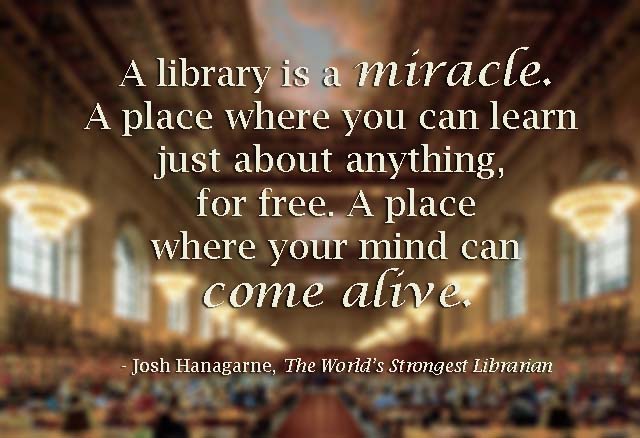
He has loved to read for pretty much his whole life, his mom being the great kind of mom who took him to the library at a really early age and read to him and with him. So he talks about favorite books and authors. He is now obviously a librarian, and he shares stories about all the wacky people and situations he encounters working at a large library in downtown Salt Lake City. He so clearly loves books and being able to work in a stronghold of information (despite the wackiness) that it’s just great fun to read what he writes about books and libraries. Great quote from the book:

A library is a miracle

Last, and this ties in to my previous point about his faith background: he has struggled with faith off and on for a lot of his life, wanting to have the strong faith that his mother so clearly has and wants to instill in her family, but just not always “feeling it.” Faith involves both knowledge and feelings, essentially, and he talks a lot about how he has often wondered about what he feels and doesn’t feel in that regard. I liked that rather than being at a point of anger at God or bitterness about organized religion or the LDS faith in particular, he is at a point of just not knowing, of being uncertain. He wants to “feel it” and can cite several specific (and beautiful) examples of when he did have a prayer answered or a concern addressed by God, but for much of his day-to-day life, he just doesn’t feel a connection with the divine when seeking it through prayer or other religious activity.

Hanagarne shows no antagonism but expresses more of a sense of loss, of the “pieces of his life” not “fitting together” and meaning the big thing they used to mean. He worried that his mother, especially, would be angry or distraught (“I’d pictured a maternal rebuke, disappointment and tears, … a guilt trip…”) when he told her he was going to stop going to church because he wasn’t “getting anything out of it anymore,” but she just told him, “The older I get, the more I see that people just have to live their own lives and make their own choices. I’d be lying if I said I like this. I don’t. … But you’re my son and whatever happens, we’ll all still love you and that won’t change.”

I love how he expresses his search, his experiences, his feelings and non-feelings, and his uncertainties. I love his dialogue with his mother. It’s all so honest and real, and what I’d say is a view on an ongoing process. I love how supportive and still hopeful (I thought) and faithful his mother is as they talk.

I feel hopeful for him, too. He is blessed, and we’re all lucky enough to be able to read about his story, the warmth, the wonderful family love, the fun, all mixed in with the challenges of regular life and the specific challenges of Tourette’s.