Most people have probably at one time or another been to a potluck: a delicious event in which there are tables full of food brought by all the participants. The variety of gustatory pleasures can be almost overwhelming. If done right, there’s plenty for everyone. The basic rule is this: bring enough for yourself (or your family/group) and a few more.
What a great rule! Lots of people can eat as long as pretty much everyone who comes brings just a little more than they need. This can take care of those who can’t bring something for one reason or another.
What if everyone lived life by this philosophy? Take care of yourself and your immediate family and then reach out to help just a few others. Watch out for them and their needs; check in on them regularly, be friends, make sure they have food and shelter and someone to lean on. I’ve already written about how it can be overwhelming to think about all the needy “out there” and how it’s simply not possible to help them all. But it is possible to just help one at a time, starfish-style. I’ve also written about my church’s home- and visiting-teaching programs, in which pairs of people are assigned to take care of a few others. It’s just a few. When ‘most everyone steps in and takes a list of people to help, everyone has an automatic pair of friends to turn to when some need arises, whether it’s more “practical” or just a listening ear. It’s a simple but beautiful system.
I’m not discounting the work of a lot of great organizations in the world that help those who are needy in one way or another, but life would certainly be happier and more comfortable for everyone if all who were able did their share plus just a little bit more. Yes, let’s all adopt the potluck philosophy.
Given my views on our society and the feminine “ideal,” it should be fairly clear at this point what I think about Victoria’s Secret. The whole way that brand markets its products just makes me shake a little with indignation. I haven’t set foot in one of those stores in years. I just won’t support that company with my dollars. And let’s be clear: the “fashion show” that VS puts on on television once a year is just soft porn that’s received a stamp of cultural acceptability.
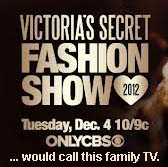
But here’s the thing: the show is now being marketed to families. Yes, somehow this spectacle of impossibly thin, tall models with unnaturally large breasts who are showcased in sexy bras and angel wings (really?) is now somehow becoming a family event. Wha? Even though most rational people would not consider this family entertainment, it’s hard to ignore how the show is being packaged and advertised. The runway models wearing itty-bitty push-up bras and panties adorned with bling galore (can someone say Bedazzler?) are being accompanied by musical entertainment. This year, it’s Rihanna, Justin Bieber and Bruno Mars. Just who is Justin Bieber’s audience? Teen and tween girls. And Rihanna’s? Same. The producers are clearly aiming to snag the eyes of young girls and prepubescent boys, not just the obvious men of all ages and teen boys.
Is anyone else outraged by this? It’s bad enough that men are going to watch this “acceptable” porn on network television and just reinforce the feminine body ideal. And it’s bad enough that women are going to see it as well and have yet another opportunity to compare themselves unfavorably to what’s honestly a runway full of genetic aberrations. Now, young girls and boys are being indoctrinated into the religion that worships the female body ideal as well.
So I received an email through my Rated Reads site, asking me for guidance on resources that can provide information about content in books for younger readers. It got me thinking again about the place for parental involvement and potential restrictions on books for elementary-school students. I suppose I’m a little late to the game in terms of this topic because Banned Books Week was over a month ago, but here goes anyway.
Before I say anything else, I’d like to make clear that I am against “censorship” in general (let me restrict this discussion purely to books). That entails actually suppressing and forbidding the viewing or use of particular passages or entire books. It’s not my place to decide what kind of content should be completely forbidden, and it just sets a bad precedent. I wouldn’t want someone else to have the power to forbid what is viewable by me or my family members.
So while I am against forbidding things entirely to most readers, parents and educators do have a responsibility to young children to make sure they read material that is appropriate for them. Even then, I hesitate to ban books entirely because, while I wouldn’t want a child getting hold of soft porn, for example, I wouldn’t agree with those people who were eager to ban Harry Potter because of its theme of magic.
What I am a proponent of is information. That’s why I started Rated Reads, a modest effort though it is. But at least it’s something. We have nearly 1,000 books featured with content ratings and moderately detailed paragraphs explaining what kind of potentially objectionable content is in each book. I firmly believe that each reader and, in the case of children, each parent should be able to have resources to find information that will allow him or her to make a decision.
I would like to think that books that are selected for a children’s library are going to be appropriate for young readers and acceptable to most parents, both in thematic content and possible sex, violence, or bad language. But young readers who are ready for young adult books, for instance, deserve to not be shocked by what they read or to have their parents be shocked. There are a lot of great young adult books that are fine for younger readers, that don’t have strong language or detailed violence or sex scenes. But there are just as many that I wouldn’t want my younger kids reading.
Since elementary schools generally have limited space, I think it would be wisest to select books that will be most age appropriate and least objectionable to parents. But at the same time, there may be a few YA books that would be great reads, in terms of stimulating thought on various topics, that might be nice picks for those libraries. And some of those might have some violence or other scenes that could be objectionable to parents or their kids. In these cases, it seems it would be particularly smart for everyone to include a kind of electronic ping with further information for the student and her parent when it comes to checkout time. This would allow parents to give a yea or nay to their child reading that book; a note could be sent home before the book is approved for checkout, providing details about why that book could be a poor choice, including themes, sex, violence, and language.
Now there are going to be some parents who are very careful about using this system, saying no to some books and yes to others based on their consideration of the information provided; there are definitely going to be other parents who simply won’t care. And that is their business. If I were that child’s teacher, or a fellow parent, I might not agree with those parents’ decision, but it wouldn’t be my responsibility to override or actively disagree in some other way. As long as a parent hasn’t been declared unfit, it is his or her responsibility to make decisions regarding his child, and that needs to be respected.
But there is no doubt in my mind that more information should be available so readers and parents of readers can make more informed decisions. I don’t think it’s always possible or practical for a parent to read every book a child would like to read, becoming the child’s first reader. We just need more information. Again, that’s why I’m doing Rated Reads. But I’d love to see more coming direct from publishers or something similar (I suppose that’s kind of another topic, but in brief, I don’t see why it would be so hard for the editor to include a brief description that states how much language or sex or violence is in it…). There’s simply not enough information available about most books.
So. What are your thoughts? Do schools sometimes need to be more cautious about what they choose to stock in their elementary libraries? Do parents need more information, and how should it be provided? And what about junior highs/middle schools and high schools?
So I have enjoyed Pinterest quite a bit since I decided to sign up and start using it earlier this year. It’s definitely handy-dandy for lots of things. My youngest even knows that if we’re trying a new recipe, it’s most likely from Pinterest. I think, like a lot of other Pinterest users, I use the site for recipes, laughs, and just useful ideas about all kinds of things.
Yes, it is delicious. But NOT 50 calories; no, it’s 500.
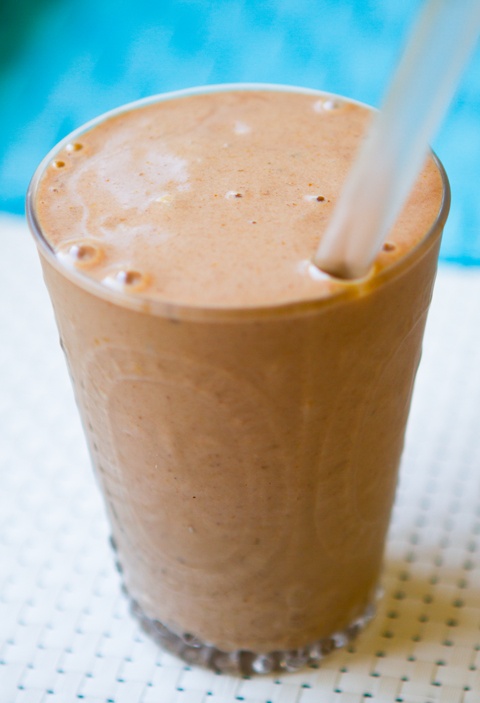
But what has really gotten my goat over the months is noticing how much of it is just blatantly false. This is the case with “no-calorie” recipes of various kinds and with “fitspiration” pins. A few examples: the 50-calorie shake. The photo shows a delectable-looking glass filled with a thick, creamy chocolate shake. It always says “50 calorie shake” underneath the photo. I have now seen this repinned by friends at least four or five times. Every time I can’t help but comment on it. Because the truth is that the shake (if the whole recipe is imbibed) is 496 calories. Nearly 500. Not 50. If one wanted to have a 50-calorie version of this shake, that person would have to get out a shot glass, because she’d only be able to drink about 2 ounces. The original site doesn’t say anything about it being “diet” or low-calorie; it’s just a healthier way to have a “shake” than going to an ice-cream shop.
There’s also the “no-calorie slushie.” The photo shows a glass with the final product, and there’s pictures of bananas and strawberries. If anyone were to think about it for just a second, she would know that bananas and strawberries HAVE CALORIES. The blogger admits that “her diet plan” doesn’t count fresh fruit or vegetables, but for those of us who do count everything (which I certainly think is a wise move), it’s about 250 calories. I’m thinking there’s a big difference between NO calories and 250. In fact, if one were to drink that no-calorie slushie every day without changing her diet in other ways, she’d gain half a pound a week.
I think I’ve already mentioned the “fitspiration” pins. Beauty Redefined writes a fab blog post about those. Here’s the thing: it’s great to motivate yourself if you’re trying to take better care of your body by eating better and exercising. But the pins that show a ridiculously thin naked midsection with hip bones protruding, for example, are not going to help anybody. They tend to say “all you have to do to get these abs is follow this plan….” Honestly, I don’t care how much I worked my abs, I would never look like that. I’d also have to cut my calories to less than 1000 per day (not healthy) and get plastic surgery to get rid of the extra skin and the stretch marks to look like that. Can we sit back for a moment here and say, OK, I’d like to get healthier, but repinning this ridiculous photo isn’t going to help me or anyone?
Yep. All lies. Why is it that we perpetuate them? I personally don’t repin these. I just don’t. If the recipe looks tasty and I’d like to try it, then I’ll repin it and give it an accurate title and caption: “fruity slushie,” for instance, or “protein-packed shake.” And even if I would like the tips for exercise, I just flatly refuse to repin those photos of tiny midsections. I’m not gonna do it. I don’t want to send the message out to my friends that image is paramount and flat abs are a holy grail. I don’t want my wonderfully normal friends to feel worried about their abs. Why should they? I also tend to make comments when friends pin some of these, just to correct the erroneous notions that are being sent along via the ever-so-simple pin. I imagine they are annoyed by me. Oh well.
So I ask: if you’re a Pinterest user, are you going to breezily send the lies along for hundreds of other pinners to see, or are you going to stop them in their tracks? When you see a claim that seems “too good to be true,” it most likely is. Think about it for a second. Do some quick calculations. Go to the original post. Do something, but just don’t send it on!
Whew! It has been quite a week in this country. The election seems to have brought out the worst in everyone, just before the vote and since the results were announced. I’ve been pondering on several topics connected to what has gone on and what people have talked about (or yelled about or written about in scathing words), and one has been the great divide in how people see wealth, or the lack of it. I have observed a lot of heated discussions about the rich, the poor, and what it means for individuals and the government to provide aid to the poor (thereby “taking” from the rich or even the middle class in the form of higher taxes).
What I’ve thought about is that everyone can give of their time and talents, whether they have money to spare or not. Money is not the only resource we all have. Even the poor can give of who they are and what they’re good at.
I live in California, where there are particularly bad problems with the economy, the state budget, and social programs, particularly education. I’ve observed in just the past four years while I’ve lived here most recently just how much education has suffered. Class sizes have gotten larger and larger, and schools’ budgets have gotten smaller. At the same time, I’ve been encouraged to see individuals doing all they can to help schools by just giving of their time. I have four children, one in high school, one in middle school, and two in elementary. My youngest is in half-day kindergarten. The teacher, as most do, asked through notes home if any parents could help out in the classroom. Given that I volunteer in a variety of capacities and write and do editing (part time, the only thing for which I earn any money) out of my home, I can’t give a lot of time to one area, but I can try to do something. So I told the teacher I could help out once a month. I did that the first time a few weeks ago, sitting in the back of the class and helping students with some projects. I watched the teacher manage a huge class of 30 5-year-olds. THAT is a huge job, let me tell you. I also watched one other parent sit at a table and go through all of the children’s daily folders and check that homework was done and everything was in order. She relayed the necessary information to the teacher. I was amazed to learn that this parent is there EVERY DAY, for the whole 3 1/2 hours the students are in the classroom. She volunteers that much of her time. And believe me, it definitely looked as if the teacher would have a hard time doing without her. She was pretty busy with that class FULL of little kids.
Not everyone can give that much of their time. But everyone can do something. Giving of ourselves makes us truly human, in all the best ways, I think. And it brings such a sense of satisfaction to us, while we’re providing needed help to others. It’s important for each of us to give of ourselves voluntarily and from the heart. At the same time, however, I think some people can sometimes use a little nudge. This is the only place in this post I’m going to really write about my “political” view, but here goes: I firmly believe that if people are being given assistance, from the government or from a faith-based organization or other group, then they can give something back for that aid. I love how Habitat for Humanity works: it requires that people give “sweat equity” to help build their own homes. They are provided a wonderful new home of their own, and they put in hours to build it and others’ homes. That’s part of why I like to donate money to that organization; I like its philosophy. I don’t think that requiring this kind of “payment” is all about “fairness,” though that is a part of it (if you’re going to get something, you should work for it in some way); it’s also about helping people to feel that they are valuable and able to give, able to work somehow. Those who are just given things without earning them tend to not feel as confident about themselves. So… I’m not against there being a government-sponsored safety net. Everyone ends up in a rough patch at one time or another, so it’s vital to have something available. But I would like to see that those who use that net for a while give back. Hunt for a new job, perhaps, for half of your day and spend the other half volunteering somewhere. This is just a general idea.
At any rate, I salute those in our society who work hard to take care of themselves (that’s SO many of you!), and then still spend more time working hard to help others. Whether you give money or time or any other of your particular resources, you are helping to build and maintain civilization.
It would be difficult for anyone to argue that women aren’t being demeaned as objects in pretty much every single corner of society. It happens so much and is such a thoroughly pervasive message in media that we’ve almost forgotten to be angry about it. We just take for granted that it’s happening.
Well, I think it’s time for women — and men — to stand up and show some anger about this phenomenon. It’s time to stop the saturation of our culture with images of sexualized women.
You can’t slap a pink ribbon on everything and say it’s “supporting” women.
I’ve been writing off and on about this topic, and I’ve nearly finished the book I’m writing, which focuses on the topic from a faith-based angle. But nearly every day, I see something else that makes me want to shake my fist and just DO something, SAY something. Yesterday it was a USA Today article about how breast cancer is being sexualized. Wha?? Yep, it’s true. I suppose I’d already kind of subconsciously noticed it myself, but the article really clarified the point. I also had just noticed a full-page ad in an in-flight magazine when I was traveling over the weekend: it showed a photo of a very trim, fairly young woman with smallish but nice breasts (a point I feel inclined to note, since most of these kinds of photos show women with larger-than-life breasts) dressed in an itty-bitty white bikini. Flat abs, no fat, no cellulite, no blemishes. And the ad had the nerve to have been run by plastic surgeons touting the message that they can do great reconstruction on women who have had breast cancer. Aaaaiiiieee!
Let’s think about this honestly. Is the average survivor of breast cancer going to look like a 20-something model? Ah, nope. She’s going to have scars, could be some pretty big and ugly ones, depending on how much surgery had to be done. She might be thin (thanks to not being able to eat much during chemo), but not necessarily in the “attractive” way. It might not even be possible for reconstructive surgery to get her back to “normal.” A friend in her 50s recently told me about her experience with breast cancer, and she said that after having a double, radical mastectomy, she was told by surgeons that the process for giving her breasts would be lengthy and, as she put it, “barbaric.” And then she wouldn’t even be able to have normal-looking breasts: they wouldn’t be able to give them nipples. She turned down the surgery; no point in going through all that to have substandard breasts.
Nope, these kinds of demonstrations of support for breast cancer aren’t help. They are simply marketing opportunities painted in pink. The article quotes Karuna Jagger, executive director of advocacy group Breast Cancer Action, as saying, “The implicit message in these campaigns is that it is breasts that are sexy; sexy is what is important; and we should care about breast cancer because it takes those lovely, sexy breasts out of the world . . . Every October, the stunts just gets more bizarre and further removed from what’s needed for this epidemic.”
Why can’t we just stand up and say, ENOUGH, ALREADY!? Sexy, young, thin, well-endowed female models are used to sell almost everything. I work out at the gym every day and can see a bank of about five TV monitors showing different networks while I exercise. I read or listen to music, but I can’t help but glance over at the monitors and see what’s going on. At any given time, I see several images of unrealistically-shaped young women, on commercials or the news or various programs. The anchors on news networks are thin and usually young (at least in comparison to the men, who can be any age). Innocuous game shows feature models showing off the prizes. Soap operas feature cute young girls and some older women who have often had various work done (at the very least, Botox and injections to plump up their lips or cheekbones). All the commercials feature women. Products for men and commercials aimed at men feature sexy models, scantily clad. Products for women and commercials selling those products for women feature women; most of them are for hair color (get rid of gray) or skin creams that aim to reduce wrinkles and make skin look younger and fresher. Car commercials even mostly feature women: young, trim models.
It’s all about sexualization. When will all women say, Enough. No more. I refuse to be sexualized, to be objectified, any more. It starts at home and with our circle of friends, even just on Facebook or Pinterest. Stop pinning the “fitspiration” pins. I don’t. I like to exercise, and it’s a vital part of my daily routine. But I refuse to put another photo in front of me that has a ridiculously skinny teen or 20-something clad in a sports bra and tight boy shorts, touting her amazing workout that will make all of us look just like her. It’s ridiculous. We should be laughing, not trying to emulate those girls! Stop posting about how you feel fat or ugly or that you look old. Don’t expect yourself to look your regular self two weeks post-baby, either. Stop focusing on how you look, period. And don’t focus on how your friends look. Support them as they do great things with their lives, as they work on being their best selves.
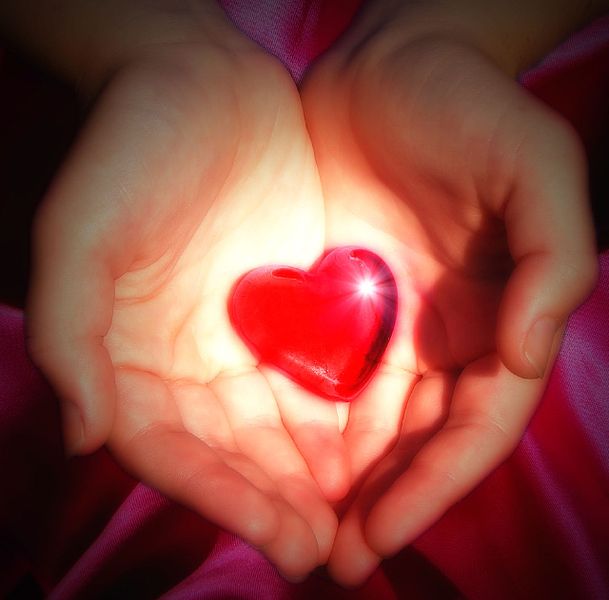
Women’s important body parts aren’t our breasts or backsides. They’re our hearts and hands. Photo by Louise Docker, via Wikipedia
Focus on YOU, women. Allow the men in your life to focus on who you are inside, too. Teach your daughters to be who they are, and teach your sons positive language about women and not to focus on appearance. Yes, be healthy. Try to eat mostly well. Exercise regularly. But don’t make how you look the end-all, be-all. Don’t let yourself be objectified. Don’t let the media and the marketers and the porn producers dictate how you feel about yourself or how society views you. Gently remind friends that they are “more than eye candy,” as Beauty Redefined enshrines in billboards, or that they are more than just numbers on a scale.
We women are amazing creatures. We nurture future generations. We lead society. We do great things. Let’s show ’em what we’ve got! We’re not about our body parts, unless we talk about our brains, our hearts, or our hands. Let’s join those hands and speak up.
With today the third anniversary of my father’s death, I’ve been pondering what to write. I thought for a while I might take a particular “angle” to discuss, like organ donation. My father suffered a massive cerebral hemorrhage and was declared brain dead, so his body was viable, and my siblings and I all agreed to donate his organs, so his kidneys and liver are now keeping three people alive. So I could take the opportunity here to talk all about that. I felt so happy to know that my very health-conscious father could help other people even as we had to lose him. I was particularly pleased when we received a letter from the woman who received his liver, and it became even more personal.
But no, I decided not to make this post all about that angle. After the full weekend I’ve had, I’ve just realized that, as always, I simply want to honor my father by living my best life. I felt blessed the other night to have a few prayers answered and to be able to make progress in some goals I’ve had for a while, and I thought it was wonderfully appropriate that my exciting evening of those things coming together came over this weekend. Saturday was three years after the hemorrhage, when I realized, late that night, that my father would not survive it. Yesterday I remembered our long drive to where he was lying in a hospital, his body kept alive by machines and medicines, so his children could be there with him. Three years ago today, we met with doctors who officially informed us of the steps they had taken to assure he truly was “gone.” We said goodbye to him and held a funeral service two days later, just a small group of family and a few friends who were in the area.
I’ve remembered him every single day that he’s been out of my life, but these anniversaries have brought home again the memories of those days and moments, where I had been hit and flattened by an emotional truck and felt hollowed out by grief the magnitude of which I had never before experienced. I had dreaded the days when my parents would die, because I knew they would be devastating, but I thought I had a lot more years with my dad. The unexpected event blindsided me.But the grief has eased over time, and the hole in my chest doesn’t feel quite so gaping. Now I remember with a chuckle all of his foibles that would make me crazy, and I recollect with fondness all the time we had together, all the experiences we shared. He taught me so much.
Right now I’m writing a book, and I’ve been able to incorporate some of the lessons he taught me about media literacy into what I’m writing, and it gives me such great satisfaction to be able to use his work within mine. He’s a part of my present even now, as I work on a project that is so important to me. I may not be able to talk to him about it and share my excitement, but I’m still somehow sharing this with him.
As I watched my oldest participate in a marching band competition on Saturday on a perfect fall afternoon, I thought of Dad, who marched in band himself many years ago and loved watching when I did so too as a high school student. My heart swelled with pride on his behalf as well as mine. I listen to my fifth-grader practice on the very same trumpet my dad played, and I feel him around somehow.
So many things remind me of Dad and keep him close here in my life. The best “angle” I can write about today is simply that he lives on, quite literally, and I will see him again someday, and even now, he is still present in my life through all he taught me and all I do that honors him.
After addressing my great discomfort with the number of strong and vulgar language in J.K. Rowling’s first book for adults,The Casual Vacancy, I looked at other bloggers’ reviews on the book, and I was perhaps a tiny bit surprised that few expressed any frustration with that issue. Several that I commented on basically did respond that they thought that the really, really frequent use of harsh language felt “authentic” to them.
So I decided to do a little analysis of how frequently the f-word, for instance, pops up in popular books to see just how much use readers are “used to” or tolerate.
My ratings website, Rated Reads, features nearly 1,000 reviews of a variety of fiction, nonfiction, and young adult books. Of those, only about 175 are rated “high” and a few are rated “DIRT” (for “don’t invest reading time” — not because of the quality of the writing, but just because of the offensive content). I thought that it would be interesting to see how many uses of the f-word tend to be used among those books my reviewers and I have already rated “high,” which means in terms of language, more than five or six uses of the f-word.
Here’s the breakdown: 17 of the “high” ratings have no use of strong language (they’re rated high for detailed sexual content); 91 have between 6 and about 15; 31 have between 20 and 40 uses of the f-word; and only 15 have more than 50 uses of that strong word (or the very rare c-word).
My conclusion? Writers of the most “popular” or “critically acclaimed” books, which are sampled fairly well on Rated Reads, don’t tend to use the f-word much more than 15 times. Only a very few use it very liberally, 50 times or more.
Which is why J.K. Rowling’s book for adults seemed so outrageous to me: she must use the f-word 100 times or so (and the c-word at least once), not to mention a liberal use all the other “milder” language. That puts The Casual Vacancy into a very small group: only about 1 percent of books, according to my sample of about 1,000 books, use strong language that casually.
It brings me back to wondering why authors use strong language. Readers who “defend” the liberal use of harsh language say it’s because the authors are being “authentic.” Especially when it comes to high school-age kids, they say, that kind of language is used all the time. I don’t argue that notion. It’s true that one can hear a lot of bad stuff in a school hallway. And then there are different groups in society that tend to use that kind of language very frequently and without any thought for what it says about them. But if most authors would hope to be “authentic,” then why do so few actually use that kind of strong language very often? In a book of 300 to 500 pages, my “most common” group of usages of the f-word only feature about 6 to 15 uses of it. That’s actually not too “true to life,” one could argue.
In fact, a lot of the books that readers really love don’t have any use of the f-word, or very limited use of it. It would seem that those authors, who write well and with large followings, don’t feel a need to use “authentic” language. Hm.
Most of the books out there that are really entertaining or thought-provoking, that open a window into other worlds of all sorts, succeed at transporting us as readers, making us think and experience other places and groups of people, and do the job we want them to do — most of the time without using really harsh language (even if the characters, places, and situations might genuinely call for that kind of language if they were to be completely “authentic”). Are most of us complaining that they don’t use more authentic language? No. But when an author does use a lot of bad language in the service of being authentic, people just say, “Well, that was authentic.” Where’s the outrage here? If only a small percentage of writers (in this case less than 1 percent) really go for it and use tons of vulgarity, why don’t they stand out from the crowd that doesn’t write with tons of that trash?
I’ll let you all ponder on these facts and draw some of your own conclusions. Then comment and let me know what you think.
All I want to say to conclude is that in real life, yes, there is plenty of “authentic” rampant use of vulgarity and harsh language. I hear it sometimes, and I heard it when I was in school. My high-schooler hears it at her school. But given the choice, we both try to avoid it as much as we can, because regardless of what we’re “forced” to hear, we still don’t like it, and we haven’t “gotten used” to it. I avoid the groups of people and places where I would be likely to hear that kind of abuse of the English language, and likewise, I try to avoid books and movies that contain that language. I don’t HAVE to read or watch those books or movies or TV programs. I have a choice. And I choose to stay away from them.
Given how gifted a writer J.K. Rowling proved herself to be as she gave readers the amazing series of Harry Potter, I couldn’t help but be excited about her writing a new book. I knew it would in no way compare to Harry Potter, but I thought that there was no way she could craft a bomb.
Well, less than 30 pages in to The Casual Vacancy, I was forced to stop reading. I’ll never know if the book is a worthy effort in terms of plot or writing style because it’s just jam-packed with vulgarity, and I refuse to read any more. I very rarely put down a book after getting started simply because it’s laced with profanity and other offensive content, but this was one of those times. I am SO disappointed. I am particularly disenchanted with Jo Rowling. From what I read in the first bit and then just after flipping through the book and stopping on random pages, I am inclined to estimate that there must be a hundred uses of the f-word (the rarely used c-word is even in the first bit that I read). Or even more. I just don’t care to read more to find out exactly how many. What’s the point?
I’ve already written about my aversion to vulgarity in books and that I don’t see a need for them to show “authenticity.” There’s just no reason for that. I know that there are people out there who disagree with me, but I am also fairly sure that quite a few readers really don’t want to read a book that contains 100 uses of the f-word.
Jo, just because this is your first book for adults doesn’t mean that it has to be “adult.” You could have written a fine book without all of that trash. I know that it doesn’t really matter to you how many copies you sell, at least financially, since you’re already set for about a hundred lifetimes. But does it matter to you that many of your loyal readers are now disappointed and disgusted by your choice to make this so full of vulgarity? I hope it does. I hope that next time you write a book you choose to make it “cleaner.” It doesn’t have to be squeaky-clean, and it doesn’t have to be appropriate for young readers, (even though that would be nice, considering the fact that some younger readers will likely try to read your adult novels even though they’re clearly “for adults”) but it would be nice if it were more accessible for everyone.
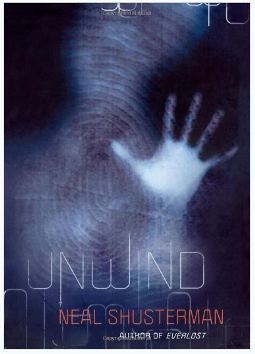
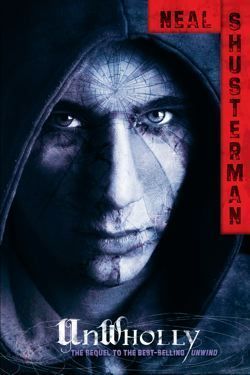
Although I write book reviews on my review website, Rated Reads, sometimes I’d just like to take a little time to write extra about the books I’ve read and put them in context in other ways. After reading Neal Shusterman’s UnWholly, the sequel to his young adult book Unwind, I find myself having to wax eloquent and enthusiastic about this series.
In brief, Unwind introduces a future in which there has been a war between pro-choice advocates and pro-lifers. It is ended when the two sides come to an agreement in which abortions are outlawed, but teens may be “retroactively aborted” or “unwound” by essentially donating their organs and ALL of their body parts. Whoa! What a concept! I love to read books that have compelling, original premises, and it thrills me when the authors are skilled enough to be able to execute those ideas perfectly. Neal Shusterman has written quite a few other young adult books, including the popular and well-regarded Skinjacker Trilogy (which I have yet to read but have heard good things about), and he also writes screenplays. So he was the right man for this job, with experience and skill.
I was introduced to Unwind by a friend, who had our book club read it, and it was a great book to use for that purpose: it’s interesting and fairly easy to read, but it is so thought-provoking that it provides plenty of material for discussion. UnWholly continues the series very well, keeping up a fast pace filled with action, and introducing new characters and new ideas that are ripe for dissection. What’s particularly interesting to me is that Shusterman doesn’t seem to have a clear “agenda” in that he’s obviously pro-life or pro-choice; he allows readers to just think about all the issues and ramifications of the choices that have been made by those two groups and society as a whole in this imagined future.
What’s nice is that Shusterman also chooses not to fill the books with bad language, vulgarity, sexual content or gore, which plenty of writers out there would certainly be tempted to do to give it “authenticity” (I’ve already discussed my feelings about THAT). There is occasional bad language and some violence, but it’s not too detailed or gross, just enough to get the point across and move along the action and plot. Good going, Neal!
This series is great for teens and adults alike, for entertainment and for the seeds of a good discussion about a variety of moral and ethical issues. Honestly, I think this trumps The Hunger Games for a few reasons and should get more attention because of that: it’s just as action-filled, compelling, and exciting, great for guys to read as well as girls (’cause honestly, there aren’t necessarily as many popular books out there geared towards teen males as there are toward female readers), but it has more elements that give food for thought. Hunger Games makes one think about the excesses of government and the concept of reality shows gone too far, but after that, it is just a good story. But Unwind and UnWholly continue to provide topics for discussion and pondering as the stories go forward, not just giving pause for thought with their premises. I’d definitely recommend this series for anyone who loved Hunger Games.

 But here’s the thing: the show is now being marketed to families. Yes, somehow this spectacle of impossibly thin, tall models with unnaturally large breasts who are showcased in sexy bras and angel wings (really?) is now somehow becoming a family event. Wha? Even though most rational people would not consider this family entertainment, it’s hard to ignore how the show is being packaged and advertised. The runway models wearing itty-bitty push-up bras and panties adorned with bling galore (can someone say Bedazzler?) are being accompanied by musical entertainment. This year, it’s Rihanna, Justin Bieber and Bruno Mars. Just who is Justin Bieber’s audience? Teen and tween girls. And Rihanna’s? Same. The producers are clearly aiming to snag the eyes of young girls and prepubescent boys, not just the obvious men of all ages and teen boys.



 Life and Lims