Treatment for mental health is hard because diagnosis is even harder

Part of the reason I write this blog is to document my particular struggles with mental health. Having to deal with some kind of challenge that’s within the range of mental health is just as common as dealing with some kind of difficulty with any kind of physical health. In other words, either category is EXTREMELY broad. Physical challenges can range from diabetes or thyroid issues to cancer or gallstones. Any disruption in mental health can lie anywhere in a big range, too. Physical illnesses can sometimes prove tough to pin down, but it seems figuring out a diagnosis of a mental illness can prove consistently more difficult. Even if a diagnosis seems mostly straightforward, finding a treatment that will help the person going through it to get to a fairly “normal” state is far more difficult.

I’m in my mid-40s, and I’ve been diagnosed with depression, bipolar, or atypical bipolar disorder variously over the past 25 years or so. I’ve gone through a number of antidepressants and some medicines that are usually prescribed to treat bipolar disorder. Some have helped for a short time, some haven’t helped at all, some have made me feel worse. Some have helped enough for me to live my life pretty normally. I’ve been seeing a very capable nurse practitioner for the past five or six years, I think, and I’ve been on an antidepressant that’s pretty much kept me mostly in “normal” mode. But I’ve still had bouts (or very, very long, standard stretches) of what I’d just call irritability. And I know that just isn’t ME. I’ve known instinctively that it’s more a quirk in my brain chemistry or something, rather than a defining characteristic of who I am. And my extremely busy life managing a household, taking care of four daughters (now one of whom is married and out of the house, so the dynamics and responsibilities have somewhat changed, but not at all taken her “off the register,” so to say), working from home part-time and volunteering and managing fairly big church responsibilities, just for a short summation, keeps me running at a high level. It’s easy to say it’s “understandable” I’m irritable. But recently I thought it was time to check in with my practitioner and address the irritability again. I’m exhausted from “managing” it. Surely there’s something out there to help me with my underlying mental health so I’m not working so hard to manage and can just live, expending a bit less energy on coping?

pill-bottle_21_G6So we visited a few weeks ago, and talked for a while. She is fantastic because she’s very thoughtful and discusses the issues with me, asks probing questions, revisits assumptions, etc. We’re partners in my care, and I really feel she’s very knowledgeable, and she’s sensitive as well. That’s a biggie. She said to me that perhaps I’m not really on the bipolar spectrum at all. All she could say was that I’m just my own thing. So there might not be either a diagnosis for whatever I present as yet, or because mental health really is so varied and unique to each of us, maybe there isn’t or won’t be, if that makes sense. All we know is there have to be some kinds of ways to help me with some kind of existing medication so I can function better. So she said she’d try something, a medication that psychiatrists sometimes use to help with that part of mood. It’s a seizure medication used off-label in this way. She tried me on a very small dose, and I actually do feel it’s helping. My life is still CRAZY BUSY!, but I feel a little less like I have to work hard to manage my mood even while I’m managing my life. So I’m feeling hopeful and a little happier, just to have an extra tool in my arsenal, and to know that my practitioner is really awesome at her job.

This just leads me to a few conclusions yet again: we still don’t know a lot about mental health and illness. We’re doing better than 30, 50, 70 years ago, but we have far to go. And we need far, far more practitioners who have the training, experience and skills to deal with this complex issue. So many people are suffering and there simply aren’t enough practitioners around to help them. I’m blessed to have found someone who can do what she does. Even that’s not perfect, but it’s really about the best I think there is. Meanwhile, I just wish, wish, wish we had more incentives for people to go into the profession and stay there, that the specialists were available in every small and underserved area.

I write this because I just want to put my voice out there. I’m mostly a “success story,” and that’s just because I’m not crippled by my lapses in mental health, and pretty well functioning, and I’m a very resilient, determined personality. I have at least enough income and resources that I have been able to find someone to really help, but that’s still taken a great deal of time and work on my part. It’s been a long and tough journey. It shouldn’t be this hard.

As we work to try to improve outreach, availability and quality of care, and genuine help for those of us with mental health challenges (again, not at all just a small portion of our population), let’s continue to just be kind, patient and understanding to those around us who struggle and need our help. It still does mean the world.

Purple pain

With my teen years firmly set in the ’80s, Prince was firmly set in my musical consciousness. His songs were fun, catchy, danceable and clear indicators of his genius.

But his music and persona have become part of the fabric of my family’s life, as it’s turned out, so his death today comes as a shock.

My husband, who has fantastic taste in a variety of music, and dance skills to match, has a large stack of Prince’s CDs. And in the early days of our acquaintance (in a church congregation at college, surprisingly enough), his lip-sync and dance performance of “When Doves Cry,” complete with eyeliner, purple jacket and white ruffled blouse, for a talent show gave me the notion that he was something special. Maybe that’s why I said yes when he asked me out a month later.

228122_10150184386647400_5199462_nFive years ago, when our oldest was a teen, it was announced that Prince was adding a last-minute concert in Fresno, near us. As soon as tickets were available, I pounced. I bought them for me and my husband and my teen. And we partied like it was 1999 (only it was 2011).
Just last year, when that oldest daughter got married, we knew we had to have a special father-daughter dance at the reception. It would be something that reflected US. We deliberated, brainstormed, and came up with something perfect. And it included Prince, naturally. I thought it was awesome.

The Prince is dead. Long live the Prince.

Fat-shaming: Stop. Just stop.

Following up to my last post about Harriet Brown’s Body of Truth, here’s another reminder of our society’s last acceptable prejudice. Racism still exists, but our society no longer will accept it, and we call it out whenever it appears in the news or the cultural consciousness. Our treatment of and attitude toward homosexuals is something that’s changing and is addressed frequently. Debate over policies is still complex, but how we treat individuals should be pretty clear: just be kind. Don’t name-call. Don’t lump into a category. Don’t assume.

But we’re still in the very early phases of ending the name-calling and shaming over fat. About once a week, it seems, some celebrity or other makes assumptions and puts their foot in their mouth about people who are overweight. Cheryl Tiegs stupidly assumed a couple of things in February about model Ashley Graham: One, that Graham isn’t healthy. Two, she assumed her waist size was 35 inches or more, giving her the basis for saying Graham can’t be healthy.

Here’s what happened: Graham’s waist size was revealed to be 29.5 inches. It’s perfectly within the range of what experts say is healthy (although, let’s be real … doctors really know far too little about weight and health, as Brown writes in Body of Truth, for one). And Graham works out regularly. She seems to be taking care of herself. As she said to the Daily Mail, “There are too many people thinking they can look at a girl my size and say that we are unhealthy. You can’t, only my doctor can!” (I’m guessing she’s lucky enough to have a doctor who sees the big picture of health and hasn’t pushed her to lose weight.)

And the fat-shaming of today comes from Australia, where a fitness expert just assumes that all overweight people must be unhappy. One, it is possible to be overweight and happy, and two, her remarks and attitude likely contribute to people who are overweight feeling dissatisfied with themselves simply because of their size. It’s been shown time and time again that making someone feel bad about themselves, guilty, shameful, etc., will NOT lead to them taking steps to take better care of themselves, such as incorporating some better eating habits and exercising regularly. It may motivate briefly, but in the long haul, they’ll just give up and say it’s impossible. The best motivation to help someone truly take care of themselves for life is to help them feel they are worthwhile as people; therefore, they deserve to take the time and energy to take care of their physical bodies.

One thing that needs to become more common knowledge among doctors and all of us is that fitness is a huge indicator of health. More people should get out and exercise more. Yes. But there are plenty of people who exercise regularly who are not thin. (And on the flip side, there are plenty of skinny people who have never exercised, and on top of that, they eat food that no one would call healthy. But they get a pass in others’ eyes because, hey, they APPEAR healthy, since our society still only equates health with thinness.) And we should be working to get more people fit. But it doesn’t need to be in pursuit of being thin. It needs to be fitness for its own sake.

Let’s just stop the fat-shaming. Let’s stop assuming overweight means miserable and unhealthy. Thinness does NOT automatically = healthy, and fatness does NOT automatically = unhealthy. Fat people are not necessarily unhappy, lazy, or unmotivated. They are people. And how do we treat people? With kindness. As whole, worthwhile individuals.


Get the skinny on our society’s obsession with fat

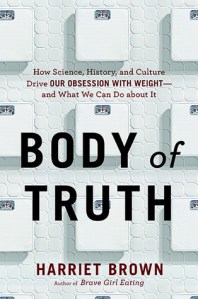
body of truthI’ve decided I’m going to make reading this book a once-a-year activity. Body of Truth is just that helpful. When I read it a year ago before it was even published, I dog-eared pages as I devoured it in just a day or two. I made my husband read it. THIS, this, is what everyone needs to know. I read it again this week in a day, dog-eared more pages, and considered making my husband read it again.
Read my review of the book on Rated Reads.

Now, I was able to keep my review to a reasonable length, but I’m going to write more about the insights I gained by reading Harriet Brown’s book. And I’ll have to split up the info into a few posts so it won’t get weighed down (ha ha). Today I’m just going to address the damage that is done by dieting. And let me tell you, that is one of the takeaways of this book that has me the most furious.

I never considered myself a dieter until the past 7 years or so. I noticed myself gaining when I was nearing 40. But I had actually dieted when I was about 12 by reducing a bit what I ate and not eating desserts. I didn’t keep track of pounds, just slimmed a little of “baby fat,” you could say. And then each time after my three pregnancies I breast-fed, counted calories (stuck to 1800 or so), and kept up my regular exercise. I got back down and a little bit more and was looking nicely trim at 33. I kept it up until, yeah, almost the 40s. Then I saw 10 pounds creep on and got a bit panicked (ha!). Then I happened to move to a new state and put on another 10 pounds, then another 10, then another 10. All of a sudden, I was a lot heavier and was feeling much different than I had before as generally an average-weight, trim-ish person. I dieted first by just really counting calories (and going hungry often) and lost 30, but it only held for a year or maybe two. It came back on, and then I started looking at other options. I did the hCG diet (yes, I know, I never DREAMED I’d be the person to do something drastic like that), but it worked and I at least lost almost 20 pounds and felt a lot better really quickly. That crept back on, and I did it again a year or so later. A couple of years ago, my best friend started doing Atkins, so I tried it. It worked and I did well enough to lose maybe 20 or 25 pounds and feel it was worth the work and sacrifice. My daughter got married, then, last year, and all bets were off. I ate, and I ate, and I ate. I was depressed and stressed and just went straight to food. And what do you know, I am now by far the heaviest I’ve ever been. I went back on Atkins for a few weeks in the fall, then something crazy happened, and then I went back on it this last month, then my grandma died. And I am 20 pounds heavier than my heaviest weight ever before.

So not counting the post-pregnancy “getting back to pre-pregnancy weight” work, I have dieted, lost and gained, at least four main times, plus a few more little times, in the past 8 years. I have been successful. I have been tough. I have focused. And then I’ve either gone back to semi-normal eating (not being hungry) and gained back, or I’ve had some eat-a-lot periods. And what do you know, I’m completely normal. Studies show very low rates of “long-term” success, which is at most watched over 5 years, and almost nothing for rates past that time period (3 years is really even the limit of most “long-term” studies). Evidence also shows that not only do people who diet tend to gain back what they lost, but they gain more on top of that.

So if I had never dieted, I’d most likely just be at my previous “heaviest,” but not the 20 pounds more than that that I am now. I might even be 10 or more pounds below that. And I’d have saved myself a lot of unnecessary work, focus and energy that could have gone to something more productive. I don’t know if you’ve been in this situation or not (likelihood is many of you have been), but this realization absolutely OUTRAGES me.

Brown writes this:

(An) oft-repeated lie about weight and health is that dieting makes us thinner and healthier. At the very least, we consider dieting benign, something that can’t hurt us even if it doesn’t really help. But the truth is, dieting is actually harmful for many of us for all sorts of reasons. And it doesn’t make most of us thinner or healthier. On the contrary.

And she says this: a 2007 investigation (as one example) confirmed that diets don’t work. “The mind-boggling element here is that we’ve known diets don’t work for a long time, and so has the medical establishment.” But still society at large, doctors, individuals … we all think they can work if people just are motivated enough, have enough willpower, work hard enough. And that big fat lie is causing us health problems. Just think: doctors who are all encouraging patients to lose weight may very well be making their patients’ health problems WORSE.

Here are some sobering points Brown tells us:

  • “Dieting nearly always makes people heavier over time. In one study of Finnish twins, the more diets people went on, the higher their risk of becoming overweight and the faster they gained weight later in life.”
  • “Dieters tend to have higher levels of cortisol, sometimes called ‘the stress hormone,’ and free fatty acids, and dieters tend to exhibit diminished executive function, (‘strained bandwidth’), maybe because using so much mental energy thinking, worrying, and negotiating about food choices leaves them too distracted to think about much else” — which in turn actually causes us to gain more weight.
  • Dieting actually has been shown in studies to lead to binge eating. It’s not just psychological, either; physiology on various levels causes us to eat more after dieting, reversing all our work (brain circuitry even changes!).
  • ”An ever-growing body of research suggests that weight cycling, or yo-yo dieting, correlates with higher levels of heart disease, impaired immune function, cardiometabolic risk, insulin resistance, triglycerides, hypertension, and abdominal fat accumulation.”
  • Studies have “found correlations between weight cycling and disordered eating, higher stress, lower well-being, and less confidence about food and eating. In other words, the more loops of the yo-yo you go around, the worse you feel about your weight, your eating, your very self.”
  • Each loop of the cycle then is harder. It’s tougher to drop the weight every go-round. Dieting changes metabolism. “People who have intentionally lost weight generally use about 15 percent fewer calories than non-dieters to perform exactly the same activities, which means they gain weight eating fewer calories than non-dieters.” As one research professor told Brown, “We know there’s some sort of derangement of the metabolic pathways, and that has a cascade effect on everything from the hormones involved with obesity to hunger.”

So people who feel fat or have been told they’re fat and need to lose weight feel “incredible shame.” Our whole culture reinforces that. Doctors reinforce that. And it’s not helping anyone. It’s not helping health; it’s not making anyone motivated; it’s not making us feel good; it’s a wicked prejudice that is still allowed. Feeling the outrage yet?

In the next few blog posts, I’ll focus on some of these last ideas and more.

Taking care of myself? Tougher than tough

My last blog post was about my goal to take better care of my health, with a multi-pronged approach. I did well for a few weeks. And then I didn’t.

The catalyst for getting completely foiled, at least for the past month, was my grandmother’s death. It was expected; she was 99, and my family and I had had a good visit with her a few months before, as we knew she was declining after a long and full life. But the day she died, I got drained, emotionally and physically, and I just had to step out of the Atkins diet that seems to work for me, at least scale-wise.

Since then, I’ve wanted to get back into focusing on my eating and doing all the other things necessary to take better care of my whole self. How well have I done? Crappy. That’s what.

Here’s the deal: I’m a mom. I have a husband and four daughters, and they are all in vital stages of their lives. Parenting them now is in a way more demanding than it was when they were little; then it was mainly sleep deprivation and not being able to catch much alone time. Life was just a lot simpler then. Now, there’s so much more of a mental game to it than just being the taxi driver. I’m there. I’m on call. I’m helping figure out all kinds of important things for the next week, the next month, the next year: their LIVES. Even my oldest, who is married and “on her own,” still needs me, and I am still there for her whenever I can be. Even more, our relationship has a new dynamic and dimension, one we’re still trying to adjust to, I think, almost a year on.

Add to my momhood my personal leaning toward taking care of other people all the time, and my own self gets left in the dust. This past month or so has been a pressure-cooker, a meat-grinder, of calendaring and coordinating activities and appointments; responsibilities, obligations, big questions, long to-do lists, and hardly having a moment to breathe and just think about myself. Granted, I know from sad experience (over and over and over again) that is a recipe for disaster, but after all these years, I’m still trying to figure out how to cut the recipe in half or something.

So I sit here again and contemplate how to take care of myself physically: eat better overall, less sugar, more fruits and vegetables (which I do really love and eat probably more of than the average person, but still)… all that jazz. Figure out how to decrease emotional eating (THAT’s a biggie). Mix up my exercise (I’ve been dedicated to working out for 25-plus years and I really enjoy it and how it makes me feel), do some more fun and different things. The pressure cooker of the past month or two is likely to be turned down a few notches for the near future. Maybe I can make some strides on me.

What I know is this: appropriate self-care can take a lifetime of practice.

The 10 best books I read in 2015

According to Goodreads, I read 51 books this year, a total of 18,639 pages. There were just a few more that I didn’t enter onto the site, but that pretty well sums it up. Thanks to that site, I end up not having to plow through many stinkers, so I did enjoy almost all of the books I read. A few stand out, however. Here are my 10 faves from this year of reading.

Young Adult

illusionsIllusions of Fate, by Kiersten White: This was practically perfect. I borrowed it from the library but then had to buy it because I loved it so much. Kiersten White has created a world not unlike ours, set in a time much like that of the early 20th century, but has imbued its nobility with magical powers only they know about and use. Her heroine is smart and courageous and all too human, and though she is “just an ordinary girl,” she is a force to be reckoned with. That’s what makes her — and the book — so great. I just lost myself in the setting, the characters and their interactions with each other, and the story. I absolutely adored this book. Bonus: it’s clean. I rated it Mild on Rated Reads.

Circus Mirandus, by Cassie Beasley: This middle-grade book is about faith, magic and hope. It’s about opening your eyes to the possibilities. It’s about family, love and dedication. It’s sweet, poignant, delightful. It’s written for children, sure, but adults will be charmed as well. It’s one of those books everyone should get to read and keep on a bookshelf at home. And since it’s for younger readers, it’s clean. I rated it None on Rated Reads.

The Storyspinner, by Becky Wallace: This book with a strong female heroine is an engaging tale of danger, cunning, political intrigue, magic and a few touches of romance. The plot and writing are excellent, seeming to have come from a more seasoned writer, and once I got into the story, I could hardly put it down. It’s clean; I rated it Mild on Rated Reads.

weight of feathersThe Weight of Feathers, by Anna-Marie McLemore: The prose in this Romeo-and-Juliet tale set in the Central Valley of California that swings between two carnival families is just so, so lovely, and the writing is so masterful it’s hard to believe this is a debut novel. It’s gotten some hype, and it actually lives up to it. I rated it Moderate on Rated Reads.
Challenger Deep, by Neal Shusterman: This book is one of those Important Novels people should read to gain a bit of empathy, understanding and awareness about mental illness, particularly in teens. It could have foundered in less skilled hands, but Shusterman has the chops to make this brilliant. He writes in an author’s note at the end that his own son “journeyed to the deep” and with his help, he’s “tried to capture what that descent was like.” He also points out the reality that helping people who are dealing with mental illness “is not an exact science, but it’s all we have – and it gets better every day as we learn more about the brain, and the mind, and as we develop better, more targeted medication.” I rated it Mild on Rated Reads.

Fiction

lake houseThe Lake House, by Kate Morton: Yes, I adore Kate Morton’s books. This one did not disappoint. Morton is a master at crafting these kinds of novels: long and richly detailed stories of family secrets that span generations and decades, that have long-reaching consequences. As I reluctantly and slowly closed the back cover, I was overcome by that sadly delicious, mixed feeling of completion that means a book has brought me much gratification as I’ve taken it all in but regret that the experience is over and can’t be duplicated. And it’s clean reading: I rated it Mild on Rated Reads.
Us, by David Nicholls: The book is practically perfect: it examines so beautifully a longtime marriage between two very different people, the highs and lows and in-betweens, without resorting to cheap plays for readers’ sympathies. Even serious matters that could, in the wrong hands, be maudlin are deftly and lightly handled. Nicholls’ previous book, One Day, was a good one, but it did resort to a big bang of a twist that could be seen as a nasty trick by the writer. Here, however, the story plays out naturally and is balanced wonderfully. There are laugh-out-loud moments that gave me no choice but to read them aloud to whoever was near and descriptive passages that made me in awe of Nicholls’ cleverness. I can’t say enough about how well written this book is. It’s not clean reading, though: I rated it High for strong language on Rated Reads.

Nonfiction

body of truthBody of Truth, by Harriet Brown: I have not yet posted a review of this on Rated Reads, but it’s coming soon. I’m also hoping to write a nice in-depth analysis on here in coming days. It’s that important. Brown shares what she’s learned in a decade of examining research on weight, obesity, eating disorders, etc., as well as from interviewing hundreds of women and scientists. The reality is this: our society is completely obsessed with weight. And though the media and doctors tend to go on certain “truths” as givens, those are not necessarily true or even based on solid research. Weight is a very complex matter, and we still know far too little about how best to regulate it. We certainly know far too little about how to help people lose weight and keep it off “for good.”

A Path Appears: Transforming Lives, Creating Opportunity, by Nicholas Kristof and Sheryl WuDunn: Husband-and-wife writing team Kristof and WuDunn explore ways that we can all make a difference by donating our time, talents or resources to help others in this world. Even a little helps. They share inspiring stories and then tell readers specifically how to make our money or time really count. I was galvanized by this terrific book. It’s simply inspiring, but it’s also practical and addresses concerns and problems with charities even as it shares solid advice on how to tailor your giving to your own interests and capacities. I rated it Mild on Rated Reads.

Smoke Gets in Your Eyes: And Other Lessons from the Crematory, by Caitlin Doughty: If you are a fan of Mary Roach’s fascinating book on what happens to our bodies after death, Stiff, you are likely to appreciate Caitlin Doughty’s book focusing mostly on the aspect of cremation. While the book is informative and curiosity-slaking while also liberally sprinkled with dry wit and gallows humor, it’s also a reminder that Americans today are far removed from death. And this is much of Doughty’s point: after spending about a year working at a crematorium in Oakland, California, she then decided to pursue the career and attend mortuary school. The experiences served to incite in her a passion for helping people in our culture reacquaint themselves with death. Rather than fearing aging and death and dead bodies and shoving all we find distasteful off onto professionals who work behind a screen, we would be better served mentally and emotionally if we had more to do with the whole process. I rated it High for language on Rated Reads.

Different kinds of mourning

Today is the anniversary of my father’s death — officially (he was on life support for a day or two and then “declared dead”). I think he was really gone very late on the 13th or early the 14th. His brain experienced two big hemorrhages and I’m sure it was really “over” fairly soon. I clearly remember the moment at 9 p.m. that day that I got the call he was unconscious. I know I went into shock myself: I sat down on the couch and was just stiff, cold and shaking.

I was not at all prepared for him to die. He was only 71, and he had worked ridiculously hard (we joked with him that he worked TOO hard) to keep himself healthy by eating well and exercising. I thought for sure he’d be around a good long while. The shock of that unexpected loss took a long while to shake off.

Six years later, I’m accustomed to his being gone. When I think of him, I don’t experience a painful stab in my chest as I did for a long while. Now it’s just a small pang of longing, much less painful. It hits in the same place, right in my heart, but the wound is no longer a gaping hole. It’s scabbed over, enough so that no one else even knows it’s there, I’m sure.

This year brought me another unexpected loss. I saw the loss coming, so I guess saying the loss itself was unexpected isn’t accurate: the grieving period I went through was what took me by surprise. Because who really thinks about the notion of mourning for a beloved child who has grown up and flown from the nest?

My firstborn got married, to an incredible young man who’s just about as incredible as she is. I was thrilled about the union (once I processed the notion of her being married pretty young, which I hadn’t seen coming either, but that’s another story. The very short version: she found a wonderful person, we love him, we love them, and it was right. Plans/expectations are one thing, but life always throws interesting curve balls.).

To say the period of engagement/wedding planning was stressful is almost a cliche. Very few people say their engagements were breezy and stress-free, and, yeah, it was busy and had its bumpy moments. Bringing two families together, planning, coordinating, … it can be tough. But all through it, you know you have this amazing day to look forward to. The reward’s huge. And the wedding day and reception were beautiful, sweet, poignant, fun, full of love and friends and family celebrating together. It was a wonderful memory.

I was thinking I’d need some “recovery” time afterward to wind down from the stress of preparation. It didn’t go quite as I’d hoped, because then my girls were all home from school for the summer and I had precious little time to myself. And my personality, my particular mix of needs, requires a certain amount of alone time, to just process the rest of life, to take a breath.

As it turns out, I realized a month or two ago, I was mourning all summer. But I didn’t really recognize it as such because it wasn’t as clear-cut a “grieving situation” as, say, my dad’s death, and my younger kids kept me so crazy all summer I didn’t get to really think much and just let everything go through my brain, my emotions, my self.

One day in the middle of the summer, I did have a moment where it struck me that I felt the loss of my daughter almost as a death. It was just one day, one morning. We hadn’t seen her in a week or more, hadn’t really had any quality time with her (she lives with her husband about a 45-minute drive away from us, and they live next door to his parents, so they get to be with his family all the time and we make a lot of trips up there to see her; as time has gone on, I’ve been able to decrease the number and frequency of trips a bit so it doesn’t seem like we’re there all the time). And I just said to my husband, “I feel like she’s dead. She’s gone. How strange. It feels like I feel with Dad.” It was so clearly a loss, and it hit me square in the chest, same thing. We saw her the next day, I think, and my husband and I ended up taking her and our 13-year-old to lunch at a salad place, and that one hour being our “old” selves in a familiar environment “like we used to be” before it all changed so much made that feeling go away, or at least recede into the background for a while.

Nearly five months after the wedding, I’m starting to feel a little more myself again. When you’re in mourning, you’re a reduced version of yourself, parts shuttered, shut down, the world seeming a little dimmer. I’ve felt the world brighten up again, I think, and I’m coming back into my own. I was sad for a few months. One consequence, in my arsenal of bad habits, was that I just ate. And ate. I went through quart after quart of ice cream. I must have gained 15 to 20 pounds over the summer. I was swallowing the pain. That last consequence I’m dealing with right now, and making progress: I put myself on a low-carb diet. I was just feeling physically cruddy, and I know all the sugar I was eating was making me feel even cloudier than the grief was. A week and a half in, I’m feeling clearer and physically much better. It’s a gift I’m giving myself: to take care of my body.

So life brings grief in various ways. Death is an “obvious” vehicle for it. But we must mourn all kinds of losses. I’m reminded occasionally, with my 17-year-old, that I mourned the loss of a “normal” child when she was born because of her Down syndrome. There are days that remind me she’s not like the “typical” teen at this stage: she’s not going to be driving (not anytime soon, for sure), she can’t babysit. We have to check on her personal hygiene sometimes, and we have to remind her about appropriate behavior around other people. It’s a loss, and I am reminded more of that now because our family dynamics have changed so much since our oldest got married and moved out.

The reality is we need to be gentle with ourselves when we mourn any loss, and realize that we have to take time to grieve. We must move through it. We also need to realize that others are mourning losses as well that may not be visible to us. Be sensitive to anyone’s mourning periods of any loss. They may breeze through the period of mourning, or they may slog through. I felt “weak” somehow this whole summer because I just wasn’t myself. I felt silly because so many of my friends had children leaving the nest, whether it was for college or for church mission opportunities or some through marriage. They all seemed to be just fine. Why wasn’t I? The truth of the matter is that it didn’t matter how other people fared, when it came to my own feelings. I had to be respectful of how I felt and how I had to work through it. I hope it makes me more sensitive to others through whatever losses they’re grieving.

Life is beautiful. It is bittersweet. It is a hodgepodge of opposites: highs and lows, gains and losses. Despite the pain of grieving, I’m grateful to be on this grand adventure.

I’m glad I didn’t marry my ‘soul mate’

Serious business.
Serious business.

Today my husband and I are celebrating our 22nd wedding anniversary. And as much as I love to celebrate and love to love, I also love to remind people that choosing a marriage partner is serious business. Sure, it involves those butterflies and fireworks, but it also involves solid doses of reality.

Here’s one: finding your soul mate is not a prerequisite for marriage. Sometimes, even, that person who feels like your “soul mate” may end up not being a good partner for you.

I love this reminder from a psychology professor at my alma mater: “Stop looking for a soul mate.” Scott Braithwaite said that when you have the idea that your soul mate is out there somewhere, and if you feel you’ve found him, you may think that the marriage relationship will be easy. Or later on when marriage does get hard (which it will), you may feel you made a mistake and thought you’d found your soul mate but didn’t. What happens then? Either looking outside the marriage for the “real” soul mate or ending the marriage to do so.

Back in my teen years and early 20s, I dated a lot. I had fun with plenty of young men. I had several serious relationships. I thought a couple might lead to marriage. They didn’t. I could even say that I probably had kind of the notion that one of those was my “soul mate.” We were a lot alike, were best friends, and had that “connection.” But it didn’t work out. While I mourned the loss of the friendship for a long time, I came to realize I was blessed not to end up marrying that person. In fact, one quality lacking in that person was something that I realized was important to me, and when I was dating my now-husband, he showed he had it.

Honestly, my husband and I don’t have what I would call a “great love story,” one that seemed fated, or meant to be, or in the stars. I probably was “crazier” about some other guys. I don’t think of him as “my best friend.” He’s not my soul mate. And that is OK. More than OK. It’s a good thing. I chose him. I chose him because of the qualities he exhibited, his dedication to me, his desire to be a good husband, his desire to be a father. He put me first. That he made me grin, was an easygoing complement to my type-A personality whom everyone can’t help but like, was a great dancer, was a great kisser… well, all those were icing on the cake.

Today, 22 years later, I am so grateful that I chose him. He wasn’t just “meant for me.” Our love story wasn’t out of our hands. It has been completely in our hands: we have written it together over all this time. We made three gorgeous babies and adopted another adorable one. We’ve moved, traveled, made friends, experienced life together, laughed, cried, supported each other. This year is particularly sweet because we got to see our oldest make her own choice of a fine husband. Today, I celebrate making a fabulous choice.

How much of life do we ‘sign up for’?

It’s difficult for me as a mother, period, and as a fellow mother of a daughter with Down syndrome, to read the words of Hallie Levine, who says she would have aborted her daughter during her pregnancy if she’d had the diagnosis then. Sure, she says now she’s grateful she didn’t, but she asserts she should have been able to and that others should be able to do so as well. Aside from all my other feelings on the subject (and I have many), I’m going to focus on one phrase she used: “I never signed up for this.”

Having heard a man whose wife is now paralyzed from the midsection down say the same thing in regards to being married, and other people in tough situations make the same remark, it strikes me that we live in a society where we really feel we should only face things we’ve agreed to. We’re so focused on freedom of choice, on contracts, on knowing so much about outcomes and possibilities, that we feel we can and do control our lives.

Assuming some equal opportunity (and that’s a topic for another blog post as well), let’s say we all get to choose the level of education we attain and what we study. We get to choose our line of work. We choose our marriage partner, if we marry. We choose how many children we have and how to raise them. We plan for and choose when to retire, and what to do in retirement.

We “sign up for” these things. We sign on the dotted line for many of them. Life is a series of contracts that we choose to accept or deny. And we’ve written escape clauses into the contracts. Many of us spend years choosing whom to marry, and when to do it, but even a few years into the contractual relationship, divorce is readily available to let us out of that signup. Pregnancy? We can avert it with birth control, we can terminate with abortion.

But how about we step back a moment and consider that life is not really within our control. It’s not just one contract after another. And when events in our era are finalized in this manner, stamped with a legal seal of approval, they often get boiled down to simple terms that don’t fully encapsulate the “real deal.”

Life is messy. It’s complicated. It involves all kinds of unpleasant surprises that we tend to think of as happening to “other people.” Even aging and death seem distant to us today, that somehow they’ll never happen to us. But they do. And the older we get, the more we experience, the more we realize that death will happen. Aging will happen. We’ll get sick, we’ll be limited in some way physically. These same things will happen to our spouses, and eventually our children.

Levine says she wouldn’t want to see someone else “forced into” her situation. But simply being alive forces us into all kinds of situations we’d rather ignore or pretend don’t exist or won’t happen to us. Choosing to get married leads us down a path in which we may very well have to care for a spouse who becomes disabled physically or loses his memory, among a host of other scary possibilities. Choosing to have children leads us down a path in which we may care for a child with a physical or intellectual disability or mental illness or any number of possibilities we never envisioned for ourselves. But those paths are real.

I don’t deny that it can be overwhelming at times to parent a child with Down syndrome. That’s just one of those “scary possibilities” I know firsthand about. I grieved for a few days when I received the results of my amniocentesis. It was an experience I didn’t count on. It was a loss, the loss of a “typical” child-rearing experience I had counted on. But life presented me this path, and I’m on it.

I don’t have any idea what other challenges lie ahead of me on life’s path, as a person, as a wife, as a mother. I won’t deny that I’ll grieve, be scared, be overwhelmed, be frustrated … any number of normal reactions. And I definitely won’t “sign up for” any of these challenges. But that’s life. And we’re all in it together. We can’t (and, yes, while many disagree with me, I heartily say “shouldn’t” when it comes to aborting in most cases) prevent these difficulties. We can learn from them, do our best to deal with them, and support each other through them. I hate to see others go through tough times, but I’ll eagerly “sign up” to lend a shoulder to cry on, a hand to help.

Let’s stop making ‘fat’ a bad word

It occurred to me yesterday that I don’t have to use “fat” as an adjective for myself. No one does. It’s another label, and while labels are necessary for products on a shelf, they are dangerous for people. (How about this?: “CAUTION: This label is toxic for your emotional health.”)

caution label

We don’t say someone “is cancerous,” just that they “have cancer.” We are striving to say someone “has Down syndrome” (or some other disability) rather than “is a Down syndrome person.” Because that label does not by any stretch describe the whole person.

So I am not fat. I have fat on my body. Right now, I have more fat than I’d like to, because I’m uncomfortable, and part of the reason I have more fat than I’d like is that I’ve been resorting to emotional eating for a few months, and the quality of some of those foods (sugary) is making my cholesterol a bit higher than I’d like. And those are the facts.

The problem with words is that they often become loaded with associated meanings that weigh them down far more than their original, “true” meaning. Some words even become so weighed down with other associations that they change meaning entirely. This happened with the word “gay.” No longer do we even use that to mean “happy or lively.” We only use it to portray someone as homosexual.

What meanings have become tied to the word “fat”? I’d like to offer these: ugly, disgusting, lazy, shameful, embarrassing, gluttonous, gross. I’m sure you can come up with many more, and they’re all negative. What’s happened is that there is a stigma attached to the word “fat,” and that stigma, rather than “helping” obese people to get healthier through diet and/or exercise, etc. (and that’s a WHOLE OTHER topic entirely), is actually hurting us all. The stigma, the shame and embarrassment of being labeled “fat,” is actually making it even harder for those who would like to make a change in their health to start an exercise program or change a few bad habits in their diets. Shame doesn’t motivate very well or for very long. Researchers Lexie and Lindsay Kite at Beauty Redefined put it this way:

(R)ampant self-loathing, which can be partially attributed to women’s self-comparisons to unrealistic and unattainable body ideals in mass media, may very well encourage women to give up on achieving healthy body weights altogether due to the perception that “healthy” or “average” is unreachable. Studies help to confirm this idea.

It’s actually true that the better you feel about your (whole) self — including your body — the more motivated you are to take care of it in every way. But if you feel shame and all those bad words associated in our culture with “fat,” the less motivated you will be to take care of yourself.

So can we shift the stigma, remove it altogether? Can we snip the associations tied to the word “fat”? It’s going to take some hard work on everyone’s part, but it is possible. Because what we’re “doing” right now — shaming the majority of our population that’s deemed to be overweight — isn’t working. It isn’t working to make anyone feel good about themselves and it isn’t working to get more people exercising, which is truly the goal. Losing weight isn’t really the “magic bullet” we think it is, but more and more we’re learning that being fit is what really counts.

Let’s take the first step toward a healthier and happier society and cut the “fat” talk right now.