Does editing out offensive language help?

So I’ve read a few good books lately that have just had more strong language (a nicer way of saying “the f-word” or rarer vulgarities) in them than I would like to see (and honestly, I’d really rather there be none, but occasionally I can understand one or two uses). One I thought was fantastic was Josh Hanagarne’s The World’s Strongest Librarian. Great book. Only drawback? About 14 f-words. Really? Why did he have to put those in there? He could have quoted some odd characters without using their exact words all the time, and he could have made clear perfectly adequately they were colorful without using all that strong language. I am that confident in his descriptive skills as a writer.

Since I wanted to share the book with my book club, the women in which share my sensibilities about vulgar content, I felt an obligation to (a) warn them about the language and (b) share with them my whited-out personal copy so they didn’t have to see all that vulgarity right there in black print. (Yes, I used a Wite-Out pen to “erase” all those f-words.) I figured if someone else had read it first and recommended it, I’d prefer to read the edited version.

whited out textSo here’s the question: does it make a difference “whiting” or “blacking” out bad language, so you can tell it was once there? Will your mind immediately fill it in anyway? Or does it make a difference not to actually see that offensive kind of content, even if you know it was there? In a similar vein, does listening to a popular song that has some bad language edited out, a quick silence in its place, or watching a movie on TV that’s been edited (let’s just say language been “quieted out” rather than replaced by less bad language), feel not much different than just hearing the language anyway? Does the silence get filled in in your brain? Or are you grateful just not to hear it in reality, even if you know that’s what’s been taken out?

I also wonder if we all might have different reactions to this because of how our brains process information. Some of us learn and remember in a more visual way and others via audio. (I just see and remember things; my husband remembers everything he’s heard, for instance.) If we’re visual, will we just fill in a blank when we know something’s been taken out in print; or if we’re audio, will we fill in with audio? Or vice versa? Or does it matter?

Obviously, it would just be nicer for those of us who do have more sensitivity to language in books or music or TV/movies if those media came without the vulgarity in the first place. But since some do, does it help to edit them and leave obvious holes that we could possibly fill in mentally, or is it just best to avoid them altogether?

Just curious about what you all think. Of course, if you don’t care about bad language or vulgar content and don’t really consider it too offensive, all of this is a moot point, so don’t make arguments about the basic concept. But if you do care about this, either for your own reading/viewing or for that of a child, I’d love to hear what you think.

This author is on fire!

I admit I enjoyed reading the Twilight books. No, they’re not great literature or written with great skill. But they were a lovely escape, and I had fun. There. But I’ll give this to Stephenie Meyer: she has a great imagination and is truly a good storyteller (this comes even from her own mouth: she’s said she’s more a storyteller than she is a writer). She is also a fine judge of other books. Five summers ago on her website, she recommended the now ridiculously popular The Hunger Games. I went out and read it and found it fascinating, thought-provoking and gripping. Most everyone else seemed to agree.

But she also not too much later recommended a fine “duet” of books by Elizabeth Knox called Dreamhunter and Dreamquake. I went out and got those at the library and found myself utterly transported. The books had such an interesting premise: in a slightly different world than ours back in the early 1900s, an area appears which only certain people can enter. Those people can go in to this area, lie down and sleep, and “catch” dreams, which they can then essentially “broadcast” to a sleeping audience in a dream theater. Interesting idea in itself. But what became even more fascinating was the mystery of why the Place came to be in the first place, and if it has some kind of purpose. By the time the whole reason behind the Place is revealed at the end of the duet, after two wonderfully rich and complex books that were a little dreamlike themselves, I was absolutely blown away. It’s so satisfying as a reader to see bits of a mystery come together magically and then just be solved. But this also had such a powerful poignancy to it that I felt my heart seize up a bit. And the setting and tone, the whole feel of the books, was superb. Original, so real, so powerful.

Mortal FireSo I was thrilled to find out a couple of months ago that a new novel was coming from this superlative author, Mortal Fire. I let myself dip into the waters of this new book and its setting and feel, relishing the opportunity to visit Knox’s world again (this book is actually set in the same general place as the other two but 50 years later, and it’s mostly unconnected with the plot of those books, so it’s not necessary to read them first). But as I continued reading and the plot thickened, I found myself gobbling it, not able to put it down. I just rushed headlong to the end, and it was just as satisfying. What a fascinating premise! What a cool way of weaving the threads of story together and making it all make sense at the end! And the setting: again, just so vivid. I came inside (after sitting outside alone reading for two hours) just babbling about how much I loved the book. And a few days later, I still feel the rush of the thrill of discovery and the power of how it all hit me, not just in how it sent my mind spinning, but how it struck me smack in my chest.

What’s interesting to me is that all these books were recommended by Stephenie Meyer, but I haven’t heard a peep about Knox’s from other readers, whereas The Hunger Games became pretty much ubiquitous, not quite annoyingly so. Sometimes I wonder why these outstanding books don’t get more attention. (I think this is also the case with Susan Cooper’s The Dark Is Rising. I am always surprised at just how many of my well-read friends have never even heard of this series, let alone read the five books, either when they came out when I/we was/were young or now.)

At any rate, Elizabeth Knox, you are amazing. I don’t lavish praise on many authors, but you have joined the elite list of authors who really impress me. I hope more discerning readers discover your books.

Witty librarian writes a strong memoir

So I finished reading Josh Hanagarne’s excellent memoir last week and am still feeling the urge to gush. This book just works on so many levels that I feel compelled to recommend it to a lot of friends, for all kinds of reasons. I’ve written a full review on my review website, Rated Reads, but I’ll share a bit more here.

First, I like to laugh, and this book made me laugh. Check. Second, I felt I had a bit of insider’s knowledge because Hanagarne was raised Mormon and talks a lot about Mormonism, such as scripture stories, the experience of serving a mission for the Church of Jesus Christ of Latter-day Saints, and a lot of other little cultural touchstones. Since I’m LDS myself, I felt I could really appreciate what he was talking about. At the same time, he explains things so well that readers who aren’t Mormon won’t miss out. I think he handles that really nicely. But I got a big kick out of some of his stories, like the one when he’s a young boy talking about Ammon and all the cut-off arms in his Sunday school class. (See my review on Rated Reads for more information or the original account in the Book of Mormon, Alma 17: 18-39, and you can better appreciate the humor).

I also enjoy learning about what it’s like to deal with particular life challenges. In this case, Hanagarne helps readers get a little idea of what it’s like to live with Tourette Syndrome. He explains it really well and makes it funny as well as informative. His way of telling his personal experience with this syndrome helps readers appreciate what it’s like without feeling sorry for him. We just get to know Josh, who has these annoying tics and outbursts.

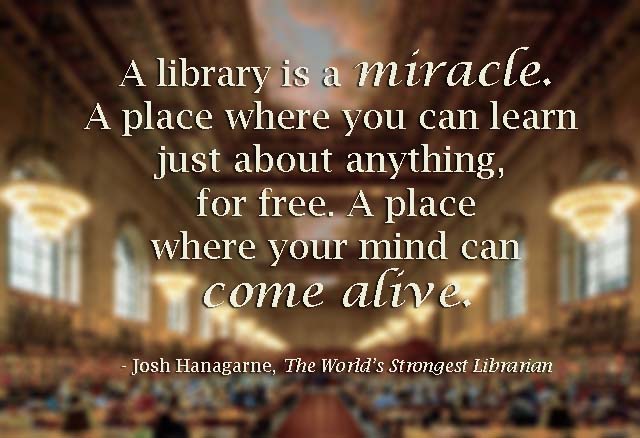
He has loved to read for pretty much his whole life, his mom being the great kind of mom who took him to the library at a really early age and read to him and with him. So he talks about favorite books and authors. He is now obviously a librarian, and he shares stories about all the wacky people and situations he encounters working at a large library in downtown Salt Lake City. He so clearly loves books and being able to work in a stronghold of information (despite the wackiness) that it’s just great fun to read what he writes about books and libraries. Great quote from the book:

A library is a miracle

Last, and this ties in to my previous point about his faith background: he has struggled with faith off and on for a lot of his life, wanting to have the strong faith that his mother so clearly has and wants to instill in her family, but just not always “feeling it.” Faith involves both knowledge and feelings, essentially, and he talks a lot about how he has often wondered about what he feels and doesn’t feel in that regard. I liked that rather than being at a point of anger at God or bitterness about organized religion or the LDS faith in particular, he is at a point of just not knowing, of being uncertain. He wants to “feel it” and can cite several specific (and beautiful) examples of when he did have a prayer answered or a concern addressed by God, but for much of his day-to-day life, he just doesn’t feel a connection with the divine when seeking it through prayer or other religious activity.

Hanagarne shows no antagonism but expresses more of a sense of loss, of the “pieces of his life” not “fitting together” and meaning the big thing they used to mean. He worried that his mother, especially, would be angry or distraught (“I’d pictured a maternal rebuke, disappointment and tears, … a guilt trip…”) when he told her he was going to stop going to church because he wasn’t “getting anything out of it anymore,” but she just told him, “The older I get, the more I see that people just have to live their own lives and make their own choices. I’d be lying if I said I like this. I don’t. … But you’re my son and whatever happens, we’ll all still love you and that won’t change.”

I love how he expresses his search, his experiences, his feelings and non-feelings, and his uncertainties. I love his dialogue with his mother. It’s all so honest and real, and what I’d say is a view on an ongoing process. I love how supportive and still hopeful (I thought) and faithful his mother is as they talk.

I feel hopeful for him, too. He is blessed, and we’re all lucky enough to be able to read about his story, the warmth, the wonderful family love, the fun, all mixed in with the challenges of regular life and the specific challenges of Tourette’s.

If I’m going to take a “personality” test, of course it’s going to be literary

So I was reading Josh Hanagarne’s blog, World’s Strongest Librarian, and he posted about using a fun little site called I Write Like, which uses an algorithm of some sort to analyze whose writing style your writing most resembles. Now I typically don’t get caught up in those cutesy types of things everyone posts on Facebook (which Jersey Shore person you’re most like or which reality show you’d be best on, etc etc.), but this certainly hooked my interest. I mean, I love to read, and I love to write. And having myself compared to a famous author can only stoke my writer’s vanity, right?

So I eagerly tripped right on over to the site and pasted in a few different paragraphs from my blog and from my reviews on Rated Reads. I clicked the “analyze” button and only had to wait a second for the site to spit out its conclusion: I write like Vladimir Nabokov. Ohhh-kaaay. Haven’t read any of his work, actually (no, I’ve never been interested in reading Lolita, thankyouverymuch). But it was a fun game to play.


I write like
Vladimir Nabokov

I Write Like. Analyze your writing!


Hanagarne noted that he hadn’t seen any female writers pop up so far, and my sample certainly lines up with that. Anyone else care to give it a shot?

When books disappoint

Watching a movie or reading a book that’s gotten a whole lot of hype can be problematic because they’re just set up for failure. How many things really, completely, amazingly, wonderfully live up to the expectations? Not many, in my experience.

But still, I read books that have received loads of attention and many glowing reviews. Because sometimes, the book really will meet expectations and I will truly be blown away.

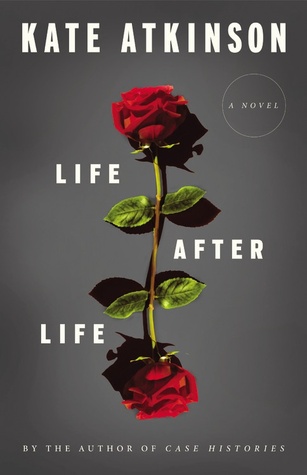
Life After LifeUnfortunately, this was not the case for Kate Atkinson’s newest novel, Life After Life. (Incidentally, one of the earliest bits of information I learned about the book was that two new novels were coming out around the same time with the same title, and both had favorable buzz. I might need to check out the other Life After Life, by Jill McCorkle, and see if I like it any better.) I suppose I should have been warned off it by at least one sign: I had read Atkinson’s also-much-lauded Case Histories and was unimpressed. Eh.

In the case of this book, though, the kudos came in from all kinds of quarters, and the premise of the book was fairly original and intriguing: the main character is born and dies immediately. But then just one little thing changes in an “alternate time line,” one could say, and she lives. And she goes on a few years and dies. But something changes, and she gets to live instead. And on and on. Ursula dies over and over again in all kinds of ways, but then she lives in alternate versions. Cool idea. (To read more about it, check out my full review.)

Sadly, though, the ending left me cold. I felt it just didn’t conclude or bring everything together in a meaningful way, or give me any satisfaction as a reader. I hate that. I complained about it several times after I put the book down, to any family members who would listen. I went to Goodreads and tried to take solace in the few other reviewers who were equally disappointed and wondering why everyone else was giving the book 5 stars. Even then, I still wonder: WHY? Why all the glowing reviews? What did I miss? Please, somebody explain it to me. It’s these kinds of endings that make me feel stupid, that somehow I’m missing an important piece of the puzzle that would make the book meaningful. But no, I felt the same way with this as I did when I finished Cloud Atlas: disappointed, annoyed that there was no apparent Greater Meaning anywhere. Everyone said there was this payoff, this Meaning, this Message. But no, I sure didn’t see it. Right now, I’m just reading something simple, an easy book without any Meaning. That way I won’t be disappointed again. I can’t handle it again quite this soon.

Soon I can hop the Hogwarts Express to L.A.

Hogwarts
Photo from Universal Orlando Resort

In book-related news that is the thrill of my day, I read that Universal is definitely going to expand its theme park in Los Angeles, a project which will finally bring Harry Potter and Hogwarts to California.

Having lived East of the Mississippi for years, I visited Florida for most of my theme-park needs: Disney World (ah, I miss you, Epcot!) being the biggie. And then as soon as I moved to California, a mere three hours from L.A., the Universal Studios theme park in Florida added the Wizarding World of Harry Potter. And since then, I have been jealous of every friend still back East who’s gotten to visit Hogwarts in person. Sure, I’ve concocted butterbeer using Internet recipes (whoa, is it super-sweet or what!), but that is not even close to being able to replicate the experience.

What cracks me up in the article from the L.A. Times is the notion that Universal was hoping at one time to build houses on the backlot. What the heck kind of shortsighted notion is that???! Muggles.

Thank goodness, that uninspired idea was shot down, and we get Harry instead on the West Coast.

Construction begins this summer. Only question is: HOW LONG WILL IT TAKE TO FINISH? Let’s hope someone waves a wand and gets it done speedy-quick. This will be almost as big as a book-release midnight party.

Farewell to E.L. Konigsburg

FrankweilerSo I just read that E.L. Konigsburg, author of From the Mixed-Up Files of Mrs. Basil E. Frankweiler, died. I can’t let this opportunity pass to write a short thank-you to her for that charming book, which I enjoyed so much as a young reader and which I have enjoyed just as much reading with my own young ones.

In a day when it’s easy for anyone to publish, and books for young readers are particularly hot items, we’re surrounded by thousands and thousands of choices for reading. I love to read the great new books that are coming out and contributing to the best of all genres, but there are some classics that still hold a special place in my heart, and Mixed-Up Files is definitely one of those. It’s a clever premise, one that any child who’s had those moments of wanting to run away can relate to, but which makes the destination very cool: two kids pack up and escape to the Metropolitan Museum of Art, where they manage to live secretly for a short time. Even now, it gives me little butterflies of excitement to think about the notion of being able to live in that awesome museum!

Then there’s the element of mystery added in to the story: is a statue the museum’s acquired for a bargain price actually the work of Michelangelo? And then there’s the interesting character Mrs. Frankweiler, who knows more than she lets on. All in all, the book is so fun to read, particularly because it’s so good at letting the reader step into the shoes of the characters and step off on a flight of fancy. It’s just the right setting for letting the imagination run wild. And personally, I’ve always loved museums, especially art museums, and my daughters love them too, so reading this story together doubled the pleasure.

Thank you, Ms. Konigsburg, for creating this story. I expect I’ll enjoy reading it to my grandkids one day too. And that is what makes a classic.

Glad to read about others’ experiences with mental illness

So I was appreciative this week to receive a book to review called Pros of Prozac: A Faith-Based Memoir of Overcoming the Stigma. Given my experience in book reviewing and my personal interest in mental health issues, this book was a welcome read.

Pros of Prozac

It’s a little slip of a book, just over a hundred pages, which the author says is mostly intentional, so someone interested in the topic can just get a quick overview of her experience. So I read it in one sitting this afternoon. Beca Mark writes about her experience with postpartum depression after the birth of her first child, struggling with mood and depression, and finally deciding to seek professional help and take medication for her depression. It took 15 months to choose to take Prozac, and Mark discovered two things: one, why did she wait so long while suffering so much? and two, she realized that she had actually been struggling with depression her whole life but hadn’t known it until Prozac made her feel really good and really herself.

Mark’s experience is actually what I would call fairly straightforward. She was really struggling, and then struggled with just the concept of taking medication because of the stigma it has in our society (and the real lack of open discussion of the topic in her otherwise close-knit, very large family), and then finally decided to give in and take the medicine. And in fairly short order, she just felt a whole lot better. And she has felt consistently better in the years she’s been taking it, which I’m guessing is probably about five. She makes clear that it hasn’t made her life easy-peasy or super-simple or solved all her problems. It has simply made her more able to think clearly and be motivated and to just be her best self. As I put it, it’s helped her to be able to cope in the way that most “normal” people (i.e. those who don’t have depression or other mental-health struggles) do.

Mark says this is a faith-based memoir, but it’s really not very heavy on the faith angle. I think her beliefs and the culture that surrounds those faith beliefs give a frame to her story, but even those who don’t consider themselves very religious can find a lot of value in her story. All in all, this is really a simple tale, and one that seeks simply to provide some basic information and encouragement to those who may find themselves struggling emotionally but feeling hesitant to accept that there might be a “label” for what they’re experiencing and that medication might help. Our culture at large still places stigma on mental health issues, as well as taking psychiatric medication. And individuals within faith communities may very well sometimes compound that stigma by saying that if a sufferer could just be more self-reliant or more faithful, they wouldn’t suffer.

I heartily support Mark’s goal to contribute to the general discussion and bring this topic “out of the darkness” into the light of day. The more those of us who do struggle with emotional challenges really talk openly about this and show that we’re pretty normal, typical, “good” people, and not weird or weak or something negative, the more others will be better educated, aware, and accepting — and supportive. And, even better, the fewer the number of people who do suffer from mental health issues will feel marginalized or hesitant to seek treatment. Mark really doesn’t want more people to suffer in silence and without treatment. Why should they? It’s pointless to suffer when there is help.

In applying Mark’s story to my experience, I find that mine is a bit more complex. (She does say that mental illnesses are complex in cause, etc.) Because I have bipolar issues, finding medications and treatments to keep me on an even keel can be trickier. Antidepressants help the most, but they tend to “poop out” after a year or two. I’m in that spot right now, I think. I have been on a number of different medications over the years, and it hasn’t been as “simple” (that’s relative, I know) as being able to get on Prozac and stick with it for years. I would like that a lot if it were that comparatively simple.

When it comes to the faith angle, I just wrote that there really isn’t a lot of it in here, so this book is really accessible for everyone. I wouldn’t have minded seeing more, personally. I have written about how my faith informs and is affected by my mental issues, too, and I don’t think Mark really digs into that as much as I have, even.

But bottom line: a good read, particularly for those who are “new” to the idea of having possible emotional struggles, and one that’s simple and straightforward and encouraging. Kudos to Beca Mark for putting her story out there and just being honest. The more of us who do so, the better.

If you love Goodreads, what do you think about Amazon’s buyout?

Amazon-Goodreads comboSo I learned the other day through a publishing-news email that Amazon.com is buying Goodreads. Since I read voraciously and use Goodreads as a simple way of keeping track of what I’ve read and want to read, this news popped out at me. On one hand, I thought, yes, it will be handy to be able to tie together some information from the two places because, yes, I do use Amazon a lot and I have a Kindle. But on the other hand, I did have to agree with some writers, like Rob Spillman on Salon.com, that this is not necessarily great news. As much as I do like using Amazon, I concur that I don’t want it pushing its way into the Goodreads community. Because that’s what Goodreads feels like: a cozy little reading community. It’s a library in which we can all mosey in and out, chatting quietly with each other about what we’ve read recently and getting and giving feedback. Now, it’s indeed going to feel like the Big Brother of Book Sales is going to be looking over our shoulders the whole visit, listening in and taking notes

truman show angles

(well, really, more like recording all our interactions via cameras on every wall, maybe in all kinds of other places, “Truman Show”-style).


Nope, I’m not thinking I’m liking this. Sometimes it’s still nice to have neutral places to visit and gather information (and people have to ask why I don’t watch any television news! ha!). And Goodreads has been great for that. Now, not so much. What’s also a little disturbing is that I don’t see any mention of this looming takeover anywhere on Goodreads. You’d think that the site would be sharing this news in a clear, obvious spot on its site, but nope. So I’m guessing most Goodreads users still have no idea this is happening. And that doesn’t seem quite right, either.

So. Time for someone to start up a new site that is actually neutral again? Any takers?

‘Clockwork Princess’ review and thoughts

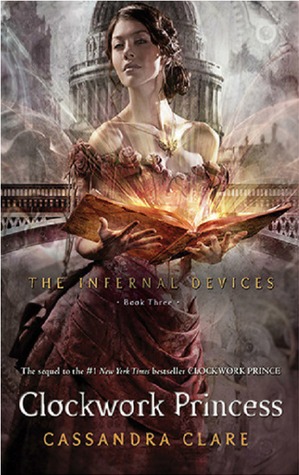
Clockwork PrincessSo I just finished reading Clockwork Princess, the conclusion to the three-book series The Infernal Devices by Cassandra Clare. These books could easily be read by someone who hasn’t read Clare’s The Mortal Instruments series, or they could be savored by those of us who already have developed a taste for the deliciously entertaining world of Shadowhunters.

The brief story: in 1878 New York, a teenage girl is orphaned, and her brother invites her to join him in London. On arriving there, she is taken by women who essentially imprison her in their house and insist that she has special powers. They spend weeks training her to shape-change, and she is astonished to learn that she actually CAN turn into other people. Luckily, she is rescued by a dashing young man named Will, and Tessa is introduced to the world of Shadowhunters, people who are charged with protecting humans from the world of demons and other “Downworlders.” As it turns out, the “Dark Sisters” were only tools in the hands of the Magister, who has very scary and nefarious plans to destroy Shadowhunters. Tessa, as well as an army of mechanized creatures, are the main components of those plans.

Clare gets to have fun in this series continuing to explore the world of Shadowhunters, but she also gets to add in components of steampunk, via the clockwork-angel necklace that Tessa wears and the clockwork creatures the Magister has created. The other ingredients that work so well for her in the Mortal Instruments are all there: teens charged with safeguarding humanity and using lots of cool weapons to kill ugly and dangerous demons; intense love affairs and some good makeout scenes; secrets and curses that throw wrenches into those love affairs and make the characters dark and brooding but tender underneath; lots of action and fight scenes; mystery and intrigue; and even some great snark, cleverness and humor. When I first started this series, the pattern was so similar to the other books that I thought it was too much of a copycat. But I enjoyed the story and the characters so much that I couldn’t help but just throw myself into it anyway.

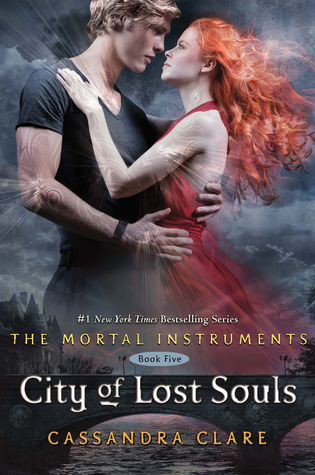
City of Lost SoulsNow that I’ve finished (and having read all five of the existing books in the Mortal Instruments), I find myself much more satisfied with how The Infernal Devices played out and concluded. When I finished the fifth book in the MI, City of Lost Souls, I was pretty annoyed with Clare. She simply got off the rails with the story and let it spin out of her control, like a wild dog in desperate need of obedience school. With the ID, she used a lot of her familiar elements but still crafted a story that is nicely paced and tamed. She tied up the series very satisfyingly and restrained herself. In fact, I felt completely happy with all of it, and I was teary-eyed with how the characters’ story lines were concluded. And having enjoyed City of Bones and the next few books in the Mortal Instruments, it was fun to tie together the characters from both series and see how they are related. When you get to know and love characters, it’s always wonderful to learn more about them.

I’d highly recommend the Infernal Devices series, and if you want to read City of Bones and its sequels, you might want to limit yourself to the first three or four books. But we’ll see. I’m hoping Clare can bring it all together and do it right in what I hope will be the real conclusion to the Mortal Instruments, which apparently will come in September 2014 and be titled City of Heavenly Fire. Next question is: how will the “City of Bones” movie be? So far, I approve of the casting. I just hope that the movie captures the humor of the books and not just the action and sizzling love stories. If it misses the humor, it will be a tragedy (which I do fear is a possibility: look at Harry Potter — those books had so much cleverness and wit that seemed to be largely missing from the movie adaptations).