Get the skinny on our society’s obsession with fat

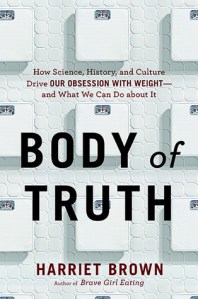
body of truthI’ve decided I’m going to make reading this book a once-a-year activity. Body of Truth is just that helpful. When I read it a year ago before it was even published, I dog-eared pages as I devoured it in just a day or two. I made my husband read it. THIS, this, is what everyone needs to know. I read it again this week in a day, dog-eared more pages, and considered making my husband read it again.

Read my review of the book on Rated Reads.

Now, I was able to keep my review to a reasonable length, but I’m going to write more about the insights I gained by reading Harriet Brown’s book. And I’ll have to split up the info into a few posts so it won’t get weighed down (ha ha). Today I’m just going to address the damage that is done by dieting. And let me tell you, that is one of the takeaways of this book that has me the most furious.

I never considered myself a dieter until the past 7 years or so. I noticed myself gaining when I was nearing 40. But I had actually dieted when I was about 12 by reducing a bit what I ate and not eating desserts. I didn’t keep track of pounds, just slimmed a little of “baby fat,” you could say. And then each time after my three pregnancies I breast-fed, counted calories (stuck to 1800 or so), and kept up my regular exercise. I got back down and a little bit more and was looking nicely trim at 33. I kept it up until, yeah, almost the 40s. Then I saw 10 pounds creep on and got a bit panicked (ha!). Then I happened to move to a new state and put on another 10 pounds, then another 10, then another 10. All of a sudden, I was a lot heavier and was feeling much different than I had before as generally an average-weight, trim-ish person. I dieted first by just really counting calories (and going hungry often) and lost 30, but it only held for a year or maybe two. It came back on, and then I started looking at other options. I did the hCG diet (yes, I know, I never DREAMED I’d be the person to do something drastic like that), but it worked and I at least lost almost 20 pounds and felt a lot better really quickly. That crept back on, and I did it again a year or so later. A couple of years ago, my best friend started doing Atkins, so I tried it. It worked and I did well enough to lose maybe 20 or 25 pounds and feel it was worth the work and sacrifice. My daughter got married, then, last year, and all bets were off. I ate, and I ate, and I ate. I was depressed and stressed and just went straight to food. And what do you know, I am now by far the heaviest I’ve ever been. I went back on Atkins for a few weeks in the fall, then something crazy happened, and then I went back on it this last month, then my grandma died. And I am 20 pounds heavier than my heaviest weight ever before.

So not counting the post-pregnancy “getting back to pre-pregnancy weight” work, I have dieted, lost and gained, at least four main times, plus a few more little times, in the past 8 years. I have been successful. I have been tough. I have focused. And then I’ve either gone back to semi-normal eating (not being hungry) and gained back, or I’ve had some eat-a-lot periods. And what do you know, I’m completely normal. Studies show very low rates of “long-term” success, which is at most watched over 5 years, and almost nothing for rates past that time period (3 years is really even the limit of most “long-term” studies). Evidence also shows that not only do people who diet tend to gain back what they lost, but they gain more on top of that.

So if I had never dieted, I’d most likely just be at my previous “heaviest,” but not the 20 pounds more than that that I am now. I might even be 10 or more pounds below that. And I’d have saved myself a lot of unnecessary work, focus and energy that could have gone to something more productive. I don’t know if you’ve been in this situation or not (likelihood is many of you have been), but this realization absolutely OUTRAGES me.

Brown writes this:

(An) oft-repeated lie about weight and health is that dieting makes us thinner and healthier. At the very least, we consider dieting benign, something that can’t hurt us even if it doesn’t really help. But the truth is, dieting is actually harmful for many of us for all sorts of reasons. And it doesn’t make most of us thinner or healthier. On the contrary.

And she says this: a 2007 investigation (as one example) confirmed that diets don’t work. “The mind-boggling element here is that we’ve known diets don’t work for a long time, and so has the medical establishment.” But still society at large, doctors, individuals … we all think they can work if people just are motivated enough, have enough willpower, work hard enough. And that big fat lie is causing us health problems. Just think: doctors who are all encouraging patients to lose weight may very well be making their patients’ health problems WORSE.

Here are some sobering points Brown tells us:

  • “Dieting nearly always makes people heavier over time. In one study of Finnish twins, the more diets people went on, the higher their risk of becoming overweight and the faster they gained weight later in life.”
  • “Dieters tend to have higher levels of cortisol, sometimes called ‘the stress hormone,’ and free fatty acids, and dieters tend to exhibit diminished executive function, (‘strained bandwidth’), maybe because using so much mental energy thinking, worrying, and negotiating about food choices leaves them too distracted to think about much else” — which in turn actually causes us to gain more weight.
  • Dieting actually has been shown in studies to lead to binge eating. It’s not just psychological, either; physiology on various levels causes us to eat more after dieting, reversing all our work (brain circuitry even changes!).
  • ”An ever-growing body of research suggests that weight cycling, or yo-yo dieting, correlates with higher levels of heart disease, impaired immune function, cardiometabolic risk, insulin resistance, triglycerides, hypertension, and abdominal fat accumulation.”
  • Studies have “found correlations between weight cycling and disordered eating, higher stress, lower well-being, and less confidence about food and eating. In other words, the more loops of the yo-yo you go around, the worse you feel about your weight, your eating, your very self.”
  • Each loop of the cycle then is harder. It’s tougher to drop the weight every go-round. Dieting changes metabolism. “People who have intentionally lost weight generally use about 15 percent fewer calories than non-dieters to perform exactly the same activities, which means they gain weight eating fewer calories than non-dieters.” As one research professor told Brown, “We know there’s some sort of derangement of the metabolic pathways, and that has a cascade effect on everything from the hormones involved with obesity to hunger.”

So people who feel fat or have been told they’re fat and need to lose weight feel “incredible shame.” Our whole culture reinforces that. Doctors reinforce that. And it’s not helping anyone. It’s not helping health; it’s not making anyone motivated; it’s not making us feel good; it’s a wicked prejudice that is still allowed. Feeling the outrage yet?

In the next few blog posts, I’ll focus on some of these last ideas and more.

Different kinds of mourning

Today is the anniversary of my father’s death — officially (he was on life support for a day or two and then “declared dead”). I think he was really gone very late on the 13th or early the 14th. His brain experienced two big hemorrhages and I’m sure it was really “over” fairly soon. I clearly remember the moment at 9 p.m. that day that I got the call he was unconscious. I know I went into shock myself: I sat down on the couch and was just stiff, cold and shaking.

I was not at all prepared for him to die. He was only 71, and he had worked ridiculously hard (we joked with him that he worked TOO hard) to keep himself healthy by eating well and exercising. I thought for sure he’d be around a good long while. The shock of that unexpected loss took a long while to shake off.

Six years later, I’m accustomed to his being gone. When I think of him, I don’t experience a painful stab in my chest as I did for a long while. Now it’s just a small pang of longing, much less painful. It hits in the same place, right in my heart, but the wound is no longer a gaping hole. It’s scabbed over, enough so that no one else even knows it’s there, I’m sure.

This year brought me another unexpected loss. I saw the loss coming, so I guess saying the loss itself was unexpected isn’t accurate: the grieving period I went through was what took me by surprise. Because who really thinks about the notion of mourning for a beloved child who has grown up and flown from the nest?

My firstborn got married, to an incredible young man who’s just about as incredible as she is. I was thrilled about the union (once I processed the notion of her being married pretty young, which I hadn’t seen coming either, but that’s another story. The very short version: she found a wonderful person, we love him, we love them, and it was right. Plans/expectations are one thing, but life always throws interesting curve balls.).

To say the period of engagement/wedding planning was stressful is almost a cliche. Very few people say their engagements were breezy and stress-free, and, yeah, it was busy and had its bumpy moments. Bringing two families together, planning, coordinating, … it can be tough. But all through it, you know you have this amazing day to look forward to. The reward’s huge. And the wedding day and reception were beautiful, sweet, poignant, fun, full of love and friends and family celebrating together. It was a wonderful memory.

I was thinking I’d need some “recovery” time afterward to wind down from the stress of preparation. It didn’t go quite as I’d hoped, because then my girls were all home from school for the summer and I had precious little time to myself. And my personality, my particular mix of needs, requires a certain amount of alone time, to just process the rest of life, to take a breath.

As it turns out, I realized a month or two ago, I was mourning all summer. But I didn’t really recognize it as such because it wasn’t as clear-cut a “grieving situation” as, say, my dad’s death, and my younger kids kept me so crazy all summer I didn’t get to really think much and just let everything go through my brain, my emotions, my self.

One day in the middle of the summer, I did have a moment where it struck me that I felt the loss of my daughter almost as a death. It was just one day, one morning. We hadn’t seen her in a week or more, hadn’t really had any quality time with her (she lives with her husband about a 45-minute drive away from us, and they live next door to his parents, so they get to be with his family all the time and we make a lot of trips up there to see her; as time has gone on, I’ve been able to decrease the number and frequency of trips a bit so it doesn’t seem like we’re there all the time). And I just said to my husband, “I feel like she’s dead. She’s gone. How strange. It feels like I feel with Dad.” It was so clearly a loss, and it hit me square in the chest, same thing. We saw her the next day, I think, and my husband and I ended up taking her and our 13-year-old to lunch at a salad place, and that one hour being our “old” selves in a familiar environment “like we used to be” before it all changed so much made that feeling go away, or at least recede into the background for a while.

Nearly five months after the wedding, I’m starting to feel a little more myself again. When you’re in mourning, you’re a reduced version of yourself, parts shuttered, shut down, the world seeming a little dimmer. I’ve felt the world brighten up again, I think, and I’m coming back into my own. I was sad for a few months. One consequence, in my arsenal of bad habits, was that I just ate. And ate. I went through quart after quart of ice cream. I must have gained 15 to 20 pounds over the summer. I was swallowing the pain. That last consequence I’m dealing with right now, and making progress: I put myself on a low-carb diet. I was just feeling physically cruddy, and I know all the sugar I was eating was making me feel even cloudier than the grief was. A week and a half in, I’m feeling clearer and physically much better. It’s a gift I’m giving myself: to take care of my body.

So life brings grief in various ways. Death is an “obvious” vehicle for it. But we must mourn all kinds of losses. I’m reminded occasionally, with my 17-year-old, that I mourned the loss of a “normal” child when she was born because of her Down syndrome. There are days that remind me she’s not like the “typical” teen at this stage: she’s not going to be driving (not anytime soon, for sure), she can’t babysit. We have to check on her personal hygiene sometimes, and we have to remind her about appropriate behavior around other people. It’s a loss, and I am reminded more of that now because our family dynamics have changed so much since our oldest got married and moved out.

The reality is we need to be gentle with ourselves when we mourn any loss, and realize that we have to take time to grieve. We must move through it. We also need to realize that others are mourning losses as well that may not be visible to us. Be sensitive to anyone’s mourning periods of any loss. They may breeze through the period of mourning, or they may slog through. I felt “weak” somehow this whole summer because I just wasn’t myself. I felt silly because so many of my friends had children leaving the nest, whether it was for college or for church mission opportunities or some through marriage. They all seemed to be just fine. Why wasn’t I? The truth of the matter is that it didn’t matter how other people fared, when it came to my own feelings. I had to be respectful of how I felt and how I had to work through it. I hope it makes me more sensitive to others through whatever losses they’re grieving.

Life is beautiful. It is bittersweet. It is a hodgepodge of opposites: highs and lows, gains and losses. Despite the pain of grieving, I’m grateful to be on this grand adventure.

Let’s stop making ‘fat’ a bad word

It occurred to me yesterday that I don’t have to use “fat” as an adjective for myself. No one does. It’s another label, and while labels are necessary for products on a shelf, they are dangerous for people. (How about this?: “CAUTION: This label is toxic for your emotional health.”)

caution label

We don’t say someone “is cancerous,” just that they “have cancer.” We are striving to say someone “has Down syndrome” (or some other disability) rather than “is a Down syndrome person.” Because that label does not by any stretch describe the whole person.

So I am not fat. I have fat on my body. Right now, I have more fat than I’d like to, because I’m uncomfortable, and part of the reason I have more fat than I’d like is that I’ve been resorting to emotional eating for a few months, and the quality of some of those foods (sugary) is making my cholesterol a bit higher than I’d like. And those are the facts.

The problem with words is that they often become loaded with associated meanings that weigh them down far more than their original, “true” meaning. Some words even become so weighed down with other associations that they change meaning entirely. This happened with the word “gay.” No longer do we even use that to mean “happy or lively.” We only use it to portray someone as homosexual.

What meanings have become tied to the word “fat”? I’d like to offer these: ugly, disgusting, lazy, shameful, embarrassing, gluttonous, gross. I’m sure you can come up with many more, and they’re all negative. What’s happened is that there is a stigma attached to the word “fat,” and that stigma, rather than “helping” obese people to get healthier through diet and/or exercise, etc. (and that’s a WHOLE OTHER topic entirely), is actually hurting us all. The stigma, the shame and embarrassment of being labeled “fat,” is actually making it even harder for those who would like to make a change in their health to start an exercise program or change a few bad habits in their diets. Shame doesn’t motivate very well or for very long. Researchers Lexie and Lindsay Kite at Beauty Redefined put it this way:

(R)ampant self-loathing, which can be partially attributed to women’s self-comparisons to unrealistic and unattainable body ideals in mass media, may very well encourage women to give up on achieving healthy body weights altogether due to the perception that “healthy” or “average” is unreachable. Studies help to confirm this idea.

It’s actually true that the better you feel about your (whole) self — including your body — the more motivated you are to take care of it in every way. But if you feel shame and all those bad words associated in our culture with “fat,” the less motivated you will be to take care of yourself.

So can we shift the stigma, remove it altogether? Can we snip the associations tied to the word “fat”? It’s going to take some hard work on everyone’s part, but it is possible. Because what we’re “doing” right now — shaming the majority of our population that’s deemed to be overweight — isn’t working. It isn’t working to make anyone feel good about themselves and it isn’t working to get more people exercising, which is truly the goal. Losing weight isn’t really the “magic bullet” we think it is, but more and more we’re learning that being fit is what really counts.

Let’s take the first step toward a healthier and happier society and cut the “fat” talk right now.

Just don’t say ‘if you just…’

Ever had a problem; been frustrated, angry or a little depressed; felt stuck? Ever had someone tell you, “Well, if you just did this ______, you’d be fine?”

I’ve had people say that to me. And it shuts me up. It doesn’t help me, but it stops me from talking to those people. I don’t know if I’ve ever said it to someone else; I hope I haven’t. I know I’ve thought it. But at least for a long while now, I’ve known better than to say it out loud. And I’ve tried to remind myself of the truth:

Any one of us can have problems and challenges that, compared with someone else, somewhere, can look tiny, easily surmountable. Sometimes it’s helpful to realize others have it worse. If we look at our lives with appreciation and gratitude for the good things we have, it can help. But usually, trying to tell ourselves logically (or have someone else “helpfully” do so) that our problems shouldn’t be such a big deal does squat for our feelings.

Here’s why: we are allowed to feel how we feel. We’re meant to feel. We’re meant to have feelings in response to life situations, whether they’re kind of everyday things or unusual things. We’re meant to have all kinds of feelings all over the spectrum of emotion. And those feelings include “bad” ones. We’re meant to just feel those feelings. And what usually happens is once we allow ourselves to feel them, really feel them, we can move on to other feelings about other life events.

The problem is when we stunt that natural process by telling ourselves we shouldn’t be feeling “so bad” or by having someone else tell us so. It stops us from moving through the feelings, talking or thinking through the ideas and emotions.

Same applies to things we could or should be doing or doing better, not just what we’re feeling. Likely we’re comparing something we’re just naturally not so good at with something that really is easy for someone else, so we feel inadequate. Or we could compare something that’s easy for us with something someone else finds more challenging. And we say those dreaded words: “Just do ___.”

We all not only have a complex mix of weaknesses, strengths, natural talents and acquired skills, but we are at different stages in life. Something that was hard for us 20 years ago might be much easier now. Ditto for those around us. And something that was easy for us a year ago might be harder now because our circumstances are more challenging in other areas or we’re struggling with events that are zapping our emotional strength.

For me, I’m finding that I am feeling a general sadness in one layer of myself/my life because my oldest daughter got married a few weeks ago and moved out. But I hate to say anything to anyone because it just “seems silly.” She lives only an hour’s drive away and we can talk and visit. Every other parent my age has already had children go off to college or serve as missionaries for our church, during which time they’re gone for a solid 18 or 24 months and only generally in contact via email or letter once a week. So I feel ridiculous saying out loud that I’m grieving a little over the “loss” in a way of my first, amazing child. But it does make me sad she’s not around all the time anymore. I miss the daily interaction and talks and jokes and hugs and smiles and everything that was our relationship while I was raising her. Things are changing, have changed. It’s real to me. But I don’t want to say anything to anyone else for fear of being compared, of essentially having my feelings belittled because their “loss” is bigger. Their child is across the country or across the world … or something “bigger.”

I also find that I feel down on myself because I have generally been doing well with eating healthy, cutting out sugar and a lot of carbs, this past 10 months or so. But the past month, since right before my daughter’s wedding and since, I just haven’t had it in me to “diet” properly. I’ve been eating junk, and lots of it, and I feel physically yucky. I feel bad because I had done so well. But I also realize that circumstances are different: I’m “recovering” from all the work and stress of preparing for my daughter’s wedding; my kids are now out of school for the summer and my “alone time” is a lot less; I’m adjusting to the change of our family dynamics, and I’m trying to “play catch-up” for some work and things that got put on hold with all I did for the wedding (because I am not just an awesome mom but very capable in planning things and organizing, and the wedding was awesome too). In short, it takes a lot of work for ME to eat well. And even though I feel yucky physically and would really like to feel better, I have to have the emotional and mental energy to focus on taking care of myself, truly properly. Others might say (and heaven knows plenty of “professionals” and bloggers say) “just do it.” Just stop eating sweets. Just stop emotional eating. Right now, for me, it’s akin to saying, “Just stop smoking. It’s so easy.” I’ve never smoked, but I have certainly heard how hard it is to stop.

I’m trying to allow myself to feel, to validate my own feelings. I’m talking to a few trusted friends who are kind enough to listen and validate as well. I’m also trying to allow myself not to take it too hard that I’ve gained a few pounds and am having a hard time with the junk food. Because I also know that I’ll be fine soon enough and will get back to where I should be. If I’m not there at this very moment, today, it’s OK. I will be soon. And that’ll be OK.

In short, I’m giving myself permission to feel, to not be “my best.” And I strive to do that for others. When they talk about feelings or issues they’re struggling with, I know that even if they sound “easy” for me, they’re not easy for them. I nod, I listen, I hug. I say, to them and to myself, “That is hard. I’m sorry you’re going through that. I love you and care about you.” And it’s true, and that’s really all it takes.

I’ll never have a thigh gap, but I am experiencing a big gap between ideals and reality

You know when you dream about eating something off-diet and demanding of some complete (thin) strangers walking by, “Do you ever eat?!”, you’re self-conscious (and frustrated) about your weight.

I’m half-proud, half-embarrassed for myself that I embarked on a strict diet last week, mainly because, yes, I want to look better. And I want it to happen fast. Here’s the thing: I have felt very self-conscious about my weight in photos of late, and I have several big events coming up for which I’ll be in numerous photographs, and I don’t want to look fat.

Yep, there it is.

Yep, my self-image is pretty distorted right now.

As much as I talk about self-image and how bad our society is about focusing on looks, whether it’s regarding weight, age, or relative size of body parts, I still struggle with it myself. Sometimes not so much, other times mightily. As I most recently mentioned to my therapist, “I feel horrible about how I look.” Her response: “Right now you’re very stressed and not feeling good about yourself in lots of other ways, so that’s not surprising.” Meaning, essentially, try not to worry about it; it’ll pass when you manage to process everything else that’s had you down.

So I kind of feel like a hypocrite when I’m urging everyone, male and female, to be more aware of how media and society all around us dose us liberally and continually with the religion of thinness and image, of airbrushed (impossible-to-achieve) perfection, and I am struggling with it so much still.

It’s complicated by the matter of health: when I’m stressed, I eat sweets. I overeat. That’s simply not good for my body, and that’s important. So I do also want to work on that. I want to break my physical and emotional addiction to sugar and my reliance on food as a crutch. But I would like to figure out how to separate that out from my worries about how those habits affect my LOOKS.

Here’s another thing: plenty of people out there have far worse eating habits than I do, but they’re thin. So their health might be in need of improvement, but they either don’t worry about it, or they don’t worry about others seeing them as fat. Because don’t we tend to judge people who are overweight? We automatically think, They need to eat less. They need to have better self-control. They need to take better care of themselves. But health and thinness are not always directly correlated.

That’s not to say I excuse myself for slipping into bad habits. I can do better by my body sometimes. But our society judges on appearance, and I judge myself. I have a lifetime of negative messages to overcome. And that simply makes it much more difficult to just take care of myself the way I should because I’m devoting so much emotional energy to the image part of the equation, which is NOT the important part; overall health is.

I have had a lot to deal with the past months, the past year, with a few breaks in the onslaught of expectations, responsibilities, and struggles to catch my breath. I anticipate having some breaks to catch my breath and focus more accurately on taking care of my health — emotional, mental, spiritual and physical — fairly soon, but in the meantime, I’m just getting through it as well as I can.

And dieting. Like I said, I’m a little embarrassed because I’m doing it almost exclusively for the reward of looking better in pictures. It’s not the example I’d like to set but I’m doing it anyway, just because right now so much has beaten me down I don’t feel good about myself in many ways; I feel weak and run-down and just not up to snuff. I feel like I’m letting people down left and right because I simply can’t do everything everyone needs me to do at all times. So that feeling extends to how I look.

I’m going to keep working on my self-image, my self-esteem, the ways I look at myself and talk to myself. I’m going to do better. Just forgive me the lapses right now in my actions and how they don’t match my ideals. It’s a process for me, and it’s a process for us all as individuals and as a society. For me, this topic mixes my mental health awareness-raising with my awareness-raising about society and image. The intersection is a little delicate, and I’m navigating it as well as I can in this tricky time. I hope I’m making progress in it all because all I can do is just hope I’m slowly doing better. I’m going to just try to remember to pat myself on the back for what I’m doing better: life isn’t about improving overnight. It’s a journey with all kinds of intertwined paths leading to a place where we’re our best selves in all aspects.

Beyond compare

The past months have just seemed nonstop stressful (well, to be completely honest and accurate, they’ve been nearly-nonstop stressful; I’ve had a few days here and there that weren’t). With the holidays and some big projects wrapped up, I now stand at the beginning of a new year.

While I’m not striving for a “new year, new me” (I cringe every time I see that in any media source the first few weeks of any January), I really have been searching within to figure out what I can do a bit better for myself, so I can feel less stressed even as life is most definitely going to continue to be hectic. After all, I’m launching an adult into the world in mere months, to provide just one example of the life experiences I’m going through. (Giving birth is a big job and one that launches a new person into the world after nine months of gestation; at this stage, I’ve been actively parenting for 18 years to make sure this person can be a full-fledged independent being. It’s exhilarating and all of a sudden terrifying.)

I’ve noted, not for the first time, that I compare myself, my strengths, weaknesses, abilities, energies, visible-to-others “products” (children, writing and editing projects, volunteering efforts), etc., to those of others all the time. Social media is a blessing in many ways, connecting me at least in small part with far-flung friends who bring various gifts into my life, but it can also be a nasty tool for comparison. Day in and day out, I see photos of friends my age who still have the same figure (at least what I can see) they had 20 years ago; I see perfect family portraits; I see kids of these friends who are doing unbelievably impressive things in music or sports. It’s easy to look askance at my own figure, which is now no longer the one I had even a decade ago; to briefly (and, honestly, selfishly) wish I’d put my kids in more activities and lessons so they could do more with their own talents; to wonder why I cannot get just four kids to smile normally all at the same time.

Even worse, I compare my current self, at age 43 years and 8 months, to the self I was (or at least imagined I was, which might be more accurate) a decade or two ago. This body is 50 pounds heavier than it was at those times, when I wore a size-6 dress and had a great figure and pretty, shapely calves. To be honest, my habits aren’t much different. I have exercised an hour every day for 20 years. I have generally eaten healthy. But I now struggle mightily with my weight. (I emotionally eat and always have, and at times it’s worse than others, but it hits me harder now.)

In examining myself, I feel weak, impatient, tired, not nearly as capable as I used to be. I almost felt I had the parenting thing down somewhere in the middle of this 18-year mothering journey I’ve been on so far: I had fewer worries for my girls and felt I’d hit my stride. Now that they’re older and the stakes feel higher somehow, it’s a whole new world and I once again feel inadequate more than I’d like.

I mostly pinpointed maybe 10 years ago the kinds of mental challenges that are my particular “cross to bear” and have been on medication pretty much ever since, have consistently gone to counseling, have tried to stay aware of where I am so I can stay or get balanced. But even with the awareness, the knowing, I am honestly terrible at balancing out my capacity to give and do with what I think I need to do and be. My mental mouth is always bigger than my emotional stomach: I put so much on my plate and live to regret it. (I either metaphorically stuff myself or throw the plate against the wall…)

I guess I feel frustrated with myself because I still somehow don’t get it yet. I don’t feel a whole heck of a lot different, stronger, wiser, than I did when I was younger. I’m just older and tireder and flabbier.

I see people around me who have double the number of kids I do. I see peers who have experienced the death of a child or a spouse, who have gone through cancer, who have what I’d term other real crises or catastrophic events. One part of me thinks when considering those things, “I should feel more appreciative of what I have” (and I really am appreciative and grateful), and another part speaks up: “I can barely handle the challenges I have, and they don’t seem nearly as ‘big’ or ‘bad’ as those others’ challenges. Man, I’m a mess if I fall apart at stupid little things.” I compare my trials to others’ trials and come up feeling inadequate! Now that’s pretty ridiculous.

So that’s where I’m at. At least part of me is an optimist, someone who’s very grateful and happy for all I have and get to experience in life. I readily smile; it truly is the natural and comfortable way for my facial muscles to arrange themselves. Even so, I can easily feel disappointed in myself for just not “getting it,” even after what should be plenty of opportunities to do so.

I guess the truth is that I really have grown stronger and more resilient as life has thrown me the same kinds of trials, just constantly tweaked, over and over. I just can’t tell. It’s not obvious. Maybe if I were able to put my current self back into what I thought was a difficult time 15 or 20 years ago, I’d sail right through without batting an eyelash. But life doesn’t usually give us that kind of opportunity. It keeps upping the ante, tightening the screws, adding on five pounds of weight to the stack as we lift.

Meantime, I keep lifting. I will also keep working on rewording my thoughts and inner instantaneous reactions so I don’t compare my right-now self to my earlier self or anyone else. I suspect I won’t be completely successful in this life, but I’ll edge ever so closer.