The best moms … know their limits

Much talk has been made over the years and even recently about “good moms” or moms who “do everything for their kids” and so on. The Time piece titled “Are You Mom Enough?” stirred quite a bit of controversy and buzz. But there are clearly as many ways to parent out there as there are parents. I would venture to say that a number of those methods employed by some parents are probably not so great, but in general, most parents get the job done passably well. But I think what bugs me the most is when people make judgments about parents whose kids are doing just fine and start saying that their parenting style is lacking. About a month ago, right around the time I was in dire need of a little me time, a Facebook “friend” posted that she was so disappointed in all the mothers who were complaining that their kids were driving them crazy. She ended by saying, “It’s about attitude!” I gently responded with a couple of kindly worded comments to the effect that just because some of us mothers were rightfully saying our kids were making us nuts (this is summertime, people!), it doesn’t make us bad parents. Just normal. A few hours later, my comments (which were completely appropriate) had been deleted. What the heck, man?! But that’s a whole other story.

Let’s just say that I consider myself in many ways a pretty normal, typical mom. For years, women have dreaded the summer months in which a passel of kids would be constantly underfoot and looked forward to school starting again (even a popular Christmas song refers to the relatively short winter break: “And mom and dad can hardly wait for school to start again!”). So feeling nutty here at the end of the summer does not make me an unusual mom, let alone a bad one.

I will say that what makes a good mom, I think, is knowing your limits. I figured out long ago that, given my personality and my mental health issues, having consistent and dependable time alone, preferably weekly, can keep me going at my best. I’m a gas-guzzling, large-capacity van, let’s just say, at this stage of my life, and I need frequent infusions of gas, oil, and water to keep me running effectively and continually transporting my load of children through their lives. I also need good quarterly maintenance.

Unfortunately, the summer months disrupt my fairly well-planned and nicely balanced routine that keeps me at my mothering best. I know this going in and start feeling a little nervous come May. But I do the best I can to plan and make allowances. And then I still end up running low on gas and oil and burning out at least once, sometimes twice, usually in the middle and at the end of the summer. A month ago, I felt myself snapping, stretched to my utter capacity for patience and sacrifice, and I scheduled a Saturday for myself. I hadn’t had more than an hour to myself in about two months. I hired a niece to babysit for the day and I went for a lovely bike ride and then had lunch and manicures and facials at the beauty school with a friend. It was wonderful. And not nearly long enough. I was not ready after merely seven hours to get back into the grind. The timing the next day of that Facebook post of my friend (unnamed here) was very unfortunate. I thought it was insensitive and judgmental. After having my comments deleted, I deleted the friend (this was not this person’s first “offense” at overreacting to innocuous comments, either). At the time, I felt it was the simplest and quickest solution to help reduce the negative influences in my life. Again, I suppose that’s a whole other story.

Mama’s stretched to snapping: it’s not a pretty picture.

A month later, I am back at snapping point. Having four children with all their demands (and whining and fussing amongst themselves, which can just grate on one’s nerves) around nonstop; then having to make sure the two older ones get to a girls’ camp; then the oldest, who can actually babysit, be gone for an entire week at band camp; then breaking my FOOT and being unable to do the things I need and want to do; then not having any time or brain-space for thinking clearly in order to work on the writing projects that mean a lot to me personally; having other big responsibilities on my plate that still need to be taken care of, broken foot or not (band boosters [the band director needs us to raise $150,000 for new instruments over the next three years?], being in charge of my university’s local alumni chapter, other volunteer things); then throw in PMS, and it’s a recipe for burnout. (Not to mention having all kinds of large and small expenses pop up until the point of ridiculousness this past four or five months, and the astonishing number of things that have kept breaking down on me the past few months till where I’m begging the financial universe for mercy…) It’s the rubber band being stretched entirely too far. It SNAPS.

I wish I could be the kind of mom who enjoys every single moment with her children. I wish I could savor every moment during the summer with them. I have done some fun things with them here and there. I just haven’t been their everything for every moment. (Nor do I think that is good for them, anyway.) I am still absolutely ASTONISHED at the amazing journey a dear friend took this summer with her seven children. They drove in a pop-up camper all the way from the western United States to Alaska and spent two months making the trip. I would have gone nuts probably on the second week, the third at the latest. How she did it is beyond me. But I am in awe and I tip my hat to her. What an amazing experience for them all. But me, I’m just getting my kids through the summer at home, barely gripping on to my sanity.

I am still trying to figure out right now how to just survive the next eight days until my children start school. It sounds silly now that I’ve managed to get through a whole summer, but the last days are seeming like an eternity because I’ve already snapped. I have no spring left. I pretty much want to curl into a ball in my bedroom, take some kind of sleeping pills so I can coast through the next days mostly unconscious, and lock the door.

I would probably be a slightly more “normal” mom if I didn’t have my mental health issues. But I do the best I can to stay on top of them. I take medication, check in with my psychiatrist, and have regular visits with a therapist. I try to be reasonable in my expectations. I’ve been trying to repeat all kinds of useful and inspirational mantras the past weeks to keep myself positive enough to survive until I have some time alone to just regroup in pretty much every way. I just don’t know who or how to ask for help. And unfortunately, when I mention my feelings and am aware that I am being stretched too far, I end up with mostly unwanted advice (one-sentence cliches that too often start with “just”… if you’d just do X, Y or Z, you’d be fine. Or just “let go and let God.” Yeah, I know all that. Doing it is really the battle, isn’t it?) I don’t want advice. I want support and practical help. Someone want to take my girls on a vacation for a few days? That would be most welcome. No mantras, no judgment. Just support and caring.

As you can see from this long post, my manic side is coming out a bit. Sorry ’bout that. But it’s my reality. I am who I am, and I’m daily trying to improve the parts of me that can be improved, and manage the things I can’t change (genetics, brain chemistry: I’m talking ’bout you). But I’m still working on it. I’m going to fall down a lot and fall short a whole lot. I just wish I were better able to figure out ways to practically deal with the snapping of the rubber band before it stretches too far. My aspirations for being a great mom are simply in knowing my limits and not pushing past them. I’ve given my children so much and taught them so much and love them a great deal. Yeah, I need some time alone, away from them, sometimes in order to be able to continue to be a good mom to them. I just want to be able to stave off the snapping.
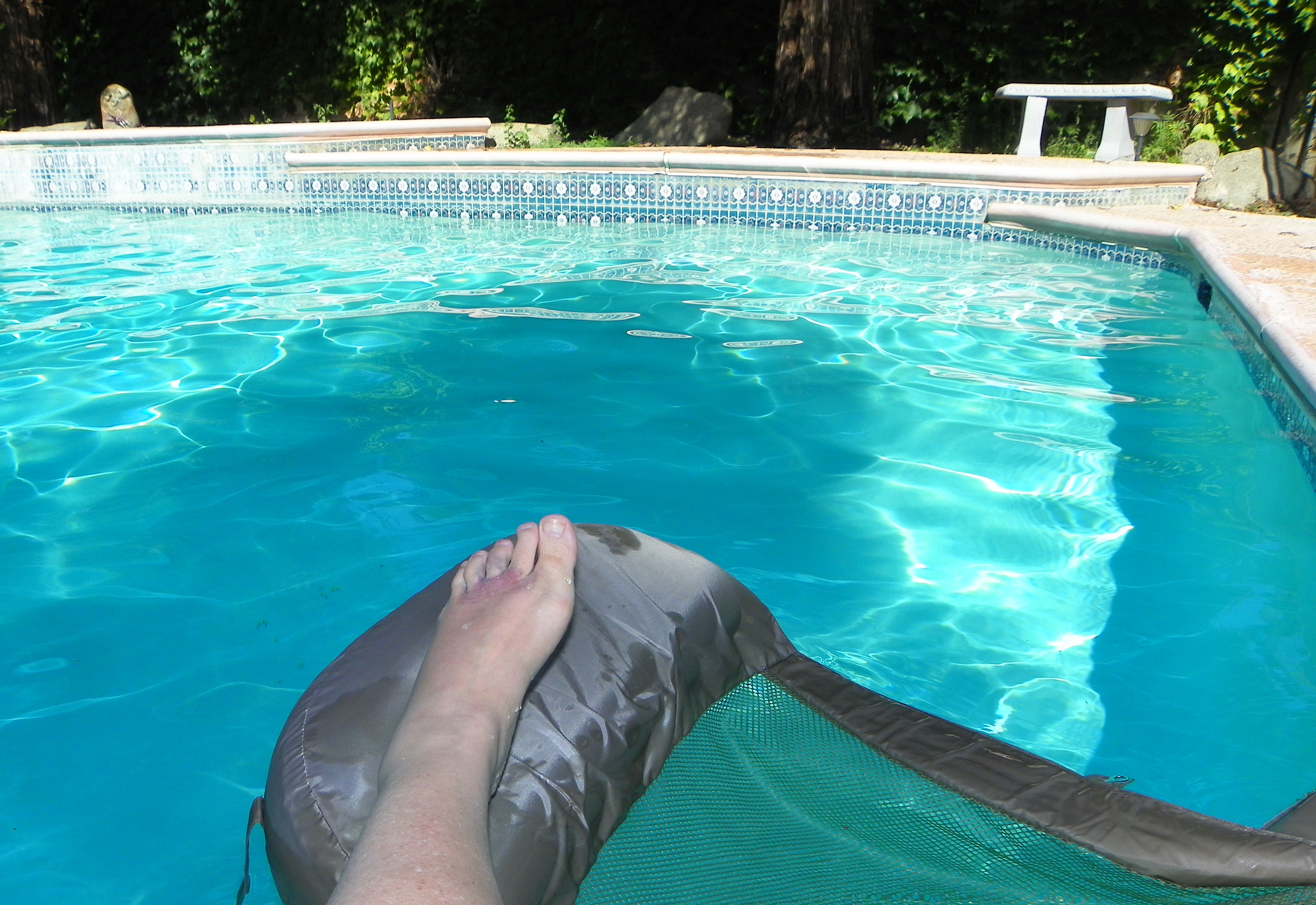

Beach bum foot

Now that I’m settled into week three of Saga of Broken Foot, I am day by day making little adjustments to my routine and to how I view life in general. I suppose that I may very well by the end of this come up with a lovely post on How I Grew From This Experience or How This Made Me a Better (Gentler, More Patient? etc.) Person. I hope that if I do choose to do that, it won’t be filled with cliches, Pablum and/or platitudes; I would like to spare you all that tedium.

At any rate, right now I can say that this Experience might be reminding me that I truly need to learn how to Let Go and stop trying to Control Everything. Being off my foot and unable to do all I normally do, combined with the other lovely Learning Experience this year of having a whole lot of medium-sized and a couple of really big expenses hit me one after the other (jab! uppercut! jab jab jab!) should theoretically help me to be able to Let Go of my control issues. I dunno. I guess we’ll see how that actually goes.

In the meantime, I’ve learned to relax a little and at least enjoy my backyard pool. Those who know me will already be familiar with my general frustration with having said pool, mainly because it takes maintenance, which we tried to do ourselves for a couple of years and ended up just failing miserably at (and had to cave and hire a Pool Guy; I have a pool guy???!), and because it costs money just for general operating costs every single day of the year, even in the many months that we can’t use it. Thanks also to the shade we have in our backyard on the pool for a good chunk of the day every day, the water is generally pretty cool, so we really can only swim in there during the day (too cold even to skinny-dip at night. Drat!!!) during about three months of the year. So I spend maybe $2500 a year for three months of swim time. That just chaps my hide. But there it is. There is a pool, and we can’t let it go green or just empty it. Ah well.

SO. We have a pool. I’m not a big fan of swimming (irony, I know). I distinctly remember being about 9 or 10 and having a perfectly nice instructor at our school system’s pool (located at the high school) try to teach me some basics. I screamed bloody murder and did not learn said basics. Eventually, I learned to tread water and float and get around, but a pool or the beach is just not my first choice of vacation destination. I can take it or leave it.

But these past two weeks, being weighted down by a heavy boot on one foot and two unwieldy crutches, I have come to appreciate the utter freedom and bliss of letting the water carry me gently in its embrace. I can take off my boot and slip into the pool and either float like a water bug on the surface, light as air, or paddle around languidly under the water, letting it do most of the work. I love how gravity seems to just take the day off for me then. No longer am I tethered to the ground; I can snip myself free and glide and gently kick.

It’s been delightful. I’ve gone outside every day with my girls for about an hour and basked in the warm sun and the brief but amazing feeling of weightlessness. I have become a beach (well, pool) bum. I think I’m actually going to be sad to see the season end, which will be a new one for me in the three summers we’ve lived in this house.

So I might not have learned a whole lot of big Life Lessons yet. Whether I do or not, I’ve learned just a little bit to relax and let go of my body and my worries for maybe an hour every day. That’s good enough for me.

I’m no superwoman

I always have a mixture of feelings and reactions when someone else refers to me as a superwoman or supermom. First, to be honest, I’m a bit pleased. I mean, who wouldn’t be when called super? It’s a compliment. It’s an affirmation that all that I try to do for myself and my family is recognized and appreciated. And in a tough, unrelentingly demanding job like mothering, there’s just never enough appreciation along the way.

Plus, I’m a bit of an overachiever. I won most of the academic awards I could possibly win throughout my school years and was valedictorian. I had my academic career pretty well mapped out, and I got the full-tuition scholarship I wanted to the university I’d wanted to attend for practically my whole life. I even got the best internship in my field that I could get. I got a job out of college. I suppose it wouldn’t be wrong to say I had been accustomed to being rewarded and recognized for the hard work I did for a long time.

That is, until I got married and started having children. I decided to be a stay-at-home mom, and I haven’t worked outside the home full time for about 17 years. The overachiever part of me has been starved. The accolades have shriveled up, and I have found myself seeking some kind of positive feedback for what I’ve been doing, which has been much more difficult than any academic work I ever decided to undertake.

So, yeah, my starving little inner overachiever has gobbled up any little morsel of recognition, any kind comments. So if someone says I’m a superwoman, I enjoy it a bit.

But I have to admit that it comes with a price. First, I have to have a week like this: sew four items of clothing, fix homemade breakfasts and dinners for my family, wash seven loads of laundry, shop, help my husband lay tile in the master bathroom, get my high schooler signed up for an online summer class so she can take art in the fall (since she’s unbelievably talented at it), make phone calls for the band booster club (since I’m secretary), play piano at church, tell the newspaper daily editor about a great photo opportunity at our church’s area youth activity (since I volunteer in public affairs), plan for a family vacation, plan a new-student gathering for my university’s local alumni chapter (since I’m the chair of the chapter), get the paperwork together to refinance our house (since I’m the family financial planner), do some editing work, and keep my book review website and blog updated.

Pant, pant. Whew!

Yep, my superwoman status takes its toll. First, I’m exhausted and sometimes at the end of my rope. Second, I end up losing a grip on a few things, such as my memory. (What was I writing about?…) The worst thing, I think, that I’ve lost hold of these past 9 months or so is my health. I love to exercise, and I go to the gym every day. But I also like to bake, and eat. Unfortunately, when I’m stressed (super-stressed, shall we say?), I tend to eat. And eat. Not carrots or celery, of course, but junk food. Ice cream, cookies, cake. The problem that has now developed is that I’ve gained about 30 pounds in the past year, pounds I worked hard to take off a few years ago after another year of super-super-stress. I no longer can wear the cute size-8 dresses that have been exiled to boxes at the top of my closet; I wear size-16 pants and size-14 dresses. It’s super-depressing.

Those are kind of obvious things. Another side effect of being a superwoman that I and others don’t often think about is that people expect it from me. They expect me to continue doing the things I already do — AND they expect I can just add in MORE things! If I can do all this, I can apparently just do more and more and more, ad infinitum. I come across as endlessly capable and a bottomless pit of energy and ability. The problem with this, obviously, is that I am NOT endlessly capable, and my energies are most definitely limited. Others don’t see the price that comes from my superwomanhood, but I do. My family does. What I want when I get this ridiculously busy and overwhelmed is for others to stop asking me to do things. But what happens instead is that others CONTINUE to ask me to do MORE. Logically, it makes no sense in a way to ask people who are really busy to do more.

What I’d like to do right now, in the middle of a superhuman year, is to retire like Superman did in the second movie. He fell in love with Lois Lane, she knew who he really was and loved him back, and he decided to forgo his superpowers and become a regular man and be with her. Most of you will probably know how that ended up. But I certainly understand what he was looking for, a little peace and quiet and a normal life. I can’t relinquish my powers or my responsibilities, nor would I want to. But I would like for the requests to stop coming in for a while. I’d like some genuine and heartfelt affirmation of what I’ve done and a pass on doing more for a bit, until I catch my breath and catch up on my to-do lists and am able to take care of myself a bit (like lose 30 or 40 pounds for my health’s sake).

No, I’m no superwoman. I have a super family and super friends, though, and my life is mostly super. But I really am going to try to lay aside the cape for a while and enjoy what I have.

The gift that keeps on not giving

So I wrote yesterday about how I’ve been overwhelmed by all the huge obligations and responsibilities of mothering four growing girls. I’ve been feeling low on the coping scale for a few weeks, so by the time my birthday hit the other day, I wasn’t steadied by very many more reserves of patience or understanding.

I knew my “special day” would be crazy, so I expected that. What I also knew, after 19 years of experience, is that my husband is nearly completely unable to surprise me with anything, including gifts. I have to tell him ahead of time for any kind of occasion what I would like. Either he goes out and gets it and wraps it for me to unwrap and exclaim, “Oh, that’s great! I love it!” or we sit down to order it online together (he’ll click the “order” button so it’s from him), or we’ll go out shopping together after the fact.

I’ve largely grown accustomed to this setup, and I do appreciate that 1) I am difficult to buy for because my mood is always changing and 2) not everyone is a great gift-giver. I like to think I’m pretty good at selecting presents for others. I mostly really enjoy it, in fact. It’s so fun to always keep my eyes peeled for little ideas that come up in the course of conversations and then seeing something in a store or online that just matches up. It’s then so fun to see how the person reacts to what I found. I really love it. But no, not everyone can do that very well.

So my dear hubby really tried to come up with some fun things for me on my birthday (the other big problem for him at this time of year is that my birthday and Mother’s Day are always very close together: two big occasions to honor me right in a row, or even on the same day). He came up with a couple of ideas, one of which was one we’ve already done a few times, and which I do enjoy, but in this case, I wasn’t really in the mood and wanted something different. The second ended up being ridiculously expensive, therefore, out of the question. The upshot: on my birthday, as I was racing around doing mommy stuff and wearing myself out, I ended up with not a single present to open.


This drawing and the new header for the site are actually gifts from my oldest daughter. She’s my amazing, in-house talented artist.


It was not a pretty combination. In fact, that snafu ended up being the match that lit the powder keg. I won’t go into detail on my reactions.

What I keep trying to tell my husband is that I really like gifts. I was informed a couple of years ago about the Five Love Languages, and what I really appreciate are Words of Affirmation and Receiving Gifts. Like the website says, gifts are not about getting “stuff” or anything fancy or expensive; it’s about what goes into it. I love just little tokens that say something meaningful, or even semi-meaningful. I want to be thought about and have that thought go into that kind of action. My husband and I have discussed the love languages a few times since our introduction to them, and he knows exactly what I really like. Has he succeeded in learning and applying that knowledge? Not so much. (Let me even quote from the site: “A missed birthday, anniversary, or a hasty, thoughtless gift would be disastrous — so would the absence of everyday gestures.” Ha! See?!)

My mom says that most men are terrible at gift-giving and that I should just accept that my husband, as great as he is in so many ways, will never be able to surprise me or give me good gifts. I wonder if that’s true. If it is, then why would the people behind the love languages encourage couples to do better at speaking their spouses’ languages? It would be a lost cause. I still have hope it’s possible to change or at least improve a little.

I’d like to simply say, no, I’m not selfish or self-centered; I don’t think I have high expectations. I just want a simple but fairly meaningful gift on special occasions and just cute, sweet little tokens to surprise me throughout the rest of the year. I think I’m worth it. In fact, I need those expressions of love and appreciation to feed me, to fill up my tank so I can keep going, keep super-mothering. I simply can’t run on emotionally empty.

What say you? Are gifts important to you or someone you care about?

Medications and me

Having a mental-health concern (that seems most likely now to be a bipolar disorder) for the past 25 years or so has naturally led to my being on various medications to try to improve my quality of life. I’ve already discussed a bit how it’s been a challenge to figure out exactly what I’ve been up against over the years (just some depression? anxiety? postpartum depression or PMS? bipolar disorder? nothing at all?), so I’ll try to go back and address what kinds of medications my doctors and I have tried to use to help me feel a bit more “normal,” or, more accurately, just better able to cope with the usual stresses and strains of life.

The first I ever took some kind of an antidepressant was toward the end of my LDS mission when I was feeling serious stress. The resident older missionary/retired doctor prescribed me a medication that would supposedly help with that. At this point, I honestly don’t remember what it was he gave me. What I do remember is that I was in pretty bad emotional shape and just going about my regular busy schedule just with a new medication didn’t help me feel any better. Besides, it usually takes a few weeks for those kinds of medications to even start making a difference, and in the meantime, I just kept feeling stressed — and guilty or bad about being stressed while I was supposed to be happy and spiritual and serving God and my fellow beings. It just wasn’t a good recipe for success as a missionary or a happy human being. So I ended up having to leave the mission behind and go home to seek help in a different environment (already talked about how that went).

I was next put on lithium when hospital doctors decided I was bipolar. I took that for a bit less than a year, I think. I felt better as time went on, mostly, but I also went back to college, where I felt more at ease and myself and had my friends around me. I am sure that the medicine must have helped though, looking back, because otherwise I probably still would have been seriously depressed/angry/stressed. But the change of environment did contribute, and after a time, I just felt that 1) the diagnosis of bipolar disorder couldn’t really fit me because I didn’t fit the “classic” signs of the “full-fledged” disorder and 2) lithium is a serious drug to be on: it can potentially damage the liver. I was having my blood tested every few months to make sure my liver was fine, but it was still a real concern. So I went off the lithium. During all this I was seeing a counselor at school, so I didn’t do all this just on my own without any professional support, but I don’t know if I had a psychiatrist on my “team” at that time.

After I married and moved to California with my husband, I know I ended up seeing a psychiatrist regularly, but I cannot remember if she had me on any medication. I know I didn’t go back on lithium. She might have put me on some kind of antidepressant, if anything, but I don’t remember for sure, and I have no idea what it was if I did take something. I do know that the first year of my marriage was very rough for me emotionally, and I prefer not to think about the way I acted. It’s too embarrassing. Luckily, my husband stuck it out with me. I also know that I was on hormonal birth control pills for the first two years of our marriage, and I am convinced that fiddling with the sensitive balance of my hormones was not a good thing for me emotionally.

I know that there were months and years I didn’t take any kind of psychiatric medicine, and there were other months and years that I did. It was always some kind of antidepressant. I took Zoloft and Wellbutrin at a few different times off and on after and between pregnancies. I took them together for a year or so, mainly because Zoloft did take away my sexual response. That’s something that’s a warning when you take that and various other medications, such as Prozac, and it’s definitely true for me. It can seem like a small price to pay, but it’s actually a pretty big sacrifice when it comes to a full intimate life with your spouse, so it bothered me greatly. Taking the Wellbutrin with the Zoloft took that side effect away.

After probably my third pregnancy, my gynecologist prescribed me a new medication, Lexapro. He said it worked well and had no significant (definitely not sexual) known side effects. I was eager to sign up. The morning after I first started taking it, I got out of bed in the morning to use the bathroom and then ended up passing out on my way back to bed. I was so scared about the weird feeling I had during that few moments that I told my husband to call 911. The paramedics came out and pronounced me fine. They said I’d most likely rubbed the back of my neck or something and had some kind of vagal episode. OK. Fine. Unfortunately, over the next 5 or 6 days that I took the Lexapro, I still felt weirdly faint and out-of-body-ish, and I figured the only thing that had changed in my life was that new medication. I visited with my general doctor, who told me that was ridiculous. But I decided it was the cause, and I stopped that Lexapro. I instantly felt better, well, fainting-wise. (The lesson here: even if your doctor says you’re being ridiculous, you still should trust your instincts.) So I went back to Zoloft or something similar, I think.

I started going to a psychiatrist again, which I hadn’t done for quite some time, just getting antidepressants from my gynecologists or general physicians, although I had still gone to see counselors for talk therapy more regularly. The psychiatrist I saw at that point, probably in 2007 or so, put me on Effexor eventually, which worked well for me for a while. He did suggest I might be experiencing bipolar disorder and might benefit not from lithium, but Lamictal (lamotrigine). He even gave me a sample pack. Even though I did consider that option, I told him that since I was feeling pretty good taking the Effexor, it seemed silly to stop taking something that was working just to try something else. He thought that was reasonable and kept me on the Effexor.

Then in 2008, my family and I moved to California from a long stint in Alabama, and life became unbelievably stressful. I’d also been taking the Effexor for probably a year or maybe a little less. At any rate, I’d probably only done well on an antidepressant for a year or so at any time I’d taken one, either because after a while, my life had settled down and I’d gone off a medication and been fine, or the medication had seemed to stop working. In this case, I just kept taking the Effexor, but my new general physician upped my dose. Shortly before another momentous, life-changing event for me, the death of my beloved dad, I started trolling the Internet and found the site I’ve mentioned already by Dr. Jim Phelps, which made me start to seriously consider the possibility that I really did have a bipolar disorder. But this psychiatrist was making the point that there was a wide spectrum of bipolar disorders, not just the “biggie” in which people stay up without sleep for a few days at a time, go on wild shopping sprees and spend tons of money, and do otherwise really foolish things they wouldn’t otherwise do. So I found a psychiatrist in my new town who was on my insurance list and made an appointment. He put me on Lamictal, which my previous physician had suggested a couple of years before. It did seem to slowly make a difference, and I was happy to be off the Effexor, although it did take a solid two or more months to very slowly wean off of that very addictive medication. (If I didn’t get a dose, I’d start feeling kind of headachy and light-headed, in a distinctively Effexor-less way.)

So I think the Lamictal gave me some relief and some hope that I was on the right track, but a couple of months into that, my dad died and sent me spinning. My psychiatrist asked me at the first appointment after Dad’s death (merely two or three weeks afterward, mind you), “So, how are you feeling?” Uh. BAD. My dad died. I’m miserable. Hard to say how the medication is working. I’d feel rotten no matter what. And that’s how it went.

A few months after that, I mentioned to some people in my church congregation that I was struggling with mental illness, and a few recommended I try a different option, a natural formulation called EMPower that was sold by a company called Truehope. The company says that the formulation contains micronutrients that are found to correct the imbalances found in those with bipolar disorder and other mental issues. I have always felt that ideally, it would be nicest to treat the actual cause of a problem rather than just the symptoms, if at all possible. This sounded like a very reasonable option, and Truehope has actually been doing scientific studies showing the benefits of EMPower.

I felt that I needed to at least give this option a shot. If I didn’t, I would never know if it could have helped me or not. So I went in to my psychiatrist, who naturally told me he didn’t agree with my decision and that he couldn’t continue to see me if I went off my prescription and took EMPower instead. I knew he’d say that, and I was ready to say, “OK. I won’t be back.” He said he knew I’d be back in a few months in even worse condition.

I tried the supplement, which is actually pretty expensive (probably about $100 a month, and not covered by insurance, of course), for about six months. I felt at first it really did help, but after a few months, I was just not feeling good enough. I tried a few adjustments and options after some phone calls with the company’s support techs, but I finally had to make the decision to end my own personal “drug trial.” I am sure that the supplement truly does help lots of people, but as with anything, nothing helps everyone. I did struggle, however, with what to do next. I firmly did not want to go back to my previous psychiatrist. He was too abrasive, and I felt I couldn’t work comfortably with him to find the best options to treat me. I finally decided to go see a nurse practitioner working in psychiatry 45 minutes away from my town because my therapist had heard good things about her from several other clients. I felt that it was going to be best for my mental health process to work with a psychiatrist who I felt comfortable with, that we were really a team, that she would be supportive. So I made the appointment. This new person, who I still see almost 2 years later, turned out to be a really good fit personality-wise, which I think makes a big difference in getting the best care possible. The only drawback is that my insurance doesn’t cover her, so I have had to pay entirely out of pocket. Luckily, I have had the spare funds to be able to pay for the visits, and it has been a good choice for me.

I’ll just call my nurse practitioner by her first name for ease of writing. Susan really went into a lot of detail with me, talking to me about the options and what she thought might work to help me, even explaining why she felt that way. I personally have really liked her approach. I like to feel that we’re on the same page, and knowing her reasoning helps me to feel more confident that is happening. We tried probably four or five different medications over the course of probably four to six months, during which time I’d go back every month to see her and check in. We tried Abilify, Prozac, and maybe Celexa. I can’t remember exactly. I did notice Prozac didn’t make me feel any better, and it just made me feel completely dead sexually, which was super-frustrating for me. So that was a no-go. I also know the Abilify didn’t do it on its own, and it actually made me feel, rather than “more normal” or “more like myself,” just kind of numb emotionally. I wasn’t stressed, kind of, but I was just dead. I didn’t feel anything. I felt like a zombie. I absolutely did not like that. She ended up adding in Cymbalta, which felt pretty helpful. Eventually, we took out the Abilify to see if that would help me feel less numb. And it did work. The Cymbalta, at the time, on its own, was a good fit for me. I’ve now been on that for perhaps 18 months.

Unfortunately, I’m afraid that now we’re getting to a point we need to tweak again. I’ve been on just antidepressants before, and I’ve either just gone off them or they’ve stopped working, and I fear this is happening now. I’m just feeling unhinged. The stresses and huge demands on my time are taking a huge toll on me, and I’m not proving up to the challenge of dealing with them in an appropriate manner. I’m coming up in a few weeks on another check-in with Susan, and I think this time we’ll have to address now how to change my dose or try something else. It’s been nice, though, for the past year, feeling pretty good and “myself.” Descending back into my “crash” mode is a scary and upsetting thing, for me and my family, and it’s nerve-wracking for me to ponder how much trial-and-error it’s going to take to get me back to happy. Will it take a couple different medications again and weird feelings of numbness or just not-effectiveness (so I’ll just feel unable to cope for a few more months? Yikes!)? My main fear is looking ahead at a few months of not being myself, far from it, especially with summer months coming on and my kids being out of school and all the stresses that places on me every summer. It scares me.

So that’s where I am, medication-wise. I’ve been a bit of a guinea pig for the past 20 years. It’s difficult because treating any kind of illness can be tricky and require some finesse. The basic stuff is kind of straightforward (infection? take an antibiotic; cold? take some antihistamines and Sudafed and wait it out), but other health issues take some trial and error. Then when it’s mental health, which is still a kind of slippery creature in the early 21st century, and every person’s needs and body chemistry is unique, it’s a science that’s more art than anything else. Being the doctor is probably a challenge, but being the patient is truly difficult. Being that guinea pig, the one on different kinds of medicines, is tricky and frustrating as all get-out. I’ve said for ages I wish there were a control group for me. But there isn’t. Good science requires a control group and an experimental group, and in this case, giving just me a medication and seeing what happens isn’t truly good science. And the onus is still on me as the patient to make the judgment calls, to figure out what’s changed, what to tell my health-care provider, about what might be significant. Do I feel better taking Lamictal even though my dad just died? Can I possibly separate out the effects of that from my normal stress reactions? Can I say I feel better on something even though a bunch of stuff has been happening in my life? If I could put myself in a quiet room without any interference from outside sources, I could judge better. But that’s never possible. (And if I could be by myself in a quiet place — resort, maybe? that would be amazing — I may very well be able to get to feeling better without the medication. Maybe. At least I wouldn’t be bothering anyone else.)

This post is incredibly long; perhaps I should have separated it into a few parts. But it’s the best answer to those who would like to know what my experience is with medications. I hope it might be of some use to those of you who struggle with similar problems and need to figure out how to look at your own situations with more clarity. Perhaps it will just make some of you more sympathetic with those in your lives who have challenges similar to mine. Or maybe those who know me but don’t know all these details about me will feel more empathetic with me. Either way, I hope this is of use to someone out there. This is an ongoing story, so I will need to update as the next few months come along and I visit my nurse again.

Perfect to a T

A visitor the other day asked me, “So, are you a perfectionist?” Ha! I had to chuckle. It’s like asking me if I like chocolate. Or ice cream. Or books.

Uh, yeah. I’m a perfectionist. I’d like to call myself a “recovering perfectionist,” but that would be implying I’d actually improved a bit and stopped some of my perfectionistic ways. Nah, I’m firmly off the wagon.

This moniker is accurate despite the fact that my friend came into my house while I was in the middle of vacuuming my dining room. The chairs were arranged haphazardly along the edge of the living room carpet, and I was wearing a ratty old T-shirt and sweats. My hair was up in a clip and I was, as is typical for a weekday, without any makeup. Luckily, and unusually for a weekday inside my home, I was wearing a bra, and this is only because there were men in my house installing some new windows. My four-year-old was running around doing whatever while I vacuumed, which was the precursor to mopping (which only happens about once a month around here, though I’d like it to be once a week). With the men stomping around upstairs and creating some background noise, plus occupying my driveway with their big truck, my home was the site of some serious action, and I was a little sweaty and rattled. My main goal was to get the house clean and put the preschooler in her room for some quiet time so I could sit down and rediscover my equilibrium.

Mostly, I wouldn’t point to these markers as signs of perfectionism. Perfectionists’ homes are just naturally clean, with outsiders never seeing the behind-the-scenes action (like the best of magic tricks, everything looks amazing with some sleight of hand); female perfectionists always are stylishly dressed with neat coifs and impeccable makeup; their children do not run wild. But I know the truth: cleaning my home is a must because I am a perfectionist. I like clean floors and surfaces. I like them to stay clean. Since people (children and husband included) live here, they do NOT stay clean. I am perpetually frustrated.

I can’t explain away the lack of makeup, the hair always in a clip on the top of my head, or the fact that I ALWAYS wear sweats and old T-shirts at home (or, if I leave the house,  blue jeans and T-shirts without holes). Perhaps that’s the one category in which I just let myself slide because even I have realized I can’t do it all. (Unfortunately, I have yet to realize I can’t even do half of it all, but I keep on trying.)

And people do see me sweat because I go to the gym every day. And I certainly do not wear makeup or have my hair fixed there (although in that case it’s in a ponytail rather than a clip).

But I can’t point to these habits and say, “See? I’m NOT a perfectionist.”

A whole list of qualities and habits shouts loudly that I most certainly AM (this is only a sampling, mind you):

  • I can’t stand having unfinished projects lying around. When I sew, for example, which is maybe once a year, I just get it all done in two days. I may sew four dresses at once, but I will sit at the sewing machine almost nonstop until they are done and I can put away all my materials and the machine back into their appropriate “homes,” out of sight.
  • Look at what I do for a living: copy editing. Can one be more perfectionist than that? The goal is to have an article or manuscript with NO ERRORS. No misspellings, no grammatical blunders, no style mistakes, no factual goofs, no libel. It kills me to look back on a story I’ve edited that still contains an error that I MISSED. That fault on my part will haunt me for days.
  • I’ve already written about my body issues and will continue to do so. Let’s just observe that my glaring imperfections (hello? 40, possibly 50, excess pounds?) do not slip by my eagle eyes. But in the interest of full honesty, I will say that I’m generally content with my hair and my face. I think I have a pretty face with some very fine features (always got compliments on my eyes and smile) and good hair that rarely gives me problems, unless it’s in dire need of washing.

The thing is, I’ve always been like this. My mom says I was born this way. I believe her. My family dynamics and circumstances tended to reinforce that tendency, but it was always there. My first two children didn’t inherit the trait, but my third has. I sympathize with her. She’s always going to excel in school and activities, but she’ll feel tormented when she doesn’t do as well as she’d hoped (it already happens, even with pictures she draws).

No, I’ll never be labeled “laid-back” or “easygoing.” But people like for me to be in charge. I get things done — and well. But it comes with a price. I’m not the friend you want to take to the beach. I won’t sit there quietly and companionably for five days running, the sand tickling my toes and the sun kissing my skin, thinking only about wispy clouds and bright blue skies. I can only sit and do nothing for about two hours. After that, I’ll be grabbing your hand and leading you on a tour somewhere, or hooking up to the Internet to write or edit or search for useful information. No, I’m not a relaxed gal most of the time. Mostly, I’ve come to be OK with that. And I’ll insist on that until stress makes my cortisol hit freakish levels and I have a heart attack. But when I’m gone, you’ll look back on my body of work and say, Look how much she got done. Wow, those articles are completely error-free. She was amazing.

Latest discoveries

It’s going to take a whole lot of posts to cover my life and experiences in this department. So I started at the beginning, but I’ve been jumping around since that first post. I’m going to try to explain a bit where I am now.

We moved to California in late summer of 2008 from Alabama, where we had lived in one town for 10 years. We were pretty well settled there, even though we hadn’t expected to stay there for so long. But our children’s needs, primarily, induced us to move cross-country. Though I had some time to plan and prepare for the move, the whole thing didn’t go nearly as smoothly as I would have liked. It took ages to get into a house of our own, during which time we lived with family and had all of our possessions in a storage unit. Then we waited and waited for our house in Alabama to sell, and after a year of waiting and one very low offer that fell through, we decided to rent it out. The stress of all those things, combined with the financial stress of paying two mortgages for a year, made life very difficult. I just felt depressed and frustrated and irritable pretty much all the time.

I had been seeing a psychiatrist in Alabama for a year or two, during which time he’d put me on an antidepressant that seemed to help fairly well. But with the move, it just wasn’t doing enough. So I started surfing the Web one morning and found a site that turned out to be very useful. It’s just a very simple-looking site by a psychiatrist who has shared many of his insights online. He also wrote a book called Why Am I Still Depressed? I pored over the site and then ordered the book. I decided that it was time to see a psychiatrist in my new town, rather than having my general doctor keep writing scripts for the old antidepressant.

The site had really struck a chord with me; its information led me to believe I was experiencing what this doctor (James Phelps) describes as bipolar II. Armed with this bit of information, I found one of the two psychiatrists in town that my health insurance covered and made an appointment. My new doctor and I talked, I shared my opinions, and he prescribed a new medication; he called my condition “atypical bipolar disorder,” but it’s just a slightly different name for what Dr. Phelps called bipolar II. The new medication seemed to work fine, and just knowing I had new information and a new medication gave me hope.

Three years later, this is still the diagnosis I’m working with. I’ve tried some different meds and a different doctor (I’ll write other posts on those topics), but we’re still going with that. Honestly, though, I still wonder how many other factors are at play. Dr. Phelps’ website talks about how thyroid disorders are sometimes tied in with bipolar II, and since I’ve been hypothyroid for about 12 years now (well, that’s when my doctor and I discovered it), I can’t help but think it may play a part in what I experience, even though I have been on thyroid replacement medication for all that time and it’s supposedly controlled (according to blood tests that my current doctor administers every year: and THAT, again, is a whole other topic). I also have noticed that I feel particular sensitivity to hormonal fluctuations, during pregnancy and postpartum and my monthly cycles, and those must be factors as well. I’m fascinated by how things work, and the complex interplay of hormones in the body is so interesting to me (I even wrote a paper about hormones for a research project in English in high school before I knew how personal it was). So I would love to figure out exactly how all these things work together to create my particular issues. Doctors, however, basically don’t seem to care about this (How could they not? Do they not have any curiosity?), at least when it comes to treating me. They just want to know that they’re finding a good medicine to treat me, and that’s all that matters. They have a point, I suppose, but I’d just love to know how all this works inside me. As far as we’ve come in being able to treat mood disorders, it still feels like we’re kind of living in the 19th century treatment-wise compared to all the other feats of medicine that exist.

So I could say now, “Well, this is it. I’m almost 42, and I’ve finally figured out what’s going on with me.” But even though I feel fairly confident that I’m on the right path — and it’s a big relief, I must say — I still wonder if in 10 years my diagnosis might change and I’ll look back and say, “Gee, we were close but not quite there.” At any rate, this is the best we have right now, and we’re going with it. It’s something, and something is better than nothing. I suppose, when it comes down to it, this is really just an extension of my previous post, “What’s in a name?”, because we have a name but that name could very well change. It’s just nice to have a name; it helps me to wrap my mind around what I experience, it helps me on occasion to explain to others if I feel so inclined, and now it might help you.

Balancing act, part one of many

It’s pretty common for women to talk about the tricky proposition of balancing the many elements of their lives. In fact, I know few women who don’t worry about getting a proper balance, let alone maintaining it. But having mental health issues just makes that balancing act that much more difficult. I can say from years of experience that it’s a razor-thin line; right on one side I might feel a little overwhelmed but still OK; on the other side, I’m far past overwhelmed: I’m stressed, I’m drowning, I’m angry and lashing out at whoever comes too close. The latter is not a pretty picture, and I don’t like thinking about the times I’ve been pushed too far on that side of the line.

What my psychiatrists and I are currently calling bipolar II or atypical bipolar disorder causes me to experience a kind of hopeless feeling in which I rarely feel that kind of depression that makes me not want to get out of bed. It’s more of an angry depression. I feel isolated, alone, abandoned by all who should love me and somehow care and know me well enough to be able to see what’s happening and help. When I feel that way, in the very extreme times, I feel that life won’t possibly get better, that I can’t take the psychological pressure that seems to be pressing in on every side of me. I just feel angry at everyone who could possibly be blamed, including God. When the anger kind of dies out, I feel depleted and in despair. So I “swing” back and forth between a sad, hopeless depression and an angry depression, if that makes any sense. I’ll try to explain further in later posts. Suffice it to say, yes, I am a type-A personality, but I’m also typically a fairly cheery, happy person who always has a smile on my face. So when I get backed into these corners where I feel trapped and angry, the rage that almost flares up out of nowhere feels so at odds with who I feel I AM that it upsets me even further.

That brief introduction to my moods is just to somehow try to explain that I can quickly get out of balance. After years of this kind of yo-yo-ing, I can feel when I’m getting close to the brink, and I start feeling desperate. I know I need some down time, alone time, unwinding time to try to swing myself back to a more stable self. The problem is when I feel I don’t have the choice to just say no to activities or pressures or expectations from others.

Some people are more sensitive about this than others. Again, finding balance is always a delicate proposition, and many people understand this for themselves and that it’s the same situation for others. Some are just more empathetic about others’ needs as they bump into their own needs. I admit I get a little irritable when I say, “Well, I can only do ___ because I am pretty busy.” In my mind, that’s me being responsible enough to know my limits and exercise my personal choice to lay down those limits and work around them. When someone else responds, “Well, yes, sure, but we’re ALL busy,” I know they’re not really going to be too respectful of whatever line I’m going to draw for myself. Or they may say, “Yes, well, but (____ organization) really NEEDS you.” Sure, every organization that relies on volunteer help of any kind always needs help and never has enough. But I cannot possibly do enough to fill in those gaps, for that group or any other. Or I might just say flat-out, “No, I simply don’t have the time and energy to do that right now,” and rather than saying, “Oh, of course, don’t worry about it. We’d love your help, but we understand that” they keep pressing on in some way. These responses essentially tell me that these people value their needs above mine. And sure, we tend to be selfish beings and that’s natural. But I certainly appreciate it when someone else rises above those human tendencies and tells me, “That’s fine. You do what you need to do.” I so greatly value when they have the kindness to respect my choice, my right to make decisions for my own life and that of my family.

You see, I know what my limits are, and I’m constantly doing the balancing act. I am a softie at heart, and I want to give my money and time to a whole lot of worthy causes, worthy people. My heart goes out to them. I may even sometimes foolishly say yes or maybe when I should have said no because I’m biting off more than I can chew or even get in my mouth at one time. But when it comes down to it, my mental health must stay intact, so I can be happy, so I can take care of my family (which is paramount in my life above all the other things that matter to me), and so I can in the future continue to give to others. Simply, it rankles me when others don’t respect that I should know best for my own life and my own well-being and continue to push me when I say no. It ticks me off. Big-time. But on the flip side, I feel respected and cared about when someone is kind enough to take me at my word and wish me the best. Perhaps I expect too much out of people, but I would love to see more sensitivity in how people treat each other. There’s just no way of knowing what someone else is going through. I’m being open here on this blog so I can help others understand what I’ve experienced, but I simply can’t go through my whole personal history every time someone demands justification for me saying no. Thank you for being understanding, those of you who have been and continue to be so with me.