Time magazine, moms and sensationalism

I’m beginning to think that most news outlets are forgetting their news roots. I’ve long since given up on watching any kind of TV “news” programs. Those seem to have left behind reporting news and facts, replacing journalism with who-can-shout-louder editorializing. Magazines don’t seem much better. Time magazine has just proved that with its newest sensational cover about attachment parenting, asking “Are you mom enough?”
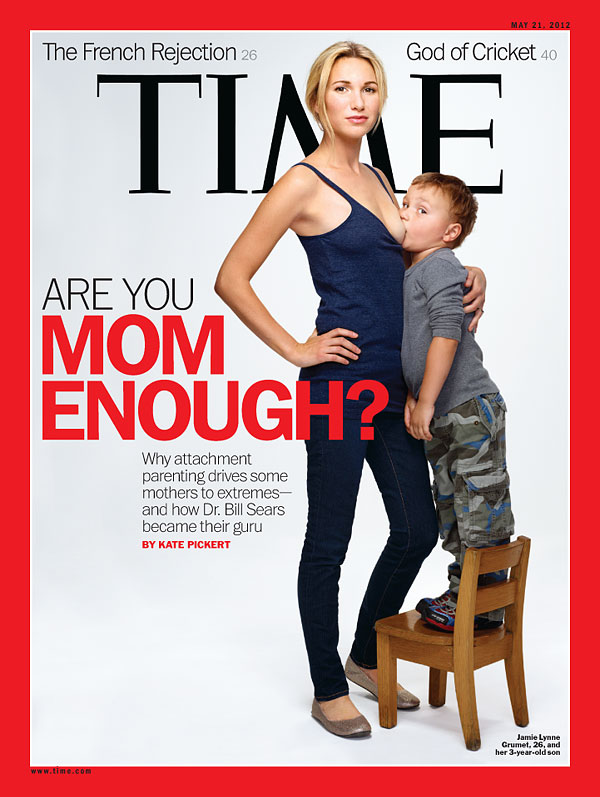
I’m not going to dispute that reporting about the practice of attachment parenting, and some facets of it that seem “extreme” to many parents out there, is a fascinating idea. But I am not happy with the cover, and many people are not, but there are all kinds of reasons that it’s getting attention, mostly negative.

Some are finding the cover to be offensive because it is partially showing a woman’s breast; many find it repulsive because it shows a young boy with his mouth on that woman’s breast. I’ve seen some people calling it “child porn.”

I’ll try to express why the cover bothers me, but first I’ll explain what doesn’t offend me about it. I don’t mind seeing a child suckling on its mother’s breast. I don’t mind seeing that in public, perhaps even in print.

I’d like to express also why it is not “child porn.” Pornography is the explicit portrayal of sexual subject matter. Child pornography is the portrayal of sexual activities involving a child. For this cover to be porn, it would require sexual activity to be occurring. A child breastfeeding is not sexual activity. More on this later.

Now. On to why the cover does bother me. Time has deliberately chosen subjects to portray that will garner attention, and the artist has posed them in a way that will grab viewers. First, I think it’s interesting the magazine chose a very thin mother who looks like she should be a lingerie model to demonstrate breastfeeding in the preschooler years. Even though this is a real mother and child who are still nursing, the mother has been chosen to reflect a sexualized image of a model. Second, the way the photo is posed isn’t what I would guess is the usual way this mother and child (or others) would take some time to nurse. Having the mom standing up, posed like a model in an advertisement, with her son standing on a stool is pretty unusual. Most likely, this mother takes a few minutes at the end of the day to sit or lie down to snuggle with her son to allow him to nurse, and it’s part of some quiet, private, mother-child personal bonding time. And neither would be looking away from each other, especially not at a camera.

What bothers me in addition to how Time has chosen to represent this topic is the reaction that it is guaranteed to cause, a negative one about breastfeeding. Even though the topic is about an “extreme” version of parenting that many of us don’t choose, this photo is essentially painting nursing with the same wide brush, and it’s going to be a setback in the still-needed push forward to make nursing more understood and more accepted in public society. That bugs me.

Having given birth to three children and nursed them all for periods of about 10 months up to about 13, I think, I know what it’s like to be a nursing mom. It’s a challenge because you’re ALWAYS on call, always needed, and this particular duty cannot be handed off to the dad or anyone else who could help. (Let’s leave out the topic of breast pumps right now and keep this simple.) I know the difference, too, because I adopted our last daughter, so we fed her formula, and man, was it nice to be able to let everyone in the family take turns feeding her. I was so free, compared to when I was tethered to the previous three by my milk supply! Add in issues that may come up with nursing — sore breasts, sore nipples, infections, what-have-you — and it’s tough work, on top of all the other things that are hard about mothering a baby or toddler.

At the same time, breastfeeding is pretty cool. I wasn’t the “natural mom” type who always gushed about how great it was to nurse, sometimes just complaining about that constant on-call thing, but I did appreciate the benefits. It was the neatest thing to know that my body was producing exactly what my babies needed, just at the right times. I was happy to make the sacrifice to nurse because I knew it was the absolute healthiest thing I could do for them. And snuggling up with them and having it just be their little soft mouths on my breast was a gift. It was just the two of us, skin to skin, and I treasured (some of) that time. (Sometimes/most of the time I just got it over with because it was feeding time and I had to move on to something else. No, I don’t treasure every single moment of life, parenting or anything.) When I gave birth to my last daughter, I knew that would be the last time I’d breastfeed, and having her latch on that first time in the hospital almost brought tears to my eyes because I knew that it was special, and not too long in the future would be the last time I ever nursed a baby.

I also know just how tough it is to nurse a baby when you’re not at home. I was raised to be modest, and still teach my own children to be modest and not show too much skin, so the idea of the possibility of any of my breast showing even for a split second in public was one that was completely opposite to that notion that was so ingrained in me. Plus, I’d never seen almost anyone out and about just nursing a baby, so doing that myself while out shopping or eating at a restaurant or running any of the myriad of errands most people do in the course of everyday life felt strange. I felt like everyone would be staring at me, no matter how discreet I was. Even in my church, where we have more children than average per woman, and where many of us breastfeed, there’s one small room set aside for nursing and taking care of babies, and I’d never seen anyone nurse a baby outside of that room, even when we were in a meeting that was just women. Thinking about it now, I still think it strange. Why in the world do young mothers surrounded by other women of various ages, most of whom probably did nurse, feel the need to leave a room full of other women to isolate themselves in a tiny room in a corner and miss out on uplifting messages? Modesty? Self-consciousness?

Nope, our society is not at ease with the idea of women nursing their babies where anyone can see. Ask any of us women who have had to try to nurse a baby in a bathroom stall (can you say ick? Would you want to eat your lunch in the bathroom?) because there was nowhere else private to do so if we’d like to see more acceptance of breastfeeding in public, and we’ll respond with a very loud and hearty YES!

I find this all so ironic because our society is so highly sexualized. Women of all ages, teen girls, and even 9-year-olds wear revealing clothing without almost anyone batting an eye anymore. Scanty tank tops are certainly normal, and sleeveless dresses are the standard for any fancy occasion. (Try finding a dress for a nice occasion with sleeves that doesn’t look like a grandma dress. Good luck to ya.) Not only celebrities sport revealing clothes: everyday people wear plunging necklines and show a lot of cleavage and breast skin. Yet women who are feeding their babies the way nature intended, with the healthiest possible food made JUST FOR THEM, are stared at and marginalized if they accidentally show any skin for a split second, or (heaven forbid) show part of their breast at all while nursing (I always preferred to be completely covered, and there are some really handy nursing cover-ups, but what’s wrong with letting a little of the top of a breast show while the baby’s head is covering most of it?).

Breasts have become, in our society, simply an object of sexualization. Women have breasts so they can feed their babies, and, yes, they are alluring and exciting for men. That’s natural as well, and part of the whole important biological process that brings new people into the world and feeds them in the early stages of life. Breasts are really useful for feeding, but they’re also fun for men and women as they come together to feel close to one another and to reproduce. But we have lost sight of the fact of their usefulness, seeing them ONLY as sexual objects. So if we see women with a baby attached to them, because of this cultural pattern today, we think “eww” because we think of them exclusively in sexual contexts.

So Time has not done nursing mothers any favors with this magazine cover. Nope, with the choices it made that I already mentioned, it has shocked viewers and made them feel revulsion. What we need as a society is to do better to educate everyone, male and female, about nursing and the great usefulness of breasts, to encourage women to use them as they need to with their babies wherever they are, and however they feel comfortable nursing. Our society has everything backward, upside-down and inside-out. Let’s help encourage women to be more modest and show less skin on an everyday basis, saving sexual behavior for the privacy of the bedroom. But let’s also encourage women to feel free to use their breasts to feed their babies, even in public, and not force them to stay at home or run for cover (especially not to a bathroom!). Parents can teach their sons and daughters about nursing and how the body works in so many amazing ways, and women who are nursing can show their other children and friends how it’s done. It’s just going to take lots of women being comfortable enough in public to feed their babies so everyone can get more comfortable to the sight of nursing moms and babies.

Time, you let us all down and did a great disservice. Stop sensationalizing and show us how things are really done.
Many thanks to my kitchen doodads

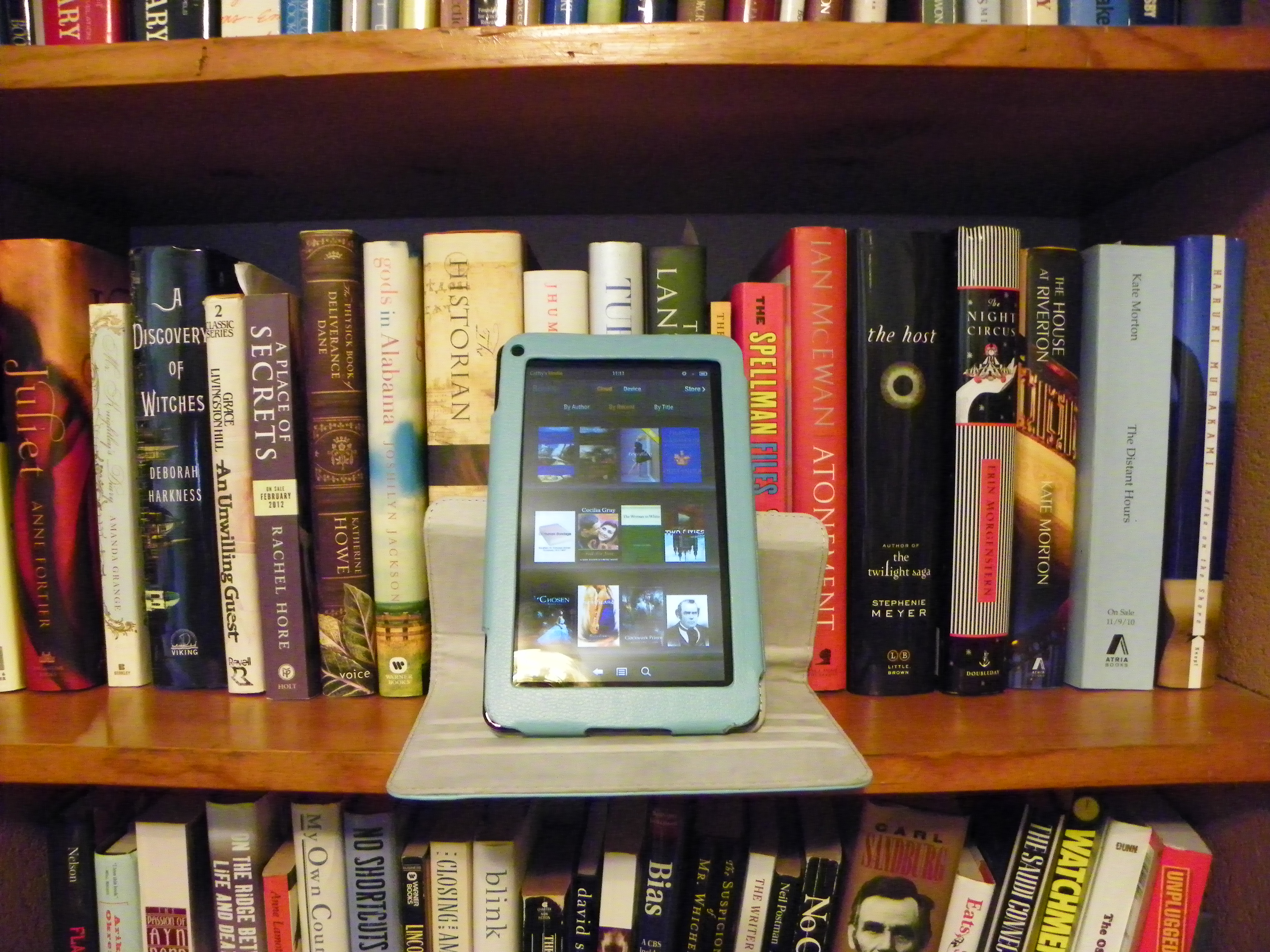
Since I wrote about my Kindle earlier this week, I thought I should follow up with an ode to the other gadgets that get me through each day. I do a few things often and well: I read, I write and edit, and I cook and bake. That leaves me either sitting on a couch or reclining in bed (reading), sweating on an elliptical machine (reading), sitting at the computer (writing and editing), or standing in the kitchen (cooking, cooking, cooking and baking). Add in running errands, shopping, picking up kids and sleeping, and that covers a good deal of my life.

I cook most meals for my family. I like to bake muffins for breakfast or throw some pancakes on the griddle; I usually make up some quesadillas, hot dogs or sandwiches for lunches, and for dinner… well, the possibilities are endless. Thanks to my fairly recently added account on Pinterest, I’ve added on all kinds of new items for dinners. And while still on the topic of my Kindle, it has made it really easy to just take my Pinterest recipes straight in to the kitchen for test purposes, without even having to print anything out. (I always wanted all my recipes in some kind of easily accessible electronic format, and while this isn’t quite that, the Kindle has moved me a step closer to it.)

For dinners, almost any cuisine makes its way to my kitchen. I’m very lucky that my girls are all pretty good about eating almost anything I make (exceptions: none of them like scallops, the youngest doesn’t particularly like asparagus, and they don’t like any kind of ethnic fare to be too spicy), so they have eaten Thai-inspired cuisine, Mexican, Chinese, Japanese, Indian,  Filipino… you name it. Much of what I make involves a fair amount of prep work, mostly chopping and slicing of vegetables. (We go through a lot of onions and garlic, and during the winter — soup and stew season — a lot of carrots and celery too.) I bake bread loaves and make all kinds of bread products, whether they be “quick” or yeast-based.

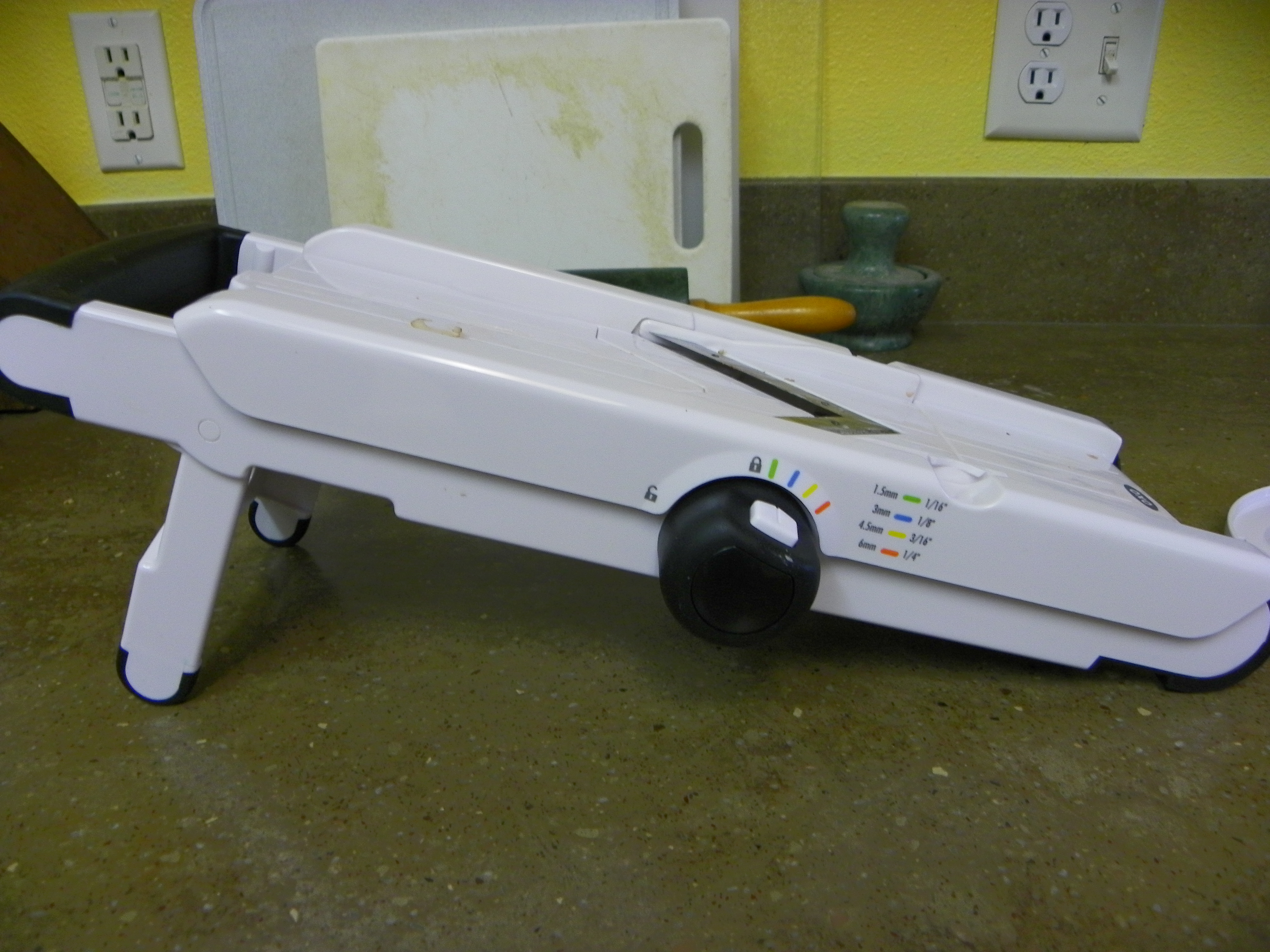
Without the proper tools, the prep work involved in every night’s meals could be overwhelming, potentially leading me to just stop cooking and resort to fast food or mostly prepared food from the supermarket. Since I don’t like those options for the basic reasons of expense and health, I have stocked up on gadgets to make my work easier over the years. This week, for instance, my husband has two occasions to shop for me: Mother’s Day and birthday. I’ve made it a little simpler for him over time by requesting kitchen doodads for gifts. My most recent acquisition was my mandoline (Valentine’s Day: isn’t it romantic?). Sure, I have choppers, and a Cuisinart food processor, but none could slice potatoes or other vegetables nice and thin. So it was time to get a good mandoline.

I did a little looking around at reviews other buyers wrote about mandolines, looking first at Williams-Sonoma, and found that a simple Oxo $40 model was preferred by many of them. That’s amazingly what my husband brought home for me from Bed, Bath and Beyond.

I use it primarily for potatoes. It’s perfect for making gratins and just perfectly thin-sliced potatoes for frying on the stovetop. It’s also great for cutting french fries. In my three months of owning it, that’s been my big use, but I’ve also used it for slicing up a bunch of vegetables for a salad. It supposedly juliennes, but I haven’t had the success I’d like to see in julienning carrots. But most of the time, I don’t do much julienning, just shredding, which leads me to …

My Cuisinart.

I didn’t get this until just a couple of years ago. The main reason for that is I was able to find a very nice mini processor 15 years earlier for only $20 that fit my budget much better than the Cuisinart. That mini processor shredded and chopped pretty nicely, and I was very happy with it. Unfortunately, it finally bit the dust and I went out in search of a replacement. I found this Black & Decker, which had not just the chopping capability (most of the mini processors I found were merely mini choppers) but also shredding capacity. But when I got it home, I found that the shredding setup was lousy and it never worked right.

So I don’t recommend this one. In fact, right now I can’t recommend a particular mini processor that both chops and shreds. I just miss the old one that died after a pretty decent life span of 15 years (which is an eternity in this day and age of electronics). At any rate, I kept it because I think I couldn’t find the box or receipt or something. And it does work very nicely for quick chopping of items like nuts, onions, garlic and celery. In fact, I think it’s much more effective than my big Cuisinart.

So since the mini chopper didn’t work for shredding, and sometimes I just really need to shred large quantities of carrots or cheese, I got the Cuisinart. I’ve enjoyed it quite a bit for those uses, and it’s been nice to finally have a full-size food processor that can puree/blend. It’s been great for a number of uses I just had to do by hand or figure out how to do with some other gadget before I had it. Note: don’t try to chop in the Cuisinart. It simply doesn’t work. When I first got it, I made a nice Mexican layer dip with beans and guacamole and salsa, and I tried to “chop” my garlic and onion in there for the guacamole. What I got was pureed onion, not chopped. And it was far too much for the avocado to handle. It was like onion dip instead of avocado dip. Nasty. But I’ve made some recipes that are based on quinoa or beans instead of wheat (for gluten-free friends or just for a kick), and pureeing the beans or cooked quinoa in there, along with the other items in the recipe, has worked fantastically. It’s made for that. I’ve also used it to puree the plums from our tree to make jam. Perfect.

I also had a little non-electric chopper I use kind of alternately with the electric mini processor. This one’s an Oxo; before I had a model from Pampered Chef. Both work fine. The PC one just broke after a while, and this one, while still working after a couple years, won’t adjust to lock so I can clean it more easily anymore. So it’s a pain to wash.

It is very effective on the same kinds of things: onion, celery, garlic, nuts. Main difference is how it’s set up and that it uses hand power (if you’re feeling aggressive or annoyed, just bang on that a few times and you’ll have gotten out your anger AND chopped your food very finely). It also allows you to chop right on a cutting board rather than having to pick up the items and put them inside of a machine’s bowl.

Now, the workhorse of my kitchen counter is my Kitchen Aid stand mixer.

I was very fortunate to get this one for only about $140. I got a basic model at Wal-Mart, and my mom worked there at the time, and at Christmas she would get 20% off one item. She let me use that discount to buy this, so after its initial reasonable price and the discount, I was only out $140. But it’s definitely worth $200. I use this every day. Before I had this, I thought I’d always be content with a hand mixer, but then one day I tried an amazing recipe for a decadent chocolate cake I found in the Oprah magazine. The buttercream filling requires beating for 10 minutes, and drizzling a sugar syrup into the filling while it’s being beaten. It’s very tiring with a hand mixer. That was kind of the last selling point for me to get that Kitchen Aid, and I’ve loved it ever since. I use it for cookies, cakes, and doughs. It’s very handy for making pizza dough. The recipe I use requires kneading for 5 or 10 minutes, so I just get it going and let it knead while doing other stuff. (I will say that I never use this for my homemade bread. It just needs real hands working it hard. But this is one of the few things I do knead by hand still.)

You can probably tell just how fond I am of these gadgets. And I have more … I just won’t go into detail about every last one of them. (The ice cream makers probably deserve a post of their own.) In this age of busy-ness, and the stage of my life in which I have four children at home, who are off to different places and activities, and in which I have all kinds of projects of my own on top of that, having these amazing time-savers is wonderful. It means a lot to me to serve healthy, yummy, homemade meals to my family, and these electronic helpers are my little kitchen elves.

Me and my Kindle: why I’m no longer a paper purist

I think there were always two places I loved to smell. One was Baskin-Robbins. My grandparents would take me there when I was very small, and I can still remember standing in front of one of those freezers, not really even tall enough to see through the glass behind which lay the big tubs of ice cream. And for years, I just loved the smell every time I stepped into one of those stores: milky with the overlay of warm fudge and toasty cones and somehow even the scent of the freezers themselves.

The other places that make my nose happy are bookstores and libraries. While graced with similar scents, libraries (and used-book stores) have the tang of age and dust. Bookstores are crisper and fresher, but both just smell like paper and ink somehow. Ahhh. So welcoming and soothing.

So I love the smell of books. I also love how they feel, just turning page after page, whether a new book with fresh, untouched paper, or an old, beloved tome with soft pages that are worn down like Grandma’s bedsheets.

Then there’s just looking at them. My office walls are lined with bookshelves, shelf upon shelf of paperbacks and hardcovers, fiction and nonfiction, classics and newly published, humor and memoir, religious, dictionaries and thesauruses. I love  swiveling around from my computer to cast my eyes on these old friends. Of course, my living room has a wall lined with books too, some of my prettiest ones, matching sets, coffee table books, and a few of my absolute favorites. And my bedroom has a small bookshelf near my side of the bed, with some books I haven’t gotten around to reading yet but hope to. My daughters’ rooms all have lots of shelves, too, with all the picture books, tween and young adult books I’ve amassed over the years. I can walk into any room of the house and feast my eyes on my paper-and-ink friends.

Now. That said, I was resistant to the idea of ebooks, particularly the Kindle. Considering how much I’ve engaged in a love affair with print books for 40 years, the concept of holding a little electronic device didn’t excite me. It was kind of ugly and just seemed rather pointless. And how could I betray my longtime associates, all with their eyes watching my every move throughout my house?

Sadly, that all changed when the Kindle Fire arrived late last fall. It seduced me with its beautiful, sleek lines and full-color screen. Its multifunctionality is what snagged me, I think. I could watch videos on it if I wanted, in larger size than I could view on my iPod Touch. Knowing that all I had to do was take along this one gadget to the gym for my daily workouts and be able to read or watch a movie or TV show, given what kind of mood I was in, was a huge selling point. I’ve been reading books on workout machines for years, and it’s always been awkward, though I’ve managed. Even using those plastic book-holders that slide over a machine’s console has certainly never been ideal. If the book is slim, the pages never get held down flat, and if it’s thick, it’s hard to turn pages. Argh. So knowing I wouldn’t have to use the plastic thingies as often was oh-so-tempting.

I had also started to be lured to the ebook device when reading a very thick novel. No matter where I was, at the gym or on a comfy couch, holding up that 750-page tome to read was sometimes a little annoying. And knowing that there was an alternative … well, I heard that siren call.

So I got a Kindle Fire for Christmas. And I have been using it practically nonstop ever since. It’s so easy to carry around, and I can switch among books easily. (I tend to like reading two or three books at the same time, and having them all in my hand at once makes switching and choosing a snap.) I’ve downloaded a number of classics that, somehow, I didn’t own … all for FREE. Who can resist free books, people?

I love the dictionary feature. I have a very good vocabulary, but there are still some books that offer up words I haven’t heard or am not too familiar with, and on my Kindle, all I have to do to look up their meanings and pronunciations is hold my finger on the word for a second. Up pops a dictionary entry. I no longer have to ignore my curiosity or interrupt my reading to go on the hunt for a dictionary off my shelf; it’s instant, and my reading can continue posthaste. It’s so cool!! I’ve been reading a series set in the 1700s that features some archaic words and location-specific vocabulary, and it has been the neatest thing to look up meanings so easily and quickly. I love it!

Along those same lines, if the dictionary won’t do it, I can quickly switch over to the Web feature and do a quick Google search for a phrase or place or something else I don’t understand or know little about. Quick, easy, handy information at my fingertips. Awesome.

I’ve already mentioned how it’s much easier to read a very thick book on my thin Kindle. It satisfied my hopes in that vein. The Outlander series I’ve been enjoying so much, set primarily in 1700s Scotland (so far), comprises about 8 very thick books. It’s been a lot easier to handle these 700-plus-page tomes as ebooks.

And let’s not forget instant gratification. I thought I’d “try” the first Outlander book on my Kindle because of its length, and I got hooked on the great story and characters. When I finished, I had to know what happened next, so all I had to do was go to the Kindle store and press a button. In seconds, the entire second book was there in my palm. Ahhh. No waiting for a trip to the library or a book to arrive in the mail (because we no longer have a bookstore here in town, thanks to Borders going under). Oh, no. When I really want a book, I can get it immediately. I love that!

All in all, my Kindle and I are very happy together. Sure, it has its downsides. I have to charge it every couple of days, but it doesn’t take long. And the Fire is hard to read in direct sunlight, such as when I’m driving in a car at certain times of day. That’s a problem. And like all electronic devices, I’m sure it’s going to give me a few fits. But even so, I’m still thoroughly enjoying my Kindle. I still love to look at all my books on the shelves. And the series I already have in hardback I’ll still finish buying in paper form, just to have a complete set, or I’ll buy certain books in their standard form for other sentimental or practical reasons. And even though I can borrow some books on Kindle from the library, most I still have to get in old-style form. That’s OK. For now, I like my new e-pal.

On life: possibilities, choices, and opening and closing doors

As I have gotten older, I’ve realized just how much it means that we as human beings have choices in our lives. I believe God put us all here on this earth for a certain number of years for a reason, and he gave us the gift of choice. He allows us to do what we want to do, and we get to learn from what we decide to do and be.

In saying that, I think much gets made of that part of the equation: hey, we have free choice! Whee! We can do what we please!   It sounds so exciting, so liberating. And it is. But the flip side of that “free” coin is this: once we make a decision, we are faced with the consequences of that decision, be they “good,” “bad,” or “neutral” consequences. And part of those consequences is that once we open a door and go through it, we can’t go back through it the other way. Life is constantly moving forward. Once the door opens, it closes behind us, and here’s the kicker … if we’re standing looking at choosing among ten different doors, or just two, we can only pick one. And we can’t go back and pick one of the other doors once we’ve gone through the one we chose.

Let me try to explain and qualify: yes, we may face many doors during our lives that are pretty much the same ones we had to choose among previously, but they’re not exactly the same doors; time is always moving forward, and things change in small and big ways. We’ll never choose again, at age 18, 3 months and 5 days, which college to attend. We may decide a year later, at age 19, 3 months and 10 days, to switch to a different college, but it’s not the exact same choice. We’re not the same people, and we don’t have the exact same options as before.

I think of life as this path along which I walk. The path is constantly branching off, and there are forks always. Some are big, with large roads to choose among, and some are just little footpaths with grass tamped down by a few travelers. But we’re always at some kind of crossroads. And at each of those decision points lies a door we pass through, which closes behind us.

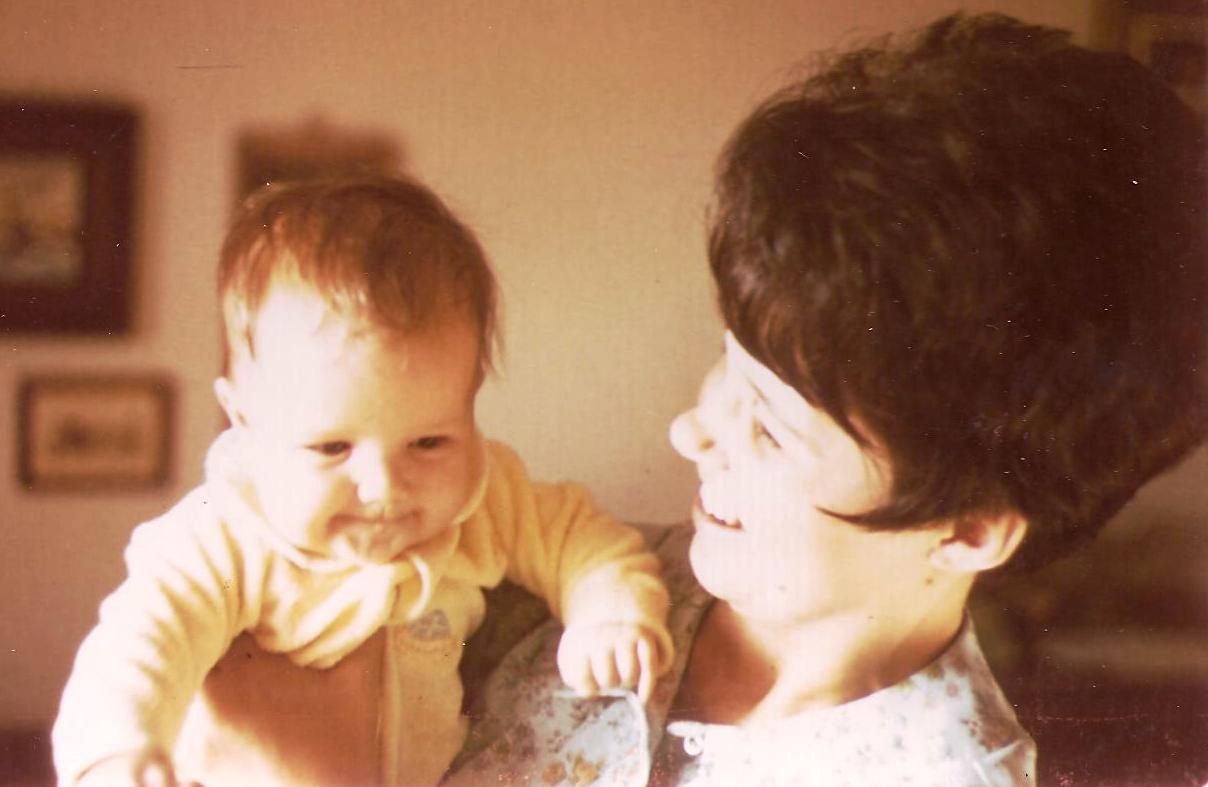
Me as a baby, with my mom: my whole life was ahead of me.

There are infinite numbers of paths the younger we are, from my experience. And as we choose paths and corresponding doors, we tend to have fewer big paths to choose among, and doors tend to shut more permanently the older we get. Sure, we hear “success” stories about people becoming athletes at decidedly older ages than usual, or becoming famous painters at 80, or some such thing, but those are well-known stories precisely because they are rare and unusual. (News means something out of the ordinary, and that’s what stories like this are: news.) For most of us, once we choose at 20 to pursue a career in business as opposed to chasing a dream of becoming a pro baseball player, the sports door is shut tightly behind us, and we won’t see it ahead again.

I think back on all the things I did as a young person. I acted in plays, sang, played piano, played French horn in band, went to various competitions for different academic pursuits, took all kinds of classes, dabbled in drawing, wrote, read like crazy, and baked and decorated cakes. I went to college as a chemistry major. I stood on the threshold of university life full of hope and excitement and the thrill of embarking on a grand adventure, a dream.

1988: My dad and I on our way to the airport to get me to college.

But once I was out of college, I had shut many doors behind me. Acting, playing French horn, academic competitions, drawing, even chemistry were all behind me. I still baked, I still read and wrote. I just changed my mind about being a chemistry major and focused on journalism. As life progressed and I made decisions to major in journalism, my other minor interests had to be sacrificed as I took more and more classes in my major. Then when I graduated, I worked 40 hours a week as a copy editor, further narrowing my journalistic interests, at least for the time, on editing rather than writing. As an adult and a college graduate, I had work to do. I had less time to explore and be general. Of a necessity, some interests had to be sacrificed.

My life further was changed when I decided to marry and when I decided to have each of my four daughters. Each of those choices opened up gorgeous paths with all kinds of interesting and beautiful plants along the road (not to mention some thorns and hills, let me add). But when I chose those doors, many others closed behind me. There were just certain things I would never do.

As a mother with children all at home, some teens, one just about to start school, and one in the middle, I have a road full of carriages to push along or to supervise. I can’t leave this path and try another one. When they’re all grown, I’ll have some different paths open up to me, some different doors to try out. But they won’t be the exact ones I might have tried before I went down those paths at ages 18, 23 and 26, for instance.

Sometimes I feel the loss of those paths never taken, considered but left behind. I admit I do envy others on different roads, on occasion, when my choices and their choices have put us past very different doors. Some have what I might consider “exciting” or “glamorous” lives. No, I am not talking about celebrities or anything like that. But I might have really enjoyed going into the foreign service as one friend did. I love to be in different places and get to know them, as well as the people populating them. I love languages and find different cultures fascinating. I would have loved to be a book editor at a big publishing house in New York. But either of those options would have been very difficult either with children or with the lifestyle I have decided is the way I’d like to raise my children, and where and how. (Yes, there are diplomats with kids or editors with kids, but I don’t see myself doing either of those jobs the way I’d like to do them at the same time as raising my children the way I’d like to do it. It’s as simple as that.)

I know there are still some interesting doors ahead of me, and I look forward to them. But I am now trying to really come to terms with the fact that the doors coming up are not going to be as plentiful or the same options as the doors I had ahead of me 20 years ago. I think that’s much of what aging and maturing and growing up really means. We come to grips with the naked truth that we are not who we were when we were young. Life is not an endless stream of possibilities anymore. We’ve already chosen many of those possibilities, and they are no longer dreams ahead of us but memories behind us. Our bodies are not the same as they were, our faces and hair not the same, our hearts and minds are not the same. On the first count, our society today, unfortunately, doesn’t allow us to gracefully accept that our bodies and faces are going to age and not look “fresh and young” anymore. In fact, society is urging us to do all we can to fight that fact. But all we can do is postpone it for a bit, not ignore it or stave it off entirely. On the count of our hearts and minds, however, I would like to think that despite missing some of those fun things I dabbled in as a young person, and just having the entire panorama of possibilities still ahead, that now I can be mostly satisfied with the paths I’ve chosen and where I am now. I got a good education, I’ve done some interesting work, I’ve traveled and lived in a variety of places and met many wonderful people, I’ve raised (so far) some amazing daughters. I’ve loved and been loved. I’ve experienced life, and I’ve been happy.

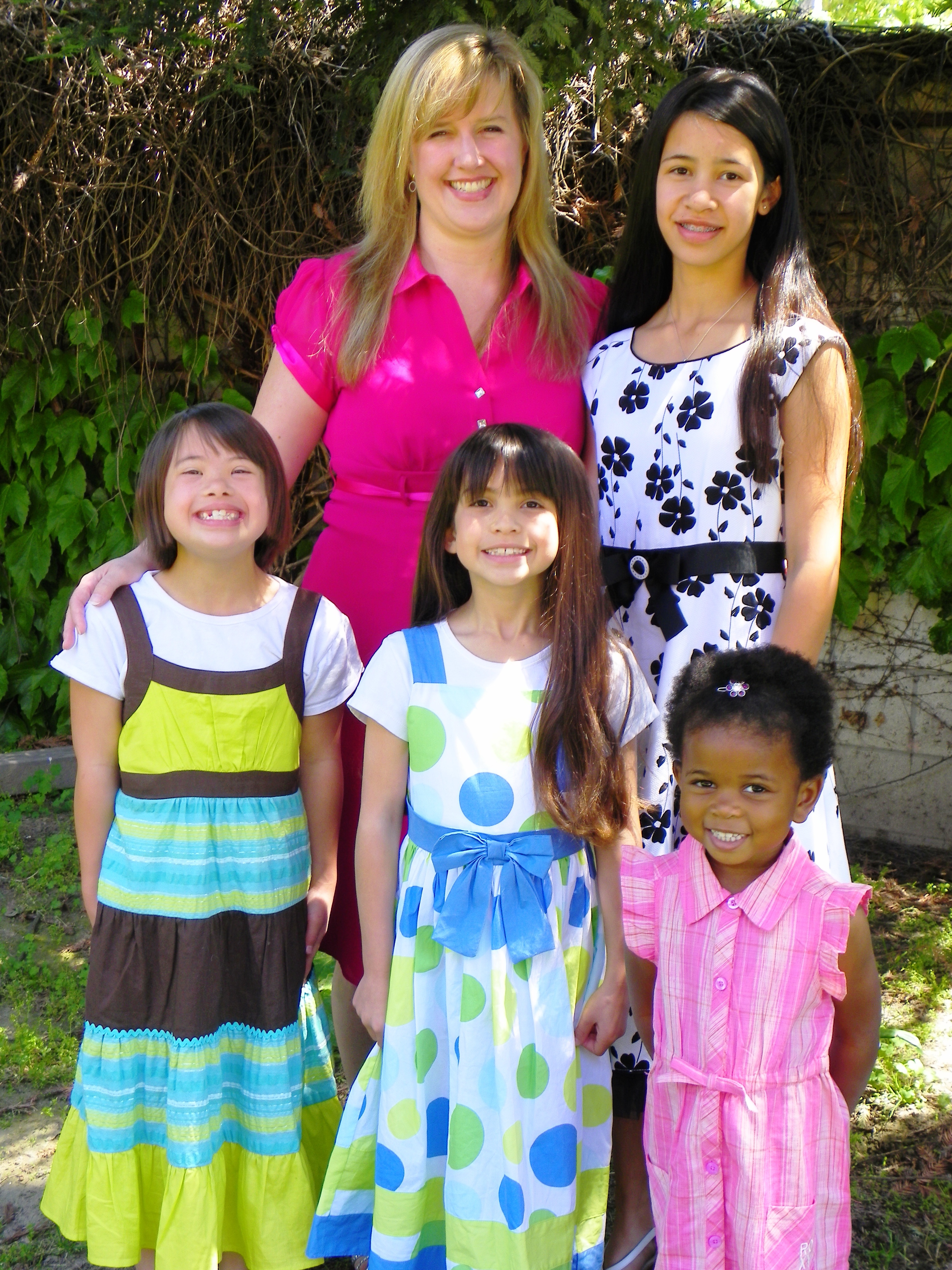
Me and my daughters, 2010. So much promise, so many doors.

Now, I see all the doors standing open to my daughters and feel pangs of memory of how it feels to be in their shoes. But I am excited for them and all that lies ahead in their young lives. I’m doing what I can not just to make interesting choices among the options available for me, but to support my girls as they make their own choices. What a gift that is.

Enough

I think about the idea of “enough” so often that I considered using it as part of the name of this website. In the end, obviously, I didn’t, but the concept comes to my mind frequently.

I’m not the type of person who wants more things. In fact, I’m usually working to get rid of things. Years of moving have taught me to pare down wherever possible. (I’m not a minimalist, however: I love my kitchen gadgets, and I use them. That’s a topic for another post.) I’m satisfied to keep a computer for seven or eight years or a TV for 10 or 15 years, even if they’re getting snazzier, wider and thinner. I have some clothes I’ve worn for years; I have a sweater I just adore that I bought in high school (guess it’s stretched out over the years…). So “enough” doesn’t apply to stuff. Well, it does, actually: I can say with confidence I have enough stuff.

No, “enough” applies to actions. I worried in high school if I had enough on my list of activities to show my dream university I was fit to enter. (I did.) Mostly, I’ve worried over the years if I’ve done enough. As a mother for about 16 years now, I think I worry the most if I’ve done enough for my four daughters, who are truly the most precious gift I’ve been given. I have generally been of the opinion that children will do best if given plenty of free time to find their own way, to keep themselves occupied and use their imaginations and their own inner resources. I haven’t scheduled them in lots of activities or sports or lessons. I haven’t spent all of my free time finding ways to keep them busy or happy. Even knowing that this strategy seems to have worked pretty well for them so far, I have moments of wishing I could just do more or be more for them because they are so amazing, so talented, so delightful. Because they are my only offspring, and these years I have of them living at home with me are my only chance to raise them: I just get this one shot. Because they deserve everything I can offer, everything the world can offer. Again, not stuff, but opportunities.

I’ve given my girls time. I’ve read with them, countless hours curled up on our beds, usually at bedtime, with countless books, many of which are now well worn, pages slipping out of their bindings, bits torn off corners. As they’ve gotten older, I’ve just sat and listened to them talk, telling me about their days, about their friends, about all kinds of thoughts swirling in their heads. I’ve not generally considered that a sacrifice, especially now that I have a high-schooler. She in particular has so much to say, so much that’s entertaining and interesting, at turns humorous and sweet. I cherish these tete-a-tetes. We’ve had “the talk,” we’ve talked about life and the big things, about faith and family; we’ve also talked about all the hilarious things that boys do and all the tasty morsels she ate for lunch. It’s been a pleasure; it’s been a treat.

Perhaps it’s a direct result of that time I’ve spent with them that I feel the urgency to do more, to give my girls the world. I’ve seen inside their souls and seen all that is possible, and I want to give it to them. Now that my oldest has realized how much she enjoys dance, she’d like dance lessons. But when would we fit those in among the band concerts and rehearsals or church activities or that extra class she’s taking in the evenings? Or as I see how much is lacking in our educational system nowadays (thanks to legislation, lack of funding and the bad economy, you name it…), I wish I could home-school or supplement with some somewhat structured lessons of my own. Oh, there’s so much I wish I could do.

But time limits me. Energy certainly limits what I can give. My budget limits me. My own needs, weaknesses and limitations keep me from being able to give all. (If you read about my struggles with my mental health, this will seem even clearer.) The number of children I have limits how much I can give to each, in some ways (I can’t be two or three places at once, sadly). But those things don’t limit how much I love.

At the same time, I know when I think about it seriously that my limitations are just part of life, even part of my children’s lives. They live in the same world I live in, where you can’t get everything you want, where you can only do so much, where the people around you aren’t perfect. No one should be handed everything on a silver platter, now or ever. Life isn’t perfect. There are always disappointments, always choices to be made between two or three good things. Giving my children everything would be doing them a disservice.

So I know in my head that I really am doing pretty well by my girls, that they are happy and well-adjusted, that they truly feel loved and secure. It’s just I struggle on some days when particular things crop up that I wish they could have or do. I wage a battle in my mind and — eventually — conquer my feelings of “not-enough” with the knowledge that they are happy, that they are loved.

I also struggle with that feeling of doing or being enough outside of my small family sphere, with the wide world around me. Every day, I see people and organizations that desperately need help, that need money, that need volunteer hours. There are children all around the world who need food; who need clothes and shelter; who need a strong, loving parent. And I don’t have to look far to be aware of those children. Teachers I know have those children in their classrooms. My daughters have these children as peers. Every time my oldest, in particular, mentions to me how grateful she is that I cook healthy food for her, that she has a comfortable house and plenty of clothes, that she has two parents in her home who love her, it’s because she has been reminded at school that all too many other kids don’t have those things. And my heart breaks, it just starts opening wide and trying to send feelers out to all those other children who don’t live in my home, to show them that someone cares. Oh, how I often wish I could parent so many other kids. Practically, however, I know I’m at my limits with the four I have right now.

There are so many worthy organizations out there that I could give time to. It’s hard to limit myself to just a few. Even as I say yes to one, I know there are many others I simply must say no to. It makes me feel bad to have to choose, to say no. It breaks my heart. The need is great so many places right now, especially, with our economy the way it is, but the need is always great in terms of hearts that need healing, souls that need to be nurtured.

I can only keep reminding myself of a story that I’ve heard a few times over the years. A man goes walking on a beach early one morning and finds a young man on the shore, bending down and picking up starfish and throwing them into the ocean. He keeps bending to the sand, grasping one starfish at a time, and throwing. The beach is just covered with starfish, who are likely going to die if left where they are, washed up on the sand. It seems a ridiculous endeavor, this picking up starfish one at a time and throwing them back. So the man asks the thrower, “Why? Why do you bother? You can’t possibly save them all. This won’t make a difference.” The young man’s reply, as he threw yet another starfish wide into the ocean, “It made a difference to that one.”

That’s the philosophy to which I cling in those times my heart breaks because I can’t possibly save the world. There are so many people in need, so many causes that are worthy. But I have to tell myself, what I do matters to “that one.” I just read about Mother Teresa’s similar thinking: “If you can’t feed a hundred people, feed just one.” I am making a difference to the four children with whom I’ve been entrusted. I hope to make a difference to the women I’ve been assigned to watch over in my church’s visiting teaching program. I hope to make a small difference in what I write here, that if what I say helps just a few readers, I’ve spent my time wisely. You, my friends, are my starfish. I wish I could rescue all the starfish lying on the beaches of the world, but I’m throwing back one at a time.

I watched this video for the first time yesterday and thoroughly enjoyed it. I hope that I can just make one person’s burden lighter each day because I’m willing to share. Enjoy this beautiful, inspiring message.


‘Authenticity’ and vulgarity in books

Those of you who have paid some attention to my biographical information (if not, take a look at “about”) will know that I run a book review website, Rated Reads. There are quite literally thousands of blogs out there that review books. What there are not nearly so many of are websites that try to provide information about the content of those books reviewed. I have been a book reviewer for probably 15 years now, and I’d say I have done it as “professionally” as is possible; I’ve written for newspaper book pages for all that time, I was the book page editor for one newspaper for a couple of years, and I’ve been a member of the National Book Critics Circle for probably 10 years. So I’d like to feel that I know a little something about book reviewing.

Since it has been well known among my acquaintances what I do in the reading sphere, many people have asked my advice on books, from all kinds of angles. What I concluded some years back was that there was a hole in available information out there about book content. I am a Christian and have been raised in particular being taught that it is wise to avoid using vulgar language or watching movies or TV shows with vulgar content, so it follows that I would want to avoid books with vulgar content as well. And those friends of mine who came from a similar background would often ask me what kinds of books I’d enjoyed that were also mostly “clean” when it came to content.

But there are no ratings systems available for books. There are many reasons for this, but the hole in available information remains nonetheless. I just thought I could do my part to fill in that gap, just a little bit. So I started Rated Reads four years ago. I’ve noticed now more blogs devoted to a similar objective: to just provide some information about book content to readers who care about sexual scenes, violence and offensive language. Some out there in the world today may criticize the movie or TV ratings systems or think they’re silly, but I think most people understand and agree that they have value in providing information that allows viewers and parents of under-18 viewers to make better decisions regarding what they watch. So I would think that logically most people would agree that having information available in a similar fashion for books would be desirable and welcome.

The naysayers have generally left Rated Reads alone. There have been a few occasions, however, when an individual who doesn’t share my values or the values of those who use the site or simply doesn’t appreciate that anyone in the world might have different values than he or she has makes disparaging comments about what I and my reviewers are trying to do. In those few cases, I have gently reminded those commenters that the site exists to provide information for those who would like to limit offensive content in what they read. They can disagree, but some people value what Rated Reads is trying to do.

As a reader, I find it laughable that some writers and readers continue to insist that, in order for their work to be “authentic,” it must contain graphic material. I think that there are a few occasions that this is actually true, but it isn’t true for nearly the number of occasions it becomes a sticking point. Writing about and for teenagers tends to get the most attention here, for some reason.

Let me just say this: I was a teen once. Yes, it was 25 years ago, and yes, it was perhaps a slightly nicer time in which not quite every scary or bad or dangerous or vulgar behavior was out in the open, and media reflected that. (An example: I distinctly remember the big fuss over George Michael’s song “I Want Your Sex.” Some radio stations simply would not play that, so there was a version called “I Want Your Love.”) Today, I am of the opinion that pretty much everything is now out in the open, rather than hidden behind doors, spoken of only in whispers. But I heard bad language when I was growing up; I heard sexual references. So I remember what it was like to be a teen and to hear and see things.

I can also say this: I have two teens. My oldest is almost 16, and she talks to me about everything. She is bombarded by vulgar language and talk about all kinds of dangerous and sad behavior. And even though, technically, students aren’t supposed to be allowed to use vulgar language at school or in the classroom, teachers have mostly given up on trying to reprimand or give any consequences. So my very tender, gentle and sweet child constantly hears peers using “f-” this and “f-” that and sexual language and all kinds of things that she simply doesn’t want to hear. (She doesn’t have a lot of choice in what she hears in class or in passing, but I will make clear that she does have a choice what she hears from friends. She has chosen friends who are like-minded in that they don’t use bad language, and if she does have friends or classmates with whom she interacts regularly who are inclined to use bad language, she has politely asked them to refrain from using it, and they have always graciously tried to honor her wishes because they like and respect her.)

So when it comes to media, including movies and books, yes, I can wholeheartedly agree that “reality” is not pretty in many respects. But just because some teens, or even many teens, are involved in dangerous behaviors or use vulgar language doesn’t mean that ALL do. My daughter has plenty of friends who don’t have sex and who don’t use rough language. This isn’t she or I being unrealistic or seeing through rose-colored glasses; it is a fact. There are plenty of great teens out there who aren’t having sex or using rough language.

Just as we can choose friends who are like-minded, we can choose media that reflects our values as well. My daughter doesn’t want to hear offensive things at school, so she certainly doesn’t want to come home and deliberately choose to read a book that has offensive material, if there are other options. I want her to have a place that she can feel comfortable, where she ISN’T surrounded by vulgarity. That is our home. And our home’s media options reflect that place of comfort and security. I don’t bring offensive media into our home. It is a sanctuary, as much as is possible, from the world of so-called “reality.” And our home life is just as “real” as what’s going on outside it — actually, more so.

So I appreciate the authors who can craft great works of literature without bringing in some of that “reality.” I’ve read many wonderful books with fully-formed characters who interact in a true-t0-life fashion with each other, with stories that are clever, that are witty, that are wise, that transport me, that make me think, that help me experience places and things I wouldn’t get to otherwise. And those books have felt absolutely real. They’ve been authentic; they have struck a chord in my heart and soul. I love those books and I give thanks to the authors who don’t feel the need to insert offensive material to make them more “authentic.” Generally speaking, I have found that the books that have used lots of strong language and detailed sexual scenes could have gotten their messages across equally well without that stuff. And all too often, those “markers of reality” have been poor substitutes for good writing. I don’t want to read a mediocre work, period, let alone by an author who thinks that inserting lots of nasty “reality” will instantly make it real. Why waste my time with that stuff when there’s just SO much good literature out there, so much I can’t possibly ever read it all?

I know well enough what’s out there, what kind of depravity and vulgarity and sadness exists. I am not so isolated or insulated that I’m completely ignorant. But I don’t have to wallow in filth just because I know it exists. Life is difficult enough for everyone that there’s no reason to choose to bring things into our lives that are filthy or degrading. We all have struggles, we all have challenges to work through. And good literature does reflect that fact. But it also can reflect that we as human beings can triumph over the bad, that we have the strength and the light in us to choose good and to be good despite the difficulties we encounter. And I’m going to choose to read books that don’t bring unnecessary vulgarity into my mind. I’m also choosing to run a website that provides necessary information so others who want to make informed choices can do so.

Readers who don’t agree with me can go ahead making their own choices. That’s fine. But respect that not everyone wants to consciously bring filth into their lives. And authors, if you write books with lots of bad language and sexually explicit material, you must appreciate that not everyone will want to read it (and parents have the right to monitor what their younger children or teens read). Most likely, you’ll have a broader audience if you could limit the offensive material you write into your book. The concept holds true just as it does for R-rated movies versus G- or PG-rated movies. More people do go to see those movies with more “family-friendly” content. They don’t have to be “cheesy” or trite or “unrealistic” just because their ratings aren’t “strong.” There have been some excellent “clean” movies, just as there are some excellent, authentic “clean” books. Consider making your writing the best it can be without using offensive material as a crutch to make it “true to life.” I, and many other readers, will thank you for it. Profusely.

A voice for vocabulary, aka, a rant on proper usage

The English language is tough and resilient and has evolved miraculously over centuries, but it takes a huge amount of abuse. Once every .003 nanoseconds, it is misused somehow, somewhere. It is time for someone to speak up on behalf of the voiceless, our lovely language, which, sadly, is unable to speak for itself, despite a slew of wise, wordy weapons in its arsenal.

Here I am going to take a stand on behalf of the proper use of vocabulary. It won’t be pretty, but I’m going to expose the improper uses of words and then show which words should have been used in their places. Brace yourselves. (These are in no particular order, mind you.)

  • “Unphased.” As in, “she was unphased by his poor use of the word.” The word that should be used here is “unfazed.”
  • “Reigned in.” I’ve seen this time and again. “She had to reign in her bad language.” “Reign” has to do with royalty. I do believe that those who have blue blood would be appalled at this improper use of “reign.” The word that should rightly stand here tall and stately is “rein.” When we talk about “reining in” a horse, we use a rein. Even queens do not “reign in” the animals that draw their carriages.
  • I heard something pretty funny in “The Hunger Games.” A character said something was “very lethal.” “Lethal” means something kills you. So if it’s “very” lethal… hm. You would be “very” dead. Brings to mind that the only way you can be somewhat dead as opposed to very dead is if you were Westley in “The Princess Bride…”: “mostly dead.”
  • “Bazaar.” Really, how often do people write about street fairs? Probably not as often as they desire to refer to something being “bizarre,” or really strange.
  • “Peddle.” More people find themselves needing to use the word “pedal” than its frequently used homonym “peddle.” “Pedal” as a verb means to move a bike along by pushing pedals with your feet. “Peddle” means to sell something. One could peddle pedals in a bizarre bazaar, if shoppers are in need of replacement parts for their bicycles.
  • Predominate. I rarely have need to use this word, and I rarely see anyone else need to use it or use it correctly. What I DO see, however, very often, is the use of this word instead of “predominant,” an adjective meaning “having influence or power” or being the “primary” focus of something. Just say the word out loud, folks. It has an “n” in it.

This is just a start, mind you. I expect to be adding lots more over time. Anyone care to weigh in?

OK, time to add some more.

  • Ravish. Most of the time people use this word in writing, they mean “ravage.” Ravish is generally associated with rape, or just a lusty man taking a woman strongly in a bodice-ripper book. But ravage is about wreaking havoc or destroying. Ravage a town, and the buildings are destroyed, the people scattered. Ravish the people of a town, and outsiders will feel particularly outraged.
  • Tenants. Whenever I see this word used, the writer invariably is talking about the belief system of a religion or just some kind of way of life. Today, fittingly enough, I read an article on HLN.com about “11 words adults just can’t spell.” I agreed with a few as being common errors (the others just didn’t seem to be the most-screwed-up ones, in my opinion), and then I clicked over to another article on HLN about Alanis Morissette giving her opinion about attachment parenting. Naturally, the article spoke of the “tenants” of that way of raising kids, when what it needed to say was the “tenets” of that philosophy. So I clicked right over from an article on spelling errors and found a biggie on MY list right there on another one. I couldn’t refrain from posting a comment on that one.

Spirituality and mental illness

As a faithful follower of Christ my entire life, my spirituality and connection to the divine have always meant everything to me. My life would not be what it is without my knowledge of and faith in God, my Heavenly Father, and His Only Begotten Son, Jesus Christ. I have always depended on the great gift of the Comforter that Christ left with his disciples, the Holy Ghost or the Holy Spirit. I’ve been taught since I was young how to understand what the Spirit is trying to communicate to me through his still, small voice. It is explained to people in various ways because it can affect and teach each of us a little differently, so each of us must learn exactly how he sounds to us. A scripture in my faith’s canon says that the Holy Ghost will speak to me in my mind and in my heart, and that really rings true in my experience. I can often just feel ideas popping into my head, and I can feel in my heart a good feeling that confirms they are from a trusted source.

But my challenges with my mental health over the years have thrown wrenches into that beautiful process off and on, in various ways. The depression, irritability and anger I’ve felt have blocked that positive flow of messages from a loving God, leaving me to feel adrift and alone and cut off. I’ve sometimes felt that there are just no answers coming to prayers, and I’ve given up asking. I’ve even gotten angry at the heavens then for leaving me in that isolated state, with no communication coming my way. All of it leads to me feeling that I’m alone and undeserving of God’s love, that for some reason he just isn’t paying attention.

Even medication I’ve taken has caused difficulties of its own. As I wrote in my previous post about my long list of medications over the years, when I tried Abilify for a few months about a year and a half ago, I felt absolutely numb. It was unnerving because I’m usually a bubbly person who often sees the bright side of things and, in terms of faith, relies on (even might take for granted) the wonderful peaceful feeling that comes from turning to prayer and scriptures and other messages of a spiritual nature. I know that when I listen to good music that reminds me of God and Christ or when I read a scripture or an inspirational magazine article, I’ll feel uplifted and recharged. I’ll feel the influence of the Holy Ghost, a marvelous gift. So for the few months I took that medication, I didn’t feel anything, including those spiritual feelings. I didn’t feel bad, but I didn’t feel good. I didn’t feel peaceful or Spirit-filled whenever I did all the things that would normally make me feel that influence. It bothered me a great deal. It was a strange feeling to go to church, where I would normally feel happy and inspired, and just feel … nothing. A black hole where there would normally be gardens in bloom with all colors of gorgeous flowers of faith.

What got me through that time was just the knowledge I had still in my mind about all the experiences I could remember. My brain had stored away the memories of knowing that God had answered my prayers at specific times and that I knew that the Holy Spirit had usually been in my heart. I couldn’t feel it then, but I trusted in my head that it had happened before and would come back to me, no matter what wacky tricks this medication was playing with me. And sure enough, when I got off that medicine and got to mostly myself again, I did feel that peace again. The black hole was gone, filled again with light.

So the wrong medication can play tricks on faith. Depression and other mental illnesses can do their own brand of damage. I’ve been through that emptiness before and am kind of feeling it again, and I’m sure I’ll keep experiencing it throughout this mortal existence. It’s not pleasant, and I’d rather not have to go through this. But my feeling is that this is my cross to bear, so I’m doing the best I can to handle it gracefully. Saying I’m doing my best is the truth, but even then it feels silly to say because “my best” can sometimes not be a whole lot. I feel alone inside of myself and that God isn’t sending me answers or the positive feelings I need. But I know in the part of my brain that’s not “messed up” somehow that he’s still there.

I think what I want most to do here is connect with other people who experience these feelings. I think that faith communities are slowly doing better at directly and publicly addressing matters of mental health in the context of religious belief, and that’s wonderful. But depression and other mental illnesses work hard to isolate their sufferers. Those of us who know in our minds and in our hearts that God is aware of us and loves us but sometimes don’t really “feel” it the way we should because of neurochemical vagaries can talk to each other to buoy each other up not just in our specific trials but in our faith. We’ve been given a great gift to have a Savior and the good news of the gospel he has taught. I believe there are still miracles today. Honestly, though, some days, amid the clouds that create a darkness of despair in my heart and head, I don’t feel a conviction that God will work a miracle in my life. And since I know that isn’t true, deep down, I have to work hard to combat the feeling that is false. A dear, dear friend of mine told me a couple of times that she and her mother were able to talk to a well-known Christian writer of our faith after he gave a talk they attended. She wrote me to remind me what he had told them: “He suffers from depression and told my mom and me that being faithful means that you remember the Lord is with you and mindful of you even when the depression doesn’t let you ‘feel’ it. He is still there!” I just cling to that like a little round life saver thrown to me in an ocean of big waves. Eventually the waves die down, and I’m still clinging on for dear life: alive and well yet again. Still.

Medications and me

Having a mental-health concern (that seems most likely now to be a bipolar disorder) for the past 25 years or so has naturally led to my being on various medications to try to improve my quality of life. I’ve already discussed a bit how it’s been a challenge to figure out exactly what I’ve been up against over the years (just some depression? anxiety? postpartum depression or PMS? bipolar disorder? nothing at all?), so I’ll try to go back and address what kinds of medications my doctors and I have tried to use to help me feel a bit more “normal,” or, more accurately, just better able to cope with the usual stresses and strains of life.

The first I ever took some kind of an antidepressant was toward the end of my LDS mission when I was feeling serious stress. The resident older missionary/retired doctor prescribed me a medication that would supposedly help with that. At this point, I honestly don’t remember what it was he gave me. What I do remember is that I was in pretty bad emotional shape and just going about my regular busy schedule just with a new medication didn’t help me feel any better. Besides, it usually takes a few weeks for those kinds of medications to even start making a difference, and in the meantime, I just kept feeling stressed — and guilty or bad about being stressed while I was supposed to be happy and spiritual and serving God and my fellow beings. It just wasn’t a good recipe for success as a missionary or a happy human being. So I ended up having to leave the mission behind and go home to seek help in a different environment (already talked about how that went).

I was next put on lithium when hospital doctors decided I was bipolar. I took that for a bit less than a year, I think. I felt better as time went on, mostly, but I also went back to college, where I felt more at ease and myself and had my friends around me. I am sure that the medicine must have helped though, looking back, because otherwise I probably still would have been seriously depressed/angry/stressed. But the change of environment did contribute, and after a time, I just felt that 1) the diagnosis of bipolar disorder couldn’t really fit me because I didn’t fit the “classic” signs of the “full-fledged” disorder and 2) lithium is a serious drug to be on: it can potentially damage the liver. I was having my blood tested every few months to make sure my liver was fine, but it was still a real concern. So I went off the lithium. During all this I was seeing a counselor at school, so I didn’t do all this just on my own without any professional support, but I don’t know if I had a psychiatrist on my “team” at that time.

After I married and moved to California with my husband, I know I ended up seeing a psychiatrist regularly, but I cannot remember if she had me on any medication. I know I didn’t go back on lithium. She might have put me on some kind of antidepressant, if anything, but I don’t remember for sure, and I have no idea what it was if I did take something. I do know that the first year of my marriage was very rough for me emotionally, and I prefer not to think about the way I acted. It’s too embarrassing. Luckily, my husband stuck it out with me. I also know that I was on hormonal birth control pills for the first two years of our marriage, and I am convinced that fiddling with the sensitive balance of my hormones was not a good thing for me emotionally.

I know that there were months and years I didn’t take any kind of psychiatric medicine, and there were other months and years that I did. It was always some kind of antidepressant. I took Zoloft and Wellbutrin at a few different times off and on after and between pregnancies. I took them together for a year or so, mainly because Zoloft did take away my sexual response. That’s something that’s a warning when you take that and various other medications, such as Prozac, and it’s definitely true for me. It can seem like a small price to pay, but it’s actually a pretty big sacrifice when it comes to a full intimate life with your spouse, so it bothered me greatly. Taking the Wellbutrin with the Zoloft took that side effect away.

After probably my third pregnancy, my gynecologist prescribed me a new medication, Lexapro. He said it worked well and had no significant (definitely not sexual) known side effects. I was eager to sign up. The morning after I first started taking it, I got out of bed in the morning to use the bathroom and then ended up passing out on my way back to bed. I was so scared about the weird feeling I had during that few moments that I told my husband to call 911. The paramedics came out and pronounced me fine. They said I’d most likely rubbed the back of my neck or something and had some kind of vagal episode. OK. Fine. Unfortunately, over the next 5 or 6 days that I took the Lexapro, I still felt weirdly faint and out-of-body-ish, and I figured the only thing that had changed in my life was that new medication. I visited with my general doctor, who told me that was ridiculous. But I decided it was the cause, and I stopped that Lexapro. I instantly felt better, well, fainting-wise. (The lesson here: even if your doctor says you’re being ridiculous, you still should trust your instincts.) So I went back to Zoloft or something similar, I think.

I started going to a psychiatrist again, which I hadn’t done for quite some time, just getting antidepressants from my gynecologists or general physicians, although I had still gone to see counselors for talk therapy more regularly. The psychiatrist I saw at that point, probably in 2007 or so, put me on Effexor eventually, which worked well for me for a while. He did suggest I might be experiencing bipolar disorder and might benefit not from lithium, but Lamictal (lamotrigine). He even gave me a sample pack. Even though I did consider that option, I told him that since I was feeling pretty good taking the Effexor, it seemed silly to stop taking something that was working just to try something else. He thought that was reasonable and kept me on the Effexor.

Then in 2008, my family and I moved to California from a long stint in Alabama, and life became unbelievably stressful. I’d also been taking the Effexor for probably a year or maybe a little less. At any rate, I’d probably only done well on an antidepressant for a year or so at any time I’d taken one, either because after a while, my life had settled down and I’d gone off a medication and been fine, or the medication had seemed to stop working. In this case, I just kept taking the Effexor, but my new general physician upped my dose. Shortly before another momentous, life-changing event for me, the death of my beloved dad, I started trolling the Internet and found the site I’ve mentioned already by Dr. Jim Phelps, which made me start to seriously consider the possibility that I really did have a bipolar disorder. But this psychiatrist was making the point that there was a wide spectrum of bipolar disorders, not just the “biggie” in which people stay up without sleep for a few days at a time, go on wild shopping sprees and spend tons of money, and do otherwise really foolish things they wouldn’t otherwise do. So I found a psychiatrist in my new town who was on my insurance list and made an appointment. He put me on Lamictal, which my previous physician had suggested a couple of years before. It did seem to slowly make a difference, and I was happy to be off the Effexor, although it did take a solid two or more months to very slowly wean off of that very addictive medication. (If I didn’t get a dose, I’d start feeling kind of headachy and light-headed, in a distinctively Effexor-less way.)

So I think the Lamictal gave me some relief and some hope that I was on the right track, but a couple of months into that, my dad died and sent me spinning. My psychiatrist asked me at the first appointment after Dad’s death (merely two or three weeks afterward, mind you), “So, how are you feeling?” Uh. BAD. My dad died. I’m miserable. Hard to say how the medication is working. I’d feel rotten no matter what. And that’s how it went.

A few months after that, I mentioned to some people in my church congregation that I was struggling with mental illness, and a few recommended I try a different option, a natural formulation called EMPower that was sold by a company called Truehope. The company says that the formulation contains micronutrients that are found to correct the imbalances found in those with bipolar disorder and other mental issues. I have always felt that ideally, it would be nicest to treat the actual cause of a problem rather than just the symptoms, if at all possible. This sounded like a very reasonable option, and Truehope has actually been doing scientific studies showing the benefits of EMPower.

I felt that I needed to at least give this option a shot. If I didn’t, I would never know if it could have helped me or not. So I went in to my psychiatrist, who naturally told me he didn’t agree with my decision and that he couldn’t continue to see me if I went off my prescription and took EMPower instead. I knew he’d say that, and I was ready to say, “OK. I won’t be back.” He said he knew I’d be back in a few months in even worse condition.

I tried the supplement, which is actually pretty expensive (probably about $100 a month, and not covered by insurance, of course), for about six months. I felt at first it really did help, but after a few months, I was just not feeling good enough. I tried a few adjustments and options after some phone calls with the company’s support techs, but I finally had to make the decision to end my own personal “drug trial.” I am sure that the supplement truly does help lots of people, but as with anything, nothing helps everyone. I did struggle, however, with what to do next. I firmly did not want to go back to my previous psychiatrist. He was too abrasive, and I felt I couldn’t work comfortably with him to find the best options to treat me. I finally decided to go see a nurse practitioner working in psychiatry 45 minutes away from my town because my therapist had heard good things about her from several other clients. I felt that it was going to be best for my mental health process to work with a psychiatrist who I felt comfortable with, that we were really a team, that she would be supportive. So I made the appointment. This new person, who I still see almost 2 years later, turned out to be a really good fit personality-wise, which I think makes a big difference in getting the best care possible. The only drawback is that my insurance doesn’t cover her, so I have had to pay entirely out of pocket. Luckily, I have had the spare funds to be able to pay for the visits, and it has been a good choice for me.

I’ll just call my nurse practitioner by her first name for ease of writing. Susan really went into a lot of detail with me, talking to me about the options and what she thought might work to help me, even explaining why she felt that way. I personally have really liked her approach. I like to feel that we’re on the same page, and knowing her reasoning helps me to feel more confident that is happening. We tried probably four or five different medications over the course of probably four to six months, during which time I’d go back every month to see her and check in. We tried Abilify, Prozac, and maybe Celexa. I can’t remember exactly. I did notice Prozac didn’t make me feel any better, and it just made me feel completely dead sexually, which was super-frustrating for me. So that was a no-go. I also know the Abilify didn’t do it on its own, and it actually made me feel, rather than “more normal” or “more like myself,” just kind of numb emotionally. I wasn’t stressed, kind of, but I was just dead. I didn’t feel anything. I felt like a zombie. I absolutely did not like that. She ended up adding in Cymbalta, which felt pretty helpful. Eventually, we took out the Abilify to see if that would help me feel less numb. And it did work. The Cymbalta, at the time, on its own, was a good fit for me. I’ve now been on that for perhaps 18 months.

Unfortunately, I’m afraid that now we’re getting to a point we need to tweak again. I’ve been on just antidepressants before, and I’ve either just gone off them or they’ve stopped working, and I fear this is happening now. I’m just feeling unhinged. The stresses and huge demands on my time are taking a huge toll on me, and I’m not proving up to the challenge of dealing with them in an appropriate manner. I’m coming up in a few weeks on another check-in with Susan, and I think this time we’ll have to address now how to change my dose or try something else. It’s been nice, though, for the past year, feeling pretty good and “myself.” Descending back into my “crash” mode is a scary and upsetting thing, for me and my family, and it’s nerve-wracking for me to ponder how much trial-and-error it’s going to take to get me back to happy. Will it take a couple different medications again and weird feelings of numbness or just not-effectiveness (so I’ll just feel unable to cope for a few more months? Yikes!)? My main fear is looking ahead at a few months of not being myself, far from it, especially with summer months coming on and my kids being out of school and all the stresses that places on me every summer. It scares me.

So that’s where I am, medication-wise. I’ve been a bit of a guinea pig for the past 20 years. It’s difficult because treating any kind of illness can be tricky and require some finesse. The basic stuff is kind of straightforward (infection? take an antibiotic; cold? take some antihistamines and Sudafed and wait it out), but other health issues take some trial and error. Then when it’s mental health, which is still a kind of slippery creature in the early 21st century, and every person’s needs and body chemistry is unique, it’s a science that’s more art than anything else. Being the doctor is probably a challenge, but being the patient is truly difficult. Being that guinea pig, the one on different kinds of medicines, is tricky and frustrating as all get-out. I’ve said for ages I wish there were a control group for me. But there isn’t. Good science requires a control group and an experimental group, and in this case, giving just me a medication and seeing what happens isn’t truly good science. And the onus is still on me as the patient to make the judgment calls, to figure out what’s changed, what to tell my health-care provider, about what might be significant. Do I feel better taking Lamictal even though my dad just died? Can I possibly separate out the effects of that from my normal stress reactions? Can I say I feel better on something even though a bunch of stuff has been happening in my life? If I could put myself in a quiet room without any interference from outside sources, I could judge better. But that’s never possible. (And if I could be by myself in a quiet place — resort, maybe? that would be amazing — I may very well be able to get to feeling better without the medication. Maybe. At least I wouldn’t be bothering anyone else.)

This post is incredibly long; perhaps I should have separated it into a few parts. But it’s the best answer to those who would like to know what my experience is with medications. I hope it might be of some use to those of you who struggle with similar problems and need to figure out how to look at your own situations with more clarity. Perhaps it will just make some of you more sympathetic with those in your lives who have challenges similar to mine. Or maybe those who know me but don’t know all these details about me will feel more empathetic with me. Either way, I hope this is of use to someone out there. This is an ongoing story, so I will need to update as the next few months come along and I visit my nurse again.

The Most Interesting Woman in the World

I’m not a beer drinker, nor do I hope in any way to promote drinking. But when I watch commercials, I have to admit I do get a kick out of beer ads.

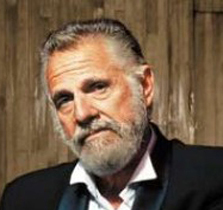
I’ve been thinking about Dos Equis’ popular character, The Most Interesting Man in the World. The ad agency’s idea was that this man would be “rich in stories and experiences:” so says Wikipedia. But I’d like to elaborate and list a set of characteristics of this fascinating male specimen.

  • “Man’s man”: the epitome of masculinity
  • Ruggedly handsome
  • Experienced, well-educated, well-traveled
  • Sophisticated
  • Suave
  • Ladies’ man (implied he could have or has had as many women in his bed as he’d like)
  • Sexually desirable
  • Discerning, tasteful
  • Well-dressed, sense of style
  • Strong, well-built
  • Everything he says is compelling, so people hang on his every word
  • Accomplished — at everything
  • Sought-after — by everyone
  • Mature, even “old” (the actor is 73): gray-haired, wrinkled, bags under his eyes

Now. Let’s look at these set of qualities as applied to a “most interesting woman.”

  • Beautiful
  • Experienced, well-educated, well-traveled
  • Sophisticated
  • Feminine, ladylike
  • Sexually desirable
  • Great taste in everything, whether it be home furnishings, cars or houses, jewelry, clothing, etc.
  • Impeccable sense of style
  • Lean, takes care of her body by going to the gym every day or, better yet, working out in her home gym with her exclusive personal trainer (yoga, Pilates, Zumba, etc.)
  • Compelling person to listen to
  • Accomplished
  • Sought-after
  • Mature, even “old”: a 70-year-old woman with gray hair, wrinkles, and bags under her eyes
  • Sexually experienced, bedding hundreds of men over the years

And here is where I have a hard time finding a photograph that would work, that any advertising agency would grasp onto as a winner, as a surefire way to get positive attention and loyal followers. The sticking point is age. Yes, there are a few women still busy as actors, but most of them are being cast as someone’s grandma or as a hilarious old lady who shoots off one-liners but is still endearing and mostly happy to hand out hugs. My husband told me, “Betty White, of course.” Yep, that amazing woman is still getting lots of work and making millions laugh. But she is not held out as a universal sex symbol, even though she does like to make naughty jokes. Can you really see Ms. White being used in an equivalent Dos Equis commercial (NOT for laughs; think the Snickers commercials)?

Here is where it really hits me just how much of a double standard there is in our culture regarding age. For men, age is desirable because it makes them wiser, more experienced, more fascinating, even mysterious. Some gray hair and wrinkles make men appear “distinguished,” not “old.” Men who look distinguished and have experience are sexually desirable, and even young women will hang all over them. (Are there any 50-year-old or 70-year-old women surrounding the Dos Equis man? Noooo. Those females are all in their 20s.)

Women, however, are not allowed, let alone encouraged, to grow old naturally. There are plenty of women in Hollywood who are being praised for “aging well,” which generally means they are touted for looking 30 when they are biologically 50. They modestly proclaim that their regimes of a vegan diet, drinking lots of water, avoiding the sun, never missing Pilates, and faithfully moisturizing have kept their faces and figures looking youthful. The women who look 50 when they’re 50 end up either being pushed out of the profession or playing someone’s grandma because looking your age is NOT “aging well;” it’s embarrassing and shameful. And 70? That’s a small club of actresses indeed. They never get to be surrounded by young, hot men hanging on their every word, hoping they’ll bed them (maybe for comedic purposes, but not in any seriousness.)

I’d like to propose that we women fight back. Let’s make ourselves the Most Interesting Women. I’ll use myself for an example, but I’d encourage each of you female readers to put a photo of yourselves somewhere with a list of your best qualities (or post that list on your mirror).

  • 40-something, middle-aged, wiser than I was at 20
  • More stylish than I was at 20, I have a better sense of what I like, what reflects “me” and what looks good on me.
  • Great, authentic, winning smile. That hasn’t changed, no matter how old I am. I love to smile and I love to make other people a little happier by shining it on them.
  • Attractive, especially to my husband, who thought I looked beautiful even when I was about to give birth and looked like I’d swallowed a torpedo.
  • Well-traveled, at least throughout the United States
  • Well-educated and well-read
  • Accomplished and well-rounded
  • A very talented cook and baker, I feed everyone well, and I do it on a budget. (“We eat well aboard the Tweedledee.” Guess the movie.)
  • Musical
  • Humorous (well, in a geeky way)
  • Not as lean as I once was, but softer and more classically beautiful, I still love to exercise. It just feels good.
  • Versatile
  • Sought-after (for getting things done)
  • Desirable (and you are not getting any details here)

What do you say, ladies? Tell me how you are fascinating.