How much should we really say ‘anything is possible’?

I’ve thought about this idea a lot, but seeing this little article reminded me: “Do we really want cartoons telling our kids they can do anything?

Now, I haven’t been thinking a lot about the idea in terms of cartoon or movie themes, but the media portrayal of this concept is one facet to consider. I can’t count how many times I’ve seen motivational posters, pins, memes, etc. online or somewhere out and about that say something to the effect of, “If you work hard enough, you can do anything you can dream of!” In the case of this article, it addresses the related but even less likely trope, “If you dream it and believe hard enough, it can happen.”

I don’t believe either one is right, true, or even healthy. Let’s just think about this: how many people do you know of who dreamed of being NBA stars or actors? How many of them actually achieved their dreams? My husband played basketball in high school and was pretty talented. Problem: he’s only 5’8″. I think there have only been a handful of players in the past few decades of NBA history who have been that short. So my husband still sighs sometimes: “If only I’d been taller.”
I also happen to know a couple of people personally who became actors. And they’re not even particularly well known. But they are making a living in the movie business.

pie in skyI’m in no way saying we shouldn’t encourage each other, particularly children and teens, to dream big. But at the same time, we’re doing them a disservice if we tell them “all they have to do” is believe hard enough or work hard enough and their dreams will come true. Because in reality, those kinds of pie-in-the-sky dreams don’t usually come true for most regular people. Even those who dream of going to a particular university (which isn’t quite as lofty or nearly-unattainable) quite often can’t, no matter how talented or hard-working they may be. Sometimes we may try and try and work really hard, but things just don’t fall into place; there are mountains in the way that we simply can’t climb over or move.

Even as I write this, I must clarify that I’m an optimist. I love to encourage people and to shoot for the stars myself. But I’m also midway through my life, and through personal experience and plenty of observation, I know what reality tends to be. What the odds are. Sure, we hear of stories of people who “beat the odds.” But the nature of “the odds” is that one person is the exception to the rule, while the rule comprises a million others. Only a few win a million bucks in the lottery; the rest lose lots of hard-earned cash.

Let’s still encourage each other and young people to work hard, to do their best, to dream, to envision futures that will please them. But let’s also help them to shape goals and futures that are realistic, that have a touch of “dream” to them but still a good chunk of attainability. Because don’t we want more people to really be able to achieve their goals and find that glowing, wonderful satisfaction in reaching that star, even if it’s still in our own galaxy?
Another summer over, another to-do list undone

My four girls all started back to school today. It’s a delightful year in which the two older ones are both now at the same high school and the two younger ones are both at the same elementary school. (Next year, though, the oldest will be at college and the three others will all be in different schools.) It’s the last year of free, living-at-home education for my oldest, and I dread her flying the coop. But for now I have her for this one last year. All in all, good things.

Again, as always happens come August, I am relieved to have the school break over with and my children back at school. Honestly, they are too. They had a fun summer, but they really do enjoy being in school. They enjoy the learning and the socialization.

But I find myself with mixed feelings. I’m not just jumping up and down that my kids are no longer constantly underfoot. I feel regret about not having done anything I’d hoped to do with them (aside from the trips we planned to take and actually went on). Even though I know in reality my best shot is just to get through two and a half months with four children always around with my sanity mostly intact by the end, I still foster these high hopes of doing extra things for and with them.

For instance, this year, as I also had thought of last year, I wanted to teach the oldest and the third one, who’s ready for it, the rules of grammar. They’re great at English and always do well on tests because they naturally “know” how everything should sound and be, but they have no idea what most of the rules are. I don’t think schools are really teaching that so much anymore, so I’d hoped to go over some rules and even do some sentence diagramming. Did we? No.

I’d also hoped to take a little time here and there to introduce some basic piano concepts to my youngest. She’s not ready for real lessons, but I had thought I could teach her some basics. Did I sit down at the piano with her once? Nope.

I had thought I might take some time to learn a bit more about how best to grow herbs here in our area and finally successfully grow a few out my back door. Did I grow a single one? No, indeed.

I think I actually had fewer expectations and plans for this summer than I did last summer. But I still feel I got absolutely nothing ticked off that fairly short but apparently grandiose list. As always, I just survived. I feel so much happier and can do more (including more with my kids) when I get regular blocks of time to myself. And it’s so much harder to get any time to myself during the summer; it’s so hit and miss and not nearly enough. I need regular refills of time and when I don’t get them, I am running on empty, and it’s not a pretty sight. You can just smell the burning.

With a lot of summers under my parenting belt now, you’d think I’d learn from the experience not to have any expectations for doing anything cool with the kids. It’s sad, but it’s true. We went on our family trips, and we went to the library every week. We read together. I made breakfasts and dinners. I made them a bubble table (which they used for about a week) and bought them a bunch of paints and rolls of paper (which they used for about two weeks). That’s the extent of my mothering fabulousness. But I’m just not one of those moms who relishes every single moment with the kids and who loves to get down in the dirt with them or … whatever looks so great on someone else’s Facebook wall or Pinterest boards. I enjoy them sometimes; I do cool things with them sometimes; other times, I just want to be left alone. And that’s OK.

Perhaps next year I’ll finally ease up on my expectations for myself. But, knowing myself, I probably won’t. But I guess it’s time to just let my regrets go and just start celebrating the start of a new school year and some very welcome and necessary time for myself.

Down syndrome ‘cure’ research creates flurry of questions

Yes, she lights up our lives just as she is, but any improvement for her would be great too.

I have a child with Down syndrome, but I’m not involved in the “community” in any way at this stage of our lives. (When she was little, I was on the board of directors of the local Arc, which advocates for and serves people with disabilities, but that’s pretty much been the extent of my activism or involvement.) I get a monthly email from the National Down Syndrome Society (or is it Congress? see: I don’t pay a lot of attention), and I sometimes read it. But generally, I don’t pay a lot of attention to the latest news.

This month, I’m late to the party in hearing about this latest bombshell of research: scientists have found a way to “silence” the extra chromosome that causes trisomy 21 in the lab.

Whoa, dude.

I’m still trying to get a handle on what the research really means. But essentially, it could mean there could be some kind of treatment developed in the future to help reverse some of the symptoms associated with people having a whole extra chromosome. Biggies: maybe reducing the likelihood of heart problems or even the cognitive delays that affect all people with Down’s. Apparently, it couldn’t “cure” DS before birth, but it would be a treatment sometime during a person’s life.

Of course, people who have children or other family members with Down syndrome, or who are self-advocates, have varying opinions about this news. Some worry that “curing” DS would remove a valuable segment of the population that arguably helps teach others about love and understanding.

Here’s my take: if it’s possible to give my daughter a better life, I’m all for it. Of course, I love her just the way she is, and I love how she is just herself and how she contributes in her unique way to our family. But I have every confidence she would be just as wonderful and a delightful contribution to our family and to the community if she didn’t have Down’s. I am not actively seeking or hoping for a cure. No, but if this research were to lead to some improvement in her life, even a drastic change, I’d still take it. If it allowed her to be able to (finally) understand math, for heaven’s sake, I’d take it. Why not?

I don’t expect that this research will lead to any real change or treatment within her lifetime, really. But in the land of what-if’s, I’m firmly on the side of taking a cure. I don’t think Down’s makes her the delightful, amazing kid she is; I think she’s just that person anyway. And if she could lead an even more productive and healthy life, I’d let her. Doesn’t every parent want the best for their child? I know I do.

As for the idea of taking away a whole “culture,” I still feel there are plenty of other people with disabilities of varying types that still teach us that extra love and compassion. I don’t see us curing any of those things wholesale. It would just be a strange kind of selfish to just keep people with a disability disabled if they didn’t have to be, just so we could have another way to help people be compassionate. That just seems upside-down and weird to me.

I’ll be interested to see what comes of this research. I won’t hold my breath for a cure or any real life-changing treatment from it. But it’ll certainly be interesting to see what happens.

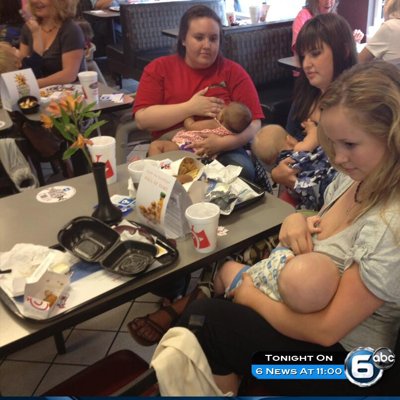
If breast is best, why do we never see anyone actually feeding their babies?

nursing
Courtesy of Twitter/News 6, via Yahoo

So a few hours after reading this news item on Yahoo, I find myself not being able to keep quiet about it: once again, breast-feeding moms are finding themselves being asked to stop feeding their babies in a public place. This time, it was at a Chick-fil-A in Tennessee. Honestly, though, the location is pretty much not important. What is important is the fact that it keeps happening.

Disclaimer: I am not a breast-feeding activist. I only gave birth to three daughters and breast-fed them all up until they were about a year old. I adopted one daughter after them and just bottle-fed. I enjoyed nursing my girls, but it was a heck of a lot of work and was literally draining. It was really, really tough to be THE on-call food for the babies. And my girls didn’t nurse for 20 or 30 minutes every four hours, giving me a solid break in between. They would nurse for a shorter time every two to three hours, making it feel as if they constantly needed me, just for sustenance (let alone all the other needs an infant has). It was exhausting and a HUGE invasion of my personal space. It made me kind of crazy. Even so, I breast-fed them. It was healthiest for them, which was important to me, and it was nearly free, whereas formula is super-expensive.

I never went to a La Leche League meeting or consulted a lactation specialist or read a book about breast-feeding or anything. I didn’t make a big deal out of it. I just fed my babies. And here’s why I feel the need to weigh in on this news item: it is a pain in the rear to breast-feed a baby in public. My oldest child is 17 and the youngest that I nursed is 11, so it’s been a decade since I’ve been in the situation of needing to feed a fussy child while out and about. No matter how well you plan and feed a baby before leaving the house, etc., there are darn sure going to be times that baby has to eat while you are outside of your house. And here’s the plain truth in our society even now: you almost never see a woman publicly nursing her baby, whether it’s at a store of some type, a restaurant, or a park. But that doesn’t mean they’re settling in to a nice, quiet, private room designated for nursing at any of these places, because VERY FEW public places have rooms for mothers to feed their children. There are more and more family bathrooms available different places, at least, which is definitely helpful, but still not a lot of spots for nursing.

What does this mean, then? There’s nowhere to go to “privately” breast-feed a baby. Restaurants, especially not fast-food restaurants, do not have somewhere to go if a baby gets hungry fast. So you either pack up and leave, with the baby wailing all the way home, before you’ve gotten to eat yourself, or you stay and feed the baby.  But since we still so rarely do see anyone else breast-feeding in public places (whereas you can see plenty of women and men handing babies their bottles out and about), none of us feel comfortable with the notion, even breast-feeding moms themselves, in many cases.

Now that’s plain ridiculous. But here’s why: people who’ve either not been around breast-feeding mothers very much or who have absorbed our upside-down society’s notions that baring a little portion of breast while getting a baby latched on or off is somehow public indecency either outright make comments or ask women to leave or “cover up” or they stare or make weird faces at them because they are uncomfortable.

The problem is not that women are being inconsiderate and not “covering up”. The problem is that in our backwards, inside-out, upside-down society, it’s somehow acceptable for women to wear teeny tank tops and blouses that are so low-cut they show a solid third of a breast, and no one bats an eyelash. No one asks a woman showing a ton of cleavage to leave a public place. But if a woman doing her best to “discreetly” breast-feed her baby happens to show for a split second a good portion of her breast (maybe even her nipple, for heaven’s sake!), then it’s lewd.

And that’s what has my hackles up. Because when I see other people posting about this topic, and still so many people, EVEN WOMEN, EVEN MOTHERS, comment that they think these women should be more careful about “covering up,” I know we have a big problem in our culture. Women stage “milk-ins” to raise awareness whenever these news items pop up. A lot of commenters say these are unnecessary. I’m thinking, however, they’re still very necessary. We need men, women, and children, of all ages, to see mothers breast-feeding their children, enough that they become comfortable with it. Because most people clearly aren’t comfortable with it. And it’s not because it’s dirty or lewd or filthy. It’s because they just don’t see it happen often enough.

If nursing moms still need to stage “milk-ins” or “nurse-ins” to finally get our generally very-non-prudish society comfortable with a really healthy and natural activity, then I support them all the way.

Yes, ‘family’ channels have a responsibility to families

I wrote an article two summers ago for the Deseret News about “family friendly” TV shows. At the time, I was feeling particularly annoyed by the Disney Channel, especially the show “Good Luck Charlie.” Two years later, I still feel just as annoyed, and I’m pretty much banning the channel from our house.

Good Luck

I’m reminded again of this because of the latest information about the channel and this particular show, stating that the show will be adding a set of lesbian moms and their child to the show next year. Now, I’m not going to get into my stance on homosexual unions or parenting or anything like that. I will simply say that this is a hot-button issue and that the country is fairly close to evenly split on opinions about it. What’s at issue here is that probably half of the parents in this country (I’m just very roughly going to guess on this since the opinions still tend to be 50-50 on the topic of same-sex marriage) might have some reservations about this issue and may not be excited that a channel geared at young children is introducing this kind of controversial topic.

Now I got a comment on my original article two years ago, with the commenter saying that I’m essentially expecting all shows to reflect what I think reality should be, rather than what it is. And, of course, that’s not at all what I’m saying. Any channel out there can run whatever kind of programming it wants to. It doesn’t “have” to be responsible to any set of people or values or expectations of any kind. And I’m OK with all kinds of wacky non-realities in TV shows. I love fantasy and lots of situations that are far different from my own or what is “ideal.” Watching those can either just be fun or entertaining or acceptably escapist, or they can be informative and worldview-expanding. That’s great.

However, when a network is essentially setting itself up to be known for being “family friendly” or, in the case of Disney, building on a long tradition of expectations for that quality, I do believe it has some responsibilities. If you don’t agree with me about this, just stop reading now. You won’t agree with anything I say further. In the case of being responsible about portraying families to young children, I think it’s irresponsible to introduce some of these more mature concepts that parents would prefer to address themselves. I also think it’s irresponsible to portray parents who are mean, parents who are immature and just goofy, and parents who don’t seem to care about their kids’ welfare — NOT because these scenarios don’t reflect reality, but because on the DC, they’re played just for the purpose of getting cheap laughs.

I cringe every time I see the mom on that show put down one of her kids or plot against them or do anything else that belittles them. It angers me when they act like little kids themselves rather than responsible adults. (Again, this is not to say that parents can’t have fun and act childlike; it’s AWESOME when parents get down in the mud and play with the kids or color alongside them or swing with them at the park. I am saying that when they act like brats to get laughs, it diminishes the meaning and value of parenting and the importance of love and trust in family relationships.)

I’m putting our satellite service on pause for the summer, and when I take it off pause in the fall, I plan to block the Disney network. I don’t want my girls seeing that stuff anymore. And I doubt that Disney will care. The folks there clearly plan to continue on the path toward putting parents in a position of goofiness and un-respectability. I just won’t support them.

How to make a bubble table. You’re welcome.

So it is the first day of the first full week of my daughters’ summer vacation. If you’re a parent, you may very well be like me in that just thinking about having the house full of children all day, every day, with no school or other activities to engage their attention makes you feel … well, nutty. I decided that this summer I would provide a few more fun things for them to do to keep them out of my hair and me outside the loony bin. First off, I went to Hobby Lobby and bought nine bottles of tempera paint in the good basic colors as well as two 100-foot rolls of paper, as well as a bag of assorted brushes. We’ve rolled out that paper on the tile in the entryway and the girls have had a good ol’ time. Now, granted, I’ve kept the paint and pretty much all non-Color Wonder crayons, paints, markers, etc. out of the room of the 6-year-old because even up until very recently she has not proved herself to be at all responsible with their use. So these paints are still not in her room, but stepping up to letting her use them was a bit of a leap of faith for me (control and clean freak that I sometimes can be). So far, so good.

Next idea: making a bubble table. Now, my girls were entertained for a good long time at San Francisco’s Exploratorium last fall just at the big bubble table. Exploratorium bubble table

They could probably have stayed there for the whole of our visit, but there were other children who wanted to use it. So I’ve been trying to find somewhere online that describes how to make one for home use. I searched on Pinterest and had no luck. So I came up with my own version. Here’s what we did:

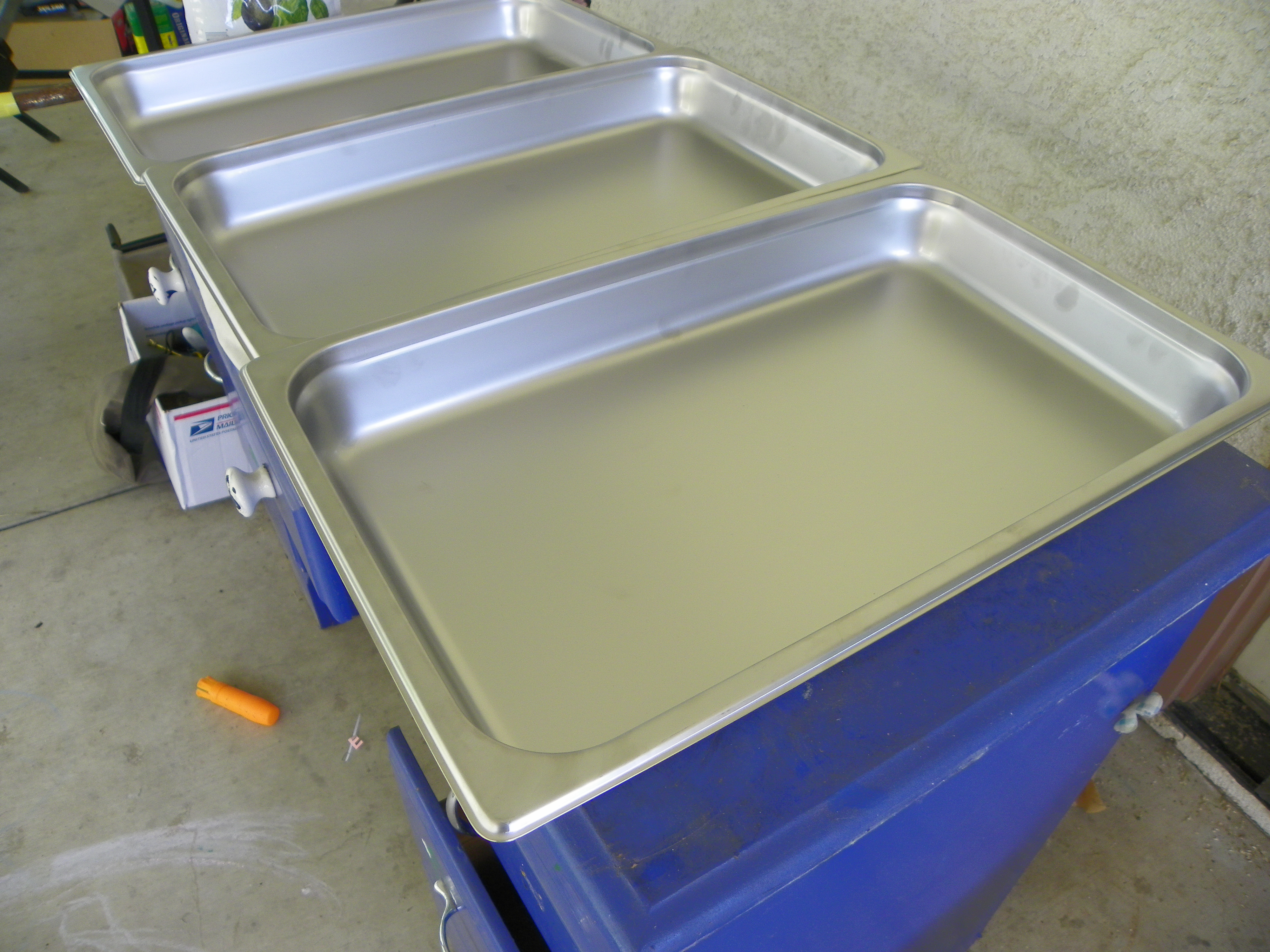
First, for the “table” part: I wanted to have some kind of large but shallow metal containers that could hold the bubble solution. I finally hit upon using restaurant-grade serving containers, the kind that are used in big buffet tables. I was lucky enough to find three of a good size at our local Smart and Final. Buying three at a time also reduced the price for me on this visit, so each one was $12. Now, if you’d like to keep this DIY cheaper, you could use the $2 foil containers of similar size, but I figured I’d end up replacing those a lot, so the $12 per container was a good investment. I also had to have three because I have four kids, one of whom is old enough to not really need/want to use the bubble table. The younger three, though, definitely each need their own.

metal serving containers

Next, I wondered what in the world I’d use for large rings. The Exploratorium had big rings with handles on them, which I figured I wouldn’t find anywhere. My husband then became the genius when he came up with the idea of using tomato cages, like this one at the right: tomato cage


Using his wire cutters, he clipped off the circle parts of the cages from the long straight “stick” parts of the cage and left just a few inches of those straight pieces on the circles. Then he bent each down into a little curlicue that the girls could hold.

making a tomato cage into rings

Last is the bubble solution. I’ve found a few recipes online, including one that’s been circulating on Pinterest and Facebook that uses corn syrup. So far, I think I like the recipe that uses glycerin. But since I just set it up an hour ago, it may well be that any of the bubble solutions will work better tomorrow after having time to sit and mix nicely and evaporate just so. Here is a link to some recipes. As I said, I think I like the one that uses 1 gallon of water, 2/3 cup of dish detergent liquid, and 2 or 3 tablespoons of glycerin.

I set up my three metal serving containers on an old desk that’s on our back patio that my oldest uses for her art projects. It’s not pretty back there, but it’s fun and useful. At any rate, now that desk is the bubble table.

bubble table setup

bubble tableAnd I’ve been hearing a whole lot of happy squealing from three girls for an hour now. Yes! Score one for summertime mama.

Motherhood: Growing your own friend from scratch

Being out of the country and away from my four daughters for 8 days recently, I was struck anew by how much I not just love them — because of course I love my offspring — but how much I like them. I’ve never been gone from them this long, and in the past when my husband and I went on trips together, they were younger. I missed them, but when they were little and the days were endless cycles of feeding, diapering, clothing, and just keeping them alive and well, I was largely relieved to have a break from that caretaking cycle.

Now they keep me just as busy, but in completely different ways. They can be their own caretakers in most ways: they can go potty by themselves now (diapers are a distant memory), they can feed themselves (even cook), get dressed, and even get themselves places on their own (oldest has a driver’s license). Now my job is to make sure they’re learning and becoming who they should and could be. It’s to make sure they are nurtured in so many more complex ways as they make their way through tricky adolescent and pre-adolescent years. It’s to support them in their activities, volunteering as a band booster and so on. The job title is the same — Mother — but the duties and job description are very different and much more complicated and nuanced. I don’t have to just show up and go through the motions; I have to bring my A game.

What’s happened, though, in the course of their becoming these independent selves, morphing from little eating and pooping machines who cry to communicate or just repeat “no” or “why?” ad nauseam is that they have become people. They are completely their own selves, with amazing personalities and unique mixtures of traits, talents, and quirks. What’s more, we have become friends in many ways. Sure, I’m not one of those parents who is more of a pal to their children than a parent, but it’s absolutely true that my daughters are my friends. My oldest in particular, who’s turning 17 this week and will fly out of the nest next year (cue the leaky eyes), is such a fun person. She’s nearly an adult, and she is mature in so many ways and simply fun to be around. We have all kinds of inside jokes and we can look at each other and grin at something we just know we’re both thinking. She is so delightful and pleasant to be around that I miss her presence when she’s not.

brianna as flower

And I felt that keenly while in another country. I didn’t talk to my girls for more than a week. I emailed and Facebook-ed a little, with one short chat session. (Even then, though, they were all using my mom’s account, but I could tell when a different child started typing. I knew exactly who I was “talking” to because of just how they phrased things.) But as much as I enjoyed my time alone with my husband and loved all the great scenery we soaked in and famous sites we visited, I missed my friends back at home. There were so many times I thought, “Oh, Brianna would like this. Oh, Cami would love that.” I was sure one would respond a certain way with a certain phrase to something we saw.

And as much as I loved (but often just plain endured) the different phases of mothering, I am loving this one, in which I can see how the little seeds I sowed have grown into full-size plants. They’re still here in my own garden, but in not too long they will be transplanted to other gardens. Right now, though, I marvel at how much I like them, how simply miraculous it is that I was growing my own friends all this time and didn’t quite realize it. I love them, but, even better, I really, really like them. Today, I will celebrate Mother’s Day with some really amazing friends. I can’t imagine life without them.

Farewell to E.L. Konigsburg

FrankweilerSo I just read that E.L. Konigsburg, author of From the Mixed-Up Files of Mrs. Basil E. Frankweiler, died. I can’t let this opportunity pass to write a short thank-you to her for that charming book, which I enjoyed so much as a young reader and which I have enjoyed just as much reading with my own young ones.

In a day when it’s easy for anyone to publish, and books for young readers are particularly hot items, we’re surrounded by thousands and thousands of choices for reading. I love to read the great new books that are coming out and contributing to the best of all genres, but there are some classics that still hold a special place in my heart, and Mixed-Up Files is definitely one of those. It’s a clever premise, one that any child who’s had those moments of wanting to run away can relate to, but which makes the destination very cool: two kids pack up and escape to the Metropolitan Museum of Art, where they manage to live secretly for a short time. Even now, it gives me little butterflies of excitement to think about the notion of being able to live in that awesome museum!

Then there’s the element of mystery added in to the story: is a statue the museum’s acquired for a bargain price actually the work of Michelangelo? And then there’s the interesting character Mrs. Frankweiler, who knows more than she lets on. All in all, the book is so fun to read, particularly because it’s so good at letting the reader step into the shoes of the characters and step off on a flight of fancy. It’s just the right setting for letting the imagination run wild. And personally, I’ve always loved museums, especially art museums, and my daughters love them too, so reading this story together doubled the pleasure.

Thank you, Ms. Konigsburg, for creating this story. I expect I’ll enjoy reading it to my grandkids one day too. And that is what makes a classic.

Special needs AND adolescence? Whoa.

I’ve mentioned a few times I have a daughter with Down syndrome. She has been an utter delight in so many ways, and such a blessing to our family. She smiles and hugs and just shines like the sun around pretty much everyone. She’s silly and goofy and has a great time with everything. She was even an “easy” baby, just so content to sit and observe and smile (a relief after my first baby, who was very demanding and had to be held ALL THE TIME).

Yeah, I had an adjustment period getting used to the idea of having a child with a mental disability. Luckily, I was able to absorb that information before she was even born, thanks to a blood screening test and then an amniocentesis. It is a shock; it’s scary; it’s unnerving. It’s not something you ever expect will happen to you. It changes things. But I came to terms with the new emotions and fears and uncertainties and just embraced the sweet daughter I got.

Honestly, even though for the first few years of her life, she was slower in her development than other kids (and than my first), and she needed special early-intervention services, it wasn’t often I thought that it was just that much different than raising my older daughter. It was mostly just a minor adjustment in expectations and in schedule, sometimes. I thought, “you know, this isn’t too bad. She’s not really different from other kids.” And honestly, she still isn’t.

But as she’s gotten older and is now a teenager, so much has changed. As time has marched forward further and further, it’s become clear just HOW much behind other kids she is, at least in terms of what she is learning (reading is great; comprehension is still not as great; and math? ARGH), and how much younger she really acts than other kids. When your child is only 6 and has lags in development and seems more like a 3- or 4-year-old, compared to other 6-year-olds, it’s still not a big difference. But when she’s now 14 and acts like and has the grade level, basically, of a 7-year-old, that gap is much bigger. It’s a gaping chasm that is obvious to everyone.

I was getting accustomed to that growing distance in development as well. But now she has hit puberty and has started menstruating, and man, that is a whole other story. My 10-year-old, who is bright and intensely curious and conscientious, learned about the whole “female thing” last year and asked me with great concern, “Mom, have you told Marissa about this? ‘Cause she’s going to start this soon.” I replied, “You’re right, kiddo. But how would I explain this to her ahead of time? Would she really understand? How would she react?” I thought it would be easiest to just catch her when it first happened and do a very simple explanation. She was fine with it, too, for a few months, happy to be like a “young woman,” like her older sister and mom.

rainBut then the hormones seemed to kick in. Now she’s been moody and sometimes snappish, completely out of nowhere. She will burst into tears like a sudden cloudburst. I thought it was probably just PMS, as in “pre-” menstrual, but now it happens whenever. Her teacher called today to let me know she’s been bursting into tears in class sometimes too.

It’s so much easier to explain the how and, especially, the “why” of hormones and moods and all that female stuff to a young woman who understands the nuances and can do a little better at looking inward and analyzing a bit and piecing things together. But I fear those kinds of things are lost on my second child. So it just breaks my heart to see her going through these moods and having no idea why she feels so sad all of a sudden.

Nope, this is a lot trickier than just making sure my toddler is learning to walk properly or hold a pencil well so she can write. Those were walks in the park. Now, life is much more complicated. But isn’t that always the case?

Safety: is it just an illusion?

Again, in reference to recent hotly debated issues, I’m not going to address gun control. I do think, though, it’s interesting to think about what constitutes true “safety,” or implied or felt safety. I’ve been thinking that most of the safety measures that are being implemented in schools right now, for instance, are really more there to create the illusion of safety than really, truly making our kids completely free from danger during school.

Kids are smart enough to figure this out really quickly, too. I have children at a high school, a middle school, and an elementary school. Soon after Sandy Hook, all three schools immediately started sending home letters and providing recorded information via phone calls about their stepped-up efforts to ensure students’ safety. Honestly, my first reaction on hearing the first phone call message was, “Right. Like changing which gates are going to be open at which times and which will be locked all day is really going to change things that much.” Yep. I was skeptical, and I’m still skeptical a month later.

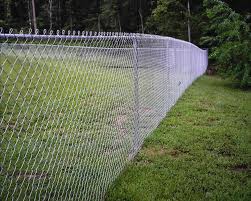
fenceThe high school started locking more of its gates two days ago. When I picked up my child and a friend at the end of the school day, I heard a good amount of reasoning from the backseat about how they viewed the new policies. Mostly it was this: it’s not going to do any real good. For one thing, the fences surrounding the school are just about six-foot-tall chain-link numbers. My little teen girl has jumped them any number of times (for good reason, let me just say; she’s not a rule-breaker) when she’s been at school outside of regular hours. So locking more gates isn’t exactly going to keep anyone out who really wants to get in.

The kids also observed that the recent threat that actually occurred at the school was by a student, and he had told a classmate about his intention to harm someone the next day at school (I think on a Facebook page). Allowing only students in to a few particular gates in the morning would not have kept this kid out because he belonged there!

The door to my kindergartener’s class is now locked every day the second the kids have all lined up and marched inside. If we arrive even 30 seconds late, then she has to stand outside, knock, and wait for someone inside to open the door. This is the only change I could see as making some kind of difference. The classroom’s only access is that door, and because of the design of the schools here (we’re in California, so the weather’s temperate, so the buildings all have rooms that open directly to the outside, not using any hallways), the room is then secure if the heavy door is locked. There are some smallish windows, but it would be difficult to get in through them. So I think this is the only measure that makes sense, though it stinks if we’re running late. That’s OK, though.

Aside from that, all the gate-locking in the world is like having a basic home alarm system: it helps the most as merely a deterrent to the casual intruder. But someone who is absolutely determined to get in will easily find a way around it.

These are just a few simple examples of how the schools are trying to demonstrate their increased commitment to our children’s safety. But really, it doesn’t mean much to me. Life is impossible to secure. Wacky, random, and tragic things happen everywhere. It’s impossible to fortify ourselves or everywhere we go to a point that we will be completely safe from any threat. Stuff happens. People are crazy. They do stupid, crazy, horrible things sometimes. Yes, it’s good to do what we can to reduce the harm, but so much of what the schools are doing really just seems pointless. I want to be safe, and I sure as heck want my kids to be safe. But neither I nor anyone else can guarantee their safety anytime, anywhere.

That’s the thing: we can talk about gun safety, about gun control and rights, we can talk about making security better in all kinds of contexts. But (yes, TSA) there are always holes in the systems and loose ends and cracks of some kind or another, whether it’s human error or breakable machines, etc. Stuff slips through all the time.

Thinking we can actually keep everyone safe in any situation is just fruitless and ridiculous. We can try. I’m not saying we shouldn’t. But in the end, all the measures in the world are merely an illusion of security. Because life and other people are unpredictable and not safe. We can just do the best we can to go about our business and take care of each other in the meantime.