Till we meet again

Earlier this year, I learned that a man who’s like a second father to me had cancer. He was doing so well for so long this year (from my standpoint of living at a distance from him) that I’d almost forgotten the clock was ticking on my time with him.

I was able to visit him for about an hour when I was in his state for a family event. I cherished those moments sharing him once again with two of my children, letting them spend a little time with this great man. I did know it was possible it was my last visit with him, but I hoped it wasn’t.

Now, his time on Earth is over, and he’s moving on to a new stage of life, one where he will be reunited with his sweet, sweet wife who died some years ago.

I met Robert Harbertson when I was assigned as a missionary for my church to the visitors centers at Temple Square in Salt Lake City. Rather than spending 18 months going “door to door,” as many are familiar with our church’s missionaries, I had the unusual volunteer opportunity of basically being a tour guide, of showing visitors from all over the world around Temple Square and introducing them to some of the history and beliefs of The Church of Jesus Christ of Latter-day Saints. This amazing, dear man was assigned to be in charge of all of us young volunteers (as well as the older ones, retired couples serving together). As such, he was an authority figure and a parental figure, who watched out for us and made sure we were safe and happy and thriving and getting along with each other. I saw him every day and knew he had absolutely my best interests at heart.

My 12-year-old says now her favorite story about him (I’ve told my children — and anyone else who will listen — plenty of good stories) is his opinion on the thickness of the peanut butter in my daily sandwich. Mind you, this same man handed down a rule that we young missionaries were not to comment on others’ food choices; we had missionaries serving there from countries all around the world, and sometimes they ate some strange-looking things to us Americans (or maybe vice versa). He didn’t want any comments on the “weirdness” of cultural food options to make anyone feel hurt. Even so, one day I was sitting at our lunch table and about to sink my teeth into a perfect peanut butter sandwich: it was made from the homemade whole grain bread provided in our break room and a very thick layer of creamy, gooey peanut butter. He reached around me and actually handled my sandwich, squished it, and said, “Sister Carmode! How much peanut butter did you put in that sandwich?!” I told him to mind his own business. Well, basically. We still had a good laugh.

President, as we just tended to call him, had a stern facade, which could be mighty intimidating if you didn’t know him, and if he had the need to make a point. But after just a short time of knowing him, I was wise to his game: just ready to pop out from behind the stern face was a huge, impish grin. He was also competitive, reminding us that he played college basketball, and we learned at the beginning of a spiritual address from a top church leader that President and this apostle regularly played a serious game of racquetball. I’m sure it was take-no-prisoners.

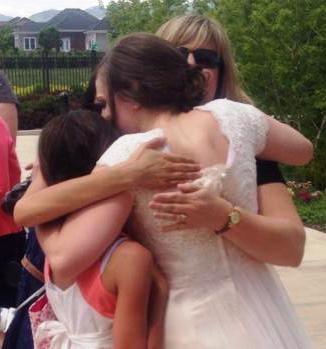
Here we are together at a 20-year reunion.

But at the heart of this stern, rule-making, authoritarian figure was a warm, gooey heart that held a spot for little ol’ me. He was in charge of probably 100 or more young women during his volunteer time, but he could make me feel I was the only one he had to take care of. Honestly, I love and miss my dad a great deal, but thanks to a very tough upbringing, Dad wasn’t a naturally, unconditionally-loving kind of person. So being in President’s care, having that place in his big heart, not just during the time he was assigned to watch out for me but in the two decades since, was a window into an experience I hadn’t quite had. It gave me a better understanding of what it means to be loved unconditionally and a boost to my feelings for myself.

When I was dating my husband, I took him to visit President and his wife, and he got their stamp of approval. It just so happened that was 2 1/2 months before my parents got to meet my then-future husband. I visited President on my way across country during one of our long-distance moves, with my firstborn baby girl. I’ve visited many times over the years and had little booster shots of that man’s love, all the while giving my girls the opportunity to experience it a little themselves.

We met in a place where a famous choir often sings “God Be With You Till We Meet Again.” Now, I sing it to President. I look forward to meeting you again.

Parents who don’t hover are the ones in danger, not their kids

I’ve read a couple of articles lately that have reminded me just how tough it is to parent these days. And not in the ways you might think.

First, I read a great column about one woman’s experience, When kids were unbreakable, remembering her “dangerous” childhood and giving her kids some more opportunities for freer play. I think most of us who are in our 40s and up fondly recall hours of free play when we were growing up. I was particularly lucky to live “out in the country” most of the time before I turned 10, after which point I was more in neighborhoods. In both living situations, though, I was away from my house (and my watching mom) for hours at a time, playing in the dirt and in creeks, exploring the woods, walking along dirt roads, riding bikes along suburban streets or cutting through unfenced yards to walk to friends’ houses. I rode my bike with no hands a number of times, and once I ended up needing stitches in my elbow because of it (and I didn’t do it again). I don’t remember a lot of other dangerous things I must have done, just that I had lots of fun, was mostly smart about it, and paid attention to what was going on around me. Dad taught me to shoot a rifle in the backyard a few times (in the country); Mom taught me how to use a knife (and lots of other tools) in the kitchen.

The short story is this: my mom and dad didn’t watch my every move. I wasn’t penned inside my house; I wasn’t watching TV or any other screens very much. I ran and played. I breathed fresh air. I invented all kinds of fun games by myself and with friends and (if forced 🙂 ) my younger siblings. I made something fun out of “nothing,” the materials at hand. My mom felt fine — and was a perfectly great parent — letting me go outside her supervision for those hours.

Today, things are far different. We live in a hyper-vigilant society, in which we have 24-hour news coming at us from TV and the Internet and smartphones. Every instance of bad things happening to kids is reported to us. We fear strangers and are sure if we aren’t watching our kids every moment, that someone will likely snatch them. We live in a time when we are told to know the signs of child abuse. This is a good thing; abuse is not pushed under the rug as much and is better reported. But it’s made us all wary of being the kinds of parents who let our kids have free creative time to explore and imagine and play, without being within 10 yards of them at all moments. We fear that our kids might get kidnapped and/or abused. We fear that we’re not being “engaged” with our kids, providing them lots of fun play options. We fear we’re not good enough. I’m fairly sure that these weren’t concerns for our parents.

Which brings me to the second, and very disturbing but not surprising, article, Woman Calls CPS After Seeing Kid Play Outside. It upsets me to read it because I’ve been in a similar position. When my first two were only 2 years old and a few months old, I was reported (anonymously, though I was able to piece together who it was because I knew her personality and modus operandi) to CPS because someone was concerned they were undernourished and one had a raw, chapped rash between her lips and her nose. Here’s what the circumstances were: my kids were and still are, many years later, petite. The infant had Down syndrome, and many people don’t realize that children with Down’s have their own growth chart. My pediatrician measured her growth against other DS kids. She was fine and perfectly healthy. In fact, we’ve always been blessed that she’s been remarkably healthy, with no heart problems, no digestive problems, almost no ear infections, even. But she looked, to one too-sensitive observer, to be “too small.” My 2-year-old just had a bad (and difficult to break) habit of licking above her lips and that small area was for a fairly short period of time just red and chapped, and I did everything I could think of to make it better. This apparently also made me an object of concern.

A case worker came out to our house and questioned me and looked at the kids, and I was lucky enough that that was the end of it. My kids also were too young to know anything was going on. But it was extremely upsetting for me. I was scared and just sick to my stomach. Raising my kids was hard, and I was always grateful for a break and me-time, but I certainly didn’t want them taken from me!

It was also my introduction to the brave new world of Big Brother: everyone is watching you. And they are given the power over your life to call a number and anonymously report the possibility of you being a Bad Parent. Then you are thrown into what I have discovered is not just a flawed system, but one that’s in some places openly hostile and dangerous to normal, good parents. I don’t have space to tell all the stories, but I could relate a number of them, of good and loving parents who have ended up having to take time-consuming and unnecessary parenting classes, hire attorneys, and be in genuine fear for their parenting and working lives because someone misconstrued something they did in public. It is terrifying.

We have become a nation of helicopter parents, it’s true. And we’ve become a nation of people who are quick to jump to conclusions, who are quick to call “the authorities” on the basis of a tiny possibility of a problem, who don’t know their neighbors from Adam, who have no idea of any context of the lives of the people they’re reporting on. If we knew each other better, knew that our neighbors were good parents who love their kids, whose parenting styles assuredly are different from ours but are NOT BAD, who support their kids and teach them and are making them into responsible adults, we’d be far less likely to go straight to the government with a concern rather than talk to our neighbors first, if we do anything. But we don’t. We are very connected with disembodied people via smartphones and tablets and computer screens, and with talking heads on the news, but not truly interconnected with a community of real, living, breathing people. We’re taking a quick way out to call the authorities and assuage some kind of guilty conscience (for not being better involved, for not knowing Mr. and Mrs. Smith and their two kids next door) or to pat ourselves on the back for “doing the right thing,” as the government and news outlets repeatedly tell us.

Would it be possible at this point to go back a little, to recapture the sense of community we had as neighbors, to support each other in the tough job that is parenting, and to let our kids have the space they so desperately need (as studies keep proving) for free play and imagination and learning how to navigate the world? I’m a little worried that it’s not, that we’ve gone too far. But I desperately hope we haven’t.

Education problems? Families are the solution

If you’ve read my blog much at all, you may have noticed that I have a few passions: I care about and advocate for mental health issues, education, and other issues related to the media (content that’s suitable for families and kids, better accountability on issues like image and portrayals of women).

In the 14 years or so I’ve had kids in school, I’ve been involved in different aspects of education. At times, I’ve attended school board meetings and advisory meetings; at other times, I’ve been involved with specific organizations like the band boosters. I’ve always gone to my kids’ parent-teacher conferences and back-to-school nights and open houses and so on. I’ve helped out in classes sometimes and gone to activities. In all this time, I’ve observed all kinds of problems, some of which I’ve written about.

But in all I’ve done to participate, read, ask questions, and educate myself about education in the United States today, I’ve realized one thing underlies most of the problems and concerns: families aren’t playing the role they should in the development of children and their overall education.

I’ll say that again: Taken on the whole, families (i.e. parents) in this country aren’t teaching, supporting, and nurturing their kids. Why? Lots of reasons. But to be brief and try to get at a core issue, families simply aren’t “whole” anymore. I read a great overview of how there is no “average American family” anymore and it provides a few revealing statistics, taken from a new book: “Take 100 children who are representative of American life, … and 22 live in families where mom stays home and dad earns the income — the ‘typical’ family experience of 65 percent of kids in the 1950s. Another 23 live with a single mother; it’s a 50-50 proposition whether that single mom was ever married. Seven live with a cohabiting single parent and three each are being raised by a single dad or grandparent.”

If many kids are living with just one parent, and that parent has to do the job of two parents, and is necessarily away from the home working to provide for the family, it follows that those kids won’t have the level of involvement in their day-to-day lives and school lives as a household in which there are two parents. And in those households in which both parents are working (because that’s their choice or because of economic necessity), kids will have more involvement in their lives than the families with one parent around, but they simply won’t have the time dedicated to them that a family has with two parents with only one parent working outside the home. I’m not casting blame here at all; I’m simply looking at the realities of time constraints and what kind of actual QUANTITY time kids have with parents, as opposed to the oft-talked-about “quality” time.

The reality is that quality is great, but a certain amount of quantity is vital. As a stay-at-home parent (I do editing work from home on my own schedule, which is a luxury I really appreciate), I get lots of face time with my kids, who are all in formative periods of their lives. They come home from school and have questions or comments or needs, and I’m there for them. They are lucky to have a parent there to help them with needs and to do informal teaching. Kids’ learning really happens during moments they have questions and someone can answer tailored to their interests.

So with the new reality being kids living in homes with single parents who must be absent and with two parents who are both often absent (during those crucial times of afternoon into early evening), kids aren’t getting as much time for informal learning from their parents. That learning includes all kinds of topics: building character, learning to manage finances, learning about interesting topics that schools don’t necessarily provide classes in, getting opportunities for family “field trips.”

Schools are places to learn the sciences, literature, math, writing, history, etc. I was quite good in all the school subjects when I was growing up, but I wouldn’t feel comfortable teaching advanced math or sciences to my kids; I’d rather they have teachers who specialize in each subject and who are particularly adept in those to help them learn about those topics.

I guess I sound rather old-fashioned. But the reality is that it’s not the job of schools to teach character, for instance. Schools can’t take my kids on trips very often at all to learn about different areas of our state or country. Schools can’t teach faith, and they don’t often have time to focus on basic life skills that are more easily learned informally at home.

Character Counts is a nice program, but it isn't enough to replace parents teaching their kids about character 24/7.
Character Counts is a nice program, but it isn’t enough to replace parents teaching their kids about character 24/7.

Time in school is finite, and as I’ve observed at a variety of meetings with other parents and educators, it’s becoming more and more difficult to fit in during a school day all the core subjects, let alone other things schools are having to teach kids because their families aren’t doing it very well or at all. In our town, elementary schools focus on a different character trait every month to teach students: respect, responsibility, caring, trustworthiness, fairness, citizenship. Why? The “Character Counts” program was started to “combat youth violence, irresponsibility and dishonesty” by stressing positive character traits. This means that the community and schools were finding that kids and teens were acting badly and needed to be taught values; families weren’t doing the job.

Over the past dozen-plus years I’ve been actively participating in community education, I’ve seen all the problems that exist. I’ve also seen all the programs school systems have started or turned to to combat the problems. I’ve seen how little time and money exist for schools to be able to surmount all these issues by themselves. And the simple fact of the matter is this: no matter how much schools try to do to “raise” kids into good, contributing members of society, they simply can’t parent kids. Parents parent. And no one else can do that very challenging, intense, nonstop, VITAL job.

I’ll continue to be involved in school meetings and advisory panels and so on. I’ll continue to give ideas on how better to teach and support all kids, mine and everyone else’s. But nothing I or the schools can do will take the place of the home. The solution is to support families and homes. Our nation, our communities, absolutely must find ways to strengthen families. In the article I mentioned earlier, Brad Wilcox, director of the National Marriage Project at the University of Virginia, says this: “Kids raised by their own intact, married parents are more likely to flourish. Given that, public policy should help strengthen both the economic and the married foundations of family life for kids in the United States.”

Until we change our attitudes about marriage and family life, our children (including their education) will continue to suffer.

Rolling on in to middle age

Recently I took my girls roller skating. The 12-year-old had been going somewhat frequently of late and had gotten pretty good but the 7-year-old and 15-year-old (my child with Down syndrome) hadn’t been in ages and were like baby deer out on the rink. But they got better and enjoyed themselves during our two-hour visit.

As for me, I love donning the wheels and racing around the rink. It was my weekend social activity when I was a tween, and decades later, I still can hold my own. It’s an interesting/frustrating kind of challenging to “race” around when the rink is full of little kids — it’s like a slowly shifting obstacle course. So I was excited when the DJ announced it was backwards-skate time. I can still do it, after all these years, and since most of the little people jamming the floor could barely move forward, let alone go backwards, the time meant I had a much emptier space for skating. Yes! Only difference at this stage in my life is that I wasn’t just focused on my skating: I was also looking around to see where my kids went. And that meant loss of focus on the specialized form of backwards skating. As Queen sang so often when I was skating socially, I bit the dust. Big-time. And falling when going backwards means a particularly spectacular, unbroken-by-arms fall. OUCH. I got up and kept on going and my lack of focus had me back on the hard floor pretty quickly. I could feel my brain shaking around in my head, so I decided it was time to remove myself from the floor for a while.

A little while later, my perceptive and sensitive 12-year-old looked at me with concern and said, “Mom, people were laughing at you.” I realized then that it just didn’t matter. It didn’t bother me at all. I told her so. Maybe it’s because they’re a bunch of kids and it doesn’t matter to me if a bunch of snotty kids are laughing at me, or maybe I’ve finally started reaching a point where it doesn’t bother me quite as much what other people think. I just told my daughter, “You know what? It doesn’t matter to me. I was having fun. Don’t you worry about what people think about me.”

It’s made me think more about how I’m at an age where I can and should stop worrying about what other people think. I’ve read so often about how older women say they live so much more freely and contentedly because they just don’t care about how they look or what other people think, and it seems like a great thing to me. But as our society holds on so tightly to youth and beauty, allowing/encouraging women my age and even into their 50s and 60s to still look “traditionally” young and beautiful, i.e., desirable, sexy, etc., I wonder if that transition into that delightfully free mindset will take even longer.

‘Cause here’s the thing: how long do any of us really need to be beautiful, to have that be one of our defining characteristics? On one hand, I felt uncomfortable in my skin, didn’t feel thin and pretty, when I was growing up, but then around the age of 17 or so I grew to appreciate that I was attractive, that a fair number of guys considered me pretty. And I realized I could use that, I could “work” it. I could flirt, I could be cute and attractive. I could just have fun dating. My attractiveness was a tool, one of the arrows in my quiver. The quiver also included my smarts, my talents, my wit, my personality, my character. But my “beauty” was almost of equal value at that stage in my life as any of my other arrows. I carried around that awareness of its presence for a long time, even past its “usefulness” in “securing a mate.” (That’s a topic for a whole other blog post, methinks.) Two decades into my marriage and my parenting life, it’s honestly just not necessary or important, definitely not like the other valuable arrows I have cultivated. But everywhere I look in our society, I still see messages that tell me my beauty should be treasured above all, should be curated, should be preserved. There are plenty of options for that preservation, after all, and whole multi-billion-dollar industries begging for my attention and money.

No, society today is not at all supportive of a gracious and peaceful acceptance of aging, of losing youth and “beauty.” We don’t get to just comfortably slide into older age. We fight it, we see others fighting it, we are encouraged to fight it. But eventually, whether we get to slide comfortably and willingly, or we fight it the whole way, all of us who make it to old age will be old. We will lose our youthful appearance. What if we actually just accept and embrace the inevitable instead of fighting it tooth (yellowing) and nail (thinning and cracking)? What if we came to appreciate all the other things that make us who we are and stop worrying about the thin veneer of attractiveness, of appearance? What a world that would be! Think of the inner peace! Think of all we could do in the world without using up our (yes, finite) energies on something ridiculous like how we look!

So I’m encouraged a bit by my reaction to my ridiculous-looking falls at the roller rink. Maybe I am just starting to accept the fact that I’m middle-aged. Maybe I’m starting to not worry so much about how I look and how I think others think about me. Maybe. Because I’d like to use my limited energies on the things that matter the most to me, and there are lots. My family, my friends, worthy causes deserve my full attention. And all they need of my appearance is my smile. I still have that, and the only thing I need to do to keep it in top condition is keep using it.

Great divides

Humans tend to be pretty divisive. We can be divided between individuals or, it seems even more commonly, between groups. We group ourselves in all kinds of ways, and then we cling to our groups and hiss and claw at other groups (yeah, I have cats). I’ve written about this before, and here I am thinking about it and writing about it again.

I just finished reading, for example, a compelling and fascinating book, The Good Spy by Kai Bird, about Bob Ames, a CIA agent in the 1960s and 1970s who worked tirelessly to build and maintain relationships, even friendships, with key players in the Middle East, some of whom the U.S. would have considered enemies, so he could contribute to peace between some very, very divided groups in the Holy Land and its environs. He did make great contributions to the peace process, and then he was killed in the 1983 bombing of the American embassy in Beirut. The book’s examination of the complex, longstanding issues and conflicts in that area and of the passionate, extremist beliefs and actions of individuals and their groups reminded me just how bad things can get among us very flawed humans. And before anyone thinks, “Well, that’s just one small area,” let me remind them that this small area’s conflicts deeply affect the entire world.

The most recent divisiveness I’ve seen has involved a group I’m a part of, this one my religious group. The Church of Jesus Christ of Latter-day Saints has been in the news for some time now, for a variety of reasons, but very recently it has been the focus of discussions about women’s place in the church. A very small group of LDS women felt that women were being marginalized in our church, so they ultimately decided a straightforward way to solve this problem was to ask, then demand, that women in the church be granted the priesthood, which for the church’s whole history has been granted only to men. I do not have the space to discuss the doctrine involved here, but I can only say briefly that my understanding, my study, my experience, my feelings about the topic lead me to conclude that giving the priesthood to women is not the answer to certain problems that may exist (and I word it this way to recognize that some individuals in the church, human as they are, are definitely not perfect — none of us are!! — and have made some poor decisions or behaved in ways they shouldn’t have, thus making some women feel marginalized, and that does need to change).

From what I have read, the leader of this group finally made some choices that were too far out of the boundaries that have been set for and by the LDS Church, and she was excommunicated, or put out of the organization, according to its own rules, well known to its members. It is sad, for many reasons. But from everything I’ve learned over the years, this seemed to have become a necessary action for the church to take. It is not permanent; anyone who is “disciplined” in any way by church leaders is given opportunities and time to resolve their problems and concerns and find their way back, with support and help from these same leaders.

What I have found particularly distressing is the divisiveness this has caused within our church group. Because, the thing is, there are plenty of other groups within this large group, and these groups are now rallied against each other to some degree. Some — again, human and imperfect as they are, somewhere along the long path to being more like Jesus Christ, whom we strive to emulate — have made unkind comments on news stories online or have posted negative things on social media about the issue. Whichever “side” they’re on, their approaches are wrong.

I have many dear friends I admire greatly who disagree with me on this issue and other topics that relate to “groups” within this larger group we all share. I wish we didn’t disagree, but that’s the nature of things: we all have different life experiences and different ways of interpreting and seeing issues. Usually, we can simply remember that each “adversary” is a friend, a fellow human being, a fellow child of God, and treat them with compassion and kindness, even as we respectfully disagree on opinions. And sometimes, yes, sometimes, division will happen and sever people permanently. Jesus himself spoke of this happening. When he sent out his apostles to teach his doctrine, he told them, “I came not to send peace, but a sword. For I am come to set a man at variance against his father, and the daughter against her mother, and the daughter in law against her mother in law. And a man’s foes shall be they of his own household.”

I believe as part of the doctrine of my faith that we are living in a time close to the Second Coming of Jesus Christ. These latter days are ones that will be difficult for everyone, on many, many levels and for many reasons. I do believe we are being “sifted” and “tried,” to see where we stand, as we prepare for Jesus’s return. That’s my belief. I do make judgments about issues and where I stand on them; I cannot stand by and not make a judgment call, a decision, on most topics because Jesus has also said we cannot be lukewarm. We can’t sit on the fence. We have to choose a side, and we must do so as wisely and thoughtfully as possible, weighing things, considering, praying, seeking inspiration for ourselves. My friends and other groups may very well end up on the different side of the fence from me. Strangers I read about may end up on a different side. All I can do is state what I believe and possibly why, and still be kind and compassionate even as I disagree. I do have to judge an issue for myself, but I don’t have to judge a person who disagrees. I don’t have to be mean. I certainly don’t have to be mean and nasty online.

I do not know the future or the details of the big picture. Only God does. In the meantime, I can follow my Savior’s teachings as well as his example, by making choices that are the best ones I know how to make, trusting that we all will someday understand more of the big picture in which these issues fit, and by being loving and compassionate to all, even as I stand firm in my beliefs and decisions. I appreciate and support the statements made in a video by one female church leader:

Those who are struggling for whatever reason should be able to find within our sisterhood a spirit of warmth, inclusion, and love.

Occasionally, some of our brothers and sisters may find themselves away from the fold because of personal choices. Without condoning those choices, it is important to remember the Savior’s message of leaving the ninety and nine safely in the fold and reaching out with love, with kindness, and with compassion to the one. We can demonstrate that compassion by ensuring that our communications with one another are respectful and kind.

A wedding is a promise of best days to come

The wedding of my littlest sister gave me the opportunity to remember the start of "best days" in my life.
The wedding of my littlest sister gave me the opportunity to remember the start of “best days” in my life.

This weekend I had the privilege of witnessing a wedding. Weddings are such happy occasions, filled with love, friendship and support and the opportunity to further cement ties of various kinds. At one point after this wedding, someone commented that the day would be the “happiest day” of this young couple’s lives. I thought immediately, “You know, it is a great day, but there will be many more and even happier days to come.” I can definitely say my wedding day was not the happiest or best day of my life; it was 21 years ago, and I was 23, and I loved my husband and was excited for the day and all it meant, but I have had so many wonderful days, better days, since.

The groom in this scenario was the next-to-youngest of eight children, and his parents were blessed to have all their older children married already, and these couples were all in attendance. I’d venture to say, from my own experience, that this day may very well have been one of the best days of the groom’s parents’ lives to date, as they were able to celebrate a beautiful, meaningful occasion not just as a couple, but as a family: the family they themselves created and nurtured.

My view is that marriage isn’t just about putting a legal or cultural stamp of approval on a romantic relationship. It’s meant to be the start of a family. And my faith teaches that families are forever: that marriage is a vow between a man and a woman that can be “sealed” in the presence of God in a temple and last forever, more than just “till death do you part.” And that promise to be faithful to each other and support each other and grow together includes having children and teaching them and loving them. That big picture, the years spent growing together as a couple in love and being able to rear children, is what brings the best days of all.

I definitely appreciate the sentiment expressed by Bruce Hafen in one of his excellent books, The Broken Heart: “One new bride reportedly said to her mother on her wedding day, “Oh, Mom, I’m so happy! I’m at the end of my troubles.’ ‘Yes, dear,’ replied the wise mother, ‘but which end?'”

A wedding day may seem the culmination or the end of a courtship, the fulfillment and denouement of romantic love. But it’s really just the start of something much bigger, deeper, and wider. I’ve enjoyed some wonderful days with my love of 21 years, as well as a bunch of stinky ones. We’ve had our share of troubles and stresses and real difficulties. We’ve had our share of disagreements and I’ve had moments or even hours during which I’ve been very frustrated with him (and I’m sure he’s been in the same boat with feelings about me), to the point where I was beside myself and unsure where to go next, how to resolve our problems, how to feel less angry or disappointed. But I’ve had moments of pure contentment, absolute satisfaction, utter bliss. I’ve been satisfied that despite the difficulties, I made a good choice of spouse and that despite everything, I still just LIKE him a lot almost all of the time.

We’ve been blessed to have four daughters, three biological and one adopted. And we’ve had days and weeks of frustration in parenting, of being at wits’ end, of not knowing how to proceed with parenting challenges. As our kids have gotten older, these moments have become more frequent and intense, because they’re more and more their own people with distinct personalities and very definite plans to exert independence. They can and do make their own decisions, and it’s our job to guide them and provide meaningful consequences, discipline and teaching, combined with big doses of love and compassion. But the whole job has gotten almost exponentially harder and more challenging with each year each gets older.

At the same time, these independent people we’re rearing are also sources of immense joy and happiness. At the best of times, when everyone is getting along, when we’re just having fun, simply being ourselves together and laughing and being distinctly us, the unit that is uniquely the Marce and Cathy Lim family, it is the best of anything I’ve ever experienced. It really does feel like heaven on earth, the best version you can dream up.

Here’s why these years can contain the best days I’ve ever had: there are more of us than just the two we started out with. Our little couple expanded into a sixsome composed of some amazing people who are wonderful to be around as individuals but even better when combined. I cherish our wedding day as the start of what we have now. But it was just a seed, an embryo, of what we were meant to be and to have. And as time goes on past today, past this year, past these moments where I can enjoy other young couples’ “seed” days of weddings, our Lim tree is growing and growing. There are far more “best days” ahead, and I look forward to them with great anticipation.

Safety nets and support systems

A few weeks ago, an outspoken acquaintance was ranting about public education, among other social issues. The married man in his mid-30s (who has no children, mind you) said, “Anyone who sends their kids to public school is a neglectful parent.” Bold — but undeniably hyperbolic — words. And while I appreciated the kernels of insight (far) below them, with many frustrations of my own about public education, I had to disagree for a number of reasons, aside from the obvious point that there are plenty of us very good parents who still are sending our kids to public schools.

Then I was talking with my mom about my grandma, who’s 97 and in probably better health than I’m in, and living in a nice retirement community. She recently fell a couple of times and got an infection, so she spent a few days in the hospital and now is in transitional care and needing a bit more attention, rather than being pretty much independent. My mom has been with her there (visiting from the town she lives in about a 6-hour drive away) and has been outraged at the lack of attentive care she’s been witnessing — and this is with my mom there near her, at a highly ranked facility, and my grandma has very good insurance and financing. We’re not even talking about a not-so-great facility paid for by Medicare.

I won’t go into all my concerns about public education, about health care, about elder care. They’re each deserving of thousands and thousands of words. What strikes me, though, is that as a 40-something woman who has children at home, one daughter about to attend college, and a mother who’s retired and a grandma who’s quite old, I am in that spot of life where there are plenty of people to worry about and take care of on some level. And as much as I’d love to be the kind of person who could home-school my kids, I’m just not. Plus, I still want them to have the opportunities for learning about the world that exist outside my home. And I wish my mom and grandma could live with (or nearer to) me and I could help watch out for them.

We all need safety nets.

Here’s the thing: none of us in our society today is capable of doing it all. In fact, no one ever has been able to “do it all” as we see it in our contemporary society. We have so many opportunities for self-actualization and fulfillment (which can be “bad” or “good,” depending on to what lengths we go to achieve them) and for involvement in the world around us today. But we depend on our public-sector system to provide certain services to take care of our wide and varied needs, like education and health care. Decades ago, extended families lived either in one home or very close by, and they worked together, sharing all the duties. Communities were truly communal; everyone did something to take care of someone else, essentially. Today, extended families are often distant. My mother is 2000 miles away from me, as well as most of my siblings. It’s my job and my husband’s to take care of my children; he provides most of the money from his 40-hour-a-week job to buy what we need, and I carry out many of the functions at home (another blog post entirely, too…). I feel we’re actually blessed to be able to have that setup (I am pleased with it, let’s make a note of that, too); I have flexibility to be able to be there for my girls when they need me throughout the day and to be involved in educational and extracurricular activities. I also am able to pursue some of my own interests, which makes me feel “me” and better able to take care of my family.

“It takes a village” has now become a bit of a trope, but it’s still true. Individuals need systems around them to allow them to live and thrive. Nuclear families best provide individuals with what they need, and extended families best support nuclear families.

So what’s wrong now? I am positive much of it is the breakdown of nuclear families; we have so many single-parent families today. Extended families are just as broken in many respects; some aren’t broken, just distant because of necessity. The basic solution is twofold: do all we can as a society to support the nuclear family, helping and encouraging the formation and permanency of families, and then to make sure the public-sector services are good and dependable. Everyone, every family, needs to know that education is well funded and well run. And families who are responsible for their elder members need to know they will be supported in those vital endeavors as well.

I’m not “for” government running everything. I am “for” programs that will provide help to families, who are the backbone of our society. I am “for” making sure there are safety nets and support systems in place, not to replace the work of families, but to help them do their work better. Because if our families are struggling, our whole society is in a real pickle.

I will not admonish you to ‘enjoy this stage’

I think one of the worst things to hear as a parent, at least of young children and definitely of kids still at home, is “Enjoy this stage: they’re going to grow up before you know it!” Honestly, any unsolicited advice or “pseudo-advice,” which is what I’d call this admonishment, is generally unwelcome. Adjusting to parenting is hard enough — finding your own groove, your own way of handling all the changes, all the individual factors that combine to make your parenting experience unique in some ways — that getting told how to do better, or, worse, how to “think” or “feel” better about it, is a tough pill to swallow. You pretty much just wanna smack the well-intended but not-thinking person who dared to say it, perhaps with a squishy used diaper (OK, this is my reaction when I get ridiculously tired and cranky: I tend to overlook how people really can say things in well-meaning ways). Here’s my advice to improve that advice: be encouraging, give specific tips you’ve found useful, and provide a meal or babysitting if you really wanna make ’em smile!

Here’s what I know after 18 years of being a mom and being still in the middle of raising four daughters: parenting is tough. It’s physically and mentally and emotionally draining. It takes everything that’s in you and more. It makes you double- and triple-question yourself. And each stage of raising kids has its own set of challenges that exhaust your reserves (or try to) in various ways.

But I have come to appreciate that each parent, thanks to his or her particular backgrounds and skills, may be better at, more suited to, or at least enjoy certain stages more than others. I am pretty sure I was not a natural at parenting babies and toddlers, although by the time I got to my third, I was better prepared and, thus, more interested in it and wanting to “enjoy” it, “savor” it, more (as much as is possible). But with my first, who was honestly a very needy, demanding baby and gave me not a second to myself, to gather my thoughts or even shower, without fussing for me, I was always on edge. Tired is not an adequate adjective to describe how it feels to take care of a newborn in any circumstance, anyway. (This is why I reiterate: do NOT tell the mom or dad of a newborn to “just relax and enjoy it.” Enjoyment requires a level of consciousness that is precluded by the exhaustion that fogs up the brain and life in general. One can just catch snippets of enjoyment.) I did enjoy my subsequent babies more because I knew a little better what I was doing and they weren’t as demanding, naturally; plus, I had other kids by then to help with them. But I still just couldn’t dive in and fully enjoy because, like I said, that requires a lack of haziness.

What I have come to enjoy so far are the school years, in some small part because I generally get a full night’s sleep every night. Mostly, though, I love to teach my kids and help them learn, and read with them (and since I love reading, I must admit I’d rather read a book that at least has a rudimentary PLOT, rather than a long selection of letters or numbers, I don’t care how adorably illustrated and brightly colored those letters may be). I also like having them be gone for part of the day, so I can have a little time to gather my thoughts, be myself, and get some things done without their assistance or accompaniment. Yes. I admit that. When they are then home I can really have more fun with them. I like teaching them as part of our everyday life, not as a “lesson.” I chatted with my nearly-12-year-old last night about mathematics, physics, chemistry and biology, including my interest in subatomic particles and my desire to eventually make time to stop at the (fairly close-by to me) Lawrence Livermore lab (ooh… particle acceleration!). I mean, really, who wouldn’t be excited by the tiniest, unobservable pieces of matter being slung around inside a tube for a mile to see what they’ll do?

My girls are just great fun.

I found myself grateful yesterday by the simple fact that I could run inside the library for a couple of minutes and tell the same nearly-12-year-old that, yes, since she has a good stack of books for the moment, she could stay in the locked car and (probably read while doing so) wait for me. You can’t do that with littler ones. I am grateful for this stage of parenting, with a daughter who’s about to graduate high school (but hasn’t yet) and younger ones down to a nearly-7-year-old who can all open and close the car doors, buckle and unbuckle themselves and get in and out themselves. They can walk with me in the store rather than have to be stuck in a cart (although it’s still generally preferable, because it’s faster and quieter, for me to shop at Target or the grocery store by myself). They’re all potty-trained and can give themselves baths and do all the other self-care. They can even prepare food for themselves, at various levels. Yep, I’m glad to be past the stage where I have to do every detail to keep them alive and healthy. Now it’s more fine-tuning and the heftier matter of getting them properly educated and prepared for the world. It’s daunting, but it’s a stage I mostly enjoy.

I have friends who adore when their children are out of school and can pursue all kinds of things; I have friends who are/were amazing in all the cute projects they did with their toddlers and preschoolers. I know some amazing grandparents. But I no longer feel bad about not having been more like them, for instance, when my kids were at earlier stages. I am liking where we are now, despite the raging female hormones and completely unfounded crying spells. It’s fun. They’re easier to talk to, to share things with, to joke with. No, I do not treat my kids like “equals” or “friends” in that I do not expect them to be respectful of adults and do what I ask since I’m the parent. But they are so fun and so interesting that I consider them friends now. And isn’t that the greatest thing in the world: to raise your own friends?

Here’s something radical: We disagree. We can still be friends.

Civil discourse. Sometimes it seems like an impossibility, a utopia, a thing of the past. In the age of instant publication of everyone’s thoughts to a potentially huge audience, and with no way of taking back a rash, thoughtless statement once it’s escaped one’s texting or posting fingers, it feels as if cyberspace (and, thence, real space) is clogged with outrage, name-calling, and sometimes straight-up mean-spiritedness, all because we are drawing battle lines over a variety of hot topics. New blog posts that go viral, legislation, personal experiences all get hashed out in great detail as toes and fingers dig into the lines in the cybersand.

Friendship and lines in the sand: do they mix?

Again, though I don’t write about the really controversial topics on this blog or go into detail about my opinions on some of them, it may be fairly simple to figure out where I stand on certain things. I am religious and conservative. As I said in my previous post, about body image and “feminism,” sometimes people’s conclusions about what I think might be different from what I actually believe, but in general, they’re probably going to be mostly right. But the reasoning and the emotion and compassion and time I’ve taken to draw my conclusions are almost NEVER going to be as cut-and-dried and automatic as some might assume, which is a point I’d really like to make clear.

The past years, for instance, have brought same-sex marriage to center stage in the national consciousness and in legislation. And it’s been interesting to have discussions with friends (and acquaintances and their acquaintances) about the various issues that tie into that hot topic. Various states are still in the process of approving or banning it (or having their voters’ decisions overturned); attorneys general are weighing in; states are introducing legislation that deals with related issues to gay marriage (Arizona’s current potential law trying to safeguard business owners who would like to exercise religious opinions on it is a biggie this week). As all these legalities make their way through the various systems to some kind of eventual, kind-of-final resolution, many still have mighty strong opinions about all the ins and outs.

Again, I won’t talk about all my opinions on this topic. There are some truly good sites out there that do better than I could for all the sides. What’s interesting to me, however, is HOW we present these ideas. And in many ways, it is NOT a pretty picture. It’s ugly out there, folks. Discourse is so far from civil it’s not even on the spectrum sometimes (is it DATcourse? ha ha).

But when I’ve talked about this topic, for example, with friends I adore and respect and think the world of in cyberspace, mostly Facebook, I’ve found that though the discussion can still get a touch heated, it’s still pretty respectful. And so far I’m talking about people who are all of my same religious persuasion and similar backgrounds, I’d roundly say. And we still have very different and strong opinions about all the issues-within-the-issue. Here’s what I love, though: that it stays respectful and devoid of name-calling or (mostly) generalizing. I’ve not changed my mind, and I am sure they haven’t, but we’ve had some interesting discussions and even insights and ideas that were generated. And we walk away still liking and loving each other.

I think about this when I drive sometimes: when there’s a driver who’s been doing something that’s “making me crazy” on the road, it’s once or twice been someone I ended up knowing! And when I know who it is, then my frustration just dribbles right out of me. I think twice now when someone’s really going slowly or ___(fill in the blank) because I wonder, “Could it be someone I really like?”

I wonder if it’s possible to do this more in public discourse. Could we imagine that the people we’re “talking” with in cyberspace, for example, are decent human beings, ones we might be friends with in real life? Can we treat them with the respect due to that kind of relationship? This isn’t a new idea: it’s all about not de-humanizing people. (In extreme situations, severe de-humanization — or objectification, if you will — has led to slavery and genocide.)

I’ve been taught from these discussions and hope I’ve said something that might give someone else “on the other side” a new insight or understanding. And if we were all together in person, I imagine us smiling, shaking hands, and heading out for a nice dinner together, laughing, joking, and just enjoying time together as friends. Now THAT’s pretty radical.

Silence isn’t emptiness; it’s potential

Ever noticed how uncomfortable silence makes most people? It’s as if any unfilled space is a vacuum they must rush in to fill. People abhor it, indeed.

I’ve come to appreciate silence, those golden but seemingly interminable seconds between what most people consider the “active” moments. Because so much really does happen in those quiet spaces between.

I’ll use a church setting as an example. Sunday School teachers often ask questions, because they’re told that’s part of being a good teacher. Typically, however, they’ll make one of two mistakes: they’ll ask a yes/no question or one with only one short “right answer” that’s so obvious and “easy” that everyone feels silly answering it, or they’ll ask a really great thought-provoking question and then shut down any potential for discussion if no one raises their hand within about three seconds. The best teachers, however, are comfortable with waiting and letting their listeners’ minds work, even as silence descends on the group. If given a moment, participants can really create an invigorating or inspiring (or both) discussion.

Think about time you’ve shared with someone you’re either trying to get to know better or with someone you do know well but with whom you’d like to have a kind of serious or challenging talk. When you ask a question, do you sit patiently and quietly, showing with your facial and body language that you support them and respect them enough to give them some time to think and respond in a way that they’ll feel comfortable with? Or do you rush to reframe or redirect or say, “Oh, never mind” or “Don’t worry about it”?

My oldest daughter and I have talked about how many people tend to talk to us and share things with us. I think it’s because we’re active listeners. We’re comfortable with quiet and that space that is silent but most definitely not empty. We’re interested in what others have to say and don’t always have to respond to give our two cents’ worth. And maybe it’s nice to know that people feel comfortable confiding in us, trusting us with their “secrets.”

I’ve also realized that keeping my mouth shut for an extra minute or two when I might be inclined to respond quickly with an easy answer or snap judgment can yield some surprising results and make me glad I didn’t say anything. Just yesterday, my little 6-year-old, who can easily cause some frustration and annoyance in her older siblings (and parents), said to me, “So, there’s this new girl in my class, and she’s really annoying!” I admit I immediately thought, “Oh, really!? Pot, meet kettle.” But I held my tongue. Then she went on to say, “Yeah, she goes around choking people.” What? (Still not sure what exactly “choking” entails, and we’ve made sure to impress on her that if anyone at school is trying to hurt her, etc., to immediately tell a teacher; my point here is that “annoying” in her mind wasn’t quite the meaning I usually attach to it.) If I had responded what I’d been thinking rather than just continuing to listen, she might not have shared that last vital bit of information that allowed us as parents to teach her something important.

Keeping silent has value and can allow us to learn much we wouldn’t know otherwise. Unfortunately, it’s a skill that we don’t emphasize nearly enough in our culture of nonstop information. Turning off the TV, the computer, the smartphone, and other devices has power; turning off our tongues does as well.